Shopware Payment Providers Compared: Fees, Features & the Right Choice (2026)
Compare the top Shopware 6 payment providers: Mollie, Stripe, PayPal, Klarna, PAYONE & Adyen. Transparent fee tables, integration quality, and recommendations by shop type.

Which payment methods does an online store need?
Before comparing providers, the more fundamental question is: which payment methods does your shop need? Our complete guide to Shopware payment methods covers every option in detail. The answer depends on your market, but the data is clear. In European e-commerce, four payment method categories account for over 90% of all transactions.
Digital wallets (PayPal, Apple Pay, Google Pay) lead the charge, with over 20% of European consumers using them weekly, according to Statista. Credit and debit cards remain the backbone for cross-border purchases. Buy Now, Pay Later (BNPL) via Klarna or similar providers continues to grow, particularly in markets like Germany and Scandinavia. Bank transfers and SEPA Direct Debit round out the essentials, especially for B2B.
Customers who leave because their preferred method is missing
Adding digital wallets (Apple Pay, Google Pay) can boost conversion rates by 20%
Potential conversion increase through better checkout design (Baymard, 10-year study)
Top payment providers for Shopware compared
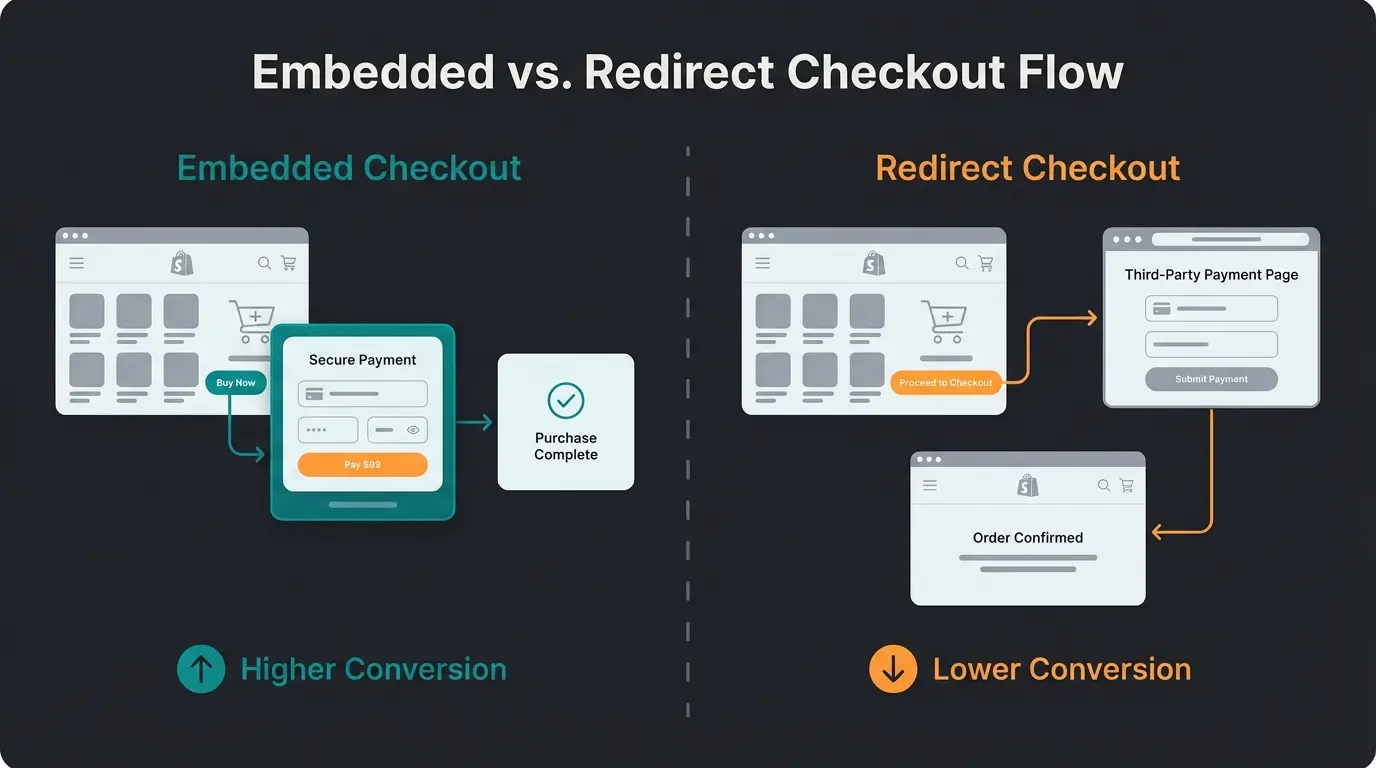
The Shopware 6 ecosystem supports dozens of payment providers through plugins. But not all integrations are equal. Some offer seamless embedded checkout experiences, others redirect customers to external pages. Some sync perfectly with Shopware order management, others create reconciliation headaches. We tested the six most relevant providers for the DACH and European market.
Mollie: the all-in-one recommendation
Mollie has become the default recommendation for Shopware merchants, and for good reason. A single contract gives you access to over 25 payment methods: Visa, Mastercard, PayPal, Klarna, Apple Pay, Google Pay, iDEAL, SEPA, Bancontact, and the new Wero, among others. The Shopware 6 plugin is available directly from the Shopware Marketplace and installs with minimal configuration.
What makes Mollie stand out is operational simplicity. No setup fees, no monthly minimums, no lock-in contracts. You pay per successful transaction only. The plugin handles webhook callbacks reliably, and the checkout experience is embedded rather than redirected, which matters for conversion. According to Mollie, credit card fees start at 1.80% + EUR 0.25 for European cards.
Stripe: the developer favourite
Stripe is the gold standard for teams with development resources. The API documentation is exceptional, the sandbox environment comprehensive, and the multi-language SDKs make custom integrations straightforward. For EU card payments, Stripe charges 1.5% + EUR 0.25 per transaction, according to Stripe. The Shopware Stripe Integration plugin works well for standard setups.
The trade-off is fragmentation. Unlike Mollie, Stripe does not bundle all payment methods under one roof. PayPal requires a separate integration. Some local payment methods need additional configuration. If you want Klarna through Stripe, it works but adds complexity. For shops that need a simple, unified payment solution, Mollie is typically the better choice. For shops that want maximum control over the checkout experience, Stripe wins.
PayPal: mandatory, but not sufficient
PayPal remains the most recognized online payment brand globally. Offering PayPal is less a strategic choice and more a hygiene factor: customers expect it. The Shopware PayPal Integration is well-maintained and supports PayPal Commerce Platform, PayPal Express, and Pay Later options.
However, relying on PayPal as your sole payment provider is a mistake. Transaction fees range from 1.49% to 3.49% depending on your plan and transaction type, making it one of the most expensive options. PayPal also holds funds more aggressively than other providers, which can create cash flow issues for growing shops. Use PayPal as one option alongside a broader payment provider like Mollie or Stripe.
Klarna: the BNPL conversion booster
Klarna specializes in Buy Now, Pay Later and is the market leader in the DACH region. Offering Klarna can increase average cart size by 20-40%, because customers feel more comfortable making larger purchases when they can spread payments. The Shopware Klarna Integration supports invoice, installments, and direct debit.
The consideration: Klarna charges higher transaction fees than card payments (typically 2.49% + EUR 0.35 for invoice). For high-margin products, the increased cart size more than compensates. For low-margin products, the math changes. Note that Klarna is also available through Mollie, which simplifies integration if you already use Mollie as your primary provider.
PAYONE: the German enterprise choice
PAYONE is a German payment provider owned by Worldline and specifically built for the DACH market. It offers comprehensive payment coverage including Visa, Mastercard, PayPal, Klarna, iDEAL, and Wero, according to PAYONE. The Shopware 6 plugin is maintained on GitHub and compatible with current Shopware versions.
PAYONE makes most sense for enterprise shops processing high volumes. Plans start from EUR 11.90 per month with competitive transaction fees at scale. The advantage over Stripe and Mollie is PCI-DSS Level 1 compliance out of the box and dedicated German-speaking support. For shops processing under 500 orders per month, the monthly fees make it less competitive than Mollie.
Adyen: the multi-channel powerhouse
Adyen serves the largest e-commerce brands globally (Zalando, H&M, eBay). Its Interchange++ pricing model passes card network fees directly to merchants, resulting in lower costs for high-volume shops, according to Adyen. The processing fee is approximately EUR 0.10-0.15 per transaction plus interchange.
For Shopware shops, Adyen is relevant only at enterprise scale. The minimum monthly invoice requirement and integration complexity make it impractical for small and mid-sized merchants. If you process millions in monthly revenue and need unified payment processing across online, POS, and mobile, Adyen is worth evaluating. For everyone else, Mollie or Stripe will serve you better at lower cost.
Fee comparison: what does each provider cost?
Transparent fee comparison is where most provider marketing falls short. Here are the actual costs as of early 2026, based on publicly available pricing pages and our research. All fees apply to European card transactions.
| Provider | Card Fee (EU) | PayPal Fee | Monthly Fee | Setup Fee | Payout Cycle |
|---|---|---|---|---|---|
| Mollie | 1.80% + EUR 0.25 | Included | EUR 0 | EUR 0 | 1-2 business days |
| Stripe | 1.50% + EUR 0.25 | Separate integration | EUR 0 | EUR 0 | 7 days (default) |
| PayPal | 1.49-3.49% | N/A (is PayPal) | EUR 0 | EUR 0 | 1-3 business days |
| Klarna | ~2.49% + EUR 0.35 | N/A | EUR 0 | EUR 0 | Net 14-30 days |
| PAYONE | Custom (volume-based) | Included | From EUR 11.90 | Varies | 1-2 business days |
| Adyen | Interchange++ + EUR 0.11 | Included | Minimum invoice | EUR 0 | 1-2 business days |
Example calculation: 1,000 transactions per month
To make this concrete, here is what each provider costs for a shop processing 1,000 transactions per month at an average order value of EUR 80. We assume 60% card payments, 25% PayPal, and 15% BNPL/other.
| Provider | Card Costs (600 tx) | PayPal Costs (250 tx) | Other (150 tx) | Monthly Fee | Total |
|---|---|---|---|---|---|
| Mollie | EUR 1,014 | Included in card | EUR ~280 | EUR 0 | ~EUR 1,294 |
| Stripe | EUR 870 | Separate (~EUR 600) | EUR ~220 | EUR 0 | ~EUR 1,690 |
| PayPal only | N/A | EUR ~1,745 | N/A | EUR 0 | ~EUR 1,745 |
| PAYONE | Custom | Included | Included | EUR 29+ | Contact for quote |
Shopware integration: plugin quality compared
A payment provider is only as good as its Shopware plugin. We evaluated each provider on installation effort, checkout experience, compatibility, and update frequency.
| Provider | Installation | Checkout Type | SW6 Compatibility | Update Frequency | Store Rating |
|---|---|---|---|---|---|
| Mollie | Plug and play | Embedded | Current (6.6+) | Monthly | 4.5/5 |
| Stripe | Configuration needed | Embedded/Redirect | Current | Regular | 4.0/5 |
| PayPal | Plug and play | Embedded + Express | Current (official) | Monthly | 4.2/5 |
| Klarna | Via Mollie or direct | Redirect | Current | Quarterly | 3.8/5 |
| PAYONE | Setup required | Embedded | Current (6.7+) | Regular | 3.5/5 |
| Adyen | Custom integration | Embedded | Variable | Irregular | N/A |
Mollie and PayPal offer the smoothest Shopware installation experience. Both plugins are available on the Shopware Marketplace and work out of the box after entering API credentials. Stripe requires more configuration but rewards the effort with greater customization options. PAYONE and Adyen require dedicated setup time, often with agency support.
The checkout type matters more than most merchants realize. Embedded checkout (Mollie, Stripe, PAYONE) keeps the customer on your domain throughout the payment process. Redirect-based checkout sends them to an external page, which introduces friction and can reduce conversion by 5-10%. For optimal results, choose a provider that supports embedded or component-based checkout in Shopware 6.
Payment providers by shop type
The right payment provider depends on your business stage, order volume, and target market. Here are concrete recommendations based on scenarios we see regularly at Qualimero.
| Shop Type | Recommended Provider | Why |
|---|---|---|
| Starter shop (<100 orders/month) | Mollie | No monthly fees, all methods from one contract, simple setup |
| Growing shop (100-1,000 orders/month) | Mollie + PayPal Express | Best fee-to-feature ratio, Klarna included via Mollie |
| Enterprise (1,000+ orders/month) | PAYONE or Adyen | Volume discounts, PCI-DSS compliance, dedicated support |
| International shop | Stripe or Mollie | Multi-currency support, local payment methods per country |
| B2B shop | PAYONE or Unzer | Invoice payment, direct debit, enterprise compliance |
| Developer-led shop | Stripe | Best API, most flexible custom integration options |
Payment providers and conversion optimization
Your payment provider choice is a conversion rate lever. According to Baymard Institute, the average cart abandonment rate is 70.2%. Of those who abandon, 13% do so specifically because their preferred payment method is not available. That is revenue you are leaving on the table.
Three specific optimization opportunities stand out. First, express checkout buttons (PayPal Express, Apple Pay, Google Pay) placed on the product page or cart page can bypass the entire checkout form, reducing friction dramatically. Second, BNPL options like Klarna increase average cart size by 20-40% because customers feel comfortable buying more when they can spread payments. Third, embedded checkout rather than redirects keeps the customer on your domain and reduces cognitive load.
The next frontier is dynamic payment method ordering. AI-powered systems can analyze customer behavior and display the most likely-to-convert payment method first. A returning customer who always pays with Klarna sees Klarna prominently. A new international customer sees credit card options first. This level of personalization is where an AI-powered product consultation layer adds value beyond just product recommendations.
Payment optimization gets customers to complete purchases. But what about the 70% who never reach checkout? An AI employee guides visitors to the right product, answers questions in real-time, and increases the number of customers who actually add to cart. Our clients see +35% higher cart values and +60% checkout rates.
See How AI Consultation WorksConclusion: our recommendation
After testing and comparing all major Shopware payment providers, the verdict is clear. Mollie is the best all-in-one solution for the majority of Shopware shops. Fair pricing, excellent plugin quality, all major payment methods from a single contract, and no monthly fees make it the lowest-risk choice.
Stripe is the right choice for shops with in-house development teams who want maximum API flexibility and plan to build custom checkout experiences. PayPal should be offered by every shop as a trust signal, but never as the sole payment option. Klarna is worth adding separately or via Mollie for shops selling products above EUR 50 average order value. PAYONE and Adyen belong in the enterprise tier for shops processing thousands of orders per month.
Whatever you choose, remember: the payment provider is just one piece of the puzzle. A seamless checkout experience only matters if customers actually reach it. For a complete view of Shopware payment strategy, see our Shopware Payment Guide.
The best payment setup means nothing if visitors leave before adding products to cart. A Qualimero AI employee helps customers find exactly what they need, answers questions instantly, and guides them to purchase. +35% cart value, +60% checkout rate, 16x ROI.
Book a DemoFrequently asked questions
Mollie is the best all-in-one payment provider for most Shopware 6 shops. It offers all major payment methods (credit cards, PayPal, Klarna, Apple Pay, SEPA) from a single contract with no monthly fees. For developer-led shops needing maximum API flexibility, Stripe is the stronger choice.
Transaction fees for European card payments range from 1.50% + EUR 0.25 (Stripe) to 1.80% + EUR 0.25 (Mollie). PayPal charges 1.49-3.49% depending on volume. Mollie and Stripe have no monthly fees, while enterprise providers like PAYONE start from EUR 11.90 per month. For a shop processing 1,000 orders at EUR 80 average, expect EUR 1,200-1,800 in monthly payment processing costs.
Not necessarily. Mollie covers all major payment methods from a single integration. However, many shops benefit from adding PayPal Express as a separate checkout option alongside their primary provider, since PayPal brand recognition drives conversion for hesitant buyers.
Most providers (Mollie, PayPal, Stripe) offer plugins on the Shopware Marketplace. Installation involves downloading the plugin, entering your API credentials, and configuring which payment methods to activate. The process typically takes 15-30 minutes for Mollie or PayPal. Enterprise providers like PAYONE may require agency support for initial setup.
Mollie bundles all payment methods (including PayPal and Klarna) under one contract with plug-and-play setup. Stripe offers lower card fees (1.5% vs 1.8%) but requires separate integrations for PayPal and some local methods. Choose Mollie for simplicity, Stripe for API flexibility and custom checkout builds.
At minimum: credit/debit cards (Visa, Mastercard), PayPal, a BNPL option (Klarna), and bank transfer (SEPA). For German shops, adding Apple Pay and Google Pay is increasingly important. The new Wero payment method offers significantly lower fees (0.1-0.5%) and is worth watching as adoption grows.

Lasse is CEO and co-founder of Qualimero. After completing his MBA at WHU and scaling a company to seven-figure revenue, he founded Qualimero to build AI-powered digital employees for e-commerce. His focus: helping businesses measurably improve customer interaction through intelligent automation.