Why checkout is where e-commerce conversions die
Roughly 70% of online carts are abandoned before purchase, and in about 13% of those cases the shopper simply could not find their preferred payment method. Payment configuration in Shopware is not a technical afterthought. It is one of the highest-leverage conversion decisions a merchant makes, and it is usually made once and never revisited.
The Baymard Institute puts the documented average cart abandonment rate at 70.22%, aggregated across 50 separate studies rather than a single vendor sample. That number gets quoted constantly. What gets quoted far less often is the breakdown underneath it, because that is where the fixable part sits. Roughly half of abandonments trace back to unexpected extra costs, a quarter to forced account creation, and 13% to a missing payment method. Only the last of those is solved in the payment settings, but it is the one that costs nothing to fix.
Preferred method not offered at checkout (Baymard)
Currence data, 2025 reporting year
One caveat before the fee tables start. A missing payment method is a hard, measurable loss, but it is rarely the largest one. In the integration projects we run on Shopware, the bigger leak sits earlier: the shopper is not certain the product is right, so the payment step becomes the convenient place to stop. That distinction matters, because the fix is different. If you are still evaluating the platform itself, our Shopware guide covers the architecture layer above this one.
Payment friction is only half the story. The other half is unanswered product questions, which now arrive through as many channels as payments do: web chat, WhatsApp Business, Instagram DMs. The market still files the software that answers them under chatbot as a service, which badly undersells what a properly trained digital colleague does with live product data.
Shopware Payments: the native payment solution
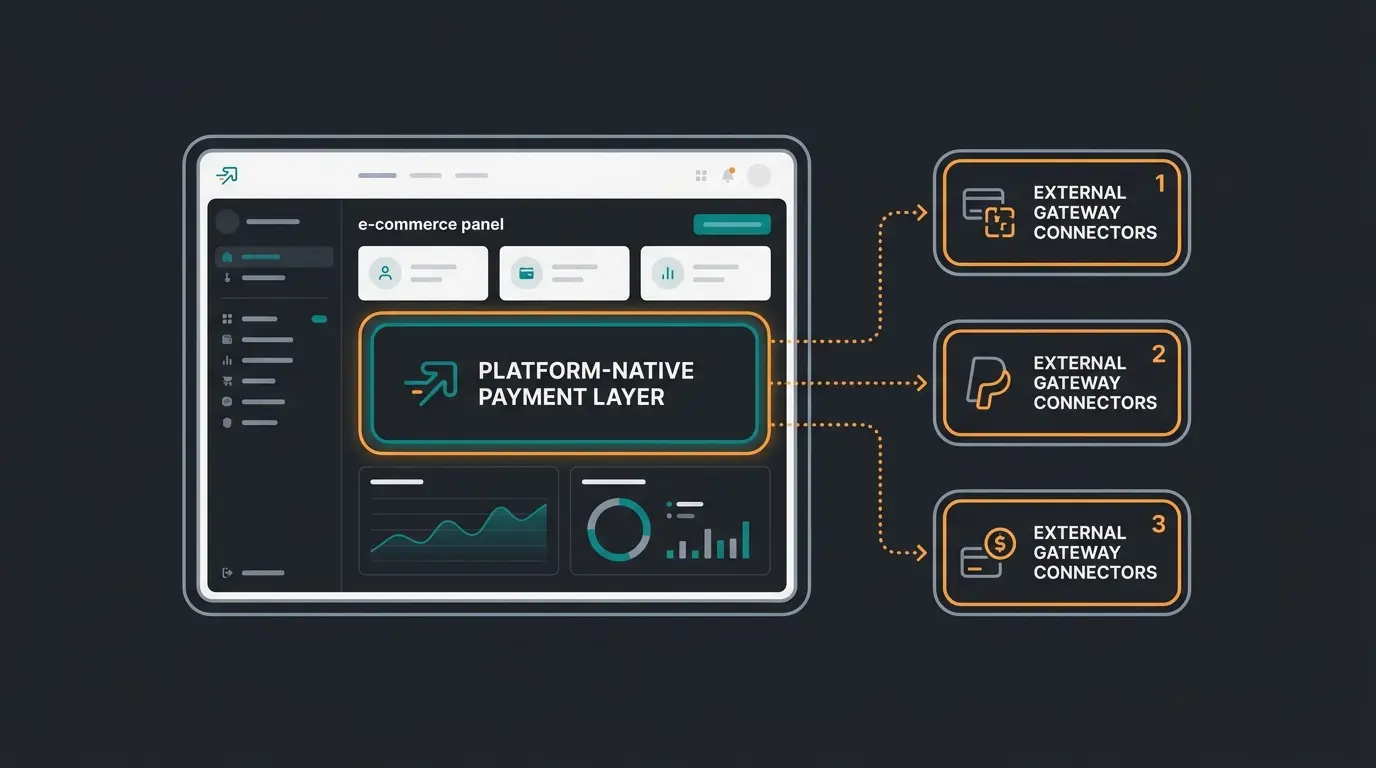
Shopware Payments is the payment solution Shopware launched on 10 June 2026 in partnership with PayPal. Built on PayPal's global payments infrastructure and embedded natively in the platform, it gives merchants one contract, platform-level reporting and international method coverage without installing a third-party gateway plugin.
This is the single biggest change to the Shopware payment landscape in years, and it is the reason a guide written before June 2026 is now incomplete. The method portfolio at launch covers cards, digital wallets including Apple Pay and Google Pay, buy-now-pay-later options, and PayPal's own experiences: PayPal, Venmo and PayPal Pay Later. Onboarding runs inside the Shopware admin. You connect an existing PayPal Business account or create one in the same flow, complete the compliance checks, then configure methods centrally.
"Expanding our collaboration with PayPal enables us to deliver a truly embedded, out-of-the-box payments experience for merchants of all sizes," said Sebastian Hamann, Co-CEO at Shopware, in the launch announcement. "Shopware Payments simplifies the path from setup to sale, giving merchants more control, transparency, and flexibility."
Two facts about availability matter more than the marketing. First, as of Q3 2026 Shopware Payments is live for merchants in Germany and Austria only, with expansion across key EU markets and the United States introduced incrementally as local licensing allows. Second, it is optional by design: Shopware states plainly that there are no penalties, restrictions or commercial disadvantages for running a different PSP. Pricing is transaction-based with no upfront licence cost, and the published rates vary by region and method, so the pricing page is the only source worth quoting.
Support is handled by Shopware across every plan, including Community Edition, with escalation paths into PayPal for compliance and fund management. Community Edition merchants get a defined SLA of five business days during core support hours. That is a real number, and for a shop processing time-critical B2B orders it is also a reason to read the plan-specific response times before switching.
"Together with Shopware, we're helping merchants accelerate growth with embedded payments that are easy to adopt and deliver superior checkout performance," said Jeff Pomeroy, Payment Services and Crypto at PayPal, in the same announcement.
| Criterion | Shopware Payments | Third-party gateway |
|---|---|---|
| Contract and onboarding | One flow inside the Shopware admin, PayPal Business account required | Separate PSP contract, plugin install, API key exchange |
| Availability | Germany and Austria live, phased EU and US rollout | EU-wide, most providers also cover UK, CH and US |
| Pricing model | Transaction-based, no upfront licence cost | Transaction-based, some with volume tiers or monthly plans |
| Method coverage | Cards, Apple Pay, Google Pay, PayPal, Venmo, PayPal Pay Later | Adds iDEAL, Bancontact, TWINT, Swish, BLIK, Przelewy24, MobilePay |
| B2B purchase on invoice | Not covered at launch | Billie, Riverty or Mondu via Mollie, Adyen or a direct contract |
| Support path | Shopware first line, escalation into PayPal | PSP support, plus the plugin vendor for integration bugs |
| Best for | Standard B2C catalogues in DE and AT that want one contract | Cross-border sellers, B2B merchants, region-specific coverage |
Shopware payment providers compared
The five third-party providers that matter most for Shopware 6 are Mollie, PayPal, Klarna, Stripe and Adyen. They differ on transaction fees, supported methods, B2B capability, regional coverage and integration effort. For most merchants the deciding factor is which markets they sell into, not which gateway is cheapest per transaction.
Here is the opinion that usually gets me disagreement in workshops: the fee comparison is the most overrated part of this decision. A 0.4 percentage point difference on card fees is worth a few hundred euros a month at EUR 100k volume. Missing iDEAL in the Netherlands costs you a double-digit share of that market's checkouts. The rates below are current as of Q3 2026 and taken from the providers' published pricing. For the full head-to-head including PAYONE and integration quality scores, see our Shopware payment providers compared breakdown.
| Provider | EEA consumer card fee | Standout methods | B2B invoice | Setup effort | Best for |
|---|---|---|---|---|---|
| Mollie | 1.80% + EUR 0.25 | iDEAL, Bancontact, TWINT, Swish, BLIK, Klarna, Billie | Yes, via Billie or Riverty | Low, API key only | Small to mid-sized EU shops |
| PayPal | 2.49% + EUR 0.35 (EEA) | PayPal, Pay Later, cards, Venmo (US) | No | Low | Trust-sensitive B2C baskets |
| Klarna | From 2.99% + EUR 0.35 (DACH) | Pay later, instalments, direct bank transfer | Limited | Medium | High-consideration B2C, Nordics and DACH |
| Stripe | 1.5% + EUR 0.25 | Cards, Apple Pay, Google Pay, 135+ currencies | Via invoicing add-ons | Medium, developer-led | Multi-market and multi-currency sellers |
| Adyen | Interchange plus, contract-based | Single platform for online and in-store, advanced risk rules | Yes, with configuration | High, enterprise onboarding | Volume above roughly EUR 5m per year |
| Amazon Pay | Contract-based | One-click checkout using Amazon address and payment data | No | Low | Shops with a heavy Amazon-native audience |
| Payrexx | Contract-based | TWINT, PostFinance Pay, Swiss cards | No | Low | Swiss and Liechtenstein storefronts |
Now the part the fee table cannot show you. Payment preference is not a European constant, it is a national habit, and getting it wrong looks exactly like a broken checkout to the shopper.
| Market | Methods that decide the checkout | Cost of ignoring it |
|---|---|---|
| Germany | PayPal, purchase on invoice, SEPA direct debit, cards | Invoice-first shoppers abandon rather than prepay an unknown shop |
| Netherlands | iDEAL (about 71% of online payments), Wero, cards | Cards alone read as a foreign shop, not a local one |
| United Kingdom | Cards, PayPal, Apple Pay, Klarna | Post-Brexit cross-border card rates rise and decline rates follow |
| Nordics | Klarna, Swish (SE), MobilePay (DK, FI), Vipps (NO) | Invoice-after-delivery is the default expectation you are refusing |
| Switzerland | TWINT, PostFinance Pay, cards | TWINT is not optional for a Swiss consumer storefront |
| Austria | EPS, cards, PayPal, purchase on invoice | EPS absence is read as a German shop shipping across the border |
This is not a new observation, it is just one that keeps getting ignored. Christian Holst, co-founder and research director at the Baymard Institute, made the point in a checkout optimisation Q and A: "There are great regional differences in how users perceive 3rd payment gateways (like paypal or worldpay)." Shoppers in some markets have been trained for two decades that a hosted third-party payment page is the safe option. In others the same page reads as an unnecessary detour.
Mollie
Mollie is the most flexible all-in-one provider for Shopware 6. A single plugin unlocks more than 25 payment methods, integration runs on an API key rather than a contract negotiation, and pay-per-transaction pricing with no monthly fee makes it the default choice for small and mid-sized merchants.
The published rates are unusually legible. European Economic Area consumer cards cost 1.80% + EUR 0.25, commercial cards 2.90% + EUR 0.25, and cards issued outside the EEA 3.25% + EUR 0.25. Method-specific rates sit alongside them: Bancontact at 1.40% + EUR 0.25, TWINT at 2.30% + EUR 0.25, Swish at 1.25% + EUR 0.25, and Billie for B2B invoice purchase at 3.49% + EUR 0.35 in DACH. Volume pricing starts above EUR 100,000 per month. All figures from the Mollie pricing page, Q3 2026.
Where it falls short: reporting is functional rather than deep, and merchants running complex fraud rules or interchange-plus economics will outgrow it. For a shop under roughly EUR 3m annual volume selling across two or three EU markets, that ceiling is theoretical.
PayPal
PayPal remains the most widely accepted online payment brand in Europe, and since June 2026 it also underpins Shopware Payments. Shopware merchants can now reach PayPal two ways: natively through the new product, or through the standalone plugin they were already running. Both are legitimate, and the choice is operational rather than technical.
Merchant pricing in Germany sits at 2.49% + EUR 0.35 for commercial transactions inside the EEA, with a cross-border surcharge of 1.29% when the buyer sits outside it. That is meaningfully above Mollie's card rate, and merchants still run it, because PayPal buys something a cheaper rail does not: a buyer who does not have to re-enter card details or evaluate whether your shop deserves them.
The honest trade-off is the fee floor. On a EUR 12 basket, 2.49% + EUR 0.35 is a 5.4% effective rate, which is why low-ticket merchants should use the Rule Builder to steer small baskets toward direct debit instead. Full configuration walkthrough: setting up PayPal in Shopware.
Klarna
Klarna is the leading buy-now-pay-later provider across Northern Europe and the DACH region. Klarna reports average order value increases of around 40% among merchants using its BNPL products, driven by invoice purchase and instalment options that move the purchase decision away from available balance.
Put that in context before you build a business case on it. Across all of global e-commerce, BNPL accounts for roughly 5% of transaction value according to the Worldpay Global Payments Report, rising to about 11% in fashion and 9% in electronics. It is a category-dependent lever, not a universal one.
- Strongest in: Sweden, Norway, Finland, Denmark, Germany, Austria and the UK, where invoice-after-delivery is a normal consumer expectation
- Weakest in: Southern Europe, where the rate premium climbs to 4.99% + EUR 0.40 in markets such as Italy, Spain and Portugal
- Fee reality: 2.99% + EUR 0.35 in DACH versus 4.99% + EUR 0.35 in the UK and Ireland, both via Mollie's published rates
- Watch for: returns handling, which is materially more involved than a card refund and needs a documented process before launch
The maths is simple enough to run on a napkin. If Klarna costs you 1.2 percentage points more than cards and lifts average order value by even 15%, it pays for itself. Setup detail: Klarna for Shopware.
Stripe
Stripe offers the most developer-friendly payment API for Shopware 6, with transparent pricing from 1.5% + EUR 0.25 on standard European cards and native support for Apple Pay, Google Pay and more than 135 currencies. That makes it the strongest option for merchants expanding beyond a single market, and a slightly over-engineered one for merchants who are not.
Cards issued outside your account country add roughly 1.5 percentage points, and a currency conversion adds another 1%. Per the Stripe module for Shopware documentation, the module supports Visa, Mastercard, American Express, China UnionPay, Discover and Diners. Stripe beats Mollie when you need custom checkout logic or non-European currencies. Mollie beats Stripe on European local methods and on the time it takes a non-developer to get live. Deeper walkthrough: Stripe integration for Shopware.
How to configure payment methods in Shopware 6
Shopware 6 ships with four default payment methods, prepayment, invoice, cash on delivery and direct debit, which you activate under Settings, then Commerce, then Payment methods. For anything beyond that, such as cards, PayPal or Klarna, you install the relevant payment plugin, connect it with an API key, and assign it to the right sales channel.
That last step is where most setups break. The official Shopware payment methods documentation states it directly: an activated payment method is not automatically available in the storefront, because the sales channel assignment decides what customers see. Method activation and method availability are two separate switches, and only one of them is where people look.
Extensions, then My extensions, then upload or install from the store. Activate after install, not before.
Paste the live and test API keys from the provider dashboard. Live keys in a test environment are the most common cause of silent failures.
Sales Channels, then your channel, then Payment methods. Add each method explicitly and set the default.
Optional per method. Leave blank for unrestricted availability, or attach a Rule Builder condition.
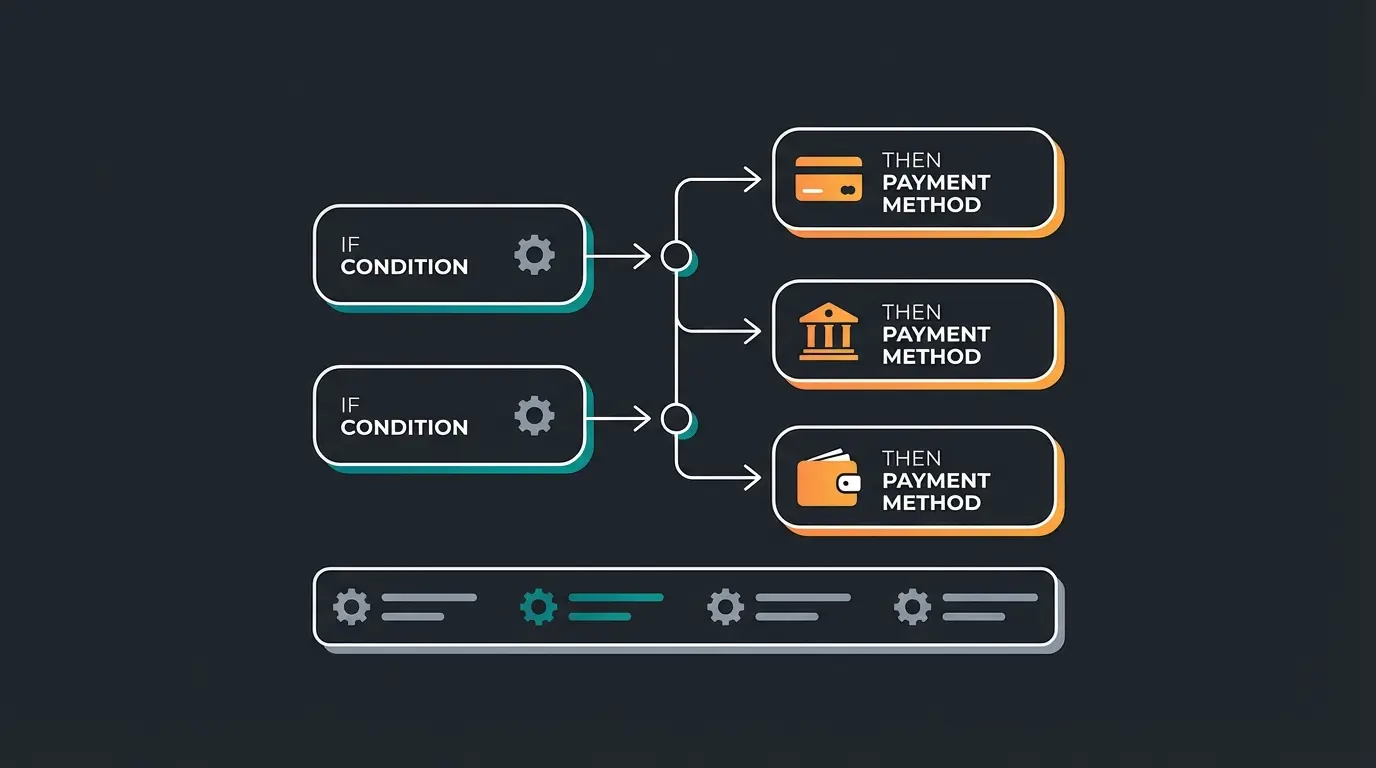
The Rule Builder is the part worth spending an hour on. It sits under Settings, then Rule Builder, and every payment method has an availability rule field that accepts one. Leave it empty and the method shows for everyone. Attach a rule and Shopware evaluates it per cart, in real time.
One more configuration detail that catches people out on upgrades. Since Shopware 6.5 every payment method carries a technical name alongside its display name, and changing that technical name on an existing method can render it inoperable. If a plugin vendor has not yet supplied one, wait for their update rather than inventing your own. For method-by-method configuration, including SEPA mandates and cash on delivery surcharges, see every Shopware payment method in detail.
- Method not visible in checkout: the sales channel assignment is missing. This accounts for the majority of reports.
- Method visible but rejected: test-mode credentials are still active in a live channel, or the live keys were pasted into the sandbox field.
- Method disappears for some carts: an availability rule is matching in an unexpected way. Check for a second rule assigned to the same method.
- Plugin installed but no method appears: the plugin is installed but not activated, or the payment method itself is inactive under Settings.
- Order stuck in open status: the webhook or return URL is unreachable, usually a staging domain left in the provider dashboard.
- Different method shown than selected: a default payment method is overriding the customer choice at the sales channel level.
Payment strategy by business model
The right payment stack depends on the business model. B2C shops under EUR 100 average order value should lead with PayPal and cards, high-ticket retailers above EUR 500 need instalments and financing, B2B merchants require purchase on invoice with 30 to 90 day terms plus buyer verification, and cross-border sellers need local methods before they need cheaper ones.
| Business model | Lead with | Add | Skip | Reasoning |
|---|---|---|---|---|
| Standard B2C, AOV under EUR 100 | PayPal, cards, SEPA direct debit | Apple Pay and Google Pay for mobile traffic | Instalments, cash on delivery | Fixed fees dominate at low basket values, so steer small carts to direct debit |
| High-ticket B2C, AOV above EUR 500 | Cards, Klarna instalments, purchase on invoice | A financing partner for baskets above EUR 2,000 | Cash on delivery | Liquidity is the bottleneck, not trust. Instalments convert hesitation into orders |
| B2B wholesale | Purchase on invoice with 30 to 90 day terms, SEPA | Billie, Riverty or Mondu for scoring and receivables cover | BNPL consumer products, Amazon Pay | Business buyers abandon when asked to pay immediately from a personal card |
| Cross-border EU plus UK | Local method per market: iDEAL, Bancontact, TWINT, Swish | Cards and PayPal as the universal fallback | Single-market optimisation | Method coverage decides conversion abroad. Fee optimisation is a second-order problem |
A worked example from the high-ticket row, because it is the one people get wrong most often. A Shopware merchant selling e-bikes at an average basket of EUR 2,400 runs cards and PayPal only. The card fee looks fine on the spreadsheet. What the spreadsheet does not show is the shopper who wanted to spread the cost across twelve months, found no option, and went to a competitor who offered one. Adding instalments costs roughly 1.5 percentage points on the transactions that use it. Losing the order costs 100%.
There is a limit to how far this goes. More methods is not automatically better. Six payment options at checkout produce choice paralysis in exactly the way six shipping options do, and the Rule Builder exists so you can show four relevant methods instead of eleven irrelevant ones.
PSD2, SCA and PCI DSS compliance
PSD2 has required strong customer authentication for online payments in the EU since September 2019, so any Shopware merchant selling into Europe needs a provider that handles 3D Secure 2. Merchants who touch card data directly also carry PCI DSS obligations, which hosted checkout fields and tokenisation shift back to the provider.
Strong customer authentication is the requirement that a payment be verified with two independent factors: something the customer knows, has, or is. In practice that means 3D Secure 2, triggered at the issuer. The relevant detail for conversion is not the rule, it is the exemptions. Transactions up to EUR 30 can use the low-value exemption and skip authentication entirely, until the customer has made five consecutive low-value payments or exceeded EUR 100 cumulatively, at which point the issuer forces a challenge.
Exemptions cut friction and they also cut your liability shift. A transaction authenticated through 3D Secure 2 moves fraud chargeback liability to the card issuer. An exempted transaction leaves it with you. Merchants running transaction risk analysis exemptions to boost conversion are making a deliberate trade, and it is worth knowing you made it before the first chargeback arrives. Every provider in the table above handles SCA automatically. None of them will tell you which exemptions they are claiming on your behalf unless you ask.
PCI DSS scope works the same way: it is determined by where card data lands. If your Shopware storefront renders a hosted field or redirects to the provider, card data never touches your server and your scope collapses to the lightest self-assessment tier. Build a custom card form against a raw API and you have taken on the full obligation. For nearly every Shopware merchant, the hosted route is the correct answer and the only reason to choose otherwise is a checkout design constraint that is rarely worth the compliance cost.
- 3D Secure 2 is active on every card method, not only the default one
- Card data is captured through hosted fields or a redirect, never a custom form posting to your own server
- You know which SCA exemptions your provider claims and what that does to liability shift
- Your provider contract names the PCI DSS self-assessment tier your integration falls into
- UK-bound traffic is tested separately, since post-Brexit cross-border rates and decline behaviour differ
- Refund and chargeback workflows are documented for BNPL methods, not just cards
AI consultation at checkout
AI-assisted consultation at checkout reduces abandonment by explaining payment and financing options at the moment hesitation appears, rather than after the shopper has left. Qualimero clients running AI product advisors report a 35% increase in cart value and a 60% improvement in checkout rate.
The mechanism is narrower than the category marketing suggests, so here is what actually happens. A shopper sits on a EUR 2,400 product page for ninety seconds without adding to cart. That is not a payment problem yet. A trained digital colleague with access to the live payment configuration can say that this basket qualifies for twelve-month instalments at a specific monthly figure, which converts an abstract price into a decision the shopper can actually make. The same applies in reverse for B2B: a purchasing manager asking about payment terms gets the real answer, or gets routed to a human with the full conversation attached.
Two client examples, both with published numbers. Rasendoktor, the lawn care specialist, was handling 2,000 to 3,000 consultation-heavy enquiries per season with a support team that could not keep up. Their AI employee Hektor now answers 100% of web chat enquiries, which produced a 16x return on investment and cut support costs by 40%. Signed, a retailer for custom signage, automated 70% of enquiries across Instagram and TikTok with their digital employee Alex, reaching 18x ROI and a 30% lift in up- and cross-selling.
Neither of those is a payment integration. Both are consultation problems that were showing up as checkout losses, which is the pattern worth recognising. If your abandonment sits mostly on high-consideration products rather than low-ticket repeat purchases, the payment settings are not where the money is. AI product consultation covers how the advisory layer connects to live product and payment data.

Shopware Payments vs WooCommerce and Shopify
Shopware 6 gives merchants more payment freedom than Shopify, which surcharges third-party gateways by up to 2% depending on plan, and a more coherent native option than WooCommerce, which depends on WooPayments or a patchwork of plugins. Since June 2026 Shopware also offers a first-party solution in Shopware Payments, without making it mandatory.
| Criterion | Shopware 6 | Shopify | WooCommerce |
|---|---|---|---|
| Third-party gateway penalty | None | 0.2% to 2% surcharge by plan when not using Shopify Payments | None |
| Native payment product | Shopware Payments, optional, since 10 June 2026 | Shopify Payments, strongly incentivised | WooPayments, optional |
| Conditional method logic | Rule Builder, native and granular | Requires an app for most conditions | Plugin-dependent, quality varies |
| B2B purchase on invoice | Native B2B components plus third-party scoring | Limited, app-dependent | Plugin-dependent |
| Method breadth in EU markets | Broad via Mollie, Adyen, Payrexx | Broad, but the surcharge applies | Broad, at the cost of plugin maintenance |
The plain reading: Shopify's surcharge is the single largest structural difference, and it compounds with volume rather than shrinking. A Basic-plan Shopify merchant using an external gateway pays 2% on every order on top of that gateway's own fee. Shopware charges nothing for the same choice. WooCommerce also charges nothing, and hands you the maintenance burden instead. If you are earlier in the evaluation, what is Shopware covers the platform beyond payments.
Shopware payment FAQ
Use Shopware Payments if you sell B2C in Germany or Austria and want one contract with onboarding inside the admin. Choose a third-party provider such as Mollie or Adyen if you need B2B purchase on invoice, region-specific methods like iDEAL or TWINT, or an existing PSP contract you cannot exit.
Install the plugin under Extensions, activate it, enter the provider API keys, then assign the method to your sales channel under Sales Channels and Payment methods. The sales channel assignment is mandatory. Without it the method stays activated in the backend but invisible in checkout.
Shopware charges nothing extra for using any payment provider. You pay the provider directly: from 1.5% + EUR 0.25 with Stripe, 1.80% + EUR 0.25 with Mollie, and 2.49% + EUR 0.35 with PayPal for EEA transactions. Shopware Payments uses transaction-based pricing with no upfront licence fee.
In most cases the method is not assigned to the active sales channel. Check Sales Channels, then your channel, then Payment methods. If it is assigned, check the availability rule attached to the method, then confirm you are not running test credentials in a live environment.
For B2B on Shopware, purchase on invoice with real-time creditworthiness scoring is the requirement. Billie and Mondu are built for it, and Riverty covers similar ground. Mollie offers Billie at 3.49% + EUR 0.35 in DACH. Shopware Payments does not cover B2B invoice terms at launch.
Pick a provider with local method coverage, then use the Rule Builder to show methods by billing country. iDEAL for the Netherlands, Bancontact for Belgium, TWINT for Switzerland, Swish for Sweden. Mollie and Adyen cover the widest European method set from a single integration.
Shopware itself does not store card data when you use a hosted payment integration, which keeps your PCI DSS scope at the lightest self-assessment tier. Building a custom card form that posts to your own server moves the full obligation onto you. Use hosted fields or a redirect unless you have a specific reason not to.
Yes, and many Shopware merchants do. A common setup is Mollie for European local methods plus the PayPal plugin for PayPal's own checkout. Each provider registers its own payment methods, and the Rule Builder decides which appear per cart. Reconciliation across two dashboards is the only real cost.
A clean provider stack removes friction at the last step. It does nothing for the shopper who is still unsure the product is right. Qualimero's AI employees answer product and financing questions in real time, with access to your live Shopware data. Clients see up to 35% higher cart value and 16x ROI.
Book a 30-minute demo
Kevin is CTO and co-founder of Qualimero. As an AI architect with over 15 years of experience as CTO and CPO in the tech industry, he designs the AI systems that automate tens of thousands of customer interactions daily for Qualimero's clients — reliably, securely, and at scale.