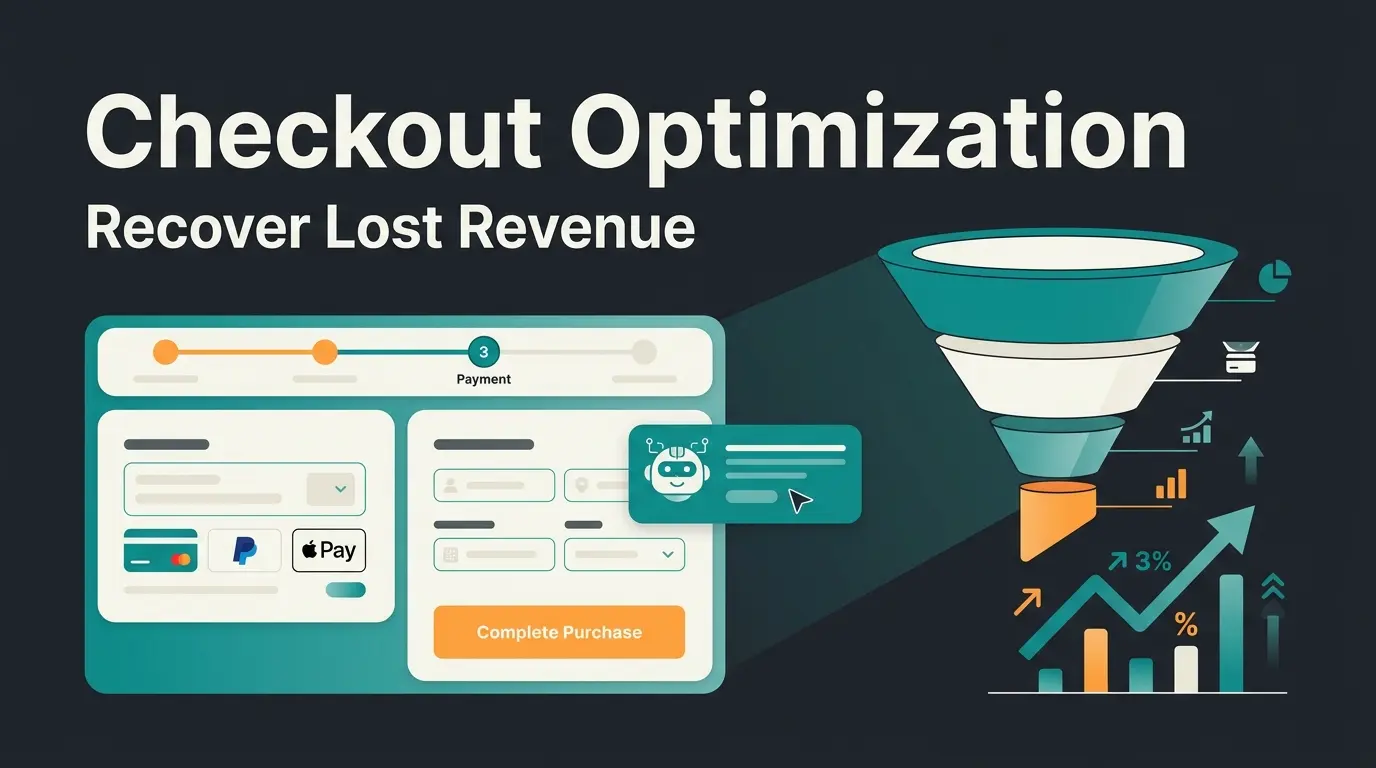
The 70% problem: why Shopware stores lose sales at checkout
On average, 70.19% of online shopping carts are abandoned before checkout completes. For Shopware stores, that means roughly 7 out of 10 potential sales never convert, costing mid-size e-commerce merchants thousands in monthly lost revenue. The number comes from Baymard Institute, aggregated across 49 studies conducted between 2012 and 2025.
Think of it this way: if a physical store had 100 customers fill their shopping baskets and 70 of them dropped everything at the register and walked out, you would treat it as an emergency. Online, most merchants accept it as normal. That gap between offline expectations and online reality is where the opportunity sits.
On mobile, the picture is worse. Mobile abandonment hits 80.02% compared to 66.41% on desktop, according to the same Baymard research. For Shopware merchants who see 60%+ traffic from mobile devices, that difference alone can represent a significant portion of lost Shopware conversion optimization potential.
Why customers abandon Shopware carts: causes and psychology
Cart abandonment happens for two distinct reasons: hard facts like unexpected shipping costs, forced account creation, and slow loading times, and soft facts like purchase anxiety, decision fatigue, and missing trust signals that are far harder to detect in analytics.
The obvious reasons (and the data behind them)
Baymard Institute tracked the top reasons across multiple studies. The numbers are specific: 39% of buyable abandoners cite extra costs (shipping, tax, fees) revealed too late. Mandatory account creation drives away 24%. Slow delivery estimates cost another 23%. A checkout process that feels too long or complicated? 22%.
These are fixable. Transparent shipping on the product page, guest checkout enabled, multiple payment options. Standard checkout optimization work.
The invisible reasons analytics won't show you
Here is where it gets harder. About 43% of shoppers who abandon were never ready to buy on that visit. They were comparing prices, saving items for later, or simply browsing. No email will recover someone who was never a buyer.
Then there is the middle group: customers who wanted to buy but had unanswered questions. Does this product fit my use case? Is this the right size, the right variant, the right spec? For consulting-intensive products like garden supplies, technical equipment, or configurable goods, this is not a minor factor. It is the primary conversion barrier. And standard Shopware checkout flows offer zero help for it.
Shopware 6 analytics: what you can (and cannot) track
Shopware 6 does not natively track cart abandonment events or provide an abandoned cart dashboard. Merchants must rely on workarounds like Google Analytics 4 enhanced ecommerce, third-party plugins, or custom Flow Builder automations to identify where and why customers leave.
GA4's enhanced ecommerce integration has improved since 2025: events like add_to_cart, begin_checkout, and purchase now include currency, cart value, and product category. That gives you a funnel. But a funnel shows where customers drop off, not why. The diagnostic gap remains.
| Capability | Shopware 6 native | GA4 integration | Plugin required |
|---|---|---|---|
| Cart event tracking | No | Yes (add_to_cart, begin_checkout) | — |
| Abandoned cart list/dashboard | No | Custom report | Yes |
| Individual cart recovery data | No | No | Yes (Klaviyo, CleverReach) |
| Abandonment reason analysis | No | Funnel drop-off only | No (no tool solves this natively) |
| Automated recovery emails | No | No | Yes |
| Real-time intervention | No | No | AI-based solutions only |
The bottom row matters most. Every plugin and analytics tool in this table is reactive. They tell you what happened after the fact. None of them intervene while the customer is still on the page.
Strategy A: reactive recovery with cart abandonment emails
Reactive cart recovery sends automated emails to customers who left items behind. While effective, recovering 5-15% of abandoned carts on average, this approach only works for logged-in customers, requires GDPR-compliant consent, and treats the symptom rather than the cause.
The mechanics are straightforward. A plugin (Klaviyo, CleverReach, or Shopware's own Flow Builder with email automation) detects that a logged-in customer added products, started checkout, then left. After a delay of typically 1-4 hours, the first recovery email goes out. Best practice is a sequence of three: reminder, incentive, final urgency. According to Sender.net, sending 3 emails recovers 37% more carts than sending just one.
Open rates are strong at 44-45%, well above the 20-25% average for marketing emails. Recovery conversion sits at roughly 10.2% on average. That sounds good, until you factor in the denominator.
I have tested recovery email setups on multiple Shopware 6 installations. The recovery rate typically lands between 8-12% of reachable abandoned carts. The key word is reachable. Guest visitors, mobile bouncers who never logged in, and customers who abandoned before entering their email are excluded entirely. For most Shopware stores, that means recovery emails only address 30-40% of total abandonments.
Strategy B: proactive prevention with AI sales assistants
Proactive prevention uses AI-powered sales assistants that engage customers during the browsing and decision phase, before they reach the cart. By answering product questions, providing personalized recommendations, and addressing purchase uncertainty in real-time, AI assistants can increase checkout rates by up to 60%.
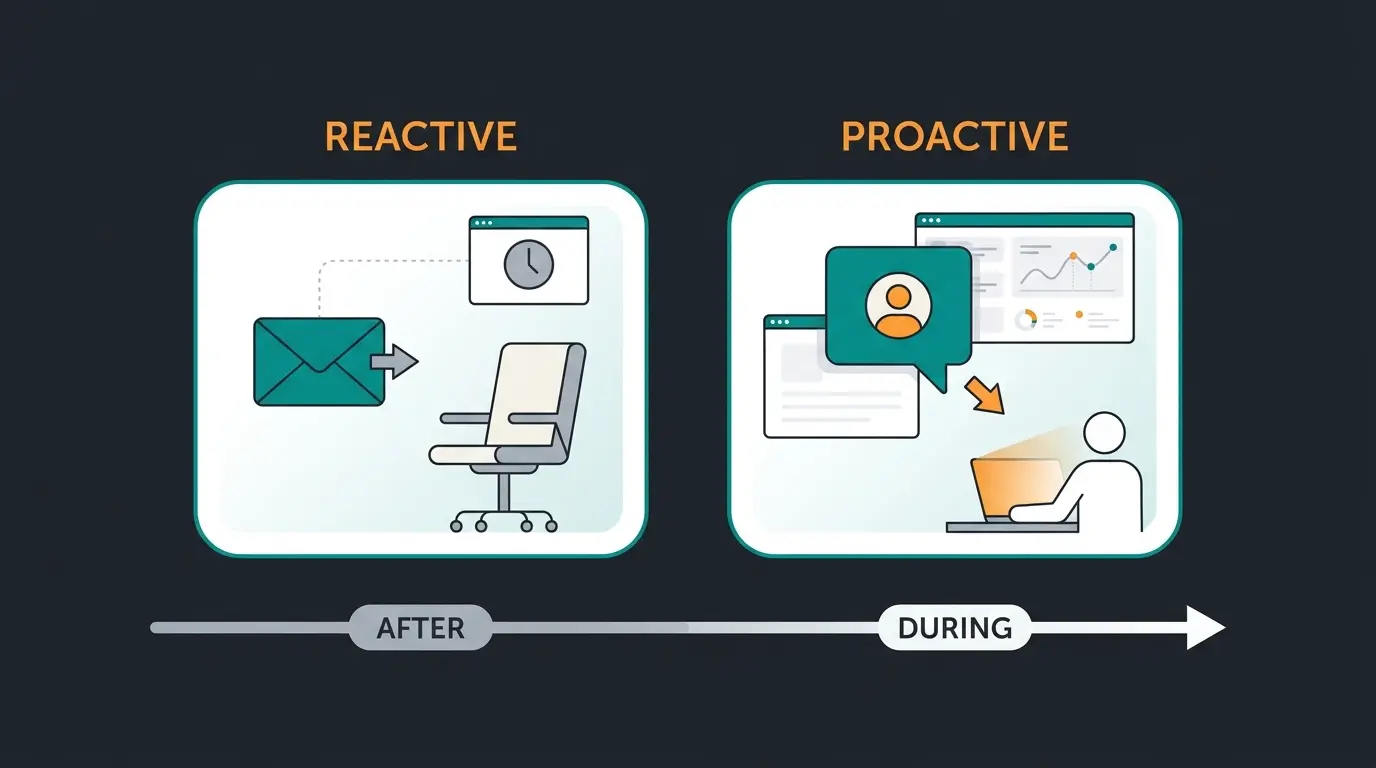
The difference is timing. Recovery emails react after the customer left. An AI employee intervenes while the customer is still on the page, still deciding, still reachable. No consent form needed. No email address required. The consultation happens in the moment the question arises.
Rasendoktor, a lawn care specialist running WooCommerce, deployed an AI employee named Hektor for product consultation. The result: 16x return on investment, 100% webchat automation rate, and a causally measured incremental revenue of +4.20% per visitor in an ongoing A/B test. Before the AI deployment, 2,000-3,000 consulting-intensive inquiries per month went unanswered during peaks. Each unanswered question was a potential abandoned cart.
Gartenfreunde, a garden and wellness e-commerce store, saw a 7x higher conversion rate after deploying their AI employee Kira for AI product consultation. The 45% click-through rate on AI-recommended products tells the story: when customers get answers to their questions, they buy.
For Shopware merchants specifically, this is relevant because the platform's plugin ecosystem is strong on reactive recovery but offers nothing for proactive prevention. That gap between Shopware cross-selling strategies and real-time consultation is where the highest-impact improvement sits.
Reactive vs. proactive: complete comparison
Reactive email recovery works after abandonment and recovers 5-15% of lost carts. Proactive AI prevention works before abandonment and can increase checkout rates by 60%. The most effective strategy combines both, but the impact distribution is not equal.
| Dimension | Reactive (recovery emails) | Proactive (AI sales assistant) |
|---|---|---|
| Timing | After abandonment (1-24h delay) | During browsing/decision phase |
| Reach | Logged-in customers with consent only | All visitors, no login required |
| GDPR requirement | Consent or legitimate interest + soft opt-in | None (no personal data collected) |
| Avg. recovery/conversion lift | 10-15% of reachable carts | Up to +60% checkout rate |
| Setup complexity | Medium (plugin + email templates + flow) | Low (AI training on product data) |
| Ongoing cost | Per-email or platform fee | Monthly SaaS subscription |
| Shopware 6 integration | Klaviyo, CleverReach, native Flow Builder | API-based, platform-agnostic |
| Root cause addressed? | No (treats symptom) | Yes (resolves purchase uncertainty) |
The table reveals the structural limitation of reactive recovery: it only reaches a fraction of abandoners, requires consent infrastructure, and does not address why the customer left. Proactive prevention works on the largest abandonment segment, the customers who had questions but nobody to ask. Combined with ecommerce conversion rate optimization, both approaches cover the full abandonment funnel.
Anti-abandonment checklist for Shopware merchants
Reducing cart abandonment in Shopware requires a three-step approach: first fix technical basics, then add proactive AI consultation for purchase-uncertain visitors, and finally deploy GDPR-compliant recovery emails as a safety net.
- Show shipping costs on the product page, not first at checkout
- Enable guest checkout (reduces forced-account abandonment by 24%)
- Offer minimum 3 payment methods including PayPal and credit card
- Page load under 3 seconds, especially on mobile (mobile optimization for Shopware)
- Display trust signals: reviews, security badges, return policy
- Implement progress indicator in multi-step checkout optimization
- Deploy AI sales assistant trained on your product catalog
- Configure product comparison and recommendation capabilities
- Enable real-time answers to sizing, compatibility, and use-case questions
- A/B test AI consultation vs. no consultation to measure incremental revenue
- Install cart recovery plugin (Klaviyo, CleverReach, or native Flow Builder)
- Ensure GDPR consent collection at checkout
- Set up 3-email sequence: reminder (1h), incentive (24h), final (72h)
- Track recovery rate weekly and optimize subject lines
The order matters. Fixing technical basics costs the least and removes the most obvious barriers. Proactive consultation addresses the largest recoverable segment. Recovery emails catch whatever falls through.
Prevent, don't just recover
The most cost-effective way to fight cart abandonment in Shopware is to prevent it. Recovery emails remain a useful safety net, but their structural limitations, GDPR consent requirements, logged-in-only reach, symptom-level treatment, cap their impact at 10-15% of a subset of abandoners.
Proactive AI consultation targets the root cause. Customers who leave because they had unanswered questions are the highest-value recovery segment, because they already wanted to buy. Every Shopware merchant selling consulting-intensive products should consider this the first investment, not the last. From what we have tested, the ROI timeline is weeks, not months.
Your Shopware store brings the traffic. An AI employee turns that traffic into completed checkouts. Start with a free demo to see how it works with your product catalog, or read the full guide on how to increase your conversion rate across the entire funnel.
The average cart abandonment rate is 70.19%, based on 49 studies aggregated by Baymard Institute. Mobile abandonment is significantly higher at 80.02%, while desktop sits at 66.41%. Rates vary by industry, from 61% in grocery to over 80% in B2B and finance.
Shopware 6 has no native cart abandonment dashboard or event tracking. You need Google Analytics 4 with enhanced ecommerce enabled (tracks add_to_cart and begin_checkout events) or a dedicated plugin like Klaviyo or CleverReach that logs abandoned carts for logged-in customers.
Abandoned cart emails require either explicit consent or a documented legitimate interest basis under GDPR. You can only email customers who provided their address during checkout and agreed to marketing communications. Fines for non-compliance reach up to EUR 20 million or 4% of annual revenue, according to Enzuzo.
A realistic recovery rate for abandoned cart emails is 10-15% of reachable carts. Open rates typically hit 44-45%, well above standard marketing emails. Sending a 3-email sequence instead of a single reminder improves recovery by 37%, according to Sender.net.
AI sales assistants engage customers during the browsing phase, before they abandon. They answer product questions, provide size and compatibility guidance, and give personalized recommendations in real-time. Qualimero clients see up to 7x higher conversion rates and checkout rate increases of up to 60% compared to unassisted sessions.
Cart abandonment happens when a customer adds items but never starts checkout. Checkout abandonment happens when a customer begins the checkout process but does not complete payment. Checkout abandonment rates are typically lower (around 25-40%) because the customer showed stronger purchase intent. Both require different strategies to address.
Merchants using Qualimero's AI employees see up to 60% higher checkout rates and 16x ROI. See how it works with your product catalog in a free demo.
Book a free demo
Kevin is CTO and co-founder of Qualimero. As an AI architect with over 15 years of experience as CTO and CPO in the tech industry, he designs the AI systems that automate tens of thousands of customer interactions daily for Qualimero's clients — reliably, securely, and at scale.