How much does Shopware store development cost?
Shopware store development costs range from EUR 3,000 to EUR 100,000+, depending on project scope, customization depth, and who builds it. A small shop on Community Edition with a standard theme costs EUR 3,000-8,000. A mid-size store with custom design and ERP integration runs EUR 18,000-40,000. Enterprise setups with complex B2B logic start at EUR 40,000 and climb fast.
I have seen every version of this conversation. A store owner gets three agency quotes, each wildly different, and has no framework to evaluate which one is realistic. The gap between EUR 12,000 and EUR 65,000 for what sounds like the same project is not random. It comes down to seven cost drivers that most agencies do not break down transparently.
Those seven drivers: license edition, design scope, plugin volume, integration complexity, data migration quality, hosting infrastructure, and ongoing maintenance. Each one compounds. According to BrandCrock's 2026 cost analysis: "Shopware 6 costs do not scale linearly. Moving from a standard theme to a custom frontend often adds another EUR 8,000 to EUR 20,000."
| Project scope | Initial build cost | Monthly ongoing | Timeline | Best for |
|---|---|---|---|---|
| Basic / MVP | EUR 3,000-10,000 | EUR 200-500 | 4-8 weeks | Startups, testing a concept |
| Standard store | EUR 18,000-40,000 | EUR 1,000-2,000 | 3-5 months | Established retailers going online |
| Complex store | EUR 40,000-80,000 | EUR 2,000-4,000 | 5-9 months | Growing brands with ERP/PIM needs |
| Enterprise | EUR 80,000-150,000+ | EUR 4,000-8,000+ | 6-12 months | Multi-country, B2B, high volume |
For a broader view of all Shopware costs beyond development, including licensing, hosting, and plugin expenses, the parent guide covers the full picture.
Cost breakdown by project phase
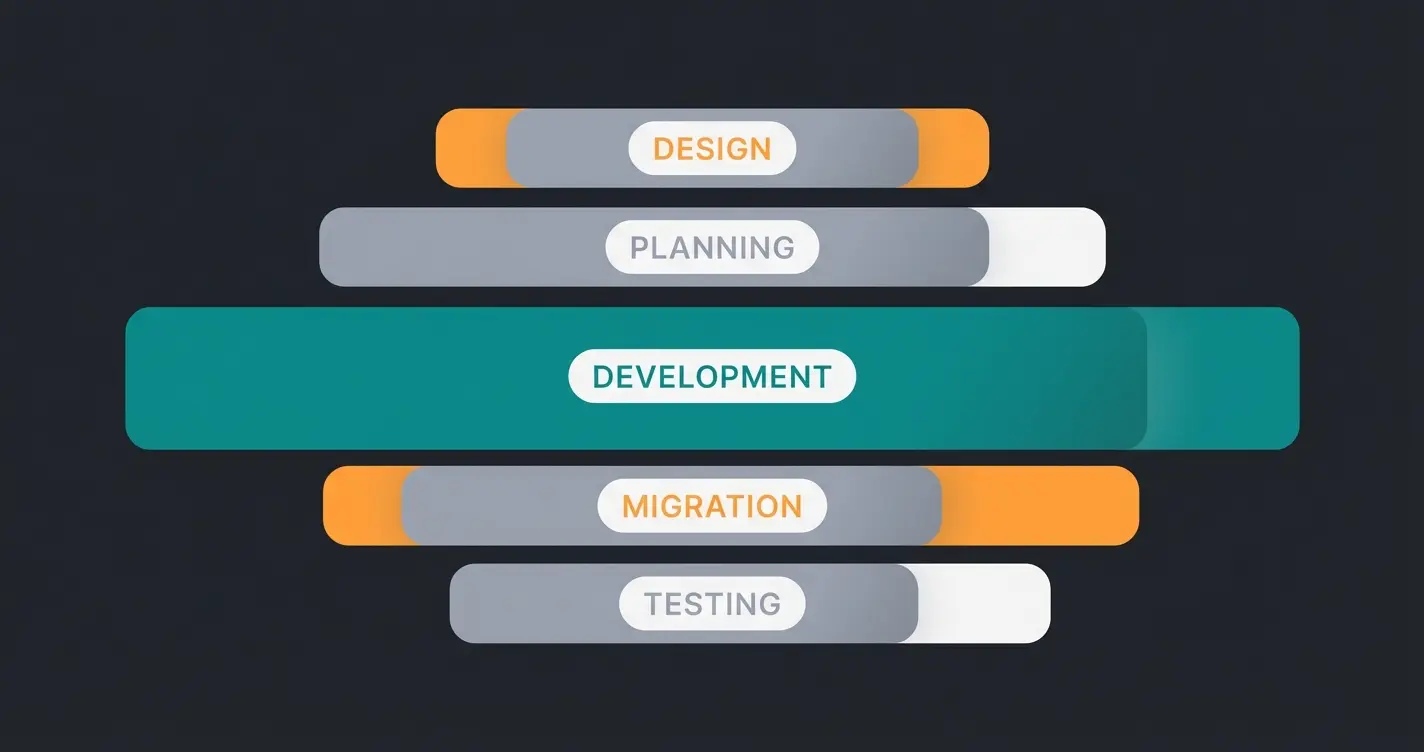
Shopware development budgets split across five phases: planning and consulting (10-15% of budget), UX and design (15-25%), core development (30-40%), content and data migration (10-15%), and testing with launch prep (5-10%). The development phase absorbs the largest share, but underinvesting in planning is where projects go over budget.
Requirements analysis, technical architecture, vendor evaluation. EUR 1,500-6,000 for a standard project.
Wireframes, visual design, responsive templates. Standard theme adjustments: EUR 2,000-5,000. Fully custom: EUR 8,000-25,000.
Theme implementation, plugin setup, custom features, payment and shipping integration. EUR 5,000-40,000 depending on scope.
Product data import, category mapping, media migration. Clean data: EUR 2,000-8,000. Legacy systems with messy data: often double.
The phase that catches most store owners off guard is data migration. I watched a EUR 25,000 project balloon to EUR 40,000 because the product data from the old system had duplicates, inconsistent attributes, and missing identifiers. BrainStream Technolabs reports medium-complexity development costs of EUR 10,000-25,000, but that assumes clean, structured data going in.
Agency vs. freelancer vs. DIY
Agencies charge EUR 8,000-100,000+ for full Shopware builds, freelancers EUR 3,000-20,000, and DIY with Community Edition costs EUR 0-2,000 in software plus your time. The right choice depends on technical expertise, budget, and how much risk you can absorb if something breaks two weeks before launch.
According to Index.dev's 2026 European developer rate analysis, senior Shopware developers in Germany charge EUR 95-125 per hour as freelancers. Certified agencies in the DACH region bill EUR 100-180 per hour. The gap reflects overhead, but also team depth: when your freelancer gets sick mid-project, there is no backup.
| Factor | Agency | Freelancer | DIY (Community Edition) |
|---|---|---|---|
| Hourly rate | EUR 100-180 | EUR 60-125 | Your time |
| Typical project cost | EUR 18,000-100,000+ | EUR 3,000-20,000 | EUR 0-2,000 (software) |
| Timeline | 3-9 months | 2-6 months | 1-6 months |
| Risk if unavailable | Low (team backup) | High (single point of failure) | You are the only resource |
| Post-launch support | SLA-based, EUR 300-1,000/mo | Varies, often project-based | Community forums only |
| Best for | Complex stores, enterprises | Specific features, budgets | Technical founders, MVPs |
Agencies offer security and breadth. Freelancers offer speed and lower rates. DIY offers control at the lowest cost. There is no universally right answer. But here is what goes wrong most often: store owners pick the cheapest option for a complex project, then spend more fixing the result than the agency would have charged.
A hybrid approach works for many mid-size projects. Use an agency for architecture, core development, and ERP integration, then bring in a freelancer for specific customizations later. Companies across Europe are combining senior Western European architects (EUR 80-100 per hour) with implementation teams from Central and Eastern Europe, where rates run EUR 32-45 per hour. For a deeper look at evaluating Shopware development services and what to ask in that first call, the dedicated guide covers the selection process.
Shopware license costs
Shopware offers four editions as of April 2026: Community (free, open source), Rise (from EUR 600 per month), Evolve (from EUR 2,400 per month), and Beyond (custom pricing, typically EUR 5,000+ per month). Your edition choice directly affects total project cost, because paid editions include features that would otherwise require custom development.
| Edition | Monthly cost | Annual cost | Highlights | Best for |
|---|---|---|---|---|
| Community | Free | EUR 0 | Full open-source, capped at EUR 1M GMV | Startups, MVPs, technical teams |
| Rise | From EUR 600 | From EUR 7,200 | AI Copilot, advanced product mgmt, pro support | Growing businesses |
| Evolve | From EUR 2,400 | From EUR 28,800 | B2B components, workflow automation, multi-channel | Established retailers, B2B |
| Beyond | Custom (EUR 5,000+) | EUR 60,000+ | Enterprise scalability, dedicated success manager | Large enterprises, multi-country |
The Community Edition is genuinely free and functional. Since March 2025, Shopware caps it at EUR 1 million GMV. Cross that threshold and you need Rise or higher. For most serious stores doing EUR 500K+ in annual revenue, Rise at EUR 600 per month is the practical starting point. The Shopware Intelligence+ add-on costs an additional EUR 19-29 per month depending on your plan.
Ongoing costs after launch
After launching, expect EUR 350-2,000+ per month in ongoing costs: hosting (EUR 30-500), plugin subscriptions (EUR 50-250), maintenance (EUR 300-1,000), and continuous development (EUR 200-2,000). These are the costs agencies often skip in the initial quote. They add up faster than most store owners expect.
| Cost category | Basic store | Standard store | Enterprise |
|---|---|---|---|
| Hosting | EUR 30-80 | EUR 100-300 | EUR 300-500+ |
| License (paid edition) | EUR 0 (Community) | EUR 600 (Rise) | EUR 2,400-5,000+ |
| Plugin subscriptions | EUR 0-50 | EUR 50-150 | EUR 150-300 |
| Maintenance/updates | EUR 0 (self) | EUR 300-600 | EUR 600-1,000+ |
| Ongoing development | EUR 0 (DIY) | EUR 200-500 | EUR 1,000-2,000+ |
| Monthly total | EUR 30-130 | EUR 1,250-2,150 | EUR 4,450-8,800+ |
The Shopware Extension Store lists over 4,000 plugins. Most stores run 8-12 commercial plugins, adding EUR 500-3,000 per year in subscription costs alone. Security patches, core updates, and plugin compatibility testing require regular attention. Ignoring maintenance for six months is how stores end up with broken checkouts after a Shopware core update.
Total cost of ownership over 3 years
The 3-year total cost of ownership for a Shopware store ranges from EUR 15,000 for a basic DIY setup to EUR 250,000+ for enterprise. The initial build is only 30-50% of the total. Ongoing license fees, hosting, maintenance, and development consume the rest, which is why a cheap build with expensive ongoing costs often costs more than doing it right upfront.
Community Edition, standard theme, self-managed hosting
Includes EUR 86,400 in license fees alone over 3 years
Custom pricing, multi-country, complex integrations
These numbers come from real project data. BrandCrock's detailed breakdown for a standard Rise store shows annual operating costs of EUR 15,000-22,000, compounding to EUR 50,000-80,000 over three years including the initial build. For Evolve stores, annual operating costs of EUR 40,000-55,000 push the 3-year total to EUR 140,000-200,000.
Most mid-size Shopware stores will spend EUR 60,000-100,000 over three years. That sounds like a lot. It is not, when you compare it to the alternative.
How to optimize your Shopware development budget
Start with the free Community Edition and a standard theme to reduce initial costs by 40-60%. Prioritize must-have features for launch and phase additional development over time. Every euro spent before you have real customer data is a guess. Every euro spent after is informed.
- Start with Community Edition. Free, fully functional, and it lets you validate your business model before committing to EUR 600+ per month in license fees.
- Use a standard theme first. EUR 2,000 in theme adjustments versus EUR 15,000 for custom design. Launch fast, redesign when revenue justifies it.
- Limit plugins to essentials. Every plugin is a maintenance liability. Start with 4-6 core plugins, not 15. Add more when you hit specific bottlenecks.
- Phase your integrations. Manual order export works for 20 orders per day. Build the EUR 8,000 ERP integration when volume demands it.
- Negotiate agency contracts by phase. Do not sign a EUR 50,000 fixed-price contract upfront. Break it into discovery (EUR 3,000-5,000), MVP (EUR 10,000-15,000), and iteration phases.
- Automate where it counts. Product consultation and customer service are the support costs that grow with every new SKU. AI tools handle these at a fraction of the cost of additional headcount.
Is it worth the investment?
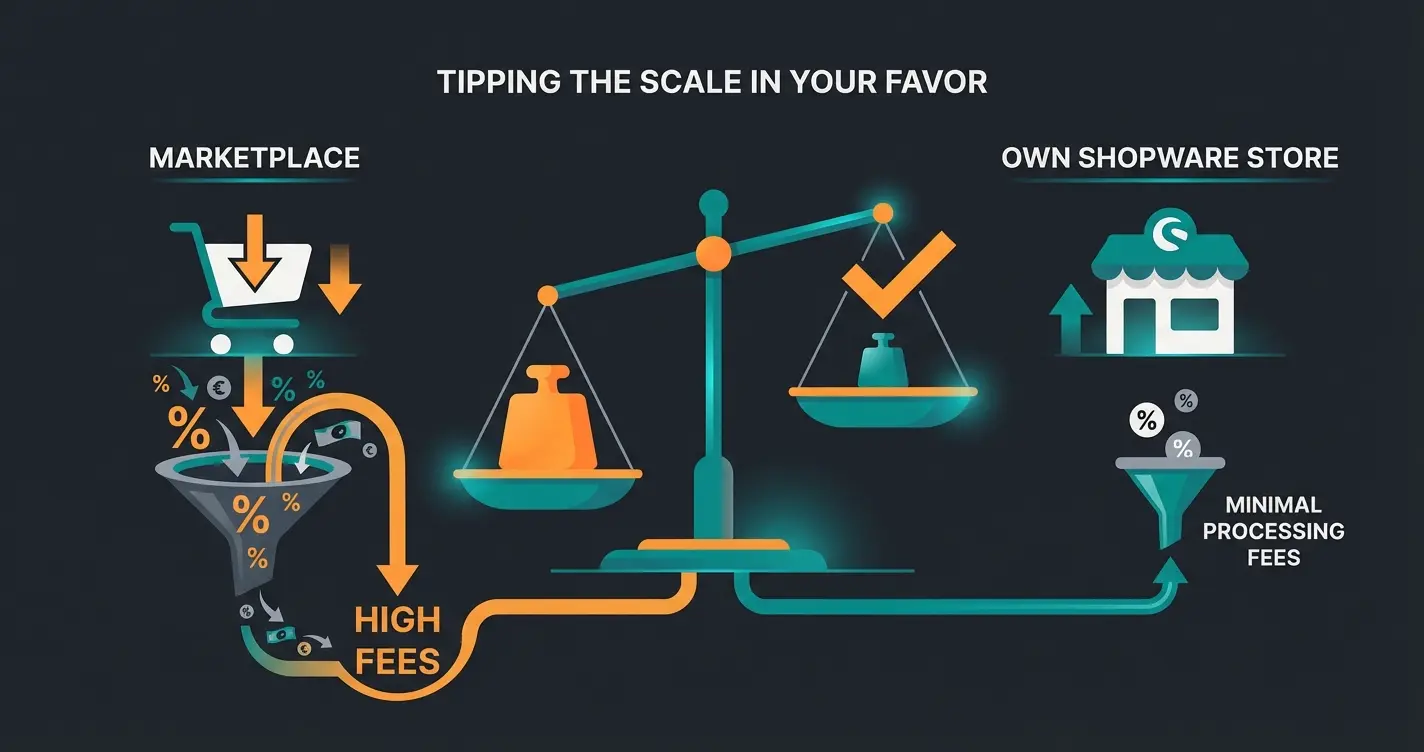
A Shopware store typically pays for itself within 12-18 months when properly optimized. Compared to marketplace fees of 15-45% per transaction, owning your store breaks even fast once you cross EUR 10,000 in monthly revenue.
According to Webgility's 2026 marketplace fee analysis: "For many e-commerce sellers, marketplace fees represent the second-largest cost after cost of goods sold, consuming anywhere from 15% to 45% of the sale price." On a Shopware store, your transaction costs drop to 1.5-2.9% in payment processing fees. At EUR 30,000 monthly revenue, the difference between 15% marketplace fees (EUR 4,500) and 2% processing (EUR 600) is EUR 3,900 per month. That is EUR 46,800 per year, which covers the entire 3-year TCO of a standard store.
Global e-commerce sales are projected to reach $6.88 trillion in 2026, a 7.2% year-over-year increase, according to Shopify's global e-commerce data. The market is growing. The question is not whether to invest in your own store, but how to make that investment work harder.
FAQ
A basic Shopware store on Community Edition with a standard theme costs EUR 3,000-10,000 for the initial build plus EUR 30-130 per month in ongoing costs. This includes hosting, basic plugin setup, and payment integration. Expect 4-8 weeks from start to launch.
Development timelines range from 4-8 weeks for a basic MVP to 6-12 months for enterprise projects. A standard mid-size store with custom design and ERP integration typically takes 3-5 months. The biggest variable is data migration quality, which can add 4-8 weeks if your existing product data needs cleanup.
Yes, and this is the approach I recommend for most businesses. Start with Community Edition, a standard theme, and 4-6 essential plugins. Upgrade to Rise when you cross EUR 1 million GMV or need professional support. Add custom design, ERP integration, and advanced features as revenue justifies the investment.
The three most underestimated costs are data migration with poor source data (often doubles the quoted migration price), plugin subscriptions (EUR 500-3,000 per year for 8-12 commercial plugins), and maintenance after launch (EUR 300-1,000 per month for updates, security patches, and bug fixes). Budget 30-50% of your initial build cost for year-one surprises.
Shopware gives you full code ownership, stronger B2B features, and no revenue-based transaction fees beyond payment processing. Shopify is faster to launch and simpler to manage but charges 0.5-2% transaction fees on top of payment processing, and customization depth is more limited. For European B2B or complex product catalogs, Shopware is typically the stronger choice.
A standard ERP integration via REST API with basic order and stock sync costs EUR 5,000-15,000 depending on data complexity. Simple integrations with well-documented APIs like SAP Business One or Xentral start around EUR 5,000. Custom ERP logic with bi-directional sync, complex pricing rules, and multi-warehouse support can reach EUR 12,000-20,000.
An AI-powered product advisor turns browsers into buyers. Qualimero clients see up to 16x ROI and 7x higher conversion rates. See how it works for your Shopware store.
Book a demo
Lasse is CEO and co-founder of Qualimero. After completing his MBA at WHU and scaling a company to seven-figure revenue, he founded Qualimero to build AI-powered digital employees for e-commerce. His focus: helping businesses measurably improve customer interaction through intelligent automation.