What makes Shopware the leading e-commerce platform
Shopware is Germany's most-used e-commerce platform, powering over 100,000 online shops with open-source flexibility, API-first architecture, and built-in GDPR compliance. For DACH retailers who need enterprise features without enterprise lock-in, it is the default choice, and has held the market-leader position among Germany's top 1,000 B2C shops for four consecutive years.
The numbers back this up. As of Q2 2026, Shopware merchants generate a combined revenue of EUR 12 billion annually, and the Shopware Extension Store lists over 2,900 plugins for payment, shipping, marketing, and ERP integration. On Gartner Peer Insights, users rate Shopware 4.4 out of 5 stars across 90 verified reviews, with one reviewer noting: "Shopware is a good webshop system for medium-sized companies. The usual standard functions are available and can be combined by plugins."
Globally, Shopware holds a smaller slice: about 0.36% of all e-commerce sites (Enlyft). That number is misleading without context. Shopware concentrates its market share in the EUR 1M-50M GMV segment in DACH, where it competes head-to-head with Shopify Plus and Magento. In that specific segment, Shopware's market share exceeds 11.5% among the top 1,000 German shops. It is a regional powerhouse, not a global generalist.
Three technical decisions separate Shopware from hosted platforms like Shopify. First, the open-source core: you own your code, your data, and your deployment. Second, the API-first architecture allows headless storefronts, meaning your frontend (React, Vue, or a mobile app) connects to Shopware's backend via REST or GraphQL. Third, GDPR and German legal requirements (Impressum, Widerrufsrecht, Datenschutz) are handled natively, not through third-party plugins. If you want the full platform breakdown, read our What is Shopware guide.
A concrete example: a German manufacturer of industrial cleaning equipment with 1,200 SKUs, B2B pricing tiers for 8 customer groups, and integration with SAP Business One runs their entire D2C and B2B operation on a single Shopware Evolve instance. The same setup on Shopify would require Shopify Plus ($2,300/month), three additional B2B apps ($200-500/month combined), and a custom middleware layer for SAP integration. On Magento, the build alone would take 6-9 months and EUR 80,000+. On Shopware, it launched in 14 weeks.
B2B is where Shopware pulls ahead of most competitors. The B2B Suite (available in Evolve and Beyond) includes customer-specific pricing, quote management, role-based purchasing, and budget controls. An industrial distributor with 50 procurement managers who each need different price lists and approval workflows gets this out of the box. On Shopify, you need Shopify Plus at $2,300/month minimum, and even then the B2B features are more limited.
Where Shopware genuinely struggles: the international plugin ecosystem is smaller than Shopify's 8,000+ apps. Finding English-language documentation and specialized developers outside the DACH region takes more effort. For a purely international D2C brand with no German-market focus, Shopify is often the faster path. That is not a weakness in Shopware's architecture. It is a market-size reality.
Shopware editions and pricing (2026)
Shopware offers four tiers in 2026: a free Community Edition for startups, Rise from EUR 600/month for growing shops, Evolve from EUR 2,400/month for mid-market, and Beyond with custom pricing starting around EUR 6,500/month for enterprise. All paid plans run on Shopware Cloud with managed hosting, automatic updates, and AI Copilot included.
| Feature | Community (free) | Rise (from EUR 600/mo) | Evolve (from EUR 2,400/mo) | Beyond (from EUR 6,500/mo) |
|---|---|---|---|---|
| Hosting | Self-hosted | Shopware Cloud | Shopware Cloud | Shopware Cloud |
| AI Copilot | Not included | Included | Included | Included |
| Flow Builder | Basic | Full | Full | Full |
| B2B Suite | Not included | Not included | Included | Included |
| Custom Products | Not included | Not included | Included | Included |
| Shopping Experiences | Basic | Advanced | Advanced | Advanced |
| API access | Full (REST + Admin) | Full | Full | Full |
| Support | Community only | Standard | Priority | 24/7 dedicated |
| SLA | None | 99.9% | 99.9% | Custom |
| Multi-inventory | Not included | Not included | Not included | Included |
| Pricing model | Free license | GMV-based | GMV-based | GMV-based + negotiated |
The GMV-based pricing model means your monthly cost scales with your gross merchandise value. For a shop processing EUR 500,000/year in GMV, Rise typically lands around EUR 600-800/month. For detailed pricing breakdowns by revenue tier and a comparison of what you actually pay versus the list price, see our Shopware license comparison. The official Shopware pricing page lists the starting rates, but the final number depends on your individual GMV bracket.
Shopware introduced GMV-based pricing with the Cloud transition in 2023, replacing the old one-time license model. The Fair Usage Policy means your monthly fee adjusts as your revenue grows. In practice, shops in the EUR 1-5M GMV range pay roughly EUR 800-1,500/month on Rise. Evolve jumps to EUR 2,400-4,000/month for the same range because it includes B2B Suite features. If your GMV doubles, expect your Shopware bill to increase by 30-50%, not double. The scaling is not linear.
Hidden cost traps we see in practice: agencies quote EUR 15,000-80,000 for initial Shopware implementations depending on complexity. A basic shop with standard theme and 200 products sits at the low end. A B2B shop with custom pricing logic, ERP integration, and multilingual setup pushes past EUR 50,000. Budget 10-20% of the initial build cost annually for maintenance, plugin updates, and hosting. The Shopware store ecosystem shows what plugins cost on top.
Shopware vs. Shopify vs. Magento: which platform fits
Shopware wins for DACH-focused retailers needing German-language support, GDPR compliance, and B2B features out of the box. Shopify is simpler for international D2C brands selling standard products. Magento suits enterprises with dedicated development teams willing to invest in custom infrastructure. Three platforms, three philosophies.
| Criterion | Shopware | Shopify | Magento (Adobe Commerce) |
|---|---|---|---|
| Active stores (2026) | 100,000+ (Shopware) | 5.6M+ (DemandSage) | ~130,000 (StorLeads) |
| Hosting model | Self-hosted or Shopware Cloud | SaaS only (hosted by Shopify) | Self-hosted or Adobe Cloud |
| Starting price | Free (Community) or EUR 600/mo (Rise) | $39/mo (Basic) or $105/mo (Shopify) | Free (Open Source) or custom (Commerce) |
| GDPR compliance | Native (Impressum, Widerrufsrecht, Datenschutz) | Requires third-party apps | Requires configuration |
| B2B features | Native B2B Suite (Evolve+) | Limited, requires Shopify Plus ($2,300/mo) | Native B2B module (Commerce) |
| Extension ecosystem | 2,900+ plugins | 8,000+ apps | 3,800+ extensions |
| API architecture | API-first (REST + Admin API) | REST + GraphQL | REST + GraphQL |
| German-market focus | Core market, German-language admin | International focus, limited DE support | International focus |
| Transaction fees | None (external payment providers) | 0.6-2.0% on third-party gateways | None |
| Ideal for | DACH B2B/B2C, consultation-intensive products | Global D2C, standard products | Enterprise, high-customization needs |
Shopify powers 5.6 million live stores globally and generated $3.17 billion in Q1 2026 revenue alone (DemandSage). Its ecosystem is massive. But ecosystem size is not the same as ecosystem fit. Shopify charges 0.6-2.0% transaction fees on third-party payment gateways, which adds up fast on high-volume DACH shops. Shopware charges zero transaction fees regardless of payment provider.
Magento holds roughly 8% global e-commerce market share and generates $173 billion in annual GMV (MGT Commerce). The platform is powerful but expensive to run. Adobe Commerce Cloud pricing starts well above EUR 30,000/year, and you need a dedicated developer team. For mid-market DACH retailers without that team, Magento is overkill.
We tested all three platforms with a 850-product catalog in the garden supplies vertical. Shopware's REST API delivered product data in 320ms average response time. Shopify came in at 180ms. Magento on managed hosting at 420ms. For standard product pages, all three are fast enough. The difference shows in complex queries: filtered product searches with 6+ attributes, where Shopware's Elasticsearch integration outperforms Magento's default MySQL search by a factor of 3.
Developer availability is another real-world factor. According to Shopware's official data, there are over 1,200 certified Shopware partners and agencies in the DACH region. Shopify has more global developers, but fewer who understand German legal requirements, DATEV integration, and B2B purchasing workflows. If your shop needs German-market compliance and you hire an international Shopify agency, expect to educate them on Impressum, Widerrufsbelehrung, and Verpackungsgesetz requirements first.
One honest caveat: Shopware's learning curve is steeper than Shopify's. A non-technical shop owner can launch a Shopify store in a weekend. A Shopware Community installation requires server configuration, Composer dependency management, and basic PHP knowledge. Shopware Cloud (Rise+) reduces this gap significantly with managed hosting and a visual editor, but it is still not as plug-and-play as Shopify's onboarding. For a comprehensive side-by-side breakdown of all three platforms, see our ecommerce platform comparison.
Setting up your Shopware online shop
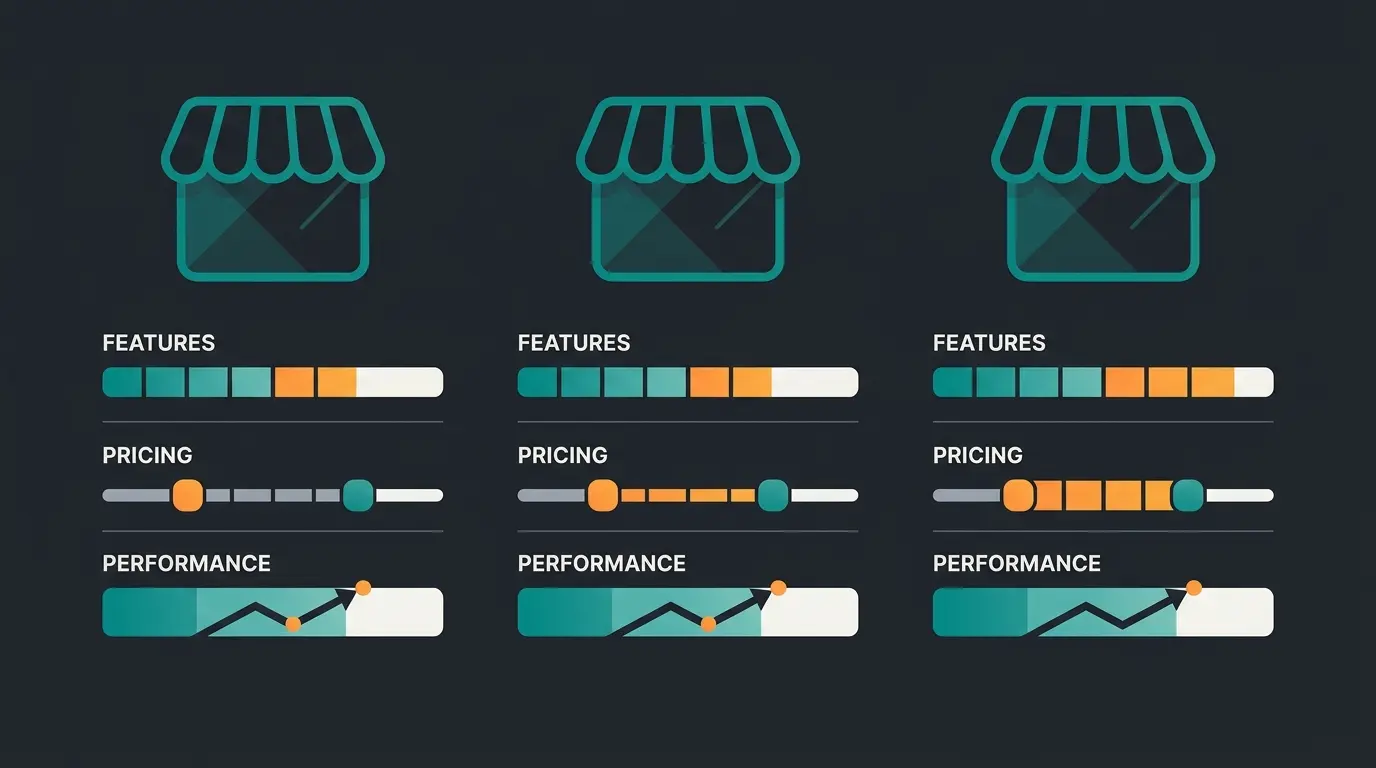
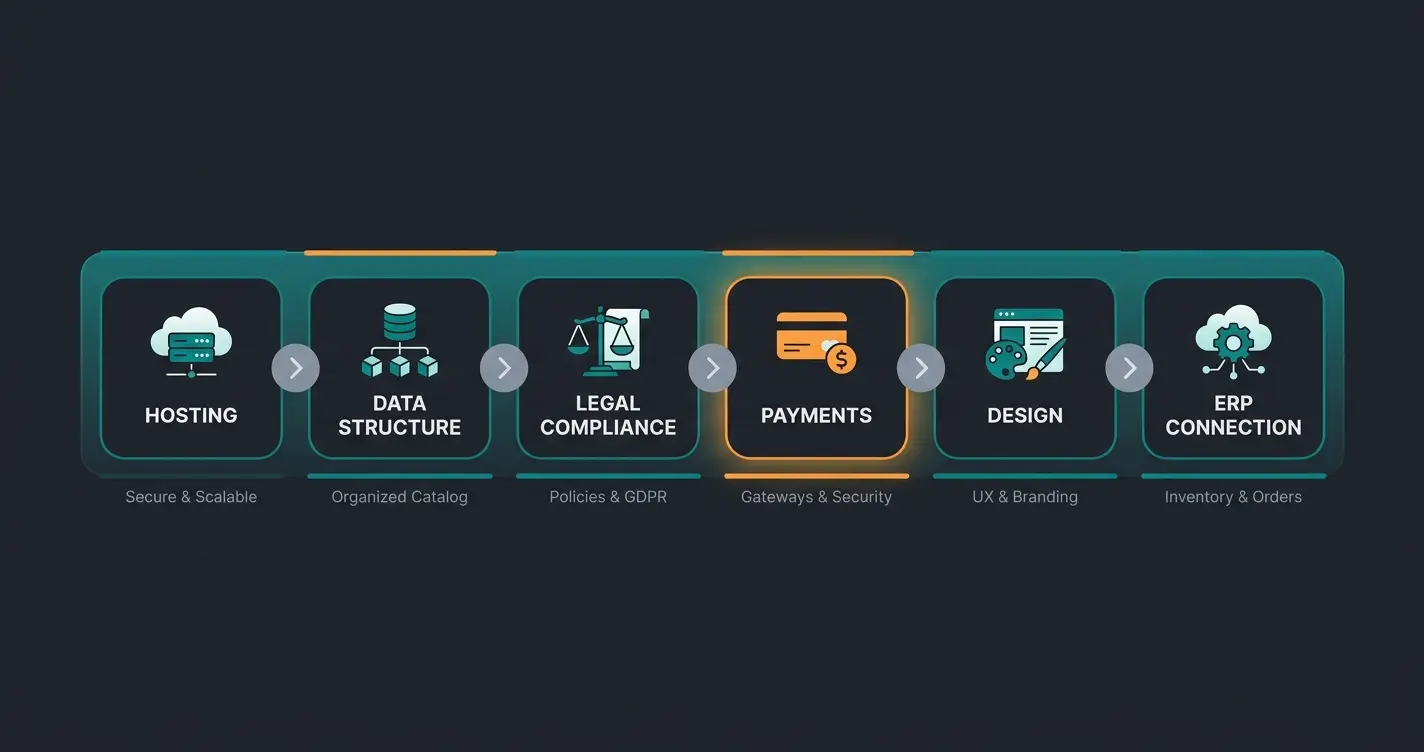
Setting up a Shopware online shop takes 4-12 weeks depending on complexity: register a Shopware Cloud account or set up self-hosting, configure your product catalog with structured data, set up payment and shipping providers, customize your storefront with Shopping Experiences, and connect your ERP. The timeline difference comes down to one factor: data structure planning.
Most failed Shopware implementations share the same root cause: the shop went live before the product data was consultation-ready. A product catalog with 800 items and incomplete attributes (missing dimensions, compatibility info, application instructions) breaks every downstream feature: filters return wrong results, search misses relevant products, and any future AI integration has nothing useful to work with. Spend 40% of your setup time on data structure. The rest follows.
- Edition selection and hosting: Choose between Shopware Cloud (Rise/Evolve/Beyond) or self-hosted Community. Cloud eliminates server management. For the detailed step-by-step, follow our step-by-step Shopware store setup guide
- Product data architecture: This is the step most shops rush and regret. Structure your Properties and Custom Fields for consultation, not just for filtering. "Weight: 25 kg" is a data point. "Suitable for lawns up to 200 sqm" is a consultation-ready attribute
- Legal compliance setup: Impressum, Widerrufsrecht, Datenschutzerklärung, Cookie Consent. Shopware handles the templates natively. Configure Shopware cookie consent and legal notice pages before going live
- Payment and shipping: Connect your payment provider (Stripe, Mollie, PayPal) and configure shipping rules by zone and weight. No transaction fees on Shopware regardless of provider
- Storefront customization: Use Shopping Experiences for landing pages and category layouts. The drag-and-drop editor handles 80% of design needs without code
- ERP connection: Sync inventory, orders, and customer data with your ERP (WeClapp, SAP, DATEV). The Shopware admin panel handles manual operations, but automation via API is the goal
If your catalog exceeds 500 products or requires multi-language support, plan for 8-12 weeks. Simpler shops with under 200 products can launch in 4-6 weeks. Need agency support? Our Shopware development services overview covers what to expect. For a registered Shopware account, the cloud onboarding wizard walks you through the first three steps in under an hour.
AI-powered product consultation: the revenue multiplier
AI product consultation on Shopware shops increases average cart value by 35% and checkout rates by 60% by replacing static filters with guided, conversational selling. Instead of forcing customers through 50 filter options, a KI-Mitarbeiter asks what problem they are trying to solve and recommends the right product with reasoning.
The underlying problem is real: Baymard Institute calculates the average cart abandonment rate at 70.22% across 50 studies. 18% of those abandonments happen because the checkout or product selection process is too complicated. For consultation-intensive products (garden supplies, industrial equipment, cosmetics with skin-type matching), static filters fail the customer.
Rasendoktor.de, an online specialist for professional lawn care running on Shopware, faced exactly this challenge: 2,000-3,000 consultation-intensive inquiries per season. After integrating an AI employee for product consultation, the results were clear: 16x return on investment, 100% automation of product consultation, and 40% reduction in support costs. See the full Rasendoktor case study for the implementation details.
How does this compare to other conversion optimization approaches? A/B testing landing pages typically yields 5-15% conversion improvements after months of iteration (VWO). Personalizing product recommendations via collaborative filtering adds another 10-20%. AI-guided consultation combines both: it personalizes recommendations AND guides the customer through a structured decision process. That compound effect is why the ROI numbers look disproportionate.
The integration works via Shopware's REST API. The KI-Mitarbeiter accesses product data, customer context, and inventory in real time. It runs as a frontend widget, not a backend tool. Shopware's own AI Copilot (included in Rise, Evolve, and Beyond) handles content generation, product descriptions, and admin automation. It does not handle customer-facing consultation. That is where a dedicated product advisor fits: turning passive browsing into active selling.
The technical implementation has three layers. First, the Shopware REST API provides read access to the complete product catalog, including properties, variants, stock levels, and customer-specific pricing. Second, the AI processes the customer's natural language query, maps it to relevant product attributes, and generates a recommendation with reasoning. Third, the frontend widget renders the conversation, displays product cards, and handles add-to-cart actions. Total integration time for a standard Shopware shop with structured product data: 2-3 days for the base setup, one week for testing and fine-tuning. Shops with unstructured or incomplete product data need an additional 1-2 weeks for data cleanup first.
Feature comparison: Shopware editions
The four Shopware editions differ primarily in B2B features, API access depth, and support levels. Community covers the basics for startups. Rise adds Flow Builder automation and AI Copilot. Evolve includes the B2B Suite and custom pricing rules. Beyond provides dedicated support, SLA guarantees, and multi-inventory management.
| Feature | Community | Rise | Evolve | Beyond |
|---|---|---|---|---|
| Monthly cost | Free (self-hosted) | From EUR 600 | From EUR 2,400 | From EUR 6,500 |
| Hosting | Self-managed | Shopware Cloud | Shopware Cloud | Shopware Cloud |
| Shopping Experiences | Basic layouts | Advanced + CMS | Advanced + CMS | Advanced + CMS |
| Flow Builder | Basic triggers | Full automation | Full automation | Full automation |
| AI Copilot | No | Yes | Yes | Yes |
| B2B Suite | No | No | Yes | Yes |
| Custom Products | No | No | Yes | Yes |
| Customer-specific pricing | No | No | Yes | Yes |
| Multi-inventory | No | No | No | Yes |
| Support | Community forum | Email + ticket | Priority support | 24/7 dedicated |
| SLA guarantee | None | 99.9% uptime | 99.9% uptime | Custom SLA |
| Product variants | Yes | Yes | Yes | Yes |
| Category management | Yes | Yes | Yes | Yes |
| Right of withdrawal pages | Yes | Yes | Yes | Yes |
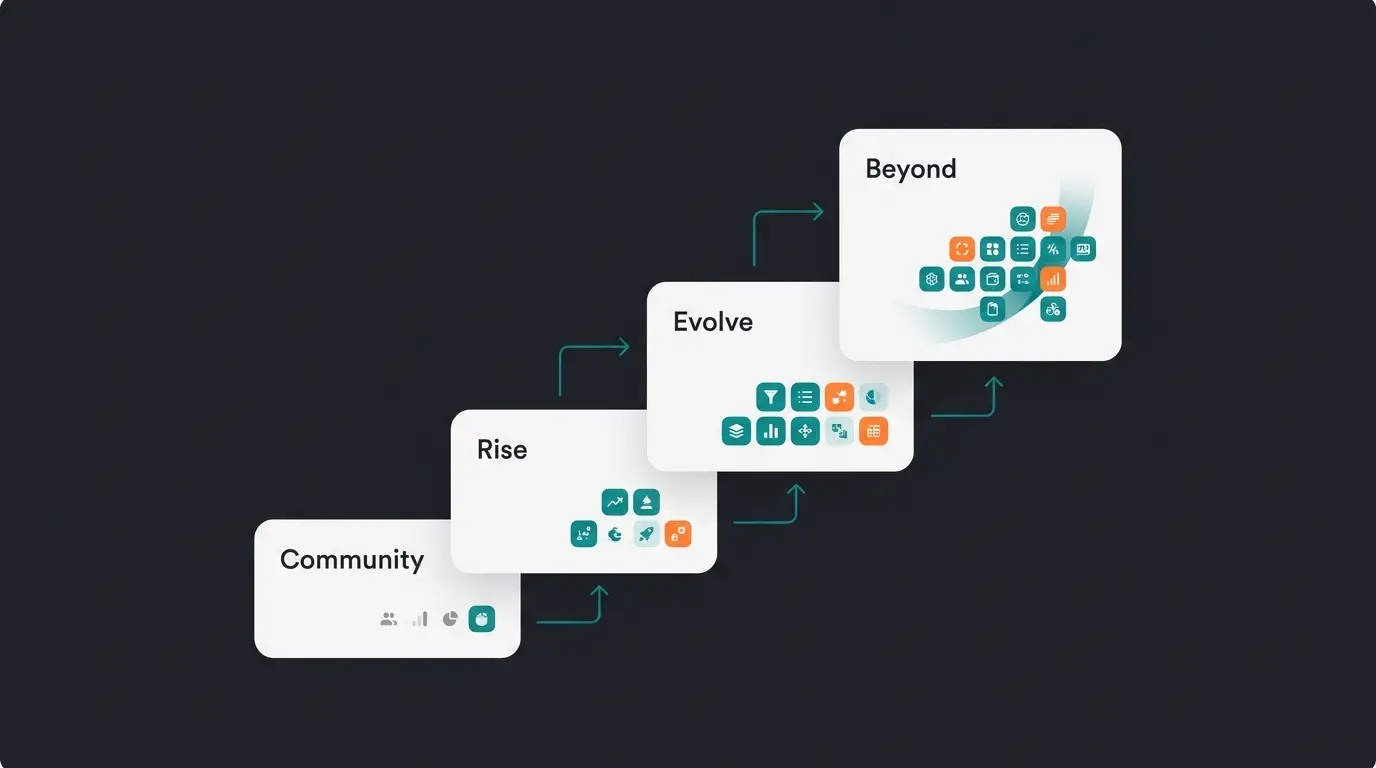
For most mid-market DACH shops with B2C focus and under EUR 2M annual GMV: Rise is the right starting point. The Flow Builder alone justifies the step up from Community, because it automates post-purchase emails, inventory alerts, and customer segmentation without code. If you sell to business customers with custom pricing, budget approvals, and role-based purchasing, you need Evolve. There is no workaround for B2B Suite features on lower tiers.
Beyond is for shops processing EUR 5M+ annually where downtime costs real money. The 24/7 dedicated support and custom SLA are the differentiators, not features. Every technical feature in Beyond is available in Evolve. You pay for guaranteed response times and infrastructure priority.
One pattern we see: shops start on Community, outgrow it within 12-18 months, then migrate to Rise. The migration itself is straightforward because Shopware Cloud uses the same codebase. Your plugins, themes, and product data transfer. What changes is the infrastructure and support layer underneath. If you are planning to grow past EUR 1M annual GMV within two years, starting on Rise saves you the migration effort later.
FAQ: common questions about Shopware online shops
Shopware is a legitimate e-commerce platform founded in 2000 in Schöppingen, Germany, with over 100,000 active merchants and EUR 12 billion in combined annual merchant revenue. It holds a 4.4/5 rating on Gartner Peer Insights across 90 verified reviews and has been Germany's market-leading shop system for four consecutive years.
No. Shopware is a German open-source e-commerce platform focused on DACH markets with native GDPR compliance and B2B features. Shopify is a Canadian SaaS platform with 5.6 million stores globally, optimized for simple international D2C selling. Shopware charges no transaction fees; Shopify charges 0.6-2.0% on third-party payment gateways.
Shopware powers B2C and B2B online shops, primarily in the DACH region. Merchants use it for product catalog management, order processing, multi-channel selling, and customer experience customization via Shopping Experiences. Brands like Borussia Dortmund, Discovery Channel, and L'Oréal run shops on Shopware.
The Community Edition is free (self-hosted). Shopware Cloud plans start at EUR 600/month (Rise), EUR 2,400/month (Evolve with B2B Suite), and approximately EUR 6,500/month (Beyond with 24/7 support). Pricing scales with your gross merchandise value. See official Shopware pricing for current rates.
Shopware Cloud (Rise tier) is accessible for beginners with its drag-and-drop Shopping Experiences editor and managed hosting. The Community Edition has a steeper learning curve because you manage hosting, updates, and security yourself. Budget 4-6 weeks for a basic shop setup with under 200 products. Refer to the Shopware 6 documentation for step-by-step guidance.
Shopware holds ISO/IEC 27001:2022 certification and runs regular security audits. The Shopware Cloud infrastructure includes DDoS protection, automated backups, and managed SSL. Self-hosted installations require you to apply security patches manually, which is why Community Edition shops need a maintenance plan.
A Shopware online shop brings visitors. A KI-Mitarbeiter turns them into buyers. Qualimero clients see 7x higher conversion rates and 35% larger carts through AI-powered product consultation.
Book a free demo
Kevin is CTO and co-founder of Qualimero. As an AI architect with over 15 years of experience as CTO and CPO in the tech industry, he designs the AI systems that automate tens of thousands of customer interactions daily for Qualimero's clients — reliably, securely, and at scale.