Why this comparison matters now
Shopware 5 reached end of life in July 2024. That is not a future event. It has already happened. If your shop still runs on version 5, you are operating without official security updates, without new features, and without a guaranteed future.
I have spoken with dozens of shop owners in the DACH region over the past year who delayed their migration decision. Some because the shop was running fine. Others because the cost felt too high. In almost every case, the delay made the eventual migration harder, not easier.
This guide compares Shopware 5 and Shopware 6 across every dimension that matters for a real business decision: architecture, features, costs, migration effort, and future outlook. Not marketing claims, but what we have seen in practice across our Shopware comparison guide and direct client work.
What is Shopware 5 and what is Shopware 6
Shopware 5 launched in 2010 and became the backbone of mid-market e-commerce in the DACH region. Built on PHP with Smarty templates, it offered a mature plugin ecosystem and a familiar admin interface. For over a decade, it served businesses reliably. The platform grew to power thousands of online shops across Germany, Austria, and Switzerland.
Shopware 6 is a fundamentally different platform. Released in 2019, it was rebuilt from the ground up using Symfony and Vue.js. The core philosophy shifted to API-first architecture, meaning every function of the shop can be accessed and controlled through APIs. This enables headless commerce, multi-channel distribution, and the kind of flexibility that modern e-commerce demands.
The critical distinction: Shopware 6 is not an upgrade of Shopware 5. It is a separate platform. Your Shopware 5 plugins, themes, and customisations do not carry over directly. This is both the biggest challenge and the biggest opportunity of the transition, as noted by Shopware themselves.
| Attribute | Shopware 5 | Shopware 6 |
|---|---|---|
| Release year | 2010 | 2019 |
| Framework | Custom PHP / Smarty | Symfony 6 / Vue.js 3 |
| Architecture | Monolithic | API-first, headless-capable |
| Template engine | Smarty (server-side) | Twig + Storefront (Vue.js admin) |
| Database abstraction | Direct MySQL | Data Abstraction Layer (DAL) |
| Status | End of life (July 2024) | Actively developed |
| Next version | None | Shopware 6.7 (May 2025), 6.8 (2027) |
Technical architecture comparison
The architectural gap between Shopware 5 and 6 is not incremental. It is generational. Shopware 5 was built for a world where the online shop was a single-channel storefront rendered on the server. Shopware 6 was built for a world where commerce happens across apps, social media, marketplaces, voice assistants, and IoT devices simultaneously.
At the core is the API-first approach. In Shopware 5, the API was an afterthought, limited to basic product and order management. In Shopware 6, the API is the foundation. The admin interface itself runs on the same APIs that external integrations use. This means anything you can do in the admin panel, you can automate through the API, as documented in the Shopware Developer Documentation.
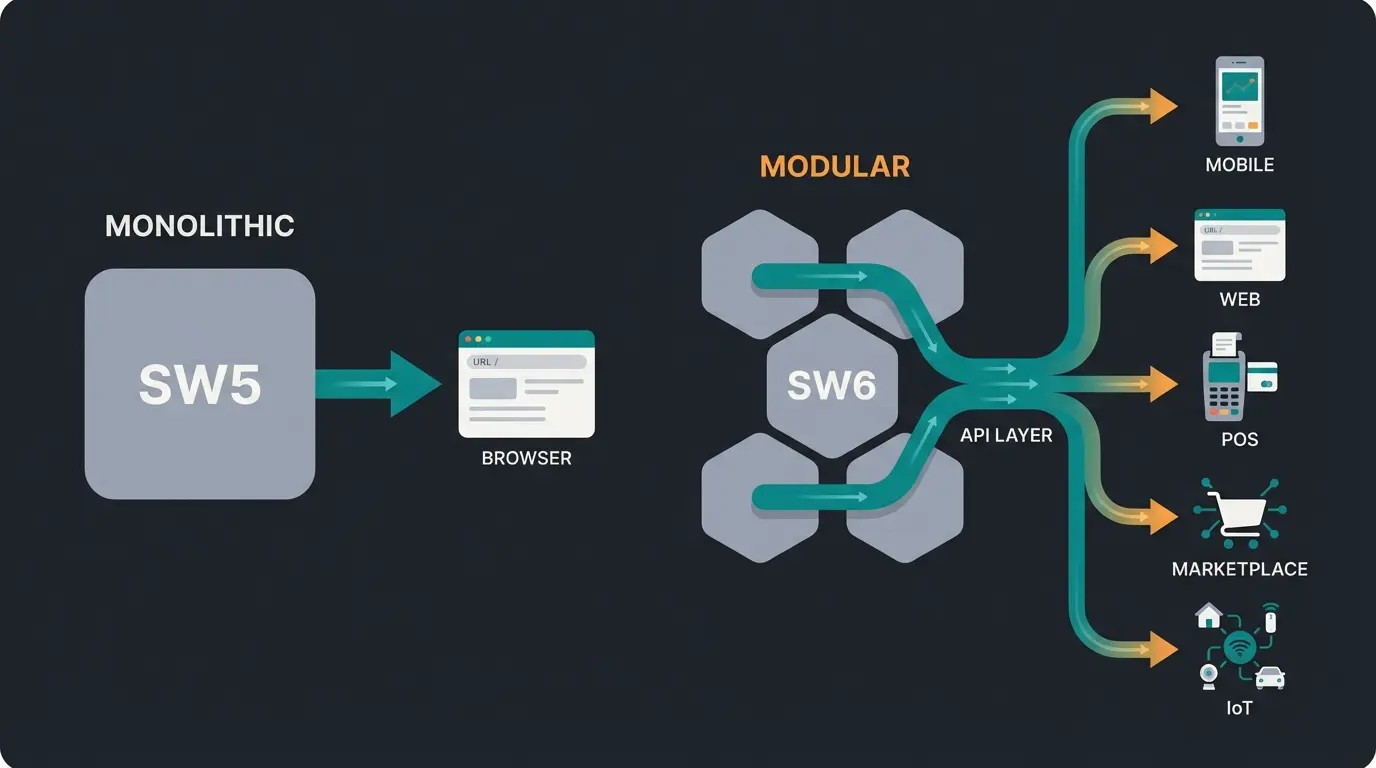
Headless commerce is the practical consequence of this shift. With Shopware 6, you can decouple the frontend entirely and build custom storefronts using React, Next.js, or any framework, while the Shopware backend handles products, orders, and business logic. Shopware was named a Leader in the IDC MarketScape Worldwide Headless Digital Commerce assessment for 2024, ranking among the top providers out of 27 evaluated platforms.
The database layer changed fundamentally too. Shopware 5 used direct MySQL queries, which made custom extensions fragile and version-dependent. Shopware 6 introduced the Data Abstraction Layer (DAL), a structured query system that ensures extensions work consistently across updates. For shop owners, this means fewer broken plugins after core updates.
| Component | Shopware 5 | Shopware 6 |
|---|---|---|
| Programming language | PHP 7.x | PHP 8.2+ |
| Frontend framework | Smarty templates | Twig (Storefront) / Vue.js 3 (Admin) |
| API coverage | Limited REST API | Full Admin API, Store API, Sync API |
| Headless support | Not supported | Full headless via Store API / GraphQL |
| Extension system | Plugin + Theme system | Apps + Plugins + Themes |
| Build tooling | Grunt / manual | Webpack (migrating to Vite in 6.7) |
| Caching | Basic HTTP cache | Advanced HTTP cache + App cache |
| Performance | Adequate for small shops | Optimised for high-traffic, multi-channel |
Feature comparison: Shopware 5 vs Shopware 6
Features are where the migration decision gets concrete. Shopware 6 does not just have more features. It has fundamentally different capabilities that did not exist in the Shopware 5 architecture. Here is what matters most for a business evaluating the switch.
Every admin function accessible via API, enabling full automation
Create pricing, shipping, and payment rules without developers
Native support for marketplaces, social commerce, and POS
AI-powered product descriptions, translations, and image generation (Shopware 6 only)
| Feature | Shopware 5 | Shopware 6 |
|---|---|---|
| Content management | Shopping Worlds (limited) | Shopping Experiences / Erlebniswelten (full CMS) |
| SEO tools | Basic meta tags | Advanced SEO: meta tags, breadcrumbs, rich snippets, canonical URLs |
| Rule Builder | Not available | Visual rule builder for shipping, payment, pricing, promotions |
| Multi-language | Basic language packs | Native multi-language with per-language content |
| B2B features | Via plugins only | Native B2B Suite (quote management, budgets, roles) |
| AI features | None | AI Copilot for content, translations, image generation |
| Payment integrations | Plugin-dependent | Native payment handler framework |
| Flow Builder | Not available | Visual automation workflows (order events, emails, tags) |
| Admin interface | ExtJS-based | Vue.js 3 (modern, responsive, customisable) |
| Product search | Basic search | Elasticsearch-powered with AI-assisted ranking |
The Rule Builder alone justifies the migration for many shops. In Shopware 5, custom shipping rules, customer-group pricing, or conditional payment methods required a developer and custom plugin code. In Shopware 6, a shop manager can configure these in the admin panel in minutes. I have watched clients cut their development dependency by half just through the Rule Builder and Flow Builder combination.
Cost and licensing differences
Shopware 6 restructured its pricing model in 2025. The Shopware Community Edition remains free, but with a critical change: since March 2025, the Fair Usage Policy restricts the free edition to shops under EUR 1 million annual GMV. Shops exceeding that threshold must upgrade to a paid plan.
| Edition | Monthly cost | Best for |
|---|---|---|
| Community | Free (under EUR 1M GMV) | Small shops, startups, testing |
| Rise | From EUR 600/month | Growing shops needing professional features |
| Evolve | From EUR 2,400/month | B2B shops with wholesale portals and quote workflows |
| Beyond | From EUR 6,500/month | Enterprise shops where downtime means significant revenue loss |
Licensing is typically 15-25% of total cost of ownership. Hosting, development, plugins, and ongoing maintenance make up the rest. For a full breakdown, see our Shopware editions comparison.
Shopware 5 end of life: what you need to know
Shopware 5 reached end of life in July 2024. This means no more official security patches, no new features, no plugin certification, and no guaranteed compatibility with payment providers, hosting environments, or legal requirements.
For shops that cannot migrate immediately, the vendor safefive offers commercial Long-Term Support with continued security updates. This buys time, but it does not buy a future. Every month on Shopware 5 increases technical debt and narrows the window for a clean migration.
- No official security patches since July 2024. PCI DSS and DSGVO compliance becomes your responsibility.
- Plugin ecosystem is shrinking. Developers are moving to Shopware 6. Finding Shopware 5 specialists gets harder every quarter.
- Payment providers are dropping support. Some PSPs no longer certify new integrations for Shopware 5.
- Hosting providers are phasing out PHP 7.x support, which Shopware 5 depends on.
- No path to AI or headless commerce. These capabilities require Shopware 6 architecture.
Migration from Shopware 5 to 6
Migration from Shopware 5 to 6 is not a simple update. It is a replatforming project. Products, categories, customers, and orders can be transferred using Shopware's official Migration Assistant, but themes, plugins, and custom code must be rebuilt or replaced.
Based on what we have seen across dozens of projects, here is what to expect:
- Audit your current setup. Document every plugin, custom feature, and integration. Identify Shopware 6 equivalents.
- Plan your data migration. Use the Migration Assistant for products, customers, orders, and media. Budget 2-4 weeks for data mapping and testing.
- Rebuild your theme. Smarty templates do not work in Shopware 6. Budget for a new Storefront theme or headless frontend.
- Replace plugins. Check the Shopware Store for Shopware 6 versions. Some plugins have no equivalent and require custom development.
- Test extensively. Run parallel environments for 2-3 weeks before switching. Validate SEO redirects, payment flows, and order processing.
- Go live with a hypercare period. Plan 1-2 weeks of close monitoring after launch.
Typical migration costs range from EUR 3,000 to EUR 15,000 depending on shop complexity, with a timeline of 3 to 6 months. For detailed step-by-step guidance, read our Shopware migration guide and the dedicated Shopware 5 to 6 upgrade guide.
A Qualimero AI employee handles product advisory and customer service in your Shopware 6 shop, 24/7. Our clients see +35% cart value and 7x higher conversion. Start with a free demo.
Book a free demoShould you switch platforms instead
If you are leaving Shopware 5 anyway, the question deserves asking: should you migrate to Shopware 6, or switch to Shopify, WooCommerce, or another platform entirely?
The honest answer depends on your situation. Shopware 6 makes the most sense if you operate in the DACH region, need German-language support and DSGVO compliance out of the box, have B2B requirements, or want to stay in the Shopware ecosystem. If your business is purely B2C, sells internationally, and values simplicity over configurability, Shopify may be the better fit.
- Stay with Shopware 6 if: DACH market focus, B2B needs, complex product configurations, headless commerce ambitions
- Consider Shopify if: pure B2C, international-first, small team, simplicity over customisation
- Consider WooCommerce if: tight budget, existing WordPress infrastructure, very small catalogue
- Consider other platforms if: enterprise-scale (Commercetools, SAP Commerce) or niche requirements
For a full analysis, see our Shopware alternatives comparison. If Magento is on your shortlist, our Magento vs Shopware breakdown compares licensing, hosting effort, and long-term maintenance side by side.
Future outlook: Shopware 6.7, 6.8, and beyond
There is no Shopware 7 on the horizon. Shopware has confirmed that the next major release is Shopware 6.7, scheduled for May 2025, followed by 6.8 in 2027. The platform will continue evolving within the 6.x line, which means migrating to Shopware 6 now positions your shop on the actively developed branch for years to come.
Shopware 6.7 brings significant changes: migration from Webpack to Vite for faster build times, full Vue 3 compatibility (dropping the compatibility mode), and a move from Vuex to Pinia for state management. For a deeper look at what is coming, read our Shopware 7 and future roadmap analysis.
FAQ
Shopware 5 reached official end of life in July 2024. No more security patches or feature updates are provided by Shopware AG. Commercial Long-Term Support is available through the third-party vendor safefive for shops that need more time to migrate.
Shopware 6 is a completely new platform built on Symfony and Vue.js with an API-first architecture, while Shopware 5 used custom PHP with Smarty templates. Key additions in Shopware 6 include headless commerce, the Rule Builder, Flow Builder, native B2B features, and AI Copilot.
A typical migration takes 3 to 6 months, including data migration (2-4 weeks), theme rebuilding, plugin replacement, testing (2-3 weeks), and a hypercare go-live period (1-2 weeks). Complex shops with many custom plugins may take longer.
Migration costs range from EUR 3,000 for straightforward shops with clean data to EUR 15,000 or more for complex setups with custom plugins, integrations, and large product catalogues. This does not include ongoing Shopware 6 licensing fees.
For any shop starting fresh or planning for the future, Shopware 6 is objectively the better choice. It offers modern architecture, active development, AI features, and headless commerce capabilities. Shopware 5 is only viable for shops with commercial LTS that need time to plan their migration.
Conclusion and next steps
Shopware 5 served the DACH e-commerce market well for over a decade. That chapter is closed. Shopware 6 is the present and the future, with an architecture built for headless commerce, AI automation, and multi-channel distribution.
If your shop still runs on Shopware 5, start your migration planning now. The longer you wait, the fewer Shopware 5 specialists will be available, and the higher the risk of security or compliance issues. The standard has moved.
After migration, make the most of your new platform. A Qualimero AI employee provides 24/7 product advisory, recognises returning customers, and increases cart values by up to 35%. See it in action.
Try Qualimero free for 14 days
Lasse is CEO and co-founder of Qualimero. After completing his MBA at WHU and scaling a company to seven-figure revenue, he founded Qualimero to build AI-powered digital employees for e-commerce. His focus: helping businesses measurably improve customer interaction through intelligent automation.