
What is Shopware 6
Shopware 6 is an open-source, API-first commerce platform built on Symfony 7 and Vue.js 3 and developed in Germany. The current version in 2026 is Shopware 6.7. It pairs a headless commerce core with a built-in CMS and ships as a free Community Edition alongside the paid Rise, Evolve, and Beyond tiers.
The official Shopware repository on GitHub states it plainly: "Shopware 6 is an open headless commerce platform powered by Symfony 7 and Vue.js 3 that is used by thousands of shops." That one sentence carries three technical facts worth checking: it is open source, it is headless, and it runs on a current PHP and JavaScript stack rather than a legacy one.
The version history matters for any buying decision. Wikipedia records that "Shopware is an open source e-commerce software written in PHP," and that Shopware 6.0 shipped in 2019 as a complete rebuild of the older Shopware 5. Seven years later, the 6.x line has reached 6.7. This is a mature platform, not an early release.
For the full technical reference, Shopware maintains its own Shopware developer documentation. If you are still choosing between platforms rather than versions, our Shopware comparison puts version 6 next to the main alternatives before you commit.
Shopware 6 key features
Shopware 6 key features are its API-first headless architecture, the no-code Rule Builder and Flow Builder for automation, and Shopping Experiences, a drag-and-drop CMS that merges content and commerce. Native B2B, multi-language, and multi-currency support ship with the platform, not as paid bolt-ons you discover later.
"Headless" is the term most likely to be oversold here, so it is worth being precise. In Shopware 6, the storefront and the admin are separated, and every function is reachable through an API. You can run the standard Storefront, or build a custom frontend: a mobile app, a kiosk, an ERP integration. The core logic does not change. That separation is exactly what lets an external system read product data and write to the cart in real time.
| Feature | What it does | Who it matters to |
|---|---|---|
| API-first core | Every function exposed via REST and Store API | Teams building custom frontends or AI integrations |
| Rule Builder | No-code conditional logic for pricing, shipping, and promotions | Merchandisers without developer support |
| Flow Builder | Event-driven automation: trigger, condition, action | Operations teams cutting manual steps |
| Shopping Experiences | Drag-and-drop CMS that places products inside content | Content and marketing teams |
| Native B2B | Price lists, roles, budgets, quotes in commercial tiers | Wholesalers and manufacturers |
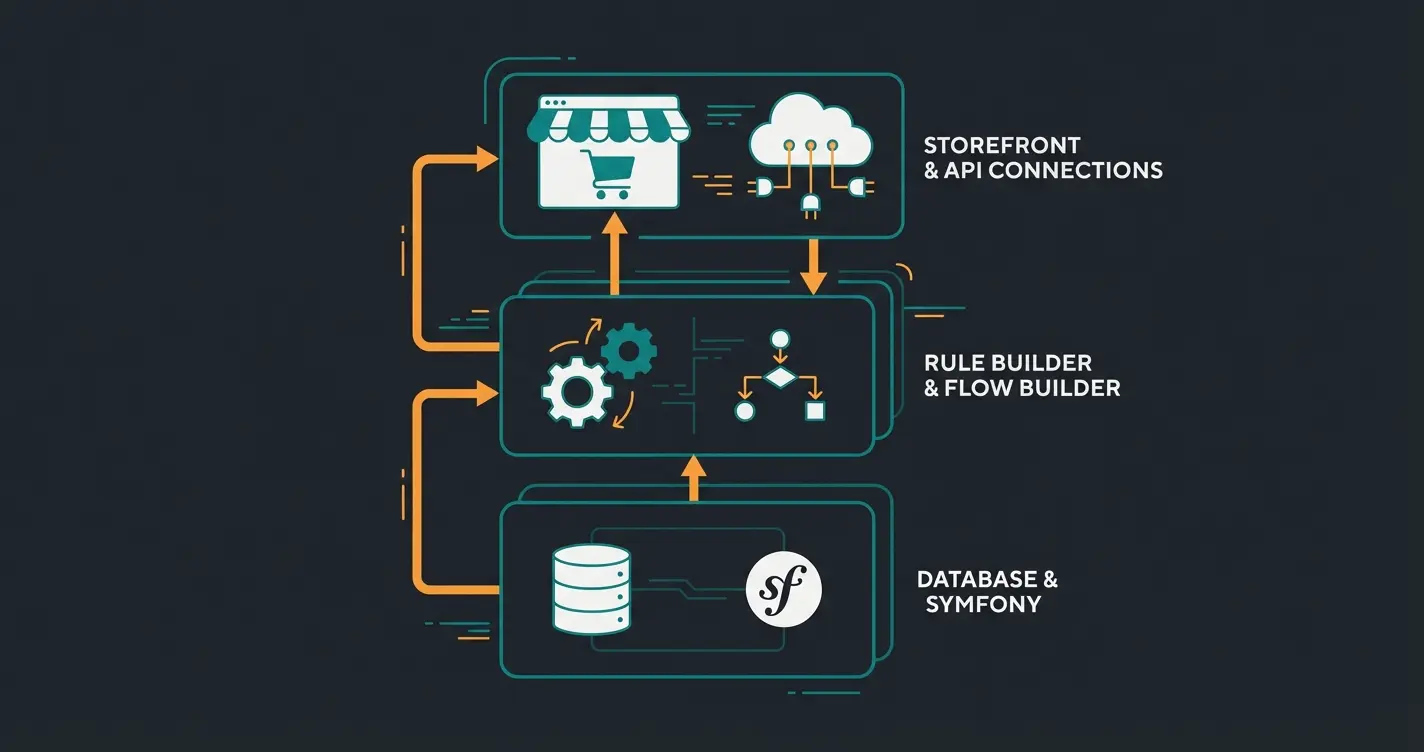
The Rule Builder and Flow Builder are the two features that pay for themselves fastest. The Shopware Rule Builder defines conditions in plain business terms: customers from Switzerland, cart over 200 CHF, shopping on a Sunday, gets a 10% discount. The Flow Builder then executes actions off any event: an order comes in, the system checks whether the buyer is a VIP, and routes a message accordingly. Both work without a single line of code, which is rare at this depth.
Shopware 6 editions and pricing 2026
Shopware 6 comes in four tiers in 2026: the free open-source Community Edition, plus the paid Rise, Evolve, and Beyond plans. The Community Edition stays free to install and extend, but the Fair Usage Policy, now in effect, restricts free commercial-grade use once a shop passes roughly 1 million euros in annual GMV. Above that threshold, a paid plan is required to keep account and store access.
| Plan | Best for | Indicative entry price | Key additions |
|---|---|---|---|
| Community Edition | Developers, startups, shops under 1M euros GMV | Free, open source | Full core: Rule Builder, Flow Builder, Shopping Experiences |
| Rise | Growing B2C brands and SMEs | from around 600 euros/month | Commercial support, AI Copilot, managed hosting options |
| Evolve | B2B merchants and scaling brands | from around 2,400 euros/month | B2B Suite: price lists, quotes, roles, budgets |
| Beyond | Enterprise and market leaders | from around 6,500 euros/month | Multi-inventory, subscriptions, 24/7 priority support |
System requirements for Shopware 6
Shopware 6.7 requires PHP 8.2 or higher, MySQL 8.0+ or MariaDB 10.11+, and Composer 2.2+ on a LAMP or LEMP stack. A production self-hosted install needs at least 4 GB of RAM, plus Elasticsearch or OpenSearch once the catalog passes roughly 10,000 products. Shared hosting will technically install it and then fall over under real traffic.
| Component | Minimum for Shopware 6.7 |
|---|---|
| PHP | 8.2 or higher |
| Database | MySQL 8.0+ or MariaDB 10.11+ |
| Composer | 2.2 or higher |
| Node.js | Required for admin and storefront builds |
| Server stack | LAMP or LEMP, 4 GB+ RAM for production |
| Search (10k+ products) | Elasticsearch or OpenSearch recommended |
One practical note from real projects: the database version trips people up more than PHP does. MariaDB 10.11 is the floor, and older shared hosts often run 10.6 or lower. Check that first. If your host cannot meet these versions, that is your signal to move to a specialist Shopware hoster before you install anything.
Shopware 6 vs Shopware 5 and Shopware 7
Shopware 6 replaced Shopware 5 with a full Symfony and Vue rebuild, an API-first core, and a redesigned admin. Shopware 7 is the next step in the same line, not a reason to wait: most live shops run 6.x today, and the 6-to-7 upgrade is far smoother than the 5-to-6 migration ever was. If you are on 5, the move to 6 is a migration project, not an update.
| Aspect | Shopware 5 | Shopware 6 | Shopware 7 |
|---|---|---|---|
| Architecture | Legacy PHP with Smarty templating | Symfony 7 and Vue.js 3, API-first | In-line evolution of the 6.x core |
| Status in 2026 | End of life, support winding down | Current, version 6.7 | Rolling out gradually |
| Upgrade effort | 5 to 6 is a full data migration | Baseline | 6 to 7 is an in-line upgrade |
The takeaway is simple. If you run Shopware 5, plan the migration to 6 now while the path is well documented, and read how Shopware 6 compares to Shopware 5 in detail first. If you are new to the platform, start on 6.7 and treat Shopware 7 as a future upgrade, not a reason to delay a launch.
Shopware 6 vs competitors
Against Shopify, Shopware 6 trades hosted convenience for open-source control and stronger native B2B. Against WooCommerce and Magento, it offers a more integrated, modern stack with less plugin sprawl. Shopware fits merchants who want data ownership and B2B depth more than a fully managed SaaS. It is not the right pick for a two-product hobby store.
| Criterion | Shopify | Shopware 6 | Magento (Adobe Commerce) |
|---|---|---|---|
| Platform type | SaaS, fully hosted | Self-hosted or PaaS, open source | On-premise or cloud, monolithic |
| B2B capability | Weak without Plus | Strong, native B2B Suite | Very strong but complex |
| Customizability | Limited to apps | High, open code plus API | Extremely high |
| Time to market | Very fast | Medium | Slow |
| AI integration | Many generic apps | Deep, via the Store API | Powerful but heavy to build |
| Data location | Mostly US servers | GDPR-friendly, EU hosting possible | Depends on hosting |
Where does Shopware 6 win? Shopify is often too rigid for real guided selling, because deep access to product attributes is exactly what its app model limits. Magento is overkill for most mid-market projects and expensive to maintain. Shopware 6 sits in the middle: flexible enough for custom AI consultation, modern enough to avoid the maintenance swamp. For the head-to-head detail, see Shopware vs Shopify, Shopware vs WooCommerce, and Shopware vs OXID. ERP-driven merchants should read Shopware vs JTL, while Shopware vs PrestaShop and Shopware vs Spryker cover the open-source and enterprise ends. Still weighing the field? The full Shopware Alternatives overview maps every option.
The 2026 release on Symfony 7 and Vue.js 3
GMV limit for free Community Edition use
Plus MySQL 8.0+ or MariaDB 10.11+
The missing piece: automated product consultation
Shopware 6 gives you a storefront, not a salesperson. A self-hosted shop stays silent while a shopper hesitates in front of 50 near-identical products. An AI product advisor closes that gap: it asks the right questions, filters the catalog live through the Shopware API, and guides the buyer to the correct product the way in-store staff would. That is where basket value and conversion actually move.
First, a distinction that Shopware markets loosely. The native Shopware AI Copilot, available in commercial plans, is an admin tool: it writes product descriptions, generates image keywords, and summarizes reviews. Useful, but it helps the merchant, not the buyer. Consultative AI works on the frontend, in dialogue with the customer, at the moment of decision. Copilot saves you time. A product advisor makes you the sale. These are not the same product, and treating them as one is the most common mistake I see.
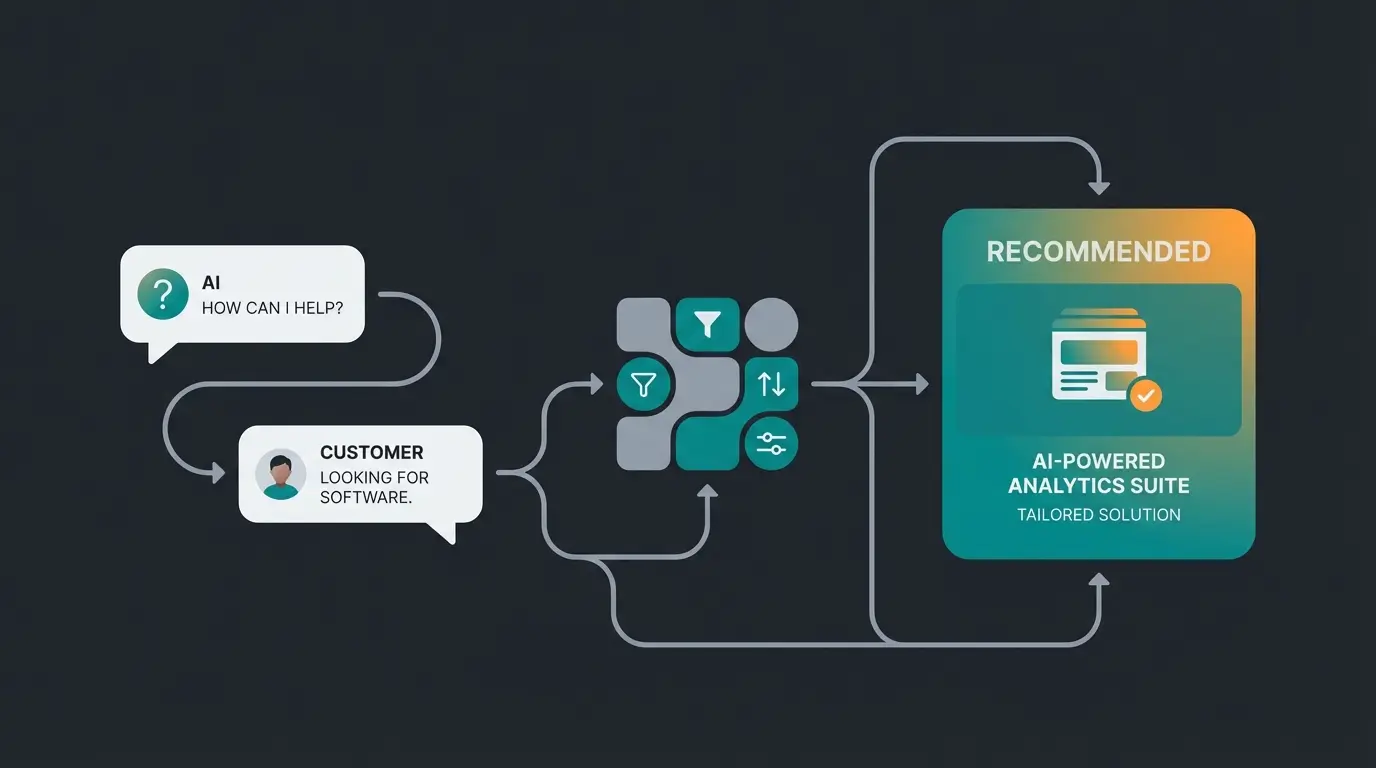
This is not theory. HELLA Lightstyle sells auxiliary vehicle lighting, a product with real consultation weight: buyers have to match ECE approval rules, wiring kits, and mounting positions before they can buy with confidence. Many of them shop on evenings and weekends, exactly when technical support is offline. HELLA added the AI product advisor Ella, and the numbers followed: support inquiries down 60%, technical advice available 24/7, and 100% legally compliant product recommendations. See the full HELLA Lightstyle AI product advisor story for the setup detail.
The mechanics are straightforward on an API-first platform. The advisor pulls product data live through the Store API, runs the conversation in an overlay with no page reload, and writes the chosen product straight into the Shopware cart through the Cart API. Merchants running this approach see up to 30% higher basket value and 97% of routine consultation handled automatically. That is the model behind our AI product consultation for complex, technical, and regulated catalogs.
Implementation guide
Launching a Shopware 6 store runs in three phases: provision hosting and install 6.7, migrate and clean your product data, then activate the sales layer with AI product consultation. Merchants moving from another system should sequence the migration first, because clean, structured product data is what later powers both search and AI advice. Skip the data hygiene and every downstream step suffers.
Choose a specialist Shopware hoster, install 6.7, and plan Redis or Varnish caching from day one.
Use the Migration Assistant, then structure product attributes so search and AI have something to work with.
Add AI product consultation to your consultation-heavy categories and wire follow-ups through the Flow Builder.
On phase two, data quality is not optional. An AI advisor can only reason as well as your attributes allow, so fields like material, use case, and weight have to be complete and consistent. If you are coming from another platform, our Shopware migration guide covers the general path, and the WooCommerce to Shopware walkthrough handles that specific move. A PIM such as Akeneo pays off here if your catalog is large.
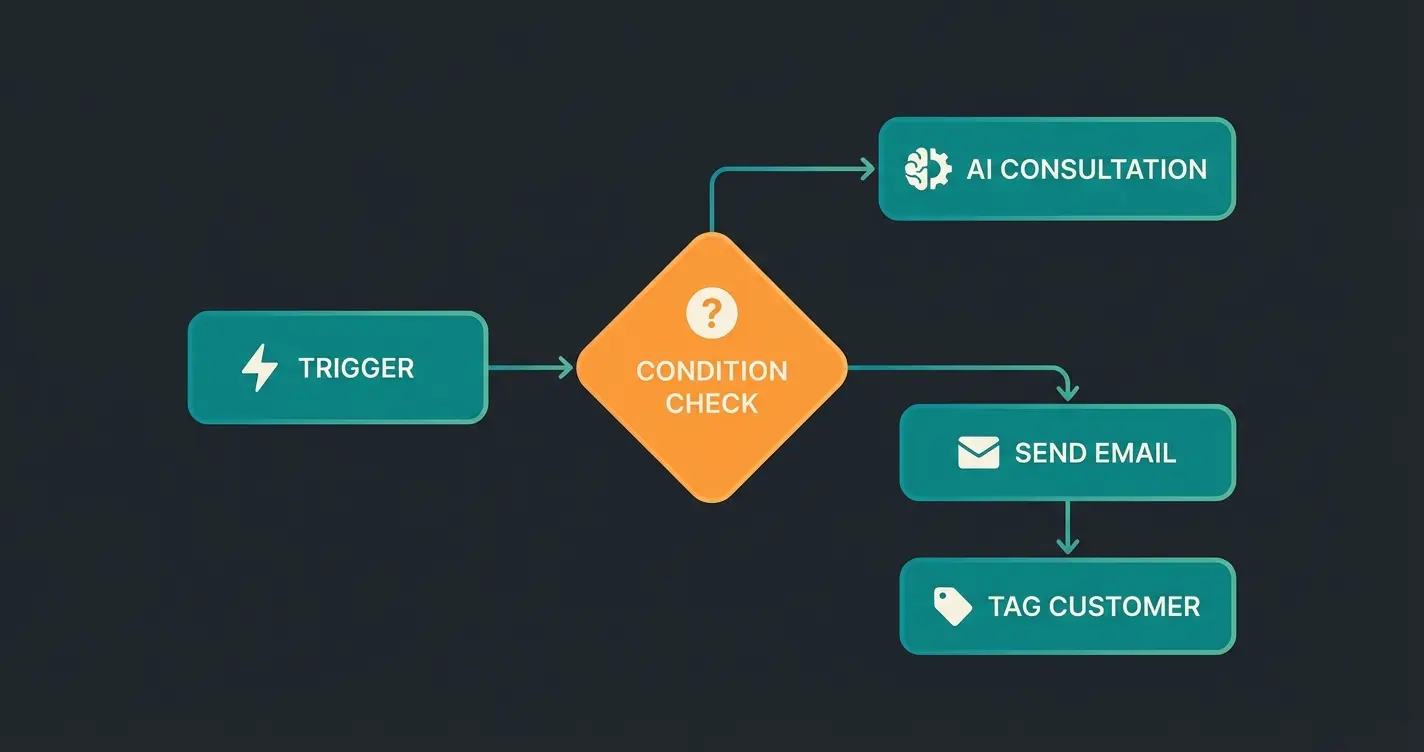
On phase three, pick the categories where decisions are hardest: think mattresses, ski gear, or technical parts, the products where buyers hesitate and abandon. Define the three to five questions your best salesperson would ask, then connect the advisor through the API. The Flow Builder handles the rest: a shopper who drops out of a consultation gets a follow-up email an hour later with their personal result. That is a silent recovery channel most shops never build.
Frequently asked questions about Shopware 6
The current version in 2026 is Shopware 6.7, built on Symfony 7 and Vue.js 3. The 6.x line has evolved steadily since Shopware 6.0 first shipped in 2019. Shopware 7 is the next generation and is rolling out gradually.
The Community Edition is free and open source to install and extend. Since the Fair Usage Policy took effect, shops above roughly 1 million euros in annual GMV must move to a paid plan (Rise, Evolve, or Beyond) to keep account and store access. Below that threshold, the free edition is fully usable.
The Community Edition costs nothing. Paid plans start at around 600 euros per month for Rise, roughly 2,400 euros for Evolve, and about 6,500 euros for Beyond, with final pricing confirmed by Shopware on request. The right tier depends mainly on your B2B needs and GMV.
Yes. Shopware is an established German open-source platform that powers thousands of live shops and scores 4.5 out of 5 on professional review sites like OMR and G2. Lower ratings on consumer sites usually reflect support frustrations rather than software quality.
Shopware 6 is used to build and run online stores, from B2C brands to complex B2B operations. Its API-first architecture and native B2B features make it a strong fit for consultation-heavy catalogs where deep integrations, including AI product advice, add real value.
Shopware 6 gives you the storefront. A KI-Mitarbeiter gives you the salesperson: live product consultation that guides buyers to the right product and lifts basket value by up to 30%, the way it did for HELLA Lightstyle.
See AI product consultation in action
Kevin is CTO and co-founder of Qualimero. As an AI architect with over 15 years of experience as CTO and CPO in the tech industry, he designs the AI systems that automate tens of thousands of customer interactions daily for Qualimero's clients — reliably, securely, and at scale.