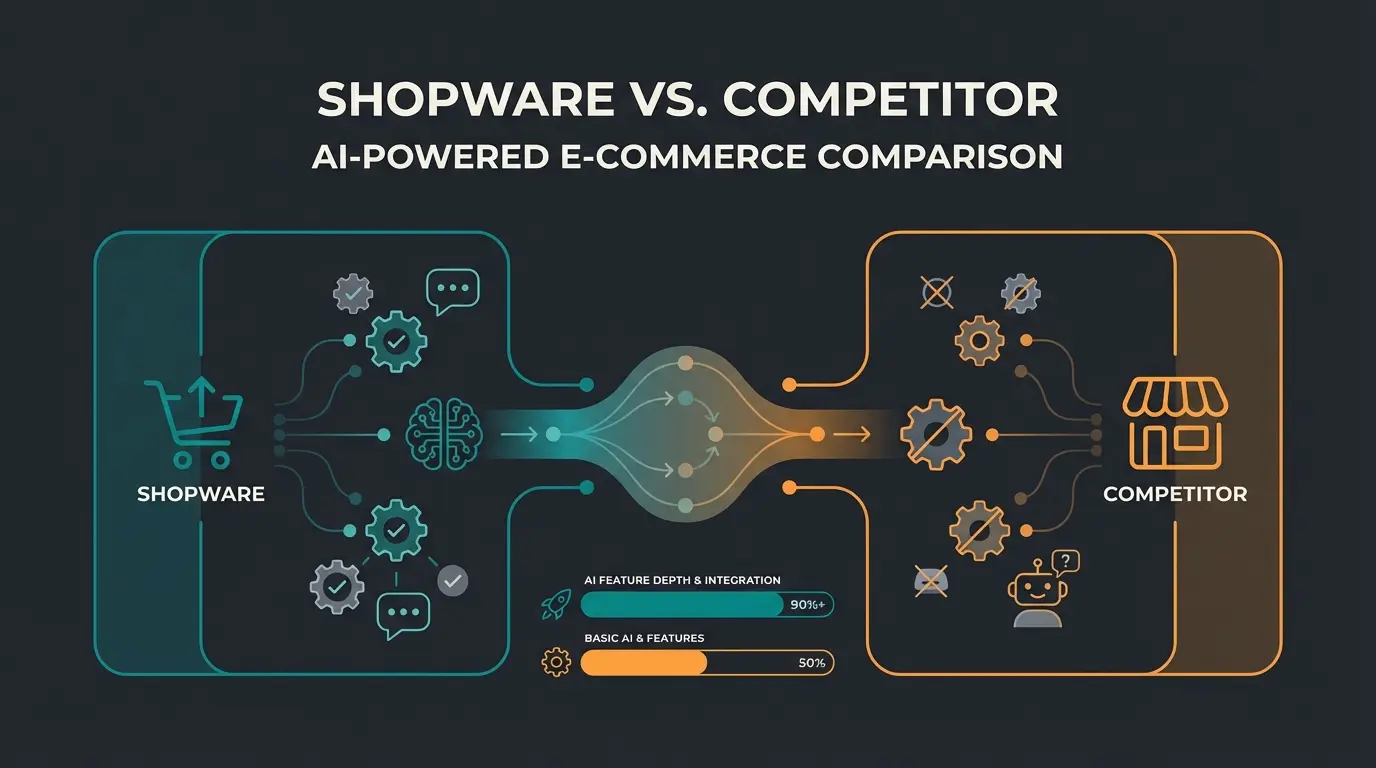
Shopware comparison 2026: who it really competes with
Shopware is an open-source, API-first ecommerce platform from Germany, and its main competitors are Shopify, Adobe Commerce (Magento), WooCommerce, OroCommerce, Spryker, and regional systems like OXID, JTL and Gambio. It targets mid-market and B2B merchants who want full data control and deep customization. Shopify wins on speed, OroCommerce on B2B process depth, WooCommerce on WordPress integration.
A Shopware comparison usually hides two separate questions. First the platform question: is Shopware 6 the right system at all, or should you run Shopify, Magento or WooCommerce? Second the edition question: does the free Community Edition still cover you, or does the 2025 Fair Usage Policy push you onto Rise, Evolve or Beyond? We answer both. For the full platform background, read our independent Shopware guide.
This is not a feature checklist copied from vendor pages. We compare on total cost of ownership over three years, on B2B capability, on data sovereignty (which still matters for German and EU merchants), and on AI readiness. A platform that only works as a silent backend loses ground in 2026, so we also test how far each one lets you bolt real sales consultation onto the storefront.
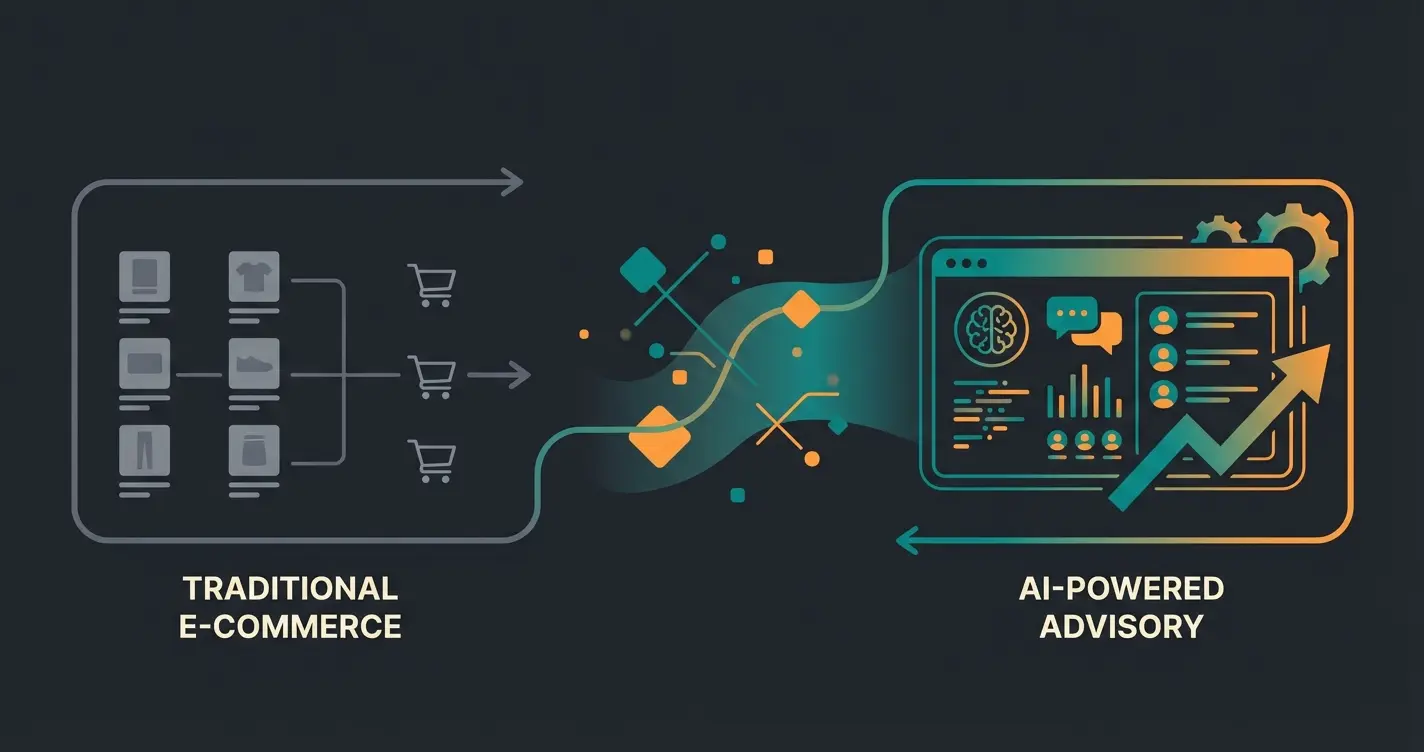
Quick decision matrix: Shopware vs the competition
Short version: Shopware fits mid-market and B2B merchants who need an open-source, API-first platform with deep customization and EU data hosting. Choose Shopify for the fastest launch, WooCommerce if you already run WordPress, Adobe Commerce for global enterprises, and OroCommerce when complex B2B workflows are the whole business. The matrix below maps each platform to the shop it actually fits.
If you want the platform background before the comparison, our complete Shopware guide covers history, architecture and roadmap in one place.
| Platform | Best for | Starting price | B2B depth | Data control |
|---|---|---|---|---|
| Shopware 6 | Mid-market, B2B, D2C brands wanting customization | Free / from EUR 600/mo | Strong (native B2B components) | Full (self-host or EU cloud) |
| Shopify | Fast launch, standard D2C catalogs | From ~USD 39/mo | Medium (needs Plus or apps) | Limited (US SaaS) |
| Adobe Commerce (Magento) | Global enterprises with large IT teams | Quote (often six figures/yr) | Strong (but costly) | Full (self-host) |
| WooCommerce | WordPress shops, content-led commerce | Free + hosting and plugins | Weak (plugin-dependent) | Full (self-host) |
| OroCommerce | Manufacturers, distributors, heavy B2B | Free / enterprise quote | Very strong (native RFQ, CRM) | Full (self-host) |
| Gambio | Small shops under ~100 products | From ~EUR 19/mo | Weak | Medium (German SaaS) |
Need more depth on the three systems most German merchants shortlist? This second matrix adds maintenance effort, GDPR posture and AI readiness, the columns standard comparisons leave out.
| Criterion | Shopware 6 (Self-Hosted/PaaS) | Shopify (SaaS) | Magento / Adobe Commerce |
|---|---|---|---|
| Target group | Ambitious SMEs, B2B, D2C brands focused on individuality | Startups, D2C brands with standard products | Global corporations with large IT departments |
| Maintenance effort | Medium (updates needed, automatable via PaaS) | Low (fully managed hosting) | Very high (complex architecture) |
| Data protection (GDPR) | Excellent (EU server location selectable, full data control) | Good (US corporation, data transfer often debated) | Good (self-hosted), but complex to secure |
| B2B focus | Strong (native B2B components, individual price lists) | Medium (B2B strong only in Plus, often needs apps) | Strong (but expensive to implement) |
| AI readiness (backend) | High (AI Copilot for text and images, native from Rise) | High (Shopify Magic / Sidekick) | Medium (Sensei AI available, but slow) |
| AI consultation (frontend) | Very high (API-first allows deep external sales AI) | Medium (closed ecosystem limits external data) | High (but API often slow and complex) |
| Main cost driver | Initial setup and development | Transaction fees and app subscriptions | License costs and developer hourly rates |
Shopware editions compared: Community, Rise, Evolve, Beyond
Shopware ships one free open-source edition (Community) and three commercial tiers: Rise from EUR 600 per month, Evolve from EUR 2,400 per month, and Beyond from EUR 6,500 per month. They differ mainly in B2B components, support SLA, and cloud versus self-hosted options. Since March 2025, the Fair Usage Policy caps the free Community Edition at EUR 1 million annual GMV.
For the tier-by-tier breakdown, see our Shopware editions comparison. The move from the current Shopware 6 generation to the next only sharpens these differences, since every tier inherits the same API-first core.
The Fair Usage Policy: the end of unlimited free scaling
For years the Shopware Community Edition was the open secret: start free, scale without limits. That ended in March 2025. Shopware now caps free use at EUR 1 million annual gross merchandise value. Its own Fair Usage Policy announcement states that Community Edition shops above the threshold lose access to the Shopware Store and their Shopware Account unless they upgrade to at least Rise.
The policy is not just paperwork. From 14 April 2026, GMV reporting is automated for Community Edition shops running version 6.7.8 or newer, so the threshold is measured, not self-declared. The code stays open source. But for a professionally growing shop, the free edition is no longer a permanent home.
What each edition actually buys you
The differences are not about a longer feature list. They are about B2B depth, support response time, and whether the operational tooling (Flow Builder, Rule Builder, AI Copilot) ships in a usable form. Here is the practical view.
| Edition | From (monthly) | Best for | What you actually get |
|---|---|---|---|
| Community | Free (under EUR 1M GMV) | Startups, sub-EUR 1M shops | Full open-source core, no manufacturer SLA, GMV reporting required |
| Rise | EUR 600 | Professional B2C shops past the tinkering phase | Extended Flow Builder and Rule Builder, AI Copilot, manufacturer support |
| Evolve | EUR 2,400 | B2B and fast-growing retailers | Modular B2B Components: quick orders, roles, quote and budget approvals |
| Beyond | EUR 6,500 | Market leaders, complex enterprises | Multi-inventory, Digital Sales Rooms, 24/7 support |
The Evolve tier is where Shopware earns its B2B reputation. The old monolithic B2B Suite is gone; in its place sit modular, API-first B2B Components: quick orders for repeat buyers, granular rights and role management, quote workflows, and multi-level budget approvals. Compared with Shopify, where the same depth needs Plus plus apps, Evolve delivers it in one system.
Most common choice for professional B2C shops (Qualimero project base, 2026)
Dominant in B2B for the modular components
Startups and sub-EUR 1M GMV shops
Large corporations with complex requirements
Shopware vs the market leaders: a system comparison
Against the field, Shopware lands mid-pack on price and high on flexibility. It undercuts Adobe Commerce on total cost, beats WooCommerce and Gambio on B2B depth, and trades launch speed for control against Shopify. OroCommerce and Spryker outrank it on heavy B2B and enterprise workflows, while OXID and JTL stay niche, mostly German plays. Here is how each matchup breaks down.
Once the edition is settled, the real question is why Shopware over the international field. We start with the comparison most German merchants run first: Shopware vs Shopify.
Shopware vs Shopify
This is the most common matchup in the DACH market. Shopify is the worry-free package: hosting included, the fastest time-to-market, and the largest app store in commerce. The cost shows up later. If you skip Shopify Payments, you pay up to a 2% surcharge on every order, and your data sits with a US provider, which still triggers compliance debates in B2B and pharma.
Shopware trades that convenience for control. You decide whether the shop runs on Hetzner, AWS Frankfurt or a managed host, you pay no platform transaction fee beyond your payment provider, and you own the data foundation. The price is higher setup effort, unless you run Shopware Cloud.
The agency team at what.digital puts the trade bluntly: "Shopify's app ecosystem beats Shopware's plugin chaos by miles." It is a fair hit. Shopware's plugin compatibility checks cost time that Shopify users rarely think about.
Verdict: pick Shopify for standard fashion or lifestyle catalogs that need to go live fast. Pick Shopware for complex products, B2B requirements, and full control over customer data. If you currently run WooCommerce, our Shopware vs WooCommerce deep dive runs the same trade for that platform.
Shopware vs Magento (Adobe Commerce)
Magento once dominated and is now an enterprise system with enterprise costs. Development is expensive, the architecture is heavy, and it only earns its keep above roughly EUR 50 million in revenue. Shopware is often called the modern Magento: the same open-source philosophy, a current stack (Symfony, Vue.js), faster to build on, and cheaper to maintain. Our Magento vs Shopware comparison runs the numbers in detail.
For the genuine enterprise and marketplace tier, Spryker enters the picture. It outscales Shopware on composable, multi-region architecture but costs far more to run. Our Shopware vs Spryker comparison shows where each one wins in complex B2B.
Shopware vs OroCommerce
OroCommerce is the one competitor built B2B-first. Where Shopware added B2B components onto a B2C core, OroCommerce started from manufacturers, distributors and wholesalers. The vendor describes its platform as "developed from the ground up for the complex needs of manufacturers, distributors, and wholesalers," and it shows: native quote management (RFQ), customer-specific catalogs and pricing, and a built-in Salesforce connector all ship in the open-source core.
The trade is reach versus depth. Shopware covers B2C and B2B in one system, has a far larger plugin store, and a bigger DACH agency network. OroCommerce goes deeper on B2B process, CRM and corporate account hierarchies, but it is overkill for a shop that also sells to consumers. For the query orocommerce vs shopware the honest answer is workload-based: choose OroCommerce when complex B2B workflows are the entire business, choose Shopware when you serve both sides of the counter.
Shopware vs Gambio
Gambio is a German SaaS platform that positions itself as the budget entry point, starting around EUR 19 per month. It targets small shops with fewer than 100 products and ships a solid admin, built-in payment integrations, and German-language support from day one. For a solo merchant with a manageable range, Gambio delivers a working shop without touching code.
The ceiling arrives fast. Gambio has no API-first architecture, so custom integrations need workarounds rather than clean API calls, and its templating is rigid next to Shopware's Twig frontend. AI readiness is essentially nil: no content AI, no product-data enrichment, no foundation for guided selling. Past roughly EUR 500,000 in annual revenue, or the moment you need real B2B features, Gambio runs out of road while Shopware keeps scaling.
We also cover Shopware vs JTL, Shopware vs OXID and Shopware vs PrestaShop in dedicated comparisons. For the full field, our Shopware alternatives guide ranks every contender side by side.
One source worth reading with a critical eye: Shopware publishes its own comparison of eight ecommerce platforms (August 2025). Read it knowing Shopware ranks itself first in its own list. Vendor comparisons are marketing, not benchmarks. Gartner's verified Shopware reviews sit closer to neutral, though they are gated and thin on pricing.
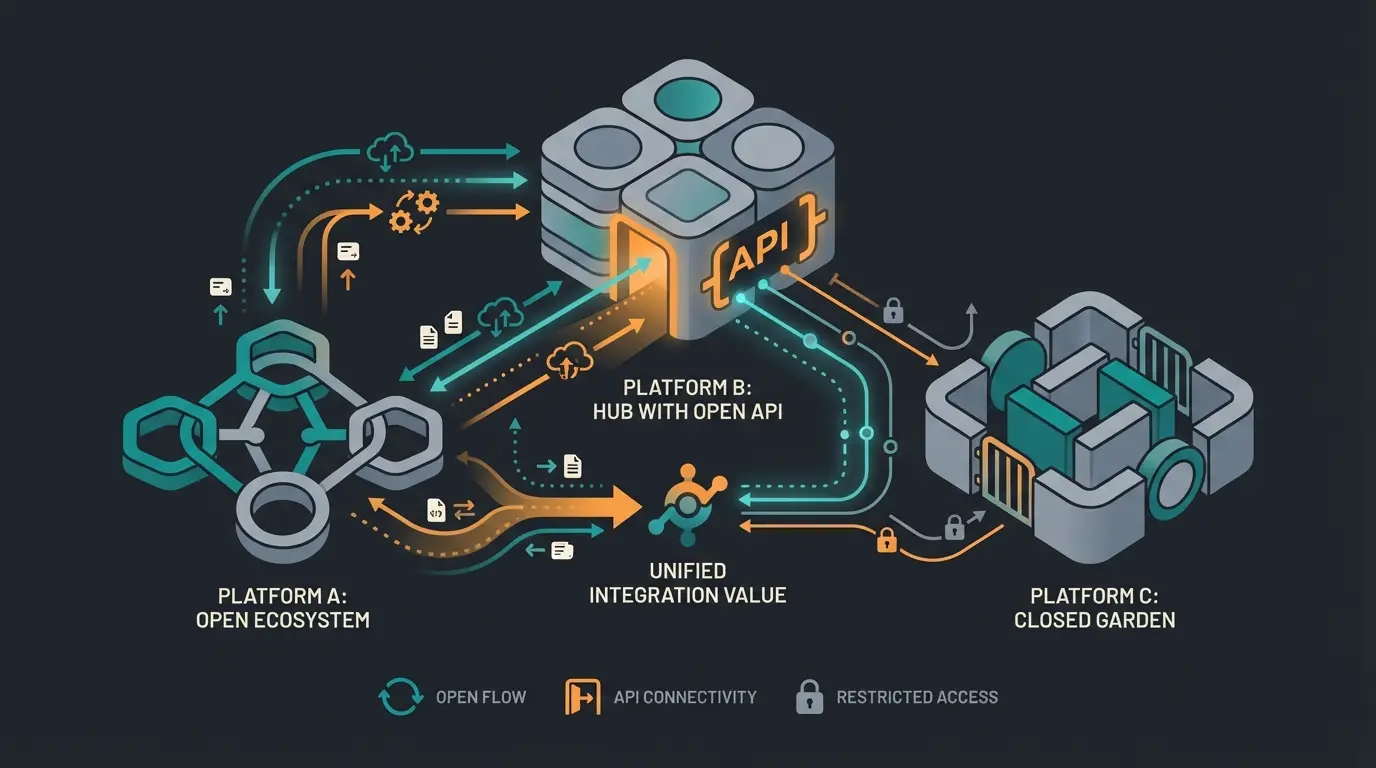
Shopware versions: 5, 6 and 7
Shopware 6 is the current generation, an API-first rebuild that replaced the legacy Shopware 5. Shopware 7 is the forward roadmap, evolving the 6 architecture rather than breaking it. Any new shop should start on Shopware 6. Shopware 5 shops should plan their migration, because community support and plugin availability keep shrinking.
The split matters because Shopware 5 and 6 share a name but not a codebase. Shopware 5 ran on a Zend and Smarty stack; Shopware 6 moved to Symfony with a Twig and Vue frontend and a headless API at its core. Our Shopware 5 vs 6 comparison covers the upgrade path, and our Shopware 7 breakdown explains what the next version changes.
| Version | Status (Q2 2026) | Recommendation |
|---|---|---|
| Shopware 5 | Legacy, winding down | Migrate to 6 |
| Shopware 6 | Current, API-first | Default for new shops |
| Shopware 7 | Roadmap, next generation | Plan for it, do not wait on it |
The real gap: frontend sales consultation
Every platform here ships backend AI for writing product texts or tagging images. None ships frontend AI that actually advises the customer. That gap is where Shopware's API-first design pays off: it is the easiest platform to extend with an external sales-consultation layer that reads live product data and guides buyers in real time.
Credit where due. Shopware's AI Copilot (from the Rise edition) generates product descriptions, extracts properties into filter attributes, and summarizes reviews. Shopify's Sidekick and Magic do the equivalent inside their own ecosystem. Both save the shop owner time. Neither helps the customer standing in front of 5,000 articles who does not know which one fits.
The difference is openness. Shopify's closed ecosystem limits how deeply an external system can read product data without Plus. Shopware exposes clean, structured product properties over the REST API, so an external KI-Mitarbeiter can query them in real time and recommend precisely. You run Shopware as the transaction engine and layer guided selling on top, which is far harder on a walled-garden SaaS.
This is not theory. Garden-care retailer Neudorff runs an AI product advisor that hits 97% accuracy on recommendations with responses under five seconds. Lawn-care specialist Rasendoktor reports a 16x return on its AI advisor. Pooldoktor, live since January 2026, measures +18.75% revenue per user against a control group. The platform underneath has to expose its data for any of that to work, and that is exactly where Shopware leads the field.
Basic Shopify or Community Edition. Focus on making products available: search, filter, checkout. The customer has to know what they want.
Shopware Rise or Evolve. Focus on automating processes: Flow Builder, backend AI Copilot, personalized newsletters. Efficient, but still silent toward the customer.
Shopware plus external AI. Focus on consultative selling: needs analysis and problem-solving instead of product lists. The result is higher conversion and fewer returns.
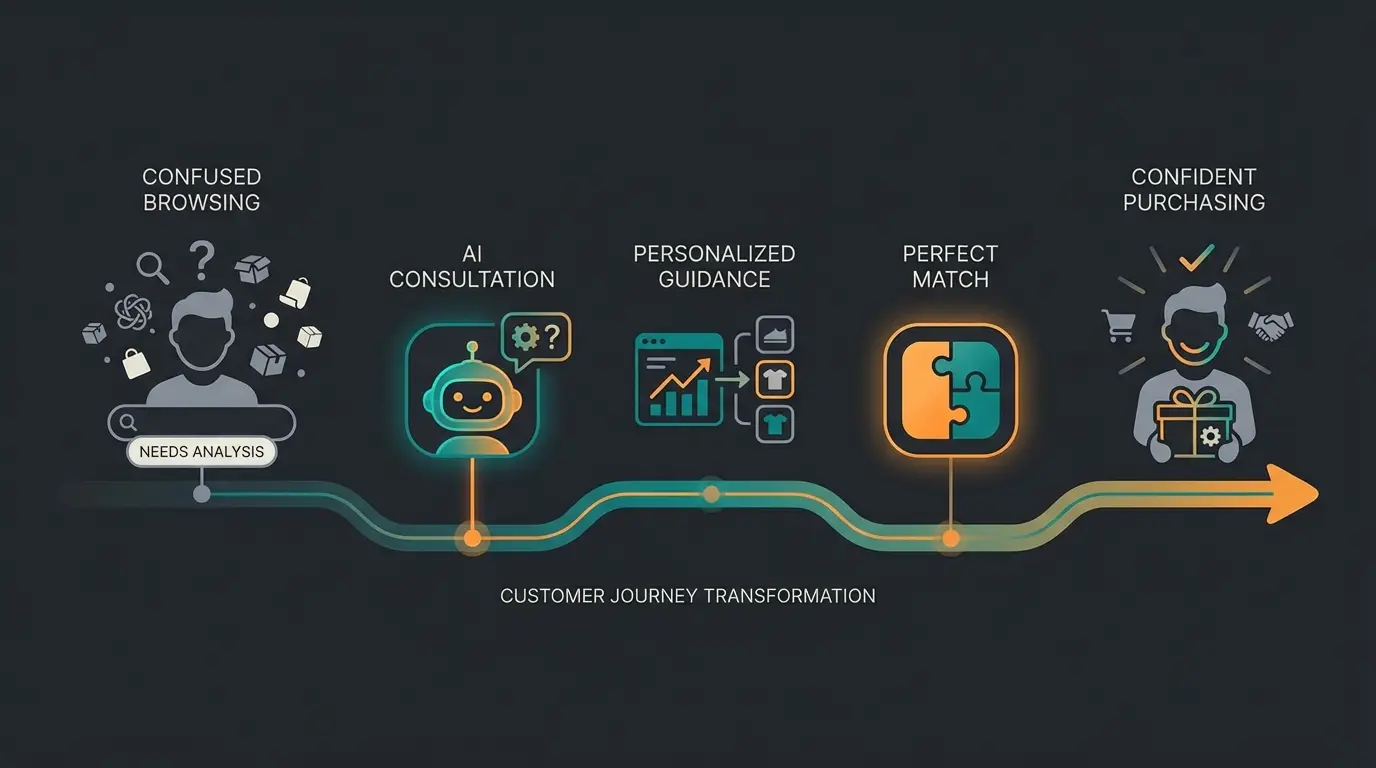
Total cost of ownership: the three-year view
License price is the smallest part of the bill. Over three years, a growing EUR 1.5 million shop pays roughly the same total on Shopify Advanced and Shopware Rise, around EUR 80,000, but the cost structure is the mirror image: Shopify front-loads almost nothing and then bleeds transaction and app fees, while Shopware front-loads setup and then runs cheap. Above a certain revenue, Shopware wins on TCO.
The scenario: EUR 1,500,000 annual revenue, a B2B and B2C mix, consultation-heavy products. Comparing only license cost (EUR 384 versus EUR 600 a month) is the naive read. Here is the full three-year picture.
| Cost item | Shopify Advanced | Shopware Rise (Self-Hosted) |
|---|---|---|
| License / subscription | ~EUR 14,000 (EUR 384/mo) | ~EUR 21,600 (EUR 600/mo) |
| Transaction fees* | ~EUR 27,000 (0.6% external payment) | EUR 0 (no platform fee) |
| Hosting | EUR 0 (included) | ~EUR 5,400 (~EUR 150/mo) |
| Apps / plugins | ~EUR 10,000 (many features cost extra) | ~EUR 3,000 (more in core) |
| Setup / agency | ~EUR 30,000 (faster) | ~EUR 50,000 (more complex) |
| Total (3 years) | ~EUR 81,000 | ~EUR 80,000 |
*Shopify note: using Shopify Payments removes the surcharge but locks you into its conditions. Choosing external providers (PayPal, invoice via Ratepay) triggers the penalty fee.
Charged when you skip Shopify Payments
No transaction fee regardless of payment provider
More shipped in Shopware's core vs paid apps
When Shopware typically matches or beats Shopify
Conclusion: when Shopware is the right call
Pick Shopware if you sell B2B or complex products, need EU data control, and want to customize without enterprise costs. Skip it for a simple, standard catalog that only needs to launch, where Shopify is faster and cheaper to start. If you are moving off another system, plan the data migration early: catalog structure, customer groups and SEO redirects cause the most pain.
Two rules keep most projects honest. Do not save at the wrong end: a free Community Edition without support is a false economy once you are growing. And do not stop at the backend: Shopware gives you the data, the API and the checkout, but the consultation layer that converts browsers into buyers is something you add on top.
Ready to switch? Our Shopware migration guide walks the full process, and the WooCommerce to Shopware migration guide covers that specific path step by step.
FAQ: Shopware comparison questions
Shopware's main competitors are Shopify, Adobe Commerce (Magento), WooCommerce, OroCommerce and Spryker, plus regional systems like OXID, JTL and Gambio. Shopify is the closest mainstream rival on the SaaS side, OroCommerce the closest on pure B2B. Gartner's verified review listings track the same alternative set for buyers comparing them in 2026.
Shopify is a hosted SaaS platform with the fastest setup and up to a 2% surcharge on external payment providers. Shopware is open source and self-hostable, with no platform transaction fee and full EU data control. Shopify wins on speed and app count; Shopware wins on B2B depth, customization and data sovereignty.
Shopware is an ecommerce platform with a built-in content layer, not a standalone CMS. Its Shopping Experiences tool handles CMS-style landing pages, content blocks and storytelling inside the shop. For a pure content site you would still use a dedicated CMS; for commerce-led content, Shopware's native tools usually suffice without a second system.
Shopware's Community Edition is free and open source, but only up to EUR 1 million annual GMV under the Fair Usage Policy introduced in March 2025. Above that you move to a paid edition starting at EUR 600 per month (Rise). From 14 April 2026, GMV reporting is automated for Community Edition shops.
Not natively. Shopware ships backend AI (the Copilot for product texts and image tagging, from the Rise edition) and intelligent search, but no frontend sales advisor out of the box. Its API-first architecture lets you integrate an external KI-Mitarbeiter that reads live product data and guides buyers, which closed SaaS platforms restrict.
Shopware stores product properties in a clean, structured way and exposes them over a REST API with no rate-limit penalty. That lets an external advisor query attributes like size, material or use case in real time. For consultation-heavy ranges, that open data foundation beats the closed product models of hosted SaaS rivals.
Shopware gives you the open data and the API. A Qualimero KI-Mitarbeiter adds the consultative selling layer: live product advice that lifts conversion and cart value. See it run on your own catalog in a free demo.
Book a demo
Kevin is CTO and co-founder of Qualimero. As an AI architect with over 15 years of experience as CTO and CPO in the tech industry, he designs the AI systems that automate tens of thousands of customer interactions daily for Qualimero's clients — reliably, securely, and at scale.