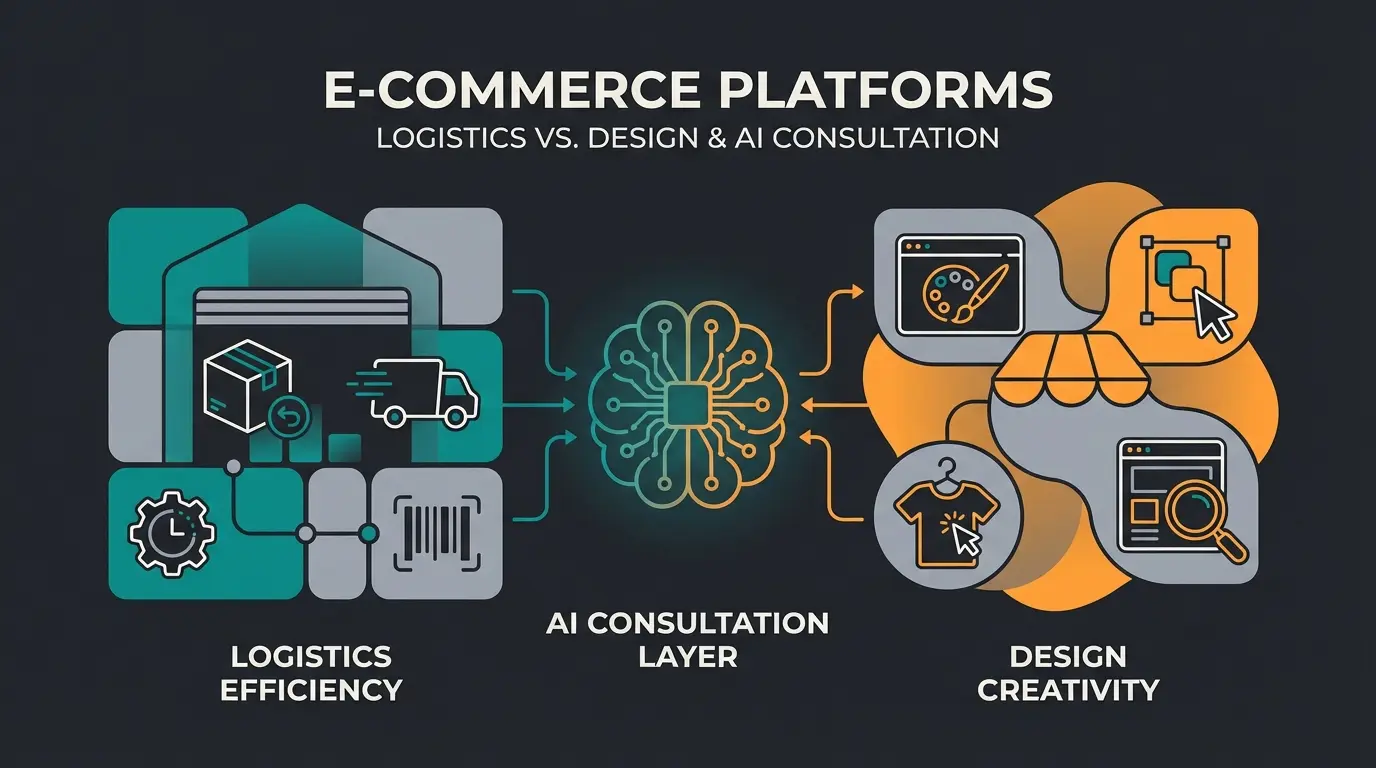
The core verdict in 60 seconds
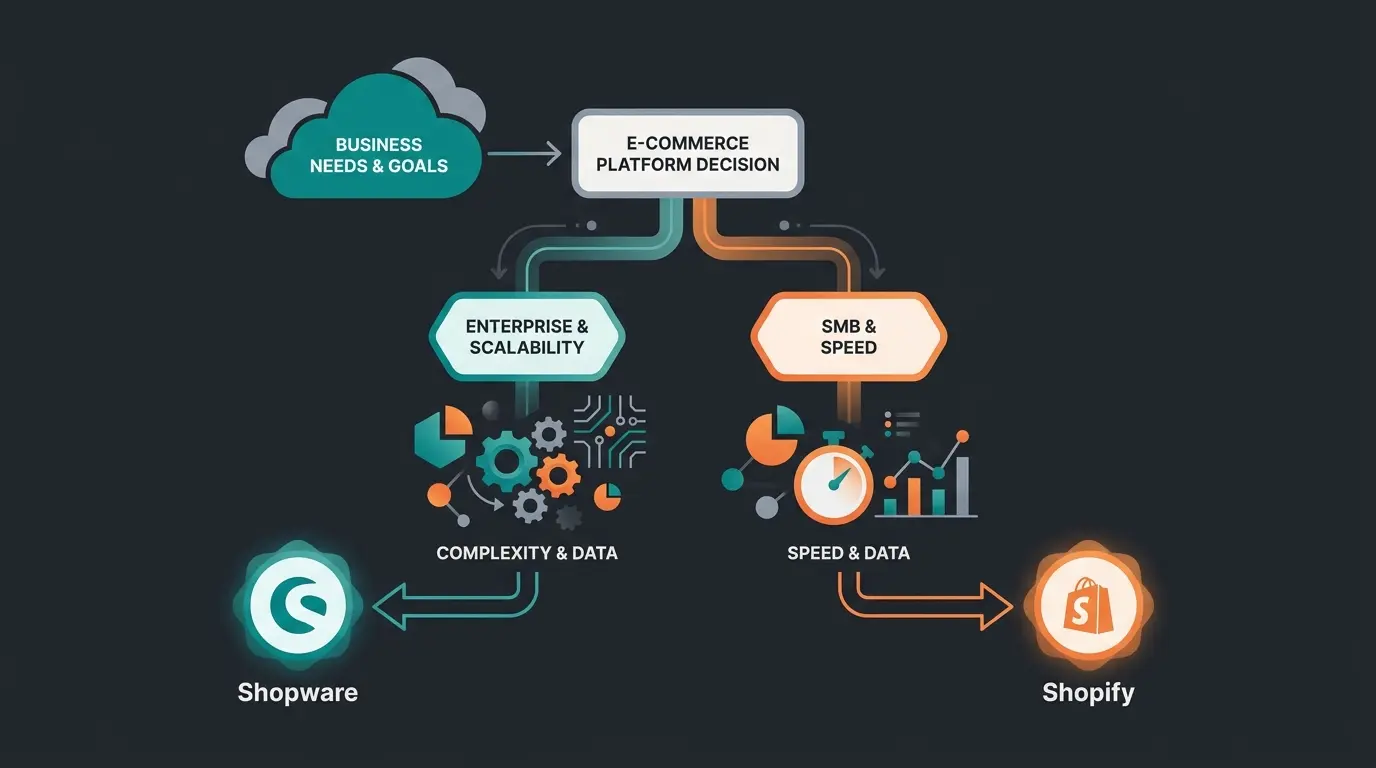
Shopware is the platform you build on when your products need explanation, your B2B buyers expect custom pricing, and your compliance team insists on German server hosting. Shopify is the platform you rent when speed to market matters more than backend flexibility, and your catalog fits standard product templates. For the full picture across all platforms, see our Shopware comparison guide.
That distinction held for years. In 2026, the lines blur. Shopify's Winter '26 Edition dropped 150+ updates including per-market checkout customization and expanded B2B Collective across 35 additional countries. Shopware 6.7 answered with Agentic Commerce, a sales channel type that feeds product data directly to AI platforms like ChatGPT.
I have deployed both systems for clients ranging from a 50-SKU garden supplies store to a 30,000-SKU industrial parts distributor. The honest answer: which platform fits depends on exactly four factors. Product complexity, team size, compliance requirements, and how much you are willing to spend before your first sale.
| Criterion | Shopify (SaaS) | Shopware 6.7 (PaaS / Self-Hosted) |
|---|---|---|
| Best for | D2C brands, standard products, fast international scaling | B2B, complex products, custom processes, strict GDPR needs |
| Setup time | Days to weeks | Weeks to months |
| Cost entry | From $39/month (Basic) to $2,300/month (Plus) | Free (Community) to EUR 6,500/month (Beyond) |
| Transaction fees | 0.5-2% on external payment providers | None |
| Hosting | Fully managed (SaaS) | Self-hosted or managed PaaS |
| Data sovereignty | US corporation, EU hosting available since 2023 | German company, full self-hosting possible |
| B2B features | B2B Markets, Company Profiles, payment terms | B2B Components: approval workflows, custom pricing, ERP integration |
| AI focus (2026) | Sidekick: admin automation, product text generation | AI Copilot: content, search. Agentic Commerce: AI product feeds |
| Customization | Liquid templates, Shopify Functions, Hydrogen (headless) | Open-source Symfony/Vue.js, full API-first architecture |
| App ecosystem | 8,000+ apps in Shopify App Store | ~4,000 extensions in Shopware Store |
| Consultation gap | No native solution for complex product advice | No native solution for complex product advice |
Shopware 6.7 vs Shopify Plus 2026: feature crosscheck
Shopware 6.7.10 (May 2026) and Shopify's Winter '26 Edition represent the most significant updates both platforms have shipped in two years. While Shopify expanded its global commerce infrastructure, Shopware doubled down on technical depth and AI-native distribution. The gap between them is narrower than ever, but the direction of travel differs.
| Feature | Shopify (Winter '26) | Shopware 6.7 | Winner |
|---|---|---|---|
| Checkout customization | Per-market checkout flows, Checkout Extensibility API | Full Twig/Vue.js checkout control, no restrictions | Shopware (depth) / Shopify (ease) |
| B2B pricing engine | Volume pricing, quantity rules on Horizon themes | Rule-based Individual Pricing: percentage, fixed, tiered discounts per customer | Shopware |
| AI product distribution | Sidekick for admin tasks, Magic for content generation | Agentic Commerce: JSONL feed for ChatGPT and AI platforms | Shopware |
| Headless commerce | Hydrogen + Oxygen (React-based storefront) | API-first with Frontends (Vue.js, React) | Tie |
| 3D product visualization | AR Quick Look on iOS, third-party apps for 3D | Native CAD-to-3D converter (.glb), beta since Feb 2026 | Shopware |
| International selling | Shopify Markets: 35+ countries via Collective | Multi-language, multi-currency native | Shopify (reach) / Shopware (control) |
| Payment flexibility | Shopify Payments + ACH (new Winter '26) | Any payment provider, no transaction surcharges | Depends on region |
| Compliance (GDPR) | EU hosting available, DPA standard | German HQ, self-hosting, GDPR-native architecture | Shopware |
| Compliance (accessibility) | Theme-level WCAG 2.1 support | Full frontend control + withdrawal button (6.7.9) | Shopware |
| Developer ecosystem | Shopify Functions, App Bridge, GraphQL API | Symfony 7.4, open-source core, full backend access | Shopware (depth) / Shopify (tooling) |
| Performance | Global CDN, automatic optimization | Tag-based cache invalidation (6.7), requires tuning | Shopify (out of box) / Shopware (ceiling) |
| Analytics | Built-in Shopify Analytics + GA4 | Improved GA4 integration (6.7.7), custom dashboards | Shopify |
| Content management | Shopify Sections, metaobjects, Online Store 2.0 | Shopping Experiences (CMS), Flow Builder | Tie |
| Video management | Third-party apps | Native video in Media Manager (6.7) | Shopware |
| Migration tools | Built-in migration from major platforms | Store Migration plugin, manual for complex setups | Shopify |
Total cost of ownership: 3-year calculation
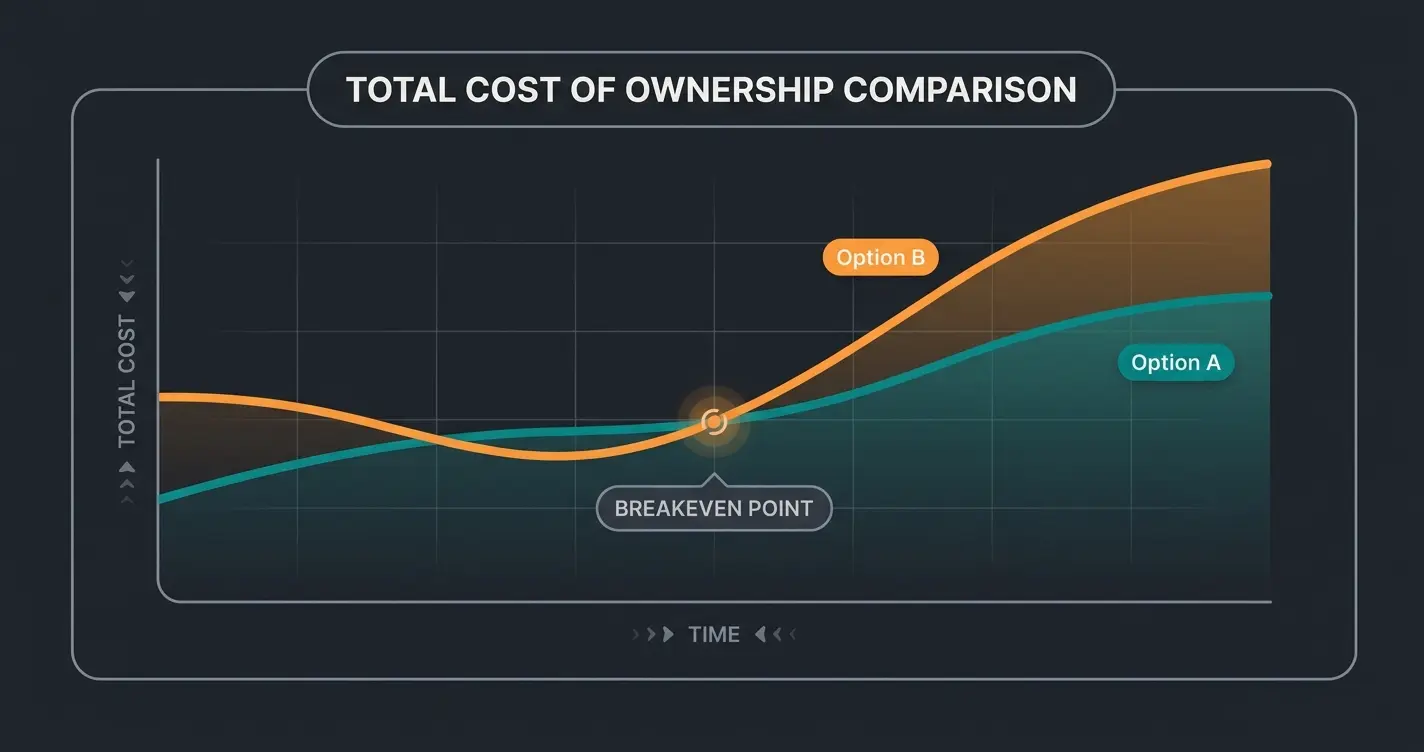
Price comparisons between Shopware and Shopify are misleading when they only show license fees. The real cost includes hosting, plugins, agency work, transaction fees, and the inevitable customizations that every growing store needs. I have seen Shopify stores that cost more than Shopware at scale, and Shopware projects that blew their budget before launch.
These calculations use Q2 2026 pricing. Shopware's published rates: Rise at EUR 600/month, Evolve at EUR 2,400/month, Beyond at ~EUR 6,500/month. Shopify Plus starts at $2,300/month on a 3-year term. Evolve and Beyond pricing is negotiated individually based on your GMV.
Scenario 1: EUR 1.5M annual revenue (mid-market B2C/B2B)
| Cost item | Shopify Advanced | Shopware 6 Evolve |
|---|---|---|
| License / subscription | ~EUR 384/month ($399) | EUR 2,400/month |
| Transaction fees (external provider) | 0.6% = ~EUR 750/month | EUR 0 |
| Hosting | Included | ~EUR 200/month (managed) |
| Apps / plugins (monthly) | ~EUR 300/month | ~EUR 100/month |
| Initial setup / agency | EUR 15,000-30,000 | EUR 40,000-80,000 |
| Maintenance & updates | EUR 0 (automatic) | ~EUR 500/month |
| 3-year total | ~EUR 68,000 | ~EUR 170,000 |
At EUR 1.5M revenue, Shopify costs roughly 60% less over three years. The gap is real. But it narrows fast when you need custom checkout logic, complex B2B pricing, or deep ERP integration, because those Shopify apps and custom development hours add up.
Scenario 2: EUR 10M annual revenue (enterprise)
License + apps, zero maintenance. But 0.25% GMV fee kicks in above threshold
License + hosting + agency maintenance. No transaction fees at any volume
Migration, theme customization, app integration
Custom development, ERP integration, B2B configuration
The Fair Usage Policy reality
Shopware's Community Edition still exists, but the Fair Usage Policy (March 2025) changed the math. Exceed EUR 1M GMV and you lose access to the Shopware Store for plugins and security updates unless you upgrade to a paid plan. For a detailed breakdown of what each edition includes, see our Shopware editions comparison.
B2B capabilities compared
B2B was Shopware's strongest competitive advantage for years. In 2026, the picture is more nuanced. Shopify has closed roughly 70% of the gap for standard B2B use cases, while Shopware is restructuring its own B2B architecture from a monolithic Suite to modular Components.
Shopware B2B: from Suite to Components
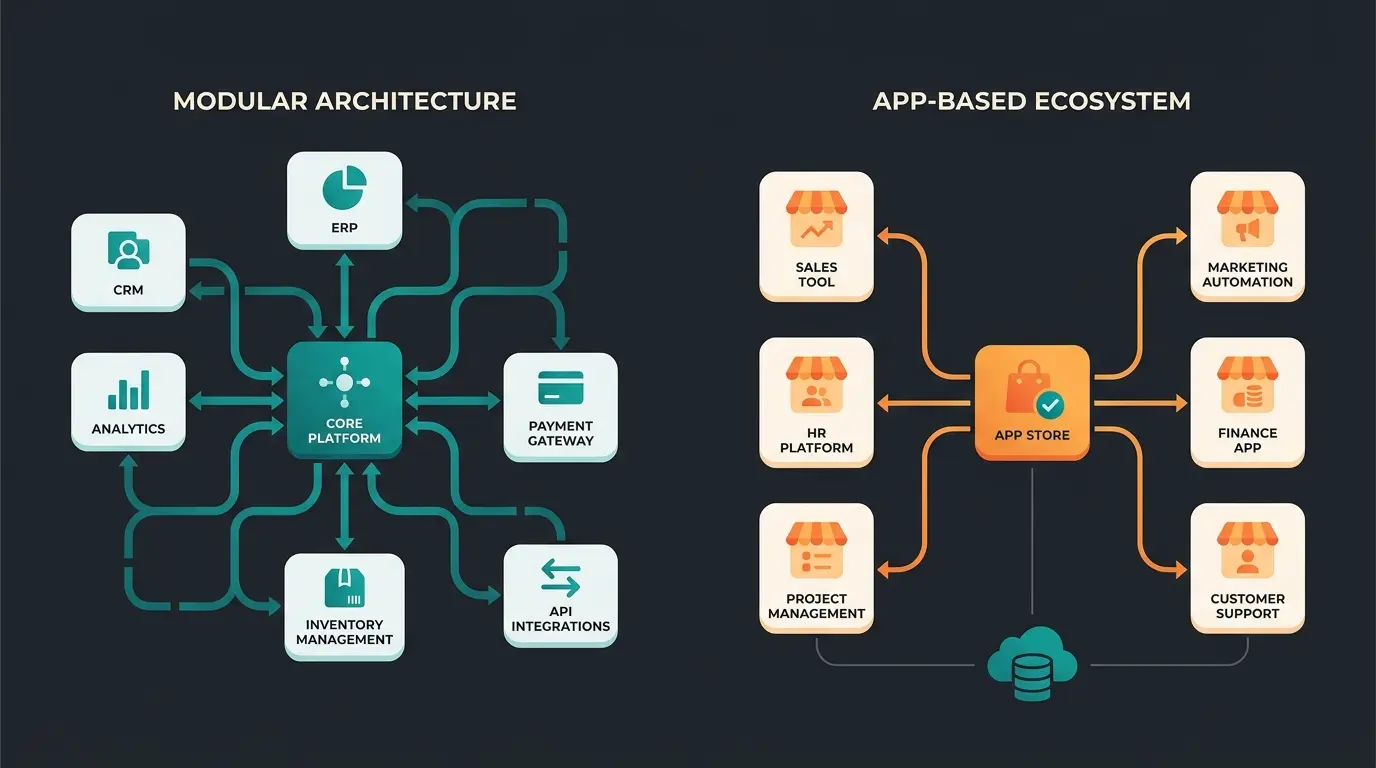
The Shopware B2B Suite enters maintenance mode with version 6.8. Security patches continue, but no new features. The replacement: B2B Components, a modular system where you activate only what you need. This mirrors the broader Shopware 5 vs 6 evolution from monolithic to modular architecture. Customer portals, quick order, approval workflows, quote management, and the new rule-based Individual Pricing engine all work independently.
Individual Pricing (introduced in 6.7) is the standout. You define customer-specific price books with percentage, fixed-price, or volume-tiered discounts. These appear directly in the storefront without custom development. For a manufacturer with 500 distributors, each with negotiated terms, this removes weeks of agency work.
Shopify B2B: catching up fast
Shopify's B2B Markets now support Company Profiles with multiple locations and buyers, flexible payment terms (Net 30/60/90), and catalog-level pricing per customer group. The Winter '26 Edition added ACH payments and per-market checkout customization, closing two major gaps.
All Horizon themes work with B2B volume pricing and quick order lists out of the box. Shopify Collective expanded to 35+ countries, allowing B2B brands to source products from other brands and resell directly. For 80% of B2B merchants, especially DTC brands that also sell wholesale, this covers enough ground.
| B2B Feature | Shopware (Evolve+) | Shopify Plus |
|---|---|---|
| Approval workflows | Native, multi-level with role-based permissions | Via apps (draft orders as workaround) |
| Custom pricing per customer | Rule-based Individual Pricing, unlimited price books | Volume pricing, company-specific catalogs |
| ERP integration | Direct API to SAP, Microsoft Dynamics, many connectors | Via apps (Celigo, Pipe17, custom) |
| Quick order / bulk ordering | Native quick order with CSV upload | Native on Horizon themes |
| Payment terms | Fully customizable via payment plugins | Net 30/60/90 native, ACH payments (new) |
| Sales rep login | Native employee management with permissions | Not native, requires apps |
| Quote management | Native in B2B Components | Via Shopify Flow + apps |
| Multi-company accounts | Native company structures with departments | Company Profiles with multiple locations |
Data sovereignty and GDPR compliance
Shopware is headquartered in Schoeppingen, Germany. You can run it on German servers (Hetzner, Timme Hosting, your own infrastructure). Every byte of customer data stays where you put it. For regulated industries, healthcare suppliers, or companies with strict data protection officers, this is not a nice-to-have. It is a requirement.
Shopify offers EU hosting and standard DPA agreements. Technically, data flows to US infrastructure are hard to eliminate entirely because Shopify is a Canadian/US corporation. According to Gartner Peer Insights, Shopify scores 4.6/5 across 519 reviews while Shopware scores 4.3/5 across 90 reviews, but GDPR compliance is not part of those ratings.
For 95% of merchants, Shopify's EU hosting and DPA framework are legally sufficient. For the 5% where a Datenschutzbeauftragter reviews every data flow, or where customer data includes health-related product selections, Shopware's self-hosting is the safer choice.
The consultation gap: where both platforms fail
Neither Shopware nor Shopify solves the problem that costs e-commerce merchants the most revenue: the inability to advise customers on complex products. According to the Baymard Institute (aggregating 50 studies), the average cart abandonment rate sits at 70.22%. That is 7 out of 10 shoppers who added something to their cart and left without buying.
Both platforms have invested heavily in AI, but in the wrong direction for customer experience. Shopify Sidekick helps merchants generate product descriptions and analyze sales. Shopware AI Copilot summarizes reviews and assists with content creation. Both are admin tools. The customer standing in your store at 11pm, trying to figure out which industrial pump fits their system, gets nothing.
US and EU combined, through better checkout and consultation (Baymard)
Average gain for large e-commerce sites (Baymard)
vs 66.41% on desktop, mobile users need more guidance
One of our clients, Rasendoktor, a lawn care e-commerce retailer, saw this firsthand. Before implementing an AI employee for product consultation, customers bounced between 200+ SKUs of lawn treatment products without knowing which one matched their soil type, garden size, or season. After deployment: 16x ROI, 100% of routine consultations automated, and 40% reduction in support team workload.
The platform choice matters. But neither Shopware's API-first architecture nor Shopify's app ecosystem includes a native solution for guided selling. That third layer, an AI employee that understands your product catalog, recognizes returning customers, and conducts real conversations, exists independently of your shop system.
Migration between the platforms: what to expect
Moving from Shopware to Shopify or vice versa is not a weekend project. The complexity depends on three variables: catalog size, custom logic, and how deeply your ERP is integrated. Having guided multiple migrations in both directions, here is what the timeline actually looks like.
Shopware to Shopify migration
Typical timeline: 2-4 months. Shopify's built-in migration tools handle product data, customer records, and order history. The pain points: custom Shopware plugins that have no Shopify equivalent, URL redirects (Shopware's flexible URL structure vs Shopify's fixed /products/ and /collections/ paths), and B2B logic that needs to be rebuilt with Shopify apps. Budget EUR 20,000-60,000 depending on catalog complexity.
Shopify to Shopware migration
Typical timeline: 3-6 months. Longer because Shopware requires more configuration upfront. The upside: you gain full URL control, unrestricted checkout customization, and native B2B features. The risk: if your team does not include developers or a Shopware agency partner, the operational overhead will surprise you. Budget EUR 40,000-120,000.
- Audit all active plugins/apps and identify equivalents on the target platform
- Export and validate product data (images, variants, metadata, SEO descriptions)
- Map URL redirects for every indexed page (critical for SEO preservation)
- Test ERP/CRM integration on the target platform before go-live
- Run parallel operations for 2-4 weeks before switching DNS
- Verify GDPR compliance for customer data transfer between platforms
Market position and ecosystem
According to the EHI Retail Institute, Shopware remains the most widely used shop system among Germany's top 1,000 B2C online stores, with 11.5% market share. That is four consecutive years as market leader in the enterprise segment. Statista paints a different picture for the overall market: Shopify leads German e-commerce software installations with over 25% market share as of late 2024.
Both numbers are true simultaneously. Shopware dominates among established mid-market and enterprise retailers. Shopify dominates the long tail of smaller shops, startups, and D2C brands. The platform you compare against depends on where your business sits.
Shopify's app ecosystem (8,000+ apps) dwarfs Shopware's (~4,000 extensions). In practice, most merchants use 6-12 apps. What matters is not the total count but whether the specific integration you need exists. For German-specific needs (DATEV, lexoffice, GLS, DHL Geschaeftskundenversand), Shopware's ecosystem is more mature. For global tools (Klaviyo, Gorgias, ReCharge), Shopify wins. For alternative platforms, see our Shopware alternatives overview.
Verdict: which system for which business
After deploying both platforms across dozens of projects, my recommendation comes down to four decision paths. Not one universal answer.
Choose Shopify if
- Speed is your priority. You want to sell within weeks, not months. Time-to-market is the KPI that matters most right now
- Your products are standard. Clothing, accessories, home goods, cosmetics. Things that do not require a 10-minute conversation before purchase
- Your team is small. No dedicated IT department, no in-house developers. You want managed infrastructure
- International expansion is on the roadmap. Shopify Markets and Collective give you 35+ countries with minimal configuration
- Your initial budget is under EUR 30,000. Shopify's lower entry cost reduces risk for new ventures
Choose Shopware if
- Your products need explanation. Machine parts, medical devices, chemicals, configurable goods. Complex catalogs need complex logic
- B2B is your core business. Approval workflows, customer-specific pricing, sales rep access, ERP-driven catalogs. Shopware handles this natively
- Data sovereignty is non-negotiable. German hosting, full GDPR control, no data leaving your infrastructure
- You have technical capacity. An in-house developer or a trusted Shopware agency. The platform rewards investment in customization
- You plan to grow past EUR 50M GMV. At that scale, Shopware's flat licensing beats Shopify's percentage-based model
For comparisons with other specific platforms: Shopware vs WooCommerce, Shopware vs OXID, Magento vs Shopware, Shopware vs JTL, Shopware vs PrestaShop, Shopware vs Spryker, or the full ecommerce platform comparison.
No matter which platform you pick: the shop system manages your catalog and processes transactions. It does not sell your product. Neither Shopware nor Shopify includes a digital sales consultant that guides your customer from "I have a problem" to "this is the right product for me." That is the consultation gap. Close it before your competitor does.
FAQ: Shopware vs Shopify
The Community Edition has no license fee, but the Fair Usage Policy (March 2025) limits access to the Shopware Store for businesses exceeding EUR 1M GMV. Security updates and plugin access require a paid plan (Rise from EUR 600/month). For growing businesses, the free era is effectively over.
Yes, with proper configuration. Shopify offers EU data residency and standard DPA agreements. For 95% of merchants, this is legally sufficient. For businesses handling sensitive data (health products, regulated industries) where a data protection officer reviews every data flow, Shopware's self-hosting on German servers provides stronger guarantees.
Shopware wins for complex B2B scenarios: multi-level approval workflows, 1,000+ customer-specific price lists, sales rep logins, deep ERP integration. Shopify Plus covers 80% of B2B needs (volume pricing, company accounts, payment terms) with better usability. The right choice depends on your B2B complexity, not a blanket recommendation.
Shopware to Shopify: EUR 20,000-60,000, timeline 2-4 months. Shopify to Shopware: EUR 40,000-120,000, timeline 3-6 months. The biggest cost drivers are custom plugin replacement, URL redirect mapping for SEO, and ERP re-integration.
Shopify uses a global CDN with EU data residency options. You cannot choose a specific German data center. For 95% of merchants, this setup meets GDPR requirements. For the remaining 5% with strict data localization mandates, Shopware's self-hosting is the only option among these two platforms.
Agency fees for maintenance and updates (EUR 1,000-3,000/month), managed hosting (EUR 150-500/month), and higher initial setup costs (typically 2-3x a comparable Shopify project). The B2B Suite requires the Evolve plan at EUR 2,400/month. These costs are consistently underestimated by first-time Shopware adopters.
Both focus AI on merchant efficiency, not customer experience. Shopify Sidekick generates product texts and analyzes sales data. Shopware AI Copilot does similar backend tasks plus the new Agentic Commerce channel for AI-native product distribution. Neither platform includes customer-facing product consultation. That requires a dedicated AI employee solution.
Whether you run Shopware or Shopify, an AI employee consults your customers like a trained specialist, 24/7. Our clients see up to 35% higher cart values and 7x conversion rates. Book a demo to see it on your product catalog.
Book a demo
Lasse is CEO and co-founder of Qualimero. After completing his MBA at WHU and scaling a company to seven-figure revenue, he founded Qualimero to build AI-powered digital employees for e-commerce. His focus: helping businesses measurably improve customer interaction through intelligent automation.