Shopware alternatives at a glance
The nine strongest Shopware alternatives in 2026 are Shopify, Adobe Commerce, BigCommerce, commercetools, Spryker, WooCommerce, PrestaShop, OXID eSales and JTL-Shop. Shopify suits B2C brands wanting speed, commercetools and Spryker suit enterprise headless builds, and WooCommerce, PrestaShop and OXID suit budget-led open-source teams.
- Shopify (SaaS) from USD 39/month, approx. EUR 36. Best for B2C brands that want to stop maintaining servers.
- Adobe Commerce (enterprise licence) from roughly USD 22,000/year on-premise. Best for large catalogues with complex B2B pricing rules.
- BigCommerce (SaaS) from USD 39/month. Best for merchants who want SaaS convenience without a platform cut of every sale.
- commercetools (API-first, order-volume pricing). Best for enterprises running several brands or regions on one commerce backend.
- Spryker (composable B2B). Best for marketplace models, unified commerce and B2B processes that standard shop systems cannot express.
- WooCommerce (open source, WordPress). Best for content-led stores already running WordPress.
- PrestaShop (open source) from around USD 25/month hosting. Best for budget-led European stores with a small catalogue.
- OXID eSales (open source, German). Best for German-speaking B2B merchants who need EU data residency and a familiar legal setup.
- JTL-Shop (open source plus bundled ERP). Best for merchants whose bottleneck is warehouse and order management, not storefront design.
Gartner Peer Insights ranks a narrower field for the same query as of Q3 2026: Shopify first, then Adobe Commerce, VTEX, BigCommerce, SAP Commerce Cloud, commercetools and Salesforce Commerce Cloud. That shortlist is enterprise-weighted and drops every open-source option, which is why it reads so differently from the list above.
Worth saying plainly before the comparison starts. Shopware scores 4.3 out of 5 from 26 reviews on Capterra as of Q3 2026, which is a decent score, not a damning one. Merchants rarely leave because the software is bad. They leave because of what it costs to run at their particular stage.
| Platform | Type | Entry cost | User rating | Hosting | Best for |
|---|---|---|---|---|---|
| Shopify | SaaS | USD 39/mo (approx. EUR 36) | 4.4/5 (G2) | Vendor-managed, global | B2C brands, fast time to market |
| Adobe Commerce | Enterprise licence | from USD 22,000/yr | 4.0/5 (G2) | Self-hosted or Adobe Cloud | Large catalogues, complex B2B rules |
| BigCommerce | SaaS | USD 39/mo (approx. EUR 36) | 4.2/5 (G2) | Vendor-managed, global | SaaS without platform transaction fees |
| commercetools | API-first, composable | Custom, by order volume | 4.6/5 (G2) | Cloud, region selectable | Multi-brand and multi-region enterprises |
| Spryker | Composable B2B | Custom | 4.4/5 (G2) | Cloud or self-managed | Marketplaces and complex B2B |
| WooCommerce | Open source (WordPress) | USD 0 licence, USD 30 to 150/mo hosting | 4.4/5 (G2) | Self-hosted, your choice | Content-led stores on WordPress |
| PrestaShop | Open source | USD 0 licence, from USD 25/mo hosting | 4.3/5 (G2) | Self-hosted, your choice | Small European catalogues on a budget |
| OXID eSales | Open source (German) | USD 0 licence for CE, paid editions on request | Too few public reviews | Self-hosted, EU | German B2B with EU data residency needs |
| JTL-Shop | Open source plus ERP | EUR 0 licence, ERP from EUR 0 | Too few public reviews | Self-hosted, DE/EU | Warehouse-heavy merchants |
One caveat on that table. Entry cost is the cheapest number a vendor will quote you, not what you will pay in year one. The gap between the two is where most replatforming budgets die. If you are still weighing Shopware editions against each other rather than leaving the platform, the Shopware platform comparison handles that decision separately.
Why merchants look for a Shopware alternative in 2026
Merchants leave Shopware for three measurable reasons: licence cost escalation between the Rise and Evolve tiers, the order-volume ceilings introduced by the Fair Usage Policy, and the in-house developer capacity that self-hosted Shopware 6 requires. None of these are quality problems with Shopware itself.
Start with the numbers. Shopware pricing as of Q3 2026 runs Community Edition at zero, Rise from roughly USD 600 per month, Evolve from roughly USD 2,400 per month, and Beyond at around USD 6,500 per month or a negotiated figure. The Rise to Evolve step is where merchants flinch, because B2B Components, Advanced Search and Dynamic Access all sit behind the Evolve line. There is no half-step. Either you need one B2B feature and pay the full jump, or you build it yourself.
Then the Fair Usage Policy. Community Edition shops crossing EUR 1 million in annual GMV must move to a paid plan, and since 14 April 2026 that threshold is measured rather than self-declared: shops on version 6.7.8 or newer report aggregated GMV and daily order counts automatically, per Shopware's own announcement. Merchants who had quietly grown past the line now get a bill instead of a reminder.
Third, the running cost nobody quotes. A self-hosted Shopware 6 store needs managed hosting at roughly EUR 100 to 400 per month, plus an agency retainer that realistically starts around EUR 1,000 per month for patching, plugin updates and version upgrades. Add it up and the licence line is often less than half of what the platform actually costs. We break the full picture down in what Shopware actually costs, and the tier-by-tier feature split in Shopware editions compared.
How to choose: 5 decision criteria
Choose a Shopware alternative against five criteria: total cost of ownership over three years, B2B capability depth, data residency and GDPR hosting location, in-house development capacity, and advisory capability at the point of sale. Cost alone is the weakest predictor of whether a replatform succeeds.
1. Three-year total cost of ownership
Licence, hosting, extensions, payment fees, agency retainer, and the internal hours nobody logs. Model all six over 36 months, not 12. A SaaS plan that looks expensive at month one frequently wins by month thirty, because the maintenance line stays flat instead of compounding.
Your test question: if your store's order volume tripled tomorrow, which cost lines would triple with it?
2. B2B capability depth
This is the criterion that most often disqualifies a cheaper platform. Customer-specific pricing, quote management, budget approvals, organisation units, net price display. Shopware puts these in Evolve; Shopify caps B2B catalogues at three below the Plus tier; WooCommerce needs plugins for all of it. Spryker and Adobe Commerce express the most complex rules natively.
Your test question: can you write down your five most awkward pricing rules, and does the platform handle them without custom code?
3. Data residency and hosting location
For EU merchants handling personal data, where the database physically sits is a compliance question, not a preference. Self-hosted platforms let you choose. SaaS platforms let you choose from a menu, and sometimes only on higher tiers. OXID, JTL and self-hosted Shopware keep this simple; Shopify and BigCommerce require you to check the region list.
Your test question: does your DPA name the hosting region, and can you evidence it in an audit?
4. In-house development capacity
Composable and headless platforms trade convenience for control, and the exchange rate is developer time. commercetools, Spryker and any headless build assume at least one frontend developer on staff or on permanent retainer. If you have neither, a composable platform will quietly become the most expensive option on your list.
Your test question: who deploys a storefront change on a Tuesday afternoon, and how long does it take them?
5. Advisory capability at the point of sale
Every platform on this list stores, filters and displays products competently. None of them explain a product to a hesitant buyer. That gap has a price attached: Baymard Institute puts the average cart abandonment rate at 70.22% across 50 studies as of 2026. Backend architecture does not move that number. This criterion gets its own section later, because it is the one that changes what you should buy.
A broader view across categories sits in our ecommerce platform comparison, which covers platforms outside the Shopware orbit.
Shopify: the SaaS market leader
Shopify is the strongest Shopware alternative for B2C brands that want to stop maintaining infrastructure. Plans start around USD 39 per month with Advanced near USD 399, hosting and PCI compliance are included, and the trade-offs are transaction fees on non-Shopify Payments plus weaker native B2B functionality.
Current Shopify pricing as of Q3 2026: Basic at USD 39 per month, Grow at USD 105, Advanced at USD 399, and Plus from USD 2,300 per month on a three-year term. Annual billing cuts roughly a quarter off the first three. Hosting, SSL, CDN and PCI Level 1 compliance are bundled, which is the whole point of the model.
The fee structure is where the comparison gets interesting. Use a payment provider other than Shopify Payments and you pay an extra 2% on Basic, 1% on Grow, 0.6% on Advanced and 0.2% on Plus. At EUR 2 million annual GMV on the Grow plan, that is EUR 20,000 a year for the privilege of keeping your existing acquirer. Shopware charges nothing comparable, because it never touches your payment flow.
Ecosystem depth runs the other way. Shopify's app store carries over 8,000 apps against roughly 1,500 Shopware extensions, so the odds that your niche requirement already exists as a paid app are much better on Shopify. The reverse of that coin is app-stack creep: five apps at USD 30 each quietly doubles a Basic plan.
Adobe Commerce (Magento): the enterprise option
Adobe Commerce is the alternative for large catalogues and complex B2B pricing rules, but it is the most expensive option on this list: licence plus implementation routinely reaches six figures in the first year and it requires a dedicated development team.
Published benchmarks put the on-premise licence between USD 22,000 and USD 125,000 per year, and the cloud (PaaS) equivalent between roughly USD 40,000 and USD 190,000, scaling with GMV. Implementation lands between USD 50,000 and USD 500,000 depending on complexity, over a four to twelve month build. Year one at the low end is around USD 73,500. At the high end it clears USD 700,000.
What that buys is genuine: multi-source inventory, native B2B with company accounts and requisition lists, an extension catalogue of over 4,400 modules, and no ceiling on catalogue size. Magento Open Source remains free and is a credible option for teams with Magento developers already on staff, though it drops the B2B module and the support contract.
BigCommerce, commercetools and Spryker: the headless field
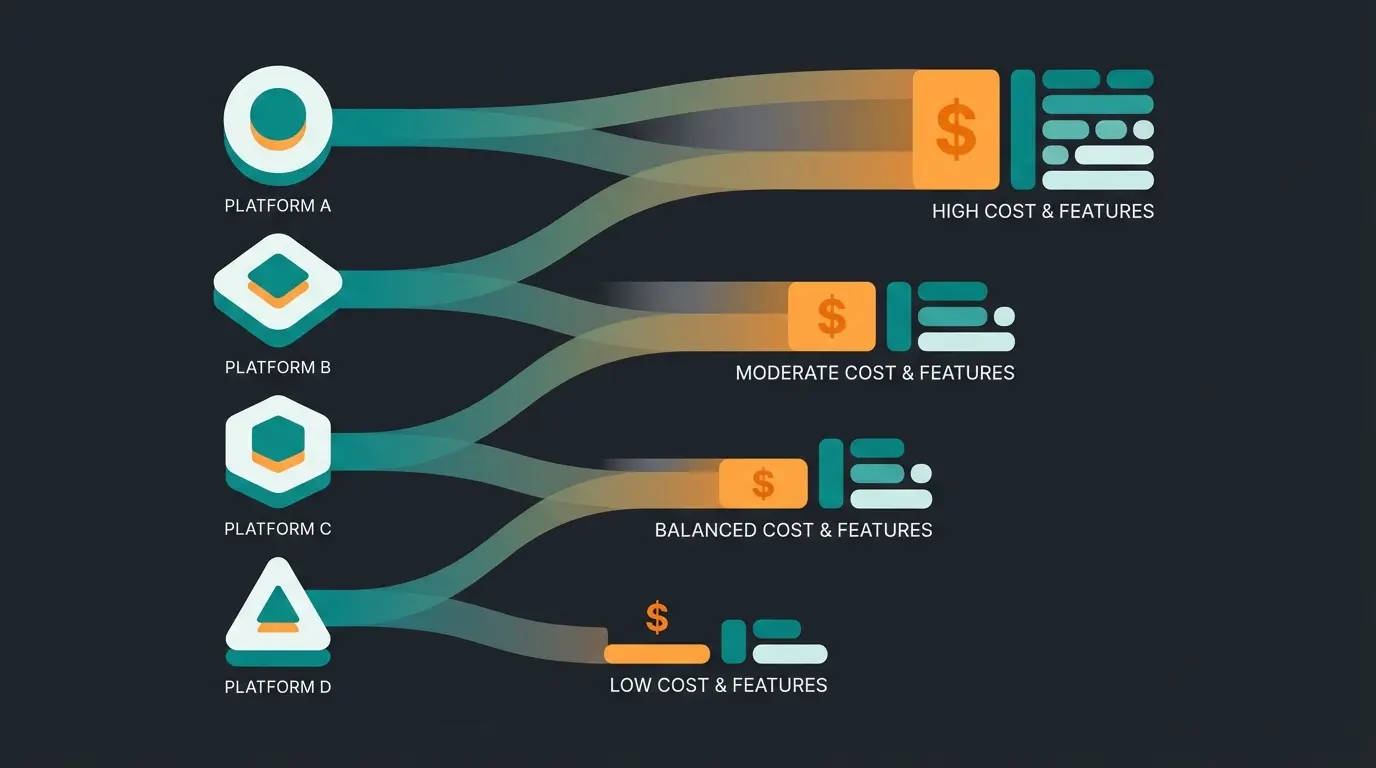
BigCommerce, commercetools and Spryker are the headless and composable alternatives to Shopware. BigCommerce is SaaS with no platform transaction fees, commercetools is API-first for enterprises with multi-brand estates, and Spryker targets complex B2B and marketplace models. All three assume you have or can hire frontend developers.
BigCommerce matches Shopify's entry price at USD 39 per month, rising through USD 105 and USD 399 per BigCommerce pricing, and renamed its tiers to Core, Growth and Scale on 1 June 2026. Its structural advantage over Shopify is simple: it takes no cut of your sales on any plan, whichever payment provider you use. Where it loses is theme ecosystem and setup friction, both noticeably thinner than Shopify's.
commercetools sells no storefront at all. You get a commerce API, and you build the frontend. That sounds like a drawback until you are running six brands across four regions, at which point it becomes the only sane architecture. It has been named a Leader in the Gartner Magic Quadrant for Digital Commerce for six consecutive years through the 2025 report, and it holds a 4.6 out of 5 on G2, the highest score in this comparison.
Spryker occupies the space Shopware Evolve aims at, one storey up. Its case is B2B processes that standard shop systems cannot model without custom work: marketplace operations, punch-out procurement, multi-level approval chains. Spryker rates 4.4 out of 5 on G2. Neither Spryker nor commercetools publishes list pricing, which itself tells you the segment.
WooCommerce, PrestaShop and OXID: the open-source field
WooCommerce, PrestaShop and OXID eSales are the free-licence alternatives to Shopware. The software costs nothing, but hosting, extensions, security patching and developer time typically put total cost of ownership between USD 300 and USD 1,500 per month for a serious store.
WooCommerce is the volume leader by a wide margin. BuiltWith detects it on roughly 39% of all ecommerce sites it scans, and on 18.2% of the top one million, which is the more meaningful figure since it filters out dormant installs. It rates 4.4 out of 5 on G2. If your business already publishes heavily on WordPress, the editorial-to-commerce path is shorter here than anywhere else. Performance above 10,000 products is the known ceiling, and it is a real one. See Shopware vs WooCommerce for the head to head.
PrestaShop runs on more than 300,000 stores worldwide against Shopware's roughly 27,000, with a module catalogue past 4,000 and a 4.3 out of 5 G2 rating. Its centre of gravity is France and southern Europe, which matters for support availability and module quality in those markets. The trade-off against Shopware is content management, which is markedly weaker. Compared directly in Shopware vs PrestaShop.
OXID eSales is the option almost every English-language list omits, and the one German B2B merchants keep shortlisting. It is German-built, EU-hosted by default, and its B2B feature set arrives without the Evolve-tier price step. Public review volume is thin, so judge it on a trial rather than on scores. We cover it in Shopware vs OXID.
One honest correction to the free-licence framing. Across all three, the licence is the only free part. Managed hosting, a commercial theme, six to ten paid extensions and a developer on call reproduce most of a Shopware Rise subscription in cost, without the vendor support line. That is a fair trade if you have the technical capacity. It is a trap if you do not.
JTL-Shop: the ERP-native German option
JTL-Shop is the alternative for merchants whose bottleneck is warehouse and order management rather than storefront design. Its advantage is the free JTL-Wawi ERP bundled into the same ecosystem, which removes a costly integration layer that Shopware stores usually have to build themselves.
The commercial logic is unusually clean. JTL's pricing keeps the Wawi Start edition permanently free, with Advanced at EUR 99 per month on annual billing and Pro at EUR 329. A realistic professional setup, meaning cloud-hosted Wawi plus JTL-Shop Standard plus marketplace connections, lands between EUR 200 and 400 per month as of Q3 2026. Compare that with a Shopware store that needs an ERP connector: a middleware integration project alone typically runs into five figures before anyone touches the storefront.
What you give up is international reach and design flexibility. JTL's templates look and behave like German mid-market software, its documentation and community are largely German-language, and its marketplace footprint outside DACH is thin. For a merchant selling into three EU countries from a warehouse in Bavaria, none of that matters. For a brand launching in the US, all of it does.
Free and open-source Shopware alternatives
The genuinely free Shopware alternatives are WooCommerce, PrestaShop, OpenCart, Magento Open Source and Shopware Community Edition itself. Community Edition is the option most merchants overlook: it keeps the platform they already know at zero licence cost, in exchange for self-hosting and no vendor support.
Community Edition deserves a second look before you shortlist anything else. You keep the same admin, the same plugins and the same data model. What changes is that you carry hosting at EUR 100 to 400 per month for a managed setup, or from a few euros a month on a bare VPS if you genuinely know what you are doing, and you carry your own updates. If you are still on Shopware 5, that migration decision comes first: Shopware 5 vs 6 covers what actually changes.
- Shopware Community Edition: free below EUR 1 million GMV, self-hosted, no vendor support. Automated GMV reporting since April 2026.
- WooCommerce: free plugin, needs WordPress plus hosting. Strongest option if you already publish content.
- PrestaShop: free, 300,000+ stores, module-heavy. Weakest content management of the group.
- Magento Open Source: free, enormously capable, and the most demanding of the four in developer hours.
- OpenCart: free, simplest to stand up, thinnest feature set. Fine for small catalogues, limiting beyond them.
- Ecwid: has a free forever tier and charges no transaction fees, useful if you only need to bolt a store onto an existing site.
Free means no licence invoice. It does not mean no cost. Budget for hosting, backups, a security patching routine and someone who owns the upgrade path, or the saving evaporates the first time an update breaks checkout on a Friday.
What real merchants say
Across Capterra, GetApp and Gartner Peer Insights, Shopware averages 4.3 out of 5 from 26 reviews as of Q3 2026, with flexibility and B2B depth praised and support responsiveness the most common complaint. Reddit threads on open-source ecommerce echo the same split.
Reading the reviews rather than the aggregate is more useful. The recurring positive is customisation depth: reviewers describe building shopping experiences on Shopware that they could not build elsewhere. The recurring negative is not a feature gap at all, it is cost banding. One verified Capterra reviewer states it directly: "premium features are really expensive. Lots of mid-size companies struggle to afford this solution. For smaller projects it is too expensive. They focusing much on enterprise."
The community picture matches. Open-source ecommerce threads on Reddit rarely argue that Shopware is bad software. The recurring verdict is narrower and more useful: WooCommerce wins on cost, PrestaShop on community size and module count, and Shopware on B2B depth. The same threads warn repeatedly that a free licence relocates cost to hosting and maintenance rather than removing it, which matches what paying Shopware merchants say about the Evolve price step from the other direction.
| Platform | G2 rating | What reviewers praise | What reviewers criticise |
|---|---|---|---|
| Shopware | 4.3/5 (Capterra, 26 reviews) | Customisation depth, B2B features, EU fit | Enterprise-weighted pricing, update breakage |
| Shopify | 4.4/5 | Ease of use, app ecosystem, uptime | Transaction fees, app-stack cost creep |
| commercetools | 4.6/5 | API design, flexibility, scale | Requires a development team, no storefront |
| WooCommerce | 4.4/5 | Cost, flexibility, WordPress integration | Plugin conflicts, performance at scale |
| Spryker | 4.4/5 | B2B modelling, marketplace support | Implementation complexity, opaque pricing |
| Adobe Commerce | 4.0/5 | Power, B2B module, extension catalogue | Cost, upgrade effort, performance tuning |
Our own reading of Shopware's review profile, including the Trustpilot outlier that drags the aggregate around, is in Shopware reviews.
The alternative nobody lists: fix conversion instead of replatforming
For consulting-intensive catalogues the measured problem is usually advisory capability rather than the platform backend. Adding an AI product advisor to the existing Shopware store is a smaller, faster and cheaper intervention than a replatform, and it addresses the conversion gap that a new backend does not touch.
Here is the uncomfortable arithmetic. Every platform in this comparison is a catalogue with a checkout attached. Change the catalogue and you change load times, admin ergonomics and licence cost. You do not change the fact that 70.22% of carts are abandoned, per Baymard Institute. A visitor who cannot work out which pool pump fits a 30 m³ pool abandons on Shopware, on Shopify and on WooCommerce alike.
I would rather show this with measured numbers than argue it. Pooldoktor, a ten-person pool supplies retailer, handles over 1,100 chat conversations a month, half of them genuine product consultation on water chemistry and filtration. Since January 2026 an AI product consultation advisor named Franz has handled them, answering in 13 seconds on average and generating EUR 112 of revenue per conversation. The lift was measured against a 10% control group, not estimated.
The pattern repeats in a different vertical. At Neudorff, a garden and plant care manufacturer with legally sensitive product advice, an AI team member called Flora took over 97% of product consultation with a measured 99.2% reduction in cost per consultation and sub-five-second response times. Michael Horn, Head of Digital at Neudorff, describes Flora as combining "our expertise with AI efficiency" around the clock. That story is documented in Neudorff and the AI advisor Flora.
Two honest caveats, because this is not a universal answer. If your catalogue is simple and self-explanatory, advisory capability adds little; a phone case does not need a consultation. And if your constraint really is architectural, no advisory layer will fix a platform that cannot express your pricing rules. The approach works where the products are complex enough that a buyer hesitates.

Migration reality check: cost, timeline and SEO risk
A Shopware replatform typically runs three to six months, costs five to six figures once data migration, theme rebuild and integrations are counted, and carries a temporary organic traffic dip from URL restructuring even when 301 redirects are handled correctly.
Timelines scale with catalogue and integration count. Stores with large catalogues, subscriptions or custom integrations land in the three to six month band; enterprise migrations run twelve to eighteen. The SEO exposure is the part merchants consistently underestimate. A clean migration still shows a 5% to 15% organic dip while Google reprocesses the structure, with 90% to 95% recovery inside a month and full recovery around month three. A migration that treats SEO as a launch-week task loses 20% to 50% of organic traffic, and some of those stores never fully recover.
Large catalogue, custom integrations. Enterprise builds run 12 to 18 months.
Normal while search engines reprocess the new URL structure.
When SEO is not a day-one workstream. Recovery is not guaranteed.
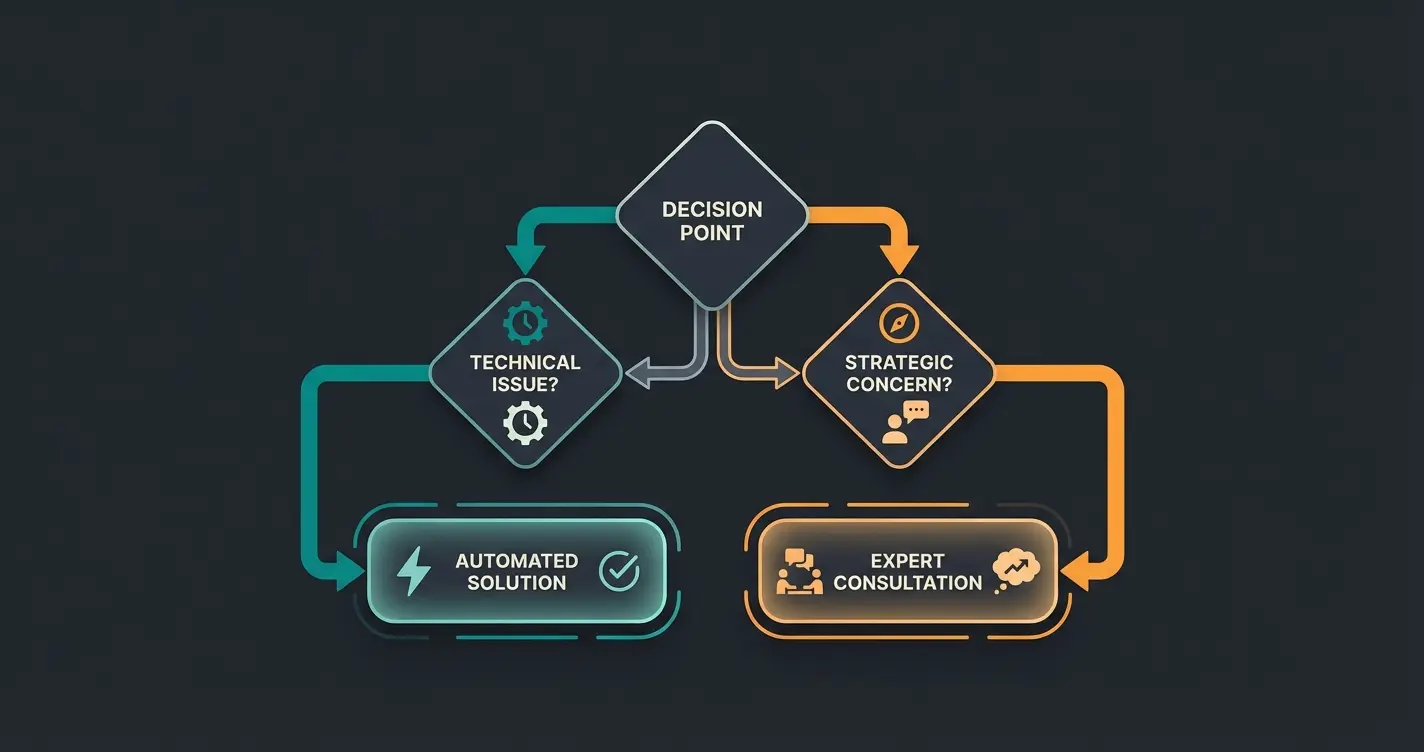
So here is the decision rule I would apply, and it is deliberately blunt. Replatform when the constraint is structural: your B2B pricing model does not fit, your catalogue has outgrown the architecture, or a compliance requirement forces a hosting change. Optimise when the constraint is commercial: traffic arrives, browses and leaves. The first is a platform problem. The second is not, and swapping backends will cost you six months to learn that. Execution detail is in our Shopware migration guide.
Frequently asked questions about Shopware alternatives
The most common questions are which alternative is cheapest, which is best for B2B, and whether switching is worth it at all. Short version: WooCommerce is cheapest to licence, Adobe Commerce and Spryker are strongest for complex B2B, and switching is only worth it when the constraint is structural rather than commercial.
There is no single best one. Shopify is the strongest choice for B2C brands wanting speed and no server maintenance, Adobe Commerce and Spryker for complex B2B, and WooCommerce for content-led stores on WordPress. Gartner Peer Insights ranks Shopify first among Shopware alternatives as of Q3 2026.
Yes. WooCommerce, PrestaShop, OpenCart, Magento Open Source and Ecwid's entry tier all carry no licence fee, and Shopware Community Edition itself is free below EUR 1 million annual GMV. Expect USD 300 to 1,500 per month in hosting, extensions and developer time for a serious store.
Better for different jobs. Shopify wins on launch speed, hosting included and an app store of 8,000+ apps against roughly 1,500 Shopware extensions. Shopware wins on native B2B depth and on payment economics, since Shopify adds 0.2% to 2% on non-Shopify Payments transactions.
Community threads on open-source ecommerce consistently name WooCommerce for cost and PrestaShop for community size, with Magento Open Source cited for teams that already have the developers. The recurring caution is the same as in Capterra reviews: free licences shift cost to hosting and maintenance rather than removing it.
Five to six figures for a store with a real catalogue, over three to six months. Data migration, theme rebuild, integration rework and redirect mapping are the main line items. Budget a further 90 days of post-launch optimisation before judging whether the migration worked.
Adobe Commerce and Spryker handle the most complex B2B logic natively, including company accounts, approval chains and requisition lists. For mid-market B2B, OXID eSales delivers a solid feature set without an enterprise price step, and Shopify only becomes viable for B2B on the Plus tier.
If you are still running Shopware 5, the honest first comparison is Shopware 6 itself, since your data model and team knowledge transfer. If you are leaving anyway, JTL-Shop and OXID keep the German legal and ERP fit, while Shopify removes the self-hosting burden entirely.
Rarely by itself. Faster load times help at the margins, but the average cart abandonment rate of 70.22% measured by Baymard is largely a guidance problem, not an infrastructure one. If visitors arrive and leave without buying, fix the advisory layer before you fix the backend.
If your visitors browse and leave, a new backend will not change that. A Qualimero AI employee advises customers inside your existing Shopware, Shopify or WooCommerce store. Pooldoktor measured 33x ROI and +18.75% revenue per visitor against a control group.
Book a demo
Kevin is CTO and co-founder of Qualimero. As an AI architect with over 15 years of experience as CTO and CPO in the tech industry, he designs the AI systems that automate tens of thousands of customer interactions daily for Qualimero's clients — reliably, securely, and at scale.