
What are the biggest Shopify disadvantages?
Open the analytics dashboard of any mid-sized e-commerce store that has been on Shopify for six months and you will spot the same pattern: the plan fee says $105, but the monthly credit card bill says $1,900. Shopify powers over 4.8 million stores as of 2026. For most of them, the platform delivers. If you want a broader overview, start with our guide on What Is Shopify.
But popularity creates blind spots. Most merchants sign up based on the advertised price and discover the real costs three months later. The disadvantages are not dealbreakers for every business, but they are predictable. Understanding them before you commit saves money and avoids painful migrations. For a balanced view that weighs these against the positives, check out our Shopify Reviews.
Industry benchmark for Shopify stores, 2025
Over 80% of merchants rely on third-party apps
Extra fee on Basic plan when not using Shopify Payments
Hard ceiling: 3 options and 100 variants maximum
| Disadvantage | Severity | Most affected |
|---|---|---|
| Costs and transaction fees | Critical | Growing stores ($10k+/month revenue) |
| App dependency and hidden costs | High | All stores relying on non-native features |
| Limited customization | High | Stores with complex products or B2B workflows |
| SEO limitations | Medium | Content-driven brands and large catalogs |
| Checkout restrictions | High | International stores, B2B, multi-step flows |
| Multilingual challenges | Medium | Stores selling in 2+ languages or markets |
| Vendor lock-in | Medium | Long-term planners evaluating migration risk |
Costs and transaction fees
Shopify's pricing looks straightforward until you read the fine print. The official Shopify pricing page shows four main plans: Basic at $39/month, Grow at $105/month, Advanced at $399/month, and Plus starting at $2,300/month. Annual billing drops those numbers by roughly 25%. But the plan fee is just the starting point.
If you use a third-party payment provider instead of Shopify Payments, Shopify charges an additional transaction surcharge on every sale: 2% on Basic, 1% on Grow, 0.6% on Advanced. Even with Shopify Payments, card processing fees range from 2.5% to 2.9% plus $0.30 per transaction. Here is what a real month looks like for a store processing $50,000 in revenue on the Grow plan, assuming roughly 1,000 orders.
| Cost component | With Shopify Payments | With third-party provider |
|---|---|---|
| Grow plan fee | $105 | $105 |
| Card processing (2.7% + $0.30 per order) | $1,650 | $1,650 |
| Shopify transaction surcharge (1%) | $0 | $500 |
| 6 paid apps (avg. $30 each) | $180 | $180 |
| Total monthly cost | $1,935 | $2,435 |
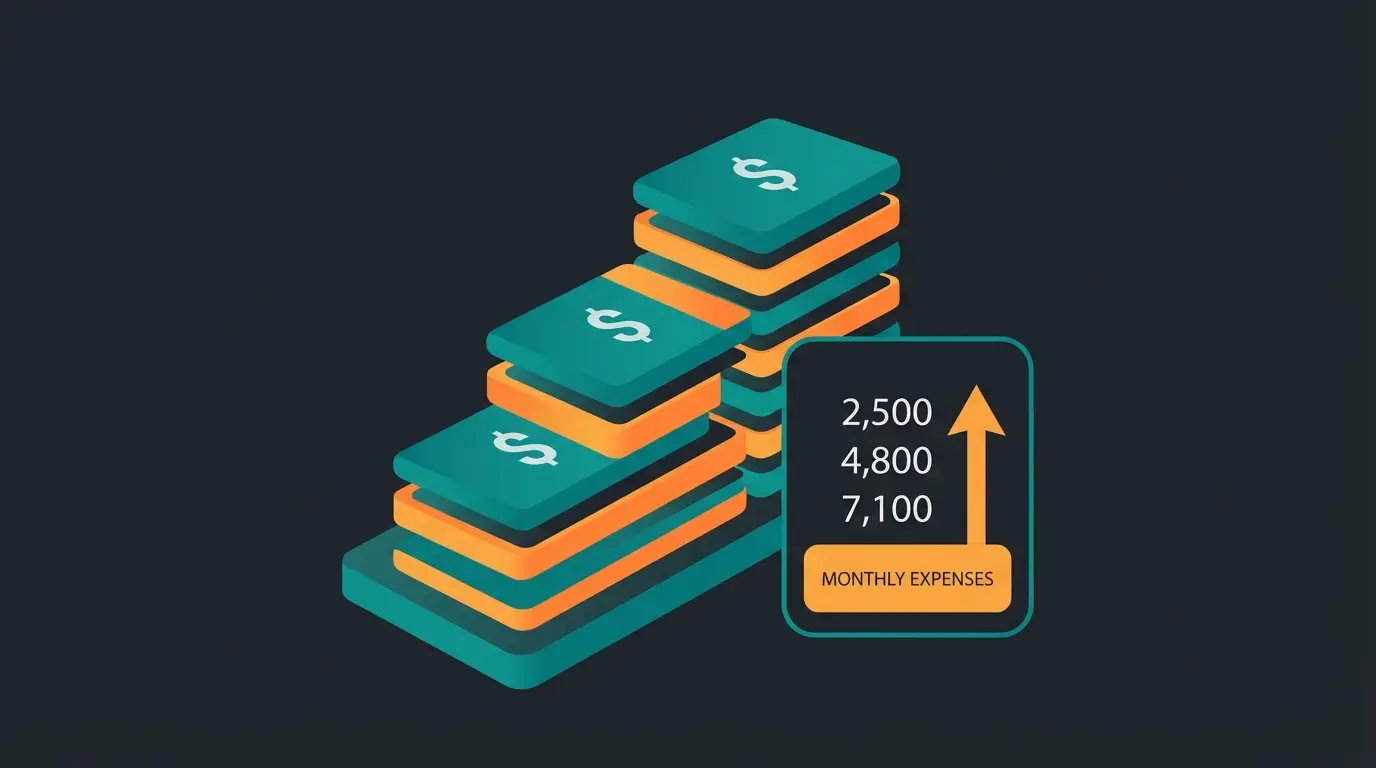
The gap between "Shopify costs $105/month" and the actual $1,935+ monthly spend is where most merchants feel the friction. Card processing fees apply on any platform, but the combination of plan fees, transaction surcharges, and mandatory app spending makes the total cost of ownership significantly higher than the sticker price.
App dependency and hidden costs
Shopify's core system is deliberately lean. Features like multi-language support, advanced analytics, loyalty programs, and product reviews require third-party apps from the Shopify App Store. The average Shopify merchant uses 6 or more apps, with monthly app spending averaging approximately $120 according to 2025 industry data.
- Translation and multi-language app: $20 to $50/month
- Product review app: $15 to $30/month
- Upsell and cross-sell app: $20 to $50/month
- Advanced analytics: $30 to $80/month
- Loyalty and rewards program: $20 to $50/month
- SEO optimization app: $20 to $40/month
Three problems compound from this model. First, costs stack fast: six apps at $30 each add $180/month, or $2,160 per year. Second, apps can conflict with each other, causing performance issues or broken checkout flows. Third, if a developer discontinues an app you depend on, you lose that feature overnight. Which means your store's uptime depends on apps built by teams you have never met.
Limited customization options
Shopify is a hosted SaaS platform. You get stability and zero server maintenance, but you give up backend access. Every customization happens within Shopify's guardrails. The template system uses Liquid, Shopify's proprietary templating language. For basic changes like colors, fonts, and layout sections, the drag-and-drop editor works fine. For anything structural, like custom product configurators or non-standard page layouts, you need a developer who knows Liquid.
The bigger limitation is the checkout. On Basic, Grow, and Advanced plans, you cannot customize the checkout flow beyond basic branding. Custom fields, conditional logic, and multi-step modifications require Shopify Plus at $2,300+ per month. Product variants also hit a hard ceiling: 3 options and 100 variants per product. If you sell configurable products with multiple dimensions (size, color, material, finish), you run into this limit fast.
Compared to open-source systems where you own the full codebase, Shopify's customization boundary is clear. The tradeoff is intentional. For most simple DTC shops, it works well. But if your business model requires deep customization, you will pay for it either in Plus plan fees or in creative workarounds.
SEO limitations on Shopify
Shopify handles the SEO basics well: automatic sitemaps, SSL certificates, and clean canonical tags. But several structural limitations cannot be fixed, only worked around. URL structure is the most cited issue. Shopify enforces prefixes like /products/, /collections/, and /blogs/ in every URL. A product page will always be yourstore.com/products/product-name, never yourstore.com/product-name.
Duplicate content is a related problem. When a product appears in multiple collections, Shopify generates additional URLs like /collections/sale/products/product-name alongside the canonical /products/ path. Shopify sets canonical tags, but these duplicate paths still dilute crawl efficiency and require monitoring.
The built-in blog is minimal. It lacks categories, content scheduling, and the flexibility of a CMS like WordPress. Robots.txt editing is restricted, limiting technical SEO strategies for larger stores with thousands of product and collection pages. These are not unsolvable problems. SEO-focused apps and careful technical setup can mitigate most issues. But they add cost, complexity, and ongoing maintenance that other platforms do not require.
Checkout restrictions
On Basic, Grow, and Advanced plans, customers are redirected to a Shopify-hosted checkout page. The URL changes from your custom domain to checkout.shopify.com. This break in the browsing experience can erode trust, particularly for first-time buyers who notice the domain switch. Custom checkout fields (delivery instructions, gift messages, VAT IDs for B2B) are not available without Shopify Plus.
Staff account limits compound the issue. Basic includes 1 staff account, Grow adds 5, and Advanced adds 15. For teams that need multiple people accessing the backend, this means upgrading plans purely for access, not features. The checkout is where revenue happens. Restrictions here cost more than restrictions anywhere else in the platform.
Multilingual and internationalization challenges
Selling in one language and one currency is straightforward on Shopify. Selling in three languages across five markets is where friction emerges. Shopify Markets handles currency conversion and basic market targeting, but full multilingual stores require a translation app, typically $20 to $50 per month.
SEO for international stores is particularly challenging. Hreflang tags, which tell Google which language version to serve in each country, require careful configuration. Incorrect implementation leads to the wrong language version ranking in the wrong market. Country-specific pricing, tax rules, and legal requirements need additional apps or manual configuration. For a deeper look at the German market specifically, see our guide on Shopify in Germany.
Shopify disadvantages by business size
Not every disadvantage hits every business equally. The impact depends on your revenue, your team size, and your growth trajectory.
| Disadvantage | Solopreneur (<$10k/mo) | Growing SME ($10k-100k/mo) | Enterprise ($100k+/mo) |
|---|---|---|---|
| Cost escalation | Low | Critical | Manageable (Plus) |
| App dependency | Medium | High | Medium (custom dev) |
| Customization limits | Low | High | Solved by Plus |
| SEO limitations | Low | Medium | High |
| Checkout restrictions | Low | High | Solved by Plus |
| Internationalization | N/A | High | Medium (Plus Markets) |
The pattern is clear. For solopreneurs and early-stage stores, Shopify's simplicity outweighs its limitations. Costs are manageable, customization needs are low, and the speed to market is unmatched. For growing SMEs, the compounding cost of apps and the customization ceiling become real friction. For enterprise operations, the decision is Shopify Plus or a more flexible platform entirely.
Shopify alternatives for critical disadvantages
If a specific Shopify disadvantage is a dealbreaker for your business, here are the platforms that address it directly. For a comprehensive breakdown, see our full e-commerce platform comparison.
| Shopify weakness | Best alternative | Why it solves it |
|---|---|---|
| Cost at scale | WooCommerce | No platform fee, thousands of free plugins, self-hosted |
| Customization | Shopware | Open source, full code access, flexible architecture |
| SEO control | WooCommerce | Full URL control, advanced SEO plugins (Yoast, Rank Math) |
| Built-in features | BigCommerce | Native reviews, multi-currency, faceted search included |
| Internationalization | Shopware | Native multi-language and multi-market support |
| Checkout customization | WooCommerce | Fully customizable checkout flow, no plan restrictions |
No platform is perfect. WooCommerce gives full control but requires hosting, security, and technical maintenance. Shopware is strong in DACH markets but has a smaller global app ecosystem. BigCommerce includes more built-in features but offers less design flexibility. According to Statista E-Commerce Platforms, Shopify's global market share continues to lead, which means ecosystem support, integrations, and community resources remain its strongest advantage.
Choosing the right platform brings visitors to your store. Converting them into buyers is the next challenge. Qualimero's AI employees handle product consultation in real-time, achieving up to 18x ROI for e-commerce stores.
Book a free demoConclusion: is Shopify still worth it despite the disadvantages?
Yes, for the right business. Shopify is still the best choice for simple DTC shops, dropshipping operations, and businesses that value speed and simplicity over deep customization. The ecosystem is vast, the checkout converts well, and the platform is reliable.
The disadvantages matter most when your business outgrows the Basic plan without being ready for Plus. That middle zone, where app costs pile up, customization hits walls, and SEO limitations require workarounds, is where Shopify creates the most friction. Our Shopify Review covers the full picture including the positives. Already decided to go with Shopify? Our Shopify Store Setup guide walks you through the process. And for inspiration, take a look at these successful Shopify stores.
One disadvantage no platform solves on its own: converting visitors into buyers. The online retailer Signed tackled this with an AI employee for product consultation, achieving 18x ROI and automating 70% of customer inquiries. Whether you choose Shopify or any other platform, AI product consultation turns traffic into revenue, and our guide to Chatbot as a Service compares that category on cost, platforms, and ROI. The right platform is the one that fits your business today and does not punish you for growing tomorrow.
Your platform choice brings traffic. An AI employee converts it. Qualimero's digital team members increase cart value by 35% and automate product consultation around the clock.
Book a demoFrequently asked questions about Shopify disadvantages
The main downsides are escalating costs from apps and transaction fees, limited customization without Shopify Plus, rigid URL structures that hurt SEO, checkout restrictions on lower plans, and vendor lock-in that makes migration difficult. The severity depends on your business size and growth stage.
With Shopify Payments on the Grow plan, Shopify takes approximately $3.00 in card processing fees (2.7% + $0.30). Without Shopify Payments, add a 1% transaction surcharge, bringing the total to roughly $4.00. On the Basic plan with a third-party provider, the total can reach $5.20.
Not necessarily. A small store on the Basic plan ($39/month) with Shopify Payments and 2-3 apps can operate for under $100/month. Costs become a concern as you grow and need more apps, higher-tier plans, or third-party payment providers. The real expense is the total cost of ownership, not the plan price.
The biggest hidden costs are third-party apps (average $120/month), transaction surcharges when not using Shopify Payments (0.6-2% per sale), premium themes ($180-$350 one-time), and the gap between what the Basic plan includes and what a functional store actually needs.
Consider alternatives if your business requires deep checkout customization, full URL control for SEO, native multi-language support, or if your monthly app costs exceed $200. WooCommerce and Shopware offer more control for technically capable teams. Shopify excels at simplicity, not flexibility.

Lasse is CEO and co-founder of Qualimero. After completing his MBA at WHU and scaling a company to seven-figure revenue, he founded Qualimero to build AI-powered digital employees for e-commerce. His focus: helping businesses measurably improve customer interaction through intelligent automation.