What is a Shopify inventory management app?
A Shopify inventory management app is a third-party tool that extends Shopify's built-in stock tracking with features like multi-channel syncing, demand forecasting, automated purchase orders, and warehouse management. These apps become essential when your store outgrows Shopify's native capabilities, typically at the point where you manage multiple locations, sell across several channels, or handle more than 500 SKUs.
Shopify's admin already supports basic inventory tracking across up to 1,000 locations, according to Shopify's official documentation. You can set stock quantities, receive low-stock warnings, and view inventory history. For a solo founder selling through a single channel, that is often enough.
The problem starts when complexity scales. Multi-channel selling (Amazon, eBay, TikTok Shop alongside your Shopify store), demand forecasting, supplier management, and automated reordering are not part of Shopify's native toolset. That is where dedicated apps fill the gap.
The cost of getting inventory wrong is substantial. According to IHL Group, inventory distortion, including overstocks, stockouts, and shrinkage, costs retailers an estimated $1.75 trillion annually worldwide. For Shopify merchants specifically, carrying costs alone run 20-30% of inventory value per year. A store holding $100,000 in average inventory pays $20,000-$30,000 annually in storage, insurance, and opportunity costs before selling a single unit.
For a deeper look at Shopify's overall inventory ecosystem, including native features and strategy, see our Shopify Inventory Management Guide.
Top Shopify inventory management apps compared
The best Shopify inventory management apps in 2026 are SKUSavvy for visual warehouse management, Stockie for AI-driven forecasting, Katana for manufacturing, and Prediko for demand planning. Each targets a different merchant profile, from simple stock alerts to complex multi-warehouse operations. We reviewed eight apps across the Shopify App Store and tested their core claims against real-world requirements.
SKUSavvy: best for visual warehouse management
SKUSavvy takes a unique approach to inventory management by combining 3D visual warehouse mapping with barcode scanning and batch picking. Instead of working from spreadsheets, your warehouse team sees a visual floor plan of exactly where products are located. That alone cuts pick times significantly for stores with complex warehouse layouts.
Rating: 4.7 stars on the Shopify App Store. Pricing: free for up to 50 orders/month, then usage-based at $0.25/order (51-500 orders), $0.19/order (501-5,000), and $0.13/order for higher volumes. The usage-based model means you only pay for what you ship, which is unusual among inventory apps and particularly attractive for seasonal businesses.
Stockie: best for forecasting and low-stock alerts
Stockie is the highest-rated dedicated inventory app on Shopify with a perfect 5.0-star rating across 80 merchant reviews. It uses your actual sales history to forecast demand, then generates purchase orders directly from those forecasts. Low-stock alerts go out via email or Slack, and everything syncs with Shopify in real time.
Pricing starts at $4.99/month with a 14-day free trial. For the feature set, including demand forecasting, PO creation, supplier management, and multi-location tracking, Stockie offers the strongest value-per-dollar ratio in this comparison. The main limitation: it does not handle manufacturing workflows or raw material tracking.
Katana: best for manufacturing and production
Katana Cloud Inventory is built specifically for brands that manufacture their own products. It tracks raw materials, work-in-progress, and finished goods in a single system, while syncing directly with Shopify orders. If you make what you sell, Katana is the only app in this comparison that handles the full production lifecycle.
Pricing starts at $99/month (Essential plan), scaling to $299/month (Advanced) and $599/month (Professional). A custom enterprise plan is available. Note that the Advanced plan, which includes manufacturing-specific features, requires a minimum of $299/month plus a $2,000 onboarding investment. Costs scale further with sales order volume, which can push monthly fees above the base price for high-volume, low-ticket sellers.
Prediko: best for AI demand planning
Prediko positions itself as an AI inventory planning platform trained on over 25 million SKUs. Its forecasting engine predicts demand, automates purchase order creation, and provides inventory analytics in one dashboard. The AI approach is particularly strong for DTC brands with seasonal fluctuations and long supplier lead times.
Pricing scales with gross merchandise value: $49/month for stores up to $100K GMV, rising to $349/month for stores up to $5M GMV. Prediko ranks at position 7 on Google for this keyword and is cited in the AI Overview, which signals strong domain authority in this space.
Fabrikator: best Stocky replacement
Fabrikator explicitly markets itself as a Stocky replacement, with AI-powered replenishment, multi-warehouse management, and bundle planning. For merchants migrating from Stocky before the August 2026 shutdown, Fabrikator provides the closest feature parity while adding AI forecasting capabilities Stocky never had.
Pricing starts at $99/month with a 20% discount for annual billing. All plans include unlimited SKUs and users. Early-stage businesses generating less than $30K/month in revenue can contact Fabrikator for discounted pricing.
Worth noting: inventory accuracy directly impacts customer experience. When a customer asks whether a product ships in their size or color, real-time stock data combined with AI product consultation turns that question into a conversion moment rather than a support ticket.
Stock Sync, Trunk, and Cin7
Stock Sync (SyncX) specializes in inventory synchronization via CSV, XML, or Google Sheets. Free plan available with manual sync only; automated Pro and Business plans at $15/month and $25/month. Best for: stores that manage inventory in spreadsheets and need a bridge to Shopify.
Trunk focuses on multi-channel inventory syncing across Shopify, Amazon, eBay, Etsy, and other marketplaces. Pro plan pricing scales from $35/month (100 orders) to $329/month (10,000 orders). Best for: multi-channel sellers who need real-time stock level consistency.
Cin7 Core is the enterprise option, recommended frequently on Reddit's r/ecommerce community for complex retail and wholesale operations. As one merchant noted: "Cin7 is a popular recommendation for inventory management due to its features and Shopify integration, but it is a higher-priced option starting around $349 per month." Best for: established businesses with wholesale, B2B, and retail channels.
Feature comparison: side-by-side analysis
When comparing Shopify inventory apps, the key differentiators are multi-channel sync capability, AI forecasting accuracy, purchase order automation, and pricing model. SKUSavvy and Stockie lead in features per dollar, while Katana and Cin7 offer the deepest enterprise integrations. The table below maps each app against the features that matter most for growing e-commerce stores.
| Feature | SKUSavvy | Stockie | Katana | Prediko | Fabrikator | Stock Sync | Trunk | Cin7 |
|---|---|---|---|---|---|---|---|---|
| Multi-channel sync | Yes | No | Yes | No | No | Yes | Yes | Yes |
| Demand forecasting | No | Yes (AI) | Yes | Yes (AI) | Yes (AI) | No | No | Yes |
| Purchase orders | No | Yes | Yes | Yes | Yes | No | No | Yes |
| Barcode scanning | Yes | No | Yes | No | No | No | No | Yes |
| Multi-location | Yes | Yes | Yes | Yes | Yes | Yes | Yes | Yes |
| Manufacturing/BOM | No | No | Yes | No | No | No | No | Yes |
| API access | Yes | No | Yes | Yes | Yes | Yes | Yes | Yes |
| Free plan | Yes (50 orders) | No (trial) | No | No | No | Yes (manual) | No | No |
| Shopify App Store rating | 4.7 | 5.0 | 4.3 | 4.9 | 4.7 | 4.1 | 4.3 | N/A |
Pricing comparison: what does each app cost?
Shopify inventory management app pricing ranges from free basic plans (Stock Sync, SKUSavvy) to $599/month for enterprise solutions (Katana Professional). Most SME-focused apps like Stockie and Prediko start between $4.99-$99/month, with pricing scaling by SKU count, order volume, or gross merchandise value. The right price depends on what you are paying for: simple sync tools cost less, while AI forecasting and manufacturing features command premium prices.
| App | Free tier | Starting price | Enterprise tier | Pricing model |
|---|---|---|---|---|
| SKUSavvy | Yes (50 orders/mo) | $0.25/order | Custom | Usage-based (per order) |
| Stockie | 14-day trial | $4.99/mo | Contact sales | Flat monthly |
| Katana | 14-day trial | $99/mo | $599/mo | Flat + order volume |
| Prediko | No | $49/mo | $349/mo | GMV-based tiers |
| Fabrikator | No | $99/mo | Custom | Flat monthly (20% annual discount) |
| Stock Sync | Yes (manual only) | $15/mo | $25/mo | Flat monthly |
| Trunk | No | $35/mo | $329/mo | Order-volume tiers |
| Cin7 Core | No | $349/mo | Custom | Flat + add-ons |
A critical distinction: SKUSavvy's usage-based pricing is unique in this category. A store processing 200 orders/month pays $37.50, while a store processing 2,000 orders/month pays $380. By contrast, Stockie's flat $4.99/month applies regardless of volume, making it the most predictable cost structure for budget-conscious merchants.
According to Shopify's own inventory management guide, the best inventory management software "should integrate seamlessly with your existing tools and scale with your business." That advice applies directly to pricing: choose a model that matches your growth trajectory, not just your current order volume.
How to choose the right app for your store
Choose your Shopify inventory app based on three factors: your monthly order volume, number of sales channels, and whether you need manufacturing or raw material tracking. Stores under 500 orders/month can start with Stockie or Stock Sync, while high-volume multi-channel sellers need SKUSavvy or Cin7. The decision matrix below maps common business profiles to the right app.
Start with Stockie ($4.99/mo) or Shopify's native tools. Low cost, easy setup, forecasting included.
Trunk ($35-$329/mo) for inventory sync, or SKUSavvy if you also need warehouse management.
Prediko ($49-$349/mo) for AI demand forecasting, or Fabrikator ($99/mo) for AI replenishment and bundle planning.
Katana ($99-$599/mo) is the only option with full production lifecycle tracking, including BOM and raw materials.
Cin7 Core ($349+/mo) handles multi-channel, manufacturing, and wholesale in one platform.
A common mistake: choosing an app based on feature count alone. A 2026 survey by Shopify found that 43% of small businesses do not track inventory at all. If you are moving from spreadsheets or no tracking to your first inventory app, Stockie or Stock Sync will deliver more immediate value than an enterprise tool you spend weeks configuring.
For stores that also manage physical warehouse operations, our guide on Shopify Warehouse Management covers the logistics side in detail, including pick-pack-ship workflows and 3PL integration. If your shortlist has already outgrown apps and moved toward full inventory systems, the Pickware vs JTL vs Xentral comparison covers that tier.
Integration and compatibility
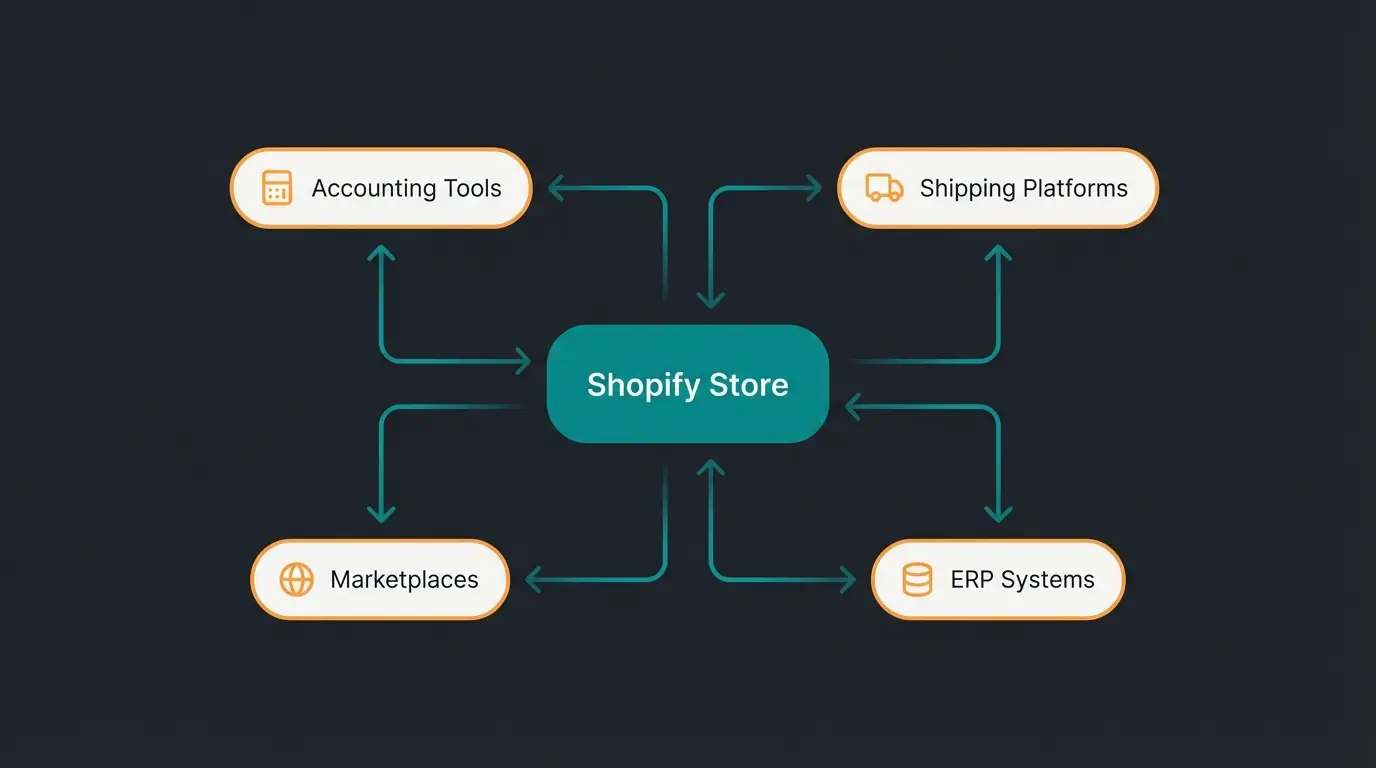
Most Shopify inventory apps integrate with the standard Shopify accounting stack (QuickBooks, Xero), shipping platforms (ShipStation, Shippo), and marketplaces (Amazon, eBay). However, ERP integration depth varies significantly: only Katana and Cin7 offer native ERP connections, while others rely on third-party middleware like Zapier or custom API work.
| App | Accounting | Shipping | Marketplaces | ERP | API |
|---|---|---|---|---|---|
| SKUSavvy | QuickBooks | ShipStation, Shippo | Amazon, eBay | Via API | REST API |
| Stockie | No native | No native | Shopify only | No | No |
| Katana | QuickBooks, Xero | ShipStation | Amazon, eBay | Native (multiple) | REST API |
| Prediko | No native | No native | Shopify only | No | Yes |
| Fabrikator | No native | No native | Shopify only | No | Yes |
| Stock Sync | No native | No native | Multiple (via feed) | Via CSV | Yes |
| Trunk | No native | ShipStation | Amazon, eBay, Etsy | No | Yes |
| Cin7 | QuickBooks, Xero, MYOB | ShipStation, Shippo, DHL | Amazon, eBay, Walmart | Native (SAP, NetSuite) | REST API |
Stockie, Prediko, and Fabrikator are Shopify-only tools, meaning they do not natively connect to external marketplaces or accounting systems. That is not a weakness if Shopify is your sole sales channel, but it becomes a limitation the moment you add Amazon or a B2B wholesale channel. Trunk, by contrast, exists specifically to solve the multi-channel sync problem but does not offer forecasting or purchase orders. The same split shows up in billing: stock movements rarely reach your Shopify invoices without an accounting or ERP layer sitting between the two.
For merchants considering deeper ERP integration with Shopify, including connecting to systems like SAP, NetSuite, or WeClapp, the complexity increases substantially. Systems built around warehouse logic rather than finance, such as Pickware, take a different route: stock, picking, and shipping live in one layer instead of three. Whichever path you pick, budget for API limits, data mapping, and total cost of ownership before you commit.
Connecting inventory with AI customer service
AI customer service agents that access real-time inventory data can instantly tell customers whether products are in stock, suggest alternatives for out-of-stock items, and provide accurate delivery estimates. This turns inventory management from a backend tool into a customer-facing advantage that directly increases conversion rates.
Most inventory apps expose stock data via API, which means an AI employee can query current availability during a customer conversation. The practical impact: a customer asking "Is the 5kg bag of lawn fertilizer available?" gets an immediate, accurate answer rather than a generic "check our website" response.
Rasendoktor, a German e-commerce specialist for lawn care products, implemented exactly this approach. Their AI employee Hektor, built with Qualimero's AI product consultation, handles all webchat inquiries automatically with real-time access to product and availability data. The results: 16x ROI, 100% automation rate, and 40% support cost savings. For a store processing 2,000-3,000 seasonal inquiries, that is the difference between three overwhelmed support staff and a system that scales without headcount.
According to Ringly.io's 2026 AI retail report, 68% of retailers plan to use AI for inventory management and supply chain by 2026. The next logical step is connecting that AI-managed inventory data to customer-facing AI agents, creating a closed loop from stock level to purchase decision.
FAQ
The best app depends on your store profile. Stockie (5.0 stars, from $4.99/mo) is the strongest all-around choice for most SMEs needing forecasting and purchase orders. SKUSavvy wins for warehouse-heavy operations, and Katana is the only viable option for manufacturers. No single app is best for every store.
Yes, Shopify's native tools support basic inventory tracking across up to 1,000 locations, including stock counts, low-stock warnings, and inventory history. However, native Shopify lacks demand forecasting, automated purchase orders, multi-channel sync, and barcode scanning, which is why most stores above 500 SKUs add a third-party app.
Third-party app pricing ranges from free (Stock Sync basic, SKUSavvy under 50 orders/mo) to $599/month (Katana Professional). Most growing stores spend between $5-$100/month. The hidden cost to consider: inventory carrying costs of 20-30% of stock value annually, which the right app helps reduce through better forecasting.
Shopify removed Stocky from the App Store on February 2, 2026, with the full shutdown scheduled for August 31, 2026. Key features like inventory transfers were already removed in July 2025. Merchants still using Stocky should export their data and migrate to alternatives like Fabrikator, Stockie, or Prediko before the deadline.
If you sell through a single channel with fewer than 200 SKUs, Shopify's native tools are likely sufficient. You need a dedicated app when you sell across multiple channels, manage multiple warehouse locations, need demand forecasting to prevent stockouts, or process enough orders that manual stock updates become error-prone. According to IHL Group, stockout-related losses alone cost retailers $1.75 trillion globally per year.
More traffic only matters when visitors find what they need. A Qualimero AI employee connects to your product and inventory data, advises customers in real time, and increases cart values by up to 35%. Our clients see an average 7x higher conversion rate.
Book a free demo
Kevin is CTO and co-founder of Qualimero. As an AI architect with over 15 years of experience as CTO and CPO in the tech industry, he designs the AI systems that automate tens of thousands of customer interactions daily for Qualimero's clients — reliably, securely, and at scale.