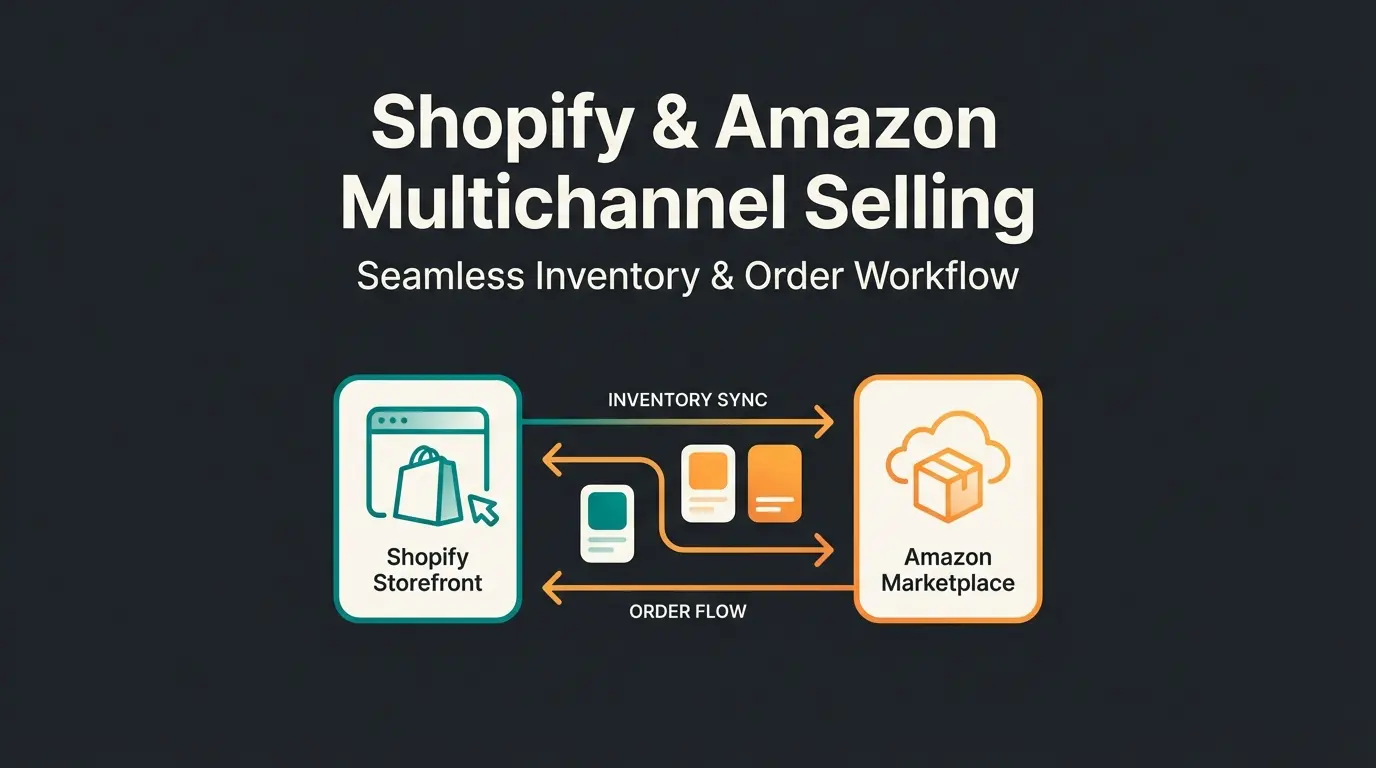
Why integrate Shopify with eBay?
eBay has 135 million active buyers spending $79.6 billion annually (Statista, Q4 2025). That is the second-largest marketplace audience after Amazon, and most of those buyers will never find your Shopify store organically.
I have worked with dozens of e-commerce merchants who treated their Shopify store as their only sales channel. The pattern is always the same: solid product, decent traffic, but revenue plateaus around month 12. The ones who added eBay as a second channel saw immediate lift, often within the first 30 days.
The numbers back this up. Multi-channel sellers earn 190% more revenue than single-channel sellers (Anchor Group, 2025). And 73% of consumers now shop across three or more channels before making a purchase decision. If your products are not on eBay, you are leaving revenue on the table for competitors who are.
The real value of integrating Shopify with eBay is not just reach. It is operational efficiency. A proper integration syncs your inventory in real time, routes eBay orders into your existing Shopify fulfillment workflow, and prevents overselling. You manage one product catalog, one inventory count, one shipping process. eBay becomes an additional revenue stream, not an additional workload. For a broader look at how Shopify handles multi-channel selling, see the Shopify POS and Multi-Channel Selling overview.
Multi-channel vs. single-channel sellers
Consumers using 3+ channels before buying
How Shopify eBay integration works
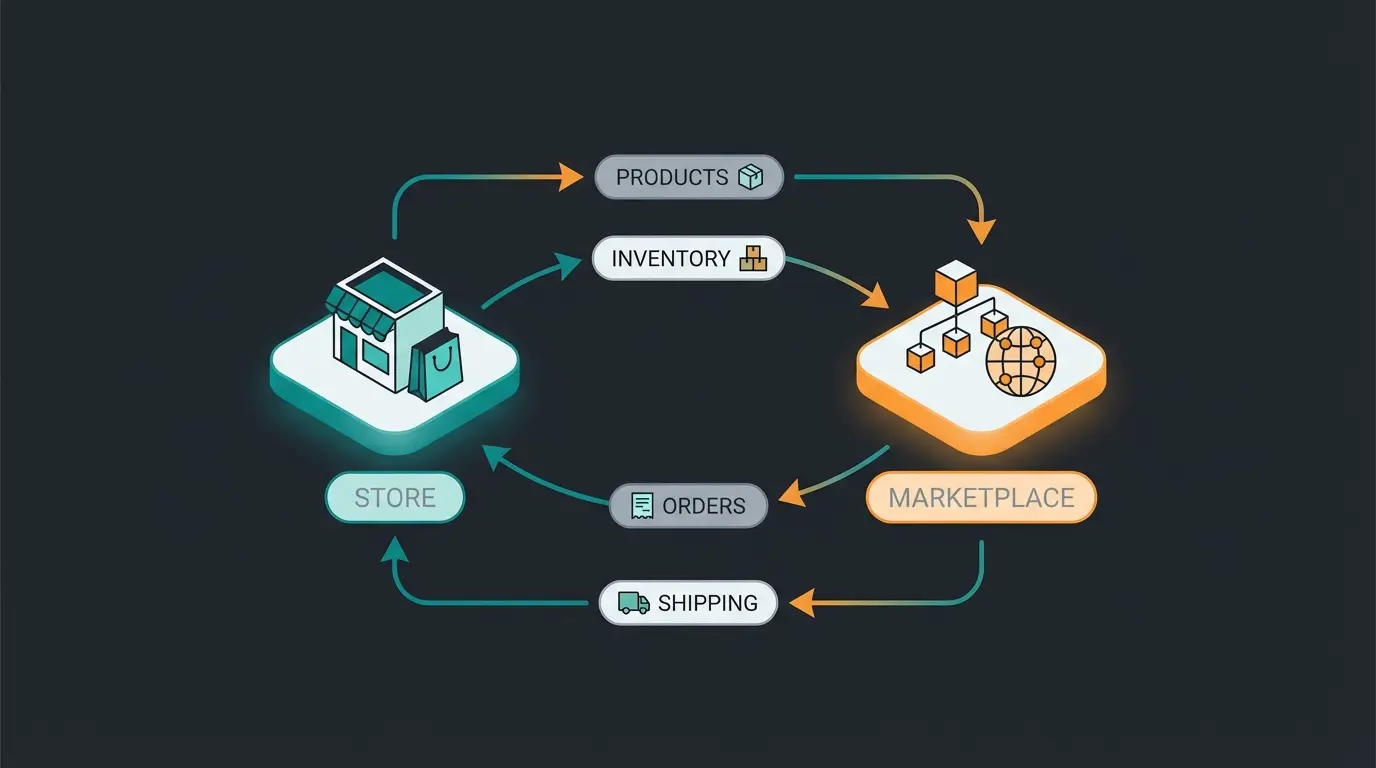
Shopify eBay integration is the process of connecting your Shopify store to your eBay seller account so that products, inventory levels, orders, and shipping updates flow automatically between both platforms. You manage everything from Shopify while eBay serves as an additional storefront.
One important detail that still trips merchants up: Shopify retired its native eBay sales channel in 2023. There is no built-in eBay connection anymore. You now need either Shopify Marketplace Connect (the official first-party app, formerly Codisto) or a third-party integration app to bridge the two platforms.
Product titles, descriptions, images, variants, and pricing push from Shopify to eBay listings
Stock levels update in real time across both platforms to prevent overselling
eBay orders pull into Shopify for unified fulfillment and tracking
Tracking numbers and fulfillment status push back to eBay automatically
The quality of this sync varies significantly between apps. Some update inventory every 15 minutes, others in near-real-time. Some handle variant mapping cleanly, others require manual intervention for every product with more than three options. That difference matters most during high-volume periods like Black Friday, when a 15-minute sync delay can mean dozens of oversold items.
Best Shopify eBay integration apps compared
Every guide on this topic pushes whichever app the author sells. Shopify recommends Marketplace Connect. CedCommerce recommends CedCommerce. LitCommerce recommends LitCommerce. Here is what an independent comparison actually looks like, based on real pricing, ratings, and feature sets as of early 2026.
| App | Rating | Free tier | Paid plans | Product limit | Best for |
|---|---|---|---|---|---|
| [Shopify Marketplace Connect](https://apps.shopify.com/marketplace-connect) | 4.2/5 (1,934 reviews) | 50 orders/month free | 1% per order, capped at $99/mo | Unlimited | Multi-marketplace sellers (eBay + Amazon + Walmart) |
| [CedCommerce eBay Integration](https://apps.shopify.com/ebay-integration) | 4.8/5 (872 reviews) | 10 products, 100 managed | $19-$89/month | Up to 100,000 | High-volume sellers needing bulk tools |
| [eBay Integration DPL](https://apps.shopify.com/ebay-integration-sync) | 4.9/5 (939 reviews) | 7-day free trial | $19.99-$69.99/month | Up to 10,000 | Sellers wanting best reliability and support |
| LitCommerce | 4.7/5 | 7-day free trial | From $29/month | Varies by plan | Sellers on 3+ marketplaces (9 channels supported) |
| inkFrog | 4.1/5 | None | From $11/month | Varies by plan | eBay-focused sellers needing template tools |
Shopify Marketplace Connect
This is Shopify's official integration (formerly Codisto). It connects not just eBay but also Amazon, Walmart, and Target Plus from a single app. The pricing model is attractive for smaller sellers: your first 50 orders per month are free, then you pay 1% per synced order up to a $99 monthly cap.
The catch: the 4.2 rating tells a story. 14% of reviews are one-star. Users consistently report syncing issues, an unintuitive interface, and slow support response times. It works well enough for sellers processing under 100 eBay orders monthly. Above that, the reliability concerns become real.
CedCommerce eBay Integration
CedCommerce is the most full-featured option for high-volume sellers. The Gold plan ($89/month) supports up to 100,000 products and 1,000 monthly orders. Bulk listing tools, multiple eBay account support, and GPSR compliance uploads are included. The 4.8 rating across 872 reviews reflects genuinely strong customer support.
The downside is pricing. The free tier only covers 10 products, making it essentially a demo. Real usage starts at $19/month (Bronze), and most growing merchants land on the Silver plan at $49/month. Worth it if you are managing thousands of SKUs. Overkill if you sell 50 products.
eBay Integration DPL
DPL has the highest rating of any Shopify eBay integration app: 4.9 out of 5 across 939 reviews, with 97% five-star ratings. That is not a fluke. The app handles two-way inventory sync reliably, includes AI-driven category mapping, and offers 24/7 live support on all plans.
No free tier, but the Silver plan at $19.99/month covers 2,500 products and 100 monthly orders. For most small-to-mid-size Shopify sellers starting on eBay, this is the best balance of reliability, features, and cost.
Step-by-step: how to connect Shopify to eBay
This walkthrough uses Shopify Marketplace Connect since it is the official app and the most common starting point. The process for third-party apps follows a similar pattern, but each app has its own dashboard and configuration flow.
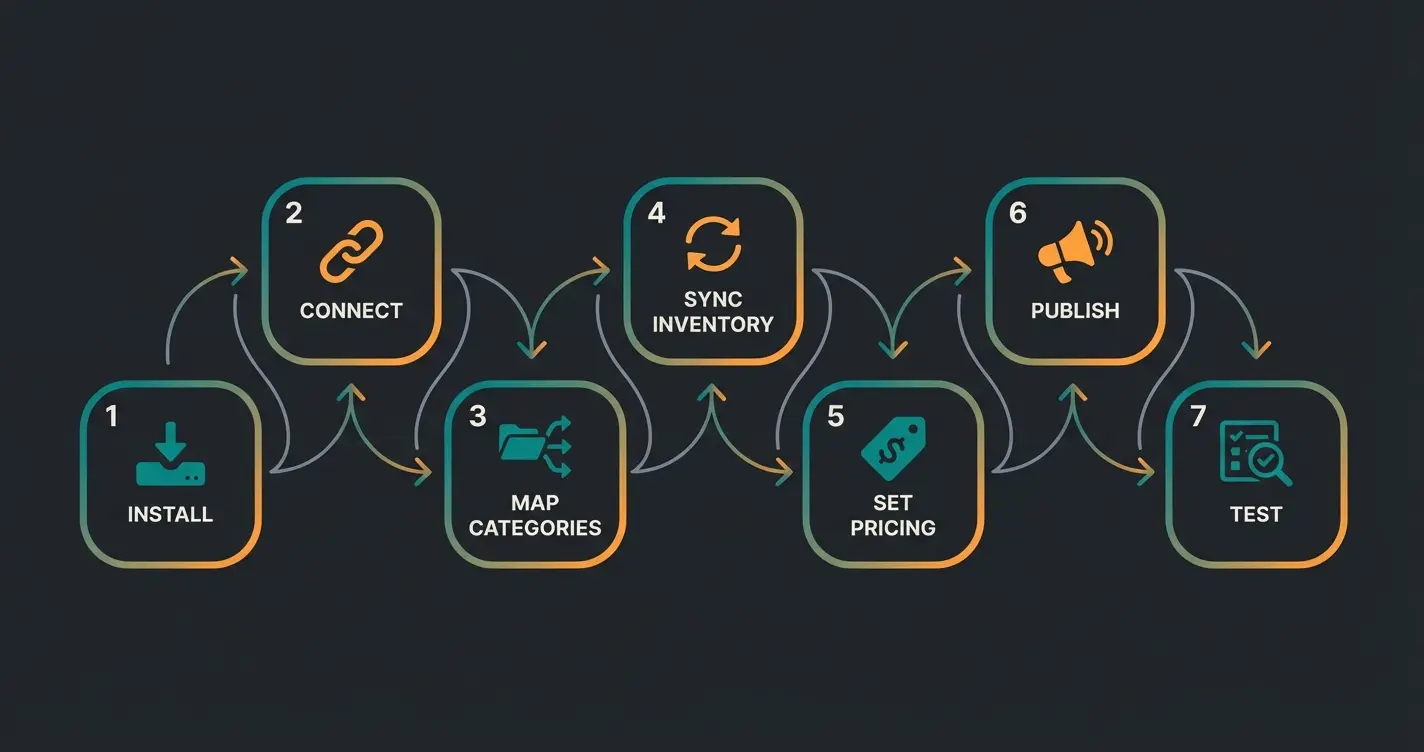
- Install the app. Go to the Shopify App Store, search for Marketplace Connect, and click Install. Approve the required permissions.
- Connect your eBay account. In the app dashboard, select eBay as a marketplace and sign in with your eBay seller credentials. You need an active eBay seller account with a linked payment method.
- Map product categories. The app will prompt you to match your Shopify product categories to eBay item specifics. This step is critical: accurate category mapping determines whether eBay shows your listings in the right search results. Take the time to map each category manually rather than relying on auto-suggestions.
- Configure inventory sync rules. Decide whether to sync all products or a subset. Set inventory buffer rules (e.g., hold back 10% of stock for your Shopify store). Choose sync frequency: real-time if available, or the shortest interval the app offers.
- Set pricing rules. eBay fees eat into margins. Most sellers add a 5-15% markup on eBay listings to cover the final value fee (typically 13.25% for most categories). Configure this in the pricing rules section.
- Publish listings. Review a test batch of 5-10 products on eBay before pushing your full catalog. Check that images, titles, descriptions, and variants display correctly on eBay.
- Test the order flow. Place a test order on eBay and verify it appears in your Shopify admin. Confirm that fulfillment and tracking sync back to eBay. This single test saves hours of troubleshooting later.
Pricing comparison: what does Shopify eBay integration cost?
Integration app fees are only one layer. The real cost of selling on eBay through Shopify includes your Shopify subscription, the integration app, eBay seller fees, and eBay store subscription fees. Here is the full picture.
| Cost layer | Small seller (<100 products) | Mid-size (100-1,000 products) | High volume (1,000+ products) |
|---|---|---|---|
| Shopify plan | $39 (Basic) | $105 (Shopify) | $399 (Advanced) |
| Integration app | $0-$19.99 | $29-$49 | $69.99-$89 |
| eBay Store subscription | $7.95 (Starter) | $24.95 (Basic) | $74.95 (Premium) |
| eBay final value fee | ~13.25% per sale | ~13.25% per sale | ~13.25% per sale |
| Total fixed costs | $47-$67/month | $159-$179/month | $544-$563/month |
Common challenges and how to solve them
No integration is perfect. I have seen every one of these issues across dozens of merchant setups. The good news: all of them are solvable.
- Inventory sync delays. Some apps sync every 15 minutes, not in real time. During flash sales or high-traffic periods, this delay causes overselling. Solution: choose an app with real-time sync (DPL and Marketplace Connect both offer this), or set inventory buffers to absorb the gap.
- Category mapping errors. eBay's item specifics are granular and change frequently. Auto-mapping often places products in wrong categories, killing visibility. Solution: map your top 20 products manually, verify they appear in the correct eBay search results, then use those mappings as templates.
- Listing quality issues. Shopify product descriptions are written for your store. eBay buyers expect different information: condition, shipping details, return policy, compatibility. Solution: use listing templates in your integration app to add eBay-specific fields without changing your Shopify data.
- Order routing confusion. When eBay orders appear in Shopify, fulfillment teams sometimes ship with wrong packaging or include wrong inserts. Solution: tag eBay orders automatically and create a separate fulfillment workflow if your packaging differs by channel.
- Return handling. eBay has its own return policies that may conflict with yours. Solution: align your eBay return policy with your Shopify policy, or set eBay-specific return rules in your seller settings. Handle all returns through eBay's resolution center to maintain your seller metrics.
Which integration is right for you?
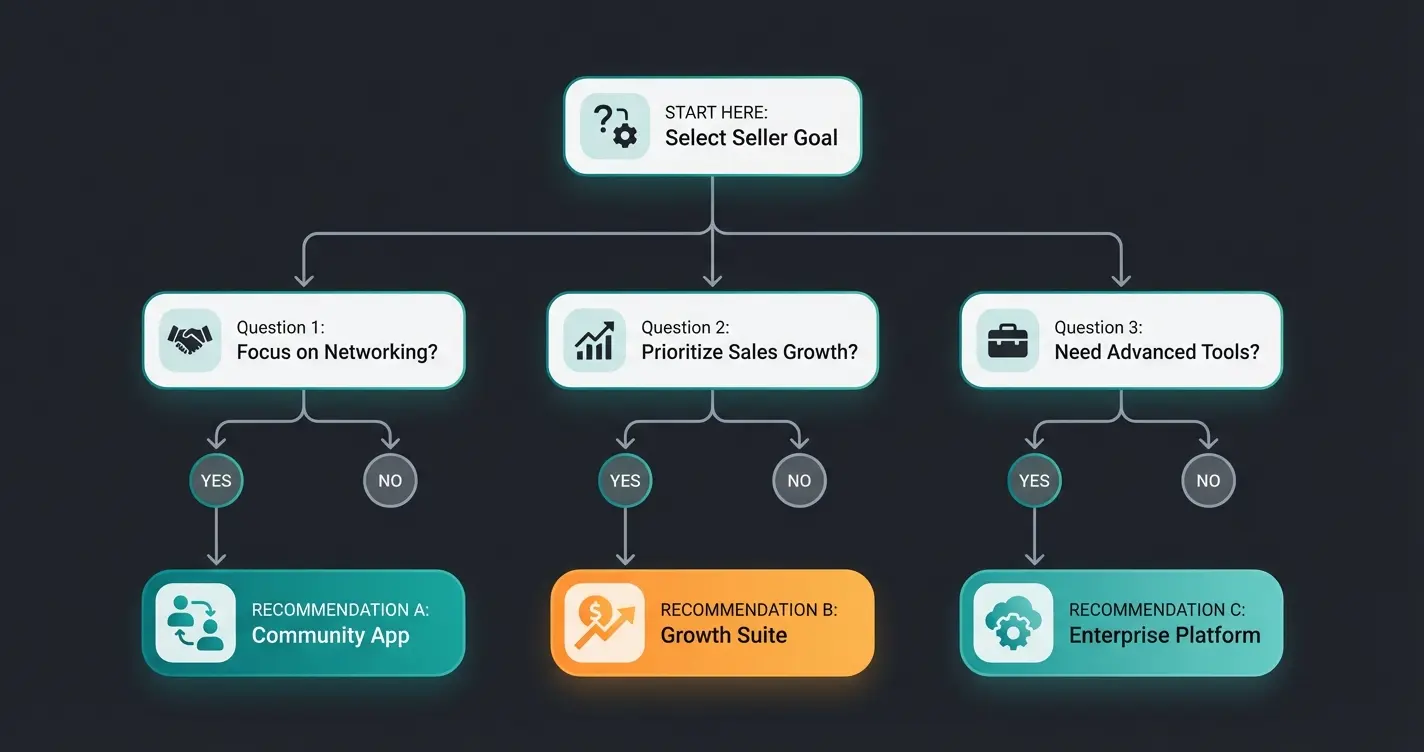
The right app depends on three things: how many products you sell, how many marketplaces you need, and how much you are willing to spend monthly. Here is the decision framework.
| Seller profile | Recommended app | Why |
|---|---|---|
| Small seller, <100 products, eBay only | eBay Integration DPL (Silver, $19.99/mo) | Best reliability, highest-rated, straightforward setup |
| Small seller wanting to test eBay first | Marketplace Connect (Free tier) | No cost for first 50 orders, good enough to validate demand |
| Mid-size, 100-1,000 products, eBay only | CedCommerce (Silver, $49/mo) | Bulk tools and multi-account support at this scale |
| Multi-marketplace (eBay + Amazon + Walmart) | Marketplace Connect ($99/mo cap) | One app for all marketplaces, simplifies operations |
| High volume, 1,000+ products, eBay focus | CedCommerce (Gold, $89/mo) | 100K product capacity, advanced bulk operations |
| Multi-marketplace, 3+ channels | LitCommerce (from $29/mo) | Supports 9+ channels including TikTok Shop and Faire |
If Amazon is your next marketplace after eBay, the Shopify Amazon Integration guide covers the same decision framework for that channel. Many merchants end up running both integrations simultaneously.
Automating multi-channel selling with AI
Adding eBay to your Shopify store solves the reach problem. It also creates a new one: more customer inquiries from more channels. Product questions on eBay messages. Order status requests through your Shopify chat. Shipping inquiries on social media. The volume scales faster than most teams expect.
This is where AI employees make a measurable difference. Signed, an online retailer for custom signs, automated 70% of customer inquiries across channels using an AI employee. The result: 18x ROI and a 30% increase in upselling, because the AI did not just answer questions, it guided customers toward the right product. Read the full Signed case study for the details.
For multi-channel sellers specifically, an AI employee handles the repetitive questions (sizing, shipping times, compatibility, return policies) that multiply with each new marketplace. Your team focuses on the complex cases that actually need a human. Learn more about how AI product consultation works in practice.
Qualimero's AI employees automate product consultation and customer service across Shopify, eBay, and social channels. Our clients see up to 18x ROI and 70% fewer manual inquiries.
Book a demoFAQ
Yes, but not natively. Shopify removed its built-in eBay sales channel in 2023. You now need an integration app like Shopify Marketplace Connect, CedCommerce, or eBay Integration DPL to sync products, inventory, and orders between the two platforms.
Shopify Marketplace Connect offers a free tier covering up to 50 synced orders per month. Beyond that, it charges 1% per order up to a $99 monthly cap. Third-party apps like CedCommerce offer limited free plans (10 products), while DPL starts at $19.99/month with no free tier but a 7-day trial.
Yes. Marketplace Connect (formerly Codisto) supports eBay alongside Amazon, Walmart, and Target Plus. It handles product listing, inventory sync, order routing, and fulfillment updates. However, user reviews note occasional syncing issues and a 4.2/5 rating that reflects reliability concerns at higher volumes.
All major integration apps offer inventory sync between Shopify and eBay. The key difference is sync speed: DPL and Marketplace Connect offer near-real-time updates, while some apps sync on 15-minute intervals. For high-volume sellers, real-time sync prevents overselling during peak periods.
It depends on your seller profile. eBay Integration DPL (4.9/5, 939 reviews) is the best overall for reliability. Shopify Marketplace Connect is best if you need eBay plus Amazon and Walmart from one app. CedCommerce is built for high-volume sellers managing thousands of SKUs.
Let an AI employee handle the repetitive inquiries so your team can focus on growth. Qualimero clients see +35% higher cart value and up to 70% fewer manual support tickets.
Start your free trial
Lasse is CEO and co-founder of Qualimero. After completing his MBA at WHU and scaling a company to seven-figure revenue, he founded Qualimero to build AI-powered digital employees for e-commerce. His focus: helping businesses measurably improve customer interaction through intelligent automation.