Shopware vs OXID in 2026: the short answer
For most mid-sized merchants in 2026, Shopware is the stronger choice: a free entry tier below 1 million EUR GMV, a far larger extension ecosystem, and an API-first architecture. OXID still earns its place in one scenario, an existing installation with deep ERP integration where the migration cost outweighs the gain.
Both platforms are German, both court the Mittelstand, and for a decade the comparison was genuinely close. Then the trajectories split. OXID retired its free Community Edition in August 2022 and moved every edition onto a paid monthly licence. Shopware kept a free tier and capped it instead, introducing a Fair Usage Policy on 24 March 2025 that draws the line at 1 million EUR annual GMV rather than at zero.
That single divergence explains most of what follows.
This comparison decides on five dimensions: licensing and total cost, technology stack, native B2B depth, ecosystem size, and migration effort. Every price below was verified against both vendors' own pricing pages in August 2026 rather than carried over from an older article, because both changed their terms inside the last 24 months. For the wider field beyond OXID, see our Shopware platform comparison.
Licensing and costs: what each platform actually charges
Shopware starts free below 1 million EUR annual GMV and moves into Rise from 600 EUR per month. OXID has had no free tier since 2022 and starts at 121 EUR per month on a 36-month term. Over three years, once hosting and agency work are included, the two totals overlap more than either vendor would like to admit.
GMV is the term that decides your Shopware bill, so it is worth pinning down. Shopware defines it as the total transaction value processed through the system: returns are included, discounts are subtracted, shipping counts, and taxes are excluded. Cross the 1 million EUR line and continued access to the Shopware Store and Account depends on subscribing to a paid plan.
Shopware states the consequence plainly on its own Fair Usage Policy page: "Businesses using the Community Edition with an annual GMV exceeding 1 million EUR, generated through their Shopware online store, must subscribe to Shopware Rise, Evolve, or Beyond to retain access to the Shopware Account and Shopware Store." The same page confirms the code itself stays open: the Community Edition "continues to be fully open source and is licensed under the permissive MIT License." Reporting is now mechanical, not honour-based. Since 14 April 2026, GMV reporting runs automatically for Community Edition shops on version 6.7.8 or newer.
OXID prices differently, and more simply. Every edition is a flat monthly licence on a fixed minimum term, with no revenue threshold anywhere in the model. OXID eSales leads its pricing page with the claim: "Transparent pricing, no revenue sharing." That is accurate. It is also the whole trade: no revenue share, but no way to run OXID for 0 EUR either.
| Cost item | Shopware (Q3 2026) | OXID eShop (Q3 2026) | Better value |
|---|---|---|---|
| Free entry tier | Community Edition, free below 1M EUR GMV | None since August 2022 | Shopware |
| Entry licence | 0 EUR under the GMV cap | Community Edition, 121 EUR/month | Shopware |
| Mid tier | Rise from 600 EUR/month | Professional, 360 EUR/month | OXID |
| Upper B2C tier | Evolve from 2,400 EUR/month | Enterprise B2C, 1,123 EUR/month | OXID |
| Native B2B tier | B2B Components in Evolve, customer-specific pricing only in Beyond | Enterprise B2B, 1,583 EUR/month, included | OXID |
| Minimum contract term | No multi-year lock-in on Rise | 36 months, 48 for Enterprise B2B | Shopware |
| Native AI add-on | Shopware Intelligence+ from 19 USD/month | No comparable native offering | Shopware |
Read that table honestly and OXID wins three of seven rows on sticker price. Professional at 360 EUR undercuts Rise at 600 EUR. Enterprise B2C at 1,123 EUR undercuts Evolve at 2,400 EUR. Anyone telling you Shopware is simply the cheaper platform has not opened the OXID pricing page. What Shopware wins is the entry point and the exit: free below the GMV cap, and no 36-month commitment on the way in. Both vendors revise their tiers often, so check the current Shopware pricing page and our Shopware editions compared breakdown before you commit.
Licence fees are also the smallest line in the bill, which is why the sticker comparison misleads. Over three years a mid-sized shop pays for managed hosting, agency retainer and extensions on top. Modelling those at DACH market rates (hosting 150 to 400 EUR per month, agency maintenance 800 to 2,000 EUR per month, extensions 100 to 300 EUR per month) and adding a 20% agency premium plus a 50% extension premium on the OXID side to reflect the smaller supplier pool produces the following three-year picture.
| 3-year cost component | Shopware (Rise) | OXID (Professional) |
|---|---|---|
| Licence | 21,600 EUR | 12,960 EUR |
| Managed hosting | 5,400 to 14,400 EUR | 5,400 to 14,400 EUR |
| Agency maintenance | 28,800 to 72,000 EUR | 34,560 to 86,400 EUR |
| Extensions | 3,600 to 10,800 EUR | 5,400 to 14,400 EUR |
| 3-year total | 59,400 to 118,800 EUR | 58,320 to 128,160 EUR |
Technology stack: API-first vs monolith
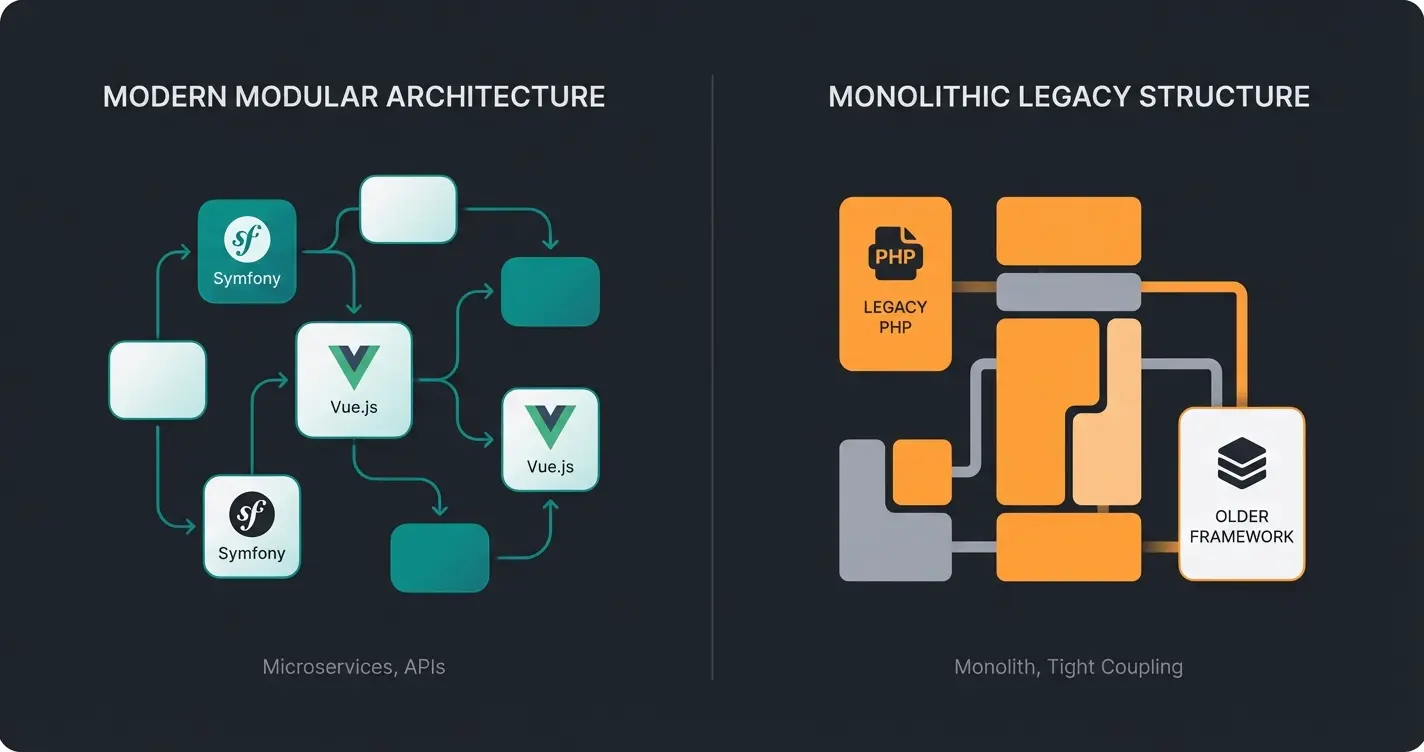
Shopware 6 runs on an API-first stack built on Symfony and Vue.js, licensed under MIT. OXID remains a largely monolithic PHP application. For headless storefronts, PWA frontends and third-party integrations, Shopware is the technically stronger platform, and the gap has widened rather than closed since 2022.
API-first is a marketing phrase until you measure what it costs you. Here is the practical difference. On Shopware 6, connecting an external system to product data, categories, properties and customer groups means authenticating against the documented Admin and Store APIs and reading structured JSON. On OXID, the same integration typically means writing a module against the core, because there is no equivalent full-surface REST layer covering the admin domain. In our own integration work that difference is roughly two to three days versus one to two weeks for a comparable connection.
| Dimension | Shopware 6 | OXID eShop |
|---|---|---|
| Backend framework | Symfony, MIT licensed | Custom PHP core, Twig templating |
| Admin interface | Vue.js single-page application | Server-rendered admin |
| API surface | Admin API and Store API, both documented | Partial, module-level extension required |
| Headless / PWA | Supported natively via Store API | Possible, but requires custom middleware |
The monolith is not automatically the loser here, and I think that gets overstated in most comparisons. Fewer moving parts means fewer things to operate. A two-person team running a stable catalogue on OXID has no deployment pipeline to babysit, no separate frontend build, and no API versioning to track. That is a real operational saving. It stops being a saving the moment your roadmap includes a second sales channel, an ERP-driven pricing feed, or an AI layer that needs live product data. If you are also weighing a version jump rather than a platform jump, our Shopware 5 vs 6 comparison covers that decision separately.
B2B capabilities: where OXID still holds ground
OXID ships stronger native B2B features at a lower tier than Shopware does. Its Enterprise B2B edition includes customer-specific price lists, order approval workflows and in-shop quoting at 1,583 EUR per month. Shopware splits the same capability set across Evolve and Beyond, and places customer-specific pricing in its top tier.
This is the section every competing comparison gets wrong, usually by declaring Shopware the winner reflexively. Check the two pricing pages side by side instead. OXID Enterprise B2B lists customer-specific price lists, order approval workflows, quote creation inside the shop, buyer management with roles and budgets, and quick, bulk and scheduled ordering, all inside one 1,583 EUR licence. Shopware's plan comparison puts B2B Components in Evolve, from 2,400 EUR, and lists customer-specific pricing and Digital Sales Rooms under Beyond.
- Customer-specific pricing. Included in OXID Enterprise B2B. On Shopware, listed under Beyond, the top tier.
- Quote and approval workflows. Native in OXID Enterprise B2B. Available on Shopware through B2B Components from Evolve upward.
- Budget and role management. Both platforms support it. OXID reaches it around 800 EUR per month cheaper at list price.
- Support response time. Shopware publishes explicit SLAs (8 hours on Rise, 4 on Evolve, 1 on Beyond). OXID includes German-language support and maintenance from Professional but does not publish equivalent reaction times.
So the honest verdict on B2B is not the one the market repeats. If your requirement is a deeply customised industrial catalogue with tiered pricing and approval chains, and nothing else on this list matters to you, OXID Enterprise B2B is the cheaper route to those features today. Shopware closes the gap on architecture and ecosystem, not on native B2B price.
Ecosystem, agencies and developer availability
Shopware's ecosystem is materially larger: roughly 3,500 extensions in the Shopware Store and more than 32,000 live shops worldwide. OXID lists over 100 certified solution partners. That gap is a hiring-risk argument rather than a popularity contest, and it surfaces as longer recruitment cycles and higher agency day rates.
Ecosystem size translates into money in two specific ways. First, extension coverage: a requirement that Shopware solves with a 300 EUR store extension may need a custom OXID module at several thousand euros. Second, supplier competition. With a partner network in the hundreds rather than the thousands, OXID merchants have fewer agencies to quote against each other, and switching agency mid-project is harder. Broader platform-share context is tracked by ecommerceDB market data if you want an independent view of platform distribution.
| Indicator | Shopware | OXID eShop |
|---|---|---|
| Marketplace extensions | ~3,500 in the Shopware Store | Smaller OXID eXchange catalogue |
| Live shops worldwide | 32,000+ | Not publicly published |
| Certified partner agencies | Four-figure global partner network | 100+ certified solution partners |
| Practical effect | More quotes, faster hiring, cheaper off-the-shelf coverage | Fewer suppliers, more custom development |
Migrating from OXID to Shopware: effort, cost and risk
A typical OXID-to-Shopware migration runs three to six months and is dominated by data mapping, not by the platform install. The three cost drivers are custom module rewrites, catalogue and customer-data mapping, and URL redirect preservation to protect existing rankings. The install itself is a day.
Two of the five competing pages ranking for this query are migration service pages rather than comparisons, which tells you where the real intent sits. Here is what those pages tend not to quantify.
Inventory every custom OXID module, every ERP touchpoint and every URL pattern currently indexed. This phase sizes everything that follows.
The dominant cost. OXID stores attributes flat; Shopware 6 uses a dynamic properties system. Mapping this badly breaks every filter in the new shop.
Custom OXID modules do not port. Each is rebuilt as a Shopware plugin or replaced with a store extension. Run this in parallel with phase 2.
OXID commonly hashes passwords with salted MD5, Shopware uses bcrypt or sodium. Without a re-hash-on-first-login script, customers cannot log in after cutover.
301 redirects for every indexed product and category URL. Skip this and rankings built over years disappear in a fortnight.
Run both systems against live data, reconcile orders and stock, then switch DNS. Never cut over during peak season.
Cost scales with module count, not catalogue size. A shop with a clean catalogue and two or three custom modules typically lands in the lower five figures. A shop with fifteen years of accumulated custom logic and a tightly coupled ERP lands in the six figures, and that is the case where staying put is the rational answer. The pattern is not unique to OXID: our Magento vs Shopware comparison shows the same relationship between legacy customisation and replatform cost.
Why consultation beats platform features
Whether you run Shopware or OXID, the larger revenue lever is not the platform. It is how well the shop advises the customer. Across Qualimero deployments, AI product consultation lifts average basket value by around 35% and checkout rate by around 60%, and it works on either system.
OXID's installed base skews technical: spare parts, industrial supply, building materials, automotive. Those catalogues share a problem that no platform migration fixes. The customer does not arrive knowing the article number. They arrive with a specification problem, and a filter tree cannot answer a specification problem.
HELLA's Lightstyle division is a clean example. Auxiliary vehicle lighting carries approval rules, compatibility constraints and ECE regulations, which meant technically complex enquiries arriving around the clock. The HELLA Lightstyle AI product advisor now handles compatibility, installation and regulatory questions directly, cutting support enquiries by 60% while keeping product recommendations legally compliant. Rasendoktor ran the same play in lawn care, where 2,000 to 3,000 consultation-heavy enquiries per season were overwhelming the support team; the Rasendoktor success story documents 100% webchat automation, 40% support savings and a 16x return.
HELLA Lightstyle, technical and regulatory product questions handled automatically
Rasendoktor, seasonal lawn care catalogue
Rasendoktor, all inbound webchat enquiries answered without a human handover
Rasendoktor, measured against pre-deployment staffing
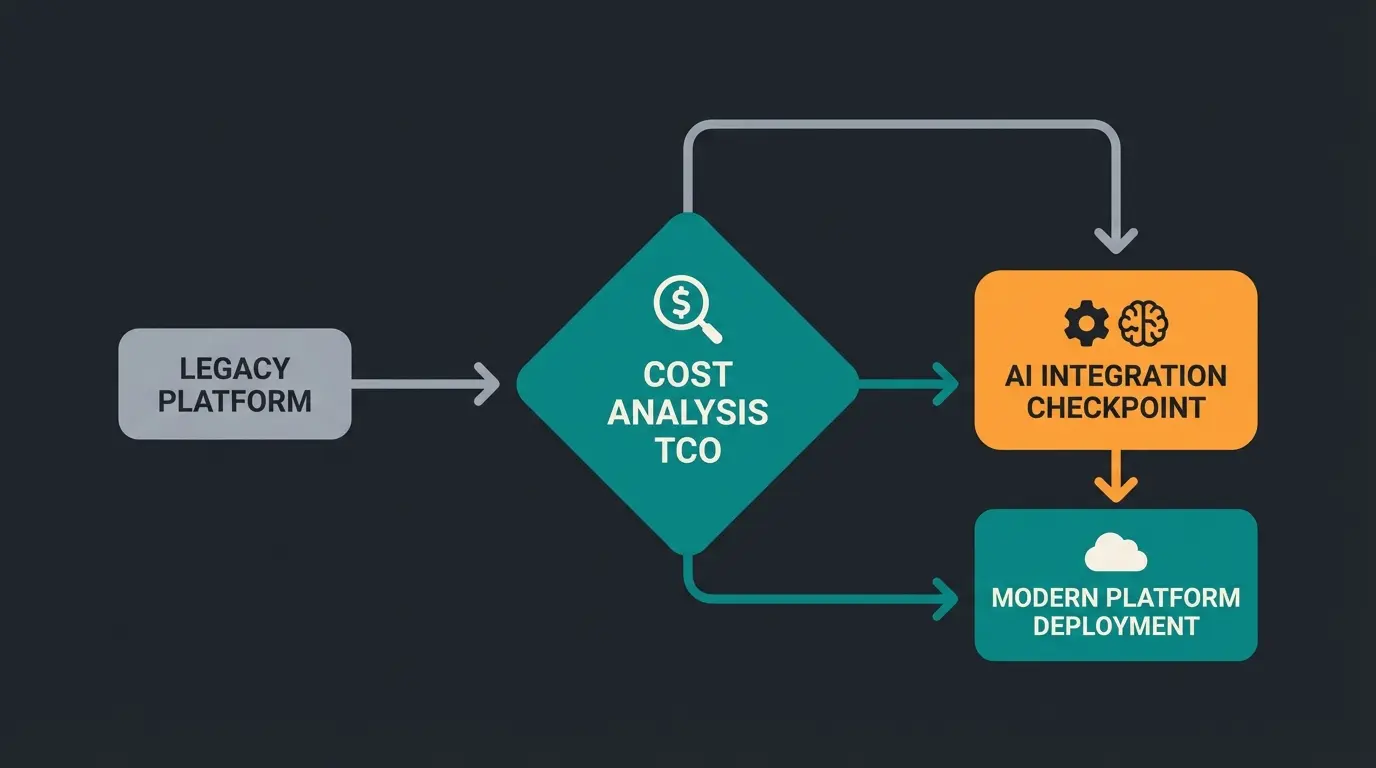
Here is the part that argues against my own commercial interest: this does not decide the platform question. An AI product consultation layer connects to OXID as well as it connects to Shopware. It is slower to build against a monolith, but it is entirely possible. So do not migrate in order to get it. Migrate for architecture, ecosystem or cost, and treat consultation as the separate question of where the next budget goes.
Which platform should you choose?
Choose Shopware for new projects, for B2C, and for any roadmap involving headless or heavy integration. Stay on OXID only if you run an existing installation with deep ERP coupling and heavily customised B2B logic, where a rewrite would cost more than it returns over three years.
| Your situation | Verdict | Why |
|---|---|---|
| New B2C project | Shopware | Free below the 1M EUR GMV cap, no minimum term, largest extension pool. There is no case for paying 121 EUR/month to start on OXID. |
| New B2B or industrial project | Shopware, with one caveat | Architecture and ecosystem win long term. But price the B2B feature set honestly: OXID Enterprise B2B reaches customer-specific pricing around 800 EUR/month cheaper. |
| Existing OXID, light customisation | Migrate | Two or three custom modules puts migration in the lower five figures, recovered inside three years through agency and extension savings. |
| Existing OXID, deep ERP coupling | Stay | Six-figure migration against a modelled saving that may be near zero. Invest in conversion and consultation instead. |
The break-even test is simple enough to run on one page. Model your three-year cost on both platforms using the components in the TCO table above, subtract, and compare the difference against a migration quote. If the saving does not clear the quote by a comfortable margin, the migration is a technology preference, not a business case. If you are not convinced by either platform, our Shopware alternatives overview covers the rest of the field.
Other Shopware comparisons
Shopware is most often weighed against Shopify, WooCommerce, JTL, PrestaShop and Spryker. Each matchup turns on a different trade-off: hosting model, B2B depth, or enterprise scale.
If the real question is self-hosted versus SaaS, start with Shopware vs Shopify. If budget is the binding constraint and you already run WordPress, Shopware vs WooCommerce is the closer comparison. German merchants running warehouse and ERP processes in one suite should read Shopware vs JTL, while Shopware vs PrestaShop covers the open-source lightweight end. At the top of the range, Shopware vs Spryker is the enterprise composable-commerce question.
FAQ
No. OXID retired the free Community Edition in August 2022, and as of Q3 2026 the Community Edition costs 121 EUR per month on a 36-month minimum term. A reduction is possible for shops below 100,000 EUR annual revenue, but there is no zero-cost entry point.
Cost scales with custom module count rather than catalogue size. A clean catalogue with two or three custom modules typically lands in the lower five figures over three to six months, while fifteen years of accumulated custom logic and tight ERP coupling can reach six figures.
OXID is currently the cheaper route to native B2B features. Enterprise B2B at 1,583 EUR per month includes customer-specific price lists, approval workflows and in-shop quoting, whereas Shopware places B2B Components in Evolve from 2,400 EUR and customer-specific pricing in Beyond. Shopware wins on architecture and ecosystem, not on B2B list price.
It depends on your customisation depth. Model three-year costs on both platforms and compare the difference against a migration quote: if the saving does not clearly exceed the quote, staying is the rational call. Shops with light customisation usually recover the cost inside three years.
The Community Edition is free below 1 million EUR annual GMV under the Fair Usage Policy that took effect on 24 March 2025. Above that threshold, Rise starts from 600 EUR per month and Evolve from 2,400 EUR per month, with Beyond priced individually. Hosting and agency costs are separate.
Products, customers and orders migrate reasonably well, but attributes do not map one-to-one because OXID stores them flat while Shopware 6 uses a dynamic properties system. Budget separately for password re-hashing, since OXID commonly uses salted MD5 and Shopware uses bcrypt or sodium.
Whichever way the Shopware vs OXID decision goes, your customers still have to work out which product actually fits. A Qualimero AI employee answers that in the shop, in real time, on either platform: +35% average basket value, +60% checkout rate, and 16x ROI at Rasendoktor. Test it against your own catalogue.
Start your free trial
Kevin is CTO and co-founder of Qualimero. As an AI architect with over 15 years of experience as CTO and CPO in the tech industry, he designs the AI systems that automate tens of thousands of customer interactions daily for Qualimero's clients — reliably, securely, and at scale.