Why the price tag only tells half the story
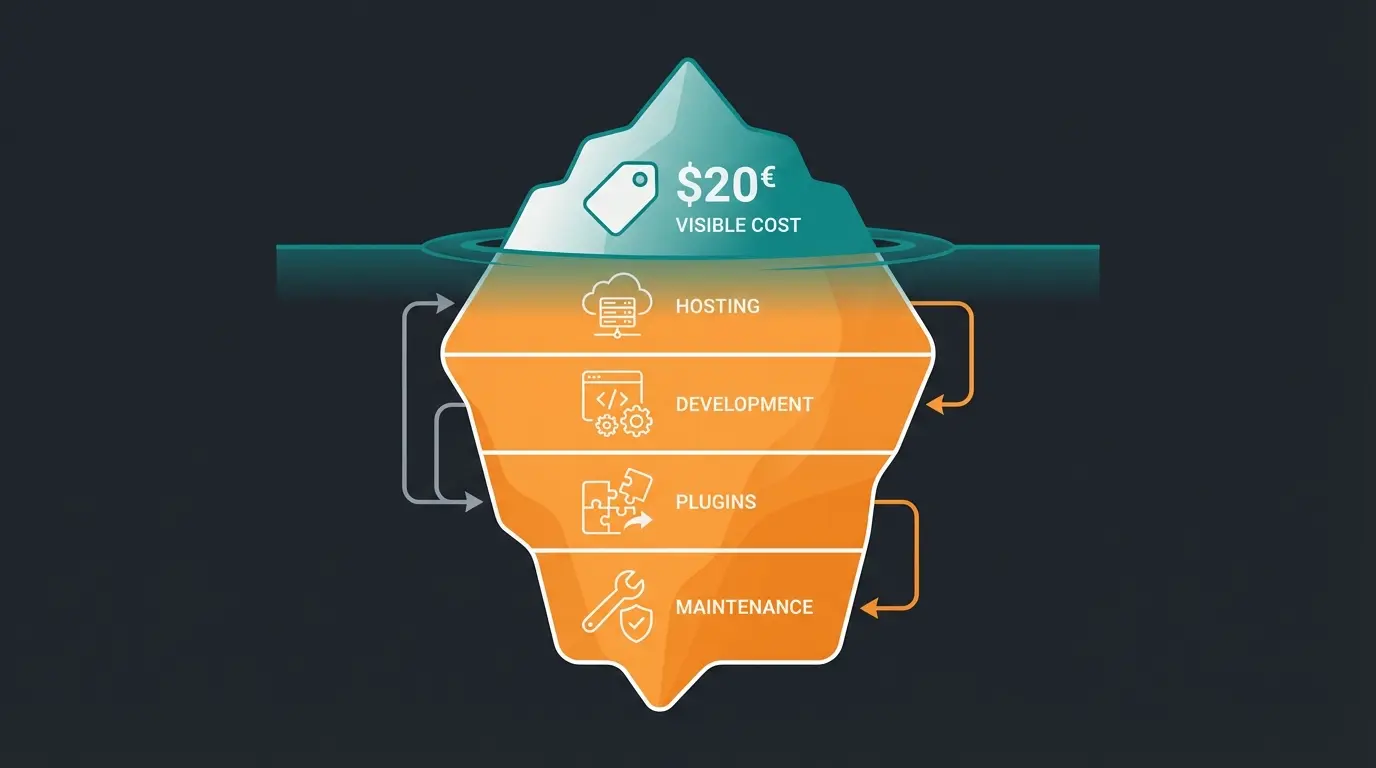
Shopware license costs are only 15 to 25 percent of what you will actually spend running a shop. The rest, hosting, development, plugins, maintenance, and personnel, makes up the bulk of the real bill. Knowing the full picture before you commit is the only way to plan a budget that holds.
Germany’s e-commerce sector reached €84.7 billion in revenue in 2025, with the HDE raising its forecast to €92.4 billion by mid-year. That represents a market where margins are tight and infrastructure decisions compound over years. Choosing a platform is a multi-year capital commitment, not a monthly subscription you walk away from.
The confusion around Shopware costs usually comes from comparing license tiers in isolation. A merchant who moves from Community to Rise sees a €600/month line item appear. But they overlook the agency retainer, plugin subscriptions, and server scaling costs that were already accumulating quietly.
Total cost of ownership (TCO) is the only metric that tells the full story. For a mid-sized merchant, that TCO typically falls between €80,000 and €200,000 over three years. We have built and maintained dozens of Shopware shops across that range, and the pattern is consistent: merchants who budget only for the license end up surprised by month six.
Official Shopware 6 license costs (monthly)
Shopware offers four tiers as of Q3 2026: Community Edition at no license fee, Rise at €600/month, Evolve at €2,400/month, and Beyond at approximately €6,500/month. Each tier unlocks progressively more native features, but the jump in price is not linear with the jump in capability. For most growing shops, the real question is whether Rise covers the gap or whether Evolve’s B2B suite justifies the 4x price increase.
Community Edition is open-source and free to download. It covers the core storefront, order management, a basic CMS (Shopping Experiences), and standard checkout flows. You own the installation. You bear the infrastructure costs. Nothing in the license prevents you from running a seven-figure shop on Community. Many do.
What Community does not include: the B2B Suite (customer portals, quote management), AI Copilot, Publisher workflow tools, Flow Builder automation, and dedicated Shopware support beyond the community forum. For shops that need any of these, the options are custom development or a tier upgrade. Custom development for B2B portal functionality alone typically runs €8,000 to €20,000, which reframes the €600/month Rise fee as a potentially cheaper path.
Tobias Schaefer, a freelance Shopware developer with over ten years of platform experience, puts it plainly: "For most shops I build, Community Edition is the right starting point. The missing features are real but rarely needed until a business has outgrown its first setup." (tobias-schaefer.com)
Shopware Rise adds flow automation, AI Copilot, digital sales rooms, and priority support queues with 8-hour response times on weekdays. For merchants who need rule-based promotions at scale or subscription models, the €600/month cost displaces significant custom development. Our assessment: for 90% of all B2C merchants, Rise is sufficient.
Evolve at €2,400/month targets mid-market merchants who need native B2B features: quote management, customer-specific pricing, advanced permissions, multi-currency catalogs, and Enterprise Search for large product catalogs. Without Evolve, those features require expensive custom development or a patchwork of third-party plugins. Support response drops to 4 hours.
Beyond is Shopware’s enterprise tier. Pricing is negotiated, but ~€6,500/month aligns with publicly available data and agency briefings as of 2026. It includes dedicated account management, SLA guarantees, 24/7 support with 1-hour response times, multi-inventory management for multiple warehouse locations, and a Customer Success Manager. See our Shopware Enterprise guide for the full feature comparison.
| Edition | Monthly fee | Target profile | Key additions | Support SLA |
|---|---|---|---|---|
| Community | €0 | Startups, developers | Core storefront, CMS, checkout | Community forum only |
| Rise | €600 | Growing D2C | Flow builder, AI Copilot, sales rooms | 8h weekdays |
| Evolve | €2,400 | Mid-market, B2B | B2B suite, quotes, advanced pricing | 4h weekdays |
| Beyond | ~€6,500 | Enterprise | Multi-inventory, dedicated CSM | 1h, 24/7 |
For current feature details per tier, the official Shopware pricing page is the primary source. What that page does not spell out is the licensing mechanics underneath the price: what you own, what you rent, and what happens when you stop paying. That comes next. For merchants planning a new build, the complete Shopware guide walks through the full setup process.
The Fair Usage Policy: what happens when you succeed?
Shopware’s Fair Usage Policy caps gross merchandise volume (GMV) at five times the annual license fee per tier. For a Rise merchant paying €7,200/year, that cap sits at €36,000 in annual GMV before an upgrade becomes required. Merchants approaching that ceiling face either a tier upgrade or a negotiated arrangement, and the cost jump from Rise to Evolve (€600 to €2,400/month) is substantial.
The rationale is legitimate: it prevents high-volume merchants from extracting disproportionate infrastructure and support value at a low-tier price. But for merchants scaling fast, it creates a planning problem. Revenue growth triggers licensing cost growth, often at exactly the wrong moment.
Since March 2025, the Fair Usage Policy also requires all Community Edition users to report their GMV. Stores exceeding €1 million in annual GMV must upgrade to a paid plan. This is not optional. Merchants who exceed the threshold and do not switch lose access to the Shopware Account and the Shopware Store entirely: no security updates for plugins, no new installations, and potentially significant security exposure.
For Community merchants approaching that threshold, the upgrade path is clear: plan €600/month for Rise into your budget once you pass €700,000-800,000 annual GMV. Once you are on a paid tier the GMV ceiling disappears entirely, which is the single strongest argument for moving to Shopware Rise before the policy forces your hand.
License models: what you own and what you rent
Shopware sells subscriptions, not perpetual licenses. The Community Edition code is MIT-licensed and yours to keep. Every commercial tier is a monthly or annual rental, every marketplace plugin has been rental-only since December 2023, and the upgrade path runs in one direction far more easily than the other.
The core is genuinely open source. Shopware publishes the Shopware 6 codebase on GitHub under the MIT license, so you can download it, fork it, and deploy it without paying anyone a cent. What the MIT license does not hand you is the connected layer: Shopware Account, the Extension Store, official support, and the hosted services built on top of the core. All four tiers run the same codebase. The difference is entitlements, not software.
One line item that almost never appears in comparison tables: Shopware Intelligence+. As of August 2026 the AI add-on costs €29/month for Community Edition users and €19/month on paid plans (Shopware pricing). Small money against a €600 license, but merchants who budget an AI line separately often pay for the same capability twice.
Plugin licensing is rental-only
Since December 2023, Shopware Store extensions are rented rather than bought. The perpetual purchase option no longer exists. According to the Shopware extension licensing FAQ, an extension purchase now includes a subscription valid for one year, and lapsed subscriptions can only be moved onto one of the two discounted rental models.
The immediate consequence is milder than most merchants fear. When a subscription expires the extension keeps running, and the admin panel starts issuing warnings. What stops is updates and manufacturer support. Then a Shopware core release lands six months later, the unmaintained plugin breaks your checkout, and the saving turns into an emergency invoice. That is the actual cost, just deferred.
Staging and test environments
Staging licensing is tiered, and development teams tend to discover this mid-project. Rise, Evolve, and Beyond subscribers register a staging domain directly in Shopware Account, and that domain inherits every active extension license from production automatically. Community Edition has no staging domain feature at all.
- Rise, Evolve, Beyond: register the staging domain in Shopware Account, extension licenses transfer automatically
- Community Edition: no staging domain feature, no automatic license inheritance
- Community workaround: running staging in a subfolder of the licensed production domain usually keeps plugins functional
- Budget impact: teams that hit this after development starts lose two to five days rebuilding the deployment workflow
Upgrading, and the downgrade nobody documents
Community to Rise is self-service. You select the plan inside Shopware Account, enter billing details, and it activates without a sales call. Moving from Rise to Evolve or Beyond is not self-service: expect a sales conversation, a contract amendment, and a billing adjustment. Timing matters here more than merchants assume. If your GMV is closing on the €1M threshold, upgrade before you cross it, because reactivating a suspended Shopware Account is slower and messier than a planned transition.
MIT license, self-hosted, capped at €1M annual GMV under the Fair Usage Policy.
Self-service upgrade inside Shopware Account. No sales call, no contract negotiation.
Sales conversation and contract amendment required. Full B2B suite and 4h support SLA.
Negotiated pricing, dedicated CSM, 24/7 support with 1h response. No published list price.
One-time costs: what does setup cost?
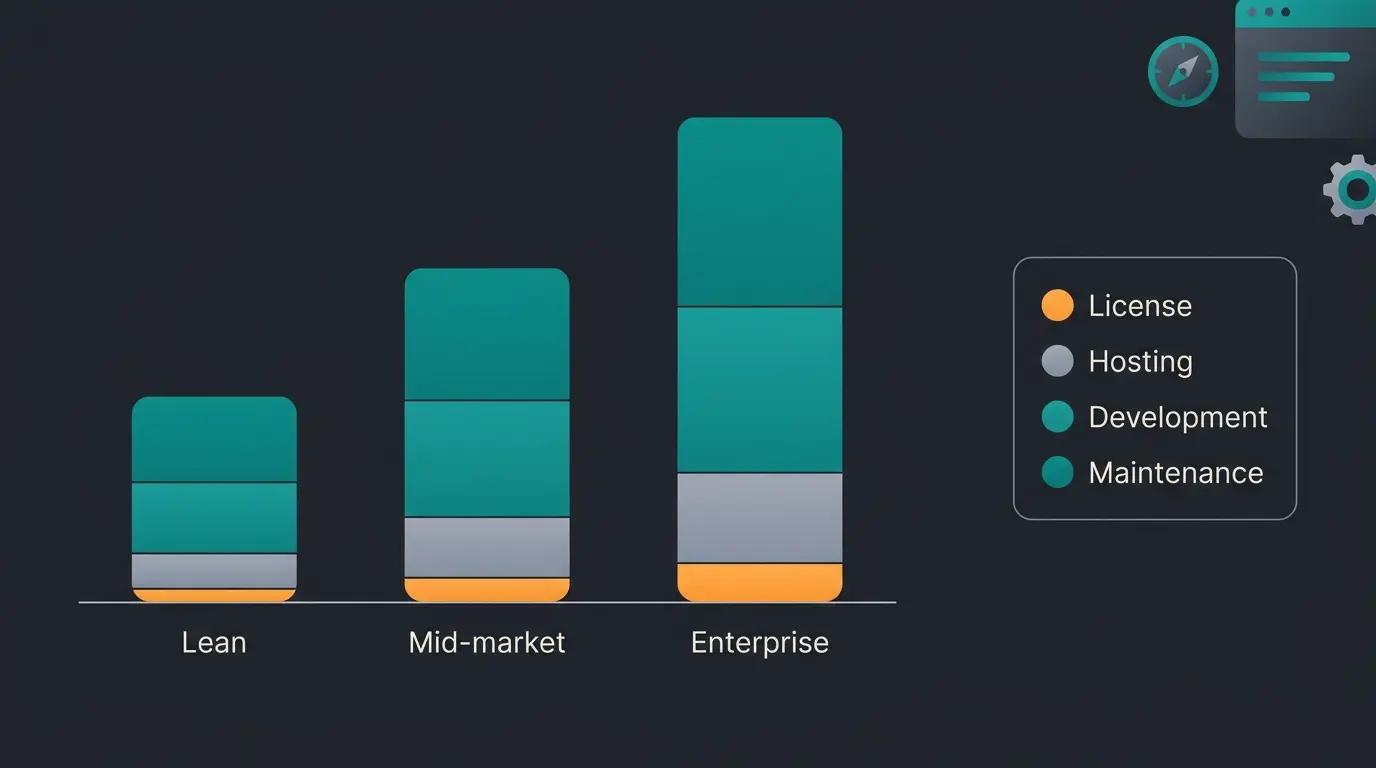
Setup costs for a new Shopware shop range from €5,000 for a lean MVP to over €200,000 for a fully custom enterprise build. The spread is wide because the definition of "done" varies enormously. An MVP with a standard theme and basic payment integration is a fundamentally different project than a headless PWA with custom B2B logic and ERP integration.
Agency hourly rates in Germany for certified Shopware partners run €100 to €180/hour as of 2026. That range reflects both the agency tier (Silver vs. Platinum partner) and the project complexity. Freelancers typically bill €70 to €110/hour, which looks cheaper but often means less structured project management and higher revision risk on complex builds.
A realistic MVP, covering theme customization, catalog import up to 5,000 SKUs, payment gateway integration, basic SEO setup, and launch testing, requires roughly 80 to 150 agency hours. At €130/hour mid-range, that translates to €10,400 to €19,500 in development alone. According to BrandCrock’s 2026 cost analysis, even entry-level setups require a minimum of 40 to 90 hours.
| Project type | Typical budget | Timeline | What’s included |
|---|---|---|---|
| Lean MVP | €5,000 - €15,000 | 4-8 weeks | Standard theme, basic catalog, payment integration |
| Mid-market shop | €15,000 - €50,000 | 8-16 weeks | Custom theme, ERP lite, product configurator |
| Full B2B platform | €50,000 - €120,000 | 16-32 weeks | B2B suite, custom pricing, deep ERP/PIM integration |
| Enterprise build | €120,000 - €200,000+ | 6-12 months | Headless architecture, microservices, multi-store |
Data migration is consistently underestimated. Moving product data, customer records, order history, and SEO URL structures from a legacy platform adds 20 to 40 hours to most projects. For shops with large catalogs (50,000+ SKUs), that climbs to 80 to 150 hours. A common mistake: skipping SEO redirect mapping during migration. Every URL that changes without a 301 redirect loses accumulated search equity. For a shop with 2,000 indexed pages, remapping URLs properly takes 10 to 20 hours but prevents the traffic loss that undermines the business case for migrating.
Third-party integrations multiply setup costs fast. A standard ERP connector (SAP, Microsoft Dynamics, or JTL) adds €3,000 to €12,000 depending on whether a pre-built plugin covers the use case or custom middleware is required. CRM integrations (HubSpot, Salesforce) range from €4,000 to €12,000. Tobias Schaefer notes that "ERP integrations are almost always more complex than the first estimate" (tobias-schaefer.com). Budget €5,000 to €15,000 per integration.
Two variables move that setup number more than scope alone: how the budget splits across project phases, and who does the building. Both are worth breaking down, because both are where quotes diverge by a factor of five for what sounds like the same project.
Where the build budget actually goes
Shopware build budgets split across five phases: planning and consulting take 10-15%, UX and design 15-25%, core development 30-40%, content and data migration 10-15%, and testing plus launch prep the remaining 5-10%. Development absorbs the largest share. Underinvesting in planning is where projects go over budget.
Requirements analysis, technical architecture, vendor evaluation. €1,500-6,000 on a standard project.
Wireframes, visual design, responsive templates. Standard theme adjustments €1,500-4,000, fully custom €6,000-20,000.
Theme implementation, plugin configuration, custom features, payment and shipping integration. €5,000-40,000.
Product data import, category mapping, redirect plan, regression testing. Clean data €1,500-5,000, messy legacy data double that.
Broken down to line items, the ranges get useful. BrandCrock's Shopware cost breakdown publishes per-work-package figures that match what we see in German agency proposals as of Q3 2026.
| Work package | Typical range | Notes |
|---|---|---|
| Standard theme with adjustments | €1,500 - €4,000 | Fastest route to a live shop |
| Custom design with custom templates | €6,000 - €20,000 | Adds four to eight weeks to the timeline |
| ERP integration | €4,000 - €12,000 | SAP Business One, Dynamics, JTL, Xentral |
| PIM integration | €3,000 - €10,000 | Becomes hard to avoid above roughly 10,000 SKUs |
| CRM integration | €2,500 - €8,000 | HubSpot, Salesforce |
| Payment and shipping setup | €1,300 - €4,000 | €500-1,500 payment, €800-2,500 shipping |
| Data migration | €1,500 - €10,000 | €3,000-15,000 from Shopware 5 with complex catalogs |
| SEO setup, training, performance tuning | €3,300 - €13,000 | The three line items most often missing from a quote |
That last row is the one worth arguing about in a kickoff meeting. SEO setup (€1,000-4,000), team training (€800-3,000), and performance optimization (€1,500-6,000) are rarely in a fixed-price quote, yet all three are required before a shop earns anything. A build that launches without redirect mapping and Redis caching is not finished. It is just live.
Agency, freelancer, or in-house
Certified agencies bill €100-180/hour, freelance Shopware developers €60-125/hour, and a DIY Community Edition build costs near zero in software plus every hour of your own time. The rate gap is not the real decision. The decision is what happens when the person building your shop becomes unavailable two weeks before launch.
| Factor | Agency | Freelancer | DIY (Community Edition) |
|---|---|---|---|
| Hourly rate | €100 - €180 | €60 - €125 | Your time |
| Typical project cost | €18,000 - €100,000+ | €3,000 - €20,000 | €0 - €2,000 in software |
| Timeline | 3 - 9 months | 2 - 6 months | 1 - 6 months |
| Risk if unavailable | Low, the team absorbs it | High, single point of failure | You are the only resource |
| Post-launch support | SLA-based, €300-1,000/mo | Project-based, varies | Community forum only |
| Best fit | Complex builds, ERP depth, B2B | Defined features, tight budgets | Technical founders, MVPs |
Within the agency bracket, certification tier moves the rate. Shopware certifies partners in four tiers: Bronze, Silver, Gold, and Platinum, with Platinum requiring 20 certifications. Across the DACH proposals we review, Silver partners typically bill €100-130/hour, Gold partners €120-150, and Platinum partners €140-180. The Shopware partner directory lists over 1,200 certified agencies, so quotes are comparable if you request at least three. One caveat from our audit work: tier does not guarantee proportional quality. We have reviewed projects where an agency charged €150,000+ for what should have been a €50,000 build.
Rates track geography more closely than seniority. Index.dev's 2026 European developer rate analysis puts German contract developers at $64-128/hour, while Polish contractors land at $50-70/hour and Romanian contractors at $45-65/hour. That spread is what makes the hybrid model work on mid-size builds: a senior architect in the DACH region owns the data model and the ERP integration, an implementation team in Central Europe does the volume work.
The hourly rate itself tells you less than you think. A Platinum developer at €160/hour who solves a problem in four hours costs €640. A nearshore developer at €50/hour who needs 20 hours plus five hours of your own project management costs more than €1,000. Abbacus Technologies quantifies the overhead: freelancer-led projects consume roughly 20 hours of internal coordination per week versus 5 with an agency, and every dollar saved on the rate adds 20-40% in management time. Effective cost per solved problem matters more than the number on the invoice.
Pricing models split the market in two. Fixed-price contracts fit clearly scoped projects with stable requirements, but they only work after detailed scoping sessions, and change requests are billed on top. Any agency that quotes a fixed price without at least two scoping sessions is guessing. Time and material fits evolving scope, third-party API work, and iterative design. Shop Studio argues fixed prices are "well calculable for both parties" after sufficient discussions and quotes fixed builds from €7,500 for small stores, €20,000 for medium, and €50,000 for large ones. A third model is gaining ground in 2026: value-based pricing, where part of the fee is tied to conversion or revenue milestones. It aligns incentives, but it requires clean baseline analytics, which rules out most new launches.
Here is the mistake I see repeated. A merchant takes the cheapest bid on a complex project, then spends more repairing the result than the agency quote would have cost in the first place. Cheap builds are not cheap. They are invoices with a delay.
Ongoing operating costs: the hidden drivers
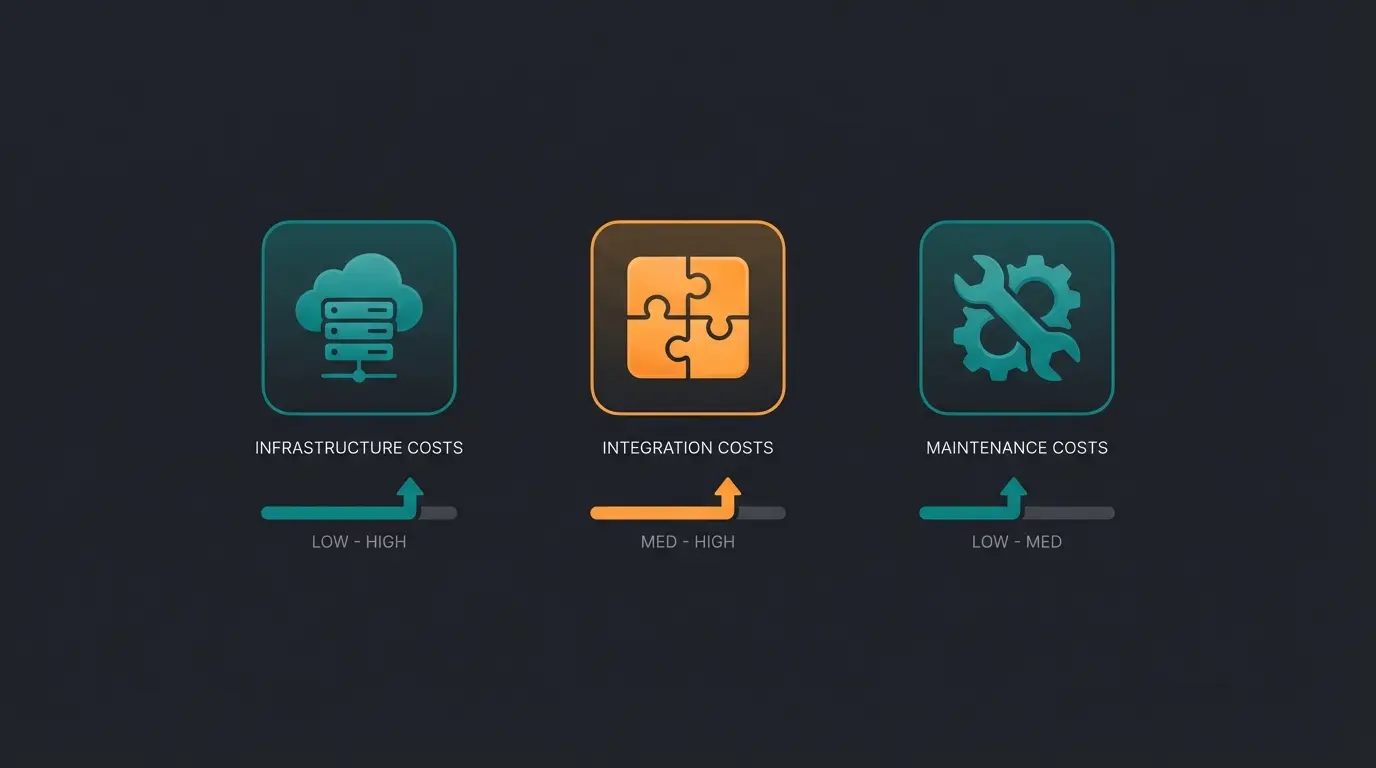
After launch, the recurring cost structure has three main components: hosting, plugins, and maintenance. Together they typically run €660 to €5,300/month for a mid-sized shop. These costs are predictable but frequently underbudgeted because merchants fixate on the one-time setup number instead of the monthly burn rate.
Hosting
Hosting costs split along a self-managed versus managed spectrum. Self-hosted infrastructure on a VPS or dedicated server runs €30 to €500/month depending on traffic volume and redundancy requirements. That price looks attractive until you factor in the internal time cost: server administration, security patching, uptime monitoring, and SSL certificate management.
Managed Shopware hosting from providers like maxcluster, Mittwald, or timmehosting runs €60 to €400/month. maxcluster became an official Shopware Recommended Hosting Partner in November 2025. The upper end covers high-availability setups with staging environments, automatic backups, CDN integration, and guaranteed uptime SLAs. According to BrandCrock, performance-focused setups with Redis, Varnish, and CDN typically fall in the €150-400/month range.
Shopware 6 is resource-hungry compared to simpler platforms. A €5/month shared hosting plan will not run it. The Symfony/PHP foundation, Elasticsearch requirement, and media handling all demand dedicated resources. For shops expecting traffic spikes (Black Friday, seasonal campaigns), auto-scaling infrastructure adds another €50-200/month in standby capacity.
Mobile commerce now accounts for over 63% of B2C orders in Germany via smartphone (Statista, 2025). That means hosting performance on mobile, particularly page load time under LTE conditions, directly affects revenue. Under-investing in CDN and caching infrastructure is a false economy when more than half your orders come from mobile devices. A €50/month CDN add-on that shaves 400ms off mobile load time pays for itself many times over in reduced bounce rates.
Plugin costs
Plugin costs are the most variable line item and the budget category everyone underestimates. The Shopware Store lists thousands of extensions spanning three pricing models: free (limited functionality), SaaS subscriptions (€10-500/month), and one-time purchases (€300-2,000). A mid-sized shop running standard operations typically needs an SEO plugin, review management, a payment gateway extension, and at minimum one analytics or feed tool.
The distinction between SaaS and one-time-purchase plugins matters more than it appears. SaaS plugins (€10-500/month) include ongoing updates, API hosting, and vendor support. One-time purchases (€300-2,000) are cheaper upfront but shift the update burden entirely to you. When Shopware releases a major version, one-time-purchase plugins may require a paid upgrade or simply stop working. We have tested both models extensively across client shops and recommend SaaS for anything touching checkout, payment, or customer data. The ongoing cost is worth the guaranteed compatibility.
Concrete example: a shop running Mollie for payments (€0/month, transaction-based), a review plugin (€29/month), an SEO suite (€49/month), Google Shopping feed (€39/month), and a cookie consent tool (€19/month) spends €136/month before any specialized plugins. Add a product configurator (€79/month) and a loyalty points extension (€49/month), and the stack reaches €264/month. An average shop uses 10 to 20 plugins. Annual plugin licensing easily reaches €1,000 to €3,000 according to BrandCrock.
Maintenance retainers
Shopware releases major updates regularly, and each update requires regression testing, plugin compatibility checks, and deployment verification. An agency retainer of €500 to €2,000/month covers this systematically. The scope typically includes: core updates (4-6 per year), plugin updates (monthly), security patches (as released), performance monitoring, and a fixed hours budget for minor fixes and adjustments.
Merchants who skip the retainer and handle updates ad hoc face concentrated costs. A major version upgrade deferred for two years becomes a €15,000 project instead of a predictable monthly expense. Worse, deferred security patches create vulnerability windows. The average cost of a data breach for a German SME is €130,000 according to IBM’s Cost of a Data Breach Report 2024. A €500/month maintenance retainer is cheap insurance.
A typical maintenance retainer at €1,000/month covers approximately 8-10 agency hours. That time budget breaks down roughly as follows: 2-3 hours per month for core and plugin updates (4-6 core updates per year, monthly plugin cycles), 1-2 hours for security patch monitoring and emergency response, 2-3 hours for performance monitoring and minor bug fixes, and 1-2 hours for quarterly compatibility testing after major Shopware releases. Shops with complex integrations (multiple ERP connections, custom plugins) should budget at the higher end (€1,500-2,000/month) to cover integration regression testing.
Hidden recurring costs most merchants miss
Beyond hosting, plugins, and maintenance, several smaller recurring costs accumulate quietly. Payment processing fees from Stripe run 1.5% plus €0.25 per transaction for European cards (Stripe). On €1,000,000/year GMV, that is €15,000 to €30,000 in processing fees alone, often exceeding the annual license cost.
Legal text subscriptions (Händlerbund or IT-Recht Kanzlei) cost €10-30/month but are mandatory for DSGVO-compliant operations in Germany. Cookie consent tools like Usercentrics add €15-50/month. SSL certificates range from free (Let’s Encrypt) to €50-150/year for extended validation. DDoS protection, if not included in your hosting plan, adds another €20-100/month. None of these are large individually. Together, they add €500-1,500/year to operating costs.
| Cost category | Low end | High end | Notes |
|---|---|---|---|
| Managed hosting | €60 | €400 | HA setup with CDN and backups at high end |
| Shopware license | €0 | €2,400 | Community to Evolve; Beyond negotiated separately |
| Plugin subscriptions | €100 | €500 | SEO, reviews, payment, loyalty, feeds |
| Maintenance retainer | €500 | €2,000 | Agency hours for updates, patches, minor fixes |
| Payment processing | €250 | €2,500 | 1.5% + €0.25/tx via Stripe; scales with GMV |
| Legal, cookie, SSL | €40 | €80 | Mandatory compliance costs |
| Total monthly | €950 | €7,880 | Excluding Beyond tier shops |
Personnel costs and AI-powered cost optimization
Personnel costs are the largest and least discussed component of Shopware TCO. Customer service, catalog management, order processing, and returns handling consume staff hours at a rate that scales linearly with order volume. For shops doing 500+ orders per day, service staffing alone can cost €5,000 to €15,000/month. That is 40-60% of total ongoing operating costs for many mid-market merchants.
Gartner benchmarks the median cost per contact at $1.84 for self-service versus $13.50 for agent-assisted channels. That is a 7.3x cost difference. For a shop handling 200 customer contacts per day, agent-assisted service costs approximately €2,700/day. Self-service automation reduces that to roughly €368/day. The annual savings potential: over €850,000.
This is where AI-driven automation creates the most measurable financial impact. Not in writing product descriptions faster (Shopware’s native AI Copilot handles that adequately), but in handling the customer-facing consultation that actually drives revenue.
The distinction matters more than most merchants realize. Shopware’s AI Copilot is a backend efficiency tool: it helps shop managers generate descriptions, crop images, and summarize reviews. Useful for saving 2-3 hours of staff time per week. But it does not generate new revenue. An AI product advisor, by contrast, is a frontend sales tool: it handles the customer’s question, "Does this replacement part fit my 2018 machine?" or "Which product suits my soil type?", 24/7 and actively guides them toward the right purchase.
Picture a specific scenario. A customer visits your Shopware shop for industrial cleaning supplies. They need a degreaser safe for aluminium surfaces in a food-processing environment. The product catalog has 40 degreasers. The filter options cover surface type and concentration but not food-safety certification. The customer cannot find the answer. Three outcomes: they call (cost: €13.50 per contact), they email and wait 24 hours (cost: €8-15 per resolution plus potential lost sale), or they leave. Option three happens most often.
This consultation gap is invisible in analytics because you cannot measure the sale that never happened. But it is the single largest cost center in e-commerce: the revenue you lose because the customer could not get an answer at the moment of decision. According to CX Dive, 73% of CX leaders expect self-service and live chat to surpass phone and email as primary support channels by 2027. The shift is already underway.
The solution: cost optimization through AI product consultation
Rasendoktor, an online specialist for professional lawn care products, handled 2,000 to 3,000 consultation-intensive inquiries per season. The product range is technically demanding: soil types, regional conditions, application timing, and product compatibility all factor into the right recommendation. Before deploying AI, that consultation required dedicated seasonal staff.
After deploying an AI employee from Qualimero trained on their complete product expertise, the results were specific: 16x ROI, 100% automation of webchat inquiries, and 40% reduction in support costs (Rasendoktor case study). The AI delivers precise product recommendations 24/7, considers regional specifics like soil conditions, and maintains consultation quality that previously required a trained horticulturist on staff.
The math is straightforward. A single customer service agent costs approximately €4,000/month fully loaded. They handle calls during business hours, with limited capacity for complex product consultation during peak season. An AI product consultation handles thousands of simultaneous conversations at a fraction of that cost, with no scheduling constraints and no sick days.
7.3x more expensive than self-service
Measured across Qualimero e-commerce clients
TCO calculation: 3-year example with ROI
A typical Shopware store’s 3-year total cost of ownership ranges from €25,000 for a lean starter to €350,000+ for enterprise. The break-even point for AI-powered optimization typically arrives within 6-12 months through reduced support costs and higher conversion rates. Here is a concrete scenario for a mid-market B2C shop on Rise.
Scenario: Mid-sized D2C shop, 800 orders/month, €800,000 annual GMV, Shopware Rise, professional agency setup, managed hosting, 15 plugins, one ERP integration (JTL), and AI product consultation deployed from month 4. GMV grows at 20% year-over-year, triggering higher payment processing costs but no tier upgrade within 3 years.
| Cost position | Year 1 | Year 2 | Year 3 | 3-year total |
|---|---|---|---|---|
| Shopware Rise license | €7,200 | €7,200 | €7,200 | €21,600 |
| Initial setup (agency) | €35,000 | - | - | €35,000 |
| Managed hosting | €3,000 | €3,000 | €3,600 | €9,600 |
| Plugin subscriptions | €3,600 | €3,600 | €3,600 | €10,800 |
| Maintenance retainer | €12,000 | €12,000 | €12,000 | €36,000 |
| Payment processing (1.5%) | €12,000 | €14,400 | €17,300 | €43,700 |
| ERP integration (JTL) | €8,000 | - | - | €8,000 |
| Legal, compliance, SSL | €1,000 | €1,000 | €1,000 | €3,000 |
| AI product consultation | €6,000 | €7,200 | €7,200 | €20,400 |
| Total | €87,800 | €48,400 | €51,900 | €188,100 |
The license (€21,600 over 3 years) represents just 11.5% of total costs. That confirms the pattern: budgeting for the license alone leaves nearly 90% of actual spending unaccounted for. The maintenance retainer, not the software license, is the single largest line item.
Now the ROI side. Rasendoktor achieved 16x ROI on their AI investment. Even using a conservative 5x multiplier, the €20,400 AI spend over three years produces approximately €102,000 in attributable value through reduced support costs, higher conversion rates, and increased average basket value. At Qualimero’s average client results (+35% cart value, +60% checkout rate), the real number is higher.
The AI line is the only line item in the entire TCO that directly generates revenue rather than consuming it. Every other cost, license, hosting, maintenance, is infrastructure. The AI product advisor is the growth engine.
How does this compare across shop sizes? Three scenarios illustrate the range.
| Lean starter (Community) | Mid-market (Rise) | Enterprise (Evolve) | |
|---|---|---|---|
| Annual GMV | €200,000 | €800,000 | €3,000,000 |
| License (3yr) | €0 | €21,600 | €86,400 |
| Setup | €8,000 | €35,000 | €120,000 |
| Hosting (3yr) | €4,320 | €9,600 | €14,400 |
| Plugins (3yr) | €4,800 | €10,800 | €18,000 |
| Maintenance (3yr) | €10,800 | €36,000 | €72,000 |
| Payment processing (3yr) | €9,000 | €43,700 | €135,000 |
| AI consultation (3yr) | - | €20,400 | €28,800 |
| 3-year total | €36,920 | €188,100 | €474,600 |
| License as % of total | 0% | 11.5% | 18.2% |
The pattern holds across all three profiles: the license is never the dominant cost. For the lean starter, payment processing and maintenance retainers together cost 5x more than the (free) license. For enterprise, the initial setup alone exceeds two years of licensing. Merchants who focus on license pricing comparisons are optimizing the wrong variable.
The comparison that matters: marketplace fees versus owning the shop
A Shopware store looks expensive until you price the alternative. The benchmark is not another shop system, it is marketplace commission. Webgility puts Etsy at a flat 6.5% of every sale and eBay at roughly 13.25% across most categories. Payment processing on your own Shopware store runs 1.5% plus €0.25 per transaction (Stripe).
Run the numbers at €30,000 monthly revenue. A 13.25% eBay commission costs €3,975/month. The same revenue through your own Shopware shop costs roughly €525 in processing fees. The €3,450 monthly gap covers the Rise license, managed hosting, a €1,000 maintenance retainer, and the full plugin stack, with change left over. Break-even against marketplace-only selling typically lands 12 to 18 months after launch.
Tobias Schaefer is blunt about what that money buys: "Shopware 6 is not a cheap platform. It's not supposed to be. It's a professional e-commerce system built for businesses serious about their online channel." (tobias-schaefer.com). The counterpoint is equally honest: if your catalog is twenty SKUs and your margin is thin, a marketplace listing is the cheaper answer and will stay that way.
Cost-saving tips: how to reduce Shopware costs
The four highest-impact Shopware cost optimizations are: maximizing the Community Edition before upgrading, choosing annual billing for 10-15% savings, preferring standard plugins over custom development, and deploying AI for customer service automation. Each has a quantifiable return.
- Maximize Community Edition first. Unless you need B2B features, Flow Builder automation, or AI Copilot from day one, start on Community. The €7,200/year you save in year one funds a proper plugin stack or a better agency retainer. Estimated ROI: €7,200 saved, zero capability loss for most B2C starters.
- Choose annual billing. Shopware offers 10-15% discounts on annual commitments across paid tiers. On Evolve, that saves €2,880-€4,320/year. The discount alone covers a mid-tier hosting setup. Low effort, immediate savings.
- Standard plugins before custom development. A custom plugin costs €2,000-8,000 to build and requires ongoing maintenance with every Shopware update. A standard plugin at €30/month costs €1,080 over three years with vendor-managed updates included. The custom route only makes financial sense when no standard plugin covers the requirement at all.
- Deploy AI where customers interact. Investing €500-600/month in AI product consultation displaces €4,000+ in monthly staffing costs while simultaneously increasing conversion and basket value. This is the single highest-ROI line item in any Shopware budget. Not a cost reduction, a revenue investment that pays back within months.
One frequently overlooked optimization: audit your plugin stack annually. After two years, most shops accumulate redundant plugins. Two SEO tools that overlap, three tracking scripts when one suffices, an abandoned A/B testing plugin still running in the background. A 30-minute audit can cut €100-300/month in unnecessary subscriptions. That is €1,200-3,600/year for half an hour of work.
Another high-impact lever: negotiate your agency retainer scope annually. Many merchants sign a retainer in year one that covers extensive post-launch support, then never renegotiate as the shop stabilizes. By year two, most shops need less hands-on agency time for basic maintenance. Reducing from a €1,500/month retainer to €800/month after stabilization saves €8,400/year with minimal risk, as long as security updates remain covered.
For merchants currently on Community approaching the €1M GMV threshold: do not wait for the forced upgrade. Plan the transition to Rise proactively at €700,000-800,000 GMV. A rushed migration under deadline pressure costs more in agency hours and potential downtime than a planned transition.
Conclusion: investment, not cost block
Shopware is not the cheapest e-commerce platform. It was never designed to be. With the right cost structure, a lean setup, smart plugin choices, and AI-powered automation, it delivers measurable ROI within the first year for most SMEs.
The merchants who struggle with Shopware costs are the ones who budget only for the license and treat everything else as an afterthought. The merchants who succeed treat the entire TCO as an investment portfolio: hosting and maintenance are the insurance, the agency retainer is quality assurance, and AI consultation is the growth engine.
The most expensive shop is the one that costs little but sells nothing. A €600/month license with no conversion optimization is a liability. The same €600/month paired with a KI-Mitarbeiter that delivers 16x ROI is the best investment in your stack.
If I had to allocate a €100,000 first-year Shopware budget from scratch in August 2026, I would split it as follows: €30,000 on setup (mid-market scope with a certified agency), €7,200 on the Rise license, €3,000 on managed hosting (maxcluster or equivalent), €12,000 on a maintenance retainer, €3,600 on plugins, and €7,200 on AI product consultation. The remaining €36,000 covers payment processing, ERP integration, legal compliance, and a contingency buffer. That allocation prioritizes the two highest-ROI lines: quality maintenance (prevents costly emergencies) and AI consultation (generates revenue).
FAQ: common questions about Shopware costs
Shopware ranges from €0/month (Community Edition, capped at €1M GMV) to ~€6,500/month (Beyond). Rise at €600/month is the standard starting point for professional shops. But license costs represent only 15-25% of total monthly spend once you factor in hosting (€60-400), plugins (€100-500), and maintenance (€500-2,000).
The Fair Usage Policy caps GMV at five times the annual license fee per tier. A Rise merchant paying €7,200/year faces a cap of €36,000 annual GMV. Since March 2025, Community Edition users exceeding €1 million annual GMV must upgrade to a paid plan or lose access to the Shopware Store and security updates.
Certified Shopware partner agencies in Germany charge €100-180/hour as of 2026: Silver partners €100-130, Gold €120-150, Platinum €140-180. Freelancers bill €60-125/hour. For a mid-market shop build, expect 200 to 400 agency hours, putting development cost in the €20,000 to €70,000 range. Rates track geography more than seniority: Index.dev puts German contract developers at $64-128/hour and Polish or Romanian contractors at $45-70/hour.
The software license is free. Running costs are not. You pay for hosting (€30-500/month), development, and plugins. Since March 2025, Community Edition is capped at €1M annual GMV. Exceeding that threshold requires upgrading to Rise (€600/month) or higher.
For a mid-market shop on Rise doing €800,000/year GMV, the 3-year TCO totals approximately €188,000 including setup, licensing, hosting, plugins, maintenance, payment processing, and AI consultation. The license represents about 11.5% of that total. The largest single cost is the maintenance retainer at €36,000.
Gartner benchmarks self-service at $1.84/contact versus $13.50 for agent-assisted. Rasendoktor achieved 16x ROI and 40% support cost reduction with an AI employee (case study). For shops handling hundreds of daily contacts, AI automation delivers the highest-leverage cost reduction available.
Payment processing (1.5% + €0.25 per transaction via Stripe), legal text subscriptions (€10-30/month), cookie consent tools (€15-50/month), and DDoS protection (€20-100/month if not in hosting). On €1M GMV, payment processing alone costs €15,000-30,000/year, often exceeding the Rise license.
Shopware’s AI Copilot is a backend tool: generating descriptions, cropping images, summarizing reviews. It saves staff time but does not generate revenue. An AI product advisor like Qualimero’s KI-Mitarbeiter is customer-facing: it handles real-time product consultation 24/7, guides purchase decisions, and directly increases conversion by up to 7x.
On license alone, Shopify is cheaper at entry. On total cost it depends on volume: Shopify adds 0.5-2% transaction fees on top of payment processing unless you use Shopify Payments, while Shopware charges no revenue share above the license. At €800,000 annual GMV a 1% transaction fee is €8,000/year, more than the €7,200 Rise license. Shopware also gives you full code ownership and native B2B features.
The extension keeps running, but updates and manufacturer support stop and the admin panel issues expiry warnings (Shopware licensing FAQ). All Store extensions have been rental-only since December 2023, with no perpetual purchase option. The practical risk is the next core release: an unmaintained plugin is the most common cause of a broken checkout after an update.
A lean MVP on a standard theme takes 4 to 8 weeks. A mid-market shop with custom design and an ERP connector runs 8 to 16 weeks, and enterprise builds with headless architecture take 6 to 12 months. Data migration is the biggest schedule variable: messy legacy product data adds 4 to 8 weeks on its own.
More traffic is only half the equation. A KI-Mitarbeiter handles product consultation, order inquiries, and customer service 24/7, at a fraction of staffing costs. Merchants report 40% support cost reductions and up to 16x ROI. See what that looks like for your Shopware shop.
Book a free consultation
Kevin is CTO and co-founder of Qualimero. As an AI architect with over 15 years of experience as CTO and CPO in the tech industry, he designs the AI systems that automate tens of thousands of customer interactions daily for Qualimero's clients — reliably, securely, and at scale.