What is Shopware Rise?
Shopware Rise is the commercial entry-level SaaS plan for merchants who have outgrown the free Community Edition. Starting at EUR 600/month, it includes Flow Builder automation, Rule Builder logic, AI Copilot via Shopware Intelligence, Social Shopping on Facebook and Instagram, and unlimited sales channels. Rise replaced the legacy Professional Edition and targets growing businesses forced to upgrade by the Fair Usage Policy.
That last point matters. In March 2025, Shopware introduced the Fair Usage Policy: any Community Edition shop exceeding EUR 1 million annual GMV loses access to the Shopware Store and Shopware Account unless it subscribes to a paid plan. For thousands of DACH merchants, Rise became mandatory overnight.
The positioning is clear. Rise sits between the free Community Edition (open-source core, community support, no commercial features) and Evolve at EUR 2,400/month (B2B Components, Advanced Search, phone support). For a full cost breakdown across all editions, see our Shopware Costs Guide.
Shopware Rise features: what you actually get
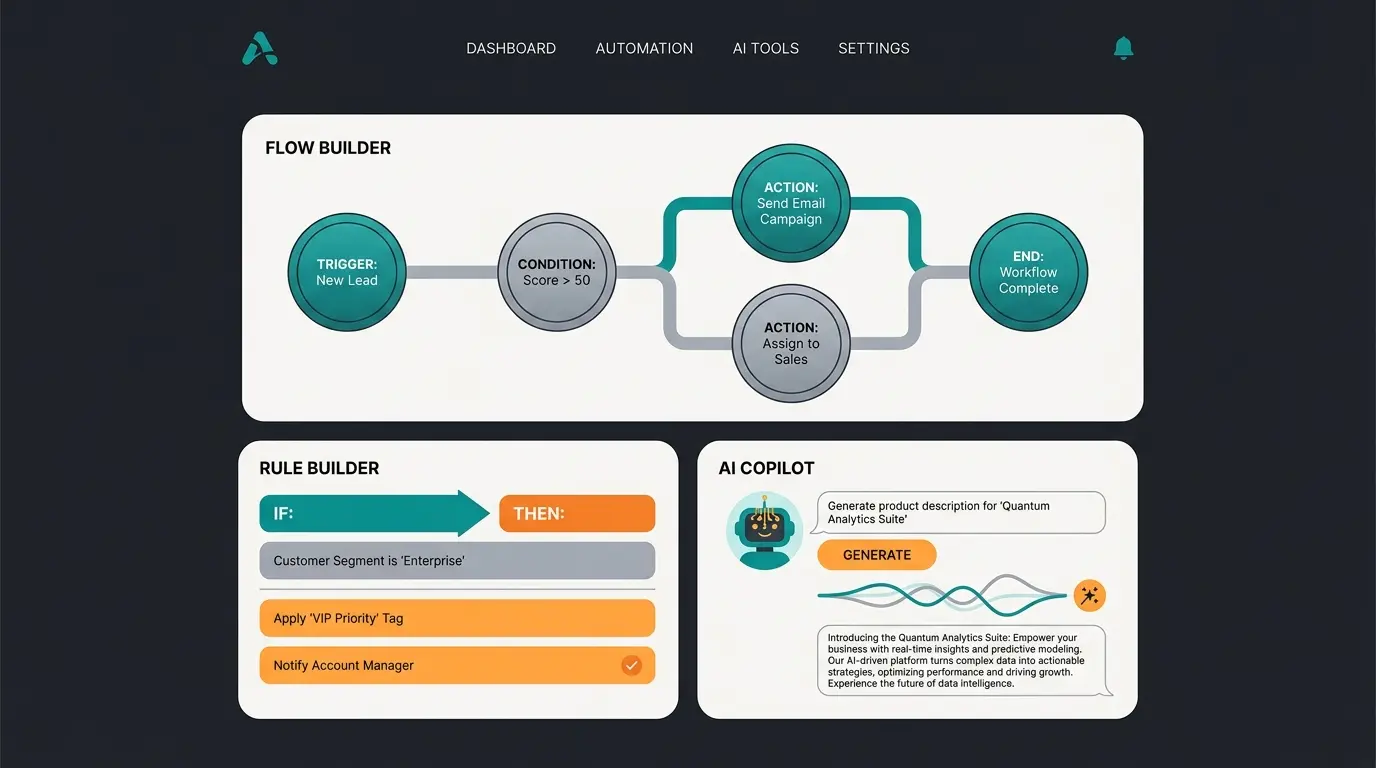
Rise includes Flow Builder for no-code automation, Rule Builder for granular pricing and display logic, AI Copilot for backend content generation, Social Shopping across Facebook and Instagram, 3D product capabilities, and 8-hour service reaction time on weekdays. That covers the core operational needs of most B2C merchants with straightforward catalog structures.
Flow Builder: automation without code
The Flow Builder is Rise's strongest feature. It uses trigger-action logic to automate business processes: order confirmations, inventory alerts, customer segmentation, promotional workflows. You define an event ("customer places order over EUR 200"), set conditions ("customer group = VIP"), and assign actions ("apply 10% loyalty discount on next order").
Rise specifically includes flow sharing between team members, which the Community Edition lacks. That distinction becomes relevant once your operations team exceeds two people. You can also use the Flow Builder for promotions and webhook actions, connecting Shopware to external tools like ERP systems or email platforms.
Rule Builder: granular logic engine
The Rule Builder defines conditions that control pricing, shipping, content visibility, and payment methods. "Show free shipping banner if cart value exceeds EUR 75 and customer is in Germany." Or: "Display net prices for B2B customer group, gross prices for B2C." Rules cascade and combine, giving merchants precise control over the shopping experience without writing code.
Rise includes Rule Builder with preview functionality. You can test rules before activating them. A small detail that prevents expensive mistakes in production.
AI Copilot: backend focus only
Shopware markets Rise heavily on its AI capabilities, and the backend features are genuinely useful. The AI Copilot generates product descriptions, summarizes customer reviews, assigns image keywords automatically, classifies customers by order history, and handles data exports via natural language queries. Since the May 2026 release (Shopware 6.7.10.0), the Copilot also includes agentic capabilities for administrative tasks.
Useful tools for merchant productivity. Not customer-facing features. This distinction is critical and we will return to it.
Shopware Rise vs Evolve vs Beyond
Rise at EUR 600/month covers marketing automation, AI Copilot, and Social Shopping. Evolve at EUR 2,400/month adds B2B Components (Quote Management, Quick Orders, Shopping Lists, Organisation Units), Advanced Search, Dynamic Access, and phone support with 4-hour reaction time. Beyond at custom pricing adds Digital Sales Rooms, customer-specific pricing, 24/7 priority support, and a personal account manager. For 90% of B2C merchants, Rise is sufficient.
| Feature | Rise (EUR 600/mo) | Evolve (EUR 2,400/mo) | Beyond (custom) |
|---|---|---|---|
| Flow Builder (incl. sharing, promotions, webhooks) | Yes | Yes | Yes |
| Rule Builder with preview | Yes | Yes | Yes |
| AI Copilot (Shopware Intelligence) | Yes | Yes | Yes |
| Social Shopping (Facebook, Instagram) | Yes | Yes | Yes |
| 3D product capabilities | Yes | Yes | Yes |
| Unlimited sales channels | Yes | Yes | Yes |
| B2B Components (Quotes, Quick Orders, Shopping Lists) | No | Yes | Yes |
| Advanced Search | No | Yes | Yes |
| Dynamic Access | No | Yes | Yes |
| Digital Sales Rooms | No | No | Yes |
| Customer-specific pricing | No | No | Yes |
| Support reaction time | 8 hours | 4 hours | 1 hour |
| Phone support | No | Yes (callback) | Yes (priority) |
| Personal account manager | No | No | Yes |
| Frontend AI product consultation | Not included in any plan | Not included in any plan | Not included in any plan |
Notice the last row. No Shopware edition includes native frontend AI that guides customers through purchase decisions. Not Rise, not Evolve, not Beyond. This gap matters more than the difference between plans.
The Evolve trap
Many merchants get upsold to Evolve because they want one specific feature. Usually Advanced Search or basic B2B capabilities. The price jump is significant: EUR 1,800/month more, or EUR 21,600 per year.
The reality for most B2C merchants: the Shopware Store offers plugins that replicate individual Evolve features at a fraction of the cost. Search extensions like Doofinder or Algolia handle enterprise-grade search for EUR 50-200/month. Simple B2B features (net prices, quick order forms) are available via third-party extensions.
Evolve becomes mandatory only when you need the full B2B Components suite with Quote Management, Organisation Units, and Approval Rules, or when 4-hour support response times are contractually required. For a detailed breakdown of Shopware Beyond enterprise capabilities, see our dedicated guide.
The conversion gap in Shopware Rise
Shopware Rise's biggest limitation is not a missing backend feature. It is the absence of frontend customer interaction. While AI Copilot handles product descriptions and review summaries in the admin panel, no native tool guides customers through complex purchase decisions on the storefront. This creates what we call the Conversion Gap.
The numbers frame the problem. According to Baymard Institute, the average e-commerce cart abandonment rate sits at 70.22% in 2026. For consulting-intensive products (technical equipment, configurable goods, garden supplies), the rate climbs higher. Visitors land on the product page, face 40 filter options, and leave.
The silent filter problem
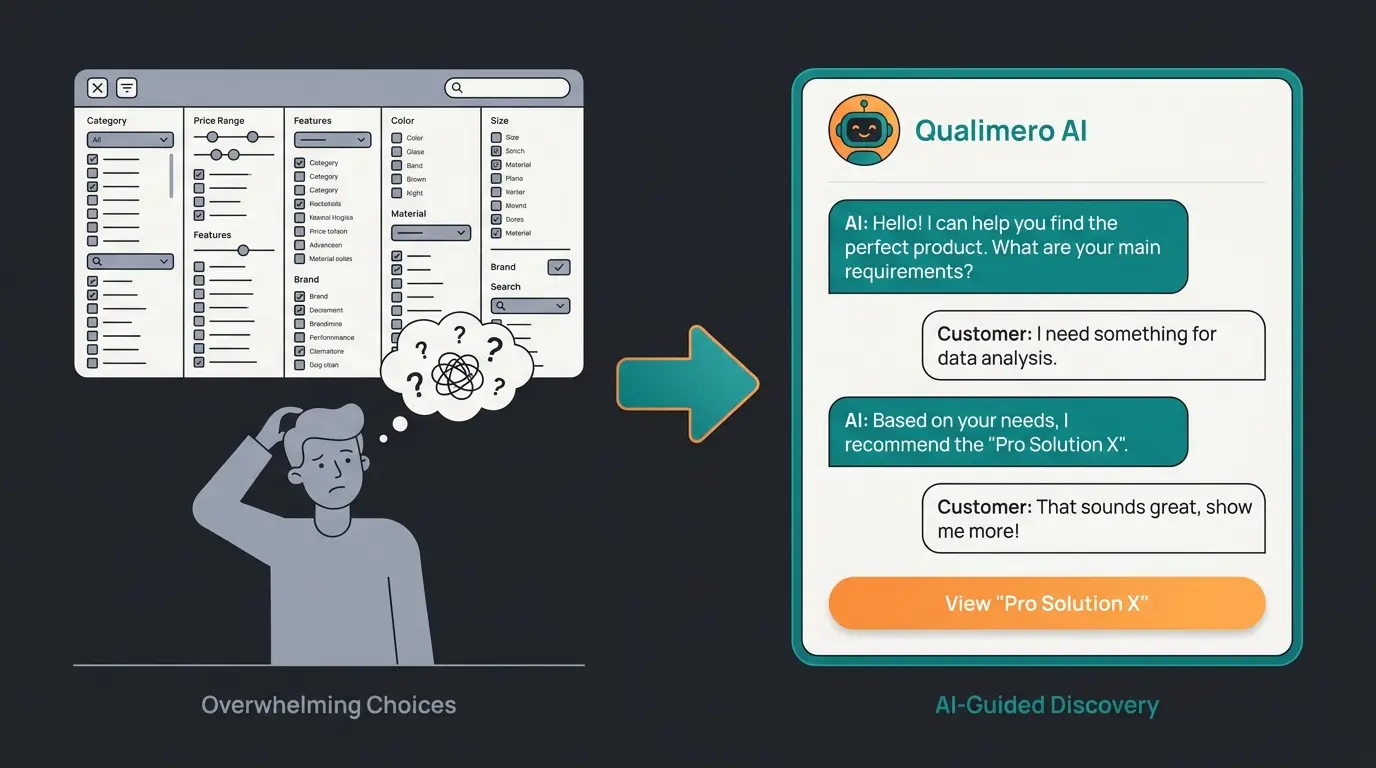
Consider an online shop selling e-bikes with 200+ models. The customer knows their budget and that they want to commute to work. They do not know whether they need a mid-drive or hub motor, 500Wh or 750Wh battery, or what frame geometry fits their height. The filter system offers all these options. The customer stares at the options, picks wrong, gets frustrated results, and leaves.
No amount of Flow Builder automation or Rule Builder logic fixes this. The problem is not in the backend. It is on the storefront, in the moment between landing and buying.
AI Copilot does not solve this
Shopware's AI Copilot generates better product descriptions. Useful. But the customer who cannot choose between three products does not need a better description. They need someone to ask: "What do you need this for?" and then recommend the right product based on their answer.
That capability does not exist natively in Shopware Rise. Or Evolve. Or Beyond. As Shopware CEO Sebastian Hamann noted in the Shopware 6.7 release announcement: the platform's AI focus remains on merchant productivity, not customer-facing consultation.
Rise + frontend AI: the smart stack
The most cost-effective Shopware strategy combines Rise at EUR 600/month with a frontend AI sales agent for AI product consultation. This approach delivers Evolve-level conversion results at roughly 60% lower total cost, because it targets the highest-impact bottleneck: the frontend buying experience.
Backend AI vs frontend AI
Backend AI (Shopware's Copilot) helps merchants work faster. Product descriptions in seconds instead of hours. Customer segments generated automatically. Review summaries at a glance. These features save operational time.
Frontend AI helps customers buy. It asks what the customer needs, processes their answer against the product catalog, and recommends specific products with reasoning. That is a fundamentally different function, and it is the one that directly moves revenue.
Why Rise + AI beats Evolve pure
For a merchant with EUR 2 million annual revenue, the calculation is straightforward.
Option A: Upgrade to Evolve. Additional cost: EUR 1,800/month over Rise. Annual premium: EUR 21,600. What you get: B2B Components, Advanced Search, phone support. What changes on the frontend for customers: nothing. The same browsing experience, the same filter system, the same conversion rate.
Option B: Stay on Rise, add frontend AI. Cost: Rise (EUR 600/month) plus AI sales agent (approximately EUR 200-400/month). Total: EUR 800-1,000/month. What changes on the frontend: customers get guided product consultation. The results speak for themselves.
Rasendoktor.de, an online specialist for professional lawn care running on Shopware, integrated an AI product advisor to handle 2,000-3,000 consultation-intensive inquiries per season. The outcome: 16x return on investment, 100% automation rate, and 40% reduction in support costs. Not from upgrading their Shopware plan. From adding frontend intelligence.
Case study: the difference in user flow
Garten-Freunde.de, a specialist retailer for garden and wellness products, faced 50+ consultation inquiries per day during peak season. After implementing an AI product advisor (named Kira), the Gartenfreunde AI success story shows measurable impact: 7x higher conversion rate among visitors who used the AI consultation, 45% click-through rate on product recommendations, and 6x ROI within the first quarter.
| Step | Standard Shopware Rise | Rise + AI sales agent |
|---|---|---|
| Customer arrives | Sees category page with filters | Sees category page + AI consultation prompt |
| Product discovery | Manual filter selection (30+ options) | AI asks: "What do you need this for?" |
| Decision support | Product descriptions only | Personalized recommendation with reasoning |
| Cross-sell | "Customers also bought" widget | Context-aware accessory suggestions |
| Result | 70%+ abandon without purchase | 7x higher conversion among AI users |
Click-through rate on AI product recommendations (Gartenfreunde)
Rasendoktor: fewer manual inquiries after AI automation
Implementation roadmap
Implementing the Smart Rise Stack takes four phases. Set up Shopware Rise as the foundation, fill feature gaps with specialized tools, add a frontend AI sales agent, then measure total cost of ownership against revenue impact. Here is each step.
Step 1: the foundation (Shopware Rise)
Start with the EUR 600/month Rise license. Configure Flow Builder to automate order processing, inventory alerts, and customer segmentation. Set up Rule Builder for pricing logic, shipping conditions, and content visibility rules. Enable Social Shopping if you sell on Facebook or Instagram. This is your operational backbone.
Step 2: fill the gaps (best-of-breed)
For search enhancement, specialized plugins like Doofinder or Algolia outperform Shopware's native search at EUR 50-200/month. Far cheaper than the EUR 2,400 Evolve upgrade just for Advanced Search. For basic B2B needs (net prices, quick order forms), third-party extensions cover the gap without a plan upgrade. Budget for Shopware agency costs separately if you need custom development.
Step 3: the turbo (AI sales agent)
Integrate a frontend AI solution that acts as a product consultant for your customers. The AI needs full access to your product catalog, customer context from previous interactions, and the ability to recommend products with reasoning. Look for solutions that integrate via Shopware's REST API, which provides access to products, categories, properties, and customer groups.
Setup time for a well-integrated AI product advisor: two to four weeks for initial configuration and catalog training, plus one to two weeks for testing. Not months. Not a platform migration.
Step 4: measure TCO vs ROI
Shift the question from "What does the software cost?" to "What does each visitor generate?" Track revenue per session before and after adding the AI sales agent. Compare the monthly cost delta (EUR 200-400 for AI vs EUR 1,800 for an Evolve upgrade) against the conversion improvement. In our experience across 25+ merchant deployments, the AI investment pays for itself within 60-90 days.
Total cost of ownership comparison
A Rise + AI stack costs approximately EUR 800-1,000/month total. Evolve starts at EUR 2,400/month. Over 12 months, the Smart Rise approach saves EUR 16,800-19,200 while delivering comparable or better frontend conversion results. Here is the line-by-line comparison.
| Cost item | Rise + AI stack | Evolve pure |
|---|---|---|
| Shopware license (monthly) | EUR 600 | EUR 2,400 |
| AI sales agent (monthly) | EUR 200-400 | EUR 0 |
| Search plugin (monthly) | EUR 50-150 | Included (Advanced Search) |
| Intelligence+ add-on (monthly) | EUR 19 | EUR 19 |
| Monthly total | EUR 869-1,169 | EUR 2,419 |
| Annual total | EUR 10,428-14,028 | EUR 29,028 |
| Annual savings vs Evolve | EUR 15,000-18,600 | Baseline |
| Frontend AI consultation | Yes (dedicated solution) | No (backend Copilot only) |
| B2B Components | No (use plugins if needed) | Yes (included) |
| Support reaction time | 8 hours | 4 hours |
The math is clear for B2C merchants. You save EUR 15,000-18,600 per year and get a capability (frontend AI consultation) that Evolve does not include at any price. The only scenario where Evolve wins is when you genuinely need the full B2B Components suite with Quote Management and Organisation Units.
Conclusion: is Shopware Rise enough?
Yes. For 90% of B2C merchants, Shopware Rise at EUR 600/month covers everything needed to run a professional e-commerce operation. Flow Builder, Rule Builder, AI Copilot, Social Shopping, unlimited sales channels. The backend is solid.
The real question is not about the backend. It never was. The merchants who outperform their competitors are not the ones with the most expensive Shopware license. They are the ones who solved the frontend problem: turning visitors into buyers through guided product consultation.
Stay on Rise. Use the EUR 15,000-18,600 annual savings compared to Evolve to invest in the one thing no Shopware plan offers natively: an AI sales agent that talks to your customers, understands their needs, and recommends the right product. Rasendoktor achieved 16x ROI this way. Gartenfreunde saw 7x higher conversion rates. The data is consistent across our 25+ merchant deployments.
We have tested all three Shopware plans extensively. Rise does exactly what it promises. The gap it leaves is the same gap Evolve and Beyond leave. Closing that gap is where the real competitive advantage sits.
FAQ: Shopware Rise
Shopware Rise is the commercial entry-level SaaS plan starting at EUR 600/month (as of Q2 2026). It includes Flow Builder, Rule Builder, AI Copilot via Shopware Intelligence, Social Shopping, 3D capabilities, and unlimited sales channels. Rise replaced the legacy Professional Edition.
Shopware Rise starts at EUR 600/month. The Intelligence+ add-on (agentic Copilot, advanced AI features) costs an additional EUR 19/month. Total base cost: EUR 619/month for the full AI-enabled Rise experience. Pricing may scale with GMV for larger merchants.
Rise (EUR 600/month) includes Flow Builder, Rule Builder, AI Copilot, and Social Shopping. Evolve (EUR 2,400/month) adds B2B Components (Quote Management, Quick Orders, Shopping Lists, Organisation Units), Advanced Search, Dynamic Access, and 4-hour phone support. Neither includes frontend AI product consultation.
Yes. Shopware allows plan upgrades at any time. Your shop configuration, data, and plugins carry over. The upgrade is a license change, not a migration. We recommend starting on Rise and upgrading only when you have confirmed that B2B Components or 4-hour support are genuinely needed.
Community Edition merchants exceeding EUR 1 million annual GMV must upgrade to a paid plan (minimum Rise) to maintain access to the Shopware Store and Shopware Account. Shopware enforces this through self-reported GMV. Non-compliance results in loss of plugin access and support.
For basic B2B needs (net prices, customer groups, quick order forms), Rise plus third-party plugins is sufficient. For complex B2B workflows with Quote Management, Approval Rules, and Organisation Units, you need Evolve. The B2B Components suite is exclusive to Evolve and Beyond.
A frontend AI sales agent integrates via Shopware's REST API, accessing product data, categories, properties, and customer groups. It provides real-time product consultation on the storefront. Merchants like Rasendoktor report 16x ROI from this approach. Setup takes two to four weeks.
Rise handles the backend. An AI sales agent handles the frontend. Merchants using this combination report 7x higher conversion rates and 16x ROI. See what it looks like in your shop.
Book a free demo
Kevin is CTO and co-founder of Qualimero. As an AI architect with over 15 years of experience as CTO and CPO in the tech industry, he designs the AI systems that automate tens of thousands of customer interactions daily for Qualimero's clients — reliably, securely, and at scale.