What a Shopware agency in Cologne must deliver
A Shopware agency in Cologne must deliver Shopware 6 development, design, migration and ongoing support from a single source. Local availability matters for face-to-face coordination, and so does an understanding of Cologne mid-market retailers who sell explanation-heavy products that customers rarely buy without advice.
A Shopware agency is a service provider that plans, builds and maintains online shops on the Shopware platform. The good ones cover the full lifecycle: strategy, design, development, data migration, hosting and support. The weak ones do one slice and hand you off for the rest.
Shopware is the platform most German mid-market shops standardise on. 115 of Germany's top 1,000 online shops run on Shopware, which keeps it the national market leader for the fourth year running (Shopware). Shopware describes itself as "the market leader among ecommerce platforms in Germany", and in the Rhineland that means most agencies you shortlist already work with it daily.
Why does location still matter when most work happens remotely? For a brochure site, it does not. For a Shopware 6 build with ERP integration, a payment provider switch and a content team that needs training, a half-day workshop in the same room saves weeks of email. An agency in Cologne can sit at your table on Tuesday; one in another city schedules a call for next month.
- Shop setup and configuration on Shopware 6
- Theme, UX and conversion design
- Custom plugin and extension development
- Data migration from Shopware 5 or another platform
- Hosting, monitoring and ongoing maintenance
- Performance, SEO and tracking setup
Full-service Shopware services
Full-service from a Shopware agency means concept, UX design, Shopware 6 development, plugin work, ERP integration, SEO and ongoing support under one roof. The advantage over hiring single specialists is one consistent point of contact for every shop topic, from the first wireframe to the security patch two years later.
A true full-service Shopware agency does not just write code. It owns the result, which is a different commitment. The list below is what "full-service" should actually mean in a contract, not just on a pitch slide.
| Service area | What it includes | When you need it |
|---|---|---|
| Shop setup | Shopware 6 install, configuration, sales channels | New shop or replatforming |
| Design & UX | Theme, custom templates, checkout optimisation | Brand relaunch, low conversion |
| Plugin development | Custom extensions, third-party plugin work | Features the standard lacks |
| Integrations | ERP, CRM, PIM, payment and shipping APIs | Connecting existing systems |
| SEO | Technical SEO, structured data, content structure | Low organic visibility |
| Maintenance | Updates, security patches, monitoring | Every live shop, ongoing |
Integrations are where projects get expensive, so this is where agency experience pays off. Connecting Shopware 6 to an ERP like WeClapp or SAP, a CRM and a PIM is rarely plug and play; it needs a clean data model and tested API mappings. For the build you want a certified Shopware partner, and you can verify status in the official Shopware partner directory. After go-live, Shopware maintenance and structured Shopware consulting keep the shop fast and secure.
SEO is the service most shops underrate, and honestly the one I argue about most with clients. A shop that ranks for nothing depends entirely on paid traffic, which is a rented audience. If organic visibility is the goal, a dedicated Shopware SEO agency handles technical SEO, structured data and content architecture from the start, not as an afterthought.
Shopware 6 migration and development
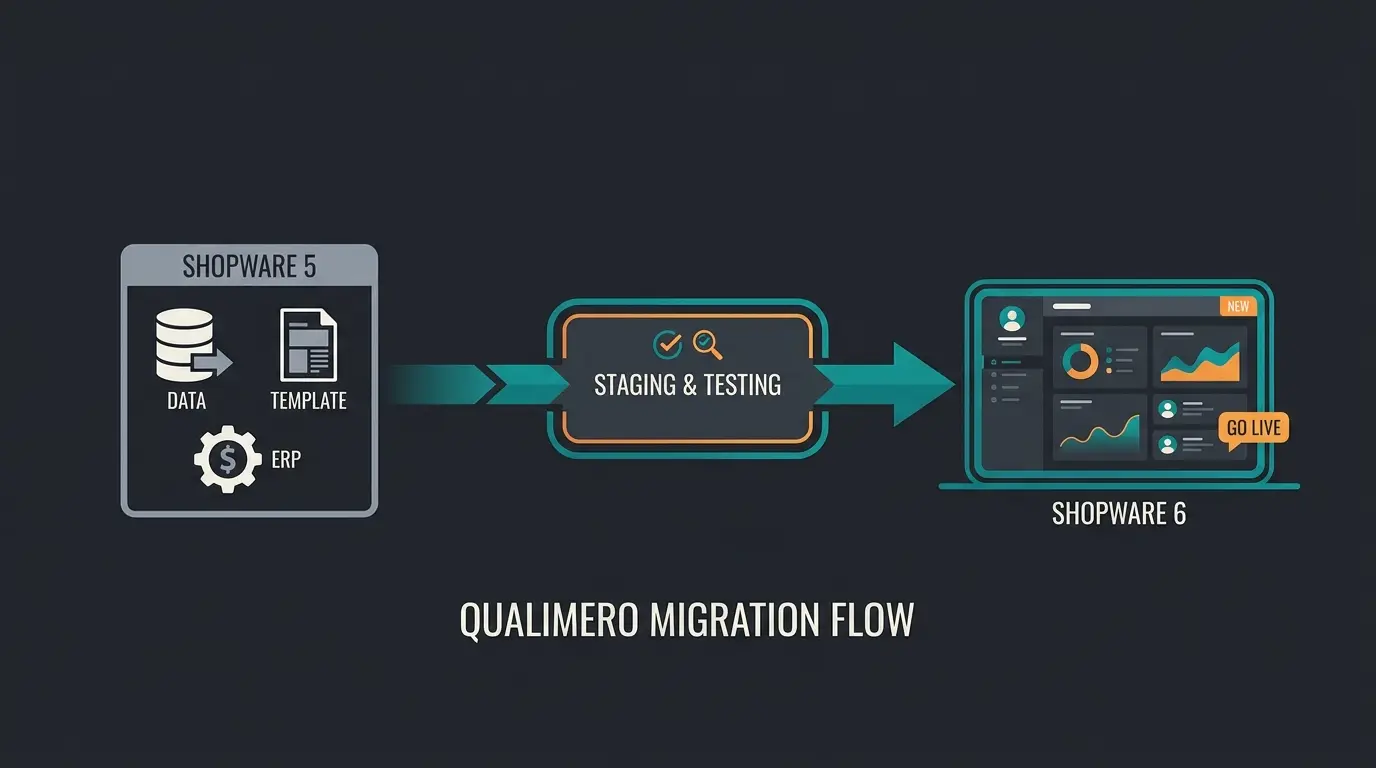
Migrating from Shopware 5 to Shopware 6 is a full rebuild, not an update. Shopware 6 uses a new template system (Twig instead of Smarty), a new API architecture and a different database structure. A realistic migration runs three to six months including a test phase and parallel operation before the switch.
The clock already ran out. Shopware 5 reached end of life on July 31, 2024, which means no more security patches, bug fixes or official support (Shopware documentation). Running a live shop on an unsupported platform is a liability question, not a feature question. Every month on Shopware 5 is a month of unpatched risk.
Shopware 6.7, the current major line as of June 2026, ships an improved Admin API, the Flow Builder for automation and faster storefront rendering. An experienced Shopware 6 agency plans the move in stages instead of one risky big-bang cutover. The sequence below is how a controlled migration usually runs.
- Audit the existing shop: data quality, plugins, custom code
- Set up a clean Shopware 6.7 instance and target data model
- Migrate products, categories, customers and order history
- Rebuild the theme in Twig and reimplement custom features
- Test payment, shipping and ERP flows in a staging shop
- Cut over with a rollback plan and post-launch monitoring
The Qualimero advantage: AI product consultation
Qualimero combines classic Shopware agency services with AI-powered product consultation that raises average cart value by 35% and checkout rate by 60%. The AI employee advises customers in real time, like a specialist sales assistant in a physical store, instead of leaving them alone with a product grid and a search box.
An AI employee is not a chatbot with canned answers. It is a digital team member trained on your product catalogue, your policies and your edge cases. It recognises what a customer actually needs, asks the right follow-up question and recommends the product that fits, across chat, WhatsApp and your shop.
Here is the problem every Shopware shop shares. The Baymard Institute reports that on average "70.19% of online shopping carts are abandoned" (Baymard Institute). For consultation-heavy products, a large share of those buyers leave because no one answered the one question standing between them and the checkout.
This is exactly the gap AI product consultation closes. The AI employee handles up to 97% of consultation requests automatically, around the clock, in the customer's language. Where a Cologne agency competitor stops at building the shop, Qualimero also staffs it. You can watch it behave on your own catalogue in a free demo.
Across Qualimero client shops
Guided customers complete more often
Handled without human handover
Our results: AI consultation in numbers
Across more than 25 active client projects, Qualimero delivers measurable results. Rasendoktor automated 100% of its webchat consultation and reached a 16x return on investment. Signed automated 70% of its social media inquiries and lifted upselling by 30%. These are documented client numbers, not projections.
Rasendoktor sells professional lawn care products, a classic explanation-heavy catalogue. Seasonally the shop received up to 3,000 consultation-intensive inquiries, which overwhelmed the support team. With the AI employee Hektor, every webchat inquiry is now answered automatically, with regional pricing for Germany and Austria handled correctly. The full Rasendoktor case study has the details.
Signed, an online retailer for custom signs, faced a flood of product questions on Instagram and TikTok. The AI employee Alex now handles 70% of those inquiries and turns social interactions into sales, with an 18x ROI and 30% more up- and cross-selling. The Signed case study breaks down the setup.
| Client | Industry | Automation | ROI |
|---|---|---|---|
| Rasendoktor | Lawn care e-commerce | 100% of webchat | 16x |
| Signed | Custom signs retail | 70% of social inquiries | 18x |
For external validation, Qualimero holds 4.9 out of 5.0 on OMR Reviews and 4.7 on Google. I would still tell you to judge any vendor on your own pilot, not on review scores. Numbers from a controlled test in your shop beat any star rating.
Cologne location: advantages for your e-commerce project
Cologne is one of Germany's largest business hubs, home to around 23,000 retail businesses in the IHK region. A local Shopware agency offers in-person workshops, fast response times and a Rhineland network, from the first consultation through to go-live and beyond.
The numbers back the location. Retail is one of the strongest sectors in the region, with roughly 23,000 businesses across the Cologne IHK area (IHK Köln). That density means local agencies see a steady stream of real e-commerce problems, which is how expertise actually accumulates.
Cologne is also where the Shopware ecosystem meets. Shopware Community Day 2026 takes place in Cologne on June 10, 2026 (Shopware Community Day), and the city hosts DMEXCO every year. For a Shopware shop, being in the same city as those events is a small but real networking advantage.
- Half-day workshops without travel logistics
- Faster response when something breaks before a campaign
- In-person training for your content and marketing team
- A Rhineland network of payment, logistics and design partners
Agency or freelancer?
A Shopware agency gives you broad expertise, cover during absences and capacity that scales with the project. A freelancer is cheaper for small, isolated changes. For a new shop build, a Shopware 5 to 6 migration or an AI integration, an agency is the safer choice.
The trade-off is real, so be honest about your project. A single Shopware freelancer can be perfect for a recurring template tweak or a one-off plugin. The risk shows up at scale: if your freelancer is on holiday during your Black Friday incident, you have no backup.
| Criterion | Agency | Freelancer |
|---|---|---|
| Expertise range | Full team, multiple disciplines | One specialist focus |
| Availability | Cover during absences | Single point of failure |
| Cost for small tasks | Higher | Lower |
| Large projects | Scales with capacity | Limited by one person |
| ERP/AI integration | In-house or partnered | Often needs subcontracting |
| Long-term support | Contracted SLA | Depends on availability |
Shopware agencies compared
Choosing the right Shopware agency depends on location, specialisation and project size. Beyond Cologne, Hamburg, Munich, Berlin and Dusseldorf are strong Shopware locations, each with a different focus, so it is worth knowing the wider landscape before you commit.
If you are weighing up cities, the picture varies. Compare a Shopware agency Munich, a Shopware agency Hamburg, a Shopware agency Dusseldorf and a Shopware agency Berlin. Dusseldorf and Cologne sit close enough that many Rhineland projects shortlist agencies from both.
FAQ - Shopware agency Cologne
Project costs depend on scope. A standard Shopware 6 shop build typically ranges from 15,000 to 60,000 EUR, while a complex B2B shop with ERP integration runs higher. Ongoing maintenance is usually billed as a monthly retainer or on an hourly basis.
A new Shopware 6 shop usually takes three to five months from kickoff to launch. A migration from Shopware 5 runs three to six months because the template and data structure are rebuilt. Integration depth is the main factor.
Shopware Cloud is a managed SaaS where Shopware handles hosting and updates, with less room for customisation. Self-hosted Shopware 6 gives full control over code and extensions but needs your agency to manage hosting and security. Consultation-heavy shops usually choose self-hosted for the flexibility.
Yes. Shops on Shopware 5, Magento, WooCommerce or Shopify can be migrated to Shopware 6.7. Products, customers and order history transfer with a migration tool, while the theme and custom features are rebuilt. Plan three to six months for a clean migration.
Yes. Qualimero provides Shopware maintenance, updates and monitoring after go-live, plus the AI employee that handles customer consultation. Support is contracted, so you are not dependent on a single freelancer's availability.
Qualimero builds the shop and then staffs it with an AI employee for product consultation. That combination lifts cart value by 35% and checkout rate by 60%, which a development-only agency does not deliver.
We build your Shopware shop and staff it with an AI employee that advises customers in real time. Our clients reach up to 16x ROI and +35% cart value. Book a demo and we will show it live.
Book a demo
Kevin is CTO and co-founder of Qualimero. As an AI architect with over 15 years of experience as CTO and CPO in the tech industry, he designs the AI systems that automate tens of thousands of customer interactions daily for Qualimero's clients — reliably, securely, and at scale.