What is Shopware consulting?
Shopware consulting covers the strategic, technical, and operational guidance for building, migrating, or optimizing a Shopware online store. It spans requirements analysis and platform selection through to ongoing development and performance tuning. The scope is broader than general e-commerce consulting because it requires platform-specific expertise in Shopware 6's architecture, API ecosystem, and plugin landscape.
Shopware itself offers official Consulting Services split into two tracks: business consulting (feature training, customer experience checks, agency selection support) and technical consulting (code reviews, load testing, migration mastery, architecture advisory). These are delivered directly by Shopware's in-house team, separate from the partner ecosystem.
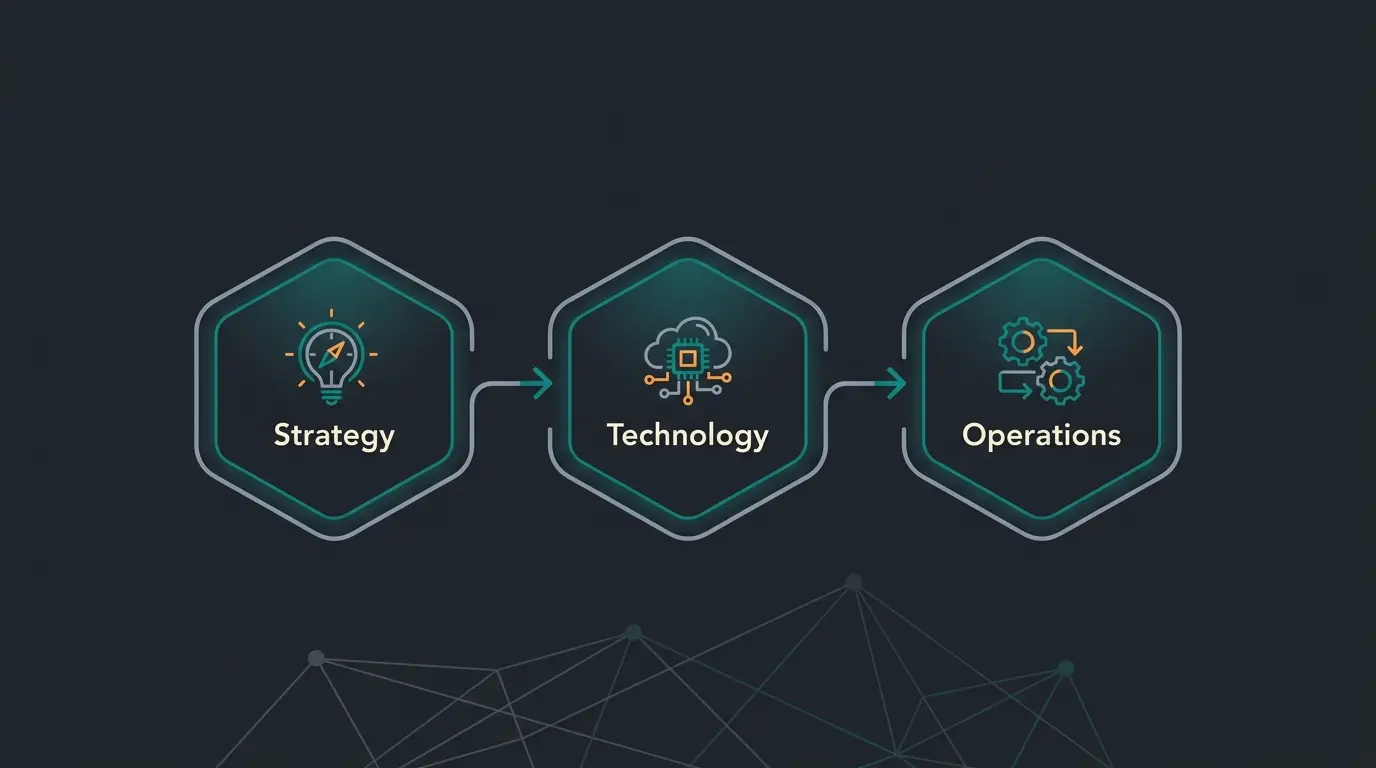
The three pillars of Shopware consulting are strategy, technology, and operations. Strategic consulting defines the business model and feature roadmap. Technical consulting handles architecture decisions, API integrations, and performance optimization. Operational consulting covers maintenance cycles, update management, and team training. Most SMEs need a combination of all three, though the weighting shifts depending on whether you are launching, migrating, or optimizing.
One distinction worth making early: Shopware consulting is not the same as Shopware development. A consultant advises, audits, and plans. A developer builds. Some consultants also code, but the core value of consulting is the diagnosis, not the treatment. If someone offers to consult and build simultaneously, you should ask who reviews their own work.
When do you need Shopware consulting?
You need Shopware consulting when launching a new store, migrating from another platform, hitting performance bottlenecks, scaling into B2B, or when your conversion rate stalls despite steady traffic. Essentially, any point where e-commerce complexity exceeds what your in-house team can handle on its own.
The most common trigger we see is platform migration. Gartner reports that 83% of data migration projects either fail outright or exceed their budget and timeline. That statistic gets worse without platform-specific expertise. A Shopware consultant who has handled ten migrations from Magento to Shopware 6 will spot integration traps that a generalist e-commerce consultant will miss.
According to commercetools' 2025 Migration Report, 88% of larger organizations plan to modernize their commerce platforms within the next 12 months. That creates a supply-demand imbalance: more merchants migrating means fewer experienced consultants available per project, and higher rates for the good ones. The same report shows that 90% of businesses that successfully migrated saw revenue improvements, with 30% reporting gains above 30%.
- New store launch - you need architecture decisions made correctly from the start. Fixing a wrong plugin structure six months later costs 4-6x more than getting it right upfront
- Platform migration - moving from Shopify, Magento, or WooCommerce to Shopware 6 requires data mapping, URL redirect strategies, and integration rewiring
- Performance bottlenecks - page load times above 3 seconds, checkout errors, or API timeouts under traffic spikes
- B2B scaling - Shopware 6's B2B Suite requires different architecture patterns than B2C, including custom pricing, role-based access, and quote workflows
- Conversion stagnation - traffic grows but conversion rate stays flat. Often a UX or product presentation problem, not a marketing problem
- Integration complexity - connecting ERP, CRM, PIM, or payment systems where standard plugins do not cover your requirements
Shopware 5 end of life and the accessibility deadline
Two hard deadlines drive most Shopware consulting demand right now. Shopware 5 stopped receiving security fixes at the end of July 2024, so every remaining Shopware 5 storefront is running unpatched. And since 28 June 2025, the European Accessibility Act applies to e-commerce services sold to consumers in the EU.
Shopware put the timeline in writing in its own migration documentation: "Until the end of July 2023, we're still making bug fixes, minor improvements, and legally necessary adjustments. From then on up until the end of July 2024, we'll only fix security issues." Two years past that cut-off, as of August 2026, nothing further has shipped. Migration advisory is now the default Shopware consulting engagement in the DACH market.
The version clock keeps running after the move, too. According to the release tracker at endoflife.date, Shopware 6.4 lost security support on 14 May 2025, and Shopware 6.5 follows on 28 February 2027. Anyone still on 6.5 is buying an upgrade project within the next two quarters, planned or not, and consulting capacity for that work will be tightest in the final quarter before the deadline.
The practical risk arrives before the legal one. Payment and shipping extensions stop being maintained for Shopware 5 too, so a payment provider forcing an API version bump can take your checkout offline with no vendor fix available. A storefront processing card data on an unmaintained platform also weakens your PCI DSS position, and a known unpatched vulnerability handling customer data is hard to defend under GDPR Article 32, which requires appropriate technical measures.
The European Accessibility Act is the second driver. Since 28 June 2025 it obliges e-commerce providers selling to EU consumers to meet defined accessibility requirements, publish an accessibility statement, and keep procedures in place for continued conformity. The technical reference is the harmonised standard EN 301 549. Shopware 6.7 ships storefront changes that make conformity reachable without a full theme rebuild. Shopware 5 does not.
Types of Shopware consulting
Shopware consulting breaks into three main types: strategic consulting (business model, market positioning, feature roadmap), technical consulting (architecture, performance, integrations, security), and operational consulting (ongoing Shopware maintenance, updates, training). Each serves different business needs and budgets, and the deliverables differ substantially.
| Dimension | Strategic consulting | Technical consulting | Operational consulting |
|---|---|---|---|
| Focus | Business model, feature roadmap, market positioning | Architecture, APIs, performance, security | Maintenance, updates, team training |
| Typical deliverables | Requirements document, platform comparison, migration roadmap | Code audit, performance report, integration architecture | Update schedule, SLA, training documentation |
| Engagement model | Project-based (2-8 weeks) | Sprint-based or per-audit | Monthly retainer |
| Cost range (EUR) | 5,000-15,000 per project | 2,000-8,000 per audit | 1,500-4,000 per month |
| Best for | New launches, major pivots, platform decisions | Performance problems, scaling challenges, complex integrations | Ongoing stability, team upskilling, update management |
| Typical hourly rate | EUR 150-250/hr | EUR 120-200/hr | EUR 100-150/hr |
Strategic consulting has the widest cost variance because scope varies enormously. A simple requirements analysis for a new Shopware 6 store might take 20 hours. A full migration roadmap from Magento 2 with ERP integration planning can take 80-120 hours.
As Shopware co-founder Sebastian Hamann described the platform's consulting philosophy: the goal is to help merchants realize their online business's full potential, not to sell consulting hours. That distinction matters when evaluating third-party consultants too. The right consultant defines a clear scope upfront and works themselves out of the engagement, not into it.
Shopware consulting vs. Shopware agency
A Shopware consultant provides independent strategic advice and specific expertise on demand, while a Shopware agency offers end-to-end implementation with design, development, and ongoing management. Consultants suit targeted problems, agencies suit full project execution. A Shopware freelancer sits between the two: hands-on implementation without the overhead of an agency, but typically narrower in scope.
| Dimension | Consultant | Agency | Freelancer |
|---|---|---|---|
| Scope | Advisory, audits, strategy | Full project delivery | Specialized implementation tasks |
| Cost model | Hourly or per-project | Project-based (fixed or T&M) | Hourly or per-task |
| Typical cost | EUR 100-250/hr | EUR 20,000-100,000+ per project | EUR 65-140/hr |
| Team size | 1 person | 4-15 people | 1 person |
| Best for | Second opinions, audits, migration planning | New store builds, complete redesigns, large migrations | Plugin development, specific integrations, bug fixes |
| Engagement length | Weeks to months | Months to years | Days to weeks |
| Independence | High (no build incentive) | Low (incentivized to build) | Medium |
The independence factor matters more than most buyers realize. A consultant who does not build stores has no incentive to recommend a rebuild when a configuration change would suffice. An agency, by contrast, generates revenue from implementation. That does not make agencies dishonest, but it shifts the economic incentive. We have seen projects where a EUR 3,000 consultant audit prevented a EUR 40,000 unnecessary rebuild.
Freelancer rates deserve their own numbers, because they are the easiest part of this market to verify. The Freelancer-Kompass 2026, a survey of 5,400 freelancers, puts the median hourly rate for IT freelancers in the DACH region at EUR 95, with software and web development at EUR 90. Shopware work tracks that figure: junior generalists charge EUR 65-85 per hour, experienced Shopware 6 developers EUR 90-120, and migration or performance specialists EUR 120-140. Rates below EUR 60 usually signal inexperience rather than value.
2026 is a buyer's market on the freelance side. For the first time since the survey began in 2016, average freelance rates did not rise, while average monthly freelance income fell from EUR 8,432 to EUR 6,653 year over year, as reported by Gründerküche. Thomas Maas, CEO of freelancermap, put it plainly in the study's press coverage: "Many freelancers are feeling the strained economic situation first-hand. Right now it comes down to knowing your own market value and actively shaping it." Read that from the buyer's chair. Senior specialists who were booked out in 2024 will answer your email this quarter.
The in-house option loses on arithmetic more often than on principle. Employed software developers in Germany earn around EUR 64,700 gross per year according to jobvector data cited in the Freelancer-Kompass analysis, which lands near EUR 85,000-90,000 fully loaded. That budget buys roughly 700 to 900 freelance hours at EUR 100-130. If your Shopware backlog is genuinely under 700 hours per year, hiring in-house is both the more expensive option and the harder one to reverse.
For Shopware 6 agency projects specifically, the combination often works best: hire a consultant for the requirements phase, then bring in an agency for execution. The consultant's architecture document becomes the agency's blueprint, which reduces scope creep and rework.
How to find the right Shopware consultant
Start with the Shopware Partner Program directory and filter by certification level, then evaluate candidates on three criteria: proven Shopware version expertise (5 vs 6), industry-specific experience matching your vertical, and transparent pricing with clear deliverables.
Shopware's directory states that it lists "over 1,200 certified Shopware agencies that specialise in a wide variety of services". That partner directory is the only place a tier claim can actually be verified, and checking takes under a minute: search the name, open the profile, read the level shown there. Several firms ranking for consulting queries hold no listing at all.
The directory covers only one of three partner types. Shopware's ecosystem of more than 1,600 partners splits into agency partners who build and migrate stores, technology partners who connect SaaS tools through the platform's API, and hosting partners who run the infrastructure. Agency rates track the tier: Bronze firms typically bill EUR 80-100 per hour, Silver EUR 100-130, Gold EUR 130-160, and Platinum EUR 150-180 and up. Central and Eastern European partners charge 30-50% less, though timezone and communication overhead can eat part of that saving.
| Tier | Certifications required | What it signals |
|---|---|---|
| Platinum | 20 | Large, complex projects and strategic collaboration with Shopware AG |
| Gold | 10 | Sustained delivery record, requalified against annual targets |
| Silver | 4 | Certified practice plus a dedicated partner manager from Shopware |
| Bronze | 4 | Onboarded partner at entry level |
A tier is a floor, not a guarantee. An uncertified consultant with three live shops in your vertical will usually outperform a Gold partner meeting your product category for the first time. Certification proves the team knows Shopware. It proves nothing about whether they know configurable bundles for industrial fasteners, or ECE approval logic for vehicle lighting.
- Check Shopware version expertise. Shopware 5 and Shopware 6 are fundamentally different platforms. A consultant experienced in Shopware 5 may lack the API-first architecture knowledge needed for Shopware 6 projects. Ask specifically which version they have worked with
- Request case studies in your industry. Generic e-commerce experience is not enough. A consultant who has worked with consulting-intensive products (home and garden, DIY, specialty retail) understands different challenges than one focused on fashion or FMCG
- Ask for a paid trial engagement. A 10-hour paid audit (EUR 1,000-2,500) reveals more about working style, communication quality, and actual expertise than any portfolio review
- Verify integration depth. If your project involves ERP, CRM, or PIM integration, ask the consultant to explain the specific API endpoints and data mapping approach they would use. Vague answers here indicate surface-level knowledge
- Verify any claimed tier in the directory, not the pitch deck. Partner badges get copied onto websites and left there after a tier lapses. The profile page shows the current level
- Ask what happens if your contract ends next month. The good ones answer with a process: repository access, hosting credentials, documentation, a handover call. The rest change the subject. It is the cheapest due diligence available and almost nobody asks it
One caveat that is easy to overlook: Shopware certification proves familiarity with the platform, not consulting ability. Every certificate the Shopware Academy issues is valid for 12 months only, deliberately tied to the release cycle, per the Shopware Academy FAQ. A badge with no issue date next to it is not a current credential, so ask for the date. The best consultants combine current platform knowledge with the ability to translate business requirements into specifications a development team can execute.
Version expertise deserves a harder test than a yes in a pitch deck. Shopware 6 runs on a Symfony backend with a Vue.js administration, a complete rewrite rather than an upgrade of Shopware 5, so a partner with ten years of Shopware 5 work is not automatically qualified for 6. Ask which Shopware 6 version their current builds target and how many 6.x projects they have shipped in the last 12 months. A specific answer, 6.7 with a defined upgrade path, tells you they keep up. A vague one tells you they are quoting from old templates.
The 7-step selection process
The vetting effort is not busywork. The Standish Group's long-running CHAOS research finds that only about a third of IT projects finish on time, on budget, and on scope, while roughly half come in late, over budget, or short on features, as summarised in this CHAOS report analysis. A structured process is the cheapest insurance available on the whole engagement. This is the sequence we recommend, whether you end up hiring a consultant, an agency, or both.
Document goals, must-have features, integrations, budget range, timeline, and success metrics before contacting anyone
Research 8-12 candidates via the Shopware partner directory, industry referrals, and reference shops in your vertical
Send the same requirements brief to the top 5-6 candidates with one shared deadline so proposals stay comparable
Score them against a weighted matrix instead of gut feeling: technical competence first, price second
Meet 2-3 finalists and insist on meeting the people who will do the work, not the sales team
A EUR 2,000-5,000 audit or concept workshop tests collaboration under real conditions before you commit
Fix deliverables, milestone payments, IP ownership, SLAs, and exit clauses in writing
The pilot in step 6 is the single highest-value step in the sequence. A paid engagement of EUR 2,000-5,000 reveals communication quality, working style, and actual expertise before you commit five or six figures. It also filters in both directions: a provider who refuses paid pilot work is telling you something about their confidence. In the vendor selections we have observed, the pilot has overturned the shortlist ranking more than once.
Step 7 is where avoidable damage gets locked in or locked out. Insist on milestone-based payments rather than large upfront sums, full IP and code ownership transferred to you, change request procedures with pre-agreed rates, defined SLA response times for post-launch support (under 4 hours for critical issues and 24 hours for non-critical ones is a reasonable ask), and an exit clause that guarantees repository access, credentials, and documentation on handover. For engagements above EUR 50,000, a contract review by an IT lawyer costs EUR 500-1,000 and is cheap relative to what it prevents.
Score proposals with a weighted matrix
Step 4 only works if you score every proposal the same way. The weighting below has held up across the selection processes we have observed: technical competence dominates, but methodology and cultural fit decide whether the project is pleasant or painful by week six.
| Criterion | Weight | What to look for |
|---|---|---|
| Technical competence | 30% | Shopware 6.7 and Symfony depth, shipped projects at your catalog size, integration experience with your ERP |
| Value for money | 25% | A rate card plus a scoped estimate, not one opaque number. Compare effective cost, not hourly rate |
| Methodology | 20% | Documented process, staging environments, testing, ticketing, and a named procedure for scope changes |
| References | 15% | Live shops you can visit and contacts you can call. Ask what they would do differently next time |
| Cultural fit | 10% | Do they push back on unrealistic requirements? A partner who agrees with everything is a vendor, not an advisor |
One more scope distinction, because buyers mix these two up constantly. If what you are buying is search visibility rather than architecture advice, the criteria change entirely: Shopware SEO work is judged on indexation, page performance, and structured data, not on delivery velocity or sprint throughput. Do not run the same checklist for both.
Does location matter for Shopware consulting?
Location matters for three things: the first discovery workshop, ERP scoping sessions where someone has to open the actual system and show you what the field is called, and stakeholder-heavy replatforms. For audits, sprint reviews, and everything after go-live, a remote consultant delivers the same result at a lower rate.
Be specific about when a room helps. Data-model decisions with your operations team run faster face to face, because the person who knows why a product attribute exists is rarely the person who documented it. The same applies to the opening workshop, while requirements are still vague. Ticket triage and deployment do not need a room.
In the DACH market the supply concentrates in Cologne, Munich, Hamburg, Berlin, and Dusseldorf. Cologne carries the densest Shopware ecosystem, partly an events effect: Shopware Community Day was held there on 10 June 2026, and the 2027 edition returns to the Confex in Cologne on 1 June 2027. Munich and Dusseldorf sit at the upper end of the German rate band, and the reason is unglamorous. Office rent and salaries feed into the day rate, not code quality.
| Region | Typical rate (EUR/hr) | Where the supply is strong |
|---|---|---|
| Cologne / Dusseldorf | 100-160 | Densest partner network in Germany, industrial and B2B focus |
| Hamburg | 110-170 | International projects, strong UX competence, established e-commerce ecosystem |
| Berlin | 100-170 | Tech-forward teams, headless builds, growing AI integration expertise |
| Munich | 120-180 | Enterprise and premium brands, complex integration scenarios |
| Frankfurt / Stuttgart | 100-160 | Mid-market focus, finance and automotive verticals |
| Remote (DACH-based) | 90-150 | Same talent pool without the office rent priced into the day rate |
| Central and Eastern Europe | 50-80 | 30-50% below Western European rates, budget the coordination overhead |
Read the spread as an overhead signal, not a quality ranking. The gap between Munich and a remote consultant on the same tier is mostly office rent and salary levels, which is why the same certified partner often quotes differently depending on which office runs your project. The exception is the bottom of the table: Central and Eastern European rates of EUR 50-80 per hour are real, but they come with timezone and communication overhead that belongs in your calculation, not in a footnote.
My own view, and consultants in expensive cities will not enjoy it: on most Shopware engagements the postcode is the least important variable on the shortlist. In the integrations we run, more projects have stalled on undocumented plugin code than on the distance between two offices. Remote consulting became the default in 2020 and nothing since has reversed it.
Proximity stays relevant for team training workshops, stakeholder alignment sessions, and projects requiring physical access to warehouse or ERP infrastructure. That is a narrow set. If a consultant bills travel time on top of the day rate, get that in the proposal before you weigh a local quote against a remote one.
What does Shopware consulting cost?
Shopware consulting typically costs EUR 100-200 per hour for independent consultants and EUR 150-250 per hour through agencies, with full project engagements ranging from EUR 5,000 for a migration audit to EUR 50,000+ for complete store implementation with ongoing advisory.
| Service | Typical cost (EUR) | Duration | What you get |
|---|---|---|---|
| Initial audit / health check | 2,000-5,000 | 1-2 weeks | Performance report, security assessment, prioritized roadmap |
| Migration planning (Magento/Shopify to SW6) | 5,000-15,000 | 2-6 weeks | Data mapping, URL strategy, integration architecture, timeline |
| Technical architecture review | 3,000-8,000 | 1-3 weeks | Infrastructure assessment, plugin audit, scalability recommendations |
| Ongoing advisory retainer | 1,500-4,000/month | Ongoing | Monthly check-ins, priority support, update management guidance |
| Full implementation advisory | 20,000-50,000+ | 3-6 months | End-to-end project oversight from requirements to launch |
According to a Clockify survey of 3,571 independent professionals across 73 countries, the average hourly rate in consulting and management is EUR 120. Western European rates trend higher at EUR 100-150 per hour, while Central and Eastern European consultants charge EUR 50-80 per hour, according to Cleveroad's IT consulting rate analysis.
For the German market specifically, nextlevels' 2026 cost data puts specialised Shopware agencies at EUR 90 to 160 per hour, or EUR 800 to 1,400 per day. The same analysis sets the project bands: EUR 15,000 to 40,000 for a standard B2C build, EUR 40,000 to 120,000 for B2B with ERP integration, and EUR 25,000 to 80,000 for a replatform. Consulting-only engagements sit below those numbers because no build is included, which is exactly why an audit is the cheapest way to test whether a partner is any good.
Consulting fees are only half the budget conversation, because most engagements end in an implementation someone has to build. If the consultant's roadmap hands over to an agency for execution, these are the project bands to plan against.
| Project type | Typical budget (EUR) | Timeline |
|---|---|---|
| Basic shop setup (standard theme, up to 500 products) | 10,000-25,000 | 4-8 weeks |
| Mid-market build (custom design, ERP integration, up to 5,000 products) | 25,000-60,000 | 8-16 weeks |
| Enterprise project (multi-channel, PIM, custom plugins) | 60,000-150,000+ | 4-12 months |
| Shopware 5 to 6 migration (data, redirects, plugin replacement) | 15,000-50,000 | 6-12 weeks |
| Performance optimization (Core Web Vitals, caching, CDN) | 5,000-20,000 | 2-6 weeks |
| Ongoing support retainer | 1,500-5,000/month | Ongoing |
Then there are the line items that appear on no proposal. Shopware's pricing plans start at EUR 600 per month for Rise and reach EUR 6,500 per month for Beyond, and the free Community Edition has been capped at EUR 1 million GMV since March 2025. Add EUR 100-400 per month for essential plugins and EUR 50-500 per month for hosting depending on traffic. None of this is consulting cost, but all of it belongs in the business case your consultant builds.
One line item gets buried consistently. Most proposals present the build or project price prominently and the Shopware maintenance retainer in a footnote. At EUR 1,000 to 5,000 per month, three years of retainer routinely exceeds the build itself. Ask for that figure in writing before comparing two proposals on project price, because otherwise you are comparing two different products.
The gap between a EUR 2,000 audit and a EUR 50,000 advisory engagement is not just scope. It reflects the difference between a diagnosis and a treatment plan with supervision. Most SMEs with fewer than 50 employees should start with the EUR 2,000-5,000 initial audit and only escalate to ongoing retainers if the audit reveals structural issues.
A note on price negotiation: fixed-price consulting engagements work for well-defined audits and reviews. For advisory work where the scope evolves, hourly billing with a monthly cap protects both sides. We have seen the worst outcomes in projects with uncapped time-and-materials contracts and no defined deliverables.
What the development phase looks like after consulting
Once the consulting roadmap is approved, implementation runs through five phases: discovery and strategy, UX design, technical development with data migration, an intelligence layer for AI product consultation, and testing with go-live. Plan a four-week hypercare period after launch, plus roughly 10-15% of the initial development cost per year for maintenance and updates.
Requirements specification, interface definition, and a data audit of your ERP product data. The consultant's architecture document feeds directly into this phase
Mobile-first storefront design built on Shopware 6 Shopping Experiences, aimed at guiding buyers to a decision rather than just looking clean
Staging setup, data migration from the old platform, ERP and PIM integration, plugin configuration
Product knowledge base, AI product advisor integration, and dynamic content rules that adapt to customer behavior
Browser, device, and payment testing, launch, then four weeks of hypercare for immediate fixes
The step most projects skip is the data audit in phase one. An AI product advisor is only as good as the product data behind it: if your ERP holds bare technical attributes without application details or use cases, the intelligence layer in phase four has nothing to work with. Clean the data before development starts. Retrofitting attributes after go-live costs a multiple of fixing them upfront.
Phase four is where proposals diverge. Most agencies treat the build as finished once the storefront renders and the ERP syncs, which leaves you with exactly what the market already has: a catalog that waits for input. Ask every candidate what their process includes after technical development. If the answer is testing and handover, the intelligence layer is your job to scope, not theirs.
AI-powered consulting as a complement
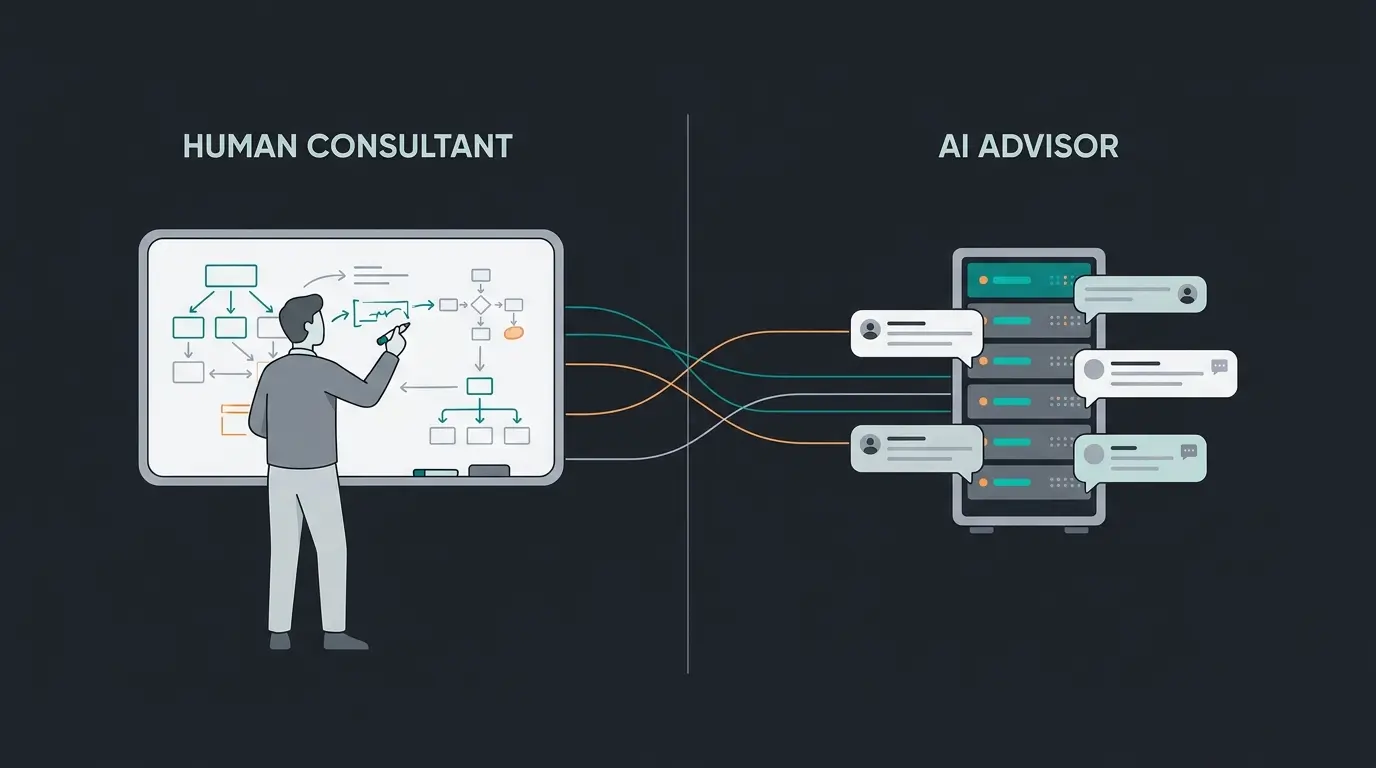
AI-powered product advisors now handle up to 80% of routine customer consultation tasks that traditionally required human expertise. Product recommendations, technical specifications, compatibility checks, and availability questions. That frees consultants to focus on strategic decisions that actually need human judgment.
This is not about replacing Shopware consulting. Strategic architecture decisions, migration planning, and business model work require human expertise and will continue to. But the operational side of consulting, specifically the day-to-day product advisory that eats into staff time, can be automated effectively. According to Gartner's marketing technology research, businesses using AI for customer-facing support see a 25% reduction in service costs on average.
Rasendoktor, an online specialist for professional lawn care, handled 2,000-3,000 consultation-intensive inquiries per season. After implementing an AI product advisor, they achieved a 16x return on investment, 100% automation of routine product consultations, and 40% reduction in support costs. The details are in the Rasendoktor case study.
The pattern repeats across catalog types and channels. Signed, an online retailer for custom and decorative signs, automated 70% of customer inquiries on Instagram and TikTok with the digital employee Alex, reaching 18x ROI and a 30% lift in up- and cross-selling. Pooldoktor built an AI product advisor that fields over 1,100 conversations per month on water chemistry, filtration, and equipment selection. Since January 2026 that advisor, Franz, has answered in 13 seconds on average and delivered +18.75% revenue per user against a control group, causally measured, at 33x ROI.
Pool and water chemistry catalog, live since January 2026 (Pooldoktor case study)
100% automation of routine product consultation, 40% lower support cost
Pooldoktor, measured against a control group, not modelled
Across Qualimero's client base, the pattern holds: +35% higher cart value, +60% higher checkout rates, and an average 16x ROI. These numbers come from stores with consulting-intensive products, exactly the type of Shopware shops that typically spend the most on traditional consulting. An AI product advisor will not replace your Shopware consultant for architecture decisions. But it will handle the portion of their work that involves answering the same product questions repeatedly.
Worth separating: what Shopware ships natively and what the advisory layer adds. Shopware's built-in AI feature set, launched as AI Copilot and folded into Shopware AI in June 2025, covers merchant-side tasks in the admin: generated product descriptions, AI-translated reviews, and context-based search. None of it talks to your customers. The layer that answers which of the 50 filter pumps fits a specific pool comes from technology partners, not from the platform.
In Shopware's partner taxonomy, this layer comes from technology partners rather than agencies: subscription software connected through the platform's API, with no development hours billed per change. Evaluate them on data, not portfolios. Ask for documented client metrics, a trial period, and clarity on one question that rarely comes up during selection: what happens to your data if you cancel. At Qualimero, all client data remains client property with full export capability at any time, and not every provider puts that in writing.
Frequently asked questions
A Shopware consultant provides expert guidance on platform strategy, technical architecture, and operational optimization specific to Shopware 6. Typical deliverables include migration roadmaps, performance audits, integration architecture documents, and training programs. According to Shopware's own consulting page, their in-house consultants cover both business discovery sessions and technical code reviews.
Independent Shopware consultants charge EUR 100-200 per hour, while agency-based consultants charge EUR 150-250 per hour. A one-time audit typically costs EUR 2,000-5,000, a migration planning project EUR 5,000-15,000, and full implementation advisory EUR 20,000-50,000+. Central European consultants tend to charge 30-50% less than Western European rates.
Choose a consultant if you need a second opinion, an independent audit, or strategic guidance without implementation. Choose an agency if you need full project delivery with design, development, and ongoing management. The most effective approach for larger projects is both: consultant for requirements and architecture, agency for execution.
In almost every case, yes. Shopware 5 stopped receiving security fixes at the end of July 2024, and the move to Shopware 6 involves plugin replacement rather than plugin porting, data mapping, and a redirect map for old URLs. Migration planning engagements typically run EUR 5,000-15,000 over 2-6 weeks.
A one-time audit takes 1-2 weeks. Migration planning runs 2-6 weeks depending on complexity. Ongoing advisory retainers are typically month-to-month with a 3-month minimum commitment. Full implementation advisory for large projects spans 3-6 months from requirements to launch.
A template-based store takes 4-8 weeks, a custom build with individual design and ERP integration runs 8-16 weeks, and enterprise B2B projects span 4-12 months. A Shopware 5 to 6 migration typically takes 6-12 weeks. Plan a 20-30% time buffer on top of every one of those figures.
Not for strategic and technical decisions. Architecture planning, migration management, and business model consulting require human judgment and experience. However, AI product advisors can automate routine customer consultation, with Qualimero clients reaching 16x to 33x ROI and up to 100% automation of standard product inquiries.
Shopware freelancers charge EUR 65-140 per hour in the DACH region: EUR 65-85 for junior generalists, EUR 90-120 for experienced Shopware 6 developers, and EUR 120-140 for migration or performance specialists. Freelancers do hands-on implementation, while consultants at EUR 100-250 per hour advise and audit. Every Shopware certificate expires after 12 months, so check the issue date either way.
A Shopware consultant fixes the architecture and leaves. An AI employee handles the product consultation your customers need every day after that. Qualimero clients see +35% higher cart value and 16x to 33x ROI.
Book a free demo
Kevin is CTO and co-founder of Qualimero. As an AI architect with over 15 years of experience as CTO and CPO in the tech industry, he designs the AI systems that automate tens of thousands of customer interactions daily for Qualimero's clients — reliably, securely, and at scale.