Search for a Shopware 6 agency and you get two kinds of results: Shopware's own partner directory, and dozens of agency landing pages that all describe themselves as experts. Neither one tells you what an agency actually does, what a project should cost, or how to separate a certified specialist from a generalist web shop. This guide fills that gap.
The advice below is deliberately neutral. We build software on top of Shopware, so we have sat on both sides of the table: as the people evaluating agencies, and as the people getting evaluated. That is the lens here.
What is a Shopware 6 agency?
A Shopware 6 agency is a specialized service provider that plans, builds, and maintains online stores on the Shopware 6 platform. It combines consulting, design, development, and integration work, and is usually a certified Shopware partner rather than a generalist web agency. That certification is the first filter worth applying.
The distinction matters because Shopware is not a small niche. Shopware states in its Shopware partner directory that it works with "over 1,200 certified Shopware agencies that specialise in a wide variety of services." Behind that network sit more than 100,000 merchants worldwide running on the platform, generating a combined turnover in the region of EUR 12 billion according to Shopware company facts. Independent tracking by Storeleads counts around 30,000 live public storefronts. Different counting methods, same conclusion: this is a mature ecosystem with real specialists in it.
Certification is tiered. Shopware ranks its solution partners by the number of certified developers and delivered projects, historically as Silver, Gold, and Platinum. A higher tier is not a guarantee of a good fit, but it does confirm verified Shopware 6 competence rather than a self-declared badge. A generalist agency that lists Shopware alongside ten other platforms rarely holds one. For the certification mechanics, our certified Shopware partner breakdown goes deeper, and the broader Shopware agency guide covers the market at a higher level.
Across the global Shopware base
Shopware 6.7 line, actively maintained
One practical consequence: the label "Shopware agency" covers everything from a two-person studio doing template installs to a 50-person shop building headless enterprise stores. The word itself tells you almost nothing. The certification tier, the reference projects, and the integration track record do. Treat the term as a category, not a qualification.
What does a Shopware 6 agency do?
A Shopware 6 agency handles the full store lifecycle: strategy consulting, UX and design, theme and plugin development, third-party and ERP integration, migration from Shopware 5, plus ongoing maintenance and performance work. Most projects touch several of these at once. Few merchants need only one.
The work breaks down into six recurring areas:
- Consulting and requirements: scoping the project, mapping business processes, and choosing the right Shopware edition (Community, Rise, Evolve, or Beyond). See our Shopware consulting guide for how this phase should run.
- Design and UX: storefront design, conversion-oriented layouts, and Shopware's Shopping Experiences (the drag-and-drop CMS).
- Development: custom themes, plugin development, and headless or API-first builds using Shopware's Symfony and Vue.js stack.
- Integrations: connecting ERP, CRM, PIM, payment, and shipping systems. This is where most B2B budgets actually go.
- Migration: moving from Shopware 5, Magento, or another platform, including data cleanup and URL structure preservation.
- Maintenance and updates: security patches, version upgrades, and Core Web Vitals tuning. Our Shopware maintenance article covers what a sensible retainer includes.
Migration deserves a flag. Shopware 5 reached end of life in July 2024, which means no more official security updates. If you are still on it, a Shopware 6 migration is not a feature project, it is a risk fix. The current line is Shopware 6.7, with 6.7.12 shipped in July 2026 per the Shopware changelog, so an agency working on old 6.4 or 6.5 templates is already behind.
Where does the budget actually go? In our experience, integration work is the line item that surprises people. A clean B2C store with a standard theme is mostly predictable. The moment you connect an ERP, sync stock levels in real time, map customer-specific pricing, and route orders back into your accounting system, the effort multiplies. That is not the agency padding hours. It is the reality of moving structured data between systems that were never designed to talk to each other, and it is worth budgeting for honestly up front.
Agency vs. freelancer vs. in-house
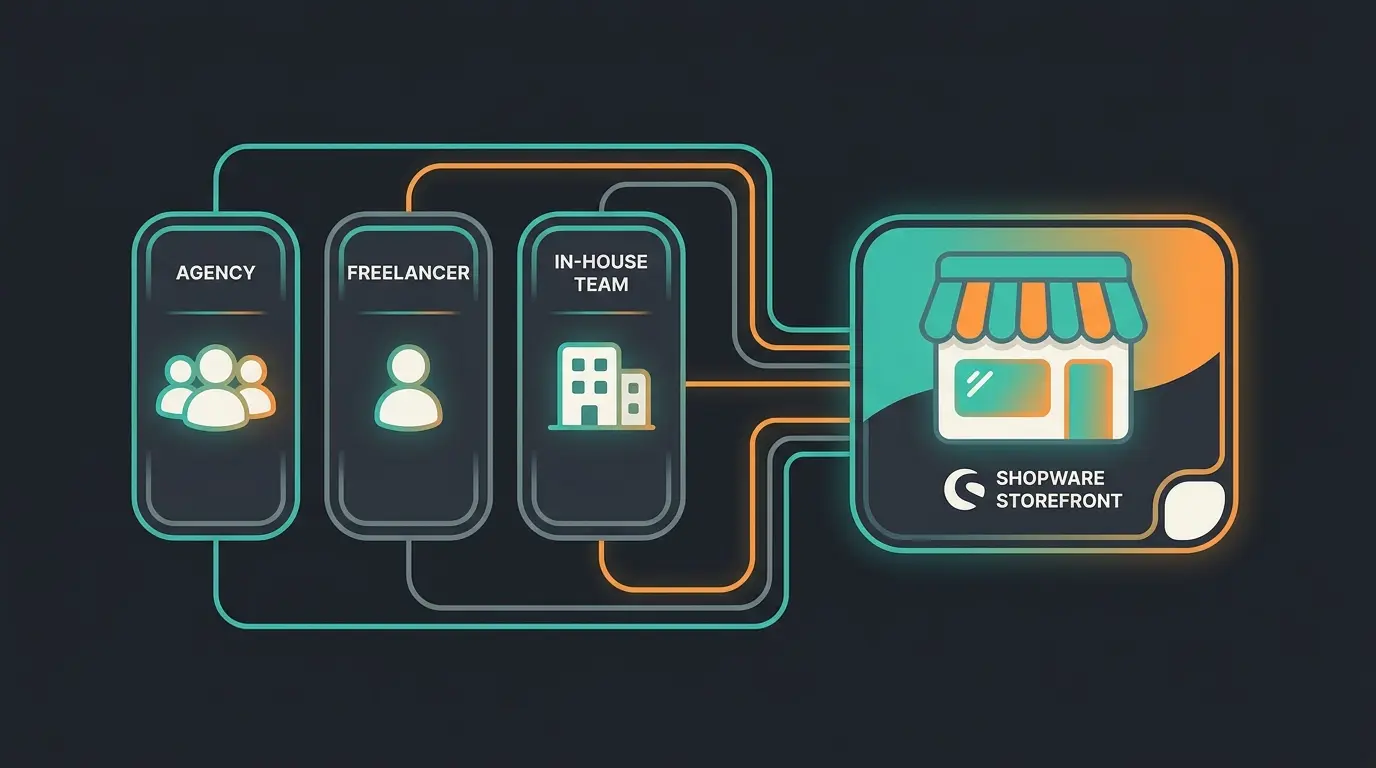
Choose a Shopware 6 agency for complex, multi-discipline projects that need continuity guarantees. Choose a freelancer for small, well-defined tasks on a tight budget. Build an in-house team only if you run continuous Shopware development at scale. For most SMEs, an agency gives the best ratio of cost to risk.
The trade-offs are concrete. A freelancer is cheaper per hour but covers one skill, so a project needing backend, frontend, and ERP work means managing three freelancers yourself. An agency bundles those skills and absorbs the coordination, but you pay a higher blended rate for it. An in-house team gives you the most control and the fastest iteration once it exists, yet the fixed cost only pays off above a certain, continuous workload. Most merchants underestimate how much of a build is integration glue, and that is exactly where a solo Shopware freelancer tends to stall.
| Criterion | Agency | Freelancer | In-house team |
|---|---|---|---|
| Typical rate (2026) | EUR 100-180 / hour | EUR 70-110 / hour | Fixed salary + overhead |
| Skill coverage | Full team (dev, design, SEO, PM) | One specialist | Whatever you hire |
| Delivery risk / continuity | Low, contract-backed | High if the person drops out | Low once the team is stable |
| Best fit | Complex builds, migrations, B2B | Small fixes, single tasks | Continuous, high-volume development |
| Ramp-up time | Days to weeks | Immediate for scoped work | Months to hire and onboard |
How to choose the right Shopware 6 agency
Evaluate a Shopware 6 agency on seven criteria: Shopware certification tier, relevant portfolio and references, technical depth in Shopware 6 and Symfony, integration experience with your ERP, transparent pricing, SEO capability, and a clear post-launch support model. Skip any of these and you inherit the risk yourself.
- Certification tier. Confirm the agency appears in the official Shopware partner directory and check the tier. Registered is a starting point; Gold or Platinum signals depth.
- Relevant references. Ask for live stores in your model (B2B, B2C, or D2C) and roughly your catalog size. A 200-product fashion shop and a 50,000-SKU spare-parts catalog are different disciplines.
- Technical depth. The team should speak fluently about Shopware 6.7, Symfony, and the Admin API, not just "we can do Shopware."
- Integration track record. Name your ERP (SAP, Microsoft Dynamics, Pickware, weclapp) and ask for a comparable integration they have shipped.
- Transparent pricing. A serious agency gives you a rate card and a scoped estimate, not a single opaque number.
- SEO capability. Migrations wreck rankings when redirects and structure are handled carelessly. A Shopware SEO agency or an in-house SEO lead should own this from day one.
- Post-launch support. Clarify the maintenance model, response times, and who owns updates after go-live.
This is not busywork. The Standish Group's long-running CHAOS research finds that only about a third of IT projects finish on time, on budget, and on scope, while roughly half come in "challenged": late, over budget, or short on features (as summarised in this CHAOS report analysis). Proper vetting is the cheapest insurance you will buy on the whole project.
A few red flags are worth naming. An agency that quotes a fixed price before scoping your integrations is either guessing or planning to bill the difference later. One that cannot name a single Shopware 6 project from the last twelve months is coasting on old work. And one that treats SEO as a post-launch add-on will hand you a migration that quietly tanks your rankings, which is the single most expensive mistake we see merchants make.
What does a Shopware 6 agency cost?
A Shopware 6 agency project typically ranges from a few thousand euros for a template-based store to well into five or six figures for a custom B2B build. Pricing depends on scope, the number of integrations, and whether you need ongoing maintenance. Hourly rates in the DACH region sit between EUR 100 and EUR 180 in 2026, with Silver partners at the lower end and Platinum partners at the top.
| Project type | Typical budget | What it includes |
|---|---|---|
| Template / starter store | EUR 15,000-25,000 | Standard theme, minor customization, basic go-live |
| Custom / professional store | EUR 30,000-70,000 | Individual design, ERP and payment integrations, B2C or light B2B |
| B2B / enterprise build | from EUR 80,000 | Complex pricing, approval flows, headless or deep integrations |
| Maintenance retainer | EUR 500-3,000 / month | Security patches, updates, monitoring, small change requests |
Two honest caveats. First, budgets under EUR 80 per hour usually mean junior staff or offshore work with heavier revision cycles, which can erase the saving. Second, the retainer is not optional. A store you never patch drifts out of security compliance and slowly loses Core Web Vitals points, so plan the ongoing cost from the start rather than treating it as an afterthought.
You can control the number, though. The most reliable lever is phasing: launch a lean version 1 with the features that drive revenue, then add complexity once the store is live and earning. A staged build spreads cost, surfaces integration problems early while they are cheap to fix, and gives you real data before you commit to the expensive parts. We would rather see a merchant ship a focused store in ten weeks than burn six months and a five-figure overrun chasing a spec nobody validated.
Regional Shopware agencies in Germany
Germany has the densest network of Shopware 6 agencies, with strong hubs in Berlin, Munich, Hamburg, Cologne, and Dusseldorf. Choosing a regional agency can simplify on-site workshops and keep everyone in the same time zone. For most projects, though, proximity matters far less than fit.
Location genuinely helps in two cases: when stakeholders want in-person kickoff and design workshops, and when internal teams need hands-on training after launch. Everything else, including day-to-day development and support, works fine remotely. If you do prefer someone local, start with a Shopware agency in Berlin, a Shopware agency in Munich, a Shopware agency in Hamburg, a Shopware agency in Cologne, or a Shopware agency in Dusseldorf, then apply the same seven criteria as above. Region narrows the list. It does not replace the checklist.
Beyond development: adding AI employees to your Shopware shop
Once your Shopware 6 store is live, an AI employee can automate customer service and product consultation directly in the shop, recovering conversions that a development agency alone does not address. A finished store is infrastructure. Turning visitors into buyers is a separate job, and it is the one most agencies hand back to you unsolved.
The gap shows up in the numbers. Research from the Baymard Institute, aggregating 49 separate studies, puts the average documented cart abandonment rate at 70.19%. For consulting-intensive products, technical parts, plant protection, complex configurations, a big share of that abandonment is simply customers who could not decide. A static filter cannot answer "which of these fits my case." A digital team member can.
That is exactly what lawn-care retailer Rasendoktor did. Facing 2,000 to 3,000 consultation-heavy inquiries per season, the team deployed Hektor, an AI employee trained on their product expertise, to answer webchat questions around the clock. The result was a 100% automation rate on webchat inquiries, a 40% cut in support effort, and a 16x return on investment. The full details are in the Rasendoktor case study. Across our client base, this layer lifts cart value by up to 35% and checkout completion by up to 60%.
Technically, this sits on top of the store rather than inside the theme. The AI employee reads product data, categories, and properties through Shopware's Admin API, so it answers with your real catalog, not a generic script. It recognizes returning customers, keeps context across a conversation, and hands off to a human when a question falls outside its scope. That is the difference between a scripted widget and a digital team member, and it is why the integration is a separate discipline from building the store in the first place.
The point is not to replace your agency. Let the agency build the store, then add AI product consultation on top of it. The two jobs are complementary, and doing both is what separates a shop that displays products from one that actually sells them.
Your agency builds the store. A Qualimero AI employee advises customers in real time, automates product consultation, and recovers lost conversions, 24/7. Clients see up to 35% higher cart value.
See AI product consultation
Frequently asked questions
For a simple template store, a capable generalist can work. For migrations, B2B features, or ERP integrations, insist on a certified partner from the official directory. Shopware lists over 1,200 certified agencies, and the certification confirms verified Shopware 6 competence rather than a self-declared claim.
A freelancer is cheaper (around EUR 70-110 per hour) and fine for small, well-defined tasks. An agency costs more (EUR 100-180 per hour) but covers backend, frontend, SEO, and project management in one team, which lowers delivery risk on complex builds. Match the choice to project scope.
A template-based store takes roughly 4 to 8 weeks. A custom build with individual design and integrations runs 3 to 6 months. Enterprise B2B projects with complex pricing and deep integrations can take 6 to 12 months, including testing and optimization.
Plan for a maintenance retainer of roughly EUR 500 to 3,000 per month, covering security patches, version upgrades, and monitoring. Since Shopware 5 reached end of life in July 2024, staying current on Shopware 6 is a security requirement, not a nice-to-have.
Yes. An AI employee integrates on top of an existing Shopware 6 store to handle product consultation and customer service in the storefront. Rasendoktor reached a 100% automation rate on webchat inquiries and a 16x ROI this way, without rebuilding the shop.

Kevin is CTO and co-founder of Qualimero. As an AI architect with over 15 years of experience as CTO and CPO in the tech industry, he designs the AI systems that automate tens of thousands of customer interactions daily for Qualimero's clients — reliably, securely, and at scale.