Why you need a Shopware agency
Last month I spoke with a Shopware merchant who had spent four months trying to connect his ERP system to Shopware 6 on his own. The integration was almost working. Almost. Except that every third order synced with the wrong tax rate, and his team had been correcting invoices manually ever since.
The cost of that DIY experiment, once you factor in the developer hours, the accounting corrections, and the lost trust with B2B customers receiving wrong invoices: north of EUR 40,000. A specialized agency would have solved the integration in three weeks for a fraction of that amount.
Shopware is one of the most powerful e-commerce platforms in Europe. But power comes with complexity. Plugin architecture, API integrations, performance tuning, custom theme development, and seamless connections to ERP, PIM, and CRM systems require deep, specialized knowledge. A professional Shopware 6 Agency brings that knowledge from day one, along with battle-tested processes that prevent exactly the kind of expensive surprises described above.
There are clear trigger points where professional help stops being optional. Complexity triggers: Multi-language shops, custom business logic, B2B pricing rules, headless architecture, or migration from Shopware 5 to 6. Time triggers: Every week your shop runs suboptimally costs revenue. An experienced agency delivers in a fraction of the time you would need. Risk triggers: A misconfigured tax system, a broken checkout flow, or a failed data migration can cost five figures before anyone notices the problem.
Migration deserves special attention. Shopware 5 reached end of life, and the architectural differences between 5 and 6 are fundamental. This is not an update you click through. Data structures, plugin APIs, and template systems changed completely. Merchants who attempt this migration without expert guidance routinely lose SEO rankings, break integrations, and discover data inconsistencies months after go-live.
Shopware agency vs. freelancer vs. DIY
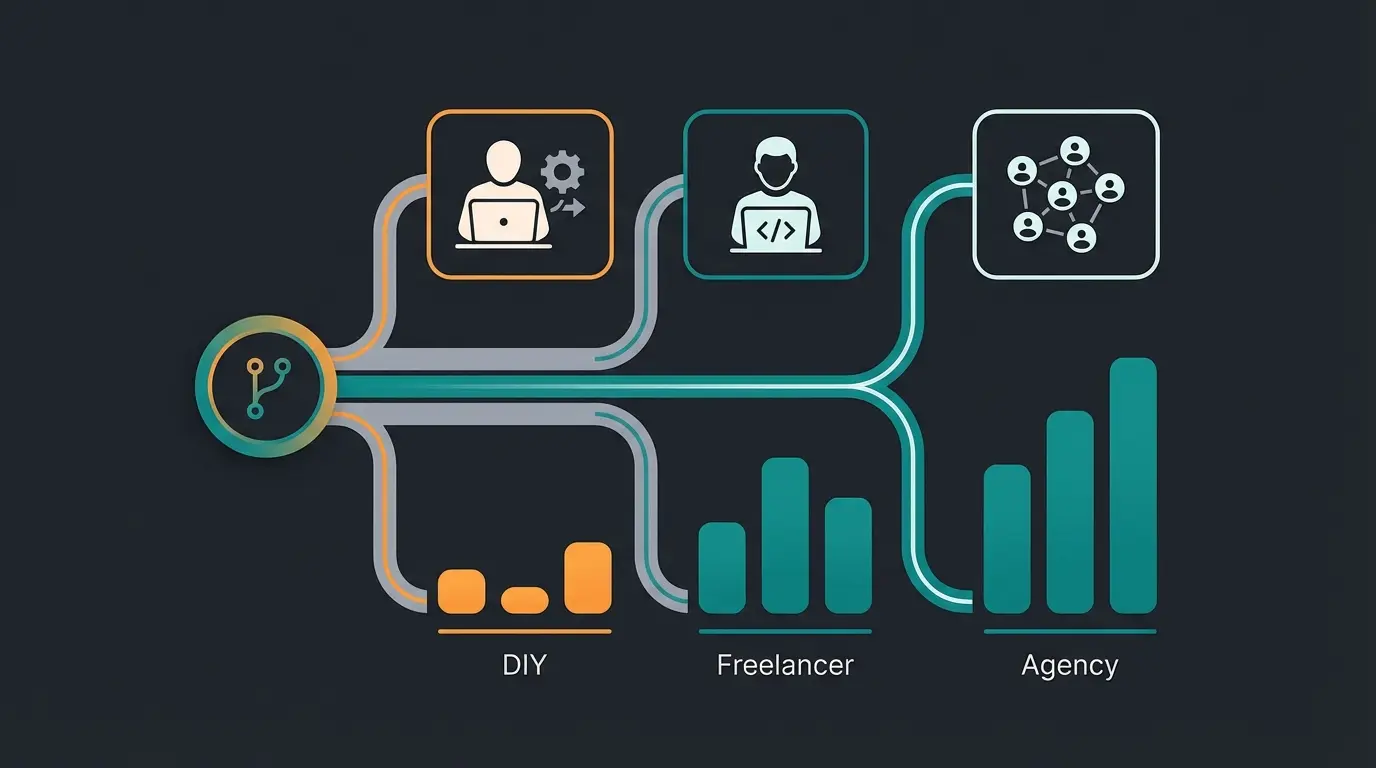
Before committing to an agency, you should understand all three options. Each has its place. The right choice depends on your project scope, budget, timeline, and tolerance for risk. Here is an honest comparison based on what we have seen across hundreds of Shopware projects in the DACH region.
DIY works for small shops with limited product ranges and standard requirements. You save budget but invest massive amounts of time. Shopware's Community Edition provides a solid foundation, but without technical expertise, you hit walls quickly. A Shopware Freelancer is the right call when you need to outsource specific tasks: a plugin development, a theme customization, or a one-time migration. Freelancers are typically cheaper than agencies but offer no holistic service. When they are sick or on holiday, you have no backup.
A Shopware agency gives you a complete team: project managers, frontend and backend developers, UX designers, SEO specialists, and often strategic Shopware Consulting as well. You get everything from one source, from concept through implementation to ongoing support. It costs more, but it reduces risk and delivers professional results at scale.
The hybrid approach is worth mentioning. Some merchants use a freelancer for specific technical tasks while an agency handles the overall architecture and project management. This can work if the freelancer and agency communicate well. In practice, coordination overhead often eats the cost savings. For projects above EUR 30,000, going all-in with one agency is usually cleaner.
| Criterion | DIY | Freelancer | Shopware Agency |
|---|---|---|---|
| Budget (entry) | EUR 0-2,000 | EUR 3,000-15,000 | EUR 10,000-150,000+ |
| Your time investment | Very high | Medium | Low |
| Technical complexity | Standard only | Medium to high | Any complexity |
| Scalability | Limited | Limited | High |
| Risk / redundancy | No backup | Single point of failure | Full team coverage |
| Ongoing support | Self-managed | Limited availability | SLA-based contracts |
| Strategic guidance | None | Rarely | Comprehensive |
| Time to market | Months (learning curve) | Weeks | Plannable (weeks to months) |
| Best for | Micro-shops, MVPs | Defined single tasks | Growing businesses |
What makes a great Shopware agency
Not every agency that lists Shopware on its website is a good Shopware agency. The market is large and quality varies enormously. The following criteria separate serious partners from those who will cost you time and money. Start with official certification, then dig deeper into what actually matters for your project.
Certification tiers explained
Shopware awards official partner certifications in four tiers. These are one of the most reliable quality indicators because they require demonstrable experience, completed training, and successful project delivery. The official Shopware partner directory lists over 1,200 certified agencies with their respective tier. For a deeper dive into what each tier means in practice, our guide to Shopware Partner certifications covers every level. If you are running Shopware 6 specifically, our Shopware 6 Agency guide helps narrow the search.
| Tier | Key requirements | What it means for you | Best for |
|---|---|---|---|
| Bronze | Active in Shopware target market | Basic competence, self-service portal support from Shopware | Small projects, simple configurations |
| Silver | Minimum 4 Shopware certifications | Dedicated partner manager, proven baseline expertise | Small to mid-sized projects |
| Gold | Minimum 10 certifications, proven high performance | Direct Shopware collaboration, priority support access | Mid-market to complex projects |
| Platinum | Strictest requirements, global activity, deep expertise | Own Shopware partner manager, maximum platform support | Enterprise, international rollouts |
A word of honesty: certification tier is a useful filter, not a guarantee. A Silver partner deeply specialized in your industry may outperform a Platinum partner who has never touched your vertical. The Shopware agency certification program details the exact requirements for each level. Use the tier as a starting point, then verify with references and portfolio work.
Beyond certifications: what really matters
Once you have filtered by certification, evaluate these factors. They reveal more about actual project quality than any badge. A great agency delivers strong Shopware Agency Services across the full spectrum, not just development.
- Portfolio with comparable projects: Has the agency built shops in your industry or at similar scale? Ask for case studies with measurable results: conversion rate improvements, page speed gains, revenue growth. Vague references are a yellow flag.
- Technical stack and processes: CI/CD pipelines, automated testing, staging environments, and code reviews should be standard. Ask about their deployment process and how they handle rollbacks.
- Communication and project management: Good agencies work with ticket systems, regular status updates, and transparent time tracking. Agile methods (Scrum, Kanban) are a strong signal of professional project management.
- Post-launch support model: What happens after go-live? Look for SLA-based maintenance contracts with defined response times. A Shopware SEO Agency mindset means they think about long-term visibility, not just the initial build.
- Team size and structure: How many dedicated Shopware developers does the agency employ? Are there specialized UX designers and SEO experts? A team that is too small becomes a bottleneck when multiple projects run in parallel.
- Specialization depth: Pure Shopware agencies typically have deeper platform knowledge than generalists who offer Shopware alongside WordPress, Magento, and five other systems. Specialization is a quality signal.
Shopware agency costs: what you really pay
Cost transparency is not the agency market's strongest suit. Too many merchants start projects without understanding the full financial picture and get surprised halfway through. Here is an honest breakdown of what a Shopware agency costs in 2026, based on real market data from the DACH region and our own observations across dozens of client projects.
Pricing models
Fixed price: The agency quotes a flat fee for a clearly defined scope. Advantage: budget certainty. Disadvantage: changes during the project (change requests) become expensive quickly. Works well for well-defined, smaller projects where requirements are unlikely to shift.
Time and material: You pay for actual hours worked. Advantage: maximum flexibility to adjust scope. Disadvantage: harder to budget precisely. Typical hourly rates for certified Shopware agencies in Germany range from EUR 100 to EUR 180 net, depending on partner tier, region, and specialization. Retainer: You book a fixed pool of hours per month. Ideal for ongoing Shopware Maintenance, support, and continuous development. Retainer models typically include discounted hourly rates compared to ad-hoc bookings.
Typical project costs 2026
| Project type | Cost range | Timeline | Typical scope |
|---|---|---|---|
| Basic shop setup | EUR 10,000-25,000 | 4-8 weeks | Standard theme, up to 500 products, basic payment and shipping integration |
| Mid-market shop | EUR 25,000-60,000 | 8-16 weeks | Custom design, ERP integration, up to 5,000 products, SEO optimization |
| Enterprise project | EUR 60,000-150,000+ | 4-12 months | Complex business logic, multi-channel, PIM integration, custom plugins, internationalization |
| Shop migration (SW5 to SW6) | EUR 15,000-50,000 | 6-12 weeks | Full data migration, SEO redirect mapping, plugin replacement, testing |
| Ongoing support retainer | EUR 1,500-5,000/month | Ongoing | Maintenance, updates, monitoring, small adjustments, security patches |
| Performance optimization | EUR 5,000-20,000 | 2-6 weeks | Core Web Vitals, caching strategy, CDN setup, database optimization |
Hidden costs to plan for
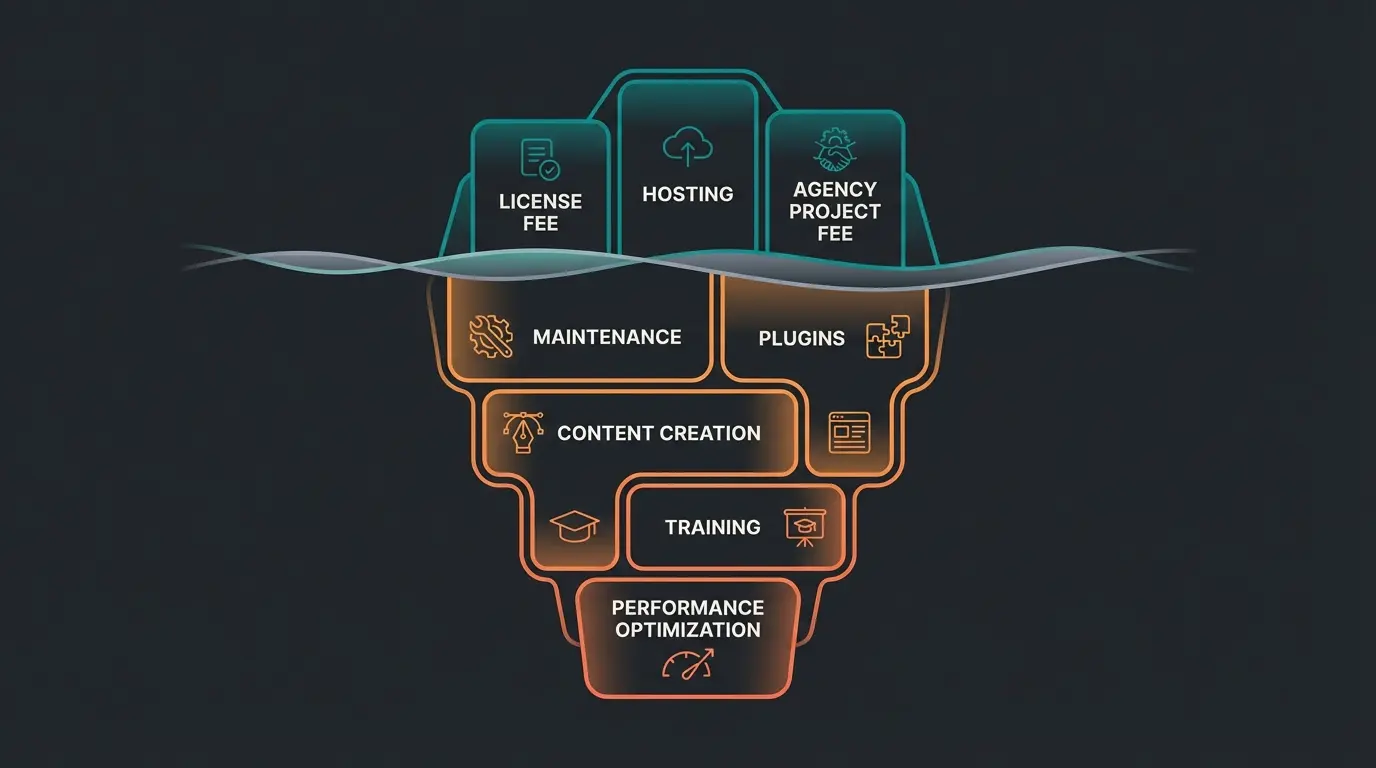
Beyond the project fee, several cost blocks catch merchants off guard. License costs: Shopware pricing plans start at EUR 600/month for Rise and reach EUR 6,500/month for Beyond. The free Community Edition is capped at EUR 1 million GMV since March 2025. Plugin costs: Expect EUR 100-400/month for essential extensions. Hosting: EUR 50-500/month depending on traffic volume. Ongoing Shopware Maintenance contracts add another EUR 200-2,000/month depending on scope. Content creation and team training are frequently forgotten line items that add up.
The ROI perspective: A well-executed Shopware project typically pays for itself within 6 to 18 months. The combination of higher conversion rates, better SEO rankings, lower operational costs, and scalable architecture outweighs the initial investment. The critical factor: choose your agency based on value delivered, not on the lowest quote.
Net rates for certified Shopware agencies in Germany, Austria, and Switzerland
Custom design, ERP integration, up to 5,000 products
Well-executed Shopware projects typically recoup their investment within this window
Scope changes and technical surprises are the norm, not the exception
Best Shopware agencies by region
Germany has a vibrant Shopware agency landscape with distinct regional strengths. While most agencies work remotely today, many merchants prefer a partner nearby. In-person workshops, kickoff meetings, and short communication lines make a real difference, especially during the early phases of a project.
North Rhine-Westphalia is Germany's densest agency cluster. The Cologne-Dusseldorf corridor hosts dozens of established Shopware agencies with strong focus on fashion, industrial, and B2B verticals. Our detailed guides to Shopware Agency Cologne and Shopware Agency Dusseldorf compare the top options in each city.
Hamburg has established itself as a powerhouse for e-commerce, shaped by large brands and an active startup scene. Shopware Agency Hamburg partners often bring international experience and strong UX expertise. Berlin offers the widest variety: from innovative boutique agencies to large full-service providers. Shopware Agency Berlin teams tend to be especially tech-forward, with growing expertise in AI integration and headless architectures.
Munich and southern Bavaria are the go-to region for enterprise projects and B2B e-commerce. Shopware Agency Munich partners frequently serve premium brands and handle highly complex integration scenarios. Expect higher hourly rates here, but also deeper enterprise experience and established processes for large-scale rollouts.
- Cologne/Dusseldorf: Strong industrial and B2B expertise, high density of certified partners
- Hamburg: International focus, strong UX competence, established e-commerce ecosystem
- Berlin: Innovation and technology leaders, widest variety of agency types and sizes
- Munich: Enterprise and premium projects, complex integrations, higher rate brackets
- Frankfurt/Stuttgart: Mid-market focus, finance and automotive verticals
- Remote-first agencies are making regional boundaries increasingly irrelevant for day-to-day work
Even the best Shopware agency builds a shop, not a sales team. A Qualimero AI employee fills the gap: 24/7 product consultation that increases average cart value by up to 35% and reduces returns. No additional headcount required.
Try it freeHow to find the right agency: 7-step process
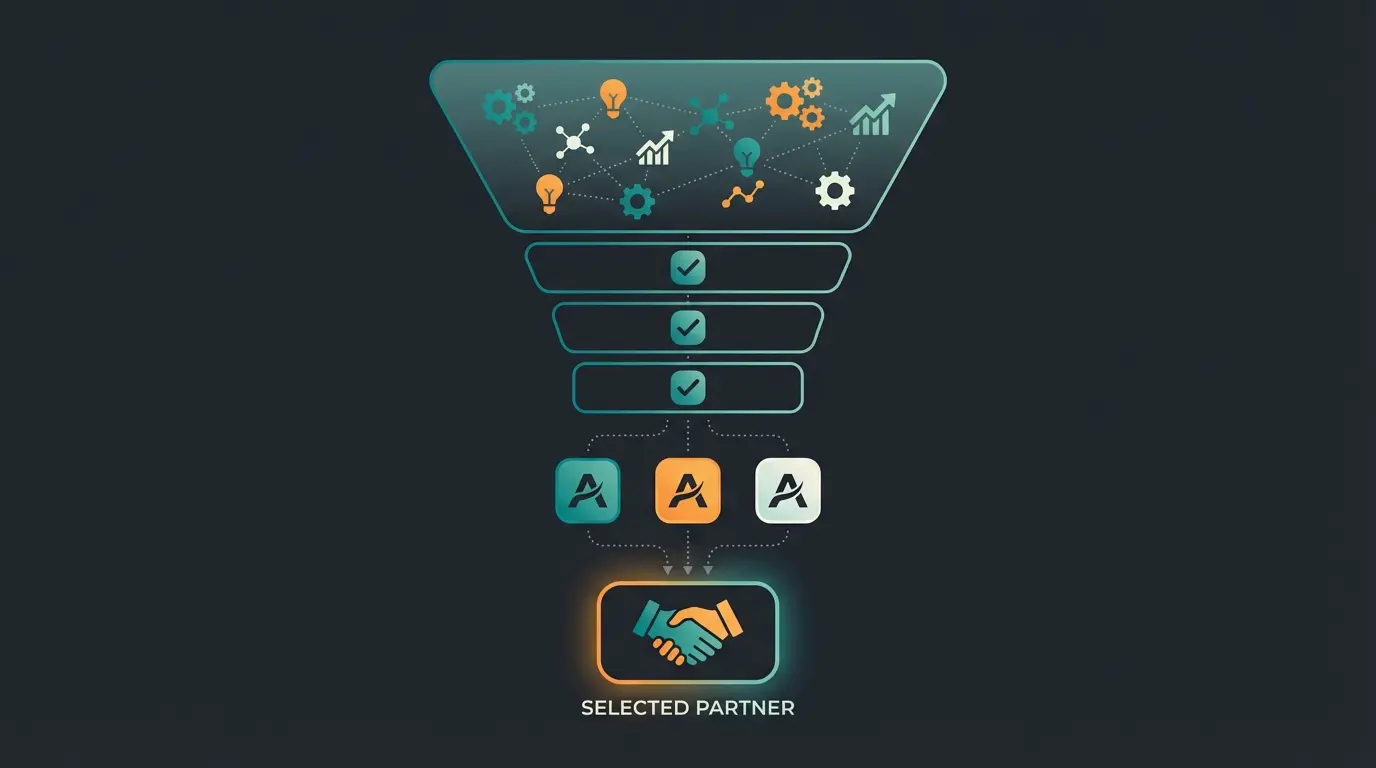
Choosing a Shopware agency is a high-stakes business decision. The following systematic process ensures you find the right partner, not just the loudest one. This framework has been tested across dozens of agency selection processes and protects you from the most expensive mistake in e-commerce: committing to a partner who cannot deliver.
Document project goals, features, integrations, budget range, timeline, and success metrics before contacting any agency
Research 8-12 potential agencies via Shopware partner directory, industry referrals, and regional guides
Send your requirements brief to the top 5-6 candidates with a unified deadline (2-3 weeks) for comparable proposals
Score systematically: technical competence (30%), value for money (25%), methodology (20%), references (15%), cultural fit (10%)
Meet 2-3 finalists in person. Insist on meeting the actual project team, not just the sales department
Start with a paid pilot (EUR 2,000-5,000): a concept workshop or small module to test collaboration under real conditions
Ensure clear deliverables, milestone-based payments, IP ownership, maintenance SLAs, and exit clauses
Step 1 is where most merchants cut corners, and where most project failures originate. The more precise your requirements document, the more accurate and comparable the proposals you receive. Include project goals with measurable KPIs, features ranked by priority (must-have vs. nice-to-have), technical requirements (ERP, PIM, payment providers), your budget range (share it openly, serious agencies appreciate the transparency), timeline with hard deadlines, and how you define project success.
Steps 4 and 5 are where you separate real expertise from good marketing. During proposal evaluation, pay close attention to how agencies approach your specific challenges. Do they ask clarifying questions? Do they push back on requirements that seem unrealistic? A good agency challenges your assumptions rather than agreeing with everything. During interviews, the most revealing question you can ask: 'Walk me through how you would handle a scope change request in week 6 of the project.'
Step 6, the pilot project, is the single most valuable step in the entire process. A pilot costing EUR 2,000-5,000 can save you tens of thousands by revealing collaboration issues, communication gaps, or quality problems before you commit to a six-figure engagement. If an agency refuses to do a paid pilot, that tells you something important about their confidence in delivering.
Step 7 deserves careful attention to contract details. Key clauses to negotiate: a detailed scope description with acceptance criteria for each milestone, milestone-based payment (never pay everything upfront), clear change request procedures with pre-agreed rates, full IP and code ownership transferred to you, defined SLAs for post-launch support, and reasonable exit clauses. Have an IT lawyer review the contract if the project exceeds EUR 50,000.
Red flags: how to spot bad agencies
Knowing what to look for is only half the battle. Recognizing warning signs early saves you from expensive mistakes. The more of these red flags you identify with a potential agency, the faster you should move on to the next candidate.
- No verifiable references: The agency cannot show comparable projects, or the referenced shops no longer exist. Always verify by visiting the actual URLs and calling the reference contacts.
- Unrealistically low prices: If a complex project is quoted at a fraction of market rates, quality, testing, or documentation is being cut. Cheap agency work always becomes expensive in maintenance and fixes.
- No structured project methodology: Professional agencies have a clear, documented process. If nobody can explain step-by-step how your project will be managed, expect chaos and budget overruns.
- Sales team only in meetings: If you never get to speak with the developers and designers who will actually build your shop, that is a serious red flag. You should always meet the people doing the work.
- No Shopware certification: An agency positioning itself as a Shopware expert without any official partner status deserves extra scrutiny. Certification is not everything, but its absence raises questions.
- Unrealistic timelines: A complex, custom shop in two weeks? Not possible without massive quality compromises. Experienced agencies give honest timelines, even if they are longer than you hoped.
- No post-launch support offering: An agency that does not offer maintenance and support after go-live is not planning for a long-term partnership. Shops require ongoing care.
- No code ownership clause: If the contract does not transfer full IP rights for custom-developed code to you, you are creating vendor lock-in. This must be contractually explicit.
- Jack of all trades: Agencies offering Shopware alongside WordPress, Magento, app development, print design, and social media management are rarely excellent at any single platform. Specialization depth matters.
Frequently asked questions about Shopware agencies
Certified Shopware agencies in Germany charge between EUR 100 and EUR 180 net per hour in 2026. Silver partners tend toward the lower end, Platinum partners toward the upper range. Regional differences also play a role: agencies in Munich or Hamburg are typically more expensive than those in smaller cities. The hourly rate alone is not decisive. A senior developer at EUR 150 often solves problems faster than a junior at EUR 80, making the effective cost lower.
A basic shop with standard theme takes 4-8 weeks. Mid-sized projects with custom design and ERP integration require 8-16 weeks. Enterprise projects with complex business logic and multiple integrations can take 4-12 months. Always plan a 20-30% time buffer for unforeseen technical challenges and scope adjustments.
Certification is not mandatory but serves as a reliable quality indicator. Certified agencies have completed official Shopware training, delivered verified successful projects, and receive priority platform support. For projects exceeding EUR 30,000, we recommend at least a Gold partner. For simpler projects, a competent Silver partner or experienced freelancer can deliver excellent results at lower cost.
Both approaches work well in 2026. Local agencies enable in-person workshops and meetings, which are especially valuable during kickoff and key milestones. Remote agencies often offer competitive rates and you are not limited to partners in your immediate region. Most agencies work hybrid today. For the kickoff and important milestones, meet in person. Handle day-to-day collaboration remotely.
An agency provides a full team with diverse specializations: development, design, SEO, and project management. A freelancer is typically one person with a specific focus area. Agencies offer more security through team redundancy and broader expertise but cost more. Freelancers are ideal for clearly defined single tasks and tighter budgets where you do not need a full-service approach.
Conclusion and next steps
Choosing the right Shopware agency is one of the most consequential decisions for your e-commerce business. With the framework from this guide, you know when an agency makes more sense than a freelancer or DIY. You understand certification tiers and what they actually signal about quality. You have realistic cost expectations grounded in current market data. And you have a proven 7-step process to find the best partner systematically. For a broader view of the entire Shopware ecosystem, our Shopware guide covers the platform from every angle. When you are ready to compare specific agencies head-to-head, our Shopware Agency Comparison breaks down the top options side by side.
One final thought. The most common mistake is not choosing the wrong agency. It is rushing the selection process. Invest two to three extra weeks upfront, and you will save months of frustration and potentially six figures in wasted spend. The right agency partnership can transform your business. The wrong one sets you back a year. Take the time. It is worth it.
The best agency builds a great shop. But even a great shop cannot advise customers on complex products at 11 PM on a Sunday. Qualimero's AI employees do exactly that: 24/7 product consultation, +35% average cart value, 16x ROI for clients. Your customers get expert guidance, your team gets relief.
Start your free trial
Lasse is CEO and co-founder of Qualimero. After completing his MBA at WHU and scaling a company to seven-figure revenue, he founded Qualimero to build AI-powered digital employees for e-commerce. His focus: helping businesses measurably improve customer interaction through intelligent automation.