What is Chatbot as a Service? Definition and fundamentals
Chatbot as a Service (CaaS) is a cloud-based SaaS model that provides businesses with ready-to-deploy AI-powered conversational agents. Instead of building from scratch, companies subscribe to a platform that handles NLP, hosting, and updates, enabling 24/7 customer service, product advisory, and lead generation at a fraction of the cost of custom development.
The term sounds abstract. In practice, it is simple: you pay a monthly fee, connect the platform to your product data and support knowledge base, and a digital agent handles customer conversations across your website, WhatsApp, and social channels. No servers to manage. No machine learning team to hire.
CaaS is a subset of the broader Bot as a Service (BaaS) category. While BaaS covers any automated agent (scheduling bots, data processing bots, internal workflow bots), CaaS focuses specifically on conversational interfaces that interact with customers or employees in natural language.
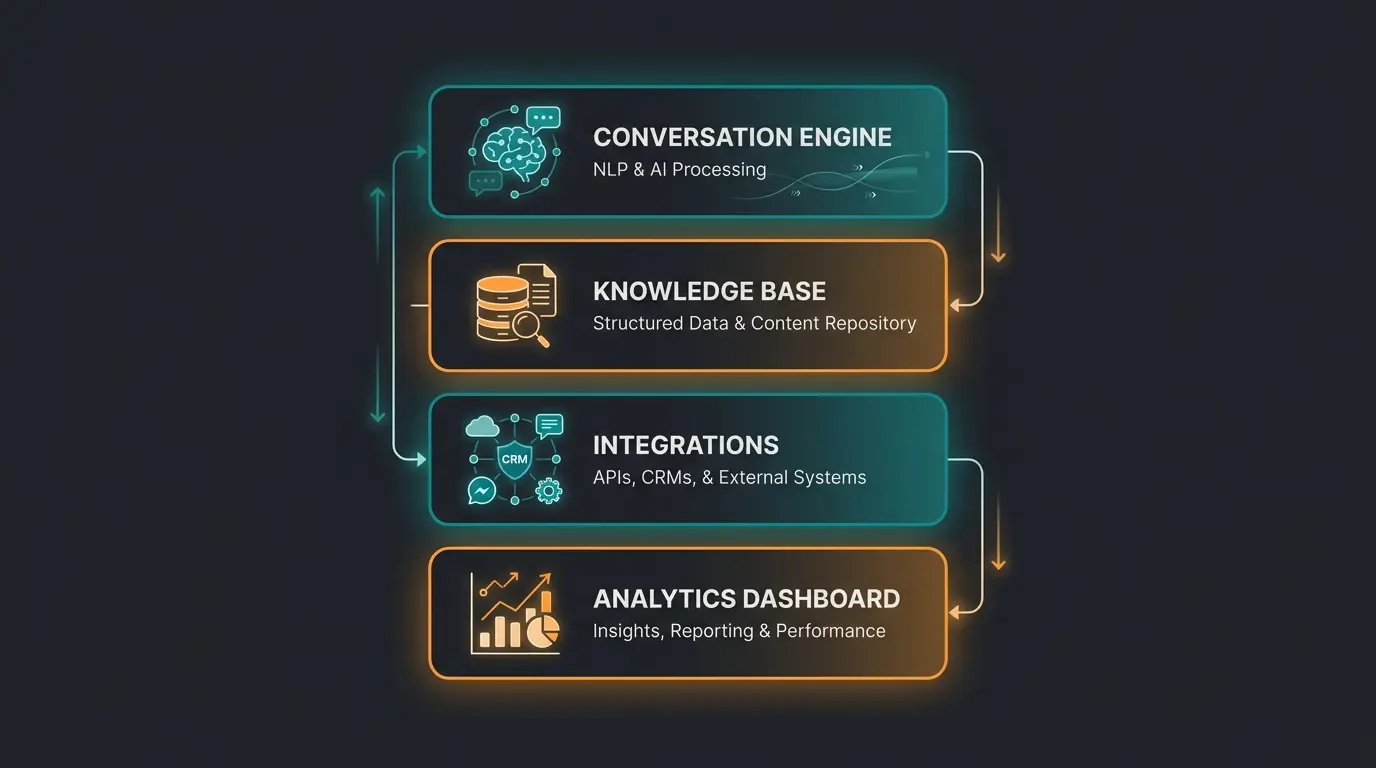
The technology stack behind CaaS has four layers. First, the conversation engine: Natural Language Processing (NLP) for understanding what a user means, not just what they type. Second, a knowledge base where your product catalog, FAQs, and policies live. Third, integrations connecting the agent to your CRM, shop system, and messaging channels. Fourth, an analytics dashboard that tracks resolution rates, conversion impact, and customer satisfaction.
What separates CaaS from hiring a developer to build a chatbot? Speed and maintenance. A custom chatbot takes 2-6 months to build. A CaaS platform deploys in days. And when the underlying language models improve (which happens quarterly now), the platform updates for you. According to IBM, the best AI customer service systems automate support at scale across websites, mobile apps, and social messaging platforms, handling thousands of concurrent conversations without degradation.
I have deployed CaaS solutions for 25+ businesses. The pattern is consistent: companies start with FAQ automation, realize the technology can do product consultation and lead qualification, then expand scope within weeks. The initial use case rarely stays the final one.
Types of chatbots: from rule-based to AI employees
There are three main categories of chatbots available as a service: rule-based systems with pre-programmed decision trees, AI-powered chatbots using NLP and machine learning, and AI employees, the most advanced form that understands context, makes decisions, recognizes returning customers, and provides personalized consultation.
Most businesses start with rule-based. That makes sense for a basic FAQ bot. But the gap between rule-based and AI-powered is not incremental. It is a category shift.
| Dimension | Rule-based | AI-powered | AI employee |
|---|---|---|---|
| How it works | Pre-defined decision trees, keyword matching | NLP + machine learning, intent classification | LLM-powered with persistent memory, context awareness, decision-making |
| Response accuracy | 60-70% (limited to scripted paths) | 85-90% (learns from data) | 92-97% (contextual, improves with use) |
| Handles complex queries | No, fails on anything outside the script | Partially, may need fallback to human | Yes, including multi-turn product advisory |
| Customer recognition | None | Basic (session-level) | Full: recognizes returning customers, remembers preferences |
| Setup time | 1-2 days | 1-4 weeks | 1-2 weeks (with product data integration) |
| Monthly cost range | $0-50 | $100-500 | $200-2,000 |
| Best for | Simple FAQ deflection, low-traffic sites | General customer support, mid-complexity queries | Product consultation, guided selling, complex advisory |
| ROI potential | Low: saves time on repetitive queries | Medium: reduces support costs 20-30% | High: drives revenue (+35% cart value at scale) |
Rule-based bots follow scripts. If the customer asks something outside the decision tree, the bot fails. I have seen this repeatedly: a garden supplies retailer had a rule-based bot that could answer "What are your shipping costs?" but broke when a customer asked "Which lawn fertilizer works on clay soil in spring?" That is not a support question. That is a consultation question. And consultation drives revenue.
AI-powered chatbots use NLP to understand intent, not just keywords. They handle more complex queries and learn from interactions. Platforms like Zendesk AI Agents and Intercom Fin fall into this category. Good for general customer support. Limited for specialized product advisory.
AI employees go further. They maintain persistent memory across conversations, recognize returning customers, make autonomous decisions (recommending products, adjusting offers, qualifying leads), and work across channels simultaneously. This is where Qualimero operates. When Rasendoktor deployed an AI employee for lawn care product consultation, the system did not just answer questions. It asked counter-questions about soil type, garden size, and season, then recommended specific products with application instructions. Cart value increased 35%. That is not a chatbot outcome. That is a sales advisor outcome.
How CaaS works: the technology behind it
A CaaS platform works in three stages: it analyzes user input through Natural Language Processing (NLP), identifies the intent and relevant entities (like product names or order numbers), then generates a contextual response, either from a pre-built knowledge base or dynamically via an LLM like GPT-4 or Claude.
That three-stage summary is what you read everywhere. Here is what actually matters in practice.
The system tokenizes the message, runs intent classification ("Is this a product question, a complaint, or a return request?"), and extracts entities (product names, order IDs, dates).
The platform checks the knowledge base (product data, FAQs, policies), the customer's conversation history, and any CRM data linked to their profile.
Based on intent + context, the system either retrieves a pre-built answer or generates one dynamically using an LLM. Advanced platforms rank multiple response candidates and pick the most relevant.
If the query requires an action (track an order, book an appointment, add to cart), the system triggers the appropriate API call to your shop system or CRM.
Every interaction feeds back into the model. Conversations that led to purchases, successful resolutions, or escalations are tagged and used to improve future responses.
The critical difference between CaaS tiers is step 2: context retrieval. A basic platform searches your FAQ database with keyword matching. An advanced platform understands that "something for the beetles on my roses" means the customer needs an insecticide for rose chafer beetles, checks which products are in stock, considers the customer's location (different regulations in different countries), and recommends accordingly.
Response times tell the story. According to industry benchmarks from IBM, AI chatbots respond in under 3 seconds on average. Human agents take 2-5 minutes for a first response, and that is before queue time. For e-commerce, where 70% of carts are abandoned (Baymard Institute), those minutes matter. A customer with a product question who waits 4 minutes does not wait. They leave.
One technical detail most guides skip: modern CaaS platforms do not rely on a single LLM. They use routing architectures. Simple queries ("Where is my order?") go to a fast, cheap model. Complex queries ("Which insulation material works best for a 1920s brick house with single-pane windows?") route to a larger, more capable model. This keeps costs low while maintaining quality where it counts.
CaaS use cases: where chatbot services drive ROI
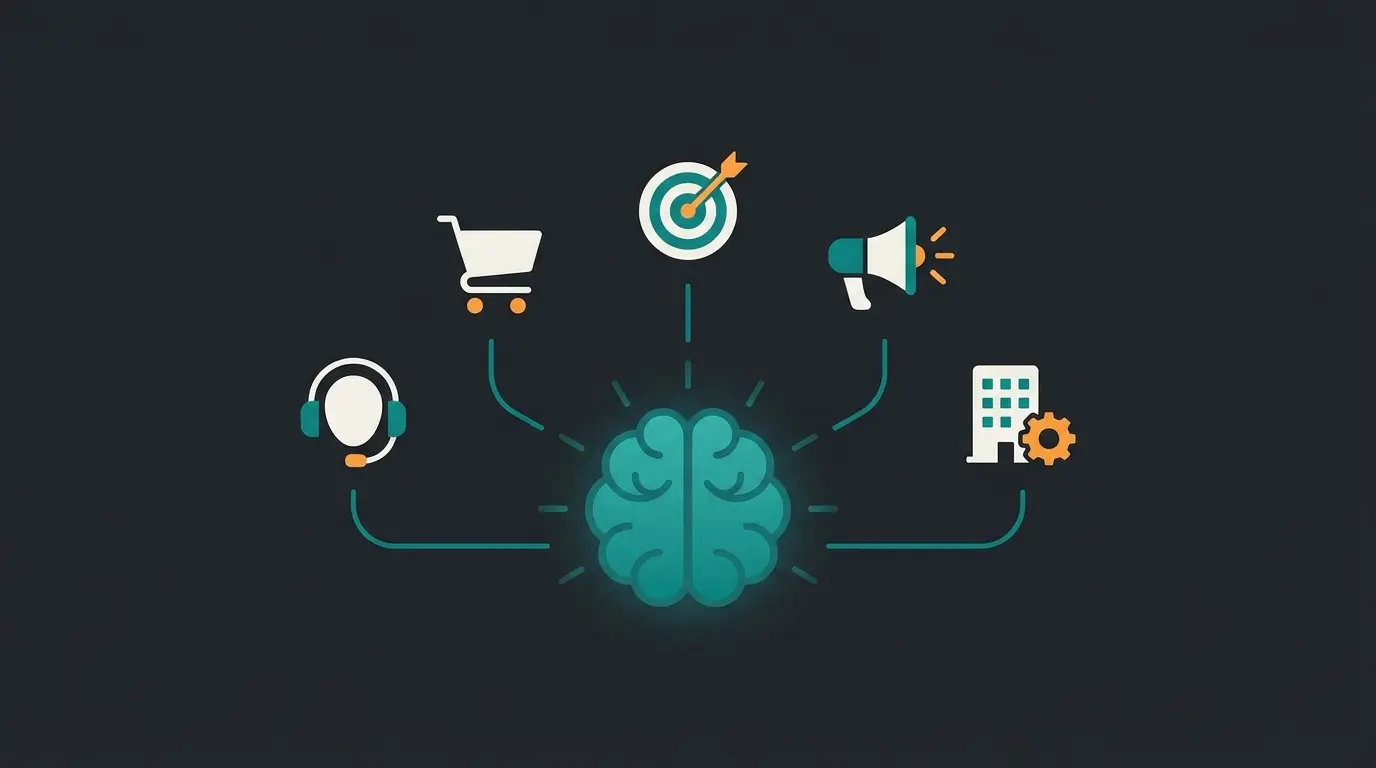
CaaS platforms drive measurable ROI across five core use cases: customer service (FAQ automation and ticket deflection), product consultation (guided selling and cross-selling), lead generation (qualification and booking), marketing (campaign bots and WhatsApp engagement), and internal operations (HR onboarding, IT helpdesk).
Not all use cases are equal. The highest-ROI deployments I have seen are not the ones automating support tickets. They are the ones generating revenue.
Customer service automation
The most common starting point, and the core use case covered in the Chatbot for Customer Service deep dive. A CaaS agent handles FAQs, order status inquiries, return requests, and basic troubleshooting. IBM reports that chatbots handle up to 80% of routine inquiries, with a cost per interaction of $0.50 compared to $6.00 for a human agent. For a business processing 3,000 support conversations per month, that is the difference between $18,000 and $1,500 in monthly support costs. Qualimero's AI Customer Service Solution achieves up to 100% automation for product-related queries.
Product consultation and guided selling
This is where CaaS stops being a cost center and becomes a revenue driver. An AI employee that understands your product catalog can replicate the in-store expert experience online. It asks qualifying questions, narrows down options, and recommends specific products with reasons. Qualimero clients using AI Product Consultation see cart value increases of 30-35% because the agent cross-sells complementary products at the right moment.
Lead generation and qualification
Contact forms convert at 2-3%. AI-powered lead qualification through conversational lead generation converts at 10x that rate. The agent asks qualifying questions in natural conversation, captures contact details, and routes hot leads directly to your sales team or books appointments in your calendar. One Qualimero client cut cost per lead by 50% while increasing lead quality.
Marketing and WhatsApp engagement
Campaign chatbots on WhatsApp and Instagram DMs open a direct channel to customers. Open rates on WhatsApp messages exceed 90%, compared to 20-25% for email. CaaS platforms enable automated product launches, personalized promotions, and re-engagement sequences through messaging channels.
Internal operations
HR onboarding bots, IT helpdesk automation, internal knowledge management. IBM's own AskHR system automates more than 80 common HR processes in natural language. Less visible externally, but often the fastest payback for larger organizations.
Real-world CaaS examples
Successful CaaS implementations show measurable results: Rasendoktor increased cart value by 35% with AI product consultation, Neudorff automated 97% of garden advisory conversations, and Signed achieved 70% customer support automation through a digital sales advisor, all using Qualimero's AI employee platform.
I could list features. Instead, here are three deployments I was directly involved in.
| Rasendoktor | Neudorff | Signed | |
|---|---|---|---|
| Industry | Lawn care e-commerce | Garden supplies (enterprise) | Custom signs retail |
| Challenge | 2,000-3,000 seasonal inquiries, 3 support staff overwhelmed | Scaling premium consultation without scaling headcount | Social media inquiries driving zero revenue |
| AI employee name | Hektor | Flora | Alex |
| Primary use case | Product consultation (soil type, lawn size, season) | Product advisory (pest control, plant care) | Product advisory + upselling via social channels |
| Automation rate | 100% | 97% accuracy | 70% support automation |
| ROI | 16x | 99% cost savings | 18x |
| Key revenue metric | +35% cart value | < 5 second response time | +30% cross-selling rate |
| Time to deploy | 2 weeks | 3 weeks | 10 days |
The Rasendoktor case is the one I reference most because it illustrates the CaaS value proposition perfectly. A seasonal lawn care retailer with consultation-intensive products. Customers need to know which fertilizer works on their specific soil type, in their specific climate, at their specific time of year. No FAQ page covers that. No rule-based bot handles it. The AI employee Hektor processes all those variables in real time and recommends the right product. Full Rasendoktor Case Study.
Neudorff is a different scale. A major German garden supplies manufacturer with thousands of SKUs. Their AI employee Flora handles pest identification, product recommendation, and application guidance with 97% accuracy. What would have required a team of trained garden consultants now runs 24/7 at a fraction of the cost. The Neudorff Case Study breaks down the implementation.
Signed proves the model works beyond garden and home. Custom decorative signs are a visual, preference-driven product. Alex, the AI sales advisor, guides customers through material options, size configurations, and personalization choices via Instagram and the website. The 30% cross-selling rate was unexpected, even for us.
Benefits and limitations of CaaS
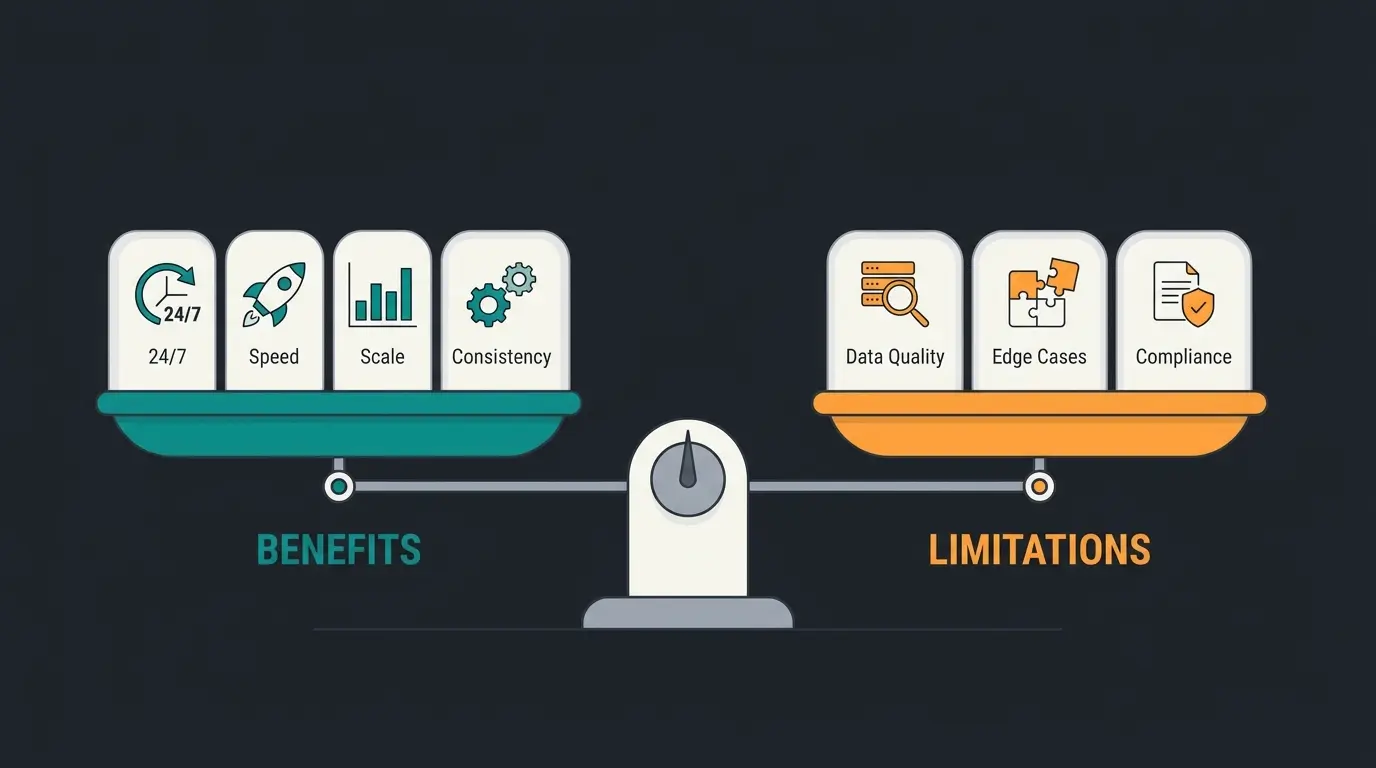
The biggest advantages of Chatbot as a Service are 24/7 availability, instant response times, scalability without hiring costs, and consistent service quality. The trade-offs: rule-based bots only handle limited queries, AI systems require training data, and complex advisory situations still benefit from human handover.
Every CaaS vendor will give you the benefits list. Here is what they usually leave out.
| Benefits | Limitations (and how to address them) |
|---|---|
| 24/7 availability without shift costs | Initial setup requires clean product data; garbage in, garbage out |
| Instant response (< 3 sec avg) vs. 2-5 min human wait | Edge cases still need human escalation; the handover must be seamless |
| Scales to 10,000 concurrent conversations without degradation | Training the knowledge base takes 1-3 weeks of real effort |
| Consistent quality: no bad days, no knowledge gaps between agents | Customer acceptance varies; some demographics still prefer phone calls |
| Data collection: every conversation becomes insight | GDPR and EU AI Act compliance adds complexity from August 2026 |
| Multilingual: serve customers in 50+ languages from one platform | Translation quality varies; test in each target language before launch |
| Cost reduction: IBM reports avg 30% lower customer service costs | ROI depends on conversation volume; under 500 monthly conversations, the math is tighter |
The honest take: CaaS is not a magic fix. If your product data is messy, your AI agent will give messy answers. If your escalation path to human agents is clunky, frustrated customers will blame the bot. As McKinsey notes, three-quarters of customers expect consistent cross-channel service experiences. A chatbot that cannot hand off to a human seamlessly breaks that expectation.
That said, the ROI data is hard to argue with. IBM's research across 412 enterprises shows an average 30% reduction in operational support costs from AI chatbot deployment. For top-quartile implementations, that number climbs to 53%. At $0.50 per chatbot interaction versus $6.00 per human agent interaction, the economics compound fast at scale.
How much does Chatbot as a Service cost?
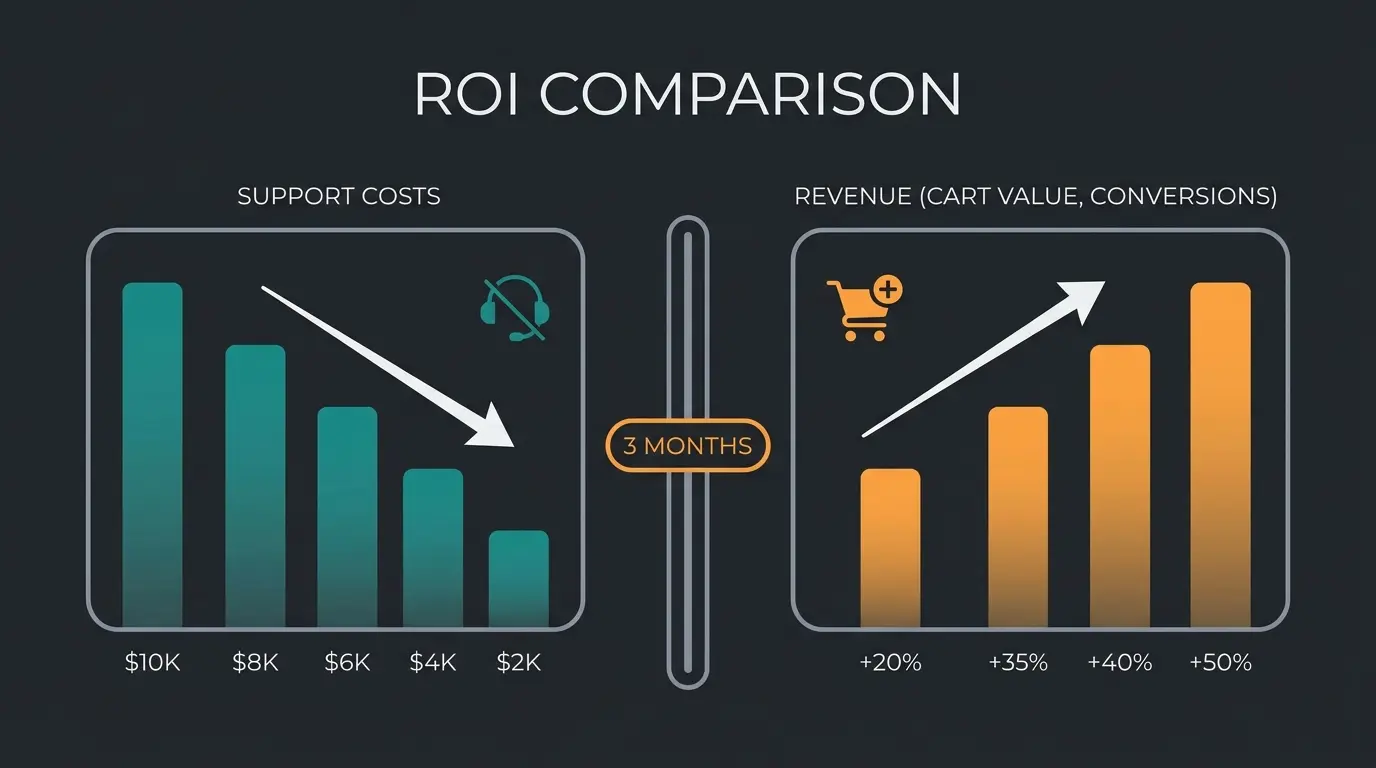
CaaS pricing ranges from $0 (free tier tools like Tidio or HubSpot) to $50,000+ for enterprise custom solutions. AI chatbot platforms for SMEs typically cost $200-2,000/month, with ROI breakeven often achieved within 3 months through support automation and revenue lift.
The question is not what CaaS costs. The question is what it costs you to not have it.
| Tier | Monthly cost | What you get | Best for | Typical ROI timeline |
|---|---|---|---|---|
| Free | $0 | Basic rule-based bot, limited conversations, branding | Testing the concept, very low traffic sites | N/A |
| Starter | $19-100 | AI-powered responses, 1-2 channels, basic analytics | Small shops under 1,000 monthly visitors | 6-12 months |
| Professional | $200-500 | Multi-channel, CRM integration, advanced NLP, custom training | Growing SMEs, 1,000-10,000 visitors | 2-4 months |
| Enterprise | $500-2,000+ | AI employee with product data integration, persistent memory, full analytics | E-commerce businesses needing product advisory | 1-3 months |
| Custom build | $10,000-50,000+ (one-time) + maintenance | Fully custom solution, proprietary models, dedicated infrastructure | Large enterprises with unique requirements | 6-18 months |
Hidden costs most vendors do not mention: knowledge base setup (plan 20-40 hours for initial product data preparation), ongoing training (2-5 hours per month to review conversations and improve responses), and integration development (if your shop system needs custom API work). For a detailed breakdown with platform-specific pricing, see the Chatbot Costs in Detail guide.
Top CaaS platforms compared
The leading CaaS platforms in 2026 include Zendesk AI for customer support automation, Intercom Fin for conversational customer engagement, Tidio for small business chat, Botpress for developer-focused customization, and Qualimero for AI-powered e-commerce product advisory. Each is optimized for different use cases and business sizes.
I have tested or integrated with most of these. No single platform wins across every dimension. The right choice depends on what you need it to do.
| Platform | Best for | Key strength | Starting price | Limitation |
|---|---|---|---|---|
| Zendesk AI Agents | Existing Zendesk users, support-heavy businesses | Native integration with Zendesk CX ecosystem, pre-trained on billions of interactions | ~$50/agent/month | Focused on support, limited sales/advisory capabilities |
| Intercom Fin | SaaS companies, conversational engagement | Strong multi-channel presence, usage-based pricing | ~$0.99/resolution | Costs escalate quickly at high volume |
| Tidio | Small businesses, budget-conscious | Free tier available, easy setup | Free / $29+/month | Limited AI capabilities on lower tiers |
| Botpress | Developer teams, custom workflows | Open-source core, visual drag-and-drop builder, pay-as-you-go | Pay-as-you-go | Requires technical setup for advanced use cases |
| HubSpot Service Hub | HubSpot ecosystem users | CRM-native, part of broader marketing stack | $20/seat/month | AI capabilities less advanced than specialized platforms |
| ChatBot (Text) | Revenue-focused e-commerce | Sales-oriented framing, proven revenue metrics ($430 avg order value) | $19/user/month | Less suited for complex product advisory |
| Qualimero | E-commerce SMEs needing product advisory | AI employees with product data integration, persistent memory, 97% accuracy | Custom pricing | Focused on e-commerce verticals, not general-purpose support |
A fair comparison: Zendesk and Intercom excel at customer support automation. They are built for that. If your primary goal is deflecting support tickets and reducing queue times, both are strong choices. Zendesk's guide to customer service chatbots outlines their approach well.
Where they fall short is product advisory. A support bot answers questions about existing orders. A product advisory AI employee helps customers decide what to buy. That is a fundamentally different task requiring deep product knowledge, contextual understanding, and the ability to ask the right questions back. Zendesk does not do that. Intercom does not do that. This is where vertical-specific platforms like Qualimero differentiate.
For developer teams that want full control, Botpress offers an open-source core with a visual builder. The trade-off is setup complexity. For budget-conscious small businesses testing the waters, Tidio's free tier is a reasonable starting point, though you will outgrow it quickly if conversation volume exceeds a few hundred per month.
How to implement CaaS: step by step
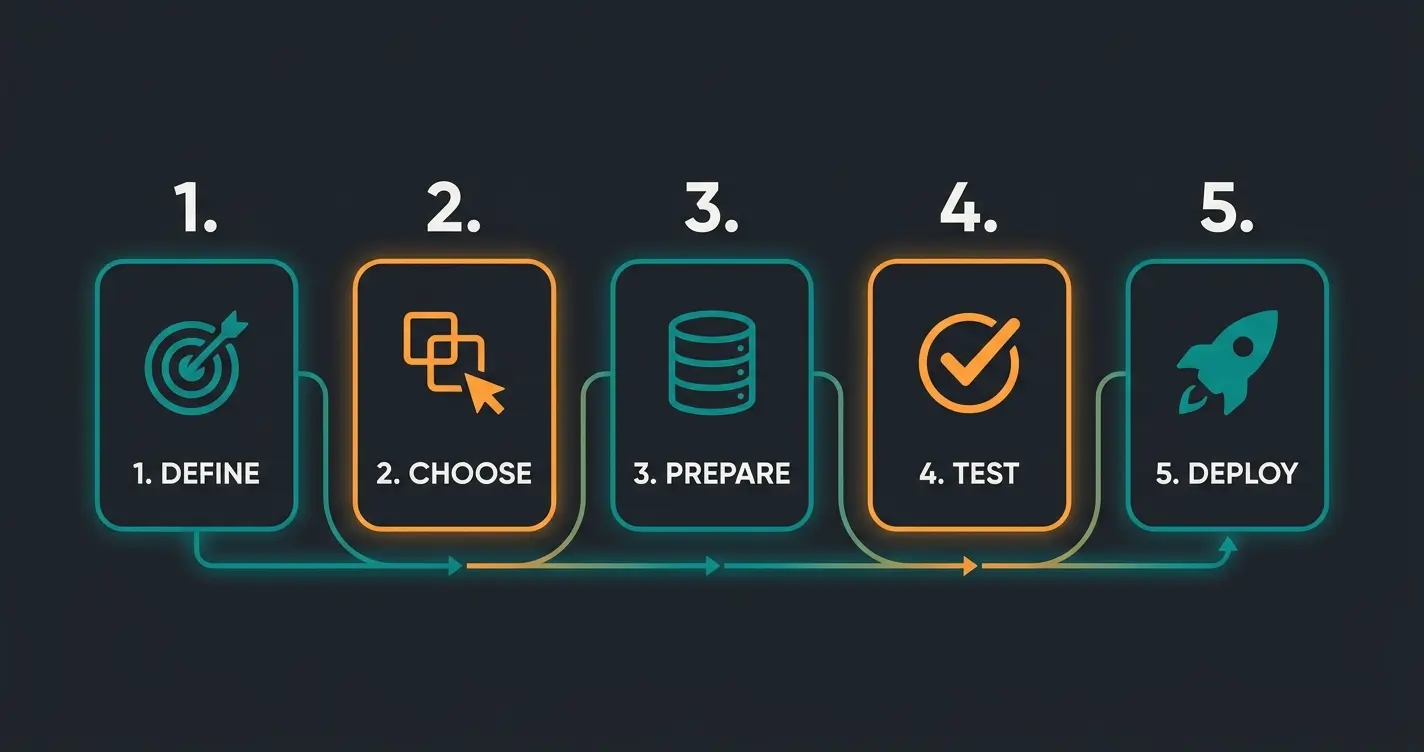
Implementing CaaS takes five steps: define your goals and primary use case, choose the right platform (build vs. buy), build your knowledge base with product data and FAQs, train and test the system, then deploy and integrate into your website or shop system.
Most implementation failures happen in step 3. Not in the technology. In the data preparation.
- Define 3-5 specific use cases. Not "improve customer service." Specific: "Answer product selection questions for lawn care," "Process return requests without human intervention," "Qualify leads and book demo calls." Start narrow. Expand later.
- Choose your platform. Build vs. buy decision: if your core business is not software, buy. Custom builds cost $10,000-50,000 upfront and need ongoing maintenance. CaaS platforms cost $200-2,000/month with maintenance included. The Build a Chatbot guide walks through evaluation criteria.
- Prepare your knowledge base. This is the hard part. Clean product data: no duplicate entries, no empty descriptions, no outdated prices. Compile your top 100 customer questions (pull from support tickets, not from imagination). Average setup time: 20-40 hours for an SME with 500-2,000 products.
- Train and test with real questions. Take the last 100 support tickets and run them through the system. Track accuracy. Anything below 85% is not production-ready. Adjust the knowledge base, add edge cases, retrain. Plan 1-2 weeks for this cycle.
- Deploy, integrate, monitor. Connect to your shop system (Shopware, Shopify, WooCommerce), messaging channels, and CRM. Start with a soft launch: 20-30% of traffic sees the chatbot. Monitor for 1-2 weeks. Scale to 100% when accuracy holds.
Average implementation timeline for a SaaS CaaS platform: 2-4 weeks from kickoff to full deployment. For custom builds: 2-6 months. The difference is not just time. It is risk. A CaaS platform has been tested across hundreds of deployments. A custom build is version 1.0 of your own code.
Chatbot as a Service for e-commerce
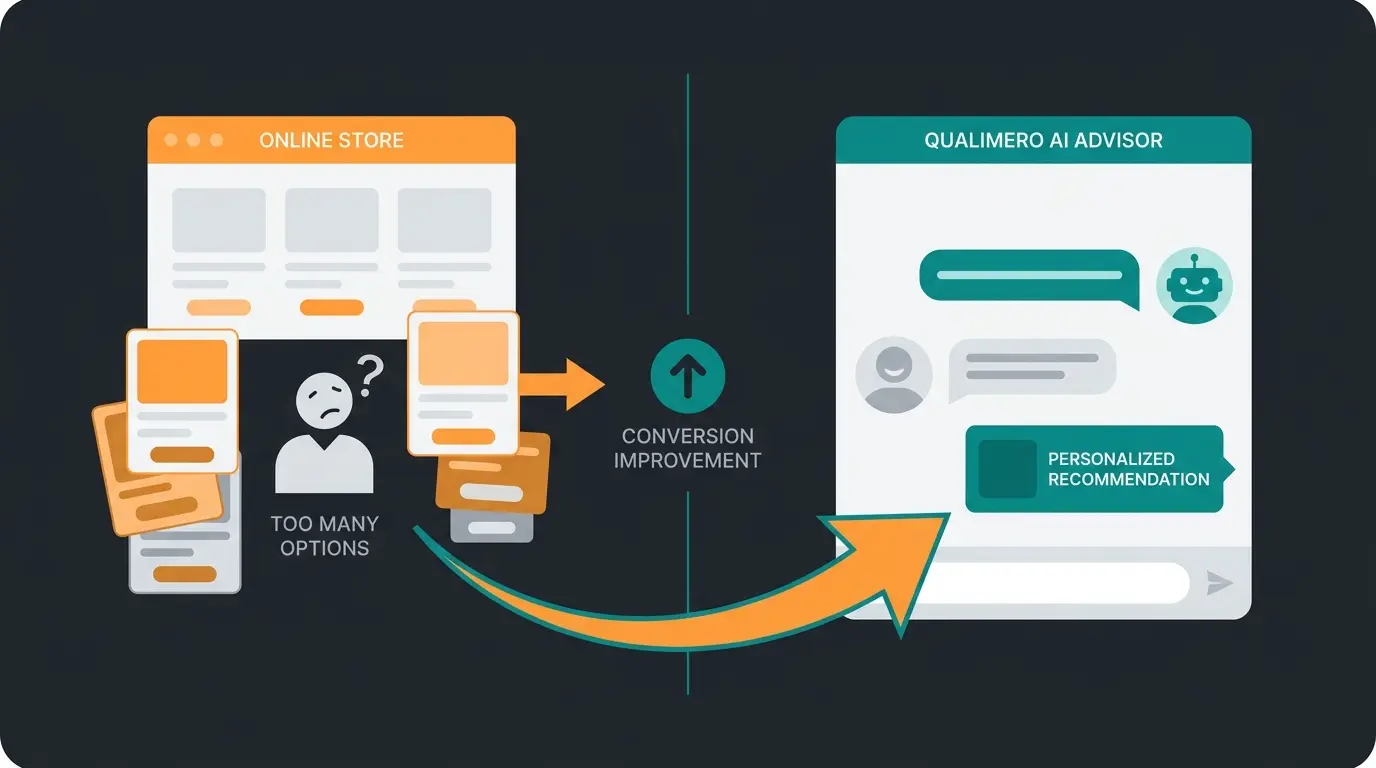
For e-commerce businesses, CaaS platforms deliver the highest ROI when deployed for product advisory and guided selling. Online shops using AI-powered product consultation see up to 35% higher cart values and 60% better checkout rates, because the AI replicates the in-store expert experience online.
E-commerce has a specific problem that general CaaS platforms do not solve well: the consultation gap.
In a physical store, a customer walks in and asks: "I need something for the moss in my lawn, but I have a dog and two kids." A knowledgeable employee considers the products, the safety constraints, the application method, and recommends a solution in 30 seconds. Online, that same customer lands on a category page with 47 products and no guidance. Baymard Institute research shows 70.19% of online shopping carts are abandoned, representing $260 billion in recoverable revenue across the US and EU annually. A significant portion of that abandonment stems from product uncertainty.
This is why generic support bots underperform in e-commerce. A support bot answers "Where is my order?" A product advisory AI employee answers "Which product is right for me?" The second question drives revenue. The first question costs money.
E-commerce CaaS requires specific capabilities that general platforms lack: deep product catalog integration (not just FAQs), cross-selling logic ("You're buying lawn fertilizer? This spreader makes application 3x faster"), inventory awareness (do not recommend out-of-stock items), and platform compatibility with Shopware, Shopify, or WooCommerce. The German Chatbot Solutions guide covers market-specific requirements for DACH e-commerce.
How this looks in practice: Signed, a custom signs retailer, deployed AI employee Alex to handle product advisory on their website and Instagram. Alex guides customers through material choices, size options, and personalization, then suggests complementary products. Result: 18x ROI and a 30% cross-selling rate. This is not support automation. This is sales automation.
AI-powered chatbots: the next generation
Next-generation AI chatbots go far beyond simple question-and-answer systems: they understand context across multiple conversations, make autonomous decisions, recognize returning customers, and work across channels, from website chat to WhatsApp to phone.
The term "chatbot" is becoming inadequate. What we are building now are AI employees. Digital team members. The distinction matters because it reframes expectations.
A chatbot answers questions. An AI employee advises, sells, qualifies, and acts. It remembers that a customer bought lawn fertilizer three months ago and proactively suggests the follow-up application. It notices a customer browsing high-end products and adjusts its consultation style accordingly. It books a callback with your sales team when it identifies a complex enterprise inquiry it should not handle alone.
The technology shift behind this: Large Language Models (LLMs) like GPT-4, Claude, and Gemini provide the reasoning layer. Retrieval-Augmented Generation (RAG) grounds responses in your actual product data instead of hallucinating. Persistent memory systems maintain customer context across sessions and channels. As of Q2 2026, leading CaaS platforms route queries across multiple LLMs depending on complexity, keeping costs low for simple queries while maintaining quality for complex advisory conversations.
The AI Chatbot for Business guide covers the business case for upgrading from a basic chatbot to an AI employee. For the technical foundations of conversational AI, including how NLP, LLMs, and RAG work together, see the conversational AI [URL PENDING] deep dive.
The future of CaaS
The future of Chatbot as a Service lies in three developments: multimodal interaction (text, voice, image), proactive outreach (the bot contacts the customer, not the other way around), and full agency, AI systems that autonomously execute tasks, not just answer questions.
Each of these is already in production somewhere. They are not predictions. They are deployments.
Multimodal CaaS means a customer can send a photo of a damaged product and the AI identifies the issue, checks warranty coverage, and initiates a replacement, all without typing a description. Voice-based CaaS extends this to phone channels, where the AI handles inbound calls with natural speech. By 2028, Gartner predicts 30% of Fortune 500 companies will offer customer service through a single AI-enabled channel capable of handling text, voice, and visual inputs.
Proactive CaaS flips the model. Instead of waiting for the customer to ask, the AI reaches out: "You bought lawn seed 6 weeks ago. Based on your region's weather, now is the time for the first fertilizer application. Here is what I recommend." This transforms CaaS from a support cost center to a revenue engine.
Agentic AI is the biggest shift. Gartner's March 2025 forecast states that agentic AI will autonomously resolve 80% of common customer service issues without human intervention by 2029, driving a 30% reduction in operational costs. Not answering questions. Resolving issues. Processing refunds, rescheduling deliveries, updating account details, filing warranty claims. Autonomously.
The companies that deploy CaaS now build a compounding advantage. Every conversation trains the system. Every product data update improves accuracy. Every month of operation deepens the knowledge base. Waiting for the technology to mature is a valid strategy only if your competitors are also waiting. Most are not.
Frequently asked questions about CaaS
Chatbot as a Service (CaaS) is a cloud-based subscription model where businesses get a ready-to-deploy AI chatbot without building one from scratch. The provider handles NLP, hosting, updates, and security. Pricing typically ranges from $0 to $2,000+/month for SMEs, with platforms like Zendesk, Intercom, Tidio, Botpress, and Qualimero covering different use cases.
It depends on the use case. Zendesk AI Agents is strongest for support-heavy businesses already in the Zendesk ecosystem. Intercom Fin excels at conversational engagement for SaaS. For e-commerce product advisory (not just support), Qualimero's AI employees deliver the highest ROI, with clients reporting 16x return and up to 100% automation. There is no universal best, only best for your specific workflow.
Free tiers exist (Tidio, HubSpot). AI-powered platforms for SMEs range from $200-2,000/month. Enterprise custom builds cost $10,000-50,000+ upfront plus maintenance. The Baymard Institute reports $260 billion in recoverable e-commerce revenue from cart abandonment, making the ROI case compelling for any business with significant consultation needs.
For routine queries (order status, FAQs, product recommendations): yes, with 85-97% accuracy depending on the platform tier. For complex emotional situations, complaints requiring empathy, or novel edge cases: no. The best CaaS implementations combine AI automation for 60-80% of conversations with seamless handover to human agents for the rest. Full replacement is not the goal. Augmentation is.
A chatbot is an application, the interface customers interact with. Conversational AI is the underlying technology (NLP, LLMs, machine learning) that powers it. Think of it like this: a chatbot is the car, conversational AI is the engine. A rule-based chatbot runs on a simple engine (keyword matching). An AI employee runs on conversational AI (contextual understanding, memory, decision-making).
CaaS can be GDPR compliant, but compliance depends on the platform and configuration. Key requirements: data processing agreements with the provider, EU data residency, consent mechanisms for data collection, and right-to-deletion implementation. From August 2026, the EU AI Act adds transparency requirements: users must be informed they are interacting with AI. Choose a CaaS provider with EU hosting and built-in compliance features.
Tidio offers a free tier with basic AI chatbot functionality for low-traffic sites. HubSpot's chatbot builder is included in the free CRM. Botpress has a free open-source core for developer teams. The trade-off: free tiers limit conversation volume (typically 50-100/month), AI capabilities, and integrations. For businesses with more than 500 monthly customer conversations, paid tiers starting at $29-100/month are where the real ROI begins.
Most CaaS platforms automate support. Qualimero's AI employees automate sales. Our clients see +35% cart value and 16x ROI because the AI advises, recommends, and converts. Not just answers. Book a 15-minute demo to see it on your product data.
Book a demo
Lasse is CEO and co-founder of Qualimero. After completing his MBA at WHU and scaling a company to seven-figure revenue, he founded Qualimero to build AI-powered digital employees for e-commerce. His focus: helping businesses measurably improve customer interaction through intelligent automation.