Conversational AI: How It Works and Why SMEs Need It
Conversational AI explained for business owners. How NLP, ML, and LLMs power AI employees, real ROI data from SME deployments, and a platform comparison. With case studies.

What is conversational AI?
Conversational AI is technology that enables machines to understand, process, and respond to human language naturally, through text or voice, using NLP, machine learning, and large language models to hold context-aware, multi-turn conversations. It is not a script. It is not a decision tree. It is a system that learns.
The distinction matters more than most people realize. A rule-based system can answer "What are your opening hours?" because someone programmed that exact response. Conversational AI can answer "I bought a rose bush last Tuesday and the leaves are turning yellow, what should I do?" because it understands context, cross-references product data, and generates a relevant recommendation in real time.
Three components make this work. Natural Language Processing (NLP) breaks down user input into structured data. Natural Language Understanding (NLU) interprets the intent behind that input. Natural Language Generation (NLG) produces a response that reads like a human wrote it. Since 2023, transformer-based large language models have accelerated all three steps dramatically, and by Q2 2026 the results are measurable: deployment timelines dropped from months to weeks, accuracy rates climbed above 90% for domain-specific tasks, and the cost per interaction fell below EUR 0.05 for most SME use cases.
IBM defines conversational AI as "technologies, such as chatbots or virtual agents, that users can talk to," but that definition undersells the shift happening right now. The current generation does not just talk. It advises, sells, troubleshoots, and remembers. In e-commerce, that means an AI employee that knows your entire product catalog and every customer interaction to date.
The global conversational AI market was valued at $11.58 billion in 2024 and will reach $41.39 billion by 2030, a 3.6x increase in six years. North America holds 26.1% of that market, but the DACH region is catching up fast as European data residency requirements push businesses toward EU-hosted platforms.
How conversational AI works
Conversational AI works through a three-step pipeline: Natural Language Processing breaks down user input, Natural Language Understanding interprets intent and context, and Natural Language Generation produces human-like responses, all powered by transformer-based language models that have fundamentally changed what machines can do with language.
User sends a message via chat, voice, or WhatsApp. The system tokenizes the input, identifies entities (product names, dates, quantities), and normalizes the language.
The model determines what the user actually wants. Not just the words, but the goal: return a product, find an alternative, check compatibility, get a recommendation.
The system pulls relevant data: previous conversations, product catalog, order history, company policies. This is where memory and personalization happen.
The language model generates a natural, accurate response. Modern systems ground their output in your actual product data, reducing hallucination risk significantly.
Every interaction improves the model. Customer satisfaction signals, escalation patterns, and correction data feed back into the system continuously.
The breakthrough came with LLMs. Before 2023, conversational AI systems needed thousands of manually labeled training examples per intent. A new product category meant weeks of data preparation. Today, an LLM-powered system can understand a query about a product it has never seen before, as long as it has access to the product data. Google Cloud calls this "generalized language understanding," and it is the reason deployment timelines have collapsed from months to days for businesses of all sizes.
I have seen this firsthand across dozens of deployments. We used to spend 4-6 weeks training a conversational AI system for a new client. Now the same setup takes under two weeks, and the initial accuracy is higher. The difference is not incremental. It is structural.
One technical detail that rarely gets mentioned: context window size matters enormously for e-commerce applications. A customer who asks "Do you have this in blue?" after browsing three product pages needs the system to know which product "this" refers to. Modern LLMs with 128k+ token context windows can hold an entire browsing session in memory, making the conversation feel genuinely personal rather than transactional. Rule-based systems reset with every message.
Conversational AI vs traditional chatbots
Traditional chatbots follow rigid scripts and can only handle pre-programmed queries, while conversational AI understands context, learns from interactions, and handles complex multi-turn conversations, making it capable of tasks like product consultation and personalized recommendations that a rule-based system simply cannot touch.
The confusion between the two costs businesses money. I talk to shop owners every week who invested in a "chatbot" and got a glorified FAQ page. The customer types a question, the system pattern-matches to the closest pre-written answer, and the customer leaves because the response does not actually address their situation. For a detailed breakdown, see the full Chatbots vs Conversational AI comparison.
| Capability | Rule-based chatbot | Conversational AI | AI employee (Qualimero) |
|---|---|---|---|
| Language understanding | Keyword matching only | Intent + context recognition | Intent + context + product knowledge + customer memory |
| Response flexibility | Pre-written templates | Dynamically generated | Generated from live product data + conversation history |
| Context retention | None (each message is isolated) | Within session | Across all sessions, channels, and customer lifetime |
| Learning ability | Manual updates only | Improves from interaction data | Continuous improvement + human feedback loop |
| Handles complex queries | No, escalates immediately | Yes, for trained domains | Yes, including product advisory, cross-selling, returns |
| Setup time | Days | Weeks to months | Under 2 weeks |
| Typical resolution rate | 20-30% of queries | 55-70% of queries | Up to 100% of chat queries (Rasendoktor) |
The numbers tell the story. Gartner predicts organizations will replace 20-30% of customer service agents with generative AI by 2026. That is not about cutting jobs. It is about redirecting human expertise to the conversations that actually need a human, while conversational AI handles the 80% that are repetitive and straightforward.
Here is what surprised me most in our deployments: the quality gap between scripted responses and AI-generated ones is not linear. It is exponential once the conversation gets past the first exchange. A rule-based system can handle "What are the shipping costs?" just fine. But "I need a product that works on clay soil, is safe for pets, and ships before Friday" requires five different database lookups, cross-referencing, and a synthesized response. That is where conversational AI earns its ROI, and where scripted systems fail silently by giving a generic answer instead of admitting they cannot help. An AI chatbot for business built on conversational AI principles delivers a fundamentally different experience.
Use cases and applications
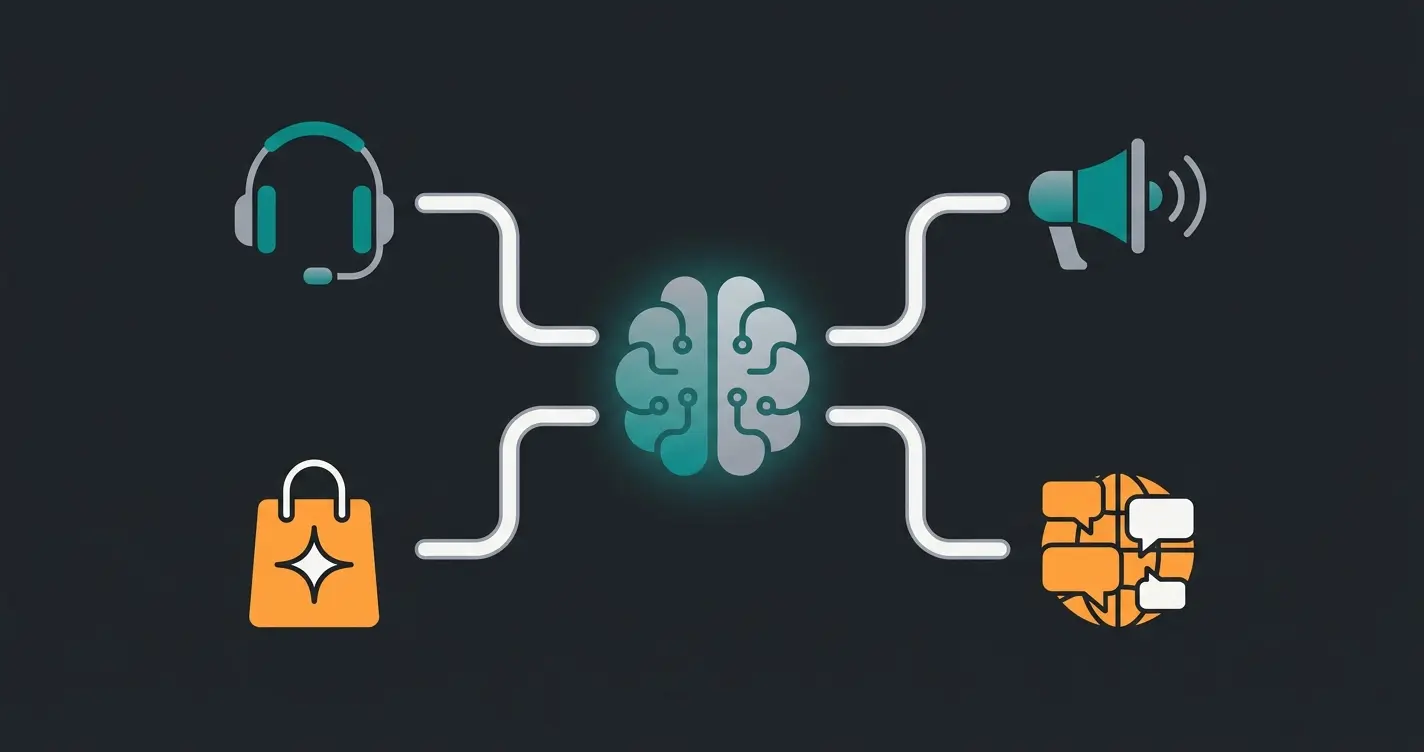
Conversational AI drives measurable results across customer service, product consultation, marketing, and sales, with e-commerce businesses seeing up to 35% higher cart values and 60% higher checkout rates when deploying AI-powered product advisors. The use cases go far beyond answering FAQs.
Customer service automation
This is where most businesses start. A conversational AI system handles order status inquiries, return processes, shipping questions, and product usage guidance without human intervention. The AI customer service model works because 70-80% of customer queries are repetitive. Conversational AI is projected to save businesses $80 billion in labor costs by 2026, and chatbot customer service implementations are leading that shift across every industry.
What makes the difference between a helpful automation and a frustrating one is handoff quality. The best conversational AI systems know when to escalate. When a customer is visibly frustrated, when the query involves a genuine edge case, when legal or safety concerns are involved. Neudorff's AI employee Flora, for instance, is trained to escalate any query about pesticide interactions to a human specialist. Knowing your limits is a feature, not a bug.
Product advisory and guided selling
This is where it gets interesting, and where most competitors miss the point entirely. Product advisory is not customer service. It is sales. A customer asks "Which lawn treatment works for clay soil in a shaded garden?" and the AI employee cross-references soil type, light conditions, product ingredients, and regional availability to recommend the right product. That is AI product consultation at its best. No scripted system can do this because the number of possible product-context combinations is astronomical.
The revenue impact is direct. In our deployments, product advisory consistently delivers the highest ROI because it converts browsers into buyers at the exact moment of purchase intent. Gartenfreunde's Kira achieves a 45% click-through rate on product recommendations, which is 4-5x higher than the industry average for e-commerce recommendation widgets. The difference: Kira does not just suggest popular products. She asks about the customer's specific situation first.
Marketing and lead generation
Conversational AI captures leads that traditional forms miss. A visitor browsing your product page at 11pm has a question. Instead of bouncing, they get an instant, qualified response. AI chatbot marketing strategies built on conversational AI consistently outperform static lead forms because they engage at the moment of intent, not after a form submission that most visitors never complete.
The data backs this up. According to Nextiva, 85% of customer service leaders are actively exploring conversational generative AI for their operations as of 2026. The shift from reactive support to proactive engagement is already happening at scale.
Multilingual and multi-channel support
For businesses selling across the DACH region or internationally, language is a real barrier. Multilingual AI chatbots powered by conversational AI handle German, English, French, and 70+ other languages natively. Combined with multi-channel deployment across website, WhatsApp, and Instagram, the same AI employee works everywhere your customers are. German chatbot solutions have become particularly sophisticated, handling regional dialects, umlauts, and the du/Sie distinction correctly.
Multi-channel is not just convenience. It is coverage. A customer who starts a conversation on your website, continues via WhatsApp the next day, and calls your support line a week later should not have to repeat themselves. Conversational AI with persistent memory across channels eliminates that friction. Traditional systems treat each channel as a separate silo, which is how customer frustration builds up.
Conversational AI platforms compared
The conversational AI platform market ranges from enterprise solutions like Google Dialogflow and Amazon Lex to SME-focused platforms like Qualimero that combine product knowledge, customer memory, and multi-channel deployment without requiring technical expertise. Choosing the right one depends on your team size, technical capacity, and what you actually need the AI to do.
| Criteria | Google Dialogflow | Amazon Lex | IBM watsonx | Microsoft Bot Framework | Qualimero |
|---|---|---|---|---|---|
| Target audience | Developers, enterprises | AWS ecosystem users | Enterprise IT teams | Azure developers | SME business owners |
| E-commerce integration | Custom build required | Custom build required | Custom build required | Custom build required | Native Shopware, Shopify, WooCommerce |
| Setup time | 4-12 weeks | 4-8 weeks | 6-16 weeks | 4-12 weeks | Under 2 weeks |
| Technical skills needed | High (API development) | High (AWS knowledge) | High (enterprise IT) | High (Azure/.NET) | None (no-code setup) |
| Product data integration | Manual configuration | Manual configuration | Manual configuration | Manual configuration | Automatic from shop system |
| Customer memory | Session-based | Session-based | Configurable | Configurable | Persistent across all channels |
| Pricing model | Pay-per-request | Pay-per-request | Enterprise license | Pay-per-request | Fixed monthly SaaS |
| Language support | 40+ languages | 25+ languages | 13 languages | 40+ languages | 70+ languages |
| Best for | Custom enterprise builds | AWS-native shops | Large organizations | Microsoft ecosystem | SMEs with fewer than 50 employees |
The Gartner Conversational AI Platforms reviews (2026 edition) confirm what we see in practice: enterprise platforms score high on capability but low on time-to-value for smaller businesses. An SME owner does not have a development team to build custom Dialogflow intents. They need a system that ingests their product catalog and starts working. That is not a limitation of the enterprise platforms. It is a different market entirely.
Gartner Distinguished VP Analyst Arun Chandrasekaran noted that "Generative AI has become a top priority for the C-suite and has sparked tremendous innovation in new tools beyond foundation models." That innovation is now reaching SMEs, not just enterprises.
For chatbot costs and pricing, the range is enormous. Enterprise platforms can run EUR 5,000-50,000/month with custom development on top. SME-focused solutions like Qualimero operate on fixed monthly subscriptions with predictable costs and no hidden integration fees. The right question is not "What does it cost?" but "What does it cost compared to the revenue it generates?" Rasendoktor's answer: 16x ROI.
Conversational AI for SMEs
Small and medium businesses can now deploy conversational AI without enterprise budgets or technical teams. Modern platforms offer plug-and-play integration with Shopware, Shopify, and WooCommerce, turning product data into intelligent conversations within days, not quarters.
I hear the same objection from almost every SME owner I talk to: "That sounds like something for big companies." It used to be. The reason enterprise platforms dominated the conversational AI space until recently is that they were the only ones building it. The technology existed, but the packaging did not. An SME with 3,000 monthly visitors and a 20-product catalog does not need Google Dialogflow. They need a system that understands their products and talks to their customers.
The cost-benefit calculation for SMEs is straightforward. A single customer service employee costs EUR 35,000-45,000/year fully loaded. An AI employee handles unlimited concurrent conversations, works 24/7, and costs a fraction of that. But the real value is not cost reduction alone. It is the conversations that never happened before: the 11pm visitor who got advice instead of bouncing, the customer who found the right accessory because the AI recommended it, the return that was avoided because the AI clarified sizing before purchase.
Here is a number that does not get enough attention: Grand View Research reports that the solution segment led the conversational AI market in 2024 with 61.1% of global revenue. That means plug-and-play platforms are already outpacing custom builds in adoption. SMEs are driving this shift because they need solutions, not projects.
The integration question is usually the first concern. With Shopware, the AI employee connects to your product catalog via API and starts ingesting data within hours. With Shopify, a native app handles the connection. WooCommerce uses a plugin. In every case, the AI employee has access to your real product data, including prices, availability, descriptions, and specifications, within the first day. No manual data entry. No CSV uploads.
The implementation path matters as much as the technology. Learn how to build a chatbot that actually works for your business, or skip the build entirely and deploy a trained AI employee in under two weeks.
Conversational AI in practice
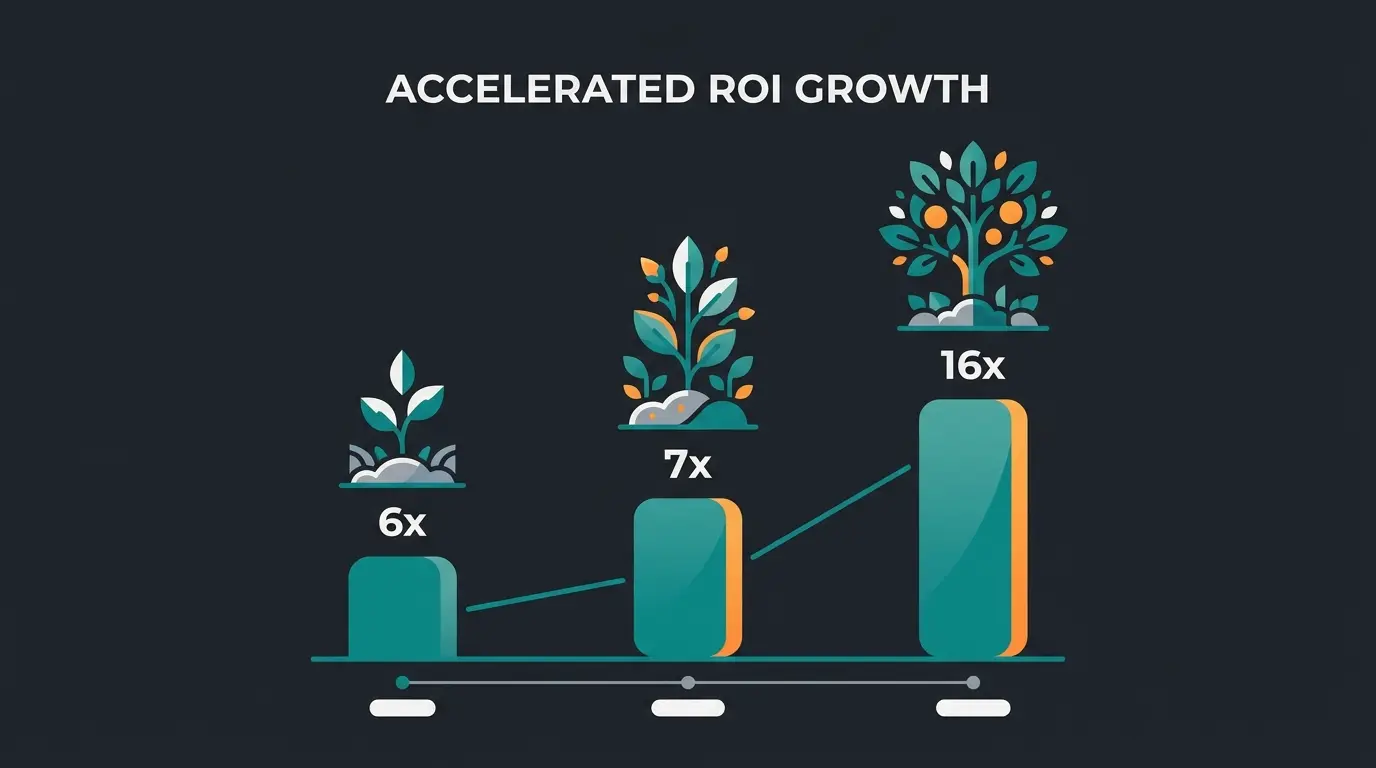
Real-world deployments prove conversational AI delivers measurable ROI for SMEs: Rasendoktor achieved a 16x return on investment, Neudorff automated 97% of product consultations, and Gartenfreunde increased their conversion rate by 7x, all within weeks of deployment. These are not enterprise pilots with million-dollar budgets. These are small teams with real revenue pressure.
Rasendoktor: 16x ROI with AI employee Hektor
Rasendoktor.de, an online specialist for professional lawn care, was drowning in 2,000-3,000 consultation-intensive inquiries per season. The product range is technical: soil types, application rates, regional climate differences. Their support team could not scale without proportionally scaling costs.
After deploying Hektor, their AI employee trained on Rasendoktor's product expertise, the results were immediate. Every single webchat inquiry handled automatically. 16x return on investment. 40% reduction in support costs. Hektor delivers precise product recommendations 24/7, considers regional specifics between Germany and Austria, and does it in under 10 seconds. The key insight: Hektor does not give generic lawn care advice. He knows which product works for which soil type in which climate zone, because he has access to the complete Rasendoktor knowledge base. Read the full Rasendoktor Case Study.
Neudorff: 97% accuracy at -99% cost per chat
Neudorff GmbH, a leading garden and plant care provider, faced a harder problem. Their product consultations involve strict legal requirements around pesticide application and environmental safety. Getting a recommendation wrong is not just a bad customer experience. It is a compliance risk.
Flora, their AI employee, achieved 97% accuracy in product recommendations from day one, with an average response time under 5 seconds and cost savings of 99% per chat interaction. The key was data integration: Flora has access to the complete product database including legal application guidelines, safety data sheets, and regional restrictions. No hallucinated advice. No generic recommendations. Every answer grounded in verified product data. See the details in the Neudorff AI Product Consultation case study.
Gartenfreunde: 7x conversion with AI employee Kira
Gartenfreunde sells high-ticket garden and wellness products. Complex purchasing decisions, long consideration phases, and a single sales employee handling up to 50 inquiries per day during peak season. The conversion rate was stuck because customers could not get answers fast enough to make a purchase decision before leaving the site.
Kira, their AI employee, guides customers through the product catalog, answers technical questions about hot tubs, garden houses, and accessories, and suggests relevant add-ons. The result: 7x higher conversion rate, 6x ROI, and a 45% click-through rate on product recommendations. For context, the average e-commerce recommendation widget achieves 8-12% CTR. Kira outperforms that by 4x because she understands what the customer actually needs before making a suggestion. The full story is in the Gartenfreunde Success Story.
| Metric | Rasendoktor | Neudorff | Gartenfreunde |
|---|---|---|---|
| Industry | Lawn care e-commerce | Garden supplies (B2C + B2B) | Garden and wellness products |
| AI employee | Hektor | Flora | Kira |
| Key metric | 16x ROI | 97% recommendation accuracy | 7x conversion rate increase |
| Automation rate | 100% of webchat | 97% of consultations | High (single employee freed) |
| Cost impact | -40% support costs | -99% cost per chat | 6x ROI |
| Setup time | Under 2 weeks | Under 2 weeks | Under 2 weeks |
| Response time | Under 10 seconds | Under 5 seconds | Under 10 seconds |
How to implement conversational AI
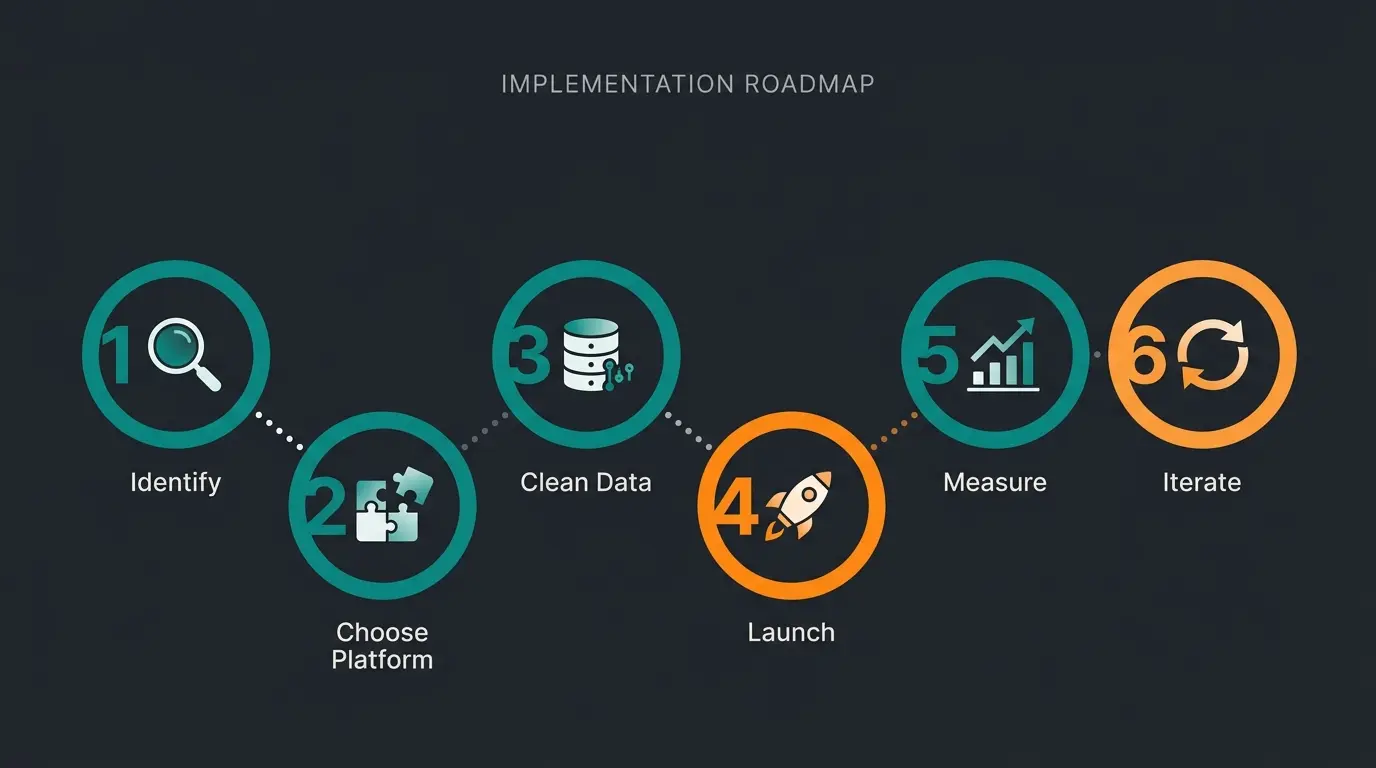
Implementing conversational AI requires four steps: define your use case and success metrics, choose a platform matching your technical capacity, integrate your product and customer data, and launch with a phased rollout starting from your highest-volume customer queries. Most SMEs overthink this. The process is simpler than it looks.
- Identify your highest-volume use case. Not ten use cases. One. Is it product consultation? Returns processing? Pre-purchase questions? Pick the one where your team spends the most time on repetitive answers. For most e-commerce businesses, that is product advisory or order status queries.
- Choose your platform based on your reality. If you have a development team, enterprise platforms give you maximum flexibility. If you do not, and most SMEs do not, choose a platform with native e-commerce integration. The honest answer: most SME owners should not build from scratch. The time-to-value difference is 2 weeks vs 3-6 months.
- Clean your product data. This is the step everyone skips, and it is the step that determines success. No duplicate entries, no empty descriptions, no outdated prices. The AI employee is only as good as the data it knows. Budget one full day for data cleanup before you start.
- Launch narrow, expand later. Deploy on one channel, usually webchat, for one use case. Monitor for two weeks. Check resolution rates, customer satisfaction, and escalation patterns. Then expand to WhatsApp, add more use cases, and extend to additional product categories.
- Measure what matters. Track resolution rate, customer satisfaction score (CSAT), average response time, and revenue influenced. Do not track vanity metrics like the number of conversations. A conversation that leads nowhere is not a success.
- Iterate based on real data. Review the conversations your AI escalated to humans. Those are your improvement opportunities. Every escalation is a training signal. After two weeks of real conversations, you will know exactly where to improve.
Average time to value for SME deployments: 2-4 weeks. That includes data integration, initial training, testing with real customer queries, and go-live. Enterprise deployments with custom Dialogflow or Amazon Lex builds typically take 3-6 months and require dedicated engineering resources. For the practical details, see how to build a chatbot from FAQ bot to product advisor.
The future of conversational AI
Conversational AI is evolving from reactive systems to proactive AI agents that anticipate customer needs, operate across channels simultaneously, and make autonomous decisions, with the global market projected to reach $41.39 billion by 2030 according to Grand View Research.
Four trends will define the next two years. First, agentic AI: systems that do not just respond but take action. Booking appointments, processing returns, updating orders, initiating follow-ups, all without human handoff. Second, proactive engagement: the AI reaches out when it detects a pattern, like a customer stuck on a product page for 90 seconds or a cart that has been sitting idle for an hour. Third, deeper personalization through persistent memory across channels and sessions, where the AI employee remembers a customer's preferences from their last visit six months ago. And fourth, voice-first interfaces moving conversational AI beyond text into phone systems and IoT devices.
Regulation is catching up. The EU AI Act requires all conversational AI systems to disclose their AI nature to users starting August 2, 2026. Article 50 mandates transparency: if a customer is talking to an AI, they must know it. For businesses already operating transparently, this changes nothing. For those hiding behind fake human names, it is a compliance deadline with real consequences. Qualimero has always disclosed AI identity by default, because trust is not optional.
The shift I am most interested in is the move from conversational AI as a tool to conversational AI as a team member. Not something you install and forget, but an AI employee that learns your business, remembers your customers, and gets measurably better every week. That is where we are heading. And it is happening faster than most industry predictions suggested even 18 months ago. For a deeper look, read about the future of Conversational AI.
FAQ
Conversational AI is technology that uses NLP, machine learning, and large language models to enable natural, context-aware conversations between humans and machines. Unlike scripted systems, it understands intent, retains context across multi-turn dialogues, and generates original responses. The global market reached $11.58 billion in 2024 and is growing at 23.7% annually.
Yes. ChatGPT is one implementation of conversational AI, built on OpenAI's GPT large language models. It excels at general-purpose conversation but lacks the product data integration, customer memory, and e-commerce-specific capabilities that business-grade conversational AI platforms provide. ChatGPT is a foundation model. A business conversational AI system adds domain-specific knowledge and action capabilities on top.
A traditional chatbot follows pre-programmed scripts and matches keywords to fixed responses, typically handling 20-30% of customer queries. Conversational AI understands natural language, learns from interactions, and handles complex multi-turn conversations, resolving 55-70% of queries or more. The key difference is intelligence: a chatbot retrieves pre-written answers, conversational AI generates contextual ones.
Enterprise platforms like Google Dialogflow or Amazon Lex use pay-per-request pricing that scales unpredictably, plus EUR 10,000-50,000+ in custom development. SME-focused platforms like Qualimero offer fixed monthly SaaS subscriptions with predictable costs, typically achieving ROI within the first month. Rasendoktor achieved 16x ROI with a fixed monthly investment.
Modern platforms have eliminated the technical barriers that kept conversational AI enterprise-only. An SME with 3,000+ monthly visitors, consultation-intensive products, and a willingness to integrate product data can deploy an AI employee in under two weeks. Our smallest active clients have fewer than 10 employees.
Product advisory ("Which soil treatment works for clay soil?"), order tracking, returns processing, cross-selling recommendations, and after-hours customer support. Neudorff automates 97% of product consultations with their AI employee Flora. Gartenfreunde increased conversion rates 7x with Kira. Rasendoktor handles 100% of webchat queries with Hektor.
Generative AI is a broader category that creates new content: text, images, code, music. Conversational AI is a specific application of generative AI focused on natural dialogue. According to Microsoft, conversational AI understands natural language and generates speech-like responses, while generative AI has a broader creative scope. Modern conversational AI systems are built on generative AI foundations.
It can be, when the platform is designed for European data residency requirements. EU-hosted conversational AI platforms process data within EU jurisdiction. The EU AI Act adds transparency requirements from August 2, 2026: businesses must disclose that the user is interacting with an AI system. Platforms operating in the DACH region should verify data residency, processing agreements, and transparency features before deployment.
More traffic means nothing without conversion. Qualimero's AI employees turn visitors into buyers, with +35% higher cart values and +60% checkout rates across 25+ active e-commerce deployments. Book a demo to see it with your own product data.
Book a demo
Lasse is CEO and co-founder of Qualimero. After completing his MBA at WHU and scaling a company to seven-figure revenue, he founded Qualimero to build AI-powered digital employees for e-commerce. His focus: helping businesses measurably improve customer interaction through intelligent automation.