What is chatbot customer service?
Chatbot customer service uses AI-powered software to automatically handle customer inquiries through text or voice conversations. These systems resolve questions about orders, products, and policies 24/7 without human intervention, reducing response times from hours to seconds and handling multiple conversations simultaneously.
The concept is straightforward but the technology behind it has changed dramatically. According to the IBM Institute for Business Value, every business leader surveyed indicated their organization planned to use AI in customer service, with 67% having already begun implementation. That is not a trend. That is a standard.
Traditional customer service relies on human agents handling one conversation at a time during business hours. A chatbot handles hundreds simultaneously, around the clock. But the real shift is not about volume. It is about what the AI can actually do. Early chatbots followed scripted decision trees. Modern chatbots powered by large language models (LLMs) understand context, remember previous interactions, and provide genuine product consultation.
Gartner predicts that by 2029, agentic AI will autonomously resolve 80% of common customer service issues without human intervention, leading to a 30% reduction in operational costs. That prediction was issued in March 2025, and the technology is accelerating faster than the forecast. For businesses in e-commerce, the question is no longer whether to deploy a chatbot, but how to deploy one that does more than deflect tickets. For a comprehensive overview of deployment models, including managed and hosted options, see our complete chatbot as a service guide.
Types of customer service chatbots
Customer service chatbots fall into three categories: rule-based bots that follow scripted flows, AI chatbots that understand natural language and learn from conversations, and consultation bots that actively guide customers to the right product, turning support into sales. The difference between them determines whether your chatbot saves money or makes money.
| Feature | Rule-based | AI-powered | Consultation bot |
|---|---|---|---|
| How it works | Pre-defined decision trees | NLP + machine learning | LLM + product data + RAG |
| Best use case | Simple FAQs, routing | Multi-topic support | Product advisory, guided selling |
| Handles complex queries | No | Partially | Yes, including follow-ups |
| Learns from conversations | No | Yes | Yes, with product context |
| Revenue impact | None (cost center) | Indirect (faster resolution) | Direct (+35% cart value) |
| Setup complexity | Low (drag-and-drop) | Medium (training data) | Medium (product data integration) |
| Example | "Track my order" button | Zendesk AI, Intercom | Qualimero AI employee |
Rule-based chatbots still dominate the market, but they fail at the moment a customer asks anything outside the script. I have seen support dashboards where 40% of chatbot conversations end with "Sorry, I did not understand your question." That is not customer service. That is a wall.
The shift from rule-based to AI-powered happened gradually. The shift from AI-powered to consultation is happening now, and it is the one that changes the business case. A support chatbot is a cost line. A consultation chatbot is a revenue line. That distinction matters more than any feature comparison.
Live chat with human agents sits outside these three categories. It delivers nuance no script can match, but only one conversation at a time. The live chat vs chatbot decision usually comes down to volume: humans win on complex, high-value cases, chatbots win the moment the queue grows faster than your team can answer it.
AI-powered chatbots using NLP solve the understanding problem. They parse intent, handle typos, and manage multi-turn conversations. But they still operate reactively: the customer asks, the bot answers. The real breakthrough comes from consultation bots that flip this model. Instead of waiting for questions, they ask the right questions. "What type of lawn do you have?" "How large is the area?" "Do you have pets?" These are the kinds of conversations that lead to the right product recommendation, and ultimately to a sale. For more on FAQ automation chatbots, see our dedicated guide.
Key technologies behind modern chatbots
Modern customer service chatbots combine natural language processing (NLP), large language models (LLMs), and retrieval-augmented generation (RAG) to understand customer intent, access product databases, and generate accurate, context-aware responses. These three technologies together make the difference between a chatbot that frustrates and one that converts.
- Natural language processing (NLP): The foundation that lets chatbots understand human language, parse intent, and handle variations in phrasing. When a customer types "where's my stuff" or "order status please," NLP maps both to the same intent.
- Large language models (LLMs): The breakthrough that changed everything in 2024-2025. Unlike previous pattern-matching systems, LLMs generate contextually appropriate responses and handle complex multi-turn conversations. They can explain product differences, compare options, and reason about customer needs.
- Retrieval-augmented generation (RAG): The critical layer that grounds LLMs in your actual data. Without RAG, an LLM might hallucinate product features or prices. With RAG, every response is anchored to your product catalog, pricing database, and support documentation.
- Dialogue management: Controls conversation flow across multiple interactions. Remembers that the customer asked about garden fertilizer two messages ago and connects it to their follow-up question about application timing.
- Sentiment analysis: Detects when a customer is frustrated, confused, or ready to buy, allowing the chatbot to adjust its tone or escalate to a human agent at the right moment.
The combination of LLMs with RAG is what makes conversational AI practical for e-commerce. A generic LLM does not know that your medium-sized jacket runs small, that the fertilizer is not safe for pets, or that the item ships from a different warehouse with longer delivery times. RAG pulls this information from your product database in real time, and the LLM wraps it in a natural, helpful response.
7 key benefits of chatbot customer service
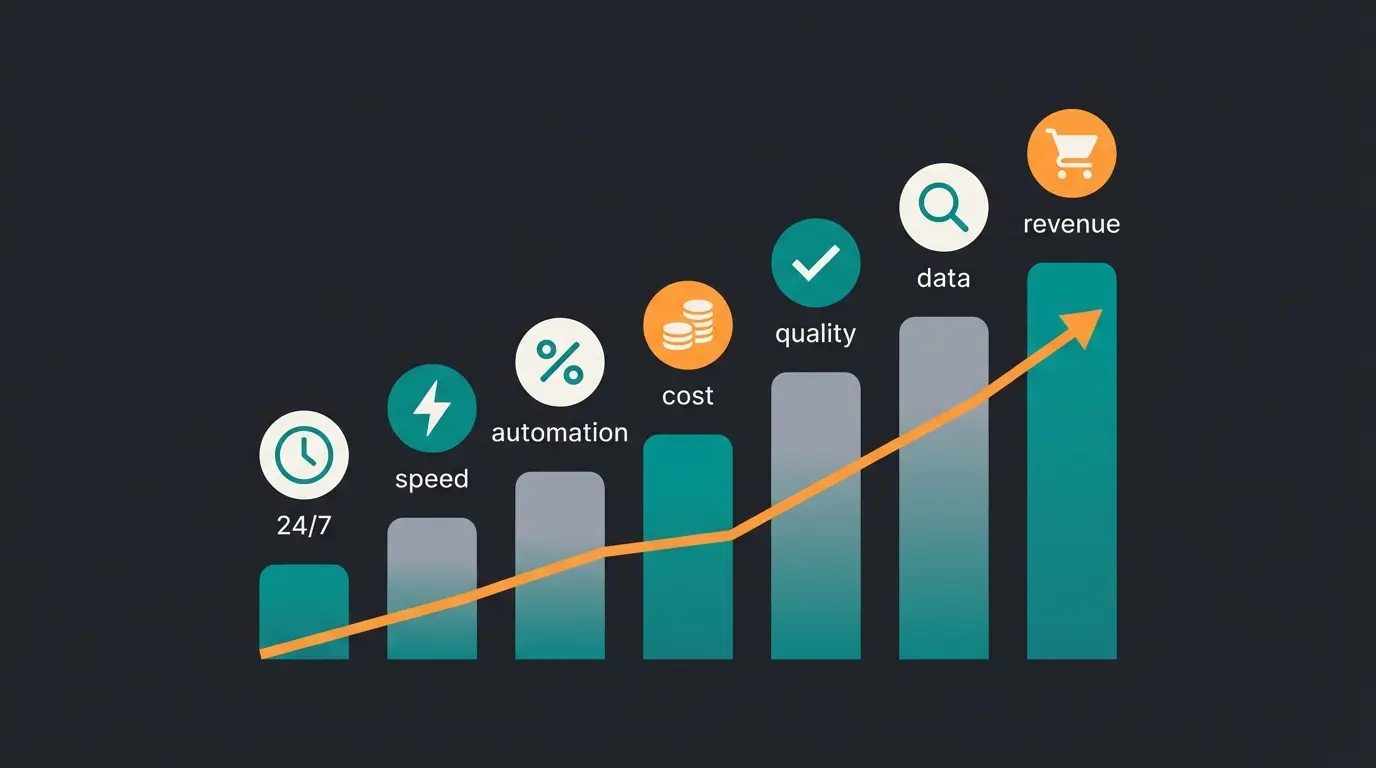
Customer service chatbots deliver measurable ROI through 24/7 availability, instant response times, up to 80% automation of routine inquiries, lower support costs, higher customer satisfaction, consistent service quality, and the ability to scale during peak periods without hiring. Here are the seven benefits that matter most for e-commerce businesses.
1. 24/7 availability without staffing costs
Customers do not shop on a 9-to-5 schedule. According to McKinsey, two-thirds of millennials expect real-time customer service, and three-quarters of all customers expect consistent cross-channel service experiences. A chatbot delivers both without requiring night shifts, weekend premiums, or timezone coverage.
For seasonal businesses like garden retailers or outdoor equipment shops, this matters even more. Peak inquiry volume often hits outside business hours, during evenings and weekends when customers actually have time to research purchases. A chatbot captures these high-intent moments that would otherwise become abandoned sessions.
2. Instant response times
The average human agent takes 2-4 minutes to respond to a live chat message. A chatbot responds in under 5 seconds. For simple queries like order tracking, return policies, or product availability, that speed difference is the gap between a completed purchase and an abandoned cart.
3. Up to 80% automation of routine inquiries
According to Invesp, chatbots can answer up to 80% of routine customer questions. That frees your human team for the 20% of inquiries that actually require empathy, judgment, or escalation authority. The Camping World virtual assistant, Arvee, increased customer engagement by 40% across all platforms while cutting wait times by a third.
4. Significant cost reduction
A chatbot interaction costs roughly USD 0.50-2.00, compared to USD 6-12 for a human agent handling the same query. According to Gartner, widespread AI adoption in customer service will lead to a 30% reduction in operational costs by 2029. For an SME handling 100+ daily inquiries, that translates to EUR 3,000-5,000 in monthly savings.
5. Consistent quality at scale
Human agents have bad days, forget product details, or provide inconsistent answers across shifts. A chatbot trained on your product data delivers the same accurate response whether it is the first inquiry or the five-thousandth. ChatBot.com reports that their platform automates 125,000 chats per year for clients like Funded Trading Plus with a 93% customer satisfaction rate.
6. Data-driven insights
Every chatbot conversation generates structured data: what customers ask, where they get stuck, which products they compare, what objections they raise. That data feeds directly into product development, merchandising decisions, and marketing strategy. No human agent consistently logs this level of detail.
A garden equipment retailer might discover that 30% of chatbot inquiries involve compatibility questions between mowers and specific lawn sizes. That insight reshapes the product page, the category filters, and the cross-sell recommendations. The chatbot becomes a continuous market research tool that costs nothing beyond its normal operation.
7. Revenue generation through consultation
This is the benefit most businesses miss. According to Invesp, 40% of consumers do not care whether a chatbot or a human helps them, as long as they get the help they need. When that help includes personalized product recommendations, the chatbot becomes a sales channel. Our clients see +35% higher cart values and 60% higher checkout rates when deploying AI employees for product consultation instead of simple FAQ deflection.
From support to sales: the consultation revolution
The most impactful shift in chatbot customer service is the move from reactive support to proactive product consultation. Instead of just answering "Where is my order?", AI chatbots now guide customers through complex purchase decisions, increasing cart values by 35% and checkout rates by 60%. This is where a chatbot stops being a cost center and starts generating revenue.
Consider the difference. A traditional support bot receives the question: "Which lawn fertilizer should I use?" It responds with a link to the fertilizer category page. The customer sees 47 products and leaves. A consultation bot asks: "What type of grass do you have? How large is the area? Do you have children or pets?" After three questions, it recommends the exact product with dosage instructions. The customer buys, and often adds the recommended spreader.
| Aspect | Support bot | Consultation bot |
|---|---|---|
| Customer says | "I need lawn fertilizer" | "I need lawn fertilizer" |
| Bot response | "Here is our fertilizer category: [link]" | "Happy to help. What type of grass do you have: ornamental lawn, play lawn, or shade lawn?" |
| Interaction depth | 1 exchange | 3-5 exchanges |
| Outcome | Customer browses, likely leaves | Customer buys recommended product + accessories |
| Revenue impact | None | +35% average cart value |
| Data captured | "User searched fertilizer" | Grass type, area size, pet ownership, experience level |
This is not theoretical. It is exactly what Qualimero's AI employees do for e-commerce businesses with consulting-intensive products. The technology is the same, whether the product is lawn care, garden furniture, or custom signage. The AI learns your product catalog, understands compatibility rules, and delivers the kind of personalized advice that used to require your best sales employee. Explore how AI product consultation works in practice.
The shift from support to conversational commerce changes every metric that matters. Resolution time drops because the AI proactively addresses follow-up questions. Return rates drop because customers receive the right product recommendation upfront. And revenue per visitor increases because the chatbot handles the kind of advisory conversation that turns browsers into buyers. This broader shift toward AI chatbots in business communication is reshaping how e-commerce brands engage customers across every touchpoint.
Real results: customer service chatbot case studies
Real-world implementations show that AI chatbots in customer service consistently deliver 16x ROI, +35% higher cart values, and 60% higher checkout rates. These are not projections. They are documented results from SMEs with under 50 employees, operating in the DACH region.
Rasendoktor: 16x ROI with 100% automation
Rasendoktor.de, the online specialist for professional lawn care, faced 2,000-3,000 consultation-intensive inquiries per season. The product range is technically demanding: customers need advice on soil types, regional conditions, application timing, and product compatibility. Their support team could not scale with seasonal demand.
Hektor, the AI employee trained on Rasendoktor's expert knowledge, now handles 100% of webchat inquiries automatically. The results: 16x ROI, 100% automation rate, and 40% support cost savings. Hektor delivers precise product recommendations 24/7, considers regional specifics, and maintains the consultation quality that Rasendoktor's customers expect from a specialist retailer. Read the full Rasendoktor success story.
Gartenfreunde: 7x higher conversion rate
Garten-Freunde.de, a leading online specialist for garden and wellness products, dealt with up to 50 consultation-intensive inquiries per day during peak season, handled by a single sales employee. High product complexity and a low online conversion rate limited growth.
Kira, the AI employee trained on Gartenfreunde's product expertise, guides customers through the complex catalog 24/7, answers standard questions automatically, and suggests suitable accessories. The results: 6x ROI, 7x higher conversion rate, and a 45% click-through rate on product recommendations. See the full Gartenfreunde AI employee case study.
Signed: 18x ROI through social commerce
Signed, an online retailer for custom and decorative signs, needed to handle customer inquiries across Instagram and TikTok more efficiently. Social commerce requires fast, personalized responses that match the platform's informal tone.
Alex, the digital employee, automated 70% of customer inquiries on social channels. The results: 18x ROI, 30% increase in upselling, and significantly improved customer experience. Alex transformed social media interactions into targeted sales opportunities, proving that consultation-focused chatbots work across channels, not just on websites. Full details in the Signed retail chatbot success story.
How to implement a customer service chatbot
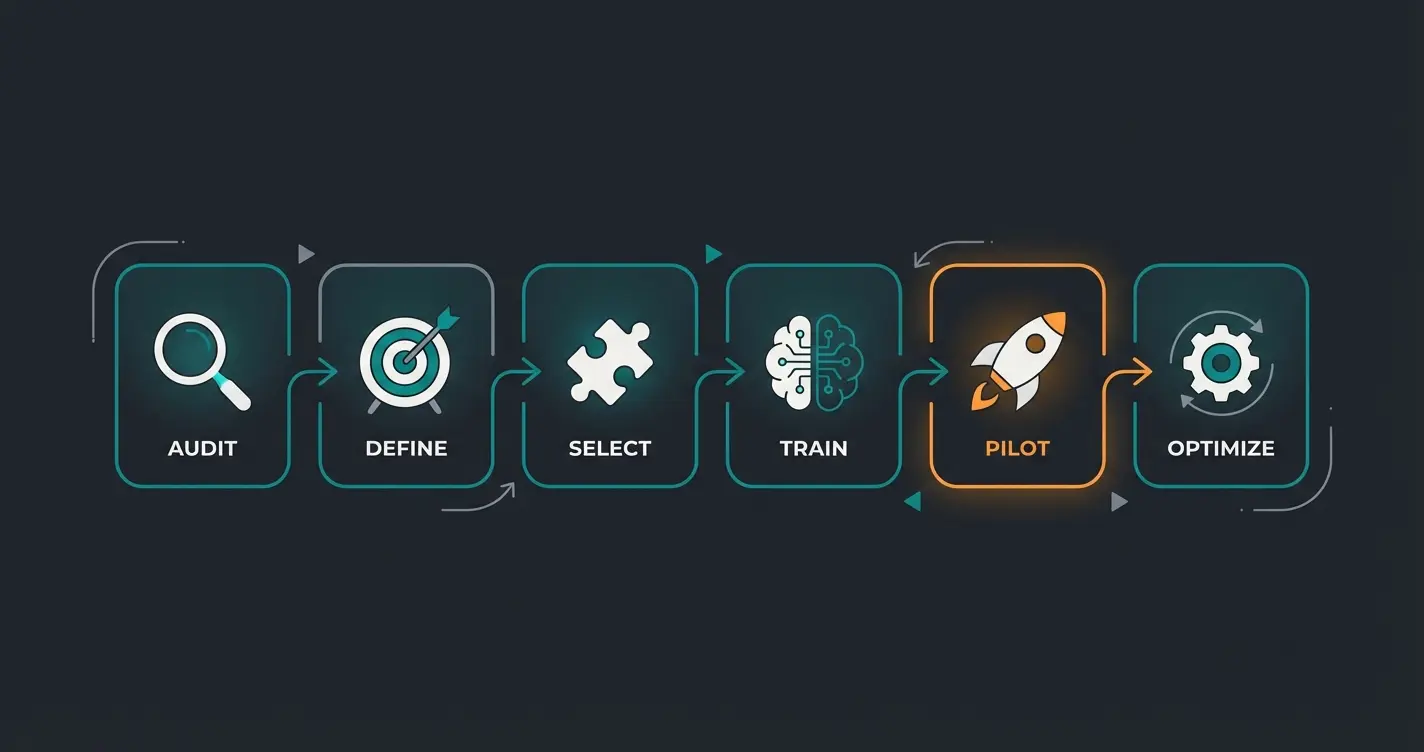
Implementing a customer service chatbot requires six steps: audit your current support volume, define use cases (FAQ, consultation, or both), select a platform with your integration needs, train the AI on your product data, run a pilot phase, and iterate based on conversation analytics. Most SMEs are live within 2-4 weeks.
Analyze your top 50 customer inquiries. Categorize them: how many are FAQ-level? How many require product knowledge? How many need human judgment? This split determines your automation potential.
Start with one use case, not five. FAQ automation is the fastest win. Product consultation delivers the highest ROI. Pick based on where you see the most volume or the biggest revenue gap.
Evaluate integration depth (Shopware, Shopify, WooCommerce), AI consultation capability, multi-channel support, GDPR compliance, and pricing transparency. See the comparison section below.
Upload your product catalog, FAQs, return policies, and any specialist knowledge your best sales employee carries. The richer the training data, the better the AI performs from day one.
Deploy on a single channel (e.g., website chat) with a clear escalation path to human agents. Monitor conversations daily for the first two weeks. Fix gaps in real time.
After 30 days, analyze: resolution rate, customer satisfaction, conversion impact, and escalation patterns. Expand to additional channels (WhatsApp, email, social) once the core performance is stable.
For a deeper look at connecting your chatbot to existing systems, see our chatbot integration guide. If you are considering German chatbot solutions specifically, that guide covers DACH-specific requirements including GDPR, data residency, and German-language NLP quality.
One practical tip for businesses with fewer than 50 employees: do not try to automate everything at once. Start with the inquiries that consume the most time and have the clearest answers. Order tracking, return policies, and product availability are typical quick wins. Once those run reliably, move to the higher-value use case: product consultation. The AI customer service solution page shows how this phased approach works in practice. You can also build your own chatbot if you prefer a hands-on approach.
Choosing the right chatbot platform
The right chatbot platform for customer service depends on three factors: integration depth with your existing shop system (Shopware, Shopify, WooCommerce), the AI's ability to handle product consultation beyond simple FAQ, and whether it can work across channels (web, WhatsApp, email). Price alone is a poor selection criterion.
| Criteria | What to look for | Red flags |
|---|---|---|
| Shop integration | Native connectors for your platform, real-time product data sync, order status access | "We integrate with everything" without specifics |
| AI consultation depth | Product-aware responses, guided selling flows, cross-sell recommendations | Keyword matching only, no product context |
| Multi-channel | Web, WhatsApp, email, social from one platform with unified conversation history | Separate bots per channel with no shared context |
| GDPR compliance | EU data hosting, data processing agreements, consent management, deletion workflows | US-only hosting, vague privacy policies |
| Pricing transparency | Clear per-conversation or per-resolution pricing, no hidden fees | "Contact sales for pricing" with no public tiers |
| Training effort | Automated product catalog import, visual knowledge base builder | Requires developer team for basic setup |
According to Zendesk, the top platforms for customer service chatbots in 2026 include Zendesk AI, Intercom, Tidio, and Gorgias, each with different strengths. For e-commerce businesses with consulting-intensive products, the critical differentiator is whether the AI can do genuine product consultation, not just answer FAQ. Most platforms handle support well. Few handle consultation. For a broader comparison including pricing tiers, see our review of the best live chat software.
As Salesforce notes in their 2026 customer service guide, the most advanced chatbots now combine autonomous resolution with seamless human handoff. For SMEs, the practical question is: does the platform require a technical team to maintain, or can a non-technical business owner manage it? The answer to that question often matters more than the AI's theoretical capabilities.
Cost-benefit analysis and ROI
A customer service chatbot typically costs between EUR 50 and EUR 500 per month for SMEs, while replacing the equivalent of 2-3 full-time support agents for routine inquiries. Most businesses achieve positive ROI within 3 months through reduced ticket volume and increased conversion from AI-guided product consultation.
| Cost factor | Without chatbot | With chatbot |
|---|---|---|
| Support staff (routine inquiries) | EUR 2,500-4,000/month per agent | EUR 50-500/month platform cost |
| Average response time | 2-15 minutes | Under 5 seconds |
| Availability | Business hours (8-10h/day) | 24/7/365 |
| Inquiries handled per hour | 8-12 per agent | Unlimited (parallel) |
| Cost per interaction | EUR 6-12 | EUR 0.50-2.00 |
| Revenue from consultation | Limited by staff capacity | +35% cart value (documented) |
| Scalability during peak | Hire temporary staff (weeks) | Instant (same cost) |
The traditional ROI calculation focuses on cost savings: fewer agents needed, lower cost per interaction. But that misses the bigger picture. When Rasendoktor deployed their AI employee, the 16x ROI came primarily from revenue generation, not cost cutting. The AI handled product consultation at a level and speed that human agents could not match during peak season. For a detailed breakdown of pricing models and hidden costs, see our chatbot costs and pricing comparison.
Budget matters most at the start. If you are testing before committing to a platform, free live chat software gives you a zero-cost baseline for measuring inquiry volume and response patterns. The limits appear fast once consultation volume grows, but the data you collect makes the business case for a paid AI employee much easier to defend.
Common challenges and how to solve them
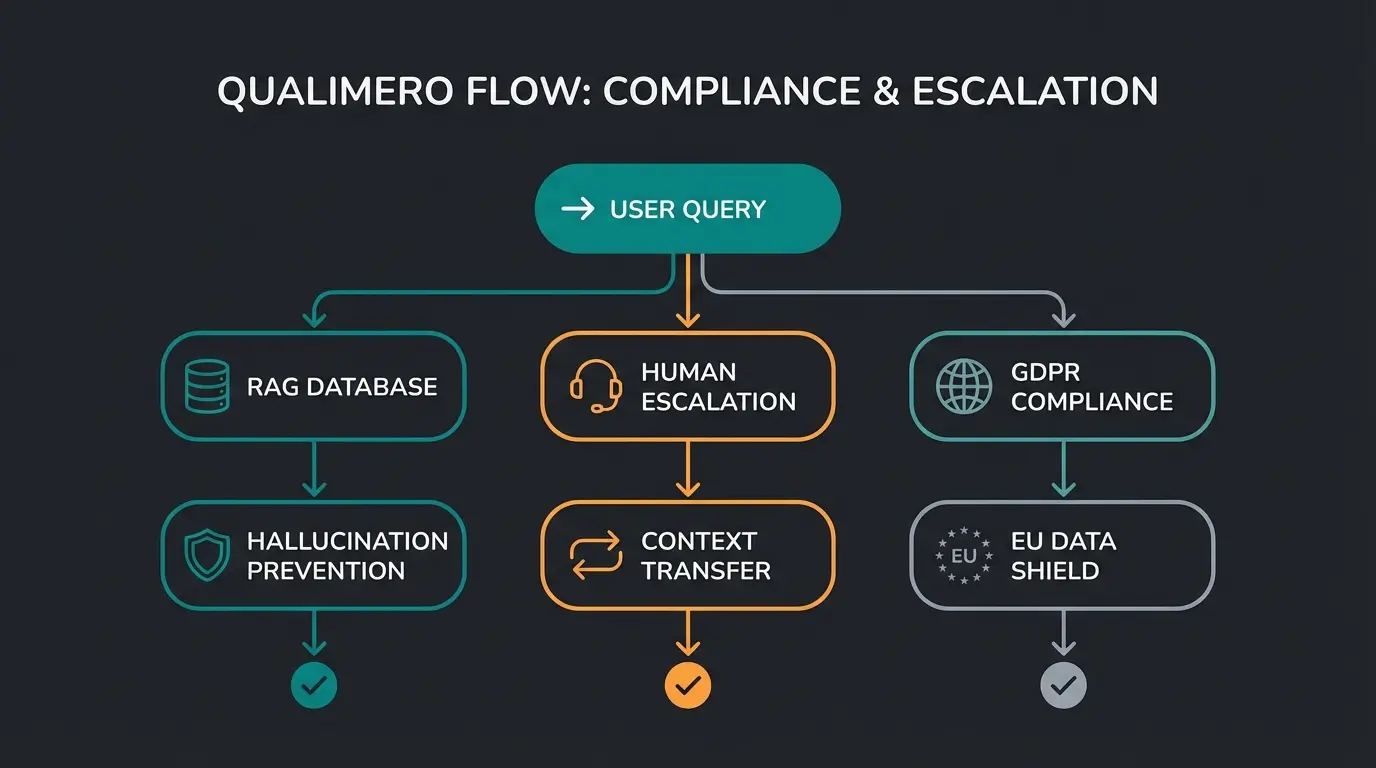
The three biggest challenges with customer service chatbots are AI hallucinations (solved by retrieval-augmented generation), poor handoff to human agents (solved by context-preserving escalation), and GDPR compliance (solved by EU-hosted, privacy-by-design platforms). None of these are dealbreakers if you choose the right architecture.
AI hallucinations
When a generic LLM invents a product feature or quotes a wrong price, that is a hallucination. In customer service, it destroys trust instantly. The solution is RAG: the AI retrieves information from your verified product database before generating a response. A RAG-grounded chatbot does not guess. It looks up the answer and presents it in natural language. Modern RAG implementations achieve 95%+ factual accuracy on product-specific queries.
The practical safeguard is straightforward: if the AI cannot find the answer in your verified data, it should say so directly and offer to connect the customer with a human agent. That transparency builds more trust than a confident wrong answer ever could. As the IBM guide to AI customer service chatbots puts it, "poorly designed or unevenly trained chatbots leave customers frustrated and harm a brand's reputation."
Poor escalation to human agents
The worst customer experience is being stuck in a chatbot loop with no exit. Effective escalation means the chatbot transfers the full conversation context to the human agent. The customer does not repeat themselves. The agent sees what the customer asked, what the bot answered, and why escalation was triggered. Sentiment detection helps: if the customer's frustration increases, the bot escalates proactively.
GDPR and data privacy
For any business operating in the EU or serving EU customers, GDPR compliance is non-negotiable. That means EU data hosting, clear consent mechanisms, defined data retention periods, and the right for customers to request deletion of their conversation data. Many US-based chatbot platforms do not meet these requirements out of the box. As the IBM guide notes, maintaining security standards and adhering to GDPR "builds trust and protects customers, as well as a business at large."
Customer trust and acceptance
Some customers still prefer human agents, especially for high-value purchases. The data suggests this is less about chatbot aversion and more about quality expectations: Invesp research shows 40% of consumers do not care whether a chatbot or person assists them, as long as the help is effective. The key is transparency. Let customers know they are talking to an AI, make human escalation easy, and deliver useful, accurate responses. Trust follows from competence, not from pretending to be human.
Frequently asked questions about chatbot customer service
Chatbot customer service is the use of AI-powered software to handle customer inquiries automatically through text or voice conversations. Modern chatbots use NLP and LLMs to understand questions, access product data, and provide accurate responses 24/7. According to Gartner, AI will autonomously resolve 80% of common customer service issues by 2029.
The best chatbot depends on your needs. For e-commerce businesses with consulting-intensive products, look for platforms with deep product data integration and consultation capabilities. Zendesk leads for general customer service automation, while specialized platforms like Qualimero focus on turning support into sales through AI product consultation.
Customer service chatbot pricing ranges from EUR 50 to EUR 500 per month for SMEs, depending on conversation volume and features. Enterprise solutions can cost more. The ROI typically exceeds the investment within 3 months: our clients average 16x ROI through combined cost savings and revenue generation from product consultation.
Chatbots replace routine interactions, not human agents entirely. They handle 80% of repetitive inquiries (order tracking, FAQs, product information), freeing human agents for complex issues requiring empathy and judgment. The most effective setup is a hybrid model where AI handles volume and humans handle exceptions.
They can be, but compliance depends on the platform. Key requirements: EU data hosting, explicit consent mechanisms, data retention policies, and customer deletion rights. Always verify that your chatbot provider offers a Data Processing Agreement (DPA) and stores conversation data within the EU.
Modern AI chatbots handle complexity through retrieval-augmented generation (RAG), which grounds responses in your actual product data. For questions beyond the AI's scope, effective chatbots escalate to human agents with full conversation context. The customer does not repeat themselves, and the agent sees the complete interaction history.
The future of chatbot customer service
Chatbot customer service is shifting from cost-cutting automation to revenue-generating consultation. Businesses that implement AI chatbots focused on product advisory, not just FAQ deflection, will capture the largest competitive advantage in 2026 and beyond.
The global chatbot market is projected to reach USD 15.5 billion by 2028, according to Grand View Research, driven primarily by e-commerce and customer service applications. But the real story is not market size. It is the fundamental change in what chatbots do. The era of "Sorry, I did not understand" is ending. The era of "Based on your lawn type and the area you described, I recommend this specific fertilizer, applied at 30g per square meter in early April" is beginning.
Three trends will accelerate this shift in the next 12-18 months. First, agentic AI: chatbots that do not just answer questions but take actions. Processing refunds, updating shipping addresses, rescheduling deliveries, all without a human agent touching the case. Second, proactive outreach: chatbots that identify customers who are stuck or about to abandon, and initiate help before the customer asks. Third, voice-first interfaces: the same AI consultation experience, delivered through voice on phone calls, WhatsApp voice notes, and smart speakers.
For e-commerce businesses, the opportunity is clear. Every hour your customers spend browsing without guidance is a lost sale. Every product return caused by the wrong purchase decision is preventable. Every support ticket that a human agent answers about order status is time that could be spent on high-value consultation. The technology exists today to solve all three problems simultaneously.
I have watched this technology evolve from the inside, building and deploying AI employees across dozens of e-commerce businesses. The pattern is consistent: companies that start with consultation rather than support see faster ROI, higher customer satisfaction, and stronger long-term retention. The cost savings from automating FAQ are real but modest. The revenue impact from guided selling is transformative.
Whether you start with FAQ automation or jump straight to AI product consultation, the first step is the same: understand what your customers actually ask, and measure the gap between what your current support delivers and what they need. The chatbot closes that gap, at scale, around the clock.
Qualimero AI employees do not just answer questions. They consult, recommend, and sell. Our clients see 16x ROI, +35% cart value, and 60% higher checkout rates. See what an AI employee can do for your shop.
Start your free trial
Lasse is CEO and co-founder of Qualimero. After completing his MBA at WHU and scaling a company to seven-figure revenue, he founded Qualimero to build AI-powered digital employees for e-commerce. His focus: helping businesses measurably improve customer interaction through intelligent automation.