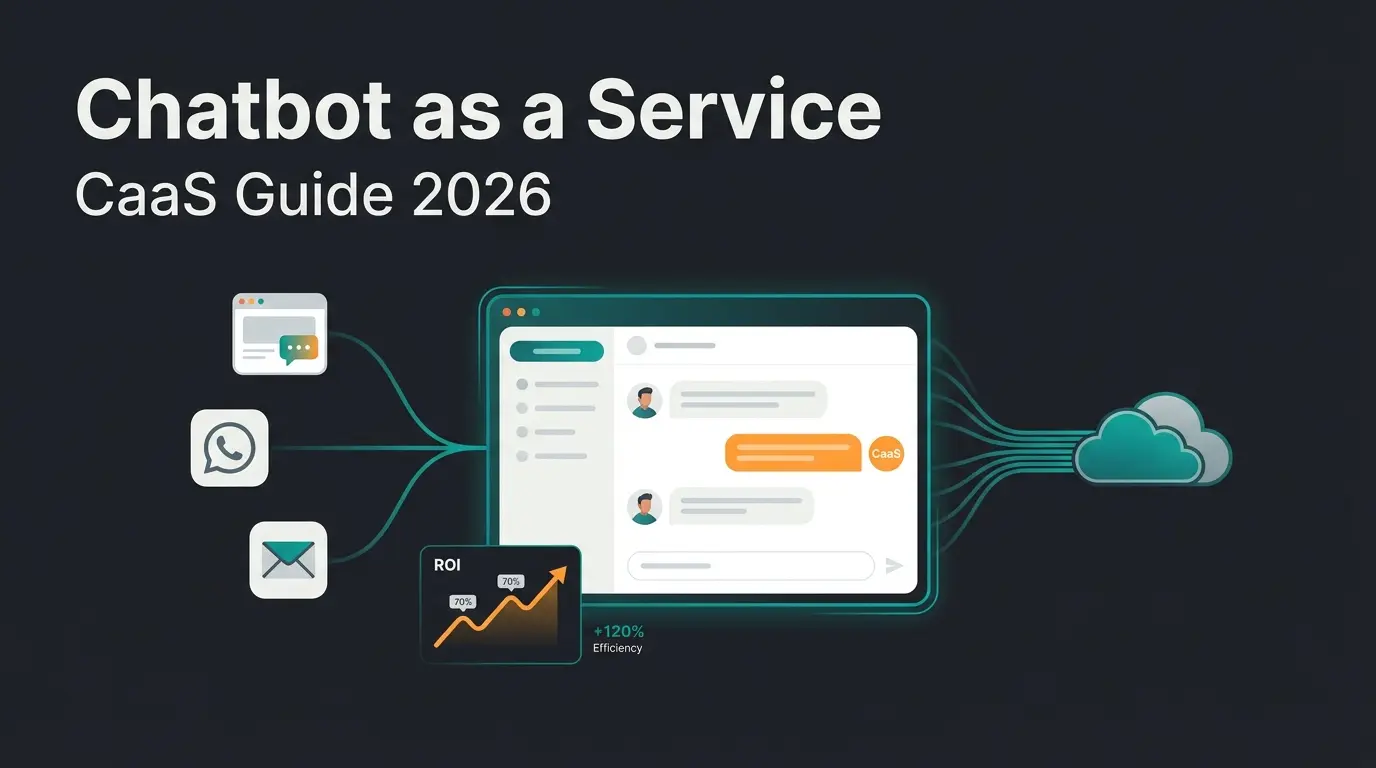
What is an ecommerce chatbot?
An ecommerce chatbot is an AI-powered tool that interacts with online shoppers in real time, answering product questions, recommending items, and guiding purchases through natural conversation instead of static menus or search filters. Unlike generic AI chatbot customer service bots that deflect to FAQ pages, a true ecommerce chatbot understands your product catalog, recognizes returning customers, and actively drives sales.
The global chatbot market reached $7.01 billion in 2024 and is projected to hit $20.81 billion by 2029, according to MarketsandMarkets. That growth is not coming from simple FAQ widgets. It is driven by AI systems that connect to product databases, order management, and customer history to deliver actual consulting in a chat window.
I have seen this shift firsthand across dozens of ecommerce implementations. The shops that treat their chatbot as a digital salesperson, not a deflection tool, consistently outperform those that bolt on a generic widget and hope for the best. The difference is not the technology. It is whether the chatbot knows what it is selling.
As IBM notes in their overview of ecommerce chatbot capabilities, the distinction between a basic chatbot and an AI agent is critical: one follows scripts, the other makes decisions. That distinction determines whether your chatbot costs money or makes money.
From FAQ bot to AI sales consultant
The evolution from FAQ bots to AI sales consultants represents a fundamental shift: instead of deflecting questions with canned responses, modern ecommerce chatbots actively drive revenue by understanding product catalogs, recognizing returning customers, and making personalized recommendations. This happened in three distinct generations, and most ecommerce stores are still stuck on Gen 1.
| Gen 1: FAQ Bot | Gen 2: NLP Chatbot | Gen 3: AI Sales Consultant | |
|---|---|---|---|
| Logic | Rule-based decision trees | Intent recognition + NLP | LLM + product data integration |
| Product knowledge | None | Keyword matching | Full PIM/ERP integration |
| Customer memory | None | Session-based | Persistent across channels |
| Revenue impact | Minimal (deflects questions) | Moderate (routes to products) | High (recommends, upsells, closes) |
| Example interaction | "Click here for our FAQ page" | "Did you mean running shoes?" | "Based on your garden size and soil type, this fertilizer fits. Want the matching spreader?" |
Gartner predicts that by 2027, chatbots will be the primary customer service channel for roughly 25% of organizations. But here is what most industry reports miss: the organizations adopting Gen 3 are not replacing customer service. They are building a new sales channel.
Gen 1 and Gen 2 bots still dominate. Most ecommerce stores run a widget that can answer "What is your return policy?" but cannot tell a customer which product fits their specific needs. The jump to Gen 3 requires one thing above all: deep integration with product data. Without it, you have a fancy FAQ page. With it, you have an automated FAQ system that actually sells.
How ecommerce chatbots drive revenue
Ecommerce chatbots drive revenue through three mechanisms: higher cart values from personalized upselling, improved checkout completion rates, and 24/7 sales coverage that captures purchases outside business hours. The numbers are not theoretical. They come from live deployments we track monthly.
Across our client base, the pattern holds. Cart values increase by 35% on average when an AI consultant recommends complementary products during conversation. Checkout completion improves by up to 60% because the chatbot resolves purchase objections in real time, before the customer abandons. And the after-hours effect catches most merchants by surprise: 30-40% of all chatbot-driven purchases happen when human staff is offline.
Across Qualimero client deployments (Q1 2026)
Average across consulting-intensive verticals
Take Gartenfreunde, an online garden and wellness retailer. Before deploying AI employee Kira, a single sales rep handled up to 50 consultation-intensive inquiries per day during peak season. Customers with complex questions about soil compatibility, plant care combinations, or product sizing simply left without buying. Kira changed that: 7x higher conversion rate, 45% click-through on product recommendations, 6x ROI. One AI employee outperformed the entire pre-sales workflow.
The Grand View Research chatbot market report projects the global chatbot market to grow at a 23.3% CAGR through 2030. And Juniper Research estimates that global retail spend facilitated by chatbots will reach $72 billion by 2028, up from $12 billion in 2023. That 470% growth is not speculation. It reflects what we see in practice: once you connect AI to actual product data, it stops being a cost center and becomes a revenue channel.
Key features of modern ecommerce chatbots
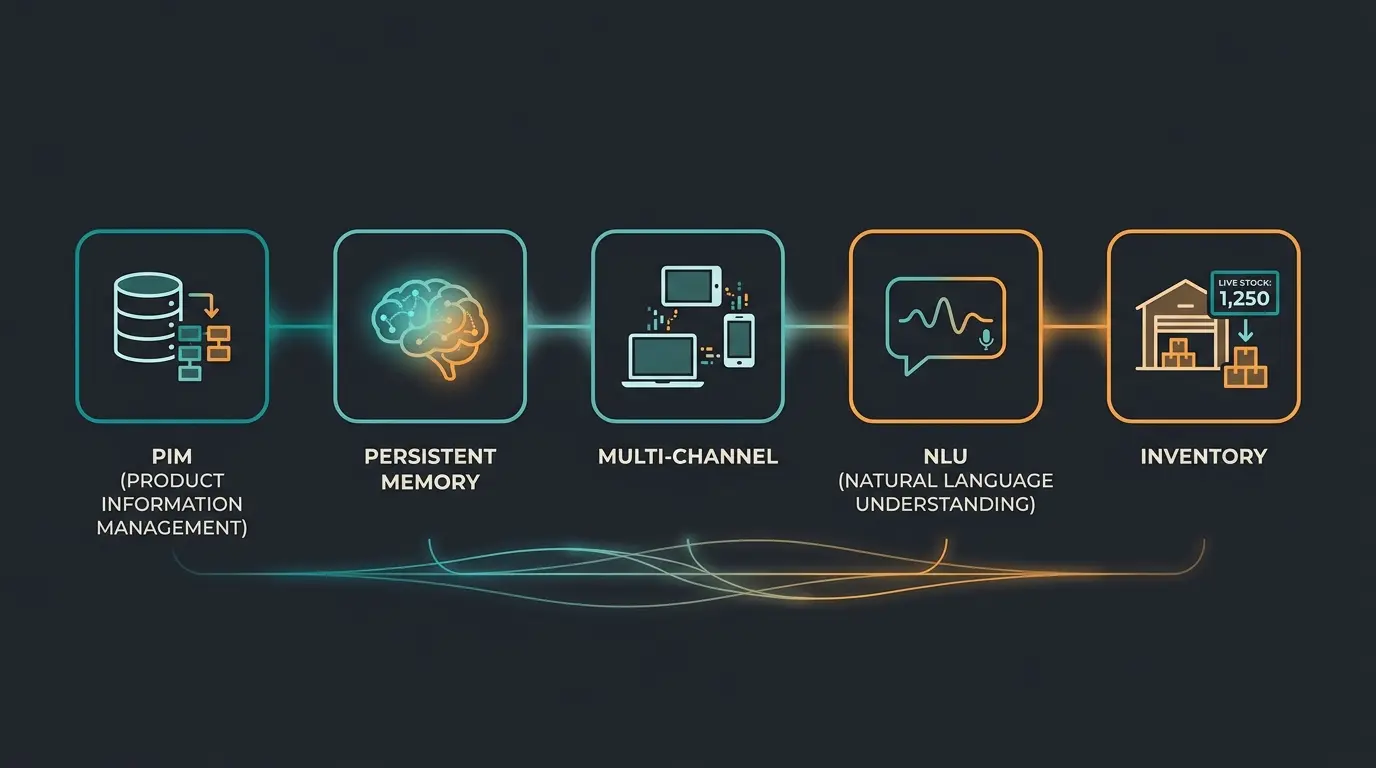
The most effective ecommerce chatbots share five core features: deep product catalog integration through PIM or ERP connectivity, persistent customer memory, multi-channel presence across website, WhatsApp, and social media, natural language understanding, and real-time inventory awareness. Miss any one of these, and you are running a glorified search bar with a chat bubble on top.
Product data integration (PIM/ERP)
This is the non-negotiable. A chatbot that cannot access your product database in real time is guessing. PIM integration means the AI knows every SKU, every attribute, every compatibility rule, every price. It can answer "Which lawn fertilizer works for clay soil in shade?" not because someone programmed that specific question, but because it understands the product data well enough to derive the answer.
At Neudorff, a garden supplies manufacturer with thousands of products, AI employee Flora achieves 97% accuracy in product recommendations. That precision is not possible with keyword matching. It requires understanding product attributes, application scenarios, and compatibility rules stored in the PIM, then updating automatically when the catalog changes.
Persistent customer memory
Session-based memory dies when the browser tab closes. Persistent memory means the chatbot remembers that this customer bought a lawn mower three months ago and now needs compatible accessories. It recalls the garden size they mentioned, the soil type they described, the budget range they indicated. This turns a transactional interaction into a relationship, and it is where the cross-sell and upsell revenue originates.
Multi-channel presence
A Harvard Business Review study of 46,000 shoppers found that 73% use multiple channels during their shopping journey. Your chatbot needs to follow the customer from website to WhatsApp to Instagram without losing context. Signed deployed AI advisor Alex across Instagram and TikTok, automating 70% of social channel inquiries and achieving 18x ROI. Same AI, different touchpoint, no lost context.
Real-time inventory and pricing
Nothing destroys trust faster than recommending a product that is out of stock or quoting a price that changed last week. Real-time inventory sync means the chatbot only recommends available products, shows current pricing, and can suggest alternatives when the preferred item is temporarily unavailable. As of Q2 2026, this is table stakes for any serious ecommerce chatbot deployment.
| Feature | Basic Chatbot | AI Sales Consultant |
|---|---|---|
| Product knowledge | Links to product pages | Understands attributes, compatibility, alternatives |
| Customer context | None between sessions | Persistent memory across visits and channels |
| Recommendation logic | "Most popular" or keyword match | Personalized based on needs, history, context |
| Channel coverage | Website widget only | Website, WhatsApp, Instagram, TikTok, email |
| Inventory awareness | Static catalog | Real-time stock, pricing, availability |
| AI product consultation | Not available | Full guided selling with upsell and cross-sell |
Conversational commerce in practice
Conversational commerce works best in consulting-intensive ecommerce verticals, where customers need expert guidance to choose from complex catalogs. Garden supplies, home improvement, specialty retail, automotive accessories. These are categories where a static product page leaves money on the table and where an AI consultant makes the difference between a bounce and a sale.
At Rasendoktor, the online specialist for professional lawn care, AI employee Hektor handles 2,000 to 3,000 seasonal inquiries that previously overwhelmed the support team. Which fertilizer for which grass type? Which application rate for which soil condition? Which timing for which climate zone? Hektor answers all of it with domain-specific training that goes beyond generic product descriptions. The result: 16x ROI, 100% automation of product consultations, 40% support cost reduction.
A completely different deployment, same principle: Signed, a retailer for custom decorative signs. AI advisor Alex works on Instagram and TikTok, where customers browse product photos and ask questions in DMs. Alex does not just answer "What material is this sign made of?" He suggests complementary items, handles sizing questions, and closes the sale without a human touching the conversation. 18x ROI, 30% increase in upselling.
Honest caveat. Conversational commerce does not deliver the same ROI for every product category. Commodities with low decision complexity, think standardized office supplies or basic electronics, show weaker results from chatbot deployments. The sweet spot is products where customers genuinely need guidance: technical items, products with compatibility requirements, or items where personal preference and use case determine the right choice. If your customers never call before buying, a chatbot will not magically create demand for advice.
What works across all verticals is the efficiency gain. Even in low-complexity categories, automating the repetitive 80% of support questions frees your team for the high-value 20% that actually requires a human. That alone justifies the deployment for most merchants.
How to choose the right ecommerce chatbot
Choose an ecommerce chatbot based on four criteria: product data integration depth, conversation quality, analytics and ROI tracking, and platform compatibility with your shop system. Everything else is secondary.
According to Salesforce, 69% of consumers prefer chatbots for quick communication with brands. But "quick" means nothing if the answers are wrong. Integration depth is the single most important differentiator. Can the chatbot access your full product catalog? Can it check inventory in real time? Can it pull order history for a returning customer? If the answer to any of these is no, you are evaluating a FAQ widget, not a sales tool.
| Criterion | Questions to Ask | Red Flag |
|---|---|---|
| Integration depth | PIM/ERP connection? Real-time or batch sync? | "We work with any product feed" (usually means CSV import) |
| Conversation quality | Multi-turn with context retention? | Demo only shows single-question interactions |
| Analytics | Revenue attribution or just chat volume? | Metrics limited to "conversations started" |
| Platform | Native Shopware, Shopify, WooCommerce connectors? | "We support all platforms" without named integrations |
| GDPR | EU data processing? Clear data ownership? | Vague privacy policy, US-only hosting |
| Best live chat software fallback | Smooth handoff to human agents? | No escalation path or binary bot-or-human model |
One thing I have learned from evaluating dozens of tools: the vendors with the most impressive demos often have the weakest integrations. Ask for a proof of concept with your actual product data. If they cannot set one up within a week, the integration they promise will take months. I have seen it happen too many times to be polite about it.
Implementing an ecommerce chatbot
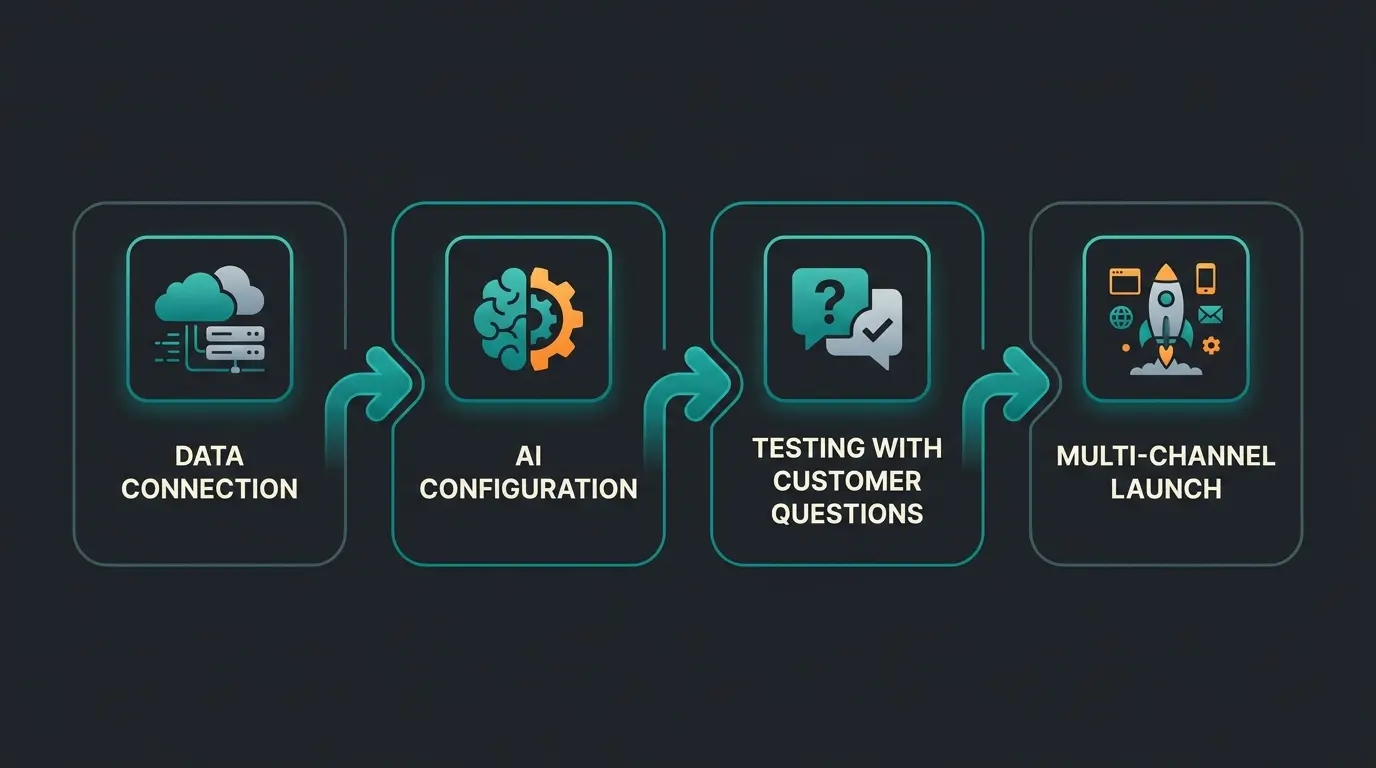
Implementing an ecommerce chatbot takes 2 to 4 weeks with a modern platform: connect your product data source, configure conversation logic, set up channel integrations, and launch with a pilot on your highest-traffic product category. That timeline assumes your product data is clean. If your PIM is a mess, add a week.
- Audit your product data. No duplicates, no empty descriptions, no outdated prices. The AI is only as good as the data it has. Budget 1-2 days for cleanup.
- Define 3-5 core use cases. Not 50. Start with product recommendation for your top category, cross-sell at checkout, and after-hours inquiry handling. Expand later.
- Connect your data source. PIM, ERP, or shop API. Real-time sync, not CSV uploads. This is where most implementations stall because the vendor promised easy and delivered complicated.
- Test with real customer questions. Take your last 100 support inquiries and run them through. Below 85% accuracy? Not production-ready. That threshold is non-negotiable.
- Launch on one channel first. Website widget, WhatsApp, or your highest-volume social channel. Measure for 2 weeks before expanding.
- Track revenue attribution. Which sales originated from chatbot interactions? What is the order value difference compared to sessions without the chatbot? If you only measure conversations, you are missing the point.
For detailed technical guidance on connecting your AI to Shopware, Shopify, or WooCommerce, see our chatbot integration guide. It covers API setup, data mapping, and the most common implementation pitfalls that we have seen trip up even experienced development teams.
How this looks in practice: our typical client connects their shop system via API in week one, configures the AI's product knowledge and conversation style in week two, runs internal testing in week three, and launches a monitored pilot in week four. By week six, most clients expand from one channel to two or three. By month three, the chatbot has paid for itself several times over.
Frequently asked questions about ecommerce chatbots
Ecommerce chatbot costs range from free (basic rule-based widgets) to EUR 500-2,000 per month for AI-powered solutions with PIM integration and multi-channel support. The ROI typically exceeds the cost within 1-3 months: Qualimero clients average 6-18x return on investment, with Signed achieving 18x ROI and Rasendoktor reaching 16x.
Yes, modern AI systems handle post-purchase processes including return initiation, order tracking, and complaint routing. The highest revenue impact comes from pre-purchase consulting: product recommendations, compatibility checks, guided selling. The best implementations cover both, with post-purchase automation reducing support costs by 40-70%.
All major platforms support chatbot integration: Shopware 5 and 6, Shopify, WooCommerce, Magento, and BigCommerce. The key difference is integration depth. Native API connections with real-time product sync outperform simple embed codes. Check whether the vendor offers a certified connector for your specific platform version.
Conversion lifts vary by product complexity and implementation quality. Consulting-intensive verticals see the highest gains: Gartenfreunde achieved 7x conversion increase with AI employee Kira. Commodity categories typically see 1.5-3x improvement. The difference is almost entirely determined by product data quality and integration depth.
Compliance depends on the vendor, not the technology. Verify three things: EU data processing location, clear data processing agreement (Auftragsverarbeitungsvertrag), and transparent consent mechanisms. As of Q2 2026, any chatbot storing conversation data must also comply with the EU AI Act's transparency requirements for consumer-facing AI systems.
More traffic only matters if visitors buy. Qualimero's AI employees turn browsers into buyers, with +35% higher cart values and up to 18x ROI. Book a demo with your actual product data.
Book a demo
Lasse is CEO and co-founder of Qualimero. After completing his MBA at WHU and scaling a company to seven-figure revenue, he founded Qualimero to build AI-powered digital employees for e-commerce. His focus: helping businesses measurably improve customer interaction through intelligent automation.