The misunderstanding around Shopware service
Shopware service encompasses far more than technical maintenance and hosting support. True service means transforming your online shop into an active sales advisor that understands products, recognizes customer needs, and delivers personalized consultation at scale. Most merchants never get past the first layer.
Search for "shopware service" and you find agencies. Dozens of them. They offer migrations from Shopware 5 to 6, hosting packages, security patches, and emergency support for Black Friday meltdowns.
That's the market's entire understanding of the word "service." Defensive. Reactive. You pay so nothing breaks.
Shopware has held market leadership in Germany for four consecutive years, powering 11.5% of the top 1,000 B2C online shops according to their 2025 press release. The platform is solid. The ecosystem is mature. But the service conversation around it is stuck in 2019.
What's missing is the sales layer. The part where your shop doesn't just exist, but actively sells. If your entire Shopware support investment goes toward keeping the lights on, you're solving the wrong problem.
The 3 types of Shopware services
Shopware services fall into three categories: technical service covering hosting, updates, and security; operational service handling SEO, analytics, and integrations; and customer experience service delivering product consultation, personalized recommendations, and conversational commerce. Most merchants only invest in the first two.
Every Shopware full service agency sells the first category. Many cover the second. Almost none touch the third.
Technical service is the foundation. Server uptime, Shopware 6 updates, security patches, performance monitoring. Without it, your shop goes offline. Agencies charge EUR 100-180 per hour for this work, and it's worth every cent when your checkout page throws a 500 error on a Saturday night.
Operational service builds on top. SEO configuration, analytics setup, plugin management, payment gateway integration. This is where most merchants max out their service budget.
Customer experience service is the overlooked category. This is where AI product consultation lives. Instead of letting visitors browse alone through 500 products, an AI employee guides them to the right purchase. It's the digital equivalent of a knowledgeable sales associate in a physical store, except it handles 200 conversations simultaneously.
| Dimension | Technical Service | Operational Service | CX Service (AI) |
|---|---|---|---|
| Focus | Infrastructure stability | Growth tools | Revenue per visitor |
| Examples | Hosting, updates, patches | SEO, analytics, plugins | Product consultation, guided selling |
| Availability | 24/7 monitoring | Business hours | 24/7 active selling |
| Cost model | EUR 100-180/hour | EUR 100-180/hour | Monthly SaaS subscription |
| Revenue impact | Indirect (prevents downtime) | Medium (drives traffic) | Direct (+35% cart value) |
| Scalability | Linear (more servers = more cost) | Linear (more hours = more spend) | Unlimited concurrent conversations |
The first two categories keep your shop running and visible. The third one makes it sell.
Why standard chatbots fail in Shopware environments
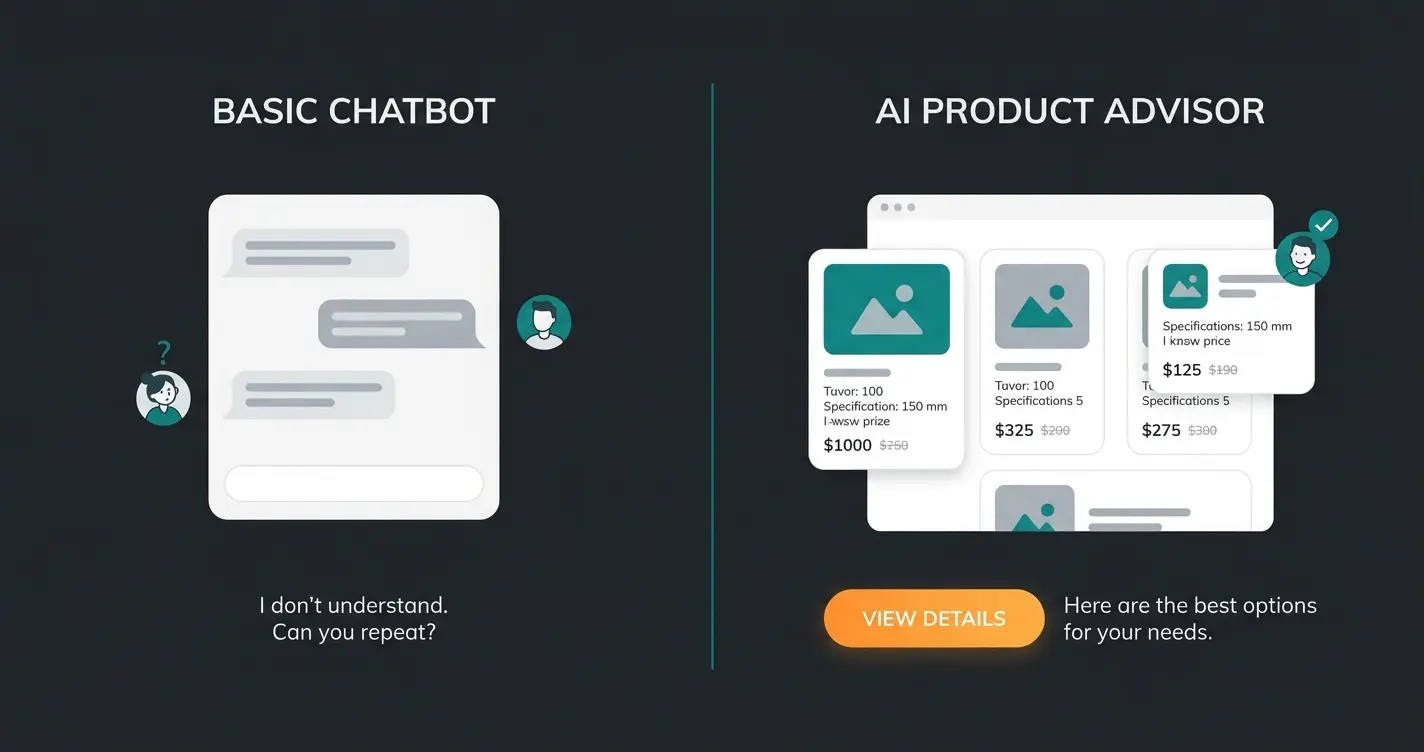
Standard chatbots fail in Shopware shops because they lack deep product data integration, cannot parse complex product relationships, and deliver generic scripted responses instead of context-aware consultation. The resolution rate data tells the story.
Most chatbot solutions work from a static FAQ database. They pattern-match keywords to pre-written answers. Ask about lawn fertilizer for clay soil and you get a generic response about your return policy. Not helpful. Not a sale.
The problem is structural. A typical Shopware shop with 2,000 products has complex relationships between items: cross-selling dependencies, seasonal relevance, compatibility constraints. A standard chatbot doesn't understand any of this. It has never ingested your product catalog.
According to Dante AI's 2026 research, e-commerce chatbots achieve an 82% resolution rate for simple tasks like order tracking and FAQ lookup. Decent for logistics. Useless for product consultation, which requires comparing alternatives, reasoning about the customer's situation, and understanding product attributes that change by season.
An AI employee takes a fundamentally different approach. It ingests your entire product database, understands which items complement each other, and knows when to recommend a premium option versus a budget alternative. The difference shows up directly in Shopware support automation outcomes: not just resolved tickets, but actual revenue generated per conversation.
Case study: AI product consultation in action
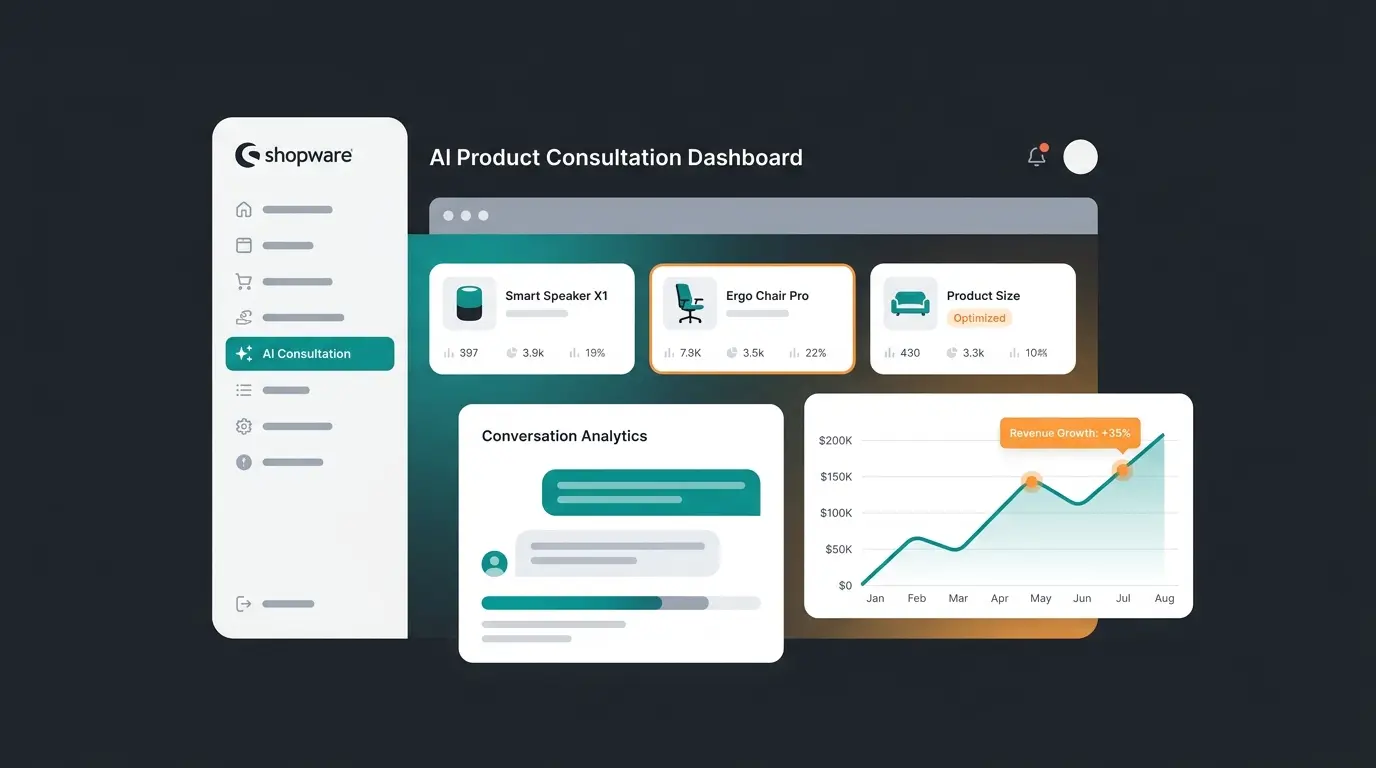
Real Shopware shops using AI product consultation see measurable results: Rasendoktor achieved 16x ROI and automated 100% of consultation queries, while Gartenfreunde's AI employee Kira delivers 7x higher conversion rates with 45% click-through on product recommendations.
Consider the typical scenario. A customer lands on a lawn care shop looking for fertilizer. Specific conditions: clay soil, partial shade, 200 square meters. In a standard shop, they scroll through 40 fertilizer products, compare ingredient lists they don't understand, and leave without buying. Cart abandoned. Revenue lost.
With an AI employee, the experience changes. The customer describes their situation in plain language. The AI cross-references soil type, garden size, shade conditions, and seasonal timing against the full product catalog. It recommends a specific product with an application schedule. In the Rasendoktor case, this approach delivered 16x return on investment and eliminated manual consultation entirely, saving 40% on support costs.
Gartenfreunde confirms the pattern in a different product category. Their AI employee Kira handles consultation for garden and wellness products. The results: 6x ROI and a 7x higher conversion rate compared to unassisted browsing. Product recommendations get clicked 45% of the time.
These aren't pilot programs. They're production systems handling real customer queries at scale, every day.
The pattern across our client implementations follows four stages:
- Customer arrives with a specific, often complex problem
- AI employee matches the problem against full product data and contextual attributes
- Personalized recommendation with clear reasoning the customer can follow
- Customer buys with confidence, often adding complementary products the AI suggested
The agentic commerce revolution
Agentic commerce represents the shift from passive product catalogs to AI-driven shopping experiences where digital employees actively guide customers through purchase decisions, remember preferences across sessions, and operate across channels. McKinsey estimates this model could redirect $3-5 trillion in global retail spend by 2030.
The numbers are accelerating fast. AI-referred traffic to retail sites grew 1,200% year-over-year through 2025, according to commercetools. Google launched the Universal Commerce Protocol at NRF in January 2026, creating an open standard for AI agents to interact with merchant catalogs and complete purchases. MetaRouter estimates AI platforms will account for $20.9 billion in retail spending in 2026 alone, nearly quadrupling the 2025 figure.
What does this mean for Shopware merchants? Your product data needs to be machine-readable, not just human-readable. An AI agent shopping on behalf of a customer won't browse your category pages. It queries product attributes, compares specifications, and makes purchase decisions programmatically.
This is where Shopware support automation meets its next evolution. The Rasendoktor case already demonstrates the principle at store level: an AI employee that understands products deeply enough to replace human consultation. Agentic commerce scales this across the entire discovery-to-purchase journey.
Implementation guide: Adding AI service to Shopware 6
Integrating AI product consultation into Shopware 6 requires four steps: cleaning your product data, selecting an AI service provider, configuring the digital sales room, and generating consultation content from your existing catalog. Most shops complete the process within two to four weeks.
Step 1: Data hygiene. Your product data is the foundation. Every product needs complete descriptions, accurate attributes, and current pricing. No duplicates, no empty fields, no outdated variants. The AI employee is only as good as the data it knows.
Step 2: Select your AI service provider. Not every solution works equally well with Shopware 6. Look for native API integration, support for the Shopware product data model, and the ability to handle complex product relationships. The Shopware Store lists certified apps, but don't limit yourself to what's there.
Step 3: Configure the digital sales room. Define conversation starting points, set product recommendation logic, and determine escalation paths for queries that genuinely need human attention. Most consultation requests don't.
Step 4: Generate consultation content. Transform your product knowledge into machine-readable material. Product comparison logic, use-case matching rules, cross-selling recommendations. AI product consultation tools can automate much of this from your existing catalog data.
The biggest mistake I see merchants make: they skip step 1 and wonder why the AI gives mediocre answers. Budget for the data cleanup. It's the least glamorous step and the most important one.
Clean product descriptions, fix attributes, remove duplicates. Typically 1-2 weeks.
Evaluate API compatibility, Shopware 6 integration depth, and product data model support.
Configure conversation flows, recommendation rules, and escalation paths.
Launch with real customer queries. Test against your last 100 support tickets. Target 85%+ accuracy before scaling.
Comparison: Agency support vs. AI sales service
Traditional agency support handles technical maintenance at EUR 100-180 per hour with limited scalability, while AI sales service delivers 24/7 personalized product consultation at a fraction of the cost per interaction. Both serve different purposes. Most budgets just haven't adjusted to reflect that.
This isn't an either-or decision. You need both. But the allocation most Shopware merchants use is inverted: 90% on infrastructure, 0% on customer-facing AI. Here's what we see across our client implementations:
| Dimension | Agency Support | AI Sales Service |
|---|---|---|
| Availability | Business hours (emergency: 24/7) | 24/7 always-on |
| Scalability | Linear: 1 developer = 1 task | Unlimited concurrent conversations |
| Cost per interaction | EUR 100-180/hour | Fraction of a cent |
| Technical depth | High (code-level fixes) | Low (no code changes) |
| Product knowledge | Limited to documentation | Full catalog integration |
| Response time | Hours to days | Under 5 seconds |
| Revenue generation | Indirect (prevents downtime) | Direct and measurable |
Agency support keeps your infrastructure running. AI sales service keeps your revenue growing. For technical emergencies and platform updates, your agency and Shopware support phone options remain essential. For everything customer-facing, an AI employee handles it faster and at scale.
Frequently asked questions about Shopware service
Shopware is an open-source e-commerce platform used primarily by mid-market and enterprise merchants in the DACH region. It powers online shops with product management, checkout, CMS, and as of 2026, cloud-based AI services including Shopware Copilot. Around 11.5% of Germany's top 1,000 B2C shops run on Shopware.
Traditional agency service costs EUR 100-180 per hour for technical work. A full Shopware 6 shop project ranges from EUR 25,000 to EUR 70,000. AI product consultation runs on monthly SaaS subscriptions with clients typically seeing ROI within the first month, based on results ranging from 6x to 16x return.
Not entirely. AI excels at customer-facing tasks: product consultation, guided selling, FAQ handling. Technical work like code updates, security patches, and platform migrations still requires human developers. The smart approach combines both: agencies for infrastructure, AI for customer interaction.
A chatbot pattern-matches keywords to scripted responses. AI product consultation ingests your full product catalog, understands relationships between products, and delivers personalized recommendations based on each customer's specific situation. Qualimero clients see 7x higher conversion rates compared to unassisted shopping.
Shopware 6 offers solid API infrastructure and a growing ecosystem of AI-ready extensions. Shopware reviews reflect strong merchant satisfaction with the platform. For AI product consultation specifically, third-party solutions currently offer deeper integration than Shopware's native Copilot, though the platform's Intelligence+ features are closing the gap.
Agentic commerce is the emerging model where AI agents autonomously discover, compare, and purchase products on behalf of consumers. McKinsey projects this could redirect $3-5 trillion in global retail by 2030. For Shopware merchants, it means product data needs to be structured for machine consumption, not just human browsing.
AI product consultation delivers measurable ROI from week one. Rasendoktor achieved 16x return, Gartenfreunde saw 7x higher conversion. An AI employee can do the same for your shop.
Book a free demo
Lasse is CEO and co-founder of Qualimero. After completing his MBA at WHU and scaling a company to seven-figure revenue, he founded Qualimero to build AI-powered digital employees for e-commerce. His focus: helping businesses measurably improve customer interaction through intelligent automation.