What is an AI chatbot for business?
An AI chatbot for business is software that uses natural language processing and machine learning to automate customer conversations, answer questions, recommend products, and resolve issues without human intervention. It operates 24/7 across websites, WhatsApp, and social channels, connecting directly to your product data, order systems, and CRM.
That definition sounds clean. The reality is messier. Most business owners hear "chatbot" and think of the popup that asks "How can I help?" and then fails at everything beyond "What are your opening hours?" Those are rule-based bots. They follow decision trees. They break the moment a customer phrases something differently than expected.
AI chatbots are a different category entirely. They parse intent, not keywords. They learn from conversations. They pull context from your product database and respond with answers that actually match the question. The shift from rule-based to AI-powered happened fast. Gartner predicts that agentic AI will autonomously resolve 80% of common customer service issues by 2029, without human intervention.
The global chatbot market reflects this momentum. Grand View Research projects the market will reach $27.29 billion by 2030, growing at 23.3% CAGR. That is not speculative growth. That is businesses deploying AI because the alternative, hiring more agents for every channel, stopped scaling years ago.
Consumer chatbots like ChatGPT and Claude are general-purpose tools. A business AI chatbot is purpose-built: it knows your product catalog, recognizes returning customers, and routes complex issues to human agents when needed. Our Chatbot as a Service Overview covers the broader managed service model and what it includes. For a deeper look at the fundamentals, see our guide on understanding AI chatbots.
Why businesses are adopting AI chatbots in 2026
Businesses adopt AI chatbots because they reduce support costs by up to 80%, increase conversion rates by 35% or more, and provide instant responses that customers now expect as standard. They handle unlimited concurrent conversations without additional headcount, and the ROI timeline is typically three to six months.
The business case is straightforward. A human support agent costs $4-8 per interaction, according to Teneo.ai's 2025 analysis. An AI chatbot handles the same interaction for $0.03-0.50. At 500 support conversations per month, that is the difference between a $4,000 monthly cost and a $250 one. The math alone explains adoption.
But cost reduction is only half the story. McKinsey's generative AI research estimates that generative AI could add $2.6-4.4 trillion annually across industries, with customer operations being one of the four functions driving 75% of that value. The revenue side matters more than the savings side for most SMBs I work with.
According to Freshworks' 2025 AI ROI analysis, companies deploying AI in customer service report 40-60% cost reductions while maintaining or improving satisfaction scores. The report found that AI handles routine queries so effectively that human agents can focus entirely on complex, high-value conversations. That matches what we see across our own client deployments.
Our own client data tells the same story. Across Qualimero deployments, businesses see +35% higher cart value, +60% checkout rates, and 16x ROI on their AI investment. Those numbers come from real e-commerce operations, not lab conditions. The pattern is consistent: when customers get instant, relevant product guidance, they buy more and abandon less.
Gartner prediction for 2029
Across Qualimero client deployments
There is a labor dimension too. SMBs with fewer than 50 employees cannot hire dedicated support teams for every channel. WhatsApp, Instagram, website chat, email. Customers expect answers on all of them. An AI chatbot covers every channel simultaneously without burnout, vacation days, or shift scheduling.
Types of AI chatbots for business
Business AI chatbots fall into four categories: rule-based FAQ bots that follow decision trees, NLP-powered chatbots that understand free-text queries, generative AI chatbots that create original responses, and AI employees that combine all three with persistent memory, product knowledge, and cross-channel presence. Each serves a different stage of business maturity.
Rule-based bots are the cheapest option. They work for businesses with fewer than 20 frequently asked questions and no need for product recommendations. The moment a customer asks something outside the decision tree, the bot fails. According to Gartner's 2025 data, rule-based bots resolve only 20-35% of queries, while AI-powered systems achieve 55-65% containment rates with mature deployments.
NLP chatbots understand intent, not just keywords. They handle typos, rephrasings, and multi-part questions. Generative AI chatbots go further by creating original, contextual responses rather than pulling from a fixed knowledge base. For a complete breakdown, see our types of chatbots guide.
AI employees represent the next evolution. They maintain persistent memory across conversations, recognize returning customers, make autonomous decisions based on business rules, and operate across channels simultaneously. Think of them as digital team members rather than software tools. This is where Qualimero operates.
| Type | Resolution rate | Best for | Limitation |
|---|---|---|---|
| Rule-based | 20-35% | Simple FAQ automation (<20 questions) | Breaks on unexpected phrasing |
| NLP-powered | 45-55% | Customer service with varied queries | No memory between sessions |
| Generative AI | 55-65% | Complex product questions, content creation | Can hallucinate without data grounding |
| AI employee | 70-85% | Full customer journey: advice, sales, support | Higher setup investment, needs clean product data |
Top use cases for AI chatbots in business
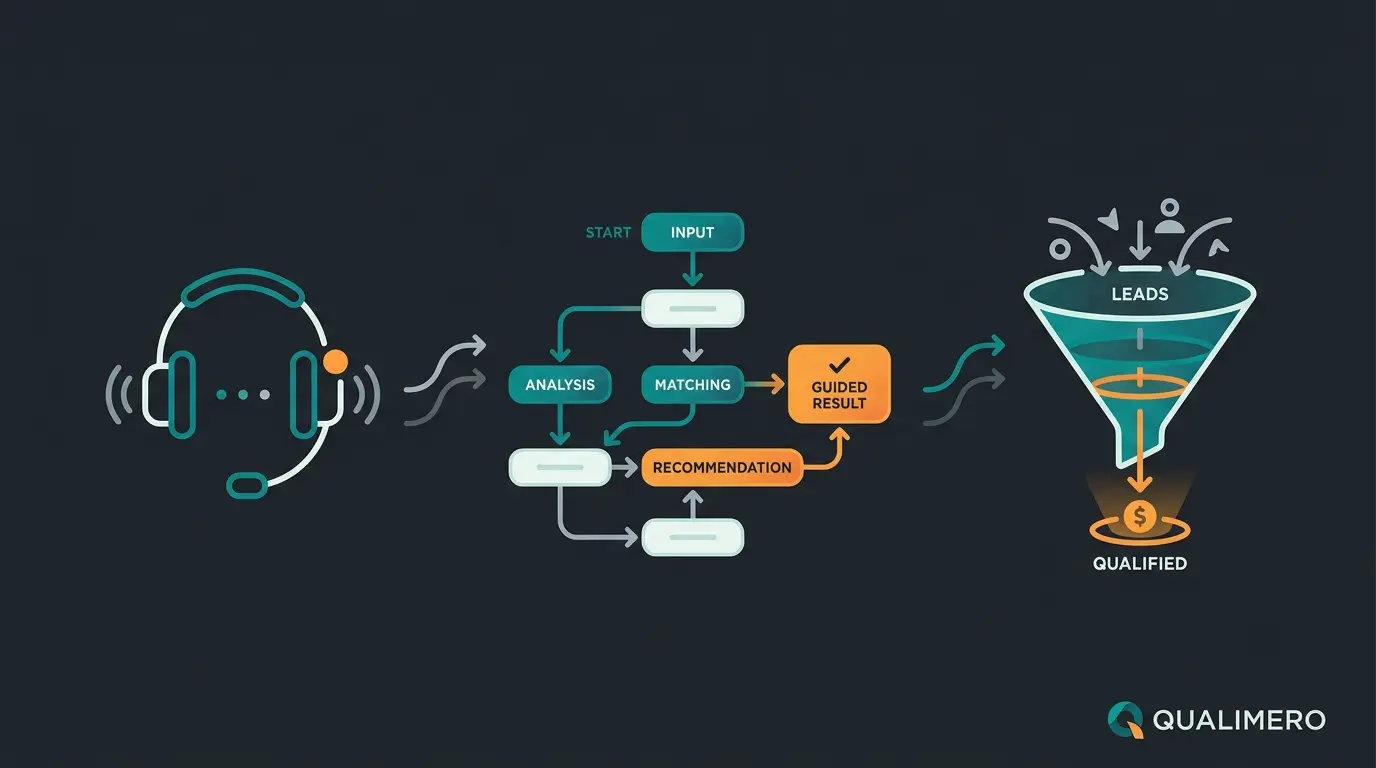
The three highest-ROI use cases for AI chatbots in business are automated customer service (reducing ticket volume by 60-80%), AI-powered product consultation (increasing average order value by 30-35%), and intelligent lead qualification (cutting cost per lead by 50% while improving conversion rates).
Customer service automation
Order tracking, return handling, shipping questions, account issues. These make up 60-80% of most support volumes. An AI chatbot resolves them instantly, 24 hours a day. Gartner estimates that conversational AI will reduce contact center costs by $80 billion globally by 2026. For SMBs, this translates to freeing your team from repetitive queries so they can handle the cases that actually require human judgment. Learn more about AI-powered customer service and how it works in practice, or dive deeper into chatbot customer service strategies.
Product consultation and guided selling
This is where AI chatbots generate revenue, not just save costs. A customer looking at 200 plant protection products does not need a search bar. They need someone who asks the right questions: what plant, what problem, what soil type. An AI chatbot trained on your product data delivers exactly that, in real time, for every visitor simultaneously. Across Qualimero deployments, this use case drives +35% cart value and +60% checkout rates. It is the single most underrated application of AI in e-commerce.
Lead qualification
Traditional contact forms convert at 2-3%. An AI chatbot that asks qualifying questions in a conversational flow converts at 10x that rate, according to our client data. It pre-qualifies leads by budget, timeline, and use case before routing them to your sales team. The cost per lead drops by 50% while lead quality improves. See how AI-powered lead generation works across channels. Businesses using Qualimero for lead qualification report 10x higher conversion than static forms, with leads pre-qualified before they reach the sales team.
AI chatbot vs traditional chatbot
Traditional chatbots follow scripted decision trees and fail when users deviate from expected inputs. AI chatbots understand intent, handle typos and complex questions, learn from conversations, and generate contextual responses. The performance gap is not incremental. It is structural.
Here is the core difference: a traditional chatbot matches keywords. A customer types "return policy" and gets the return policy page. Fine. But type "I bought the wrong fertilizer and need to swap it for something that works on clay soil" and the traditional bot stalls. An AI chatbot parses the intent (product exchange), the context (wrong product, clay soil), and the action needed (recommend alternative + initiate return). For a deeper analysis, read chatbot vs AI: the key difference.
The numbers back this up. AI-powered chatbots achieve 78% first-contact resolution rates compared to 52% for rule-based systems, according to Gartner's 2025 Customer Service Technology Survey. That 26 percentage point gap means fewer escalations, faster resolution, and lower cost per resolved issue.
| Capability | Traditional chatbot | AI chatbot |
|---|---|---|
| Language understanding | Keyword matching | Intent + entity parsing |
| Handles typos/slang | No | Yes |
| First-contact resolution | 52% | 78% |
| Learning ability | None (static rules) | Improves with every conversation |
| Product recommendations | Pre-programmed only | Dynamic, context-aware |
| Multi-language | Requires separate bots | Single bot, 30+ languages |
| Setup complexity | Low (hours) | Medium (days to weeks) |
According to Gartner's customer service predictions: "By 2028, 70% of customer service journeys will begin and be resolved in conversational, third-party assistants." That forecast is aggressive, but the underlying trend is clear. Scripted bots cannot serve a market that expects natural conversation.
I will be honest: the AI option costs more upfront. But the cost per resolved query is 3-5x lower because the bot actually resolves issues instead of routing everything to a human agent. The break-even point for most SMBs is 200-300 monthly conversations. For a complete breakdown of whether chatbot technology qualifies as true AI, read Is Chatbot Really AI?.
AI chatbot vs AI employee: what SMBs actually need
An AI employee goes beyond a chatbot by maintaining persistent memory across conversations, recognizing returning customers, making autonomous decisions based on business rules, and working across channels simultaneously. It functions as a digital team member rather than a scripted tool.
Most AI chatbots reset after each conversation. The customer who chatted yesterday about soil pH levels starts from zero today. An AI employee remembers. It knows the customer bought Product A three weeks ago, asked about compatibility issues last Tuesday, and prefers WhatsApp over email. That context changes everything about the quality of the interaction.
Neudorff, one of the largest garden supply brands in Europe, deployed an AI employee named Flora through Qualimero. Flora handles product consultation for plant protection, fertilizers, and garden care. The results: 97% accuracy in product recommendations, 99% cost savings compared to traditional support, and response times under 5 seconds. That is not a chatbot answering FAQs. That is a digital team member doing the job of an expert product advisor.
| Feature | Standard AI chatbot | AI employee |
|---|---|---|
| Memory | Resets per session | Persistent across all interactions |
| Customer recognition | None | Identifies returning visitors |
| Decision-making | Follows pre-set rules | Autonomous within business parameters |
| Channels | Usually one | Website, WhatsApp, Instagram, email simultaneously |
| Product knowledge | FAQ-level | Deep catalog integration with real-time stock, pricing |
| Handoff capability | Basic routing | Transfers with full context and conversation history |
My honest take: not every business needs an AI employee. If your product range is small and your support questions are repetitive, a solid AI chatbot handles it. But the moment your customers need consultation, not just answers, the AI employee model delivers measurably better outcomes. If your catalog exceeds 50 products, a dedicated Product Finder vs Chatbot analysis helps clarify the revenue impact. For a deeper comparison, see AI agent vs chatbot.
How AI chatbots work under the hood
AI chatbots process user messages through three stages: natural language understanding (NLU) parses intent and entities, a reasoning engine matches the query against business data and conversation context, and natural language generation (NLG) produces a human-like response. The entire cycle completes in 200-500 milliseconds.
Stage one: NLU. The system breaks down the message into intent (what the customer wants) and entities (the specific details). "I need a fertilizer for my roses that works in sandy soil" becomes intent: product_recommendation, entities: product_type=fertilizer, plant=roses, soil=sandy. This is where AI chatbots outperform rule-based systems. They handle misspellings, slang, and incomplete sentences because they parse meaning, not exact keyword matches.
Stage two: reasoning. The engine queries your product database, filters by the extracted entities, checks stock availability, and applies business logic (margin rules, seasonal promotions, compatibility constraints). As of Q2 2026, most production systems use retrieval-augmented generation (RAG) to ground responses in your actual data rather than generating answers from general knowledge. For a technical deep-dive, see how AI chatbots work or explore the evolution from rule-based to conversational AI.
Stage three: NLG. The system generates a natural-language response tailored to the customer's tone and channel. A WhatsApp response reads differently from a website widget response. The best systems adjust formality, length, and structure per channel automatically.
The whole process takes less than half a second. Compare that to the 2-3 minute average human response time in live chat. Speed alone does not win, but speed combined with accuracy does.
How much does an AI chatbot cost?
AI chatbot pricing ranges from $15-500 per month for small business plans to $1,200-5,000 per month for enterprise solutions with full AI employee capabilities. The total cost depends on conversation volume, integration complexity, and whether you need basic FAQ automation or a full AI employee with product knowledge and cross-channel support.
| Tier | Monthly cost | What you get | Best for |
|---|---|---|---|
| Basic bot | $15-100 | Rule-based flows, single channel, limited conversations | Micro-businesses, simple FAQ automation |
| Mid-tier AI chatbot | $100-500 | NLP/AI responses, multi-channel, CRM integration | Growing SMBs with 500+ monthly conversations |
| AI employee | $1,200-5,000 | Persistent memory, product catalog integration, cross-channel, analytics | E-commerce businesses with complex product ranges |
| Enterprise custom | $5,000+ | Custom models, dedicated support, advanced analytics, SLA | Large retailers, multi-brand operations |
As the ChatBot.com 2026 statistics roundup notes: "The global chatbot market reached $11.8 billion in 2026, with the customer service segment holding 31.33% market share." That growth is not driven by enterprise budgets alone. SMBs are adopting AI chatbots at record rates because the entry price dropped below $100/month for production-grade solutions.
The hidden costs matter more than the subscription. Setup fees ($500-5,000), product data preparation (the single biggest time investment), integration with your e-commerce platform, and ongoing training. I have seen businesses buy a $49/month chatbot and then spend $10,000 on consultants trying to make it work with Shopware. Budget for the integration, not just the license.
Choosing the right AI chatbot for your business
Choose an AI chatbot based on five criteria: your primary use case (support, sales, or lead gen), required channel coverage (website, WhatsApp, social), integration needs (e-commerce platform, CRM, ERP), language requirements (multilingual support quality), and budget relative to expected conversation volume.
Start with the use case. Customer support automation requires strong intent recognition and knowledge base integration. Product consultation requires deep product data access and recommendation logic. Lead qualification requires conversational flow design and CRM integration. Each use case demands different technical capabilities, and no single chatbot excels at all three equally.
Channel coverage is the second filter. If 40% of your customer conversations happen on WhatsApp (common in the DACH region), a website-only chatbot misses almost half your opportunities. Check that the solution supports every channel where your customers already reach out. According to Salesforce's State of the Connected Customer report, 46% of customers expect immediate responses when they contact a business, regardless of channel.
GDPR compliance is non-negotiable for European businesses. Ask where data is stored, how conversations are processed, and whether the provider offers a data processing agreement. For businesses operating in the DACH region specifically, see our German chatbot guide for regulatory details.
- Define your primary use case (support, sales, lead gen)
- List all channels where customers contact you
- Check integration with your e-commerce platform (Shopware, Shopify, WooCommerce)
- Verify GDPR compliance and data residency
- Test with real customer questions, not demo scenarios
- Calculate ROI based on your actual support volume and costs
- Confirm multilingual support quality (not just availability)
How to implement an AI chatbot step by step
Implementing an AI chatbot takes 2-6 weeks for most SMBs: define your use case and success metrics (week 1), connect your product data and knowledge base (week 2), configure conversation flows and test with real scenarios (weeks 3-4), launch on one channel and iterate based on analytics (weeks 5-6).
Week one is the most important. Define three to five use cases that the chatbot must handle on day one. Not 50. Three to five. "Product recommendations for beginners," "order status queries," and "return handling" is a realistic starting scope. Businesses that define clear KPIs before launch see 40% higher adoption rates, because success is measurable from day one.
Week two is where most projects stall. Your product data needs to be clean: no duplicate entries, no empty descriptions, no outdated prices. The AI chatbot is only as good as the data it knows. I have watched a six-figure chatbot implementation fail because the product catalog had 30% missing descriptions. Data quality is the single biggest success factor.
Weeks three and four: configure and test. Use your last 100 real support tickets as test cases. If the chatbot cannot answer 85% of them correctly, it is not production-ready. Iterate on the training data, not the model.
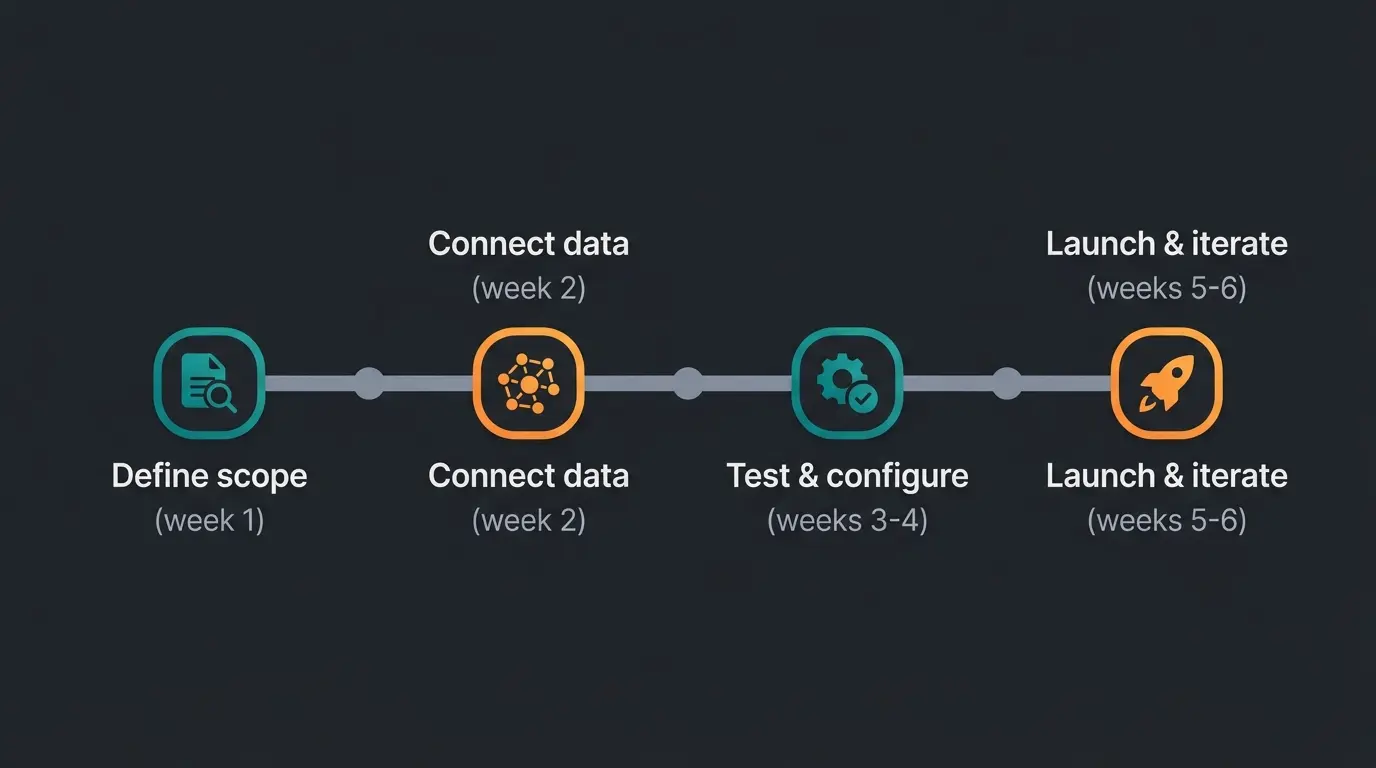
Weeks five and six: launch on a single channel first. Monitor closely. Check which queries the bot escalates to humans, and add that training data. Most businesses hit 80%+ automation within the first month of iteration. If you want to see how this looks with real product data, book a demo and we will walk you through a live setup with your catalog. For a technical walkthrough of the build process, see our guide on building your own chatbot.
Real results: AI chatbots in e-commerce
E-commerce businesses using AI chatbots report measurable results: Rasendoktor achieved a 16x ROI with AI product consultation, Gartenfreunde saw 7x higher conversion rates through personalized recommendations, and businesses across Qualimero's portfolio see 60% higher checkout rates when AI guides the purchase journey.
Rasendoktor: 16x ROI in lawn care e-commerce
Rasendoktor sells lawn care products online. The challenge: customers needed specific advice on which products work for their lawn type, soil conditions, and seasonal timing. The support team could not keep up during peak season. They deployed Hektor, an AI product advisor through Qualimero. Results: 16x return on investment, 100% consultation automation rate, and 40% reduction in support costs. The AI handles every product question without human intervention.
Gartenfreunde: 7x conversion rate increase
Gartenfreunde operates in garden and wellness e-commerce. Their AI employee Kira provides product consultation and sales assistance, recommending products based on customer needs and garden conditions. The results: 6x ROI, 7x higher conversion rate compared to unassisted shopping, and 45% click-through rate on AI recommendations. That last number is telling. When the recommendation is relevant, customers act on it.
As Shopify CEO Tobi Lutke noted in his company's Q1 2026 earnings call: "AI is fundamentally changing how merchants interact with their customers. The merchants who deploy AI-powered product discovery are seeing conversion lifts that would have been unthinkable two years ago." That matches what we see across our own client base. The businesses that deploy AI for consultation, not just support, see disproportionate returns.
FAQ: AI chatbots for business
The best AI chatbot depends on your primary use case. For basic FAQ automation, tools like Tidio or ManyChat start at $15-29/month. For product consultation and guided selling in e-commerce, an AI employee solution like Qualimero delivers 6-16x ROI by connecting to your product data and recommending specific items. Start by identifying whether you need support automation, sales assistance, or lead qualification.
ChatGPT is a general-purpose AI, not a business chatbot. It cannot access your product catalog, track orders, or integrate with your CRM out of the box. You can build on the OpenAI API to create a custom solution, but that requires development resources. Purpose-built business chatbots connect to your data from day one and handle channel routing, escalation, and analytics natively.
AI chatbot pricing ranges from $15/month for basic rule-based bots to $5,000+/month for enterprise AI employees. Mid-tier solutions with NLP capabilities cost $100-500/month. The hidden costs are setup ($500-5,000), data preparation, and integration with your e-commerce platform. Most businesses break even in 3-6 months based on support cost reduction alone.
Not automatically. GDPR compliance depends on the provider's data processing practices, server locations, and contractual agreements. European businesses should verify data residency (EU servers preferred), obtain a data processing agreement (DPA), and confirm that conversation data is not used to train third-party models. Ask specifically where data is stored and how long it is retained.
Yes, when properly connected to your product data. AI chatbots using retrieval-augmented generation (RAG) query your actual product database to answer specific questions about compatibility, specifications, and recommendations. Neudorff's AI employee Flora achieves 97% accuracy in product recommendations across hundreds of garden care products. The key is clean, complete product data.
Basic chatbots deploy in hours. AI-powered solutions with product data integration take 2-6 weeks: one week for scoping, one week for data preparation, two weeks for configuration and testing, and two weeks for launch and iteration. The biggest time investment is always data preparation, not the chatbot setup itself.
Qualimero AI employees deliver 16x ROI for e-commerce businesses by turning visitors into buyers through real-time product consultation. Not a chatbot that answers FAQs. A digital team member that knows your products.
Book a demo
Lasse is CEO and co-founder of Qualimero. After completing his MBA at WHU and scaling a company to seven-figure revenue, he founded Qualimero to build AI-powered digital employees for e-commerce. His focus: helping businesses measurably improve customer interaction through intelligent automation.