How much does a chatbot cost?
A chatbot costs from EUR 0 for a basic rule-based widget to EUR 500-2,500 per month for an AI chatbot that understands context and drives sales. One-off custom development runs EUR 5,000-50,000 and up. For most SMEs, a SaaS AI employee at EUR 300-1,500 per month is the realistic range (Stand Q3 2026).
That range looks huge because the word chatbot covers three very different products. A scripted FAQ widget and an AI product advisor share a chat window and nothing else. Before you compare prices, decide which of the three you are actually buying.
Rule-based widgets sit at the bottom: cheap, scripted, blind to anything off-script. SaaS AI platforms sit in the middle: they read context, connect to your shop, and carry the bulk of the market. Custom enterprise builds sit at the top, and they are increasingly replaced by SaaS. If the subscription model is new to you, our overview of Chatbot as a Service explains how it bundles hosting, updates, and support into one fee.
What drives chatbot cost
Chatbot cost is driven by five factors: bot type (rule-based vs AI/LLM), number of channels, conversation volume, depth of integrations (shop, ERP/CRM), and whether you build or buy. An AI/LLM bot costs more than a rule-based one, but it delivers context understanding and sales uplift that a flat FAQ script never will.
The biggest single cost factor is the brain. A rule-based bot answers only what its script anticipates, while an AI chatbot built on an LLM formulates answers from your knowledge base in real time. Every AI response consumes tokens, and at high traffic the model fees alone can reach several hundred euros per month. SaaS providers fold these token costs into the package price.
Integration depth is the second driver, and it is where support bots and sales bots split. A support bot reads static documents; a sales bot queries your live product feed. That difference decides whether you build a better answering machine or a digital AI chatbot for business that actually sells.
PIM and shop API work, Stand Q3 2026
Understanding these five drivers is the whole game. The same vendor can quote EUR 500 or EUR 2,500 for the same account, and the gap is almost never margin. It is model choice, channel count, and integration depth. If you want the technical background on how these systems reason, our guide to conversational AI covers the architecture.
Support bot vs sales bot at a glance
The clearest way to read a quote is to ask which of these two the vendor is selling. A support bot optimises for ticket deflection; a sales bot optimises for conversion. They share almost nothing under the hood, which is why they sit at opposite ends of the price range.
| Aspect | Support bot | Sales consultant |
|---|---|---|
| Primary goal | Ticket deflection, cost saving | Conversion, higher order value |
| Data source | Static PDFs and FAQs | Live product feed, PIM, shop system |
| Main KPI | Hours saved, tickets deflected | Conversion rate, average order value |
| Cost structure | Low monthly, minimal setup | Higher monthly, real integration setup |
| Typical question | "Where is my order?" | "Which product fits my needs?" |
| ROI type | Cost reduction, immediate | Revenue growth, one to two quarters |
Chatbot pricing models compared
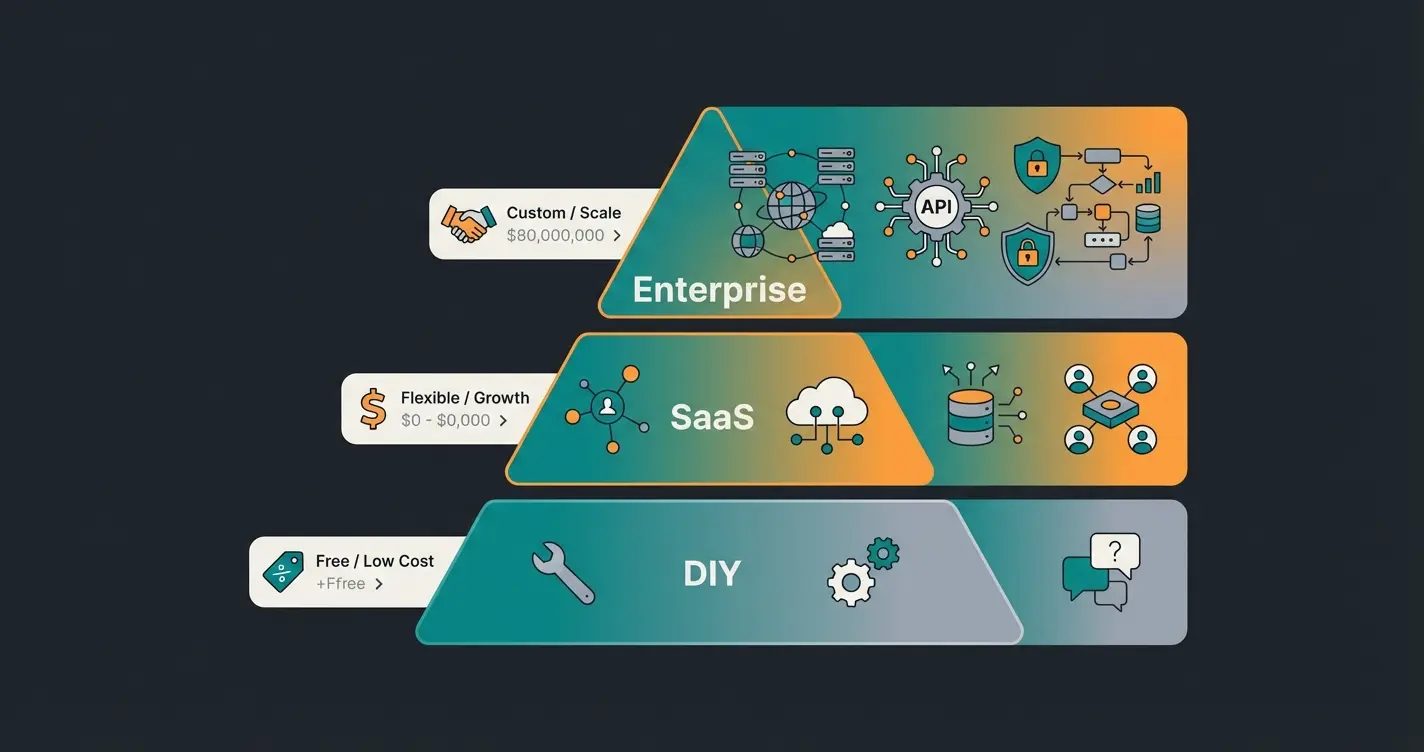
There are three main pricing models: DIY builders (EUR 0-100/month, limited AI), SaaS AI platforms (EUR 500-2,500/month, full context and channels), and custom enterprise builds (EUR 20,000+ upfront plus maintenance). For SMEs, SaaS wins on total cost of ownership because it bundles hosting, updates, LLM tokens, and support into one predictable fee.
| Factor | DIY / rule-based | Professional AI (SaaS) | Enterprise / custom |
|---|---|---|---|
| Monthly price | EUR 0-100 | EUR 500-2,500 | EUR 5,000+ |
| Setup (one-time) | EUR 0 (self-build) | EUR 2,000-15,000 | EUR 30,000-200,000 |
| Technology | Scripted if-then logic | NLP and generative AI (RAG) | Custom LLM stack |
| Best for | Simple FAQs, navigation | Support automation and sales | Complex corporate processes |
| Data integration | None / manual | PIM, shop system, CRM | Legacy systems, SAP |
| Who owns upkeep | You (manual content care) | Vendor (AI training included) | Your internal IT |
The models are not just price tiers, they are different products. A DIY builder is cheap because it does little: it cannot read free-form language, so the moment a customer types "something waterproof that is in stock" it fails. A SaaS platform costs more because you are paying for infrastructure, token budget, and integration, not just software. A custom build costs most because you fund the entire stack yourself, and in our client projects we see more enterprises migrating away from that model toward configurable SaaS, not toward it.
The honest caveat: SaaS billing is not always flat. Many platforms add per-conversation or per-resolution fees on top of the base licence, so a talkative catalogue can push the monthly bill higher than the headline price. Always clarify whether the plan counts sessions or individual messages before you sign. If you would rather assemble the pieces yourself, our walkthrough on how to build a chatbot shows what the DIY path really involves.
Cost by platform and channel
Channel choice changes the bill. A website widget is usually included in the base fee; WhatsApp adds Meta's per-message charges; WordPress and Shopware plugins add licence costs. Budget for per-channel add-ons on top of the SaaS subscription, not instead of it.
A web widget on your own domain carries no per-message postage. WhatsApp does. Since 1 July 2025 Meta bills the WhatsApp Business Platform per message rather than per conversation, and every marketing message to a German number costs about EUR 0.1131 in Meta fees alone (Stand Q3 2026). A WordPress chatbot or a Shopware plugin adds its own licence fee on top of both.
- Website widget: usually included in the base SaaS fee, no per-message cost
- WhatsApp: EUR ~0.1131 per marketing message in Germany, utility replies inside the 24h service window are free
- WordPress / CMS: plugin licence on top of the platform fee
- Shopware / Shopify: API-level integration, higher setup but real product data access
Volume is the other lever most quotes hide. Almost every professional platform scales price with monthly active users or conversations: up to about 1,000 users a month often sits in the base package near EUR 500, while 5,000 or more usually forces an upgrade to the EUR 1,000-1,500 tier. Watch whether the contract counts sessions or individual messages, because a per-message model gets expensive precisely when your bot is doing its job well and customers keep talking.
Hidden and recurring costs
The sticker price is not the full cost. Plan for per-message and token fees, WhatsApp charges, agent seat licences, content maintenance, and onboarding. Ignored, these items add 20-40% to the first-year budget (Stand Q3 2026).
- Agent seat licences: EUR 40-80 per human agent per month for handovers, often billed separately
- WhatsApp and token fees: per-message charges and LLM tokens that scale with usage
- Content maintenance: roughly 2-5 hours per week keeping answers and product data current
- Onboarding: a one-time EUR 2,000-5,000 setup fee that reputable vendors charge for proper configuration
The maintenance line is the one most budgets forget. An AI chatbot is never finished, it is more like a new hire who needs training and updates as your catalogue changes. Deep shop integration automates most of that upkeep; a cheap document-upload bot forces someone on your team to do it by hand every week.
Annual budget by business profile
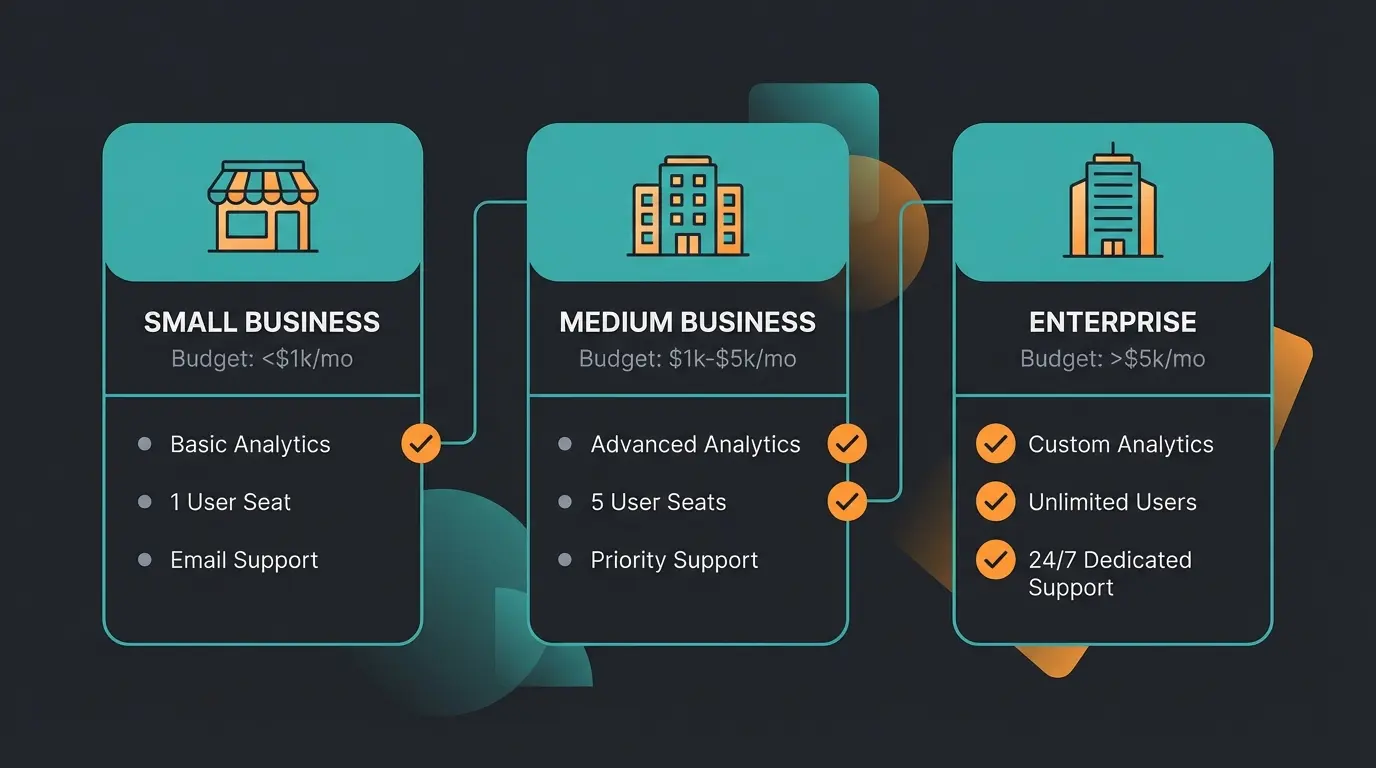
Realistic annual budgets (Stand Q3 2026): a small shop running support automation lands around EUR 4,000-9,000 per year; a mid-size shop adding AI product consultation runs EUR 10,000-25,000 per year; an enterprise multi-channel rollout starts at EUR 30,000 and climbs from there.
| Business profile | Annual budget | What you get |
|---|---|---|
| Small shop (< EUR 1M revenue) | EUR 4,000-9,000 | Support automation, FAQ deflection, basic lead capture, mostly self-service setup |
| Growth shop (EUR 1-50M) | EUR 10,000-25,000 | AI product consultation, shop and CRM integration, WhatsApp channel, professional onboarding |
| Enterprise | EUR 30,000+ | Multi-channel, EU-hosted data, deep ERP integration, multilingual, dedicated support |
Match the tier to your goal, not to your fear of the invoice. A small shop that only needs to deflect "where is my order" questions should not pay enterprise rates, and a growth shop chasing conversion should not try to run product advice on a EUR 50 widget. The budget follows the job.
ROI scenario A: support focus
For a support-focused bot, ROI comes from deflected tickets. Automating up to 80% of routine requests typically pays back the monthly SaaS fee within the first quarter for a shop handling a few thousand tickets a month. The savings are real but capped: a support bot reduces cost, it does not grow revenue.
Take a shop fielding 3,000 inquiries a month. A EUR 500 bot that resolves "where is my package" and "how do I return this" can free up around 10 hours of agent time per week. At EUR 25 per hour, that is roughly EUR 1,000 in monthly savings against a EUR 500 fee. Solid, predictable, and exactly what a chatbot for customer service is built to do. If support automation is your priority, our AI customer service page covers the setup in detail.
ROI scenario B: revenue booster
For a sales and product-advisory bot, ROI comes from higher conversion and basket value, not just saved hours. Qualimero customer Rasendoktor automated 100% of its webchat inquiries with the AI employee Hektor and reached 16x ROI, alongside a 40% cut in support load. That outweighs the subscription many times over.
Here is the difference that justifies the price gap. A support bot answers "where is my order"; a sales bot answers "which lawn fertiliser fits my soil" and then adds the matching product to the cart. Rasendoktor received 2,000 to 3,000 consultation-intensive inquiries per season, the exact volume that overwhelms a human team and where an advisory bot earns back its cost fastest. Across our client base, product-advisory deployments lift cart value by up to 35% and checkout rate by up to 60%.
You can see more of these patterns in our collection of chatbot examples, and the full numbers in the Rasendoktor: ROI of AI product consultation case study. The pattern is consistent: the expensive bot is cheaper per euro of outcome, because it earns on the revenue side and the cost side at once.
Deep dive: AI product consultation
AI product consultation is where a chatbot earns its cost back fastest for complex-product shops. Neudorff's AI employee Flora advises customers on plant protection at scale with 97% recommendation accuracy and a response time under 5 seconds, cutting cost per chat by 99%. That is not a FAQ bot with a nicer skin, it is a different technical category.
The reason it costs more is structural. A support bot works with unstructured data: you upload a PDF, the model reads it, it answers. A product-advisory bot needs structured data and live queries, so when a customer asks for "a waterproof jacket that is actually in stock" it hits your shop API in real time and must not hallucinate or quote a sold-out item. That real-time bridge to your PIM and shop system is the EUR 5,000 setup line, and it is also where the return comes from.
The Neudorff case study (Flora) shows what that looks like in a regulated, advice-heavy category. For a closer look at the capability itself, our AI product consultation page walks through how the bot turns a catalogue into a conversation that converts.
Build vs buy
Building in-house costs EUR 20,000-50,000+ upfront plus ongoing engineering; buying a SaaS AI employee costs a predictable monthly fee with hosting, updates, and support included. For nearly all SMEs, buy wins on speed to value and total cost of ownership.
The build case is narrow. It makes sense when you have highly specific requirements, in-house AI engineers, and a compliance mandate that rules out third-party hosting. Everyone else pays twice: once to build, then again, indefinitely, to maintain. A SaaS AI employee reaches production in days rather than months, and the vendor absorbs model upgrades that would otherwise be your engineering backlog.
- Build in-house: EUR 20,000-50,000+ upfront, plus continuous engineering and model upkeep, months to launch
- Buy SaaS: predictable monthly fee, hosting and updates included, days to launch
- Hybrid: SaaS platform plus custom integration work, common for shops with unusual data structures
- When build wins: strict on-premise mandates, dedicated AI team, and requirements no vendor covers
Is a chatbot worth the cost?
Yes, for shops with consultation-intensive products and steady traffic: a chatbot pays back through deflected support and higher conversion, often within one to two quarters. The break-even depends on ticket volume and average order value, not on the sticker price alone.
The industry data backs the payback. Juniper Research found that chatbots deliver around EUR 11 billion in annual business cost savings, and states that these savings "will be derived from the reduced amount of time spent on customer service enquiries." On the revenue side, consultation bots close the gap that static FAQ pages leave open. The measurable chatbot benefits show up in both columns of the ledger.
The verdict: which chatbot for which budget
The cost question has a clean answer once you match spend to job. Do not start from the price, start from the role the bot plays, then read the budget off that.
If you run a small shop and only need to deflect routine questions, a EUR 300-500 support bot is the right call, and the DIY tier is fine below a few hundred inquiries a month. If you sell consultation-intensive products with steady traffic, budget EUR 1,000-2,500 per month plus a proper setup for a sales-focused advisor: this is the tier that pays back on the revenue side, the way Rasendoktor and Neudorff did. If you are an enterprise with on-premise mandates or deep legacy integration, a custom build from EUR 30,000 may be justified, but test a configurable SaaS platform first, because most of that spend now buys speed you can rent instead.
One honest caveat holds across all three tiers: the cheapest bot that cannot answer real questions is the most expensive line in the whole comparison, because it quietly sends customers to your competitors. Spend on integration and data quality before you spend on channels.
FAQ
A professional SaaS AI chatbot costs EUR 500-2,500 per month, with most SMEs landing in the EUR 300-1,500 range (Stand Q3 2026). DIY rule-based widgets start at EUR 0-100 per month, while enterprise custom builds exceed EUR 5,000 per month plus EUR 30,000+ setup. Price depends on bot type, channels, and integration depth.
Product consultation bots need real-time access to your PIM and shop system, which requires API integration and ongoing upkeep, typically EUR 5,000+ in extra setup. Support bots only read static documents like FAQs. The difference is that a consultation bot generates revenue through conversion, as Neudorff's Flora shows with 97% recommendation accuracy, while a support bot only saves cost.
Budget for agent seat licences (EUR 40-80 per agent per month), WhatsApp per-message fees (about EUR 0.1131 per marketing message in Germany), LLM token costs, and 2-5 hours per week of content maintenance. A one-time onboarding fee of EUR 2,000-5,000 is common. Together these hidden items add 20-40% to a realistic first-year budget.
A cheap rule-based bot is worth it only for simple FAQ deflection, not for product advice. It cannot understand free-form language, so it fails on questions outside its script and can push frustrated customers to competitors. For consultation-intensive shops, the opportunity cost of a cheap bot usually exceeds the subscription of a capable one.
Measure both cost savings and revenue. For support: multiply hours saved by loaded hourly cost, then subtract the fee. For sales: track the conversion lift among bot users times traffic times average order value. A 0.5% lift on 5,000 monthly interactions at a EUR 100 order value generates EUR 2,500, often exceeding the entire monthly cost, as Rasendoktor's 16x ROI illustrates.
Stop treating a chatbot as a cost line. A Qualimero KI-Mitarbeiter advises your customers in real time, deflects routine tickets, and lifts cart value by up to 35%. See what it does for your shop.
Start your free trial
Kevin is CTO and co-founder of Qualimero. As an AI architect with over 15 years of experience as CTO and CPO in the tech industry, he designs the AI systems that automate tens of thousands of customer interactions daily for Qualimero's clients — reliably, securely, and at scale.