Chatbot vs AI: Why Your Business Needs More Than an FAQ Bot
Discover the key difference between chatbot and AI. Learn why AI-powered product consultants outperform rule-based bots for sales and customer experience.

Introduction: The End of "Dumb" Bots
We've all experienced that moment of frustration: You visit a website with a specific product question, and a hopeful little chat window pops up in the corner. You type your question: "Which running shoes are best for marathon training on asphalt?"
The response appears in milliseconds: "I'm sorry, I didn't understand that. Here are our FAQs about shipping and returns."
In that moment, the customer experience dies. And often, so does the sale.
For years, this was the standard in online customer service. The chatbot vs AI debate is therefore not merely a technical discussion—it's a fundamental decision about the future of your customer relationships. While traditional chatbots are often nothing more than glorified search masks that dismiss customers rather than serve them, generative AI (Artificial Intelligence) is ushering in a new era.
We're moving away from pure support automation ("Where is my package?") toward genuine digital product consultation ("Which product is right for me?"). Understanding how AI Chatbots have evolved is crucial for making this transition successfully.
In this comprehensive article, we'll definitively clarify the difference between chatbot and AI, illuminate the technical backgrounds (understandable without a computer science degree), and show you how an AI-powered digital product consultant can not only save costs but actively increase your conversion rate.
What Is a Traditional Chatbot? (Rule-Based Systems)
To understand why chatbot or AI is such an important distinction, we first need to examine the technology that has dominated the internet for the past decade: the rule-based chatbot.
The Logic of "If-Then" Rails
A traditional, rule-based chatbot (often called a "script bot" or "click bot") possesses no real intelligence. It doesn't "think." It stubbornly follows a pre-programmed decision tree.
Imagine a train running on rails. The train can only go where tracks have been laid. If there's no switch to the left, the train cannot go left—no matter how urgently the passengers want to go there.
Technically, this works according to the "If-This-Then-That" principle:
- If the user types the word "return" → Then display text block A (returns link)
- If the user clicks button B → Then open menu C
Limitations of Conventional Chatbots
These systems are excellently suited for static, repetitive processes. If a user simply wants to know the opening hours, a rule-based bot is efficient and error-free. But as soon as human language comes into play—with all its nuances, typos, and complex sentence structures—these systems hit their hard limits.
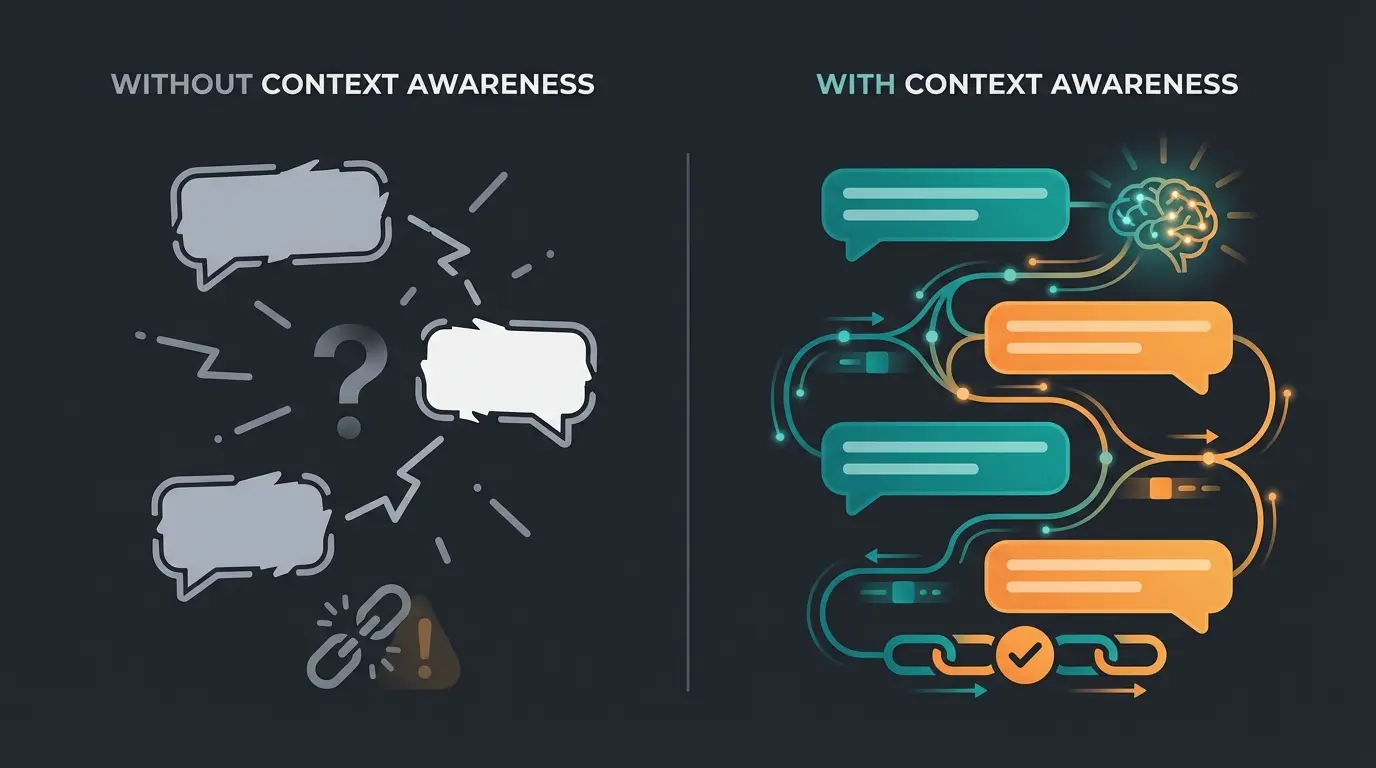
- No context understanding: A traditional bot immediately forgets what you said in the previous sentence. If you ask "Do you have the iPhone 15?" and then "Is that also available in red?", the bot doesn't understand that "that" refers to the iPhone.
- Rigid keywords: Type "I want my money back" instead of "refund," and many simple bots already fail if the keyword wasn't exactly stored.
- Frustration loops: Since the bot can't improvise, customers often end up in endless loops ("I didn't understand that. Please select from the menu.")
The history of chatbots shows how these systems evolved from simple scripts to today's more sophisticated solutions—yet many businesses still rely on outdated technology.
What Is an AI Bot? (Conversational AI & LLMs)
When we talk about chatbot vs AI today, we usually mean systems on the AI side that are based on Large Language Models (LLMs)—the same technology behind ChatGPT, Claude, or Gemini. These systems are often referred to as "Conversational AI" or "AI Agents."
How AI Understands Context (NLP)
Unlike the train on rails, AI is more like an off-road vehicle with an experienced driver. It can leave the road, navigate around obstacles, and find new paths to reach the destination.
The heart of this capability is NLP (Natural Language Processing). AI analyzes not just keywords but the intent and semantics (meaning) behind a sentence. This is where Conversational AI truly shines.
- Example: A customer writes: "My son is turning 12 and loves dinosaurs, but he doesn't like reading. Do you have anything?"
- Traditional Bot: Searches for keyword "dinosaur" → Shows 500 results (books, t-shirts, toys)
- AI Bot: Understands the connections: Age: 12 (no baby toys), Interest: Dinosaurs, Constraint: "doesn't like reading" (no novels). Result: The AI might recommend a dinosaur board game, a 3D puzzle, or a comic—and explains why.
The Machine's Memory
A crucial difference between chatbot and AI is the ability for context awareness. AI remembers the conversation flow. When the customer asks after the recommendation: "Is that also available for delivery tomorrow?", the AI knows we're still talking about the 3D puzzle.
RAG: How AI Learns Your Business (Without Hallucinating)
A common objection to AI is the fear of "hallucinations" (AI inventing facts). This is where a technology essential for businesses comes into play: RAG (Retrieval Augmented Generation).
Think of the LLM (e.g., GPT-4) as an eloquent rhetoric professor. They can formulate perfectly but don't know your inventory. RAG is the process of handing this professor your current manual and inventory list before they respond.
- The customer asks a question
- The system searches your company data (PDFs, website, database) for the answer
- The system passes the found facts to the AI
- The AI formulates a friendly, human response from these facts
This transforms a general chatbot into a specialized expert for your products—demonstrating the true difference between chatbot and AI in action. As explained by PwC, companies leveraging AI-powered solutions see significant improvements in both efficiency and customer satisfaction.
Chatbot or AI: The Direct Comparison
To simplify the decision for your business, we've summarized the most important differences in a comprehensive overview. Understanding how Chatbot AI transforms customer interactions helps illustrate these distinctions.
| Function | Traditional Chatbot (Rule-Based) | AI Solution (Generative AI / Agents) |
|---|---|---|
| Technology | Scripts, decision trees, keywords | NLP, Machine Learning, LLMs, RAG |
| Understanding | Reacts only to exact keywords | Understands meaning, context & nuances (semantics) |
| Flexibility | Rigid (train on rails) | Dynamic (off-road vehicle) |
| Learning Ability | Must be manually reprogrammed | Learns from interactions & new data sources |
| Setup | Extensive writing of dialog flows | Training with documents & website crawl |
| Primary Goal | Support ticket deflection | Product consultation & sales conversion |
| Response Quality | "I'm sorry, I didn't understand that." | "Based on your needs, I recommend X because..." |
| Costs | Cheap to operate, expensive to maintain | Higher initial investment, massive ROI through sales |
The Crucial Difference: Service vs. Consultation
Most articles on chatbot vs AI stop at customer service. They discuss how to handle complaints faster. That's important, but it leaves AI's greatest potential untapped: Revenue.
Here lies your opportunity for differentiation. We need to change the terminology.
From "Support Bot" to "Digital Product Consultant"
A traditional chatbot is a receptionist. They're polite, can tell you where the restroom is (FAQ), or transfer you to an employee. But they can't sell you anything.
A modern AI solution is a specialist salesperson. Think about the best salesperson in a brick-and-mortar specialty store. What do they do?
- They greet the customer
- They ask questions ("What do you need the product for?")
- They understand the problem
- They recommend a solution and explain the benefit
- They address concerns ("If it doesn't fit, you have a 30-day return policy")
This is exactly what AI can do in e-commerce today—around the clock, for 1,000 customers simultaneously. That's the leap from service to consultation. Discover how an AI product finder can transform your customer experience.
Slow, limited availability, high cost per interaction, unable to scale during peak times
Frustrating, strict rules, keyword-dependent, no context memory, limited to FAQ deflection
Fluid conversations, personalized advice, context-aware, drives sales, 24/7 scalability
The Concept of "Guided Selling"
In e-commerce, customers often face a "wall of products." Filters are helpful but often technically overwhelming (does every customer know what "Gore-Tex 3-layer membrane" means?).
An AI product consultant takes over guided selling. It translates technical data into customer benefits.
- Customer: "I get cold quickly when skiing."
- AI: "Then I recommend Jacket X. It doesn't have a Gore-Tex membrane, but it has extra-thick down filling specifically designed for heat insulation, even when you're not moving much."
This closes the content gap we found analyzing many competitors: Most talk about efficiency. You should talk about sales effectiveness. Learn more about how AI Product Consultation is reshaping e-commerce.
See how AI-powered product consultation can increase your conversion rates and create satisfied customers who buy—not just browse.
Start Your Free TrialReal-World Examples: How Market Leaders Use AI
This isn't future music—current data and case studies from major players who already leverage the difference between chatbot and AI prove its effectiveness.
Zalando: The Fashion Assistant
Zalando recognized that customers often don't search for "pants, blue, size M" but for an outfit for an occasion. With the new Zalando Assistant (based on OpenAI models), customers can ask questions like: "What should I wear to my father's wedding in Barcelona in November?" as reported by TacticOne, Scandinavian Mind, and Fashion Network.
The AI analyzes:
- Occasion: Wedding (festive, but not bride/groom)
- Location/Time: Barcelona in November (might rain, around 15°C/59°F)
- Result: The AI suggests outfits that are stylish but perhaps include a light coat or weather-resistant shoes
The result: Higher customer loyalty, fewer returns (because expectations are better met), and inspiration that isn't possible through a search bar, according to Zalando.
Klarna & Salesforce: Massive Efficiency Gains
The numbers in the service sector are also impressive. Klarna announced that their AI assistant handles the work of 700 full-time agents—with the same customer satisfaction.
According to the Salesforce State of Service Report from Salesforce, 85% of decision-makers expect service through AI to become a revenue driver rather than just a cost center. AI bots solve problems faster and give human employees the freedom to focus on complex, emotional cases.
Decision-makers expect AI service to drive revenue, not just reduce costs
Klarna's AI assistant handles workload equal to 700 full-time agents
AI-powered companies see triple revenue growth per employee
AI consultants operate continuously without breaks or bad days
AI Employee Benefits: Why Companies Are Switching
When we talk about AI employee benefits, it's not about replacing humans but about scaling the team and freeing them from repetitive tasks. Here are the four strongest arguments for switching from chatbot to AI.
1. Scalability Without Limits
A human employee can (in chat) perhaps serve 3-4 customers simultaneously. A rule-based bot can handle thousands but fails at complexity.
An AI employee combines both: It can conduct 10,000 consultation conversations simultaneously—each one individual and in-depth. Especially during peak times (Black Friday, holiday shopping), this is invaluable. There are no more waiting queues. This is how chatbots increase your sales dramatically.
2. Consistency and "Patience"
Every salesperson has a bad day sometimes. AI is always friendly, never forgets an upselling opportunity, and knows every detail from the data sheet. It never gets tired of explaining for the hundredth time how to change the coffee machine filter.
Studies show that AI-powered companies record a 3x higher revenue increase per employee than those ignoring AI, as documented by Workplace Journal.
3. Real Data Insights (Voice of Customer)
A traditional chatbot gives you statistics like "Button A was clicked 500 times." An AI bot delivers qualitative insights. Since customers talk to AI in natural language, you learn what customers really care about.
- Insight: "Many customers ask about vegan alternatives to product X."
- Action: You can adjust your assortment.
These data are gold for your marketing and product development. Modern AI expert consultants excel at extracting these valuable customer insights.
4. Employee Satisfaction Increases
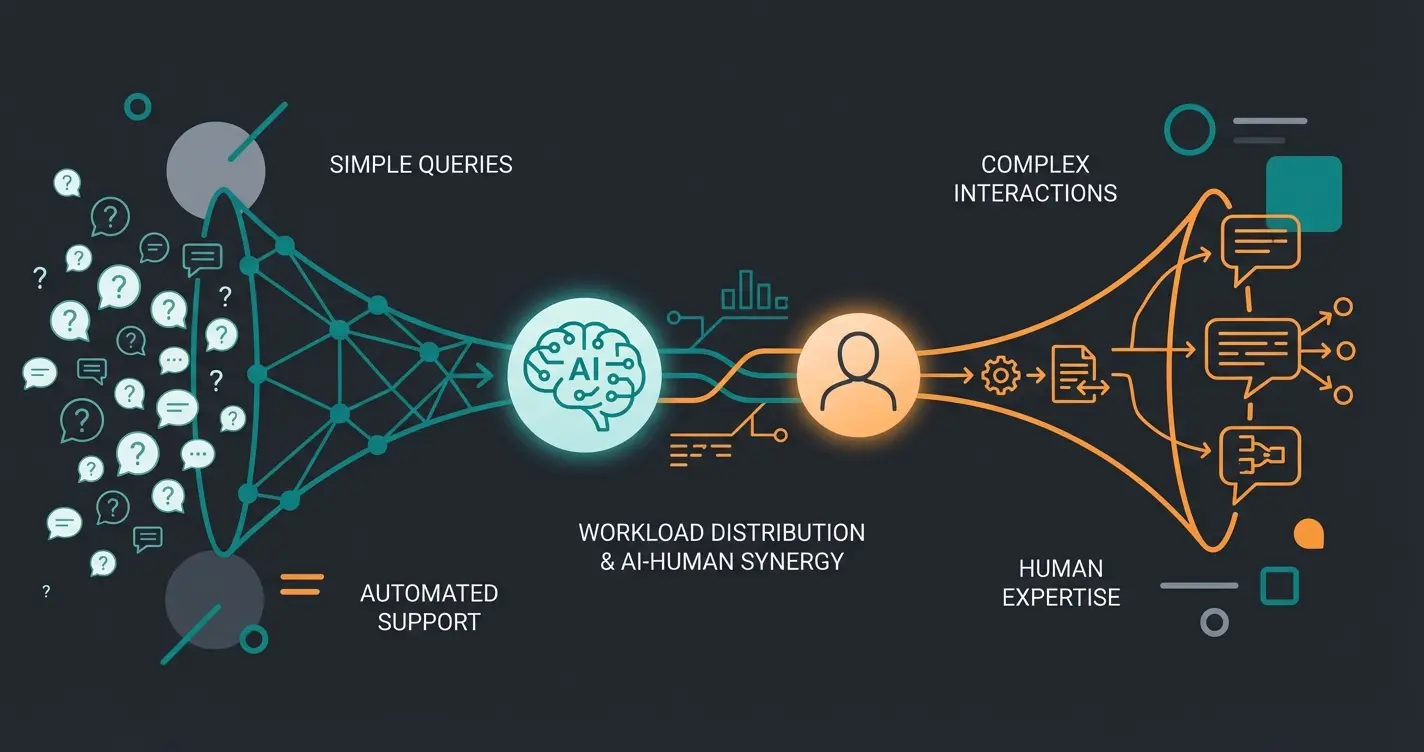
It's a myth that employees hate AI. In reality, employees hate boring, repetitive questions. When AI handles the 80% of standard inquiries ("Where is my invoice?"), your support staff can focus on the 20% of cases requiring empathy and discretion. That makes the job more interesting and valuable, as noted by Zendesk and PR Newswire.
Implementation: Isn't This Incredibly Complex?
A common misconception about chatbot or AI is the implementation effort.
- Myth: "I need months to train an AI."
- Reality: Thanks to RAG technology and modern platforms, AI is often faster to deploy than a complex rule-based bot.
With traditional bots, you must manually write every dialog path. That takes weeks. With an AI bot (like solutions based on GPT-4 that use your data), you upload your PDFs, FAQs, and product lists. The AI "reads" these in minutes and is ready for the first test question.
Of course, fine-tuning (prompt engineering, guardrails against wrong answers) requires time and expertise, but the "time-to-value" has drastically shortened with modern AI solutions. For seamless deployment, AI Chatbot integration best practices can guide your implementation.
Checklist for Getting Started
- Check your data foundation: Do you have good product descriptions and FAQs? (AI is only as smart as your data)
- Define your goal: Do you want to relieve support or sell more? (Focus on "Digital Product Consultant")
- Pilot project: Don't start with everything. Take one product category or topic area
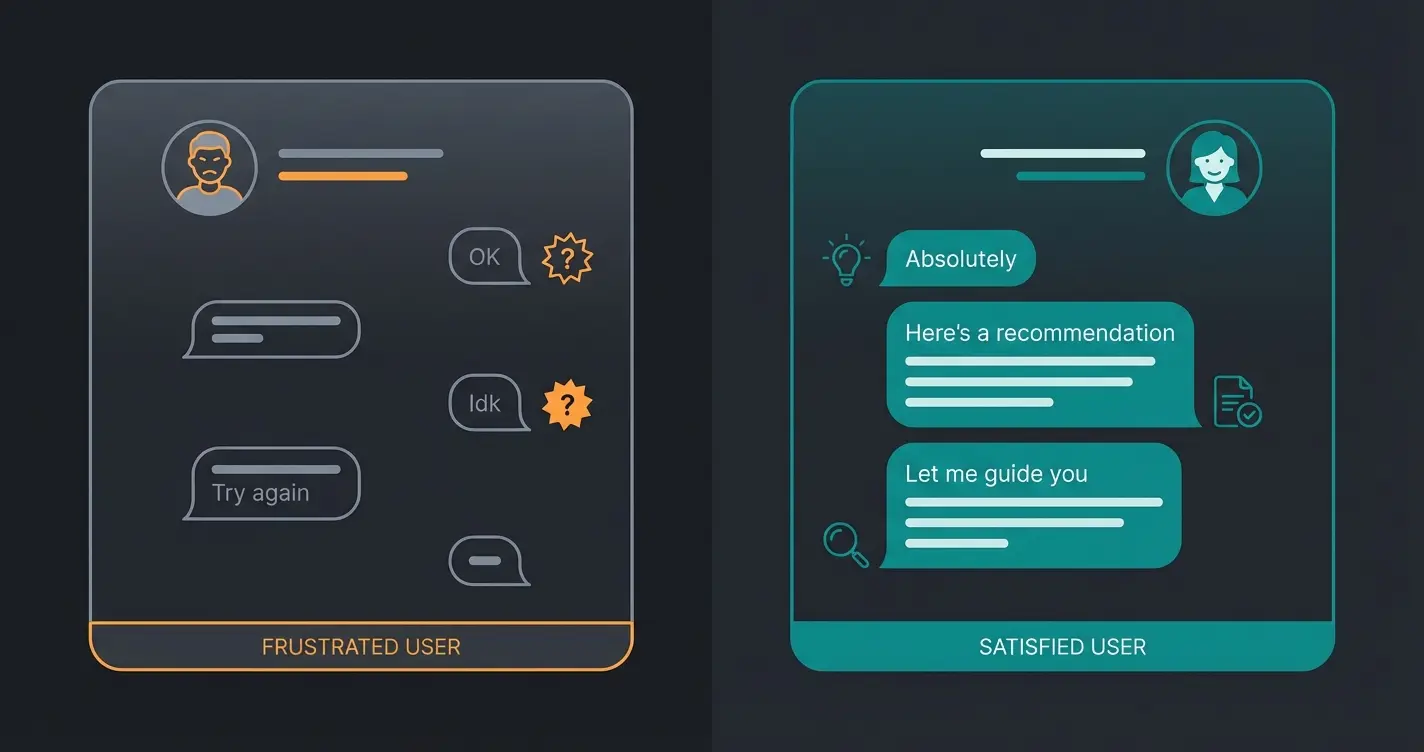
Practical Dialogue Example: Chatbot vs AI
Practical Dialogue Example: Chatbot vs AI
To illustrate the real difference, let's look at a side-by-side comparison of how each system handles the same customer request:
| Traditional Chatbot | AI Product Consultant | |
|---|---|---|
| Customer Query | "I need a quiet vacuum cleaner" | "I need a quiet vacuum cleaner" |
| System Response | "Here is a list of all vacuum cleaners in our store." | "For quiet operation, I recommend Model X or Model Y, as they operate under 60dB. Do you have pets? That would affect which filter system works best for you." |
| Follow-up | Customer must manually filter through hundreds of options | AI continues personalized conversation, narrowing options based on specific needs |
| Outcome | High abandonment, low conversion | Guided purchase, satisfied customer |
This example demonstrates why understanding AI Chatbots evolving matters for businesses serious about customer experience. The AI doesn't just respond—it consults.
Conclusion: When Is Each Solution Worth It?
The question of chatbot vs AI ultimately comes down to a simple formula: complexity and objective.
Stick with a Traditional Chatbot If:
- You only want to map very simple processes (e.g., appointment booking, status queries)
- You need 100% control over every single word of the response (compliance)
- Your budget is extremely limited and customer experience is secondary
Switch to AI (Digital Product Consultant) If:
- You sell consultation-intensive products
- You want to increase your conversion rate and cart value
- You want to relieve your support team from repetitive questions
- You want to offer your customers a modern, frustration-free experience
The future belongs not to companies that best "deflect," but to those that best consult. The leap from chatbot to AI is the step from digital answering machine to digital top salesperson. See how AI driven product consultation is already transforming e-commerce businesses.
FAQ: Common Questions About Chatbot vs AI
In acquisition often yes, but in operation (Total Cost of Ownership) usually cheaper, as it resolves more inquiries without human intervention and actively generates revenue through guided selling and higher conversion rates.
Yes, the risk exists (hallucinations). However, through technologies like RAG (restricting to your own data) and good "system prompts," this risk can be minimized to a manageable level. Most enterprise AI solutions include guardrails specifically designed to prevent factual errors.
No. It takes on the role of an assistant. Complex complaints or emotional escalations should still be seamlessly handed over to a human ("Human in the Loop"). AI handles the 80% of routine queries so your team can focus on high-value interactions.
Modern RAG-based systems can be operational in days rather than months. Upload your product data, FAQs, and documentation, and the AI learns your business. Fine-tuning for optimal performance is ongoing but core functionality is rapid.
Traditional chatbots follow rigid scripts and keyword matching. Conversational AI uses natural language processing to understand intent, maintain context across conversations, and provide dynamic, personalized responses that feel human-like.
Discover how quickly you can integrate a digital product consultant into your shop. See the difference AI makes for conversion rates and customer satisfaction.
Book Your Free Demo
Lasse is CEO and co-founder of Qualimero. After completing his MBA at WHU and scaling a company to seven-figure revenue, he founded Qualimero to build AI-powered digital employees for e-commerce. His focus: helping businesses measurably improve customer interaction through intelligent automation.