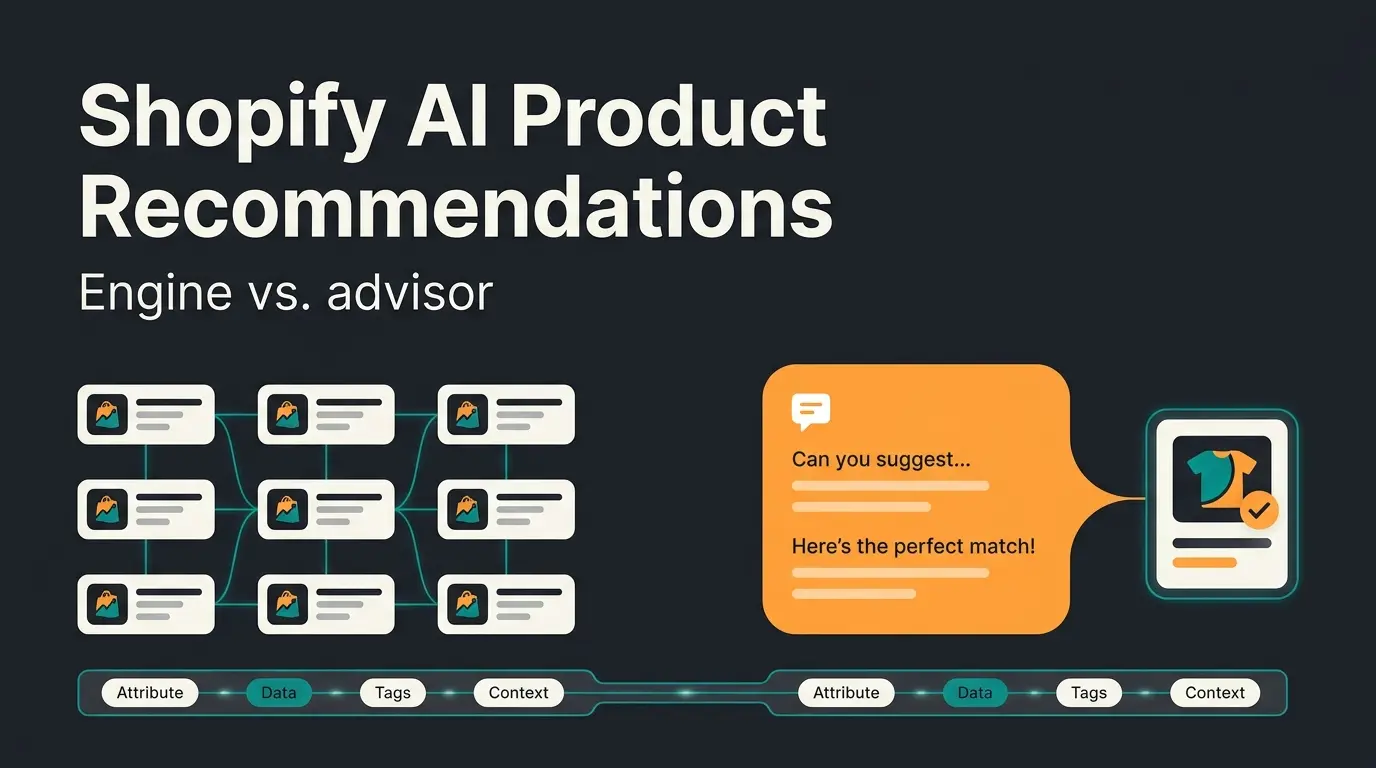
The Paradox of Choice: Why Online Shoppers Leave
Here's the uncomfortable truth about e-commerce in 2025: customers don't leave your store because they don't like your products. They leave because they're overwhelmed by choice. With thousands of SKUs, dozens of filter options, and endless product variations, finding the right product feels like searching for a needle in a haystack. This is the Paradox of Choice – and it's costing online retailers billions in abandoned carts and lost conversions.
Traditional search bars and filters assume customers already know what they want. But what about the shopper looking for "a laptop for video editing that's not too expensive"? Or the customer trying to find "skincare for sensitive skin that actually works"? These are human questions that require human-like guidance. According to AI in e-commerce statistics, more online retailers than ever are turning to AI-powered product consultation to solve this exact problem.
The consultation gap between brick-and-mortar retail and online shopping has never been more apparent. In a physical store, a knowledgeable sales associate asks questions, understands your needs, and guides you to the perfect product. Online, customers are left to navigate complex product catalogs alone – until now.
What Is AI Product Consultation?
AI product consultation represents a fundamental shift from passive product discovery to active, dialogue-based guidance. Unlike standard search functionality or filter-based navigation, AI product consultants engage customers in conversations, ask qualifying questions, and provide personalized recommendations based on actual needs rather than keyword matches.
These digital advisors work interactively and conversationally – some using generative AI and natural language processing, others employing decision trees, recommendation engines, or multimodal interfaces. They simulate the experience of personal consultation and help customers find suitable products from an extensive catalog. The result: more informed purchase decisions, higher conversion rates, and more satisfied customers.
Per quarter through better AI-guided consultation
On AI-recommended products during pilot programs
When combining chatbot guidance with marketing campaigns
Expert-level consultation without staffing costs
Chatbot vs. AI Product Consultant: The Critical Difference
One of the most common misconceptions in e-commerce is treating AI product consultants as just another chatbot. This confusion costs retailers significant conversion opportunities. Understanding the fundamental difference between these technologies is crucial for making the right investment decision.
A standard chatbot answers service questions: "Where is my package?" "What are your return policies?" "How do I reset my password?" These are reactive, FAQ-driven interactions designed to reduce support ticket volume. Their primary goal is cost reduction.
An AI product consultant, by contrast, asks sales questions: "What problem are you trying to solve?" "How will you primarily use this product?" "What's most important to you – performance, price, or portability?" This is proactive, consultative selling designed to generate revenue.
| Feature | FAQ Chatbot | AI Product Consultant |
|---|---|---|
| Primary Goal | Support (Cost Reduction) | Sales (Revenue Generation) |
| Interaction Style | Reactive (Answers Questions) | Proactive (Asks Questions) |
| Product Knowledge | Limited to Keywords | Understands Attributes & Usage |
| Conversation Logic | Script-Based Decision Trees | Dynamic Needs Analysis |
| Outcome | Link to FAQ Page | Add-to-Cart & Upsell |
| Customer Value | Time Savings | Better Purchase Decisions |
How Specialized AI Consultation Actually Works
Most competitors in this space talk about "AI analyzing data" but never explain the consultative logic that makes specialized solutions effective. Understanding the mechanics helps you evaluate which provider offers genuine consultation versus a rebranded search function.
Step 1: Needs Analysis (Bedarfsanalyse)
The consultation begins with dynamic questioning based on user answers. Instead of asking customers to select from predefined filter options, the AI engages in a conversation that adapts based on responses. "Are you looking for something for personal use or as a gift?" leads to completely different follow-up questions than "What's your budget range?"
Step 2: Product Matching
Here's where specialized AI differs from generic solutions. Instead of simple keyword matching, the AI maps technical specifications to human needs. "High lumens" becomes "bright enough for outdoor work." "8GB RAM" translates to "handles multitasking smoothly for typical office work." This translation layer requires deep product understanding that generic LLMs simply don't have.
Step 3: The Recommendation With Reasoning
The critical differentiator is explanation. A specialized AI consultant doesn't just say "Here's product X." It explains: "I recommend X because you mentioned you need portability and long battery life, and this model offers 12 hours of use while weighing only 1.2kg." This transparency builds trust and confidence in the purchase decision.
User lands on product page or initiates chat with general intent
AI asks open-ended question to understand core need
Based on answer, AI refines with targeted questions
AI matches stated needs to relevant product attributes
AI presents products with clear explanation of fit
AI addresses objections and facilitates purchase

The "Black Box" Problem and Why Trust Matters
One significant weakness in many AI consultation tools is the "black box" problem – customers (and retailers) can't understand why the AI made a specific recommendation. This opacity creates trust issues. Did the AI recommend that product because it genuinely fits the customer's needs, or because it has higher margins?
Explainable AI addresses this directly. When an AI consultant says "Based on your mention of sensitive skin and preference for fragrance-free products, I'm recommending these three options that are dermatologist-tested and contain no artificial fragrances," customers can evaluate the reasoning and trust the suggestion.
Business Impact: Why Decision Makers Should Care
Beyond the technology discussion, AI product consultation delivers measurable business outcomes that justify investment:
Conversion Rate Improvement: Active guidance through the purchase decision reduces abandonment. When customers receive confident recommendations tailored to their stated needs, they're more likely to complete purchases. The psychological principle is simple: reducing decision complexity increases action.
Return Rate Reduction: Better product fit means fewer returns. When an AI consultant ensures a customer understands exactly what they're getting and why it matches their needs, post-purchase regret decreases significantly. This directly impacts profitability.
Zero-Party Data Collection: Perhaps the most undervalued benefit – AI consultations generate rich data about why customers buy (or don't buy). Traditional analytics tell you what customers clicked. AI consultation reveals what problems they're trying to solve, what features matter most, and what objections prevent purchases.
See how AI-powered consultation can increase your conversion rates and reduce returns with personalized, explainable recommendations.
Start Your Free TrialImplementation Reality: Starting Without the Headache
Most AI providers claim "integration in minutes," but the reality requires more nuance. Here's an expert perspective on what actually determines implementation success:
Data Quality Is Everything: Your product feed is the foundation. If product descriptions are inconsistent, attributes are missing, or categorization is messy, even the best AI will struggle. Expect to invest time in data preparation – this isn't a weakness of AI solutions, it's a prerequisite for any intelligent system.
The Cold Start Problem: Generic chatbot solutions require months of training on your specific products before delivering value. Specialized solutions designed for product consultation can work effectively out of the box because they understand consultation logic inherently – they just need your product data, not months of conversation training.
Top 10 AI Product Consultation Providers for 2025
Now that we've established what makes AI product consultation effective and why it matters, let's examine the leading providers in 2025. Each offers distinct strengths depending on your use case, technical requirements, and business model.

1. Qualimero: Explainable AI for Enterprise Consultation
Qualimero is an AI platform for customer service, lead generation, and product consultation, particularly known for its advanced AI product advisors. The system recommends suitable products in real-time based on customer needs and can even check order status or schedule appointments.
As an innovation leader, Qualimero places special emphasis on explainable AI and excellent user experience (UX) – meaning the AI transparently explains its recommendations, building trust, while the user interface remains particularly intuitive.
Thanks to a "Done-for-You" approach, the Qualimero team handles AI training and integration, so companies receive an optimized digital consultant without significant effort. Qualimero is deployed by various enterprises in 2025 to automate complex consultation processes and guide customers through decision-making with personalized recommendations.
2. Zoovu: The Established Product Finder Leader
Zoovu is considered one of the most established providers for digital product finders and represents significant retail technology innovation in 2025. The platform structures product data and enriches it with conversational language to enable conversational search, product configurators, and interactive assistants.
"Our AI platform helps people find the right information online to make better purchase decisions," explains Zoovu CEO Rob Mullen. Zoovu is used by over 2,500 companies and reportedly generates more than $25 billion in annual revenue for these retailers.
Major brands already deploy Zoovu successfully – Microsoft uses Zoovu for the laptop finder in the Microsoft Store, and Nespresso offers a gift assistant with Zoovu that guides customers to the ideal coffee machine through targeted questions. These dialogue-based consultants provide personalized product recommendations across channels with proven higher conversion rates.
3. Salesforce Commerce GPT (Einstein)
Salesforce introduced Commerce GPT in 2024 as a generative AI extension for its Commerce Cloud platform. The centerpiece for consultation is the Commerce Concierge – an AI-powered shopping assistant enabling personalized, dialogue-based product conversations.
Through natural language, the Concierge helps customers effortlessly discover the right product, seamlessly across various channels from webshops to messaging apps. By integrating real-time data from Salesforce Data Cloud, Commerce GPT can provide context-aware recommendations and dynamic content.
For retailers, this means buyers receive individual guidance throughout their entire customer journey – including automatically generated purchase recommendations, tailored offers, and interactive chat consultation on demand. Since Salesforce holds a leading position in CRM, companies can seamlessly integrate this AI consultation into their existing commerce workflows. Early pilot users report that Commerce Concierge helps make the online shopping experience more personal and engaging to increase customer loyalty and revenue.
4. AskSid (Gupshup): Retail-Specialized Virtual Assistants
AskSid – now part of conversational tech company Gupshup – specializes in AI-powered virtual shopping assistants for retail brands. The solution was developed specifically for retail and brings deep domain knowledge in e-commerce.
AskSid's AI advises customers in natural language, answers product questions, helps with product selection, and can also act as a customer service bot. A notable example is luxury lingerie manufacturer Wolford, which rolled out a virtual advisor with AskSid in 15 countries.
The AI was implemented within just 4-6 weeks and quickly delivered results: 3% more online revenue per quarter through better consultation and high-quality 24/7 customer support. AskSid distinguishes itself by training AI bots on the customer's product assortments – including an automatic knowledge base ("Retail AI Brain") – and continuously learning from customer dialogues.
Since the acquisition by Gupshup (2022), AskSid can be integrated even more broadly, e.g., into messenger platforms, and helps international retailers (from fashion to cosmetics) realize digital consultation conversations at a human level.
5. FrontNow: European Pioneer in AI Consultation
FrontNow is an emerging European provider considered a pioneer in AI product consultation. The solution FrontNow Advise offers AI-powered, individualized product recommendations exactly where customers need them – whether in the online shop, customer account, or mobile.
FrontNow combines Conversational AI with personalization algorithms to guide customers through the assortment and suggest suitable options in dialogue form. Leading companies already trust it: Coop, Audi, and Zurich Airport use FrontNow to adapt their customer experience to changing customer behavior.
Beyond chat-based consultation (Advise), FrontNow also offers Enhance – AI-powered filters and personalizations on the website so customers find the right product faster. The successes show in higher conversion rates and increased basket values. FrontNow also scores with flexible integration and targets companies wanting a turnkey AI consultation solution with strong service.
6. Heyday (Hootsuite): Video Chat for Retail
Heyday – originally a Canadian startup, now acquired by Hootsuite – is an AI chatbot platform specifically for retail. It enables retailers to conduct product-related conversations with customers via chat, combining text with video chat for the most interactive experience possible.
Heyday is deployed globally: The solution counts customers in 77 countries, including major retailers like French sports chain Decathlon and fashion brand Bestseller. Lacoste also uses Heyday for international chat customer service and consultation.
Heyday's approach is to bring store consultation into customers' living rooms. Customers can ask questions via websites or messengers (e.g., Facebook, WhatsApp) – such as which running shoe fits their needs or which outfit is recommended – and the AI responds with suitable suggestions, product images, and links. Heyday can also seamlessly hand off to human employees when needed.
Heyday's success is evident in high ROI: Decathlon achieved an 875% return on Facebook ads through a Heyday chatbot by efficiently converting interested chat users to purchases. With its multilingual capabilities and easy shop system integration, Heyday is a popular choice in 2025 for retailers wanting to establish online chat consultation as a sales channel.
7. IBM Watson (XPS): Enterprise-Grade Natural Language
IBM was a pioneer in AI product consultation, developing innovative solutions with Watson as early as the mid-2010s. A well-known example is the collaboration with The North Face: IBM's Watson-based system "Expert Personal Shopper (XPS)" was used to guide customers online through a Q&A game to the ideal jacket model.
The virtual consultant asked questions like "Where and when will you use the jacket?" and recommended suitable outdoor clothing based on the answers. During the pilot phase, 60% of users clicked on at least one suggested item – proof that relevant recommendations activated customers.
IBM further developed the technology and fully acquired the XPS system from Fluid in 2016 to offer Watson broadly as a conversational commerce solution. Besides The North Face, Watson XPS was also implemented at 1-800-Flowers to find the perfect gift from a huge assortment.
Today, IBM Watson Assistant offers companies a platform to build their own AI consultants – often combined with IBM iX consulting. Large corporations use Watson-based chatbots in e-commerce, travel, and even insurance to advise customers in dialogue. IBM's strength lies in natural language processing and integration into enterprise systems; solutions are highly customizable but usually require a larger implementation project.
8. Constructor: Learning Product Discovery Platform
Constructor (Constructor.io) is a specialized provider dedicated to product data-driven shopping experiences. Unlike pure chatbot companies, Constructor focuses on AI-powered product search and discovery while also offering interactive consultation elements.
The software uses machine learning to continuously learn from shopper behavior – from search queries to clicks to purchases. Discovery tools like intelligent search bars (with autosuggest), dynamic category pages, and personalized product recommendations work hand in hand.
Constructor promises to solve challenges in the product discovery process by aggregating and analyzing all data points. Customers receive more fitting search results (even for complex queries in natural language) and curated recommendations that improve the more they use the site.
As one of the emerging players in "AI Product Discovery," Constructor has received significant investments and competes with industry giants in the search and personalization segment. Some major online retailers (in electronics and food) already use Constructor to transform their shop into a "learning consultant" that enables each user an individualized product journey.
9. Algolia: Scalable Search with AI Intelligence
Algolia is primarily known as a search-as-a-service platform but has also become an important provider for product discovery and consultation in the broader sense through its AI capabilities. Algolia's API is used by numerous online retailers to provide lightning-fast search results pages and autocomplete.
Newer AI modules also enable semantic search and personalized recommendations, so customers find relevant products without extensive filtering. In recent years, Algolia has invested heavily in AI – including through acquisition of neural search technology – and raised $150 million in funding (2021) at a $2.25 billion valuation.
For retailers, Algolia offers the advantage of a proven, scalable platform that can be relatively easily integrated into shops or apps to realize a consulting search assistant. Combined with a language model, retailers can build a chatbot that searches the product database for answers (some retailers are already experimenting with this).
Even without explicit chat, Algolia already delivers a kind of "silent consultation": customers who enter "camera for sports photography" in the search field receive matching product results thanks to AI understanding, as if a sales associate had specifically helped in a store. Through this smart product search and ability to adapt to user behavior trends, Algolia is an important component of many e-commerce technology stacks in 2025.

Provider Comparison: Strengths and Weaknesses
| Provider | Strengths (Pros) | Weaknesses (Cons) |
|---|---|---|
| Qualimero | Explainable AI, Done-for-You service, native multichannel consultation | Standard focus on enterprise use cases |
| Zoovu | Market leader, many integrations, cross-channel | Complex data structure required |
| Salesforce GPT | Seamless CRM integration, conversation quality | Salesforce ecosystem required |
| AskSid (Gupshup) | Retail specialization, fast ROI, multilingual | More suited for retail than niche markets |
| FrontNow | Strong UX, European focus, flexible modules | Less known, limited case studies |
| Heyday | Video chat option, international retail references | Limited customization depth |
| IBM Watson | Enterprise-ready, NLP competence, customizable | High implementation effort |
| Constructor | Learning recommendations, strong product search | Technically demanding for smaller shops |
| Algolia | Scalable API, semantic search, high speed | No native dialogue function |
Choosing the Right Solution for Your Business
Selecting an AI product consultation provider isn't one-size-fits-all. Consider these factors when evaluating options:
- Product Complexity: Simple products may work fine with enhanced search (Algolia, Constructor). Complex, consultation-heavy products benefit from full dialogue solutions (Qualimero, Zoovu, AskSid).
- Existing Tech Stack: If you're already invested in Salesforce, Commerce GPT integrates seamlessly. Otherwise, evaluate API flexibility and integration requirements.
- Implementation Resources: Enterprise solutions like IBM Watson offer maximum customization but require significant implementation projects. Managed services like Qualimero's Done-for-You approach minimize internal effort.
- Geographic Focus: European retailers may prefer GDPR-compliant options with local support like FrontNow. Global operations benefit from multilingual capabilities of AskSid or Heyday.
- Budget vs. Timeline: Some solutions offer quick wins, others require longer investment horizons for full ROI realization.
Real-World Example: The Laptop Purchase Scenario
To illustrate the difference between generic and specialized AI consultation, consider a customer searching for a laptop:
Bad AI Experience: Customer types "laptop for video editing cheap" into search. System returns 0 results (no laptop is tagged with "video editing" and "cheap"). Customer leaves frustrated.
Basic AI Experience: Customer types same query. System returns all laptops under €500. Customer is overwhelmed by 47 results with no guidance on which actually handles video editing.
Good AI Consultation: Customer asks about video editing laptops on budget. AI responds: "For video editing, you'll need a strong GPU and at least 16GB RAM. What type of video work – 1080p or 4K? And are you editing as a hobby or professionally?" Based on answers (hobby, 1080p), AI recommends: "For casual 1080p editing, here's the most affordable option that handles your workflow smoothly. It has a dedicated GPU and 16GB RAM, currently €549. If you can stretch to €699, this model offers 32GB RAM which gives you more headroom for longer projects."
The Future of AI Product Consultation
The ten providers presented demonstrate how diversely AI is being used for product consultation in e-commerce in 2025 – from specialized startups to tech giants. All share the goal of providing online customers with competent, personalized consultation like they know from brick-and-mortar retail.
Whether through dialogue-oriented chatbots, interactive decision trees, or intelligent search assistants – the right AI solution can make the difference, especially for consultation-intensive products. Companies benefit from increasing conversions and more satisfied customers, while consumers find their ideal product faster and more confidently.
The rapid development – especially in generative AI – suggests these digital consultation assistants will become even more natural and helpful in the future. E-commerce providers who embrace such innovations gain a clear competitive advantage in digital customer experience.
Frequently Asked Questions About AI Product Consultation
A regular chatbot answers service questions reactively ("Where is my order?"). AI product consultation proactively asks qualifying questions to understand customer needs and provide reasoned product recommendations. The goal shifts from cost reduction (deflecting support tickets) to revenue generation (guiding purchases).
Costs vary significantly by provider and complexity. Managed solutions like Qualimero offer Done-for-You services reducing internal effort. Self-service platforms may have lower licensing fees but require more implementation resources. ROI typically manifests through increased conversions (3%+ revenue increase is common) and reduced returns.
Absolutely. B2B often involves even more complex purchase decisions with technical specifications, compatibility requirements, and multiple stakeholders. AI consultation can guide technical buyers through complex configurations, ensure compatibility, and provide the detailed product knowledge B2B buyers expect.
This depends on your data readiness and chosen provider. Some specialized solutions work effectively within 4-6 weeks (as demonstrated by Wolford with AskSid). Generic solutions requiring extensive training may take months. Data preparation (cleaning product feeds, standardizing attributes) often determines timeline more than the AI platform itself.
AI consultation augments rather than replaces human expertise. It handles routine consultations at scale, available 24/7, while complex or high-value interactions can escalate to human specialists. The best implementations use AI to qualify and prepare customers, making human interactions more efficient when they occur.
Join leading brands using AI-powered product consultation to increase conversions, reduce returns, and deliver exceptional customer experiences.
Get Started Free