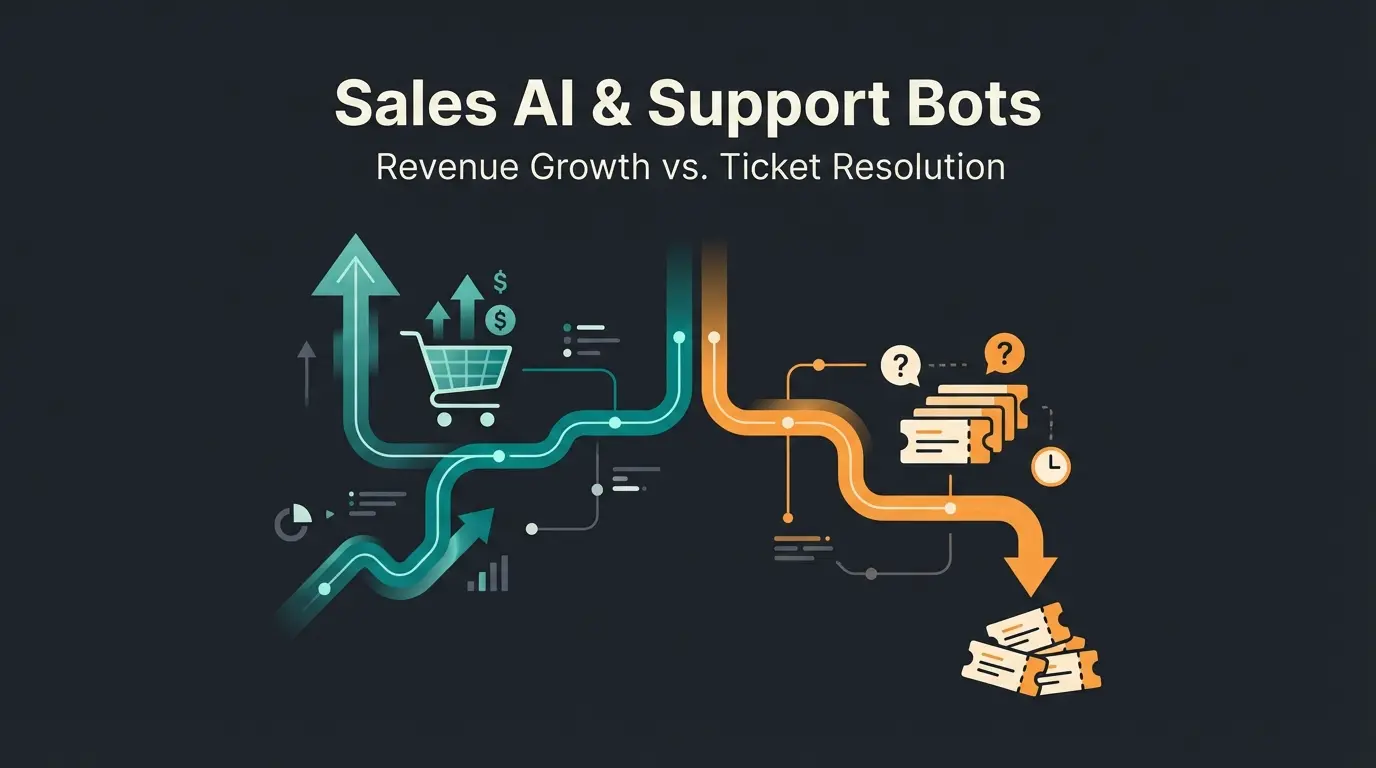
Introduction: Why Filters No Longer Work in 2025
Imagine walking into a specialty running shoe store. You tell the salesperson: "I have slight knee pain and mostly run on asphalt." The salesperson nods, asks two targeted follow-up questions, and then brings you three perfect pairs. They say: "I recommend this shoe because it has special heel cushioning that relieves stress on your knees on hard surfaces."
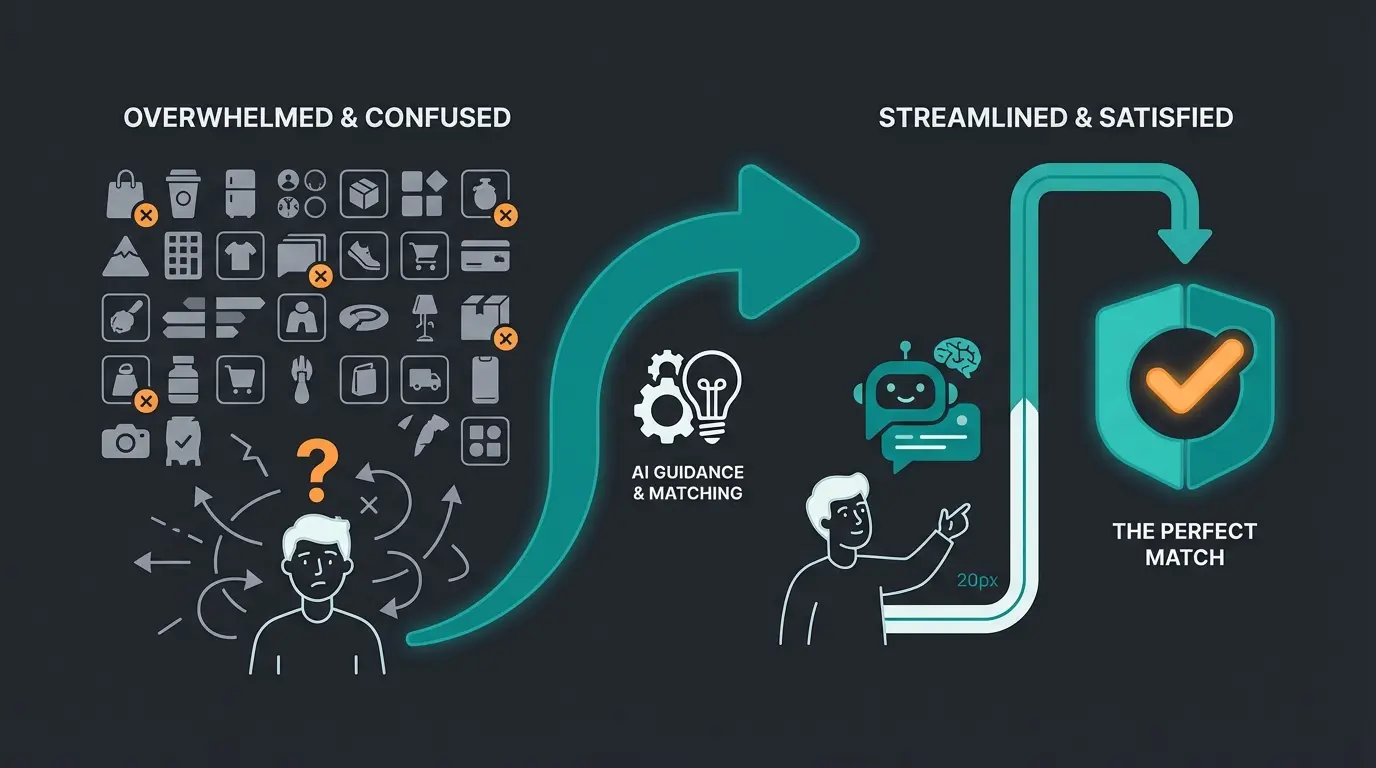
Now imagine the same situation in an average online store. You click on "Running Shoes." You see 450 models. On the left, you find a filter bar: Brand, Color, Size, Price. There's no filter for "knee pain." There's no filter for "asphalt." You're left alone with technical data sheets and hundreds of options.
This is the reality in e-commerce that we call the "Paradox of Choice." Studies from Winsome Marketing show that customers experience measurable cognitive exhaustion ("Decision Fatigue") when comparing more than seven to nine options. The consequence? According to research from Best Colorful Socks, 74% of customers abandon their purchase simply because they're overwhelmed.
This is where AI product consultation comes in. We're at a turning point. The era of static search filters and dumb FAQ bots is ending. 2025 marks the breakthrough of truly intelligent sales assistants that don't just find what you're searching for, but understand what you need. The KI Produktberatung 2025 landscape is transforming rapidly, and businesses that adapt will gain significant competitive advantages.
In this comprehensive guide, you'll learn how AI product consultation works, why it's the biggest lever against returns, and how to implement this technology step by step. Whether you're exploring KI E-Commerce Produktberatung for the first time or looking to upgrade your existing solution, this guide covers everything you need to know.
What is AI Product Consultation? (Definition)
AI Product Consultation (also known as AI Guided Selling or Conversational Commerce) is the use of artificial intelligence to simulate the dialogue-oriented consultation process of a human salesperson in the digital space. This represents a fundamental shift in how digital product consultants interact with customers online.
Unlike conventional search functions or static product finders based on rigid filters ("Show all red shoes"), AI product consultation uses Natural Language Processing (NLP) and Intent Analysis to understand the context and intention behind a customer query.
The Core Difference: Finding vs. Consulting
- Classic E-Commerce (Search/Filter): The customer must know which technical attributes (e.g., "Gore-Tex membrane") solve their problem. They must perform the translation from need to product feature themselves.
- AI Product Consultation: The customer expresses a need ("I want dry feet while hiking"). The AI takes over the translation ("Customer needs waterproof material") and recommends the appropriate product.
The emergence of AI Chatbots im E-Commerce has paved the way for more sophisticated consultation systems. However, there's a critical distinction between simple chatbots and true AI consultants that we'll explore in the next section.
FAQ Bot vs. AI Product Consultant: The Crucial Difference
Many online retailers fall into the trap of deploying a generic support chatbot, hoping it can also sell. This usually fails because the architecture is fundamentally different. Think of it as the difference between a warehouse clerk and a specialist consultant.
The warehouse clerk (FAQ bot) knows exactly where the goods are located. If you give them an item number, they'll fetch the product. But if you ask them: "What goes with my blue suit?", they shrug their shoulders. The specialist consultant (AI product consultant), on the other hand, diagnoses your problem. This distinction is at the heart of the AI product finder evolution we're witnessing today.
Comparison Table: Standard Chatbot vs. AI Product Consultant
| Feature | Standard FAQ Chatbot (The "Clerk") | AI Product Consultant (The "Consultant") |
|---|---|---|
| Primary Goal | Reduce support tickets (cost reduction) | Increase conversion & cart value (revenue) |
| Interaction Style | Reactive: Waits for user questions | Proactive: Asks follow-up questions ("Guided Selling") to clarify needs |
| Technology | Keyword matching / Rigid decision trees | LLMs (language understanding) + Knowledge Graph (product logic) |
| Context Understanding | Low. Often forgets previous messages | High. Maintains context throughout the dialogue ("Memory") |
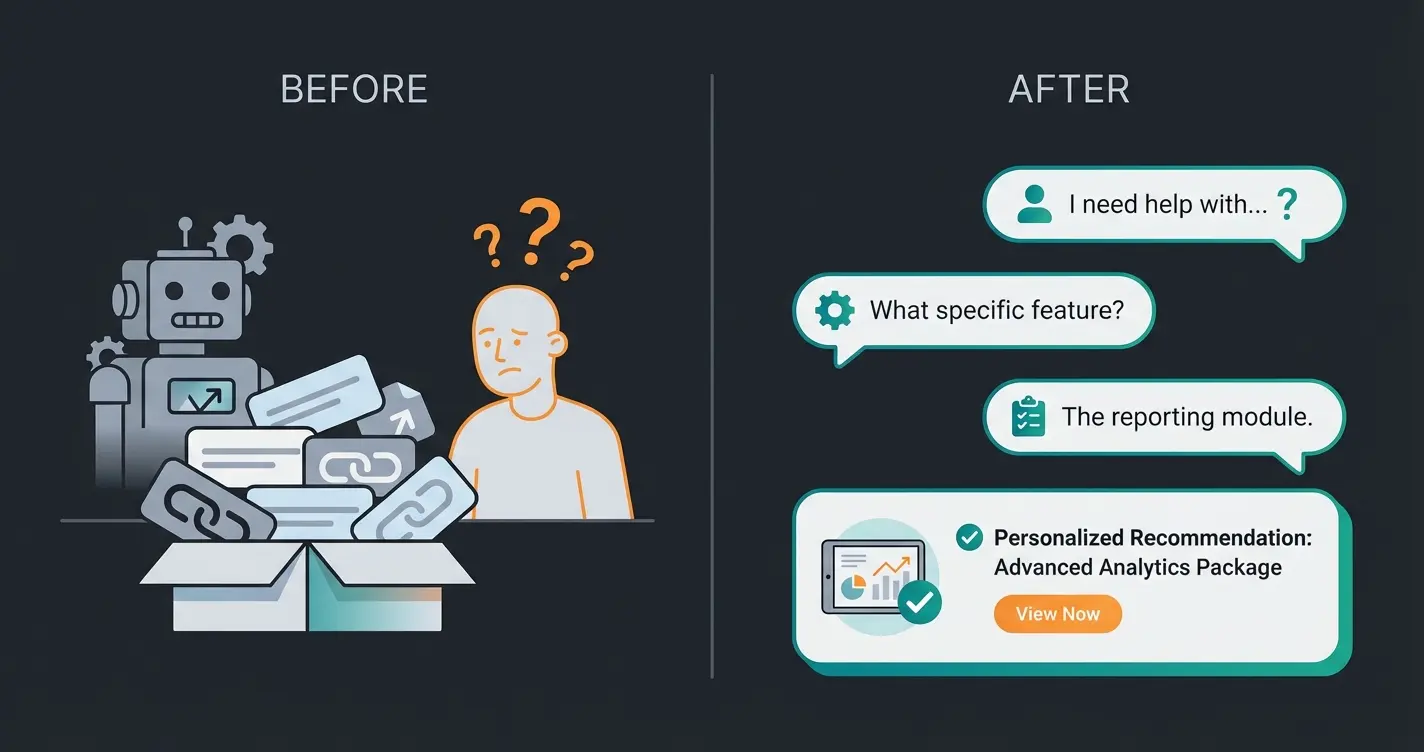
| Result | Delivers links to FAQ articles or product lists | Delivers a concrete product recommendation with reasoning |
| Data Usage | Often only accesses text modules | Uses product data, attributes, and relationship networks |
Why this difference determines your revenue: An FAQ bot that responds to the question "Which laptop for video editing?" only with "Here are our laptops" and a link to the category frustrates the user. An AI product consultant that responds: "For video editing, we need lots of RAM and a strong graphics card. Do you work more with 4K material or HD?" builds trust and leads to purchase completion.
The Psychology of Selling: Why Filters Cannot Consult
To understand why AI product consultation is so effective, we need to look at sales psychology. The classic online shop ignores a fundamental step in the sales process: needs analysis. This is where the conversational AI revolution truly differentiates itself from traditional e-commerce approaches.
The Problem of "Attribute Overload"
Customers rarely think in technical attributes. A customer doesn't want a "backpack with 40L volume and ripstop nylon." They want a "backpack for a weekend trip that won't tear easily."
Filters force customers to translate their emotional or practical needs into technical specifications. This requires expertise that the customer often doesn't have. When they're unsure whether to choose "polyester" or "merino," cognitive dissonance arises. According to analysis from Medium, the fear of making a wrong decision leads to no decision being made at all.
Building Trust Through "Reasoning"
A human salesperson builds trust by demonstrating competence. They don't simply say "Buy this!" but "Buy this, because..." This is the core principle behind the KI Selling revolution transforming modern e-commerce.
AI product consultation replicates this psychological mechanism. By explaining: "I recommend this skin cream because you indicated that your skin gets tight in winter and this product contains hyaluronic acid," it validates the customer's decision.
This reduces so-called "Purchase Anxiety." The customer feels understood and validated, which massively reduces the likelihood of purchase abandonment. This psychological approach is what separates true AI consultation from simple recommendation engines.
Opening the "Black Box": How AI Really "Thinks"
Many providers promise "AI" but don't explain how it works. For decision-makers, however, it's important to understand why modern systems don't simply hallucinate (make things up), as raw ChatGPT sometimes does.
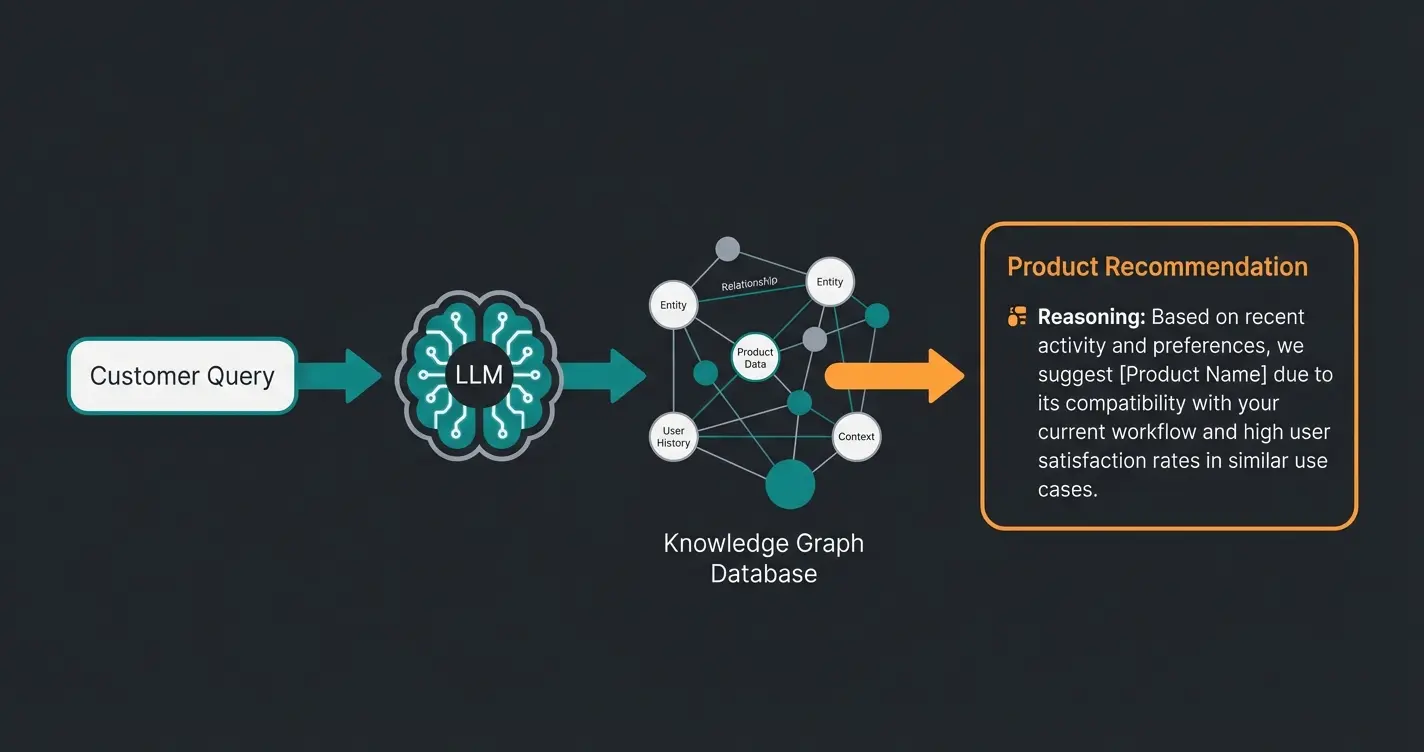
The solution lies in a hybrid technology often referred to as RAG (Retrieval-Augmented Generation), combined with Knowledge Graphs. Understanding this architecture is essential for evaluating AI consulting in e-commerce solutions.
1. The Brain: Large Language Models (LLMs)
The LLM (like GPT-4 or Claude) is the "language processor." It's extremely good at understanding human language, recognizing nuances, and formulating fluent responses. It provides the empathetic, natural dialogue.
Problem: A pure LLM doesn't know your current inventory and could invent products that don't exist.
2. The Memory: The Knowledge Graph
Here lies the crucial difference from simple bots. As explained by ZenML, a Knowledge Graph stores your product data not in tables, but in relationships.
Example: Instead of just storing "Shoe X is waterproof," the graph stores the relationship: "Shoe X" -> has property -> "Waterproof" -> is useful for -> "Hiking in rain." This relational structure, as detailed by Medium's technical analysis, enables true reasoning capabilities.
3. The Synthesis: How It Works Together
When a customer asks: "I need something for hiking in bad weather," the following happens:
- Intent Recognition: The LLM understands "hiking" + "bad weather"
- Retrieval: The system queries the Knowledge Graph: "Which products have properties that match 'bad weather'?"
- Reasoning: The graph delivers products with "Gore-Tex" or "Waterproof"
- Response: The LLM formulates the answer: "For bad weather, I recommend Model X, as it features a Gore-Tex membrane."
5 Key Benefits of Specialized AI Product Consultation
The use of AI product consultation isn't just a UX feature – it's a hard business case. Here are the five most important ROI drivers that AI chatbots in marketing and sales are delivering for forward-thinking businesses.
Companies report up to 40% higher conversion rates with guided selling
Percentage of customers who abandon due to choice overload without AI guidance
Retailers who see consultation as key to reducing returns
Round-the-clock scaling of expert knowledge without human limitations
1. Increased Conversion Rate (Guided Selling)
Guided selling processes show impressive results in studies. When customers are taken by the hand, the likelihood of a purchase increases significantly. According to Bluebarry.ai, companies report conversion increases of up to 40% through the use of guided selling tools.
The Reason: Reducing the selection to 2-3 relevant options eliminates decision paralysis. This is particularly effective when combined with multilingual AI chatbots that can serve international customers in their native language.
2. Reduced Return Rates
Germany is "Europe's returns champion." Particularly in the fashion sector, return rates are often at 50%, according to data from Sendcloud and Retourenforschung. A main reason: "selection orders" (customer orders 3 sizes) or false expectations about the product.
Impact: An AI that clarifies before purchase how a garment fits ("Customers with your build often found size M too tight, better take L") prevents the return before it happens. According to research from EHI and BTE, detailed product information and consultation are seen by 86% of retailers as the most important measure for reducing returns.
3. Scaling Expert Knowledge 24/7
Your best human salesperson can only serve one customer at a time and needs sleep. An AI scales this expert knowledge infinitely. This is where AI Customer Service and sales converge to create unprecedented value.
Scenario: A B2B customer searches for a specific replacement part for a machine at 11 PM. Instead of waiting until the next morning for support, the AI guides them through the technical specification to the right part. The revenue is secured immediately.
4. Zero-Party Data: The Treasure in the Cookieless Age
With the decline of third-party cookies, it's becoming increasingly difficult to track customers. AI product consultation generates Zero-Party Data, as explained by Bluebarry.ai's research and TermsFeed.
- What is it? Data that the customer shares voluntarily and consciously.
- Example: In dialogue, the customer says: "I have dry skin and usually buy vegan products." This is gold for future marketing and personalization, far more valuable than any click tracker.
By analyzing consultation conversations, businesses can extract valuable insights about customer preferences, pain points, and decision-making patterns that inform product development and marketing strategies.
5. Building Trust Through Reasoning
As described above: The ability to explain why a product fits creates trust. This increases not only conversion but also customer satisfaction (NPS) and customer retention. Customers come back because they felt well-advised.
Stop losing customers to choice overload. Our AI product consultant guides shoppers to the perfect product with personalized recommendations and transparent reasoning.
Start Your Free TrialPractical Examples: What Good Consultation Looks Like
To make the difference tangible, let's compare two dialogue flows. Understanding these examples is crucial for implementing effective Consultative AI solutions.
Scenario A: The Dumb Bot (Negative Example)
Customer: "I'm looking for a gift for my father, he likes tech."
Bot: "I found 542 results for 'tech'. Here's the link to our electronics category."
Result: The customer is just as clueless as before and leaves the page frustrated.
Scenario B: The AI Product Consultant (Positive Example)
Customer: "I'm looking for a gift for my father, he likes tech."
AI: "That's a lovely idea! To find the right thing: Is he more the type who likes to tinker and build things, or does he prefer ready-made gadgets that make everyday life easier?"
Customer: "More gadgets for everyday life. He likes to cook."
AI: "Got it. In that case, a smart meat thermometer or our new voice-controlled kitchen assistant could be a great fit. The thermometer is particularly popular with hobby cooks because the app tells you exactly when the steak is perfect. Shall I show you the details?"
Result: The customer feels understood, the selection has been massively narrowed down, and the product has been linked to a concrete benefit ("steak perfect").
"I need a gift for my dad who likes tech"
AI asks: "Does he prefer building things or ready-made gadgets?"
Customer reveals: "Gadgets for everyday life, he cooks"
AI recommends smart kitchen gadget with clear benefit explanation
Customer makes informed decision with reduced anxiety
How to Implement AI Product Consultation (Step-by-Step)
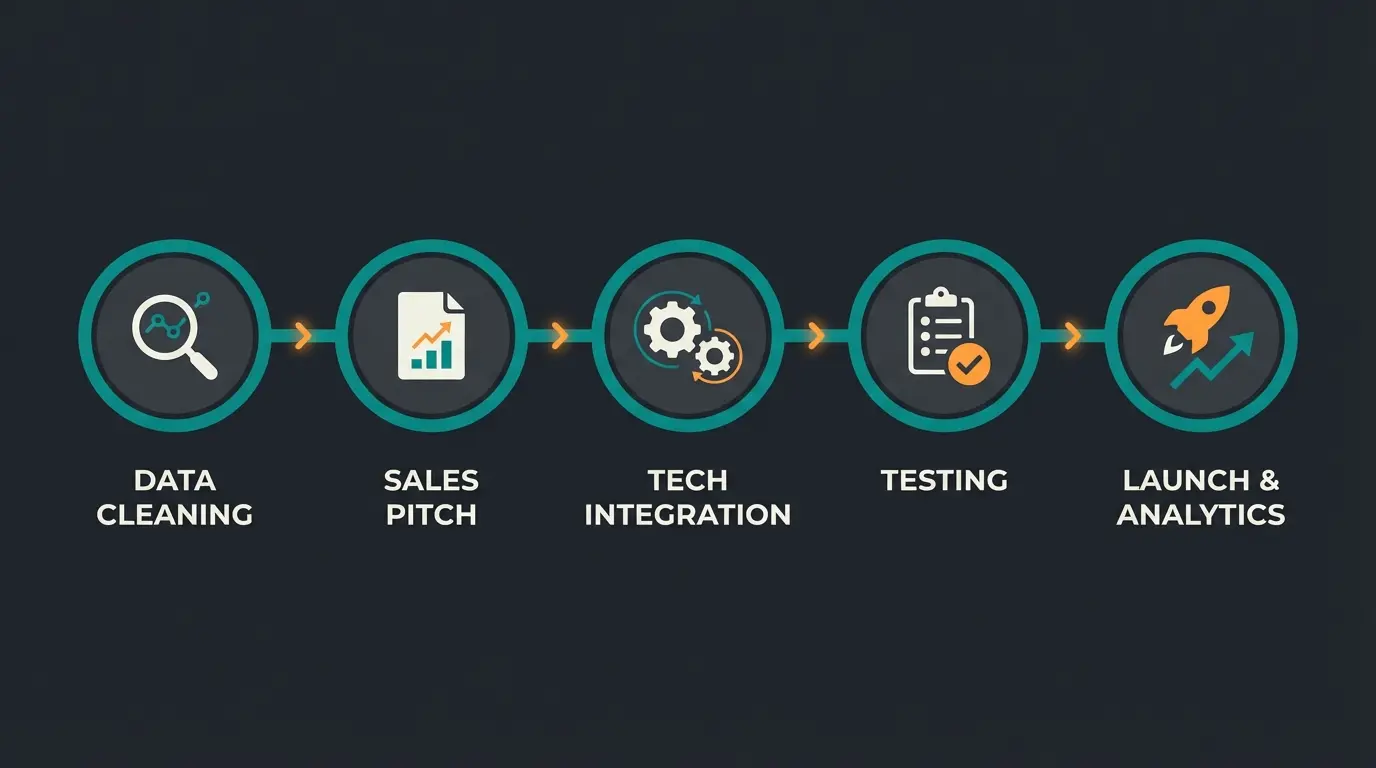
Introducing such technology often seems daunting. But with a structured plan, it's achievable. Here's the roadmap for implementation.
Step 1: Data Audit & Cleaning (The Foundation)
No AI is smarter than the data it's fed ("Garbage in, Garbage out").
- Task: Check your product data (PIM). Are attributes maintained? Are important properties missing (e.g., material, fit, purpose)?
- Tip: As noted by Threekit, consider using AI here to convert unstructured product descriptions into structured attributes.
Step 2: Define the "Perfect Sales Pitch"
Before you set up the software, you need to know what a perfect sales conversation looks like in your niche.
- Task: Sit down with your best salespeople. What 3-5 questions do they ask every customer to find the right product? (e.g., "Where will the product be used?", "How often will you use it?")
- Goal: This logic forms the backbone for the Knowledge Graph or the AI's decision logic.
Step 3: Technology Selection & Integration
Decide on a solution (Build vs. Buy). For most retailers, a specialized SaaS solution is recommended (see next section), as building RAG systems yourself is complex.
Integration: The AI must have access to your product catalog (feed) and ideally to the shopping cart to add products directly.
Step 4: Testing & Setting "Guardrails"
Before the AI goes live, it must be tested.
Guardrails: Define what the AI must not say (e.g., no medical advice, don't mention competitor products). Test edge cases ("What happens when the customer becomes abusive?").
Step 5: Go-Live, Monitoring & Optimization
Don't start immediately across the entire site.
- A/B Test: Let the AI run on only 50% of traffic first or only in a specific category.
- Analysis: As recommended by Salsify, review the chat logs. Where does the dialogue break off? Which questions doesn't the AI understand? Use this feedback to improve the data base.
Checklist: What to Look for When Choosing a Provider
The market for AI tools is exploding. When searching for an "AI product consultation" provider, use these criteria to separate the wheat from the chaff:
- Domain Specialization: Does the provider offer a solution specifically for e-commerce? General chatbot platforms often don't understand the concepts of "variants," "inventory," or "shopping cart" deeply enough.
- Hybrid Approach (Neuro-Symbolic AI): Does the provider rely only on LLMs (risk of hallucinations) or combine them with structured data logic/Knowledge Graphs? Ask explicitly: "How do you ensure the AI doesn't invent products?"
- Onboarding Effort: Does the AI need to be trained for months, or can it automatically read and understand your product feed (Google Shopping Feed, CSV, API)? Good tools are "Plug & Play" with your data.
- Integration Depth: Can the AI add products directly to the cart? Can it access user data (e.g., size from previous purchases) when the user is logged in?
- Data Privacy (GDPR): Where is the data processed? Are your customers' inputs used to train public AI models (which is often a no-go)?
FAQ: Common Questions About AI Product Consultation
A regular chatbot is reactive and keyword-based – it waits for specific questions and matches them to pre-written answers. AI product consultation is proactive, using Natural Language Processing to understand context, ask qualifying questions, and provide reasoned recommendations based on actual product data. It's the difference between a warehouse clerk who can find items by SKU and a specialist consultant who diagnoses your needs.
With modern SaaS solutions, implementation can take as little as 2-4 weeks for basic functionality. The timeline depends primarily on your product data quality. If your PIM is well-maintained with detailed attributes, you can go live quickly. If data needs cleaning or enrichment, add 2-4 weeks. A/B testing and optimization is an ongoing process after launch.
Companies typically report 20-40% increases in conversion rates and 15-30% reductions in return rates. The ROI depends on your current baseline, product complexity, and implementation quality. High-consideration purchases (electronics, furniture, technical products) and industries with high return rates (fashion) typically see the highest impact.
Absolutely. In fact, B2B often sees even higher value because product configurations are more complex and sales cycles longer. The AI can handle technical specifications, compatibility checks, and guide customers through complex selection processes that would otherwise require a human sales engineer.
Quality AI consultation systems integrate with your inventory management in real-time. The Knowledge Graph is updated continuously, so the AI only recommends products that are actually available. This is a key differentiator from generic LLM solutions that might hallucinate products.
Conclusion: From Searching to Finding – The Future Belongs to Consultation
E-commerce has spent the last 20 years optimizing logistics and availability. The problem of "findability," however, was only inadequately solved through filters. In 2025, we stand on the threshold of an era where consultation competence again becomes the decisive competitive advantage – this time digital and scalable.
AI product consultation is more than a trend. It's the answer to declining attention spans, rising return costs, and customers' desire for simplicity. Those who help their customers make decisions, instead of just bombarding them with options, will be the winners of the next e-commerce cycle.
Action Recommendation: Don't wait until Amazon or Zalando have set the standard. Start now with a pilot in your most consultation-intensive category. Your customers aren't searching for more products – they're searching for the right decision. Help them with it.
Join leading e-commerce brands using AI product consultation to increase conversions by up to 40% while reducing returns. Start with a free trial and see the difference intelligent consultation makes.
Get Started Free
Lasse is CEO and co-founder of Qualimero. After completing his MBA at WHU and scaling a company to seven-figure revenue, he founded Qualimero to build AI-powered digital employees for e-commerce. His focus: helping businesses measurably improve customer interaction through intelligent automation.