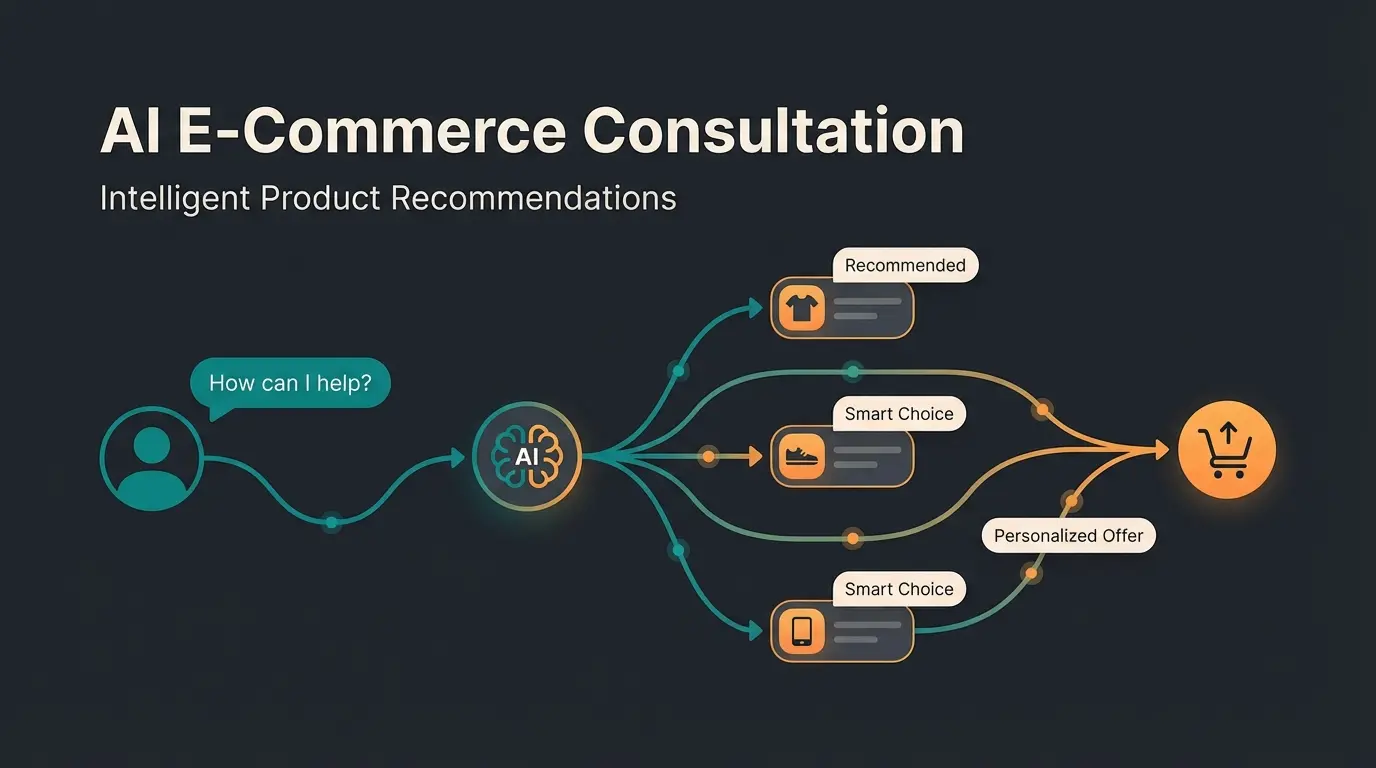
Why AI Decides Success or Failure in E-Commerce 2025
Imagine walking into a physical store. No one greets you. You wander through the aisles, searching for a product, can't find it, and leave. This is the reality in 98% of all online shops today. We've spent years buying traffic but barely invested time in intelligently receiving that traffic.
This is where Shopify AI (Artificial Intelligence) comes into play. But be careful: we're no longer just talking about having ChatGPT write emails or shifting pixels in product images. In 2025, a massive shift is taking place. The technology is moving from backend efficiency (saving time) to frontend sales performance (making money).
While most merchants still view AI as a "nice gimmick" or pure support tool, market leaders are already using AI for Shopify to digitize their best salespeople. According to icecubedigital.com, this shift represents one of the most significant transformations in e-commerce history.
In this comprehensive guide, you'll learn how to master native Shopify artificial intelligence (Magic & Sidekick), why most "AI chatbots" are a waste of money, and how you can massively increase your conversion rate with a new generation of AI Shopify tools – all while considering strict GDPR standards. Understanding AI e-commerce fundamentals is crucial before diving into specific implementations.
The Foundation: Shopify's Native AI Tools (Must-Haves)
Before we dive into advanced strategies, we need to understand the foundation. Shopify has invested heavily in its own AI solutions. These are included free in your plan and form the basis of your AI strategy.
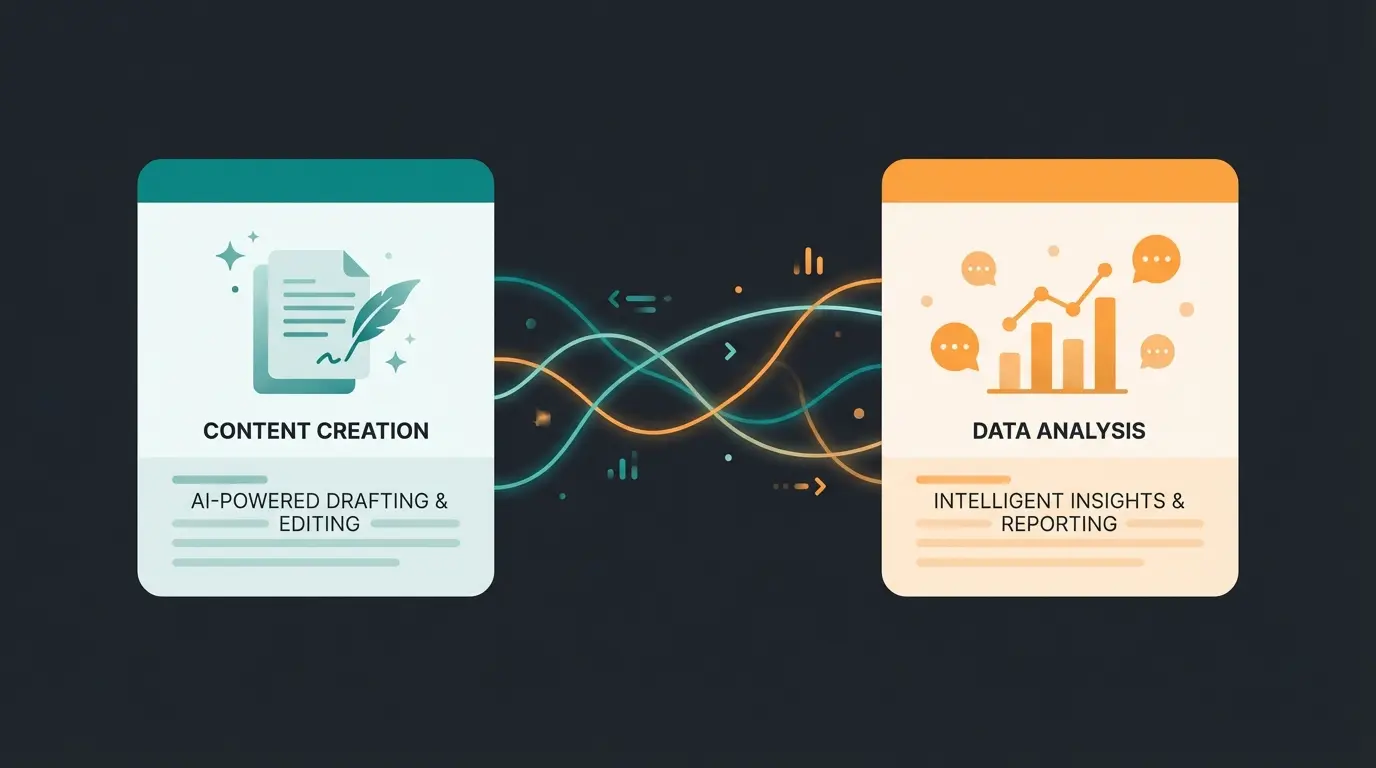
Shopify Magic: Your Content Producer on Steroids
Shopify Magic is a suite of AI features directly integrated into the admin area. It's based on large language models (LLMs) and is trained to handle e-commerce-specific tasks. As noted by wholesalehelper.io, these capabilities have evolved significantly over the past year.
What it can do:
- Product Descriptions: Generates text based on bullet points and keywords
- Email Marketing: Creates drafts for newsletters and campaigns (via Shopify Email)
- Image Editing: Removes backgrounds or replaces them with AI-generated scenes (Scene Manipulation)
- Blog Posts: Helps with brainstorming and outlining articles
According to firstpier.com, the image editing capabilities alone can save merchants thousands of dollars in photography costs while maintaining professional quality standards.
| Bad Prompt | Result (AI) | Why It Fails |
|---|---|---|
| "Write a description for this coffee." | "This coffee is insane! It will change your life and tastes like heaven on earth. Buy now!" | Too aggressive, unbelievable, generic |
| "Role: Barista expert. Product: Ethiopian Yirgacheffe. Audience: Connoisseurs. Tone: Passionate but factual. Focus: Citrus notes, Fairtrade. Format: Short sentences." | "Discover the fine citrus notes of our Yirgacheffe. Directly from Ethiopia and 100% Fairtrade traded, this coffee offers you a clear, almost tea-like flavor profile. Perfect for your pour-over on Sunday morning." | Specific, emotionally resonant, culturally appropriate |
Shopify Sidekick: Your Admin Assistant
While Magic creates content, Shopify Sidekick is your operational assistant. It lives as a chat window in your admin area and understands context. According to retailtechinnovationhub.com, Sidekick represents a fundamental shift in how merchants interact with their store backend.
What it can do:
- Data Analysis: "Why did my sales drop 10% last week?" Sidekick analyzes the data and provides hypotheses.
- Configuration: "Create a discount code for 20% off all winter jackets." Sidekick executes the action directly.
- Design Changes: "Change the theme to 'Summer Sale' layout."
2025 Update: As reported by retailtimes.co.uk, Shopify has massively rolled out Sidekick for the European market and now natively supports multiple languages. This eliminates one of the biggest barriers for international merchants. The official Shopify documentation confirms these expanded capabilities.
The Three Levels of AI in Shopify (Your Differentiation)
To truly understand the market, we need to divide AI for Shopify into three evolutionary stages. Most merchants are stuck at Level 1 or 2. Your competitive advantage lies at Level 3.
Level 1: Backend & Productivity (The Standard)
This is where Shopify Magic, Sidekick, and SEO tools reside.
- Goal: Time savings
- Function: Automation of admin tasks
- ROI: Difficult to measure (more about cost reduction through less work time)
Level 2: Customer Support / Reaction (The Status Quo)
Here we find classic chatbots like Tidio or Gorgias. According to eesel.ai, these tools dominate the current market but miss significant revenue opportunities. As brandcrock.com notes, support-focused bots handle approximately 80% of routine inquiries but rarely contribute to sales growth.
- Goal: Reduce support tickets
- Function: Answers questions like "Where is my package?" or "What are the return conditions?"
- Mode: Reactive. The customer must have a problem and ask.
- Problem: A support bot rarely sells. It solves problems but doesn't inspire.
Traditional AI Chatbot for E-Commerce solutions focus primarily on deflecting support tickets rather than driving revenue. This represents a fundamental limitation in their approach.
Level 3: Product Consultation / Proactive Sales (The Blue Ocean)
This is where the future lies. These are AI solutions that don't wait until the customer has a problem but actively consult – like a good salesperson in a store. Research from kortical.com shows that proactive AI engagement can transform the entire customer journey.
- Goal: Revenue increase (Conversion Rate & AOV)
- Function: Needs analysis, product recommendation, objection handling
- Mode: Proactive. The AI asks: "Are you looking for something for dry or oily skin?"
Why this matters: Online stores face high return rates. An AI that consults before the purchase ensures that the right product lands in the shopping cart. This dramatically reduces returns and massively increases profit. The concept of AI-driven consultation represents this fundamental shift in approach.
Users who interact with AI consultants convert 3-4x more often
Better pre-purchase advice reduces product returns significantly
Cross-selling recommendations increase average order value
Top AI Apps for Shopify: A Categorized Overview
The Shopify App Store is full of "AI" labels. Here we separate the wheat from the chaff, based on the three levels.
Category A: Marketing & Visuals (Level 1)
- Klaviyo: The market leader in email marketing uses AI for "Predictive Analytics" (when will the customer buy again?) and generating subject lines. According to cartcoders.com, Klaviyo's AI features have become essential for serious e-commerce operations.
- CreatorKit / Photoroom: Indispensable for merchants who need high-quality product photos without renting a studio. The AI generates backgrounds that perfectly match the brand aesthetic.
Category B: Support & FAQ (Level 2)
Gorgias / Tidio: These tools are excellent for minimizing support effort. They use AI to classify tickets and provide standard answers. As optimonk.com reports, these solutions can handle up to 80% of routine customer inquiries automatically.
Limitation: They are often "ticket-focused," not "sales-focused." Understanding how digital sales consultants differ from support bots is crucial for making the right choice.
Category C: The New Generation of Sales Consultation
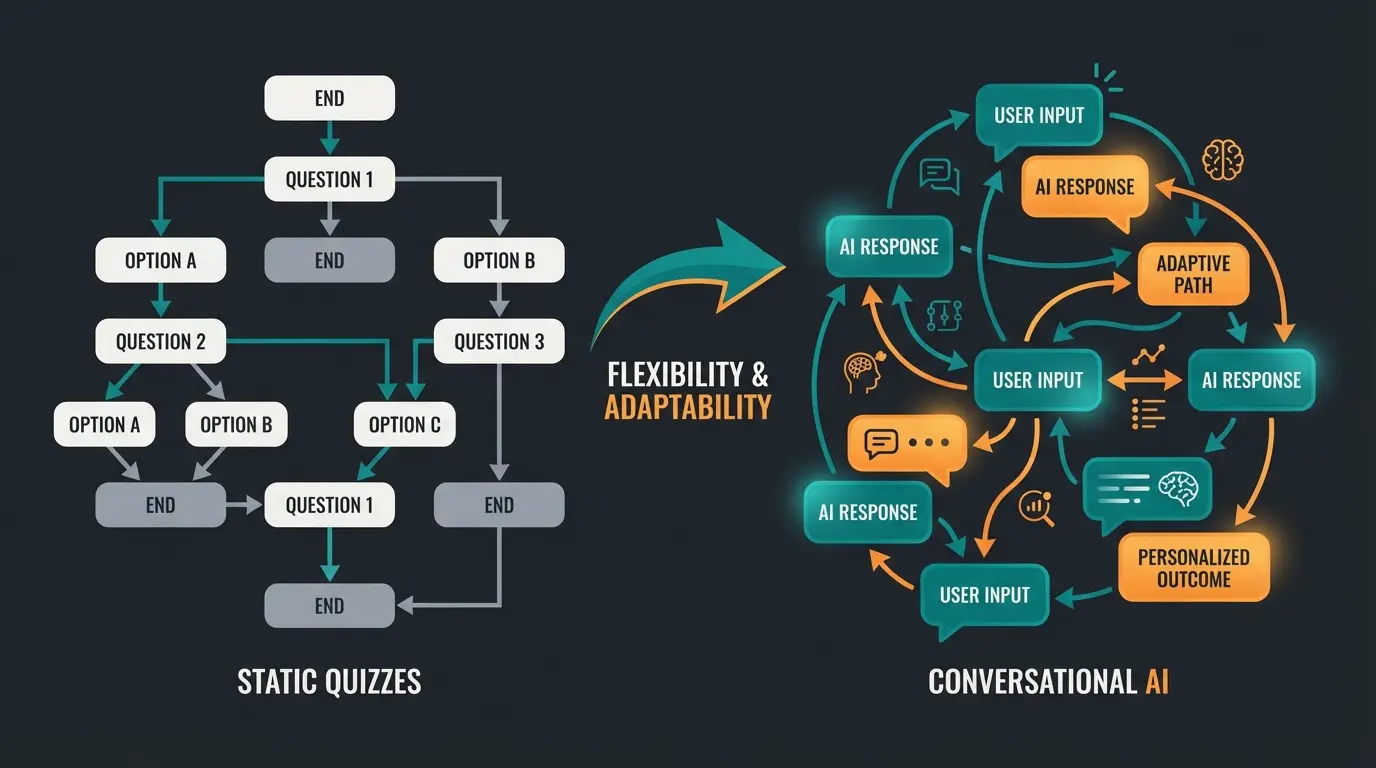
This is where it gets exciting. Merchants often face the choice: Static Quiz vs. Dynamic AI.
The Old Way: Static Quiz Apps (e.g., Octane AI)
Quiz apps were long the gold standard. According to aiquiztocart.com and acquireconvert.com, they remain popular for collecting zero-party data.
- Advantage: Collect Zero-Party-Data (customer preferences)
- Disadvantage: They are linear. If the customer has a question that's not in the quiz ("Can I use this with eczema?"), the process breaks down. The quiz is a monologue, not a dialogue.
The New Way: Conversational AI Solutions
These tools use LLMs (like GPT-4) trained on your product catalog. As documented by gorgias.com and softpulseinfotech.com, this represents the cutting edge of e-commerce AI. The AI product finder approach exemplifies this conversational methodology.
- Advantage: Real conversation. The AI understands context, nuances, and can respond to follow-up questions.
- Differentiation: Unlike a quiz, the AI can persuade. It can explain why Product A is better than Product B, based on the customer's specific inputs.
The evolution toward Conversational Commerce represents a fundamental shift in how customers discover and purchase products online.
| Feature | Standard Chatbot (Support) | AI Sales Consultant (Sales) |
|---|---|---|
| Primary Goal | Solve problems (ticket avoidance) | Generate revenue (conversion) |
| Interaction | Reactive (waits for questions) | Proactive (approaches customers) |
| Knowledge | Static FAQs & order status | Deep product knowledge & sales psychology |
| Data Focus | "Where is my package?" | "What fits my style?" |
| Technology | Often rule-based / Simple NLP | LLM (Large Language Model) / Context-based |
| Impact | Saves costs | Increases revenue & AOV |
Stop losing customers to confusion. See how AI-powered product consultation can boost your conversion rates by up to 4x.
Start Your Free TrialDeep Dive: How AI Consultation Works (Your USP)
Why is the jump from Level 2 (Support) to Level 3 (Consultation) so massive? Let's look at a concrete scenario.
Scenario: The Customer is Looking for Running Shoes
The Classic Way (Filter & Search):
The customer uses the search ("red running shoes") or filters (Size 10, Price up to $100). Result: They see 50 shoes. They're overwhelmed (Paradox of Choice). They buy nothing or order three pairs to choose from (return pre-programmed). This is where AI Product Consultation transforms the experience.
The Way with AI Consultation:
The customer lands on the page. The AI (bottom right or as a pop-up) introduces itself: "Hey! Are you looking for shoes for asphalt, trails, or the treadmill?"
Customer: "Mostly trails, but sometimes road too. And I have wide feet."
The AI scans the catalog not just by tags but by properties. It knows from product descriptions which models have "Wide Fit" and hybrid soles.
"I recommend the TrailMaster 3000. It has a cushioned sole for asphalt but enough grip for trails. Plus, it's extra wide in the forefoot area, which prevents pressure points with your wide feet."
"Since you run on trails: Do you need waterproofing spray against moisture?"
The Result:
- The customer feels understood
- Purchase probability increases massively (studies show up to 4x higher conversion rates with interaction, as documented by hellorep.ai)
- Return rate drops because the product fits
This approach exemplifies how digital product consultants create value by understanding customer needs before recommending products. The concept of AI employees extends this capability across the entire customer journey.
Critical for Compliance: AI & GDPR (The Trust Factor)
This is the point that almost all American blogs ignore but is vital for merchants operating in Europe or serving European customers. Shopify AI and data privacy are a minefield if you get it wrong. Understanding AI and data privacy is essential for compliant implementation.
The Problem: Server Locations
Many AI apps route data through US servers (OpenAI, Anthropic, etc.). After the invalidation of "Privacy Shield," this is legally complex. According to medium.com analyses and latori.com guidance, this represents one of the biggest compliance challenges for European merchants.
- Shopify itself: Uses servers worldwide but guarantees a high level of conformity through Standard Contractual Clauses (SCCs) and processing in Ireland (for EU customers). The official Shopify privacy documentation and Shopify DPA resources confirm these measures.
Legal experts at it-recht-kanzlei.de and decareto.com emphasize that proper documentation and contracts are essential for compliance.
The Solution for Merchants
When you install AI tools, pay attention to the following points to avoid legal issues:
- DPA (Data Processing Agreement): Sign a DPA with every app provider. Reputable providers (even from the USA) provide this. As createmystore.ai notes, this is non-negotiable for professional operations.
- Consent Management (Cookie Banner): AI tools that track user behavior must be listed in the cookie banner (e.g., Cookiebot, OneTrust) and may only load after consent. According to consentmo.com, proper consent management is crucial for compliance.
- Anonymization: The best AI sales tools work session-based and anonymously as long as the customer doesn't enter an email address. Ask the provider: "Is chat data used to train the public AI?" The answer must be "No" (Enterprise Privacy Standards).
- Transparency: Explicitly mention in your privacy policy that an AI assistant is used for consultation.
Practical Implementation: Prompt Engineering for Shops
Many merchants fail with AI because they give wrong instructions (prompts). Here's a visual comparison of how you should steer Shopify Magic or external tools.
The Golden Rule of Prompting
Key Takeaway: The quality of the output depends 100% on the quality of your input. Always define: Role, Target Audience, Tone, and Format.
When working with AI tools, consider these elements for optimal results:
- Role: Define who the AI should be (expert, consultant, friend)
- Target Audience: Specify who you're writing for (age, expertise level, preferences)
- Tone: Professional, casual, enthusiastic, reserved – match your brand
- Format: Length, structure, specific elements to include or avoid
This approach aligns with best practices for similar platforms. If you're also working with Shopware 6 chatbots, these prompting principles apply equally.
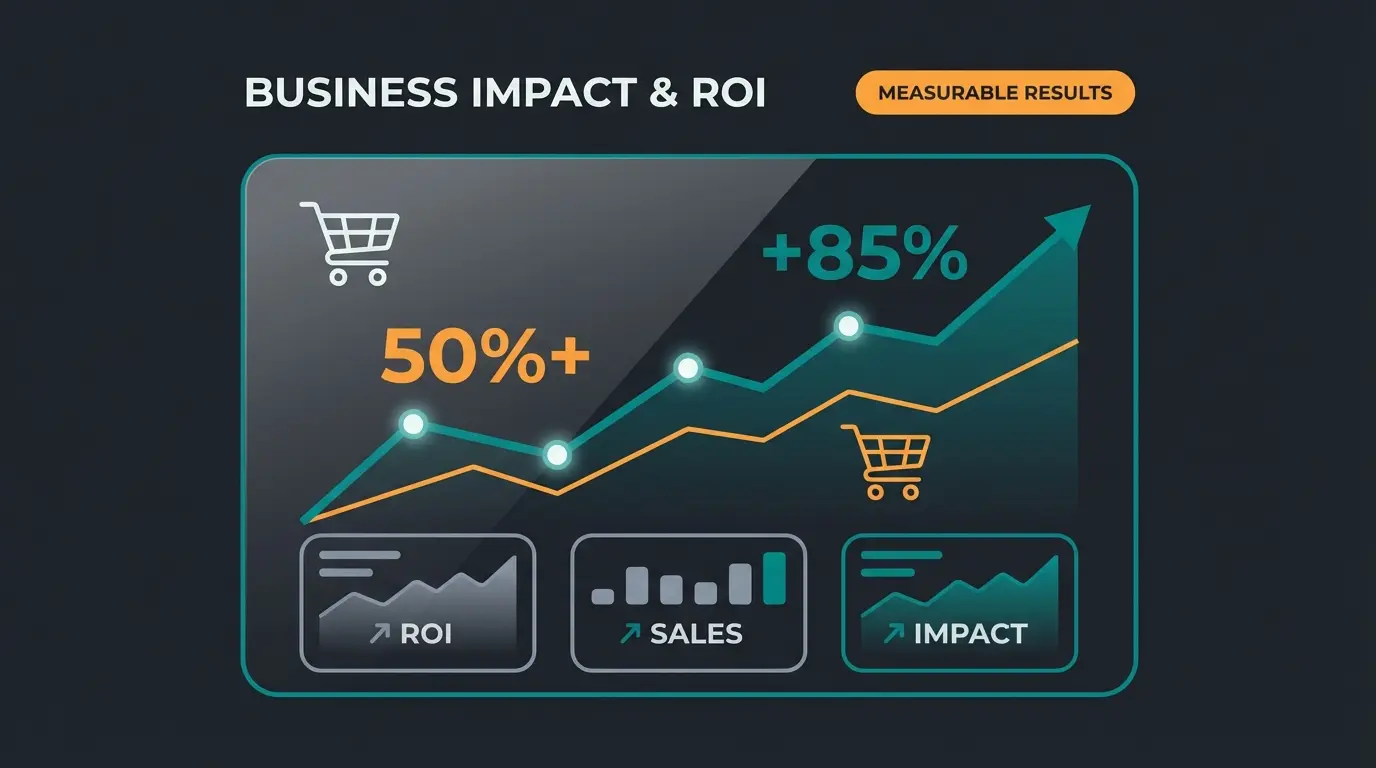
Measuring ROI: Is the Investment Worth It?
Many agencies sell AI as "innovation." You should see it as "investment." How do you measure success?
Don't rely on vanity metrics like "number of chats." According to research from ecomposer.io and popupsmart.com, focus on these KPIs:
- Conversion Rate Uplift: Compare users who interacted with the AI to those who didn't. (Benchmark: Users with AI interaction often convert 3-4x more frequently).
- Average Order Value (AOV): Does the AI manage to increase cart value through cross-selling (e.g., "These socks go perfectly with that")?
- Return Rate: Do returns decrease in categories where the AI provides consultation?
- Time on Site: Longer dwell time indicates more intensive engagement with the product.
Typical uplift for users engaging with AI consultation
Average order value improvement through smart cross-selling
Fewer returns when AI helps match products to needs
The AI Tech Stack for Modern E-Commerce Stores
To beat text-heavy competitor pages, you need to understand how different AI tools fit together in a cohesive strategy. According to praella.com and crodweb.com, the future belongs to agentic AI systems that can operate autonomously.
Shopify Core (Hosting, Checkout) + Native AI (Magic/Sidekick) – Your essential infrastructure
Consent Manager (OneTrust, Cookiebot) + DPA Contracts – Critical for European markets
Klaviyo (Email AI) + Meta Ads AI – Driving qualified traffic to your store
AI Sales Consultant – Replaces search & filters with intelligent product guidance
Helpdesk (Gorgias/Zendesk) – Handling after-sales inquiries efficiently
Conclusion & Outlook: The Future is Agentic
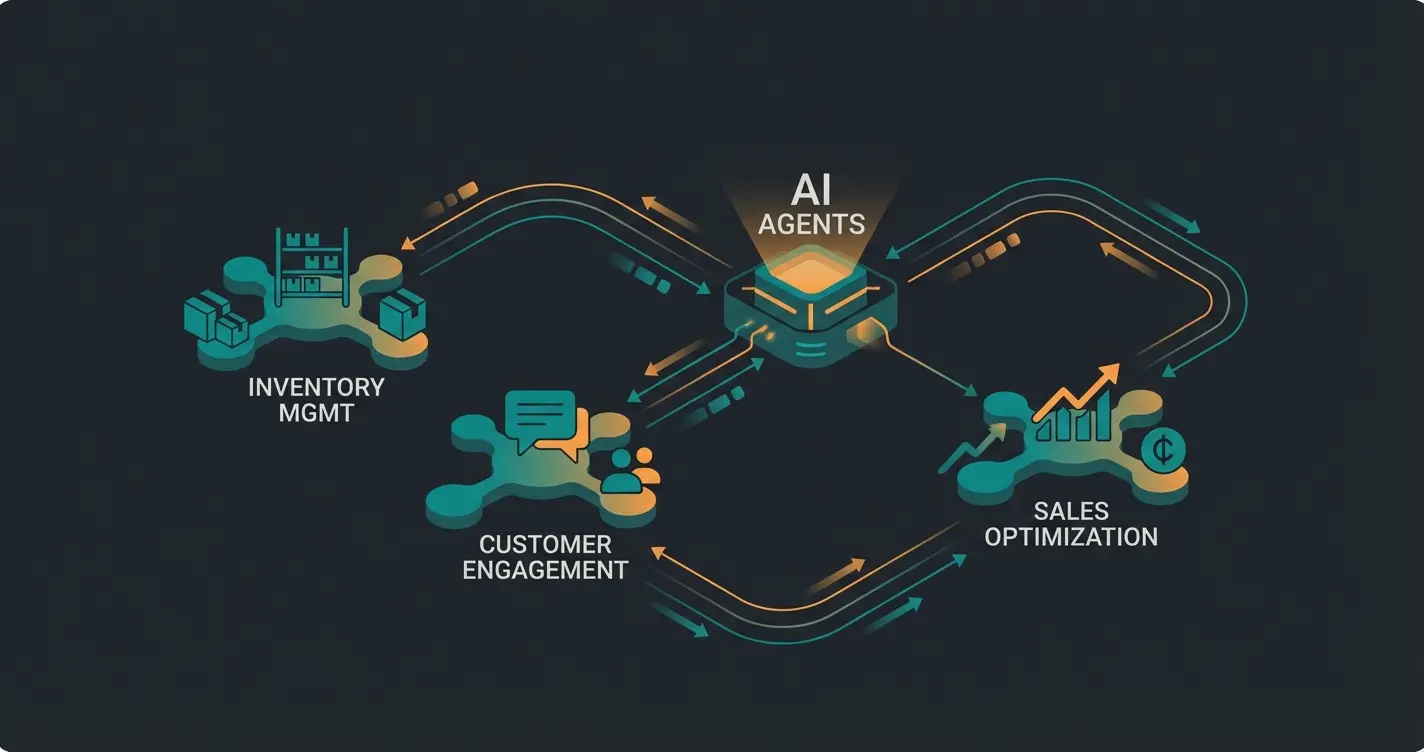
We're just at the beginning. In 2025, we're seeing the rise of Agentic AI. This means: AI agents that don't just talk but act.
- An agent that independently notices when a product is going "Out of Stock" and prepares the reorder
- An agent that notices when a customer is hesitating and automatically offers them a time-limited discount to close the sale
Summary:
- Use Shopify Magic & Sidekick for your internal efficiency – they're free and powerful
- Pay meticulous attention to GDPR compliance (servers, DPA contract) – especially for European customers
- The biggest lever lies not in support but in proactive sales consultation (Level 3)
Frequently Asked Questions About Shopify AI
Yes, Shopify Magic and Sidekick are included in all Shopify plans at no additional cost. They form the foundation of Shopify's native AI capabilities and include features for product descriptions, email generation, and image editing.
A support chatbot is reactive – it waits for customers to ask questions about orders, returns, or FAQs. An AI sales consultant is proactive – it engages customers, understands their needs, and recommends products like a human salesperson, directly driving conversions rather than just deflecting tickets.
Sign a Data Processing Agreement (DPA) with every AI app provider, implement proper consent management through cookie banners, choose tools that offer session-based anonymous processing, and explicitly mention AI usage in your privacy policy. Also verify where customer data is processed and stored.
Yes, studies show that customers who interact with AI product consultants convert 3-4x more frequently than those who don't. The key is using proactive, consultative AI (Level 3) rather than basic support bots (Level 2).
Start with Shopify's free native tools (Magic & Sidekick) for productivity. Then add a consent management tool for compliance. The highest ROI typically comes from investing in an AI sales consultant for the on-site experience, which directly impacts conversion rates and revenue.
Stop treating your store like a static catalog. Turn it into an interactive flagship experience with AI-powered sales consultation. See measurable results in conversion rates and average order value.
Get Started Today
Lasse is CEO and co-founder of Qualimero. After completing his MBA at WHU and scaling a company to seven-figure revenue, he founded Qualimero to build AI-powered digital employees for e-commerce. His focus: helping businesses measurably improve customer interaction through intelligent automation.