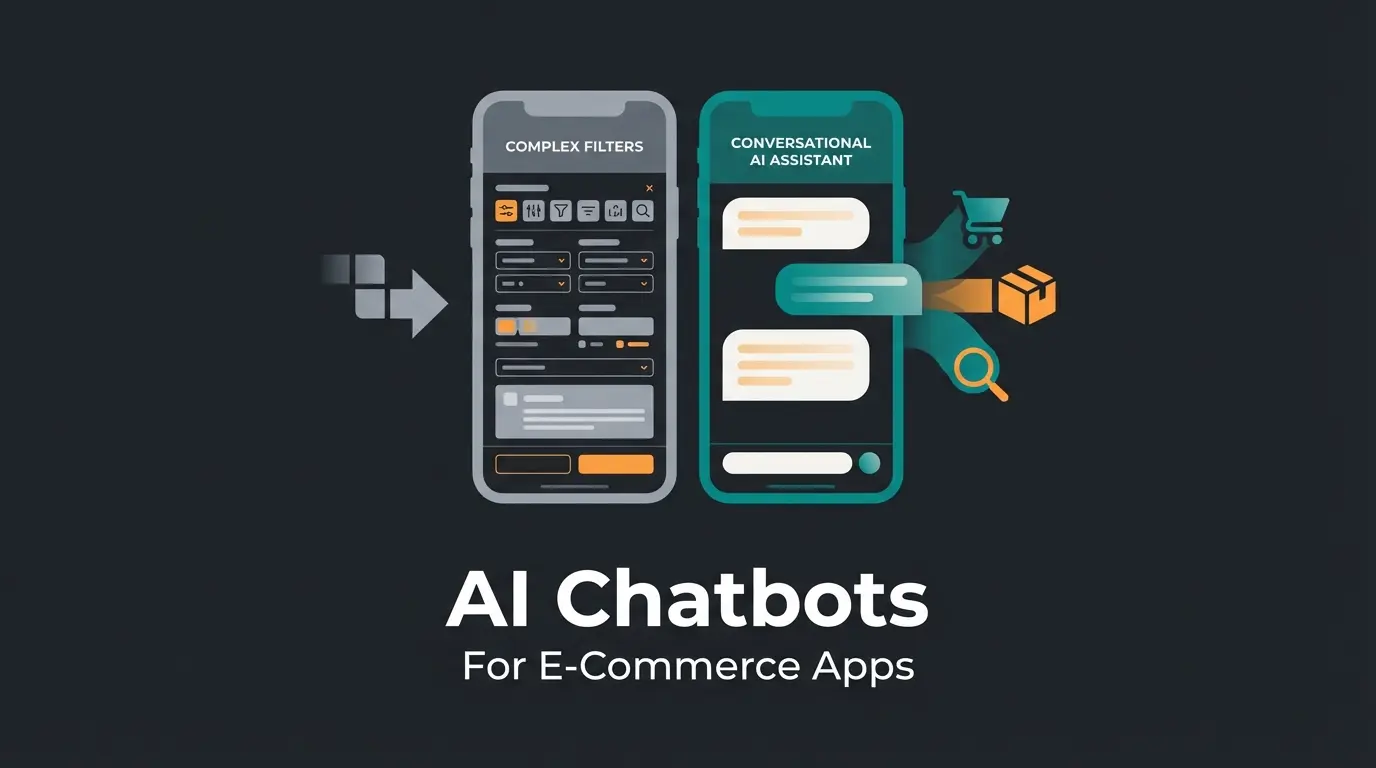
Website Chatbot: Why Simple FAQ Bots Fall Short in 2025
Discover why website chatbots must evolve from FAQ bots to AI product consultants. Learn integration strategies, GDPR compliance & boost conversions by 67%.

Introduction: The End of the Dumb Search Bar
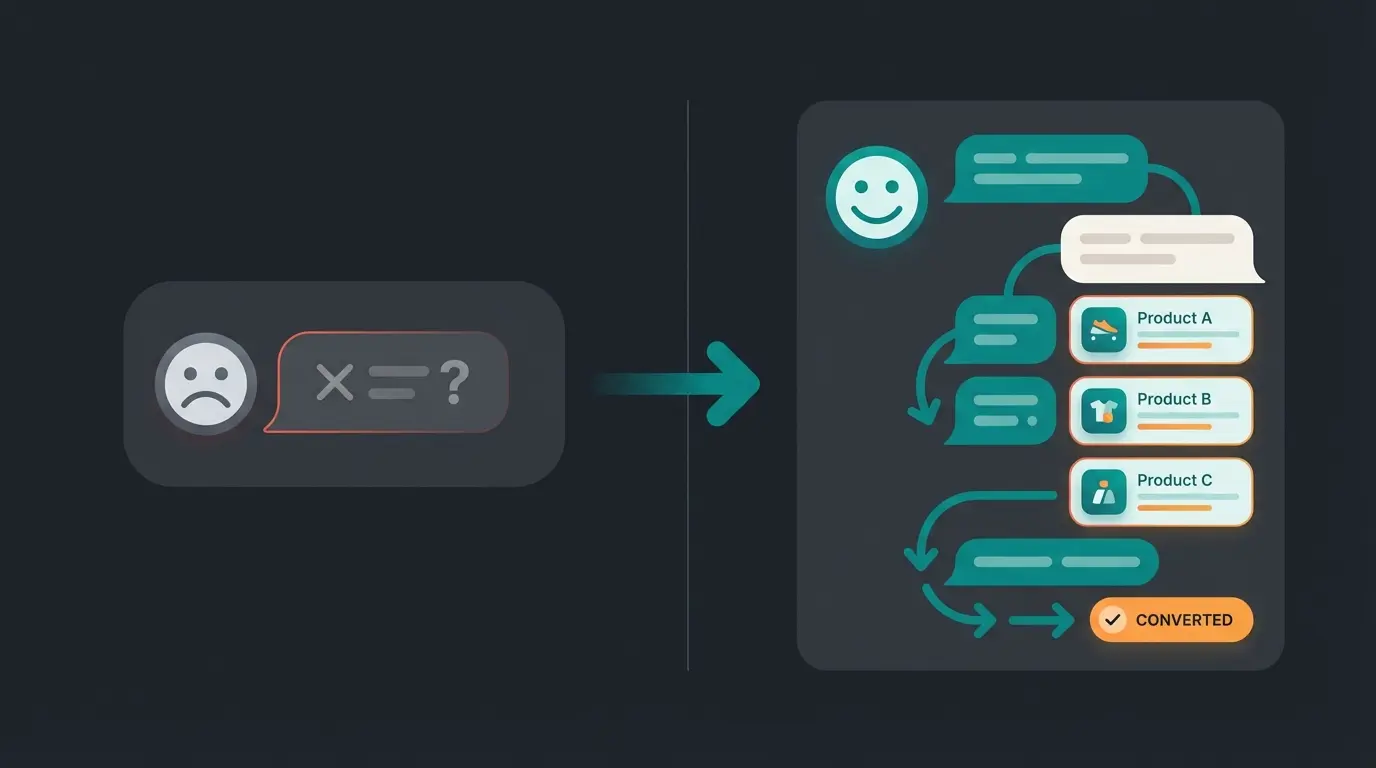
It's a scenario we all know: You visit a website with a specific question about a product, and a friendly window pops up in the bottom right corner. "How can I help?" asks the website chatbot. Full of hope, you type your question. The answer? A link to an FAQ page that only half-heartedly addresses your question, or—even worse—the message: "I'm sorry, I didn't understand that."
For a long time, chatbots on websites were little more than glorified search bars or frustrating barriers designed to prevent users from calling expensive human support. But 2025 marks a turning point.
The technology has fundamentally transformed. While many companies still rely on simple rule-based bots that drive customers away rather than engage them, a quiet revolution is happening in the background: The rise of the AI product consultant. According to IMARC Group, the German chatbot market is projected to exceed $1.6 billion by 2033, driven primarily by e-commerce growth and the demand for efficient customer service.
In this article, you'll discover why the classic support bot has become obsolete and how you can adapt your website chatbot strategy so it doesn't just save costs but actively generates revenue. We'll show you how to bridge the gap between anonymous online shopping and personal in-store consultation—fully automated, privacy-compliant, and available around the clock. Modern AI digital consultants represent this new paradigm shift in customer engagement.
Basics: What Is a Modern Website Chatbot Really?
Before we dive into strategy, we need to clarify the terminology. When we talk about a chatbot for websites today, we no longer mean the simple scripts from five years ago.
The Evolution of Chatbot Technology
To understand why some bots fail while others break sales records, it's worth examining the technological development:
- Rule-based Bots (The Past): These systems work like a decision tree. Users click on pre-made buttons ("Shipping," "Returns," "Pricing"). If the user deviates from the path, the bot is helpless. They're rigid, inflexible, and often feel robotic.
- NLP Support Bots (The Present): These bots use Natural Language Processing (NLP) to understand free text. They recognize keywords like "invoice missing" and deliver the appropriate response from the database. They're helpful for service but passive in nature.
- Generative AI & Product Consultants (The Future/Your Niche): This is where modern AI (like LLMs) comes into play. These bots understand context, nuances, and can draw logical conclusions. They don't wait for questions but lead conversations to determine customer needs—exactly like a skilled salesperson in retail, as noted by Aivanti.
Button-based logic trees with rigid, frustrating user experiences and frequent dead ends
FAQ-focused bots using natural language processing—reactive and waiting for questions
Proactive sales assistants using generative AI to guide customers toward purchase decisions
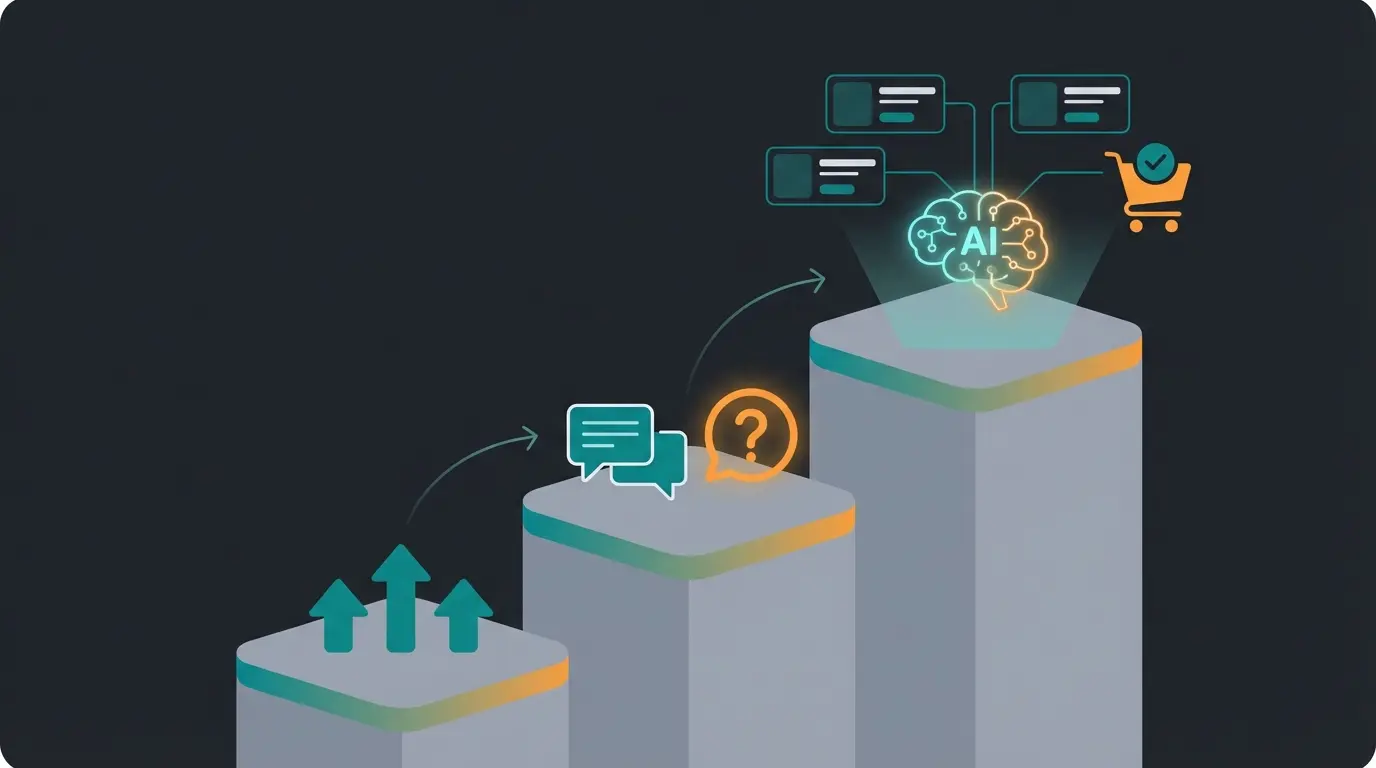
The 3 Levels of Chatbot Intelligence
For your chatbot website strategy, it's crucial to decide where you want to position yourself. We distinguish three maturity levels that define how your Consultative AI solution interacts with customers:
- Level 1: The Navigator — Function: Wayfinder. Dialog: "Click here for the price list." Value: Minimal. Only saves the user a few clicks in the menu.
- Level 2: The Supporter — Function: Problem solver (Reactive). Dialog: "Your order has been shipped and will arrive tomorrow." Value: Medium. Reduces support costs but rarely increases revenue.
- Level 3: The Consultant (Your Goal) — Function: Sales advisor (Proactive). Dialog: "For a living room of 270 square feet, I recommend Speaker X over Y because it fills the room sound better without booming." Value: High. Massively increases conversion rates and average cart value.
Why Product Consultation Is the New Standard
The e-commerce market is fiercely competitive. Customers are more informed than ever but also more overwhelmed. The selection is enormous. This is precisely where the problem lies: Most online shops leave their customers alone with this selection.
The Problem of "Silent Shelves"
Imagine walking into a specialty store for running shoes. The shelves are full, but no salesperson is in sight. You have to dig through the boxes yourself, read labels, and hope the shoe fits. This is the reality on most websites—even those with a search function.
A chatbot homepage element that functions as a product consultant changes this dynamic. It approaches the customer proactively: "Are you looking for shoes for asphalt or forest trails?" This approach represents the foundation of proactive Guided Selling that transforms passive browsing into active purchasing.
Data Doesn't Lie: The Business Case for Consultation
Integrating a consultative chatbot isn't a gimmick—it's a hard economic decision. Current market data for 2024 and projections for 2025 impressively confirm this:
Companies using chatbots strategically for sales see average revenue growth according to Exploding Topics
Interactive chatbot dialogs convert up to 3 times better than classic contact forms per Amra and Elma research
Approximately 26% of all sales can be directly attributed to chatbot interactions
Retail and financial services sectors have measured conversion rates up to 70% with AI consultation
According to Exploding Topics, companies deploying chatbots strategically for sales record an average revenue increase of 67%. Meanwhile, research from Amra and Elma and IvyForms shows that while classic contact forms often achieve conversion rates of only 3–5%, interactive chatbot dialogs convert up to 3 times better. In specific industries like retail and financial services, conversion rates of up to 70% have been measured.
Furthermore, Conferbot research indicates that approximately 26% of all sales can be directly attributed to chatbot interactions. Modern buyers are impatient. Chatbots respond instantly, while forms often require hours or days for a response. This speed is crucial as attention spans decrease. Implementing AI sales consultants addresses these modern consumer expectations directly.
The Digital Skills Gap
Many markets face skills shortages—including in sales and service. An AI chatbot scales your best sales strategy. It never has bad days, is available 24/7, and can advise 1,000 customers simultaneously without losing quality. It fills the gap left by missing personnel and offers consultation quality that would otherwise only be possible in premium retail environments.
This is where KI E-Commerce solutions truly shine, providing enterprise-grade consultation capabilities to businesses of all sizes. The ability to offer 24/7 product consultation represents a significant competitive advantage in today's always-on marketplace.
Stop losing customers to decision paralysis. Our AI product consultants engage visitors proactively, guide them through product selection, and boost your conversion rates by up to 3x.
Start Your Free TrialGuide: Embedding a Chatbot on Your Website
Many guides on chatbot integration focus only on the technical aspects ("Insert this JavaScript snippet"). However, that's the easy part. The real challenge lies in the conception.
Here's your roadmap for integrating a Sales Assistant:
Step 1: Define the Goal (Sales vs. Support)
Before implementing a single line of code, you must decide: Should the bot reduce tickets (support) or sell products (sales)?
- Mistake: A bot that tries to do both simultaneously often seems schizophrenic.
- Best Practice: Always start the dialog on product pages with a sales intent ("Do you need help choosing the right size?") and on the contact page with a service intent.
Step 2: Technical Integration
The technical hurdle today is minimal. Most modern solutions offer:
- No-Code Integration: A simple JavaScript snippet inserted into the `<head>` or `<body>` section of your website.
- Plugins: Ready-made integrations for WordPress, Shopify, Shopware, or Magento.
- Design Customization: The bot must look like part of your brand (colors, logo, tone of voice), not like a foreign element.
Step 3: The Knowledge Base (The Bot's Brain)
This is where the wheat separates from the chaff. A support bot is fed with FAQs. However, a product consultant requires different data:
- Product Data Feed: The bot needs access to your current inventory, prices, and variants.
- Consultation Knowledge: This is the "gold." You must teach the bot how a salesperson thinks. Not: "Product X has 500 watts." But rather: "If the customer has a room over 320 square feet, recommend Product X because 500 watts are necessary for that space."
Working with digital product consultants means equipping them with the contextual intelligence that transforms generic responses into personalized recommendations.
Step 4: Conversation Design (Prompt Engineering)
Don't rely on standard greetings. Your active product advice strategy should begin with the very first message:
- Bad: "Hello, how can I help?" (Too open, the user has to think).
- Good: "Hello! Are you looking for a gift today or something for yourself?" (Gives direction, starts the consultation process).
Decide between sales focus (conversion) or support focus (ticket reduction)—don't try both at once
Implement via no-code JavaScript snippet, CMS plugin, or platform integration
Feed product data, inventory, and consultation logic—not just FAQs
Create proactive opening messages that guide users into the consultation flow
Comparison: FAQ Bot vs. AI Product Consultant
To make the difference tangible, let's compare the classic approach with the modern "Consultant" approach. Use this table to argue internally why you should invest in a smarter solution.
| Feature | Classic Support Bot (Old Gen) | AI Product Consultant (New Gen) |
|---|---|---|
| Primary Goal | Cost reduction (avoid tickets) | Revenue increase (conversion) |
| Interaction Mode | Reactive (waits for questions) | Proactive (approaches customers) |
| Data Foundation | Static FAQs & text blocks | Product data, inventory & customer context |
| Conversation Flow | Rigid, linear, often dead ends | Dynamic, context-aware, guiding |
| User Outcome | "Here's a link to the help page." | "I recommend Model X because it fits your needs." |
| Key Metric | Ticket deflection rate | Conversion rate & cart value |
A Practical Example
Scenario: A customer is searching on a bicycle website.
This is the power of digital sales consultants in action—transforming confused browsers into confident buyers through intelligent conversation design.
Best Practices for GDPR Compliance & Trust
The European market operates differently than the US. While convenience often trumps all in America, in Europe and especially Germany, trust is the hardest currency. A chatbot for website project can quickly fail in these markets if data protection (GDPR) is ignored.
Data Protection as a Competitive Advantage
Don't hide your GDPR compliance in the fine print. Make it a feature. Studies show that consumers are skeptical: According to KPMG research, while 66% use AI tools, only 32% fully trust the information they receive. Transparency provides the remedy.
The GDPR Checklist for 2025
- Server Location: Use providers that host data in the EU (ideally Germany or your home country). This is a knockout criterion for many European companies, as emphasized by Moin.ai's data protection guidelines and Pexon Consulting.
- Data Processing Agreement (DPA): You must conclude a DPA with the chatbot provider, as required by Lime Technologies.
- Transparency & Consent: The user must know before entering data that they're communicating with an AI (EU AI Act transparency requirement). Obtain active consent (e.g., via cookie banner or directly in the chat window before starting) before processing personal data.
- Right to Erasure: Your system must be technically capable of immediately and irrevocably deleting a specific user's chat history upon request, as outlined by E-Recht24.
- Data Minimization: Only request data that's truly necessary for the consultation. A product consultant doesn't necessarily need the customer's last name to recommend a laptop.
When implementing consultative AI solutions, GDPR compliance should be viewed as a trust-building feature rather than a mere legal requirement. Solutions with active product consultation capabilities must prioritize data protection to succeed in privacy-conscious markets.
Closing Strategic Gaps: What Competitors Miss
If you analyze the top search results on Google, you'll mostly find lists of tools ("The 10 Best Bots"). What's missing is the strategy. A tool is only as good as the concept behind it. Understanding the landscape requires leveraging AI product consultation expertise that goes beyond simple feature comparisons.
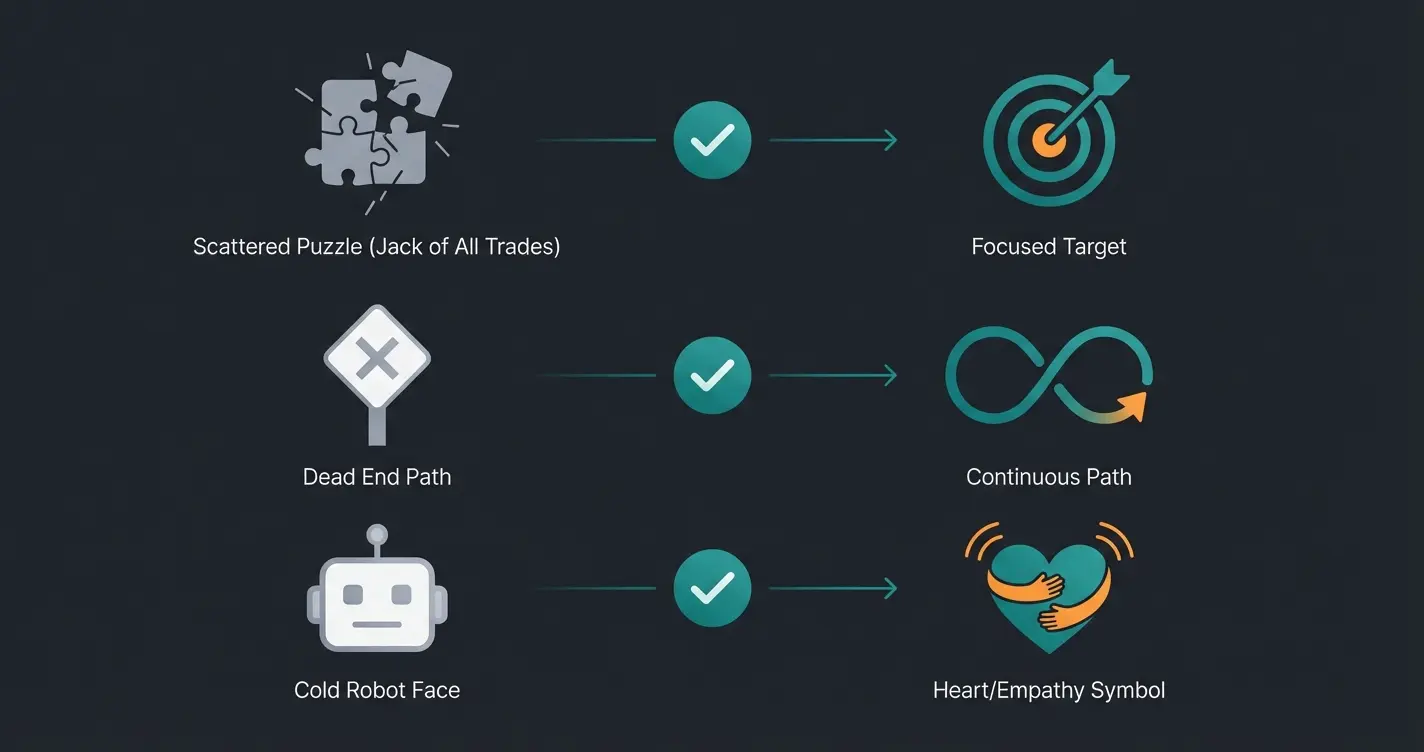
Mistake 1: The "Jack of All Trades"
Don't try to build a bot that replaces the CEO, runs support, and sells. Start focused. A specialized "Gift Finder Bot" for Christmas is often more successful than a generic "Ask Me Anything" bot. Focus creates clarity for both your team and your customers.
Mistake 2: The Dead End
Every conversation must have a goal. When the bot has recommended a product, the next step must be clear: "Should I add the product to your cart for you?" or "Would you like to see matching accessories?" Don't leave the customer alone after the consultation. Every interaction should move toward conversion.
Mistake 3: Missing Humanity
Even though we know it's a machine, we respond positively to empathy. A bot that responds to the complaint "My package is damaged" with only "Please enter the order number" seems cold. An AI bot that says: "Oh, that's very frustrating, I'm sorry. Let's sort this out immediately. What's your order number?" de-escalates the situation immediately and builds trust.
Conclusion: From Hold Music to Top Salesperson
The era of dumb chatbots that only cost nerves is over. Anyone searching for website chatbot in 2025 shouldn't be looking for a cheap support solution but for a lever for more revenue.
The technology is mature. Generative AI enables us to transfer the experience of an excellent sales conversation in a brick-and-mortar store to the digital world—scalable, around the clock, and in any language. According to Mintel's consumer research, the market is growing rapidly, and user acceptance is increasing—especially among younger demographics who already use AI daily. Insights from Sobot and Hachly AI confirm that 2025 is the year for businesses to embrace AI-powered sales consultation.
Summary of Next Steps
- Change Your Mindset: View the chatbot as an employee in sales, not in IT support.
- Set Your Focus: Start with product consultation (Guided Selling) instead of just mapping FAQs.
- Secure Trust: Rely on GDPR-compliant solutions with European data hosting.
- Measure & Optimize: Measure success not by the number of chats but by generated revenue.
Leverage this advantage. Transform your website from a silent catalog into an active sales floor. The companies that embrace AI product consultation now will be the market leaders of tomorrow.
Frequently Asked Questions (FAQ)
Costs vary significantly. Simple plug-and-play solutions start at around $50–100 per month. Professional AI sales bots deeply integrated with your product data typically range from $500 to several thousand dollars monthly, but usually pay for themselves quickly through increased revenue. Enterprise solutions with custom development may cost more but deliver proportionally higher ROI.
Yes, if configured correctly. The important factors are: server location in the EU, a Data Processing Agreement (DPA), transparency notice before chat begins, and the ability to delete data upon request. Look for providers that prioritize privacy-by-design principles and offer clear documentation of their compliance measures.
It shouldn't replace them but relieve them. The bot handles repetitive questions and initial consultation (qualification), so your human employees can focus on complex cases and closing high-ticket sales. Think of AI as augmentation, not replacement—it makes your team more effective.
E-commerce (fashion, electronics, furniture), real estate, financial services, and B2B SaaS companies benefit particularly strongly, as the consultation need is high in these sectors. Any industry where customers face complex decisions or extensive product catalogs can see significant improvements from AI-guided consultation.
Basic implementations can go live within days using no-code solutions. More sophisticated integrations with deep product data connections typically take 2-4 weeks. Enterprise deployments with custom training and extensive knowledge bases may require 1-3 months for optimal results.
Join leading e-commerce brands using AI product consultation to achieve 67% revenue growth. Our GDPR-compliant solution integrates in minutes and starts delivering results from day one.
Get Started Free Today
Lasse is CEO and co-founder of Qualimero. After completing his MBA at WHU and scaling a company to seven-figure revenue, he founded Qualimero to build AI-powered digital employees for e-commerce. His focus: helping businesses measurably improve customer interaction through intelligent automation.