The Digital Transformation of E-Commerce Consulting
The digital transformation in e-commerce is advancing rapidly. According to current data from Statista, 30% of German B2C companies already fully deploy artificial intelligence in their e-commerce activities. This development clearly shows that AI-powered consulting is no longer a future vision but a lived reality in online retail.
The significance of personalized customer consulting continues to grow steadily. Online shops face the challenge of offering their customers competent advice around the clock. Modern AI systems now enable this consulting at a level that comes very close to personal conversation. But here's the critical distinction that most articles miss: there's a fundamental difference between AI that answers support questions and AI that actively sells products.
The central challenges for online retailers lie in balancing automation with human expertise. Customers today expect a seamless consulting experience—regardless of whether they interact with an AI system or a human advisor. The integration of AI technologies into existing consulting processes therefore requires a well-thought-out concept that goes beyond simply deploying a generic chatbot.
The Empty Store Syndrome: Why Customers Leave Without Buying
Picture this scenario: A customer enters a physical store looking for a new camera. Within seconds, a knowledgeable salesperson approaches, asks about their photography interests, budget, and experience level, then guides them to the perfect product. Now imagine the same customer browsing an online shop. They face hundreds of cameras, dozens of filters, and zero personalized guidance. This is the 'Empty Store Syndrome'—and it's costing online retailers millions in lost sales.
Traditional online consulting relied for a long time on rigid FAQ systems and simple chatbots. These systems quickly reached their limits when dealing with more complex consulting situations. Modern AI-powered product consulting offers completely new possibilities for customer interaction—not by answering questions reactively, but by proactively guiding customers toward the right purchase decision.
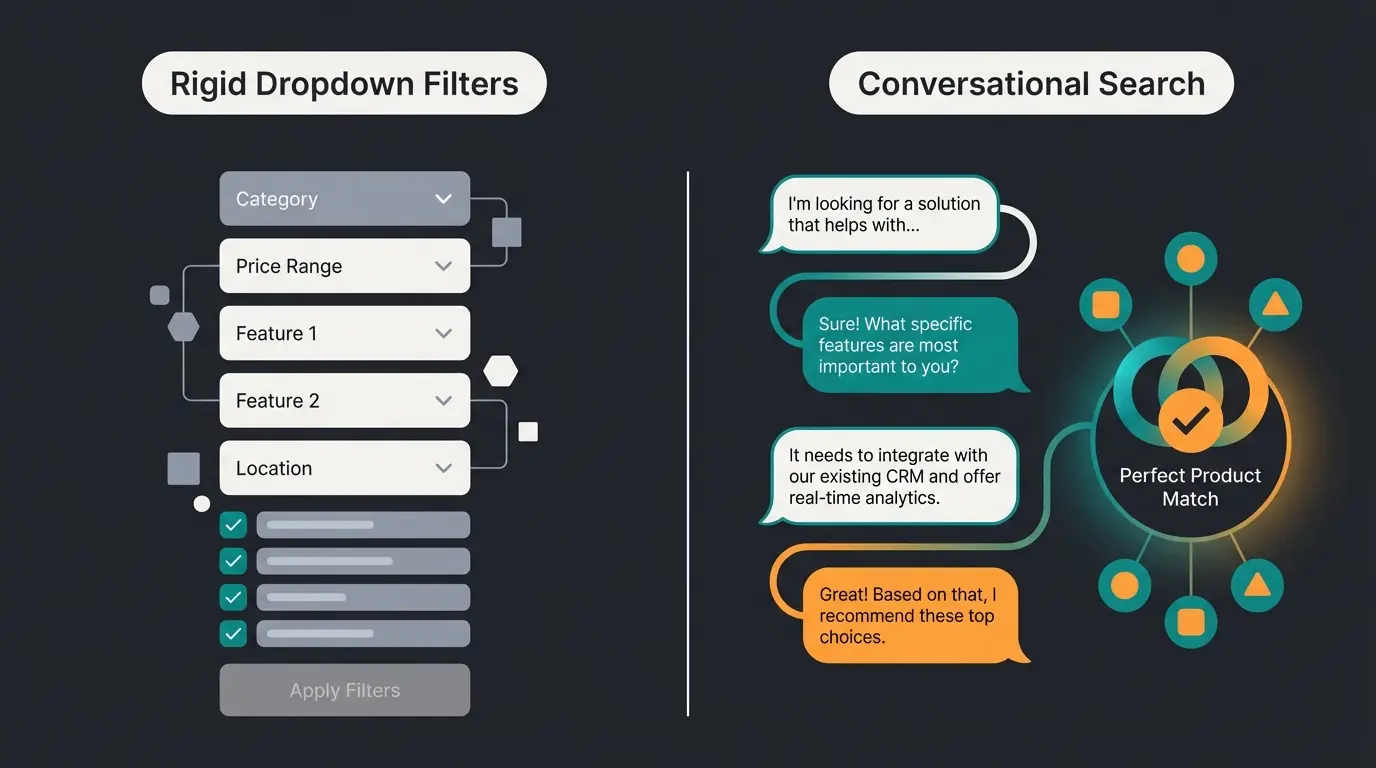
The technical developments in e-commerce consulting have made enormous progress in recent years. AI systems can now precisely analyze customer needs and make tailored recommendations. They continuously learn from every interaction and steadily improve their consulting quality. But the key shift isn't just technological—it's philosophical: moving from 'search and filter' to 'dialogue and consult.'
Basic keyword matching with limited relevance
Category-based filtering requiring customer knowledge
'People who bought X also bought Y' - statistical correlations
Dialogue-based guidance understanding actual needs, not just behaviors
The 3 Biggest Problems of Today's Online Shops
Understanding why traditional e-commerce approaches fail is essential before implementing AI solutions. Three core problems consistently undermine conversion rates and customer satisfaction.
Problem 1: Customers Browse Alone Without Help
In comparison of different consulting models, one thing becomes clear: most online shops treat every visitor identically, regardless of their expertise, preferences, or buying intent. A first-time camera buyer and a professional photographer see the same product listings, the same filters, and receive zero personalized guidance. The combination of AI technology and human expertise achieves the best results. While AI systems handle standard inquiries quickly and efficiently, human advisors can focus on complex cases that require special attention.
Problem 2: Choice Overload from Deep Product Ranges
The potentials of AI integration are impressive. Online shops record significant increases in their conversion rates through the use of intelligent consulting systems. Customer satisfaction rises while consulting costs simultaneously decrease. This development makes AI-supported consulting an important competitive factor in modern e-commerce. But without proper guidance, extensive product catalogs become a liability rather than an asset. Customers facing 500 bicycle options without expert guidance don't feel empowered—they feel overwhelmed and leave.
Problem 3: Static Filters vs. Real Customer Needs
Traditional product filters are rigid and require customers to already know what they want. A customer searching for 'a bike for weekend rides' can't express this need through dropdown menus for wheel size, frame material, or gear count. They need a conversation that translates their lifestyle into product specifications—exactly what AI consultation provides.
Sales AI vs. Support Chatbots: The Critical Distinction
This is where most AI e-commerce articles fail their readers. They lump all chatbots into 'customer service' without explaining the fundamental difference between a reactive FAQ bot and a proactive Sales Consultant AI. Understanding this distinction is crucial for making the right investment decision.
| Feature | Support Chatbot | Sales/Consultation AI |
|---|---|---|
| Primary Goal | Resolve tickets, answer FAQs | Guide purchases, increase conversions |
| Interaction Style | Reactive - waits for questions | Proactive - asks clarifying questions |
| Knowledge Base | FAQs, policies, order status | Deep product data, compatibility rules, use cases |
| Key KPI | Time-to-resolution, ticket deflection | Conversion rate, average order value |
| Customer Query | 'Where is my package?' | 'Which camera is best for me?' |
| Response Type | Direct answer or link to FAQ | Needs assessment followed by tailored recommendation |
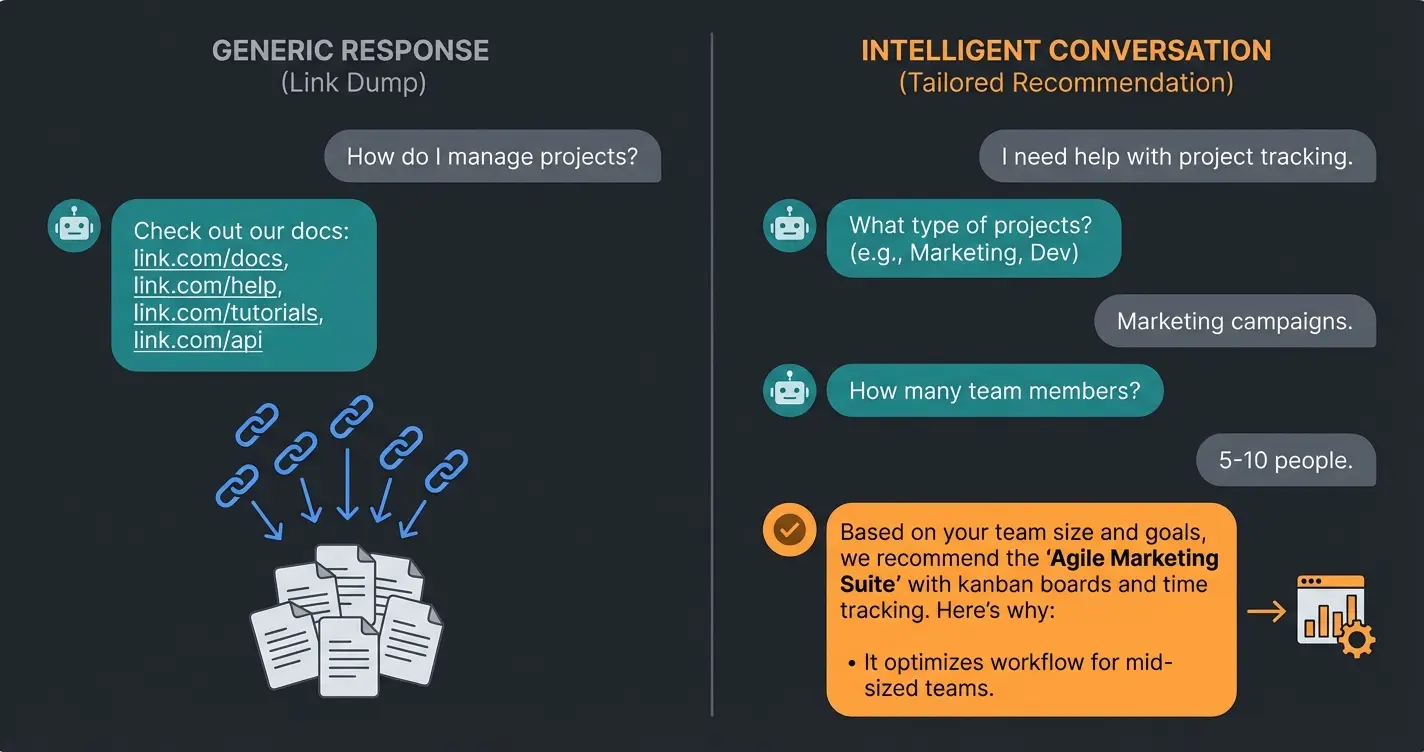
A generic chatbot excels at telling customers their package will arrive Tuesday. But ask it 'Which running shoe is best for flat feet and marathon training?' and it fails spectacularly—either returning a generic product listing or, worse, confidently recommending the wrong product. True AI consultation understands needs, not just keywords.
What Is AI in E-Commerce Really? Beyond ChatGPT Hype
The AI use cases in European e-commerce show that 56% of European online retailers use AI for customer analysis. These technologies form the basis for modern consulting in online shops. But understanding the landscape requires distinguishing between different AI applications.
Generative AI vs. Domain-Specific Expert Systems
Generic AI tools like ChatGPT can write product descriptions and answer general questions. But they lack the deep product knowledge required for accurate consulting. A true AI product consultant isn't just a language model—it's an expert system that understands technical specifications (bicycle components, skincare ingredients, camera sensors) and translates them into customer benefits. This is the difference between AI that sounds helpful and AI that actually sells products.
Machine Learning for Individual Customer Approach
Machine learning algorithms analyze customer behavior in real-time and create precise user profiles. These profiles are based on purchase history, browsing behavior, and demographic data. The AI evaluates this information and automatically adapts the consultation. But the crucial advancement is moving beyond 'people who bought X also bought Y' to understanding why they bought it and whether that reasoning applies to the current customer.
Natural Language Processing in Practice
Modern automated customer consulting uses Natural Language Processing (NLP) to understand customer inquiries and respond contextually. The systems recognize emotions, intentions, and linguistic nuances. They can engage in small talk while simultaneously providing targeted advice. This enables the shift from search-based to conversation-based product discovery.
Benefits of AI-Powered Product Consulting
AI systems process large amounts of data to suggest suitable products. They take into account multiple factors simultaneously, creating a consulting experience that no static filter system can match.
Conversion Rate: Turning Browsers into Buyers
The key to conversion optimization lies in removing doubt at the moment of decision. When a customer understands exactly why Product A suits their specific needs better than Products B, C, and D, they buy with confidence. AI consultation provides the reasoning that transforms 'maybe later' into 'add to cart.'
Average Order Value: Intelligent Upselling
Traditional recommendation engines suggest products based on statistical correlations—often irrelevant or annoying upsells. AI consultation recommends based on compatibility and genuine value enhancement. A customer buying a DSLR camera receives suggestions for a compatible lens that matches their stated photography interests, not just the most popular accessory.
Customer Satisfaction: Feeling Understood
There's a profound difference between being processed and being understood. When AI asks 'What will you primarily photograph—sports, portraits, or landscapes?' before recommending a camera, customers feel heard. This emotional connection translates directly into higher NPS scores and repeat purchases.
After AI consultation implementation
Average time per consultation
Increase in average basket size
Customer satisfaction score increase
See how intelligent product consulting can boost your conversion rates by 25-35% while reducing support costs.
Start Your Free TrialHow AI Purchase Consultation Actually Works
Understanding the practical mechanics of AI consultation helps distinguish genuine solutions from marketing hype. Here's a walkthrough of a real user journey.
Practical Example: From Vague Need to Perfect Product
Customer inquiry: 'I need a bike for weekends.' A traditional search returns 347 bicycles. A filter system asks for wheel size (customer doesn't know). But AI consultation starts differently:
- AI: 'Great! Where do you usually ride on weekends—paved roads, gravel paths, or forest trails?'
- Customer: 'Mostly paved bike paths, sometimes gravel.'
- AI: 'How far do you typically ride? Under 20km, 20-50km, or longer distances?'
- Customer: 'Usually around 30km, sometimes up to 50km.'
- AI: 'Perfect. What's most important to you—comfort for longer rides, speed, or a balance of both?'
- Customer: 'Definitely comfort. I'm not racing anyone.'
- AI presents 3 hybrid/fitness bikes with specific explanations: 'Based on your mixed terrain riding, 30-50km distances, and comfort priority, I recommend the [Bike Model X]. Its upright geometry reduces back strain on longer rides, and the 35mm tires handle both pavement and light gravel well.'
This is the difference between a search engine and a sales consultant. The AI didn't just match keywords—it understood the customer's actual needs and translated them into technical specifications.
Core Elements of AI-Powered Consulting Systems
Data-Based Product Recommendations
AI systems consider multiple factors when making recommendations:
- Similarity: Comparable items based on product features and specifications
- Purchase Behavior: Analysis of purchases by similar customer profiles
- Context: Current season, availability, and trending patterns
- Price Segment: Customer's indicated or inferred budget range
- Compatibility: Technical compatibility with existing purchases or stated equipment
- Use Case Fit: Match between product capabilities and customer's stated needs
Automated Analysis Procedures
The AI conducts continuous analyses to optimize consulting quality. It identifies frequently asked questions, measures customer satisfaction, and recognizes improvement potential. These data help to continuously improve the consultation process. This includes analyzing successful conversation patterns, identifying drop-off points, and A/B testing different recommendation approaches.
Practical Implementation of AI Consulting
Step-by-Step Integration of AI Systems
The integration of AI consulting systems ideally occurs in phases. First, basic functions are implemented and tested. After successful evaluation, extended features follow. This step-by-step approach minimizes risks and enables continuous adjustments.
Implement basic product Q&A and simple recommendations
Add needs assessment dialogues and personalization
Deploy A/B testing, analyze patterns, refine responses
Expand to complex consultations, integrate human handoff
Combining AI with Human Advisors
AI systems work most effectively in combination with human employees. The AI handles standard inquiries and routine consultations. For complex questions or emotional situations, human advisors take over. This hybrid solution offers optimal consulting quality while maximizing efficiency.
Technical Requirements
For successful AI integration, online shops need a stable technical infrastructure. This includes powerful servers, secure databases, and fast internet connections. The systems must also be compatible with existing shop software—Shopify, Shopware, Magento, WooCommerce, and other major platforms.
Legal Framework and GDPR Compliance
The use of AI in customer consulting is subject to various legal requirements. Particularly important are the General Data Protection Regulation (GDPR), transparency obligations, and customer information rights. Online retailers must consider these requirements during implementation. For the German and European market, hosting within the EU and clear data processing documentation are essential trust signals.
Choosing the Right AI Solution for Your Shop
Selecting the appropriate AI consulting solution requires understanding your specific needs and evaluating options against clear criteria.
Build vs. Buy: Self-Development or Specialized Solutions
Building a custom AI consulting system requires significant investment in development, training data, and ongoing maintenance. Specialized solutions offer faster deployment and proven expertise in e-commerce consulting scenarios. For most shops, the 'buy' approach delivers faster ROI and lower risk.
Critical Evaluation Criteria
When selecting an AI consulting solution, evaluate these factors:
- Domain Knowledge: Does it understand your product category's technical specifications?
- Integration Speed: How quickly can it connect with your shop platform?
- Answer Control: Can you prevent hallucinations and ensure accurate recommendations?
- Scalability: Will it handle peak traffic without degradation?
- Analytics: Does it provide insights into customer needs and conversion patterns?
- Human Handoff: Can it seamlessly escalate to human advisors when needed?
Success Measurement and Optimization
Systematic success measurement forms the foundation for continuous improvement of AI-supported consulting systems. According to current e-commerce benchmarks from HubSpot, online shops with integrated AI consulting solutions show significantly better metrics—averaging 23% higher conversions than traditional consulting approaches.
Central Performance Indicators
Measuring consulting success is based on various KPIs:
- Conversion Rate: Percentage of consulting conversations that result in a purchase
- Consulting Duration: Average time until purchase decision
- Customer Satisfaction: Measured through NPS and direct ratings
- Cart Value: Average order value after consultation
- Recommendation Accuracy: Percentage of accepted AI suggestions
- Escalation Rate: How often human advisors must intervene
Methods for Conversion Optimization
Systematic analysis of user behavior enables targeted optimizations. AI systems continuously learn from successful consulting conversations and adjust their recommendations accordingly. Particularly effective are A/B tests of different consulting approaches and the integration of customer feedback in real-time. Analyzing conversation patterns that lead to purchases versus abandonment reveals specific improvement opportunities.
Economic Analysis
The implementation of AI-supported consulting systems shows measurable economic advantages. Cost savings through automated processes average 40-60% compared to traditional consulting. At the same time, consulting quality increases through constantly available expertise. The ROI typically becomes positive within 3-6 months of implementation.
Documented Success Stories
The practical application of AI consulting systems in e-commerce shows impressive results. A leading electronics retailer was able to increase its conversion rate by 45% through the integration of AI-powered product consulting.
Electronics Retail: 45% Conversion Increase
MediaShop, a major electronics retailer, implemented an AI-based purchasing consultant for complex product categories like cameras, laptops, and home theater systems. The system advises over 5,000 customers daily and achieves customer satisfaction of 92%. Key success factors included deep product knowledge training and seamless integration with inventory systems.
Furniture Retail: Reducing Returns by 40%
A furniture online shop implemented an AI-based interior design consultation. The system analyzes customer preferences and creates personalized furnishing suggestions. The results after 6 months: 30% higher conversion rate, 25% increased cart value, and 40% fewer returns. The AI's ability to help customers visualize products in their spaces dramatically reduced post-purchase regret.
Documented Improvements Across Industries
The furniture chain HomeStyle recorded after introducing their AI consultation:
- Revenue Increase: +32% for consultation-intensive products
- Efficiency Gain: 68% less personnel effort in standard consulting
- Customer Retention: 43% higher repeat purchase rate after AI consultation
Key Learnings from Implementations
Experiences from various e-commerce projects show important success factors:
- Step-by-step integration of AI systems rather than big-bang deployment
- Regular training of the AI with new data sets and product information
- Combination of automated and human consulting for optimal results
- Continuous optimization of dialogue flow based on conversion data
- Clear escalation paths when AI confidence is low
The analysis of successful implementations proves: AI-supported consulting systems demonstrably increase the efficiency and quality of online consulting. They enable scalable, personalized customer care while simultaneously saving costs.
Frequently Asked Questions About AI in E-Commerce
A regular chatbot is reactive—it answers FAQs and handles support queries like 'Where is my order?' AI product consulting is proactive and sales-focused. It asks clarifying questions to understand customer needs, then recommends specific products with clear reasoning. The key difference: support bots resolve tickets, while sales AI drives conversions.
Choose solutions trained specifically on your product data rather than generic language models. Implement confidence thresholds that trigger human escalation when the AI is uncertain. Regularly audit recommendations and maintain a feedback loop where incorrect suggestions are flagged and corrected. The best systems also explain their reasoning, making errors easier to identify.
AI consulting can be fully GDPR compliant when implemented correctly. Key requirements include: hosting within the EU, transparent disclosure that customers are interacting with AI, clear data processing documentation, and providing easy access to human advisors upon request. Look for solutions that explicitly address European data protection requirements.
Implementation timelines vary based on complexity. Basic integration with major platforms (Shopify, Shopware, WooCommerce) can be completed in 2-4 weeks. Training the AI on your specific product catalog adds 2-6 weeks depending on catalog size and complexity. Full optimization typically requires 2-3 months of iteration based on real customer interactions.
Most implementations see conversion rate improvements of 25-35%, average order value increases of 15-20%, and support cost reductions of 40-60%. ROI typically turns positive within 3-6 months. The highest returns come from shops with complex products where customers benefit most from guided consultation—electronics, furniture, sporting goods, and similar categories.
Conclusion: The Future of Dialogue-Based E-Commerce
AI-powered consulting has become a decisive competitive factor for online shops. The numbers speak for themselves: already 50% of German B2C companies rely on AI-supported consulting systems in their e-commerce operations.
The combination of human expertise and AI technology enables a new quality of online consulting. Through AI-powered product consulting, retailers can professionally advise their customers around the clock while significantly reducing costs. But the real transformation isn't about cost savings—it's about revenue generation through better customer experiences.
Central Insights
The most important success factors are:
- Personalization: Individual customer approach through AI analysis of needs, not just behaviors
- Availability: 24/7 consultation without waiting times
- Scalability: Consistent quality with increasing volume
- Integration: Seamless connection of AI and human advisors
- Accuracy: Domain expertise that prevents hallucinations and builds trust
Future Perspectives
Automated customer consulting will continue to develop technologically. Major advances are expected particularly in the area of natural language processing and understanding complex customer inquiries. Visual recognition systems will enable customers to photograph products for instant identification and compatibility checking. Emotional AI will better recognize frustration and satisfaction, optimizing conversation flow in real-time.
AI will not replace humans but rather function as a valuable complement. The technology takes over standard tasks while employees can concentrate on demanding consulting situations. This symbiosis of human and machine will shape the future of online consulting. Successful online retailers are implementing these systems now to capture first-mover advantage in the transition from search-based to dialogue-based e-commerce.
Join leading e-commerce brands using AI-powered product consulting to turn browsers into buyers. See measurable results in weeks, not months.
Get Started Free
Lasse is CEO and co-founder of Qualimero. After completing his MBA at WHU and scaling a company to seven-figure revenue, he founded Qualimero to build AI-powered digital employees for e-commerce. His focus: helping businesses measurably improve customer interaction through intelligent automation.