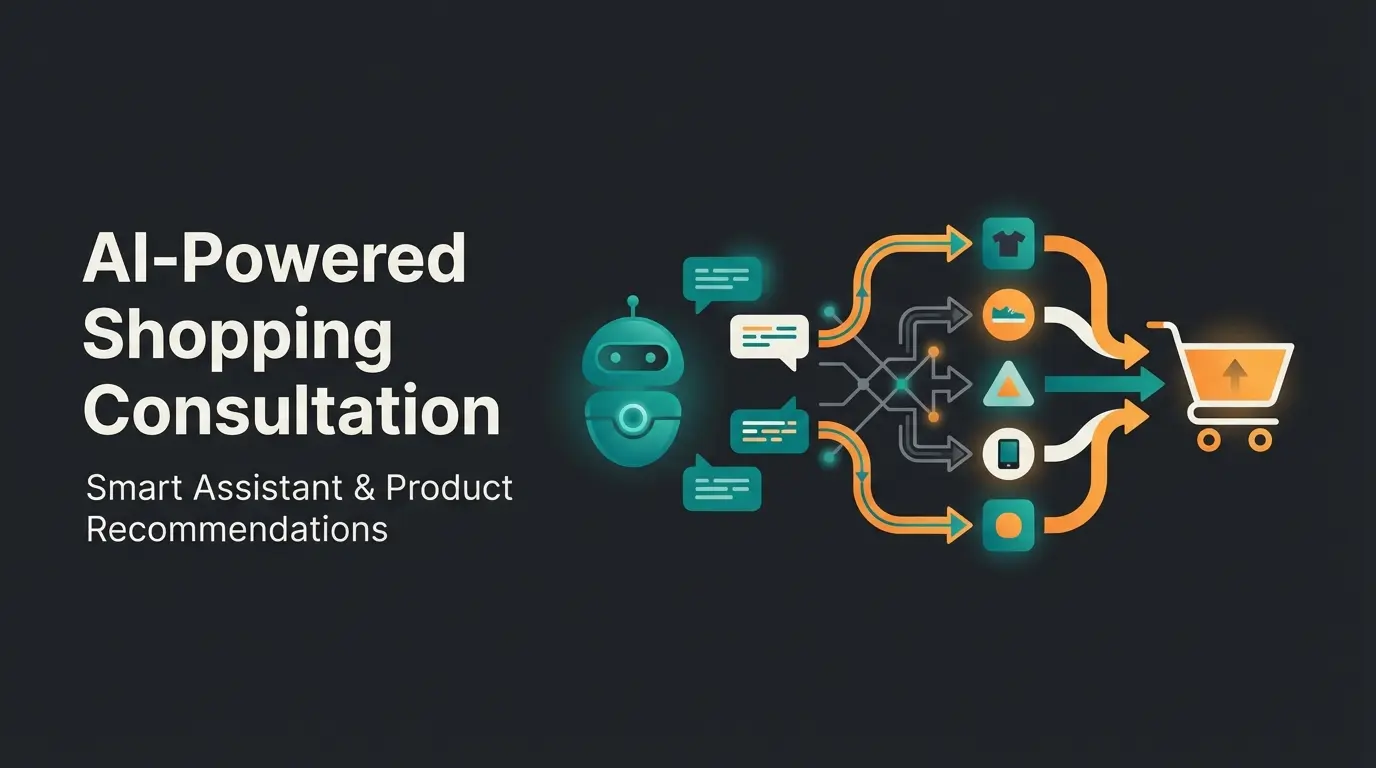
Introduction: The Next Evolution in E-Commerce
When you think of Shopify AI today, you probably have a clear picture in mind: a tool that writes product descriptions in seconds or removes the background from a product photo. That's impressive, it saves time—but it's only the tip of the iceberg.
We're standing at the threshold of a massive transformation in online retail. Until recently, artificial intelligence in e-commerce was primarily about efficiency: How can I save time as a merchant? How can I automate support tickets?
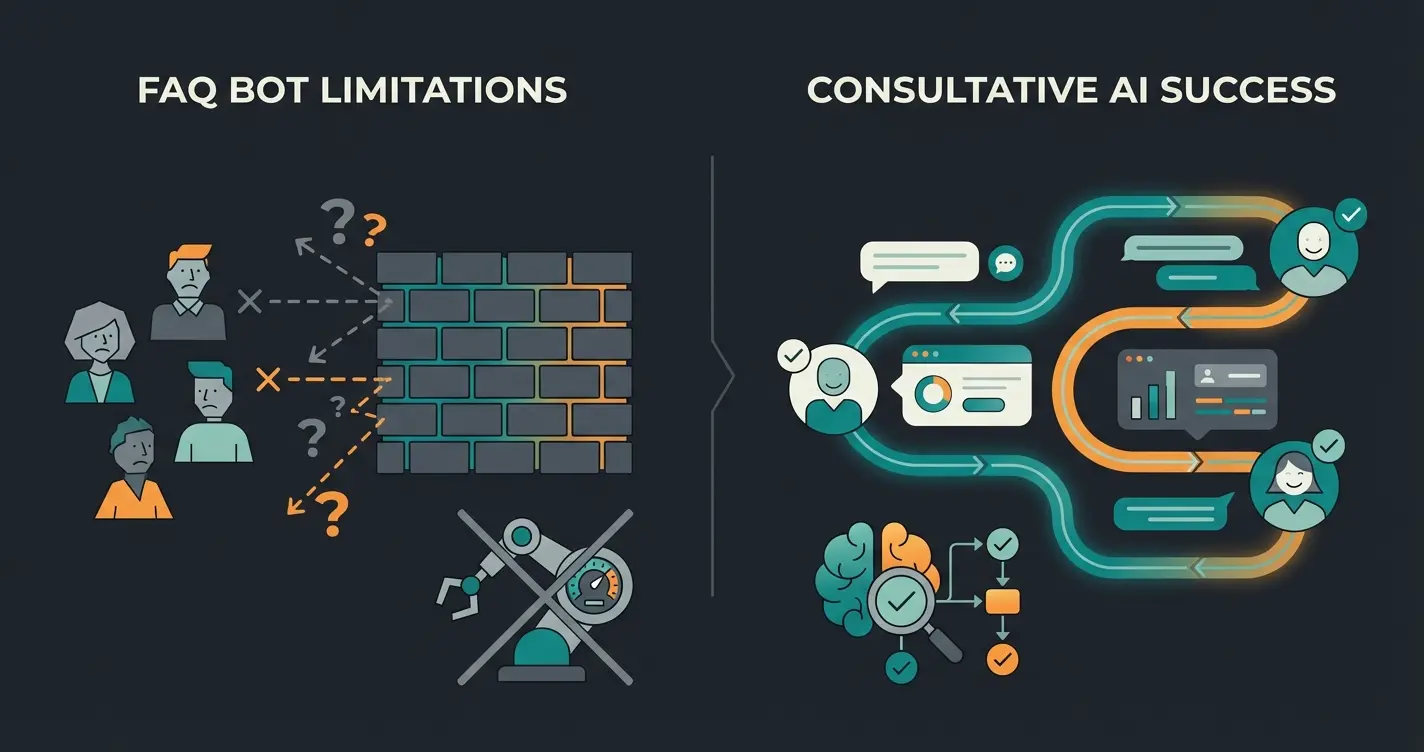
But in 2025 and looking ahead to 2026, the focus is shifting radically from efficiency to effectiveness. It's no longer just about cutting costs, but actively increasing revenue. The problem? Most online shops still use AI like a "digital bouncer." An FAQ bot intercepts customers before they can "bother" anyone.
In this guide, you'll learn why this strategy is outdated and how you can use AI to replicate the experience of a top-tier salesperson in a brick-and-mortar store—GDPR compliant and optimized for international markets.
The Basics: What Shopify Already Offers (Status Quo)
Before we dive into strategy, we need to understand the foundation. Shopify has invested heavily in native AI features. These are available out of the box and form the basis for every modern shop.
What is Shopify Magic?
Shopify Magic is the umbrella term for a suite of AI tools integrated directly into the Shopify admin area. It's not a single product, but rather a collection of helpers based on generative AI.
- Text Generation: Shopify Magic uses Large Language Models (LLMs) to create product descriptions, email subject lines, blog post drafts, and headlines. You enter a few keywords (e.g., "running shoe, waterproof, red") and a tone (e.g., "professional" or "playful"), and the AI delivers the text. According to Shopify's official documentation, this feature significantly reduces content creation time.
- Media Editing: The AI can remove backgrounds from product images or replace them with contextual scenes—a function that previously required expensive photo shoots or Photoshop experts. As demonstrated in YouTube tutorials, this feature streamlines product photography workflows.
- Language Availability: A crucial point for international markets: Shopify Magic's text generation officially supports German, English, Spanish, French, Italian, and several other languages. According to eesel.ai, the multilingual support continues to expand.
What is Shopify Sidekick?
This is where confusion often arises. Shopify Sidekick is not a chatbot for your customers. It's an assistant for you, the merchant.
Think of Sidekick as an extremely competent employee sitting beside you 24/7 with access to all your shop data.
- Function: Sidekick acts as a "Merchant's Assistant." You can ask questions like: "Why did my sales drop last week?" or "Create a discount code for all customers who haven't purchased in 6 months." Sidekick analyzes your data and executes actions in the backend. As reported by Visionz, this significantly reduces administrative workload.
- International Availability: For a long time, Sidekick was only available in English. With the 2025 updates, language support has been massively expanded. According to CXM Today, Sidekick now understands and responds in German and natively supports merchants across Europe. Retail Times and Onlinemarktplatz.de have confirmed the expanded European support.
Standard Shopify AI Features Overview
In summary, Shopify natively offers the following Shopify AI features:
- Content Creation: Text for products, emails, and pages.
- Image Editing: Magic Media Editor.
- Analysis & Control: Sidekick for backend processes.
- Shopify Inbox (Basic): Simple "instant answers" to FAQs (e.g., "Where is my order?").
Simple decision trees, keyword matching, limited responses. Could only handle pre-programmed questions.
Generative AI for content creation, backend efficiency tools, merchant-focused automation.
Active selling, needs assessment, personalized product recommendations, customer-facing intelligence.
The Gap: Where Native Tools and Standard Bots Fail
If Shopify Magic and Sidekick are so powerful, why do you need another strategy? The answer lies in the Customer Journey. Native tools optimize your work, but they don't revolutionize the shopping experience for your customers.
The Search Bar Limitation
Classic e-commerce search is based on keywords. A customer enters "mattress" and receives 50 results.
- The Problem: The customer often doesn't know which mattress they need. They're actually searching for "solution for back pain" or "mattress for side sleepers who sweat at night."
- A standard search fails here. The customer is overwhelmed, abandons their search, and leaves the shop.
This is where AI product consultation becomes essential—bridging the gap between what customers search for and what they actually need.
The FAQ Bot Dilemma
Many merchants install chatbots (often through Shopify Inbox or simple apps) to reduce support costs.
- Scenario: A customer asks: "Which running shoes are right for me?"
- FAQ Bot Response: "Here are our shipping terms" or "Please select from the menu: 1. Return, 2. Shipping, 3. Other."
- The Result: Frustration. The bot functions as a digital bouncer. It prevents the customer from speaking with a human but offers no solution for complex purchasing decisions.
Modern AI chatbots for customer service need to go beyond simple FAQ handling to truly serve customers effectively.
The European Privacy Challenge: GDPR Compliance
In Europe—and particularly Germany—trust in AI is a critical issue. Merchants and customers fear "hallucinations" (false AI statements) and data protection violations.
- Server Location: Shopify is a Canadian company. While adequacy decisions exist, data often flows through servers in the USA or Canada. According to Shopify's privacy documentation, they maintain data protection standards, though eshop-guide.de notes important considerations for EU merchants.
- AI Act & Transparency: Since August 2024 (with transition periods until 2026), the EU AI Act is in effect. Chatbots must be transparently labeled. Users must know they're communicating with a machine. Digitalzentrum Berlin provides detailed guidance on compliance requirements.
- The Gap: Most US-centric AI tools ignore the nuances of German legal requirements (e.g., imprint requirements in chat, opt-in procedures). According to Ecovis, standard solutions often fail compliance requirements.
The New Standard: AI for Product Consultation
Here's your opportunity to stand out from the competition. Instead of using AI only for deflection (support deflection), leading brands are betting on Consultative AI—advisory artificial intelligence.
Reactive vs. Proactive AI
The difference determines your revenue.
| Feature | Reactive AI (The Standard) | Proactive / Consultative AI (The Future) |
|---|---|---|
| Trigger | Waits until the customer asks a question. | Addresses the customer based on behavior (e.g., lingering on a page). |
| Dialog | "How can I help?" (Open, often overwhelming) | "Are you looking for running shoes for pavement or trails?" (Targeted needs assessment). |
| Goal | Avoid tickets (cost reduction). | Close sales (revenue increase). |
| Metric | Ticket Deflection Rate. | Conversion Rate & Average Order Value (AOV). |
Understanding Conversational AI principles is crucial for implementing this shift effectively in your e-commerce strategy.
Consultation Instead of Processing: A Practical Example
Let's walk through this using a sports store example.
Scenario A: The Standard Bot
- Customer: "I need running shoes."
- Bot: "We have 200 running shoes. Here's the link to the 'Running Shoes' category. Happy browsing!"
- Result: The customer feels abandoned. High probability of abandonment.
Scenario B: Consultative AI (Your Advantage)
- Customer: "I need running shoes."
- AI: "Happy to help! To find the perfect shoe: Do you run more on pavement or trails?"
- Customer: "Mostly pavement, but I have knee problems."
- AI: "I understand. For knee issues on hard surfaces, cushioning is crucial. I recommend models with high stability. The Model X has our best cushioning technology. Would you like me to show you details?"
- Result: The customer feels advised and understood. Purchase probability increases massively.
This approach exemplifies effective AI guided selling—transforming passive browsing into active purchasing decisions.
The Economic Leverage
Studies show that using AI that actively advises and personalizes can quadruple e-commerce conversion rates from an average of 3.1% to up to 12.3%. According to research from AgentiveAIQ, additionally, up to 35% of cart abandonments can be recovered through intelligent, proactive engagement. We're not talking about small change here, but significant growth.
Consultative AI can quadruple standard e-commerce conversion rates
Intelligent proactive engagement recovers abandoned shopping carts
AI consultation operates continuously without staffing costs
Instant product recommendations based on real-time needs assessment
Stop deflecting customers with FAQ bots. Start converting them with intelligent product consultation that understands their needs and guides them to the perfect purchase.
Get Started with Consultative AIStrategy: How to Choose the Right AI Architecture
To successfully implement Shopify AI, you should follow a step-by-step plan. Don't try to change everything at once—build logically.
Step 1: Backend Efficiency with Shopify Magic (Foundation)
Use the free tools you're already paying for.
- Let Shopify Magic revise your product texts. Make sure to manually check keywords, as the AI sometimes formulates too "American." According to eesel.ai, manual review ensures local market relevance.
- Use the Media Editor to standardize your product images.
Step 2: Strategic Management with Sidekick
Integrate Shopify Sidekick into your daily workflow.
- Instead of spending hours on Excel sheets, ask Sidekick: "Which products have the highest return rate?"
- Use these insights to improve your product descriptions (from Step 1). If customers often return due to wrong sizes, have the AI add a fit note to the description.
Step 3: Frontend Revolution with Consultative AI (Growth)
Here you leave Shopify's standard path and integrate a specialized solution for product consultation.
- Tool Selection: Look for an AI solution that specializes in sales, not support. An effective AI product consultant focuses on conversion, not ticket deflection.
- Integration: The AI must have access to your product catalog (PIM) to know availability and variants in real-time. According to Qualimero, proper PIM integration is essential for accurate recommendations.
- Compliance Check: Ensure the tool uses EU servers or at least offers GDPR-compliant Standard Contractual Clauses (SCCs) and technically implements AI Act requirements (labeling obligation).

Deep Dive: Privacy and Trust in International Markets
One aspect missing from almost all English-language guides is the European—particularly German—sensitivity to data. When you deploy AI in your shop, you must build trust.
Transparency is Mandatory (AI Act)
Since August 2024, the EU AI Act is in effect. A transparency requirement applies to chatbots.
- What You Must Do: Your bot cannot pretend to be human. It must introduce itself, e.g.: "Hello, I'm your virtual assistant (AI). I help you with product searches." The IHK Munich provides detailed guidance on proper disclosure.
- Why This is Good: Paradoxically, honesty creates trust. Customers forgive an AI for mistakes more readily than a supposed human who answers "stupidly."
GDPR Compliance Requirements
Shopify itself offers tools for GDPR compliance but doesn't guarantee it solely through platform usage. According to Shopify's GDPR documentation, merchants bear ultimate responsibility.
- Data Processing Agreement (DPA): Ensure you have a DPA with every third-party tool (including your Consultative AI app).
- Server Location: Prefer providers that host data in Europe. Shopify stores EU merchant data primarily in Ireland but also transfers to Canada (secure) and partly to the USA (caution advised here). Mstage.at provides additional guidance for Austrian and German merchants.
Implementing proper AI customer service automation requires careful attention to these compliance requirements from the start.
Comparison: Shopify Inbox vs. Consultative AI vs. Human Staff
To understand where you should invest, this direct comparison helps.
| Feature | Shopify Inbox (Standard) | Consultative AI (Specialized) | Human Staff |
|---|---|---|---|
| Availability | 24/7 | 24/7 | Mon-Fri, 9-5 |
| Cost | Free (included in plan) | Monthly fee / Performance-based | High (salary + benefits) |
| Capability | Responds to keywords ("Where's package?") | Conducts sales conversations & advises | Empathetic consultation & problem-solving |
| Context | Low (often only knows order status) | High (knows catalog, inventory, preferences) | Very high (intuition) |
| Scalability | Unlimited | Unlimited | Limited (1:1 conversations) |
| Goal | Reduce support tickets | Increase revenue | Build relationships |
Conclusion: Shopify Inbox is excellent for logistics questions. A human is unbeatable for complex complaints. But for scaling sales consultation, Consultative AI is the winner.
The evolution of Conversational AI technology has made this specialized consultation capability possible at scale.
Readiness Checklist: Is Your Shop Prepared for AI?
Before you start, go through these points to avoid technical and legal pitfalls.
- Data Quality: Are your product descriptions and metafields maintained? An AI can only recommend what it "knows." If your sneakers lack the "Material" attribute, the AI can't filter for "leather shoes."
- Legal Compliance: Have you updated your privacy policy to mention the use of AI tools?
- Labeling: Is the chatbot clearly identifiable as AI (per AI Act)?
- Fallback Option: Is there a way for the customer to switch to a human ("Human Handover") when the AI can't help?
- Language Check: Does the AI understand dialects or colloquial language? (Test terms like "sneakers" vs. "trainers" vs. "kicks").
Understanding different types of AI chatbots helps you select the right solution for your specific needs, whether that's Consultative AI for sales or support-focused bots for service.
Implementation for Shopware Users
While this guide focuses on Shopify, the principles of consultative AI apply across platforms. If you're using Shopware, the same strategic approach works—moving from basic FAQ bots to intelligent AI product consultation for Shopware can dramatically improve your conversion rates.
The key difference lies in integration methods, but the customer-facing benefits remain identical: better product discovery, higher conversion rates, and increased average order values.
Extending AI Consultation Beyond Your Website
WhatsApp Integration Opportunities
Modern consultative AI doesn't stop at your website. Implementing a WhatsApp AI bot for product consultation extends your reach to where customers already spend their time. This omnichannel approach, covered in detail in our WhatsApp chatbot guide for AI sales consultation, can significantly expand your customer touchpoints.
Understanding AI Chatbot Fundamentals
For those new to this technology, understanding AI chatbots provides the foundational knowledge needed to make informed decisions about implementation and vendor selection.
Conclusion: The Future Belongs to Advisors
We're moving away from the age of information toward the age of recommendation. Customers no longer want to scroll through 500 products. They want someone—or something—to understand their needs and show them the one right product.
Shopify AI offers fantastic tools with Magic and Sidekick for your internal productivity. But to remain competitive in 2026, you must take the step toward Consultative AI.
Stop processing your customers with FAQ bots. Start digitally advising them. The difference will show not only in customer satisfaction but directly in your bottom line.
The question isn't whether AI will transform e-commerce—it already has. The question is whether you'll use AI as a cost-cutting tool or a revenue-generating engine. The most successful merchants are choosing the latter.
Shopify Magic is a suite of generative AI tools for content creation (product descriptions, email subject lines, image editing) that helps merchants create assets faster. Shopify Sidekick is your backend assistant that analyzes shop data and executes administrative tasks—like creating discount codes or identifying return patterns. Neither is customer-facing; they both serve the merchant, not the shopper.
No. Shopify's native tools (Magic, Sidekick, Inbox) are designed for merchant efficiency and basic support automation. They excel at backend tasks and answering simple FAQs like "Where is my order?" but cannot conduct consultative sales conversations that ask qualifying questions and guide customers to the right product based on their specific needs.
It can be, but compliance isn't automatic. You need to ensure: a Data Processing Agreement (DPA) with your AI provider, transparent AI disclosure to users (required by EU AI Act), EU-based server hosting or proper Standard Contractual Clauses, updated privacy policy mentioning AI tools, and proper opt-in procedures for data collection.
Studies show consultative AI can increase e-commerce conversion rates from the industry average of approximately 3% to over 12%—a potential quadrupling of conversions. Additionally, intelligent proactive engagement can recover up to 35% of abandoned carts. Results vary based on product complexity and implementation quality.
Your product catalog needs well-maintained attributes and metafields. The AI can only recommend based on what it knows—if products lack size guides, material specifications, or use-case tags, the AI cannot effectively filter or recommend. Start by auditing your top 20% of products (by revenue) and ensure comprehensive attribute coverage.
Join leading e-commerce brands using consultative AI to deliver personalized product recommendations that convert. Stop losing customers to decision paralysis—guide them to their perfect purchase.
Start Your Free Trial
Lasse is CEO and co-founder of Qualimero. After completing his MBA at WHU and scaling a company to seven-figure revenue, he founded Qualimero to build AI-powered digital employees for e-commerce. His focus: helping businesses measurably improve customer interaction through intelligent automation.