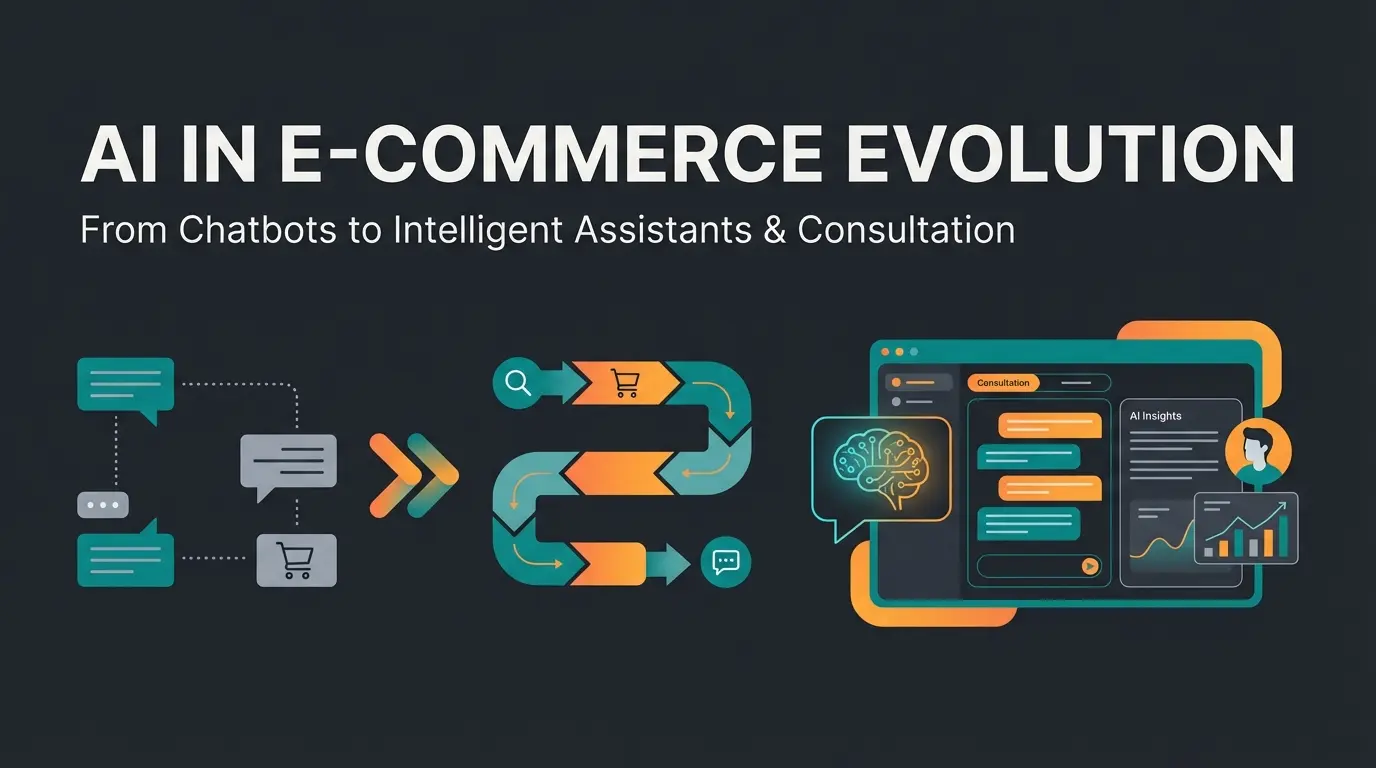
The Two Faces of AI in E-Commerce
Artificial intelligence is no longer a futuristic concept—it's the hard reality of everyday e-commerce operations. Anyone running a Shopware 6 store today cannot avoid the term Shopware AI (or internationally "Shopware Artificial Intelligence"). However, when we honestly examine the current landscape, we see a clear imbalance in how this technology is being deployed.
The majority of discussions, features, and plugins revolve around efficiency. It's about how merchants can write product descriptions faster, how images can be tagged more automatically, or how CSV file exports can run more smoothly. This is important, no question about it. Time is money. But in this rush toward automation, we often forget the most important person in the room: the customer.
While we optimize processes in the backend, customers in the frontend often still face the same static filters and search bars as they did ten years ago. They type "bicycle" and receive 500 results. They click on "red" and "mountain bike" and still have 50 results, not knowing which one suits their body height or riding style.
This is where the next major lever for Shopware Artificial Intelligence lies. It's no longer just about managing the store (admin focus), but about actively selling (customer focus). In this article, we analyze the status quo of the Shopware AI Copilot, uncover the painful gaps in the customer journey, and demonstrate how a new generation of "Consultative AI"—advisory artificial intelligence—bridges the gap between a silent online catalog and a genuine sales conversation.
Status Quo: What the Native Shopware AI Copilot Offers
To understand where the journey is heading, we first need to understand where we stand. Shopware has taken a massive step forward with the introduction of the AI Copilot. According to Shopware, these features are deeply integrated into the Shopware core (from version 6.5.1.0 and in the commercial plans Rise, Evolve, Beyond) and aim to revolutionize the daily work of store operators.
The current functions can primarily be categorized as "backend efficiency." They are tools for the merchant, not direct interaction partners for the customer. As detailed by Scope01, these capabilities represent a significant advancement in administrative automation.
Key Features for Merchant Efficiency
Based on current documentation and feature releases from Atwix and official Shopware channels, these are the core competencies of native Shopware AI:
Content Generation and Optimization
This is the most frequently used feature. The Copilot uses generative AI to create product descriptions, write texts for shopping experiences, or check and translate existing content for spelling errors. The benefit is massive time savings when maintaining large assortments. However, the limitation is clear: the customer sees the result (the text) but doesn't interact with the AI itself.
Image and Data Management
The Image Keyword Assistant analyzes uploaded images and automatically assigns relevant alt tags and keywords. Similarly, the AI Export Assistant helps create complex database queries using natural language to generate specific CSV exports, as demonstrated in tutorials on YouTube. The benefits include improved SEO and easier data handling without SQL knowledge.
Summaries and Classification
A powerful feature is the Review Summary. The AI reads hundreds of customer reviews and summarizes them into a short pros-and-cons text displayed on the product page, as highlighted by Webda. Additionally, AI Customer Classification enables automatic tagging of customers (e.g., "bargain hunter" or "high value") based on order history for marketing purposes. This functionality is further explained on Shopware and discussed on Talk Commerce.
First Steps in the Frontend
There are approaches to making AI visible to the customer as well, although these are still rather reactive:
- Personalized Checkout Messages: After purchase, the AI generates an individual thank-you message based on the shopping cart, as noted by Agiqon Shopware
- Context-Based Search: An improvement to standard search that attempts to better understand the intention behind a search query rather than just matching keywords, according to Shopware
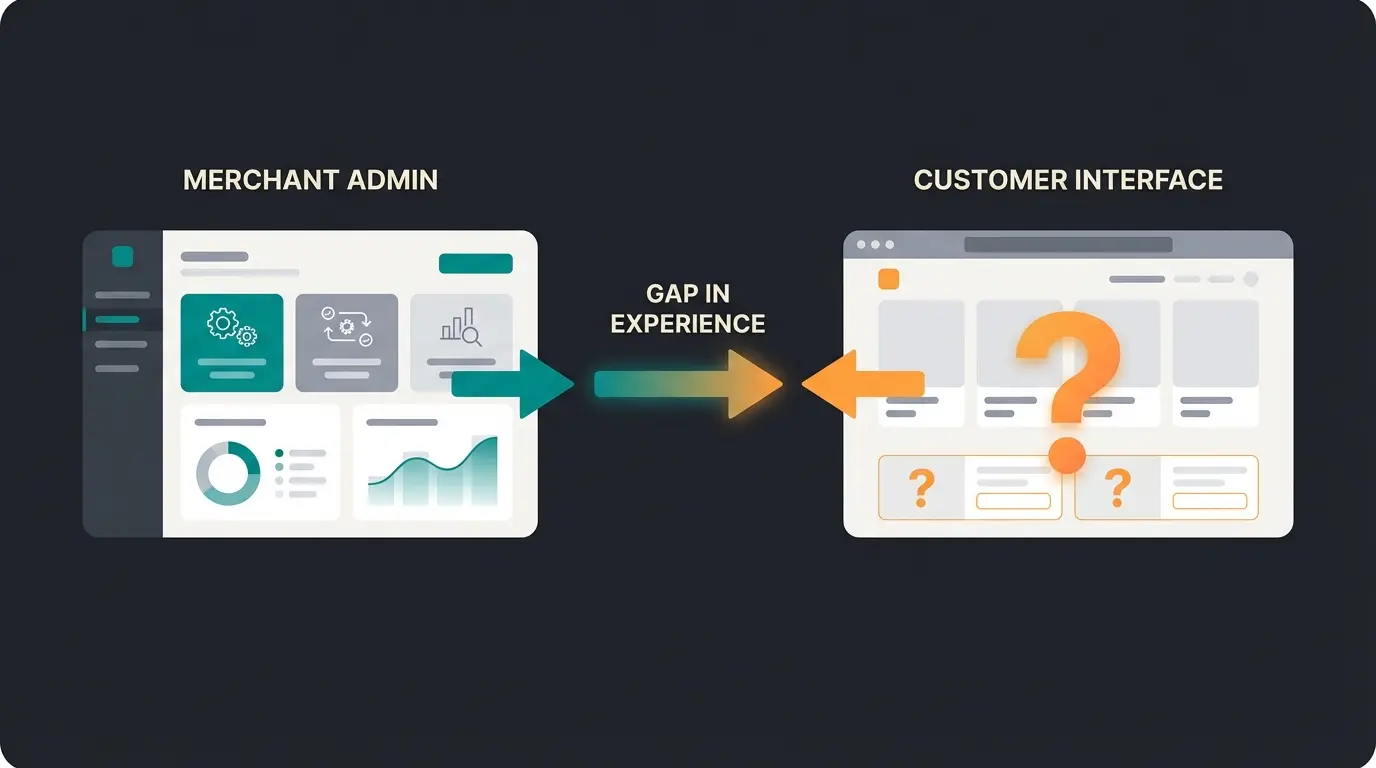
The Gap: Where Standard Stores and Simple Bots Fail
Despite the progress mentioned above, a gap exists in e-commerce. We have highly optimized logistics, lightning-fast loading times, and AI-generated product texts. Yet the way customers find products is often archaic.
The Problem of Static Filters
Imagine you're looking for a new skincare product. In a physical store, you would say: "I have dry skin that feels tight in winter, and I can't tolerate perfume." In a standard online store, you're faced with a filter bar:
- Skin type: Dry / Oily / Combination
- Brand: A-Z
- Price: $0-50
The nuance of "feels tight in winter" or "sensitive" gets lost if there's no explicit filter for it. The customer must click through hundreds of products and read the descriptions (which may even be written by AI) to figure out if the product is suitable. The result: Decision Fatigue. The customer abandons the purchase or orders three variants to return two.
The Return Avalanche in Germany
This "ordering on a hunch" approach has real economic consequences. Germany is Europe's return champion. According to research from Retourenforschung.de, approximately 550 million return packages are expected in Germany for 2025—a new record. As Sendcloud reports, especially in the fashion sector, return rates often exceed 50%. A large portion of these returns occurs because the product didn't meet expectations or didn't fit—problems that could be solved through better pre-purchase consultation.
Projected for Germany in 2025
Return rate in clothing e-commerce
Depending on product category
The "FAQ Bot" Trap
Many merchants try to close this gap with chatbots. But most of these bots are glorified FAQ search engines. Consider this typical interaction:
- Customer: "Which bike do I need for forest trails?"
- Standard Bot: "Here are our shipping conditions for bicycles." or "I found 'bicycle' in our search. Here are 400 results."
This experience is frustrating for the customer. AI in e-commerce is often perceived here as an obstacle, not a help. What's missing is the understanding of context and the ability to consult.
The Next Level of Shopware AI: Digital Sales Consultant
Here we enter the field of Consultative AI (Advisory AI). This is the evolution from generative AI (which writes texts) to interactive AI (which solves problems).
What is Consultative AI?
Unlike a search bar that waits for inputs or a filter that excludes, consultative AI conducts a dialogue. It imitates the behavior of a good salesperson in a physical store. It doesn't ask for technical parameters ("What inch should the tire be?") but for use cases ("Where do you want to ride?").
Scenario: The Mountain Bike Purchase
Let's compare the user experience (UX) in a standard Shopware store with a store that uses a specialized consultation AI.
Scenario: A customer is looking for a mountain bike for occasional forest excursions, budget around €2,000, but is not technically versed.
| Feature | Standard Shopware Search / Filter | Specialized Consultation AI |
|---|---|---|
| Input | Customer types "mountain bike" or clicks category "MTB" | Customer is asked: "What do you want to do with the bike?" |
| Interaction | Customer must set filters: "Hardtail vs. Full suspension", "Frame height", "Gearing" | Customer responds: "Forest trails, but no wild jumps. Should be comfortable." |
| Understanding | System filters strictly by database attributes. If customer doesn't know difference between hardtail and full suspension, they guess | AI understands "forest trails + comfortable + no jumps" = recommendation for quality hardtail or touring full suspension |
| Result | List of 50 bikes, sorted by price | 3 concrete recommendations with justification: "This bike suits you because the geometry is designed for comfort" |
| Psychology | Customer feels left alone ("Administrator") | Customer feels understood and advised ("Salesperson") |
Why Generative AI Alone Isn't Enough
One might think: "I'll just connect ChatGPT to my store." This is risky. Generative AI tends toward hallucinations (inventing facts). A Shopware AI for consultation must:
- Be product-faithful: It may only recommend products that actually exist in the Shopware inventory and are deliverable
- Work attribute-based: It must match technical data (Shopware Properties) in the background while conducting the conversation in natural language
- Act with sales psychology: It should not only answer questions but actively guide toward purchase completion ("Should I add the accessories directly to the cart?")
Discover how consultative AI can guide your customers to the right products, reduce returns, and increase conversions—24/7.
Start Free TrialBenefits of Specialized Consultation AI in Shopware
The use of such technology is not just a gimmick ("nice-to-have") but a solid business case. Data from 2024 and 2025 clearly shows that personalization and AI-powered interaction have massive impacts on KPIs.
Increasing Conversion Rate and Revenue
When customers feel confident, they buy. According to Ecomposer.io, studies show that AI-powered personalization can increase revenue by up to 15%. Even more impressive is the impact on cart value: as reported by Envive.ai, personalized product recommendations can increase the Average Order Value (AOV) by up to 369%.
Why such dramatic improvements? Because the AI recognizes cross-selling potentials that a static "customers also bought" algorithm would overlook (e.g., "Since you're riding in winter, you'll also need this special chain oil").
Reducing Return Rates
As mentioned in Section 3, German merchants are drowning in returns. Precise consultation before purchase ensures that the product fits the customer. When the AI clarifies whether the spare part really fits the machine (B2B) or whether the jacket runs small (B2C), the return is prevented before it occurs.
According to Retail News, with average costs of €5 to €10 per return (and sometimes up to €50 for bulky goods), a consultation AI often pays for itself through saved logistics costs alone.
24/7 Expert Knowledge and Scalability
In the B2B sector, specialized personnel are scarce. A human expert can only advise one customer at a time and sleeps at night. An AI scales infinitely. It can advise 1,000 customers simultaneously, at 3 AM or on Black Friday. The knowledge doesn't leave the company when an employee departs. The AI "learns" from the product data and remains consistent.
Through personalized AI recommendations
From AI-powered personalization
Expert consultation around the clock
Integration in Shopware 6: How Consultation Reaches the Store
Here we must be honest: the native Shopware AI Copilot does not currently offer this deep, dialogue-based consultation in the frontend to this extent. According to Shopware, the roadmap for Shopware 6.7 (expected in May 2025) and the vision of "Agentic Commerce" indicate that Shopware is moving in this direction as outlined on their official channels, but specialized solutions are currently necessary.
The Path Through Plugins and Apps
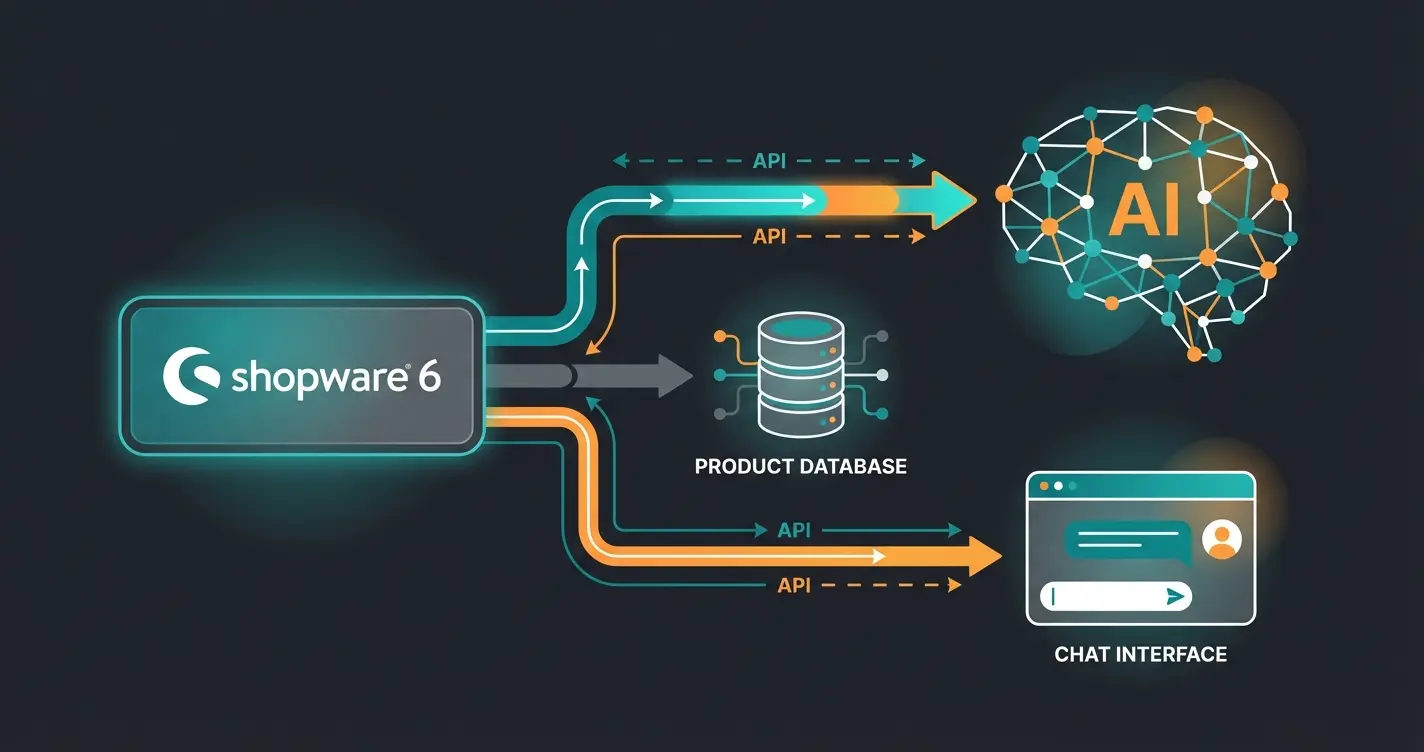
Since Shopware 6 is built on an API-first architecture, external AI solutions can be seamlessly integrated:
- Specialized Providers: There are SaaS solutions that specialize in "Conversational Commerce." These are usually installed as plugins or connected via API
- Data Flow: The AI pulls product data (title, description, properties, prices) from Shopware, indexes it, and uses it as a knowledge base for the chatbot
- Cart Handover: A good integration allows the AI to place recommended products directly into the Shopware cart (Add-to-Cart functionality)
What to Consider During Integration
- Data Quality: An AI is only as smart as the data you feed it. If your Shopware product properties are poorly maintained, even the best AI cannot filter precisely. Ironically, the native AI Copilot helps here to cleanly generate this data first
- Performance: The store's loading time must not suffer. AI computation should run asynchronously
- UX Design: The chat window or "advisor mode" must not disturb but be intuitively accessible (e.g., as an overlay or embedded in category pages)
Comparison: Administrator AI vs. Salesperson AI
To clearly illustrate the fundamental difference between the standard Shopware AI Copilot and specialized product consultation AI, let's examine this comparison:
| Feature | Shopware AI Copilot (Standard) | Specialized Product AI (Consultation) |
|---|---|---|
| Primary Goal | Save Merchant Time | Increase Customer Sales |
| User | Shop Administrator | End Customer |
| Capability | Write Texts, Tag Images | Ask Questions, Recommend Products |
| Interaction | One-way (Generation) | Two-way (Dialogue) |
| Location | Backend / Admin Panel | Frontend / Storefront |
| Impact | Operational Efficiency | Revenue & Conversion |
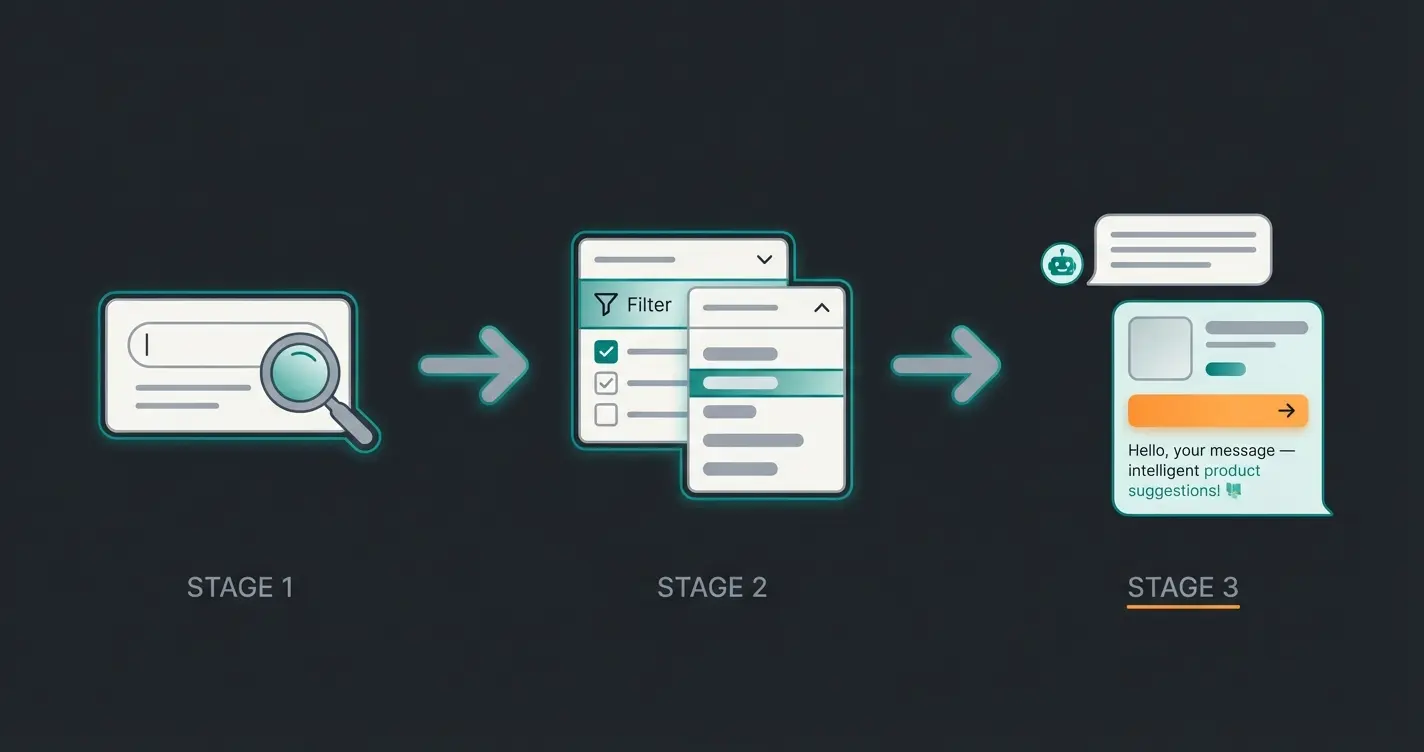
Simple keyword matching—customer types 'running shoes' and gets all products containing that term. No differentiation based on needs.
Search field plus filter sidebar. Customer selects 'Size 42', 'Red', 'Nike'. Result: narrowed list. Problem: customer must know technical attributes.
Chat interface / dialogue. Customer says: 'I need shoes for my first marathon, I have wide feet.' AI recommends 2 specific models with explanation.
Conclusion & Outlook: From Administrator to Salesperson
The introduction of Shopware AI through the Copilot was an important first step. It showed merchants how much more efficient administrative processes can be. But 2025 will shift the focus.
The market is saturated, customers are more demanding, and return costs are eating into margins. In this environment, it's no longer enough to simply make products available. Merchants must advise their customers again.
The technology for this exists. While the native Copilot covers your back (backend), specialized AI solutions can drive revenue on the front line (frontend). Those who understand this division and use it strategically—the Copilot for efficiency, consultation AI for effectiveness—will clearly stand out from the competition.
Action Recommendations
- Use native features (Rise/Evolve/Beyond) to perfect your data foundation. Let properties and descriptions be generated
- Analyze your returns and abandonment rates. Where does the customer lack consultation?
- Evaluate external AI solutions that can conduct real dialogues to close this gap before Shopware 6.7 and future updates potentially offer this natively
The future of e-commerce isn't silent. It conducts a dialogue.
FAQ: Common Questions About Shopware AI
The Shopware AI Copilot is a collection of AI-powered features within the Shopware platform that help merchants automate tasks such as text creation, image tagging, data export, and customer classification. It's included in commercial plans (Rise, Evolve, Beyond) and available from Shopware version 6.5.1.0.
The standard Shopware Copilot currently focuses primarily on backend tasks for efficiency improvement. For active, dialogue-based product consultation in the frontend (Consultative AI), specialized AI solutions or plugins are still required that integrate into the storefront.
The native AI Copilot features are available from Shopware version 6.5.1.0 and require a commercial plan (Shopware Rise, Evolve, or Beyond). The Community Edition does not offer these features by default.
Through the use of consultative AI, customers are better guided before purchase. The AI clarifies questions about fit, compatibility, and intended use, which can significantly reduce incorrect purchases and thus returns.
Generative AI creates content (product descriptions, marketing texts) and works one-way. Consultative AI conducts two-way dialogues, understands customer context and needs, and actively recommends specific products with reasoning—similar to a human sales consultant.
See how AI-powered product consultation can increase your conversion rates, reduce returns, and provide 24/7 expert guidance to your customers.
Get Started Now