Best Shopify Chatbots 2026: Why You Need Sales AI, Not Support Bots
Discover the best Shopify chatbot apps for 2026. Learn why Sales AI outperforms FAQ bots and how to boost conversions with AI product consultation.

The Paradigm Shift: From Ticket Deflector to Revenue Booster
Have you ever spoken with a chatbot and wanted to close the tab in frustration? You're not alone. The first generation of e-commerce bots were often glorified FAQ pages that shooed customers away rather than serving them. But in 2026, the tide has turned completely.
While most online retailers are still looking for ways to avoid support tickets, market leaders have recognized that the Shopify chatbot is the most powerful weapon for increasing revenue. We're witnessing the death of the "support bot" and the birth of the "Sales Associate AI", an artificial intelligence that doesn't just answer questions but actively sells, advises, and accompanies customers to checkout.
In this comprehensive guide, we analyze the market for chatbots for Shopify, illuminate the critical requirements for international markets (GDPR, language), and show you why your next bot shouldn't be a ticket system but rather a top salesperson. Understanding how AI chatbots work is the first step toward making the right choice for your store.
Table of Contents
- The Paradigm Shift: From Ticket Deflector to Revenue Booster
- Market Checklist: What to Look for in 2026
- Support Bot vs. Sales AI: The Critical Difference
- The Best Shopify Chatbot Apps Compared (2026 Ranking)
- Deep Dive: How AI Product Consultation Works
- Case Study: The 30-Second Sales Interaction
- Conclusion: Which Bot Fits Your Shop?
Why Traditional Shopify Bots Are Becoming Obsolete
For a long time, Shopify bots were measured by a simple metric: Ticket Deflection Rate. How many customer inquiries can the bot intercept so that no expensive human employee has to invest time? The goal was cost efficiency.
But this mindset has a fatal flaw: It treats the customer as a cost factor, not a revenue source.
According to cases.media, current data for 2025 and 2026 paints a completely new picture of what's possible with modern chatbot technology.
Shops using proactive AI sales assistants see significant conversion rate increases
Consumers prefer chatbots for quick answers when quality is maintained
AI-powered interactions help customers make purchase decisions more quickly
Research from ecommercefastlane.com confirms these findings, while amraandelma.com has documented similar conversion improvements across multiple industries.
The modern Shopify chatbot is no longer a bouncer keeping customers away from support. It's the friendly retail salesperson who approaches you and asks: "Are you looking for something specific, or may I show you what's new?" This transformation is exactly what AI chatbots are doing to transform conversational commerce.
Market Checklist: What You Need to Consider in 2026
Many "Top 10" lists on the internet are written for the US market. However, different rules apply for Shopify stores targeting international markets, particularly in regions with strict data protection laws. A US tool that doesn't understand nuanced language or stores data insecurely may be problematic in these markets.
Here are the three pillars for a successful chatbot for Shopify in regulated markets:
A. Linguistic Nuances & Mixed Language Usage
A simple translation bot often fails when faced with the reality of e-commerce customers who mix languages and use slang.
- The Problem: Customers use colloquial language, regional dialects, or mix their native language with English terms ("hoodie," "sneaker," "sale").
- The Solution: You need an AI (based on LLMs like GPT-4 or Claude) that understands context, not just keywords. When a customer asks: "Do you have this in green too?", the bot must know which product the customer is currently viewing.
This is where autonomous digital consultants shine: they can understand context and nuance in ways that traditional rule-based bots simply cannot.
B. GDPR (Data Protection) Compliance
The topic of data protection is not a "nice-to-have" in Europe and many other jurisdictions. It's an existentially threatening risk if ignored. Many US apps store chat logs on servers without adequate protective measures. According to decareto.com, this is a critical consideration for any international e-commerce operation.
- Server Location: Prefer providers with servers in the EU (e.g., Frankfurt) or those offering transparent Data Processing Agreements and Standard Contractual Clauses (SCCs)
- Consent Management: The chatbot may only load or track data when the user has consented in the cookie banner (e.g., via Consent Mode v2)
- Transparency: The bot must identify itself as a machine (AI Act Compliance)
As noted by pexon-consulting.de, compliance with EU regulations is non-negotiable for any serious e-commerce chatbot implementation.
C. Channel Dominance: WhatsApp and Beyond
While SMS marketing dominates in the USA, many European markets are "WhatsApp countries." According to lime-technologies.com, this has major implications for chatbot strategy.
- Over 80% of Europeans use WhatsApp daily in many markets
- Open rates for WhatsApp newsletters are at 98% according to edesk.com
- A good Shopify bot should not only live in the webshop but ideally also offer an integration for WhatsApp Business to recover cart abandoners where they are most active
Chatarmin.com reports that WhatsApp integration can significantly boost engagement rates compared to web-only chatbot implementations. For a deeper look at connecting your store with WhatsApp, see our Shopify WhatsApp integration guide.
Support Bot vs. Sales AI: The Critical Difference
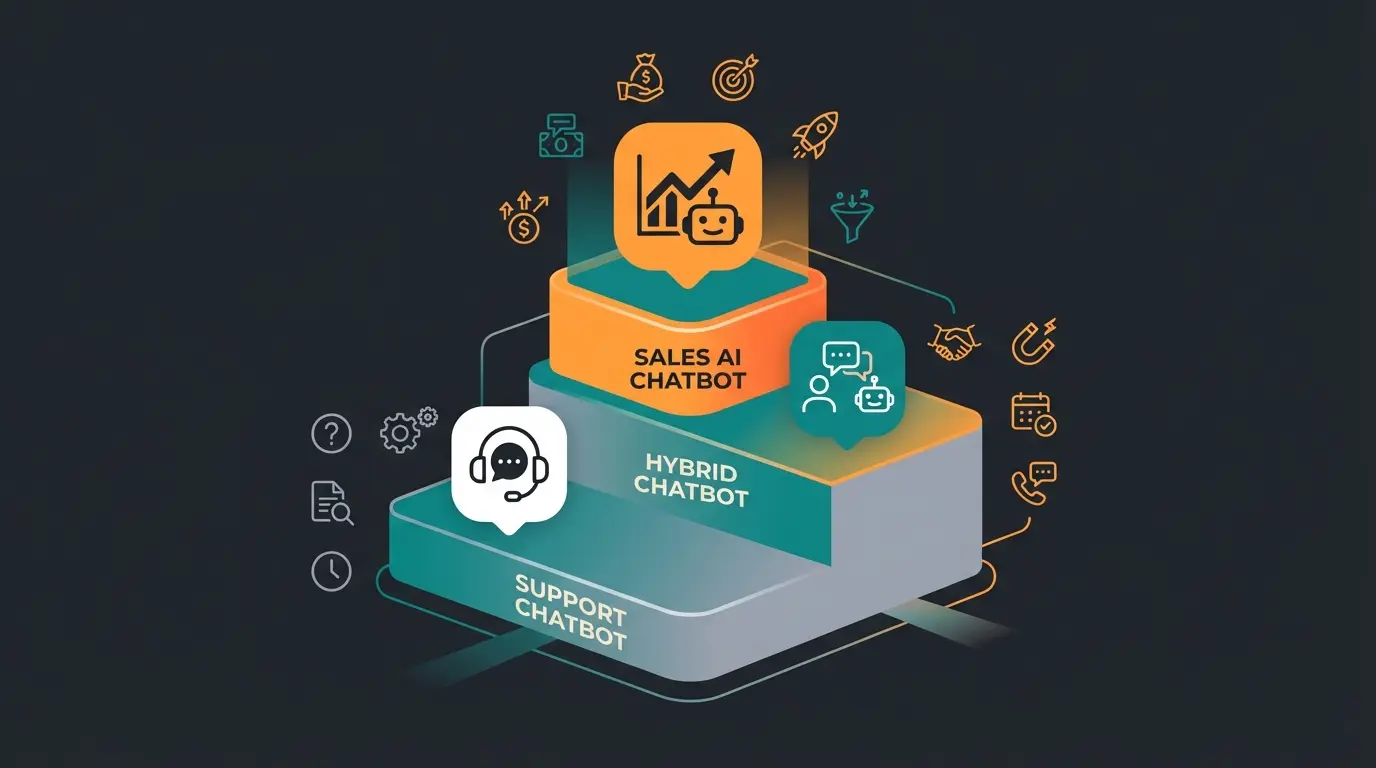
Before we look at the tools, we need to clarify the categories. Most retailers search for a Shopify chatbot app but don't know that there are two completely different types of tools. Understanding this distinction is fundamental to making the right choice.
The consultative AI comparison provides a detailed breakdown of these categories, but here's the essential comparison:
| Feature | Classic Support Bot (FAQ) | AI Sales Consultant (Sales AI) |
|---|---|---|
| Primary Goal | Reduce costs (avoid support tickets) | Increase revenue (boost conversion rate) |
| Interaction | Reactive (waits for customer question) | Proactive (approaches customers based on behavior) |
| Technology | Decision trees (If X, then Y) | LLM / Generative AI (understands context & nuances) |
| Knowledge | Static FAQ database | Dynamic product knowledge & sales psychology |
| Typical Response | "Here's the link to our shipping info." | "For dry skin, I recommend our hyaluronic cream. Shall I add it to your cart?" |
| Ideal For | "Where is my package?" inquiries | Product consultation, upselling, undecided customers |
When exploring AI product consultation providers, keep this fundamental distinction in mind. It will save you from investing in the wrong solution.
Best Shopify Chatbot Apps Compared: 2026 Ranking
Based on current market data, user reviews, and technological developments, we have categorized the top solutions. There is no single "best" bot. There is only the best bot for your specific goal. Each solution excels in different areas.
Rank 1: The Support Specialist – Gorgias
Best Choice For: Large brands with high ticket volume.
Gorgias is less a pure chatbot and more a powerful helpdesk system that is deeply integrated with Shopify. According to storecensus.com, it remains one of the most popular enterprise solutions for Shopify customer service.
- Advantages: Recognizes customers immediately (shows recent orders in chat), centralizes email, social media, and chat in one dashboard, strong automation rules ("macros") for recurring questions
- Disadvantages: Focus is clearly on support, not active selling. Pricing is often based on ticket volume, which can become expensive when scaling. The AI features are more designed to summarize responses than to conduct sales conversations.
As ringly.io notes, the pricing model can become prohibitive for high-volume stores. Meetchatty.com provides additional pricing comparisons.
Rank 2: The Beginner All-Rounder – Tidio
Best Choice For: Small to medium shops that want to start quickly.
Tidio dominates many "Best of" lists because it has a very good free plan (freemium) and is easy to install.
- Advantages: "Lyro AI" offers solid responses based on your FAQs according to tidio.com. Visual "Flow Builder" allows building simple workflows via drag-and-drop. Affordable entry price compared to enterprise solutions.
- Disadvantages: The AI is often more reactive than proactive. Less deep understanding of complex product catalogs compared to specialized Sales AIs.
For those interested in AI chatbot for e-commerce, Tidio represents a solid middle-ground option that balances features with accessibility.
Rank 3: The Free Basic Option – Shopify Inbox
Best Choice For: Merchants with no budget who do everything themselves.
Shopify's own solution is free and directly integrated into the admin area. As confirmed by oscarchat.ai and eesel.ai, it's a good starting point for beginners.
- Advantages: 100% free. Seamless integration (send product recommendations directly from the backend).
- Disadvantages: Very rudimentary automation ("instant responses"). No real AI consultation: in the end, a human usually has to respond. Doesn't scale well when you have hundreds of inquiries per day.
Rank 4: The Future – Your AI Sales Consultant
Best Choice For: Shops that require consultation (beauty, fashion, tech, supplements).
Here we leave the field of classic "support tools." New solutions position themselves as digital sales employees that can provide 24/7 product consultation. These are the AI product consultants that represent the cutting edge of e-commerce AI.
The Unique Selling Proposition: These bots are not trained with FAQs but with your product catalog and sales guides.
- Functionality: The bot analyzes metafields, product descriptions, and customer reviews. It conducts a "quiz" in chat format (e.g., "What's your skin type?" or "What occasion are you buying for?"). It doesn't just recommend a product but explains the why ("I recommend X because it's particularly suitable for sensitive skin").
- Advantage: Unlike static product finders, customers can ask follow-up questions within the same conversation, creating a natural sales dialogue.
This approach represents AI-powered guided selling at its finest, replicating the experience of an in-store sales associate in the digital realm.
Stop losing sales to confused customers. Deploy an AI product consultant that actively guides visitors to purchase, just like your best in-store salesperson.
Start Your Free TrialDeep Dive: How AI Product Consultation Works
Why is 2026 the year of the "Sales Associate AI"? Because the technology (Large Language Models) has finally advanced far enough to replace the static "product quiz." Understanding proactive guided selling is key to leveraging this transformation.
The Problem with the Old Product Quiz
Previous quiz apps were rigid:
- Question 1: Man or Woman?
- Question 2: Dry or Oily?
- Result: Product X.
If the customer had a follow-up question ("Is this also vegan?"), they had to leave the quiz and seek support. The flow was broken, and the sale was often lost.
The Solution: Dynamic Consultation
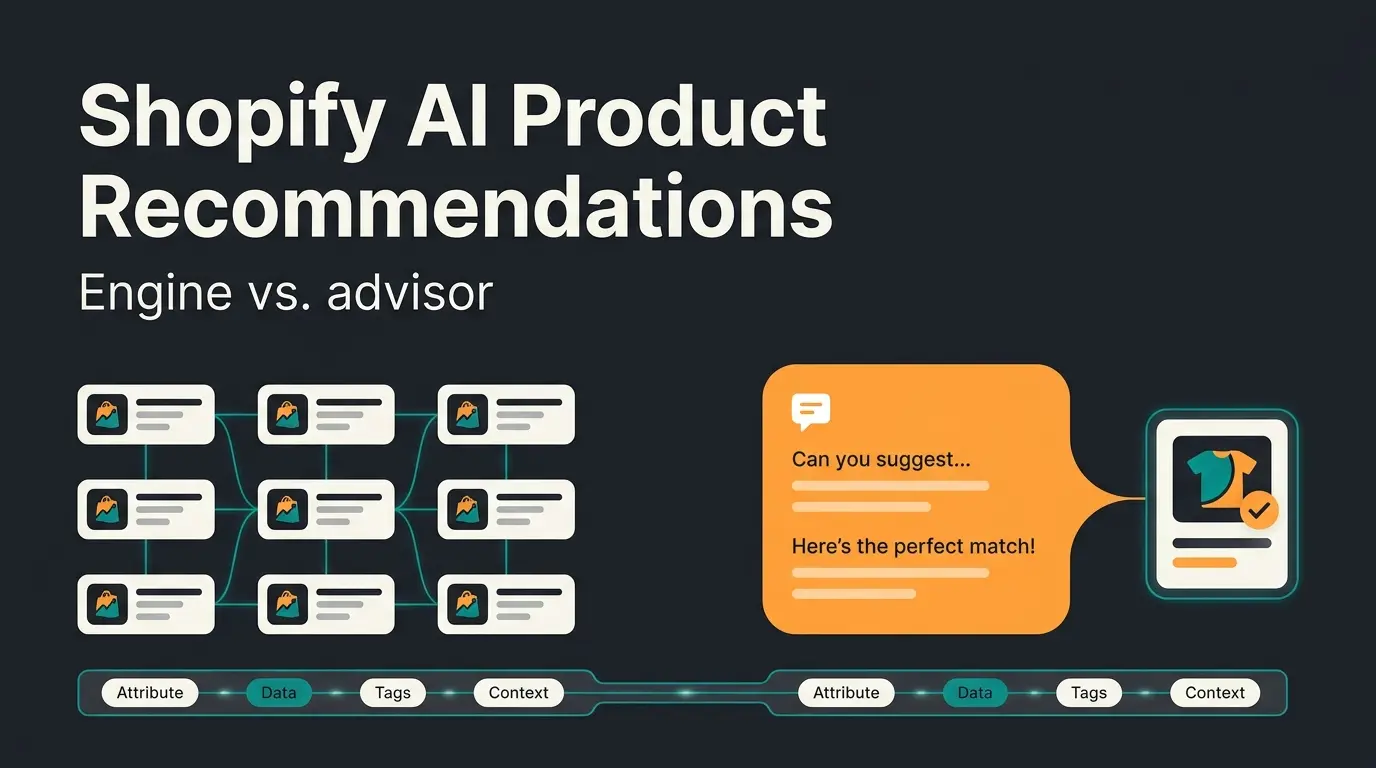
A modern Shopify chatbot with a sales focus keeps the customer in the conversation. Combined with Shopify Live Chat, this creates a seamless experience where AI consulting increases conversions rather than simply automating FAQ responses. The same engine powers AI product recommendations on Shopify, so every suggestion reflects live stock levels and the intent the customer just expressed.
The AI reads your Shopify feed in real-time. If a product is "Out of Stock," it won't be recommended.
The AI understands concepts. It knows that "suitable for winter" in a jacket means "lined" or "down-filled," even if the word "winter" isn't in the description.
Good Sales AIs use scarcity ("Only 3 left") and social proof ("Customers especially love the scent") to promote closing the sale.
Direct "Add to Cart" functionality keeps customers in the purchase flow without friction.
This intelligent approach is exactly how Shopware 6 chatbots and other modern e-commerce AI solutions are designed to function.
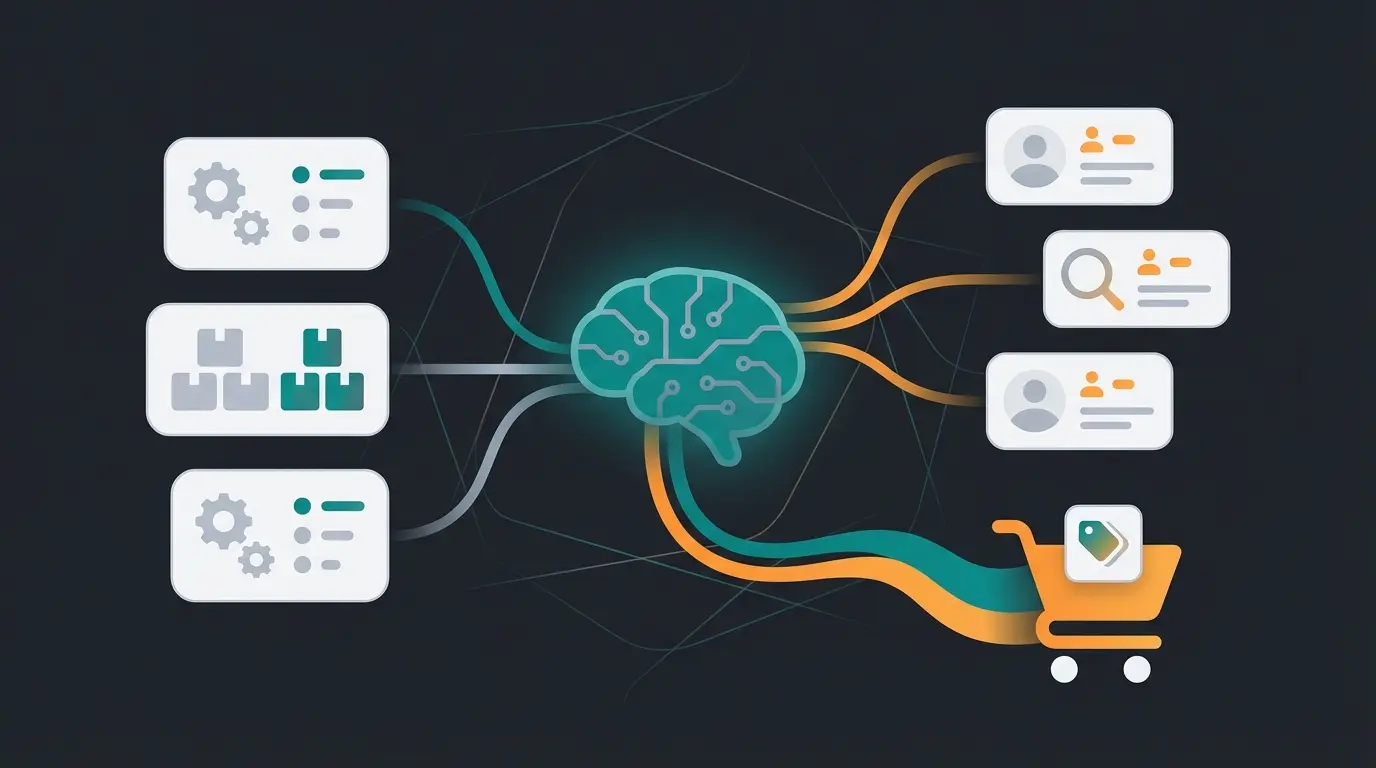
Case Study: The 30-Second Sales Interaction
Imagine a visitor lands on your shop for high-end coffee machines. They're overwhelmed by the selection. This is where the difference between support bots and Sales AI becomes crystal clear.
Scenario A: The Classic Support Bot
Scenario B: The AI Sales Consultant
The ROI Difference
While Scenario A only saved costs (no human had to respond), Scenario B actively generated revenue. According to sellerscommerce.com, this fundamental difference in approach explains why Sales AI delivers measurably higher ROI than traditional support bots.
Tailortalk.ai reports that AI-powered interactions lead to customers making purchase decisions 47% faster. Hellorep.ai provides additional case studies demonstrating similar results.
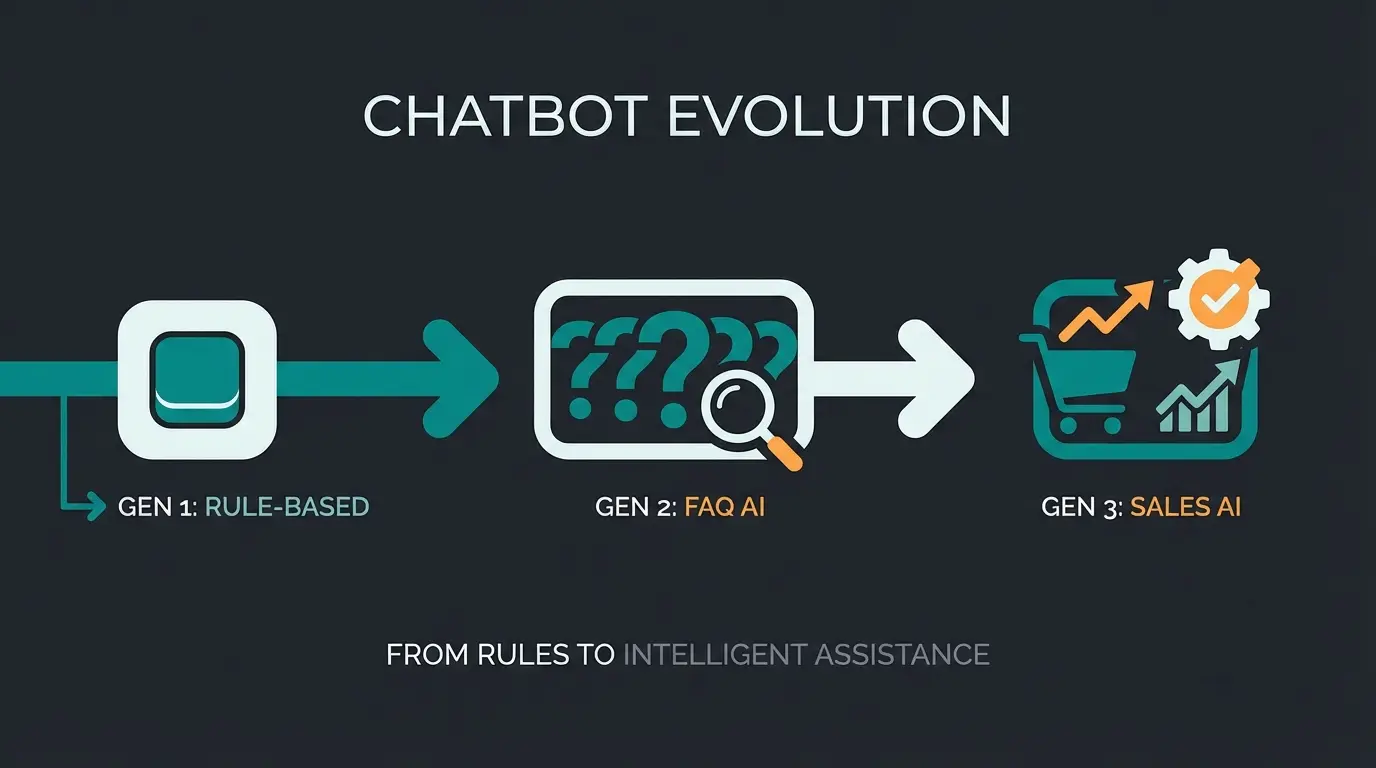
The Bot Evolution: Three Generations of E-Commerce AI
To understand why 2026 marks such a pivotal year, it helps to see how far chatbot technology has come. The evolution from simple rule-based systems to sophisticated Sales AI represents a fundamental shift in what's possible.
| Generation | Technology | Capability | Best Use Case |
|---|---|---|---|
| Gen 1 (2015-2018) | Rule-based buttons | Pre-defined responses only | Simple FAQ deflection |
| Gen 2 (2019-2022) | FAQ AI with keyword matching | Understands common questions | Support ticket reduction |
| Gen 3 (2023-2026) | LLM-powered Consultative AI | Context-aware, proactive selling | Product consultation & conversion |
We've reached the point where AI can truly replicate the consultative experience of an in-store sales associate. For more insight into this transformation, explore how AI chatbots transform the entire customer journey.
Conclusion: Which Bot Fits Your Shop?
The landscape of Shopify chatbot apps has fundamentally changed in 2026. It's no longer enough to simply be "reachable." Your bot must perform and actively contribute to your bottom line.
- Choose Gorgias if your main problem is an overloaded support team and you need to organize your tickets.
- Choose Shopify Inbox if you're just starting out and have no budget.
- Choose a Sales AI (Product Consultant) if you have traffic but your visitors leave without buying.
For those ready to explore the full potential of AI in e-commerce, the benefits of digital product consultation are becoming impossible to ignore. The question is no longer whether to implement AI product consultation, but how quickly you can deploy it.
FAQ: Common Questions About Shopify Chatbots
For pure beginners, Shopify Inbox is the best free solution. Tidio also offers a good free plan with slightly more features. However, keep in mind that free solutions typically lack the advanced AI capabilities needed for proactive selling.
Not automatically. Ensure that the provider uses servers in the EU or offers Standard Contractual Clauses (SCCs). Additionally, the bot must be considered in the cookie consent banner, and it must identify itself as a machine per AI Act requirements. Always verify data processing agreements before implementation.
Yes. Data shows that proactive AI bots can increase conversion rates by 20-67% by eliminating uncertainties for customers and recommending suitable products. The key difference is between reactive support bots (which save costs) and proactive Sales AI (which generates revenue).
Modern AI bots no longer require long training periods. They scan your Shopify product catalog often in just a few minutes ("one-click integration") and are immediately ready for use. Most solutions can be fully operational within 24-48 hours.
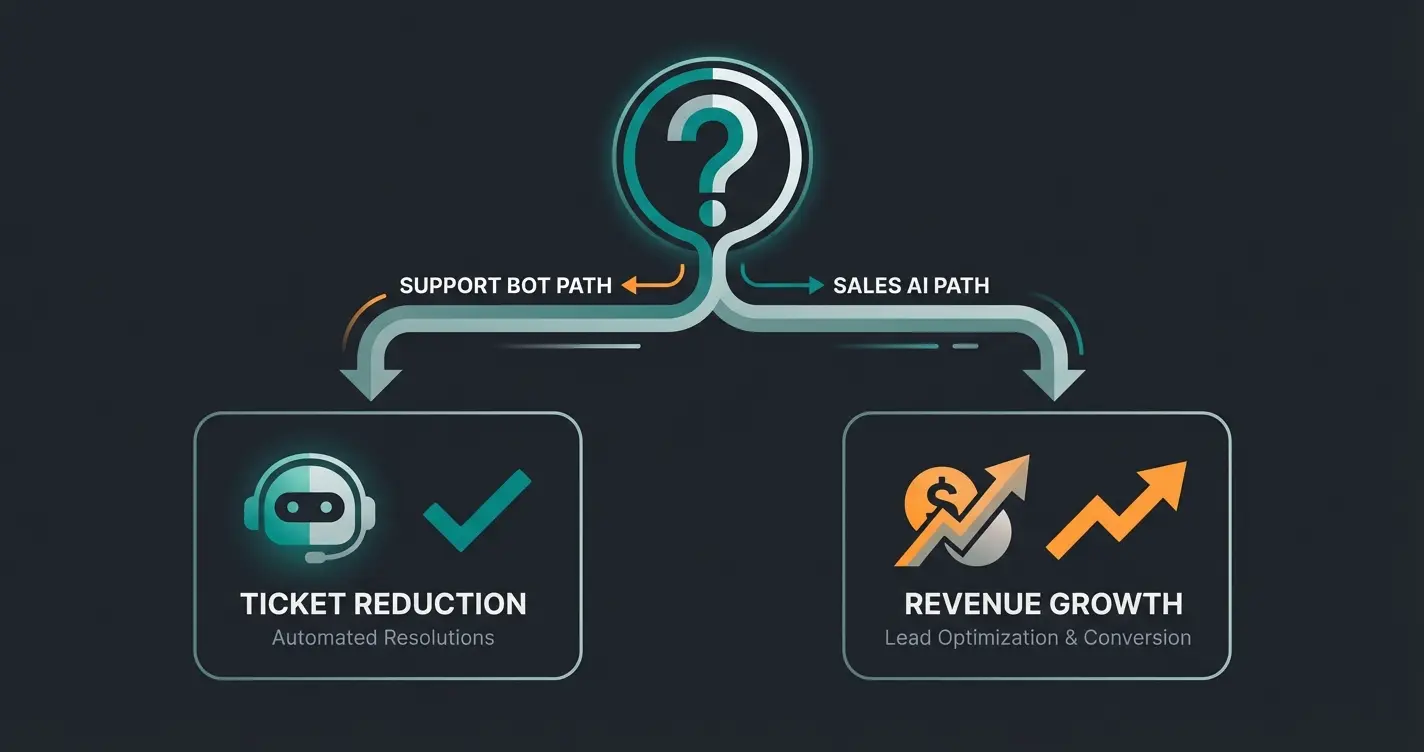
A traditional Shopify bot focuses on answering FAQs and deflecting support tickets to save costs. A Sales AI proactively engages customers, understands their needs through conversation, and guides them to products, essentially functioning as a digital sales associate that actively generates revenue.
Join leading Shopify merchants who've already deployed AI product consultation. See how a Sales AI can boost your conversion rates and deliver personalized shopping experiences 24/7.
Get Started Free
Lasse is CEO and co-founder of Qualimero. After completing his MBA at WHU and scaling a company to seven-figure revenue, he founded Qualimero to build AI-powered digital employees for e-commerce. His focus: helping businesses measurably improve customer interaction through intelligent automation.