Introduction: The End of 'Dumb' Bots
Imagine walking into a specialty store. You're looking for running shoes for your first marathon. A salesperson approaches you. But instead of asking about your running style or the terrain you'll be training on, they simply hand you a list of ten links and say: 'Pick something.' Frustrating, right?
That's exactly how chatbots on the internet behaved for years. They were glorified search engines that responded to simple keywords with rigid text blocks. But this picture is changing radically right now.
If you're asking yourself today: 'What is a chatbot?', the classic chatbot definition no longer suffices. We're in 2025, and the technology has made a quantum leap. Chatbots are no longer just there to deflect support tickets or recite business hours. The new generation – powered by Large Language Models (LLMs) and Generative AI – functions as a Digital Product Consultant. They don't just understand language; they understand products and customer needs.
Looking at the history of chatbots, we can see how dramatically this technology has transformed. In this comprehensive guide, we'll not only clarify the chatbot definition and explain the chatbot meaning for modern businesses. We'll show why classic FAQ bots are dying out and how intelligent systems today make the difference between a website bounce and a successful purchase.
Definition: What Is a Chatbot Simply Explained?
At its core, the chatbot definition is initially simple: A chatbot is a software application designed to simulate human conversation. This happens either via text (in a chat window on a website or in messengers like WhatsApp) or via voice (voicebots like Alexa or Siri).
However, the chatbot meaning can best be explained through its two evolutionary stages. To understand what a chatbot truly is today, we must distinguish between what it was (and often still is) and what it can be. Understanding these different chatbot types comparison is essential for making the right choice for your business.
1. The 'Service Agent' (The Past)
This is the image most people have in their heads. A small window in the bottom right corner of the website.
- Function: Reactive. The user asks a question, the bot delivers a pre-programmed answer.
- Goal: Save costs, relieve support staff, automate FAQs.
- Example: 'Where is my package?' → 'Please enter your tracking number.'
2. The 'Sales Consultant' (Present & Future)
This is where the real revolution is happening. This bot doesn't just wait for problems – it actively helps with finding solutions. Understanding how AI chatbots transform customer interactions is crucial for modern businesses.
- Function: Proactive and consultative. The bot asks follow-up questions to determine needs, similar to a good salesperson in a store.
- Goal: Increase revenue, boost conversion rate, strengthen customer loyalty.
- Example: 'I'm looking for a gift for my wife.' → 'Happy to help! Does she prefer a classic elegant or modern sporty style? And what price range are we looking at?'
How Do Chatbots Work? (Rule-Based vs. AI)
To answer the question 'What is a chatbot' technically, we need to look under the hood. Not every bot is 'intelligent.' In fact, many chatbot projects fail because companies use the wrong technology for the wrong purpose.
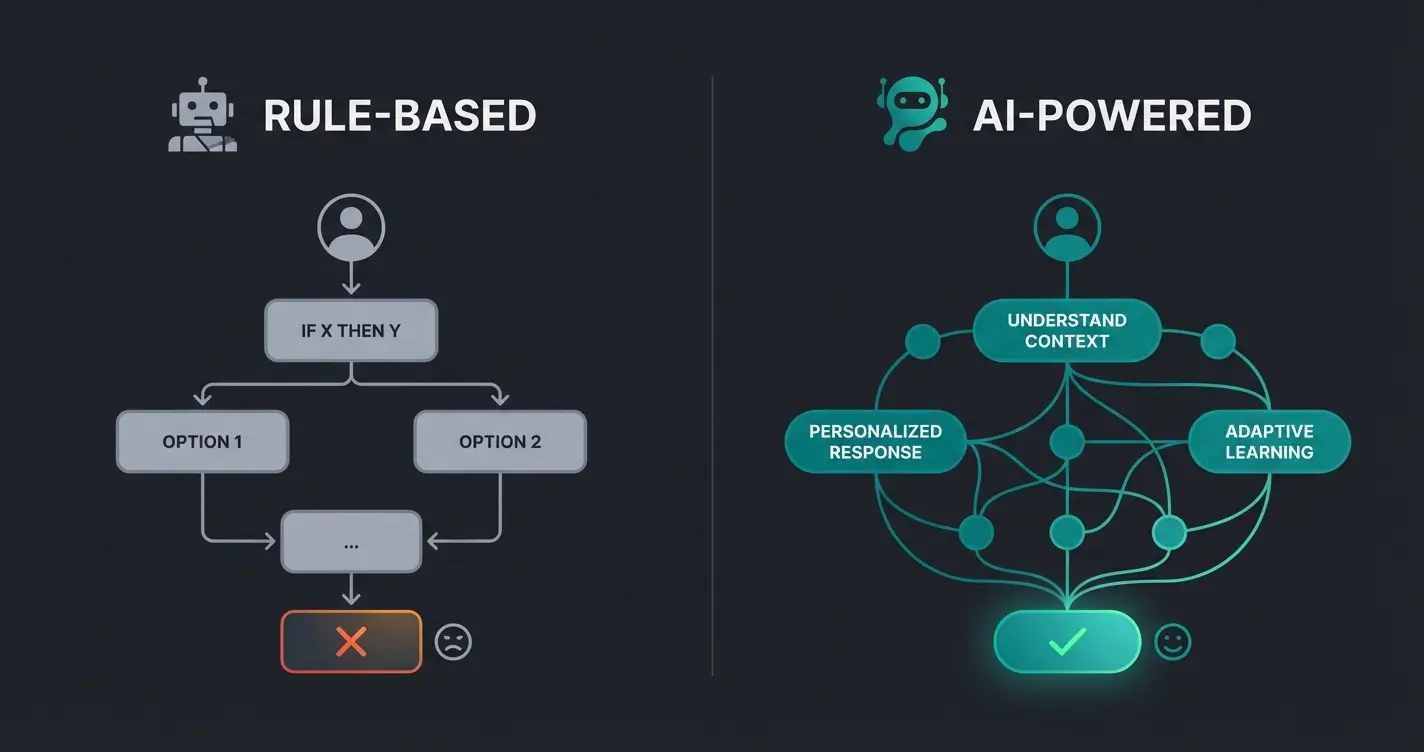
There are fundamentally two main categories: Rule-Based Systems and AI-Powered Systems. Understanding how an AI Chatbot transforms conversations is key to choosing the right approach.
1. Rule-Based Chatbots (Click-Bots)
These bots work like a decision tree. The developer defines in advance exactly which paths a conversation can take.
- How it works: 'If user clicks X, show answer Y.'
- Navigation: Mostly through buttons and menus, less through free text.
- Limitation: As soon as the user enters something not in the script (e.g., a typo or a complex sentence structure), the bot responds with the dreaded phrase: 'I'm sorry, I didn't understand that.'
2. AI Chatbots (Conversational AI & LLMs)
These systems use Natural Language Processing (NLP) and Machine Learning (ML). Since the breakthrough of Generative AI (like ChatGPT), these bots can not only recognize language but understand the context and generate dynamic responses. As AI Chatbots evolving demonstrates, this technology continues to advance rapidly.
- How it works: The AI analyzes the intent behind the input, extracts important information (entities), and formulates an appropriate response, even if the question has never been asked before.
- Advantage: They can learn. The more interactions occur, the better the system becomes. Additionally, they can use unstructured data (like product descriptions) to conduct consultation conversations.
Comparison: Service Bot vs. Consultation AI
To illustrate the difference, here's a direct comparison. This is crucial for your strategy: Do you just want to deflect tickets, or do you want to sell?
| Feature | Rule-Based Chatbot (The 'Gatekeeper') | AI Product Consultant (The 'Salesperson') |
|---|---|---|
| Technology | Static decision trees (If/Then logic) | NLP, Machine Learning, LLMs (Generative AI) |
| Primary Goal | Reduce support costs (Deflection) | Increase revenue & Consult (Conversion) |
| User Experience | Rigid, often frustrating, feels like a form | Natural, fluid, feels like a conversation |
| Flexibility | Can only answer what was programmed | Can respond to unforeseen questions |
| Data Usage | Reacts to keywords ('return') | Understands context ('The shoe pinches at the heel') |
| Setup Effort | High (manual writing of all paths) | Medium (training with data, but less scripting) |
Why Classic FAQ Bots Fail at Selling
Many companies implement a chatbot with the goal of becoming 'more digital,' and then wonder why sales figures don't improve. The reason lies in the content gap between service and consultation.
A classic FAQ bot is trained to address information deficits:
- 'What are your business hours?'
- 'How much is shipping?'
However, a customer in the buying process often doesn't have an information deficit, but a decision deficit:
- 'Will this table fit in my small living room?'
- 'Which skincare set helps with my dry winter skin?'
The Problem of the 'Keyword Trap'
A rule-based bot scans the question for keywords. If the customer asks: 'I'm looking for a cream that isn't greasy because I have blemish-prone skin', a simple bot might only recognize the word 'cream' and show all creams. Or it recognizes 'blemish-prone skin' and sends a link to a blog article.
It doesn't understand the logic of product attributes:
- Attribute A: Cream
- Condition B: Non-greasy
- Problem C: Blemish-prone skin
A customer seeking consultation doesn't want to search. They want to find. When a bot forces them to click through menus or sends irrelevant links, the customer abandons. The chatbot meaning in e-commerce is therefore shifting from 'help for self-help' to 'Guided Discovery.' This is precisely where AI product consultation makes the critical difference.
Rise of Product Consultation AI: The New Standard
Here we enter the era of the modern chatbot explained. Through the use of Large Language Models (LLMs), bots can now 'read' and understand product catalogs, similar to how a human would. The AI selling revolution is transforming how businesses interact with customers.
How Does Product Consultation AI Work?
Instead of memorizing answers, the AI accesses your product data (PIM), customer reviews, and technical specification sheets. When a customer asks a question, the AI matches the customer's requirements with product attributes.
A Dialogue Comparison: Old vs. New
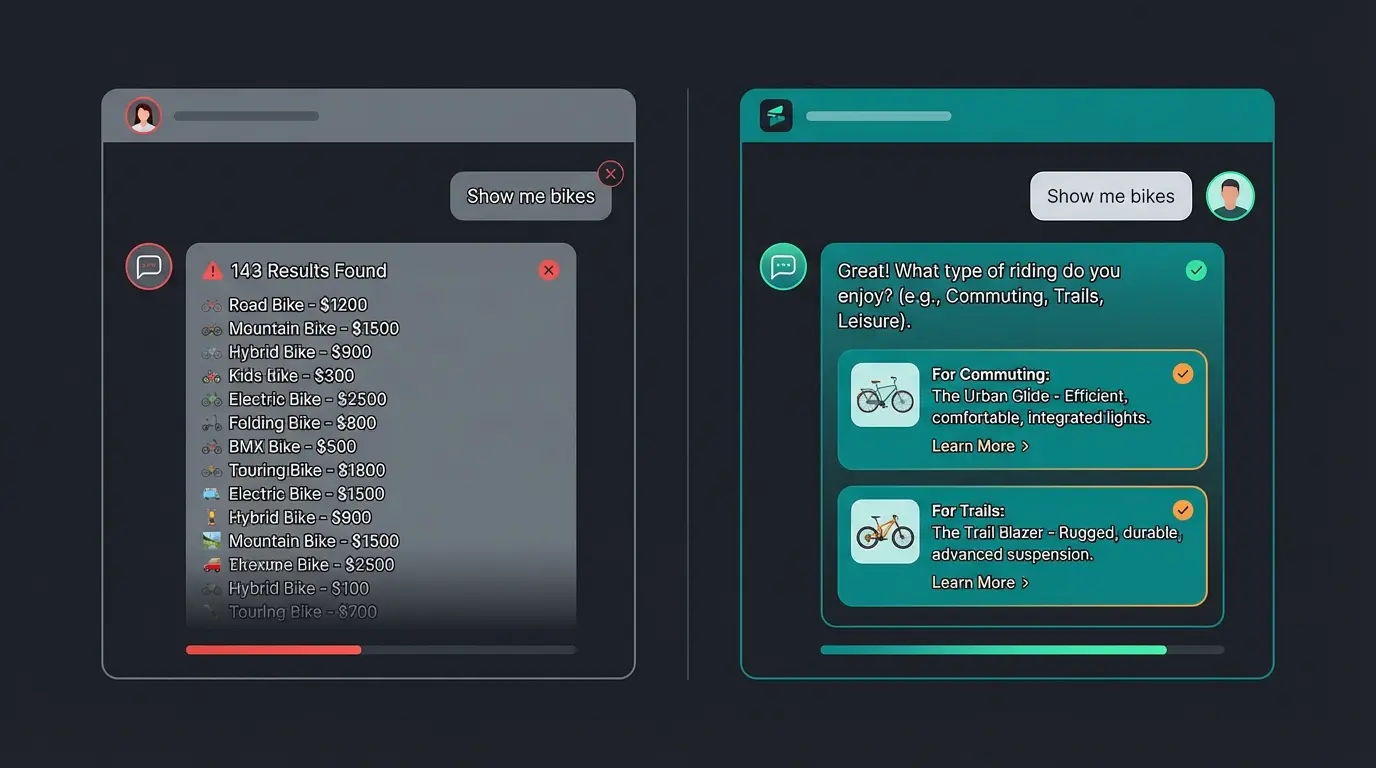
To show the massive difference in User Experience (UX), let's consider this scenario: A customer is looking for a mountain bike.
See the difference? The second bot consults. It asks follow-up questions to narrow down the selection (filtering) and delivers a recommendation with reasoning. This is what modern AI consulting e-commerce looks like.
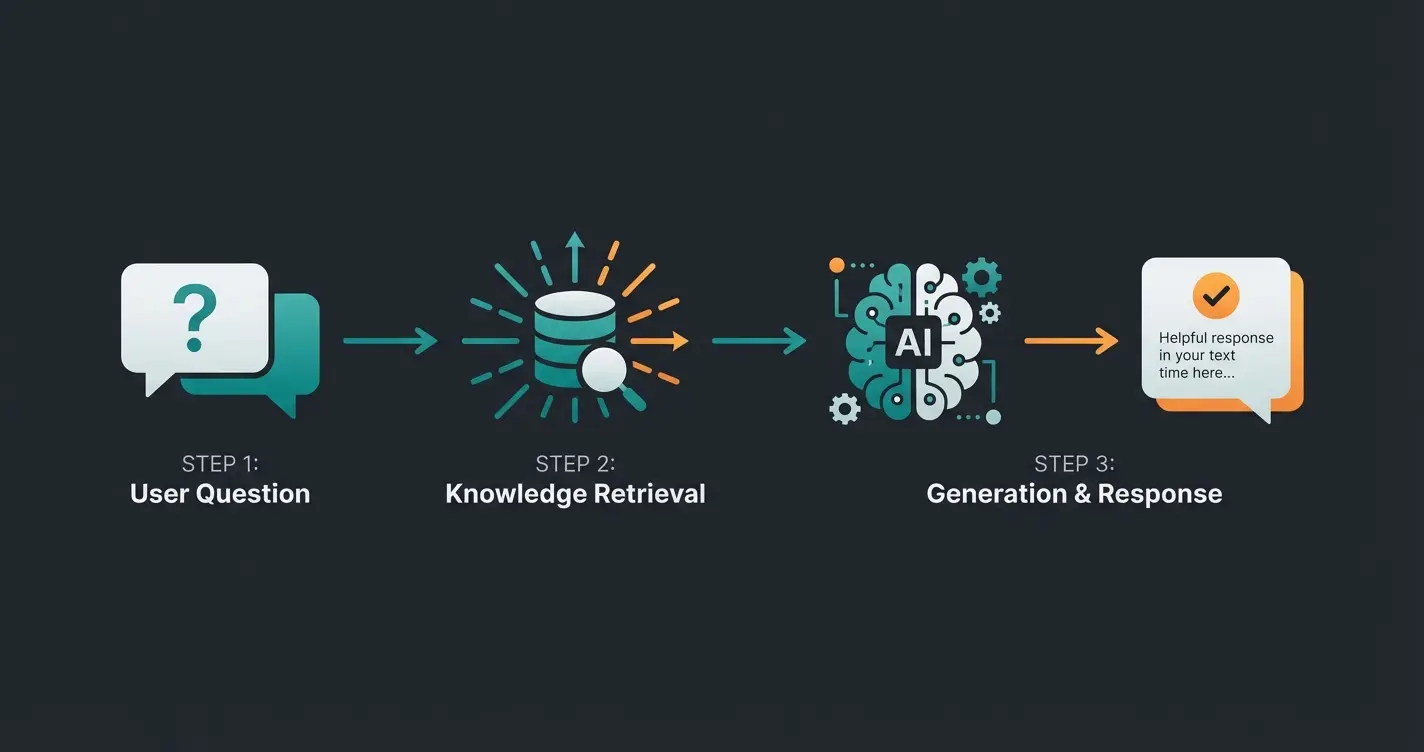
The Technology Behind It: RAG (Retrieval-Augmented Generation)
Modern bots often use a technique called RAG. The bot doesn't 'hallucinate' products but first searches your database for facts (Retrieval) and then formulates a friendly response from that (Generation). This makes the consultation safe and precise.
Rigid, pre-defined click paths. Limited to programmed responses. High user frustration when questions don't match.
Can recognize keywords and answer simple questions. Still struggles with context and complex queries.
Uses LLMs to understand context, reason about products, recommend solutions, and explain WHY. This is the current era of intelligent chatbots.
Discover how AI-powered product consultation can quadruple your conversion rates and deliver personalized shopping experiences 24/7.
Start Your Free Trial5 Benefits of AI Chatbots for E-Commerce & Sales
Why should you invest in this technology? The data for 2024 and 2025 is clear. This is no longer about 'nice-to-have' but about competitiveness. Understanding AI chatbots implementation strategies is essential for success.
1. 24/7 Purchase Consultation (Revenue, Not Just Support)
Customers shop in the evenings and on weekends. A human consultant usually isn't available then. A chatbot is.
- Fact: According to Chatbot.com, 64% of consumers cite 24/7 availability as the most important feature of a chatbot. Research from Adam Connell confirms this preference.
- Added Value: The bot catches the customer exactly at the moment of purchase interest, whether it's 3 AM or Sunday afternoon.
2. Increased Conversion Rate
This is the most important KPI. Studies show that customers who interact with intelligent AI buy significantly more often.
- Statistic: According to research from HelloRep.ai, e-commerce shoppers supported by AI chats convert at a rate of 12.3%, compared to only 3.1% without chat interaction. That's a quadrupling of purchase probability. This is further confirmed by studies from Ecomposer.io and Amra and Elma.
- Reason: Uncertainties ('Does this fit?') are immediately resolved, reducing cart abandonment.
3. Scalability of Expert Knowledge
Your best salesperson can only serve one customer at a time. A chatbot can consult thousands simultaneously – and always with the same high level of knowledge. This is where AI product consultants truly shine.
- Application: Whether it's Black Friday or the Christmas season, the quality of consultation remains consistently high without having to expensively train seasonal workers.
4. The 'Zero-Party Data' Goldmine
In a world where third-party cookies are disappearing (keyword: privacy & GDPR), zero-party data becomes the new gold. This is data that the customer voluntarily and consciously shares.
- How it works: When the bot asks: 'Who is the gift for?' or 'What's your skin type?', and the customer answers, you receive extremely valuable profile information.
- Benefit: You don't just know that User X was on the site, but that User X 'has dry skin' and 'is looking for products under $50.' This enables hyper-personalized marketing in the future. Research from Netz98, Emplibot, and Relay42 highlights the growing importance of this data type.
5. Support Relief & Cost Efficiency
Even with a focus on sales, efficiency remains a factor.
- Savings: According to DialogBits, DemandSage, and Zoho, chatbots can reduce service costs by up to 30% and completely automate routine inquiries (status, returns). This frees your human team to handle complex cases or VIP customers.
For businesses handling repetitive queries, AI chatbots FAQ automation provides significant efficiency gains.
Compared to 3.1% without chatbot interaction – a 4x improvement
Of customers cite 24/7 availability as the #1 chatbot benefit
Average service cost savings through chatbot implementation
Projected yearly growth of the German chatbot market until 2030
Real-World Examples: Who's Doing It Right?
To support the theory, let's look at market leaders who have redefined what a chatbot can achieve:
Sephora (Beauty)
A pioneer in the industry. The 'Virtual Artist' and chatbots on messenger services don't just consult on products but enable virtual makeup testing. According to case studies from Dr. Jessica Fernandes, Digital Defynd, and Agentive AIQ, the result has been millions of interactions and a massive increase in booking rates for in-store appointments.
H&M (Fashion)
Uses chatbots as a 'Digital Stylist.' The bot asks about personal style and suggests complete outfits, instead of letting users scroll through thousands of t-shirts. According to Medium and LimeChat, it learns from preferences and uses them for retargeting.
Amazon (Marketplace)
With 'Rufus,' Amazon has introduced an AI assistant that answers product questions, makes comparisons, and creates summaries of reviews. As reported by MyTotalRetail and Master of Code, this shows that even the world's largest marketplace has recognized: search alone is no longer enough – consultation is the key.
Checklist: Do I Need a Chatbot?
Not every company immediately needs a high-end AI. Use this checklist to determine your needs. For comprehensive guidance, explore Consultative AI implementation strategies.
You Should Consider an AI Product Consultant If:
- You sell products that require explanation (e.g., technology, cosmetics, sports equipment, furniture).
- Your product range is so large that customers often lose track.
- You receive many recurring questions about product features ('Does X work with Y?').
- Your support hotline is overwhelmed with questions that should be clarified before purchase.
- You have a high cart abandonment rate.
- You want to learn more about the actual needs of your website visitors (Zero-Party Data).
A Simple FAQ Bot Might Be Sufficient If:
- You only have very few, self-explanatory products.
- Your main goal is just to communicate business hours and addresses.
- You have absolutely no budget for technological development (although AI solutions are becoming increasingly affordable).
Compliance and Regulations: What to Consider
When implementing AI chatbots, businesses must also consider regulatory requirements. The EU AI Act introduces new compliance standards that affect how AI systems, including chatbots, can be deployed. Understanding these regulations early ensures your chatbot implementation remains compliant while delivering maximum value to customers.
Frequently Asked Questions (FAQ)
Costs vary widely. Simple, rule-based kit systems are available for as little as $50-100 per month. Professional AI solutions for businesses connected to product databases often start at $500-1,000 monthly, plus setup costs. Enterprise solutions can reach five-figure amounts. However, the ROI is crucial: if the bot increases the conversion rate by just 1%, it often pays for itself within weeks.
In the past, yes. Today, no. Thanks to 'no-code' platforms and LLMs, you no longer need to laboriously write dialogue trees by hand. Often, it's enough to give the AI access to your FAQs, product descriptions, and guidelines. The AI 'learns' the content automatically. Integration into shop systems like Shopify or Shopware is usually possible via plugin.
ChatGPT is the 'brain' (the language model), while a business chatbot is the 'application.' A company chatbot can use technologies like ChatGPT to understand language but is constrained by specific rules and your own data so it doesn't talk nonsense (so-called 'grounding'). It's essentially a specialized expert for your products, not an all-knowing assistant for recipes and poems.
Yes, acceptance is increasing massively, as long as the bot is helpful. According to Chatbot.com and Master of Code, studies show that over 60% of customers are open to AI service if it eliminates wait times. Transparency is key: the bot should identify itself as such and always offer an escape route to a human employee for complex problems.
Traditional search returns lists of results based on keywords. AI chatbots engage in dialogue, ask clarifying questions, understand context, and provide personalized recommendations with explanations. Instead of showing 143 products for 'mountain bike,' an AI consultant asks about your riding style, terrain preferences, and budget to recommend the 2-3 best options for your specific needs.
Conclusion: From Support Tool to Growth Driver
The answer to 'What is a chatbot?' has fundamentally changed in recent years. We're far removed from the annoying pop-ups of the early 2010s.
Today, a chatbot – properly implemented – is your most scalable, patient, and data-intelligent employee. It transforms anonymous traffic into qualified leads and satisfied buyers. While rule-based bots are slowly dying out, AI-powered product consultants are taking the helm in e-commerce.
For businesses, this means: Those who hesitate now are leaving the field to competitors who are already learning how to not just save costs with AI, but actively sell.
Are you ready to offer your customers not just answers, but real consultation?
Join leading e-commerce brands using AI product consultation to quadruple conversion rates and deliver exceptional 24/7 customer experiences.
Get Started Free Today