
Why the Classic FAQ Bot Has Become Obsolete
Remember your last interaction with a chatbot five years ago? It was probably a frustrating experience: a small window popped up, you asked a question, and the answer was: "I'm sorry, I didn't understand that."
For a long time, chatbots were considered a necessary evil – a digital shield for companies to relieve expensive service hotlines. But this image is changing radically. We're in the midst of a technological revolution that's transforming the chatbot from a passive answerer into a proactive revenue driver. As AI chatbots transform the digital landscape, businesses are discovering entirely new ways to engage customers.
In this comprehensive guide, we'll not only answer the question "What is a chatbot?" and examine the chatbot definition from a technical perspective. More importantly, we'll show how companies today use this technology not just to save costs, but to scale genuine product consultation. If you want to understand why the future of e-commerce lies in dialogue and how Agentic AI will transform the market through 2025 and beyond, you're in the right place.
Chatbot Definition: What Does It Really Mean?
To understand the potential of modern systems, we first need to clarify the basics. The chatbot meaning can already be derived from the word origin: it's a portmanteau of "Chat" (to converse) and "Bot" (robot). Understanding the chatbot definition functions is essential for any business looking to implement this technology effectively.
What Exactly Is a Chatbot?
A chatbot is a computer program designed to simulate conversation with human users, particularly over the internet. It functions as an interface between a human and a machine (User Interface). In the past, these systems were based on rigid databases. Today, they use Artificial Intelligence (AI) and Natural Language Processing (NLP) to understand nuances, irony, and complex contexts.
A Brief History of Chatbot Evolution
The development has been rapid, and understanding the history of chatbots reveals just how far we've come:
- ELIZA (1966): The "grandmother" of all bots. A simple program that simulated a psychotherapist by reformulating user inputs into questions.
- Siri & Alexa (2010s): The entry of voice assistants into everyday life, making conversational AI mainstream.
- ChatGPT & LLMs (from 2022): The breakthrough of generative AI. Suddenly, bots can not only select but create – texts, answers, and solutions.
Simple decision trees and phone menu-style interactions with no real intelligence
Basic keyword matching for frequently asked questions, limited understanding
Intent recognition and entity extraction enabling more natural conversations
Generative AI that understands needs, recommends solutions, and drives conversions
Chatbot Acceptance: A Cultural Shift
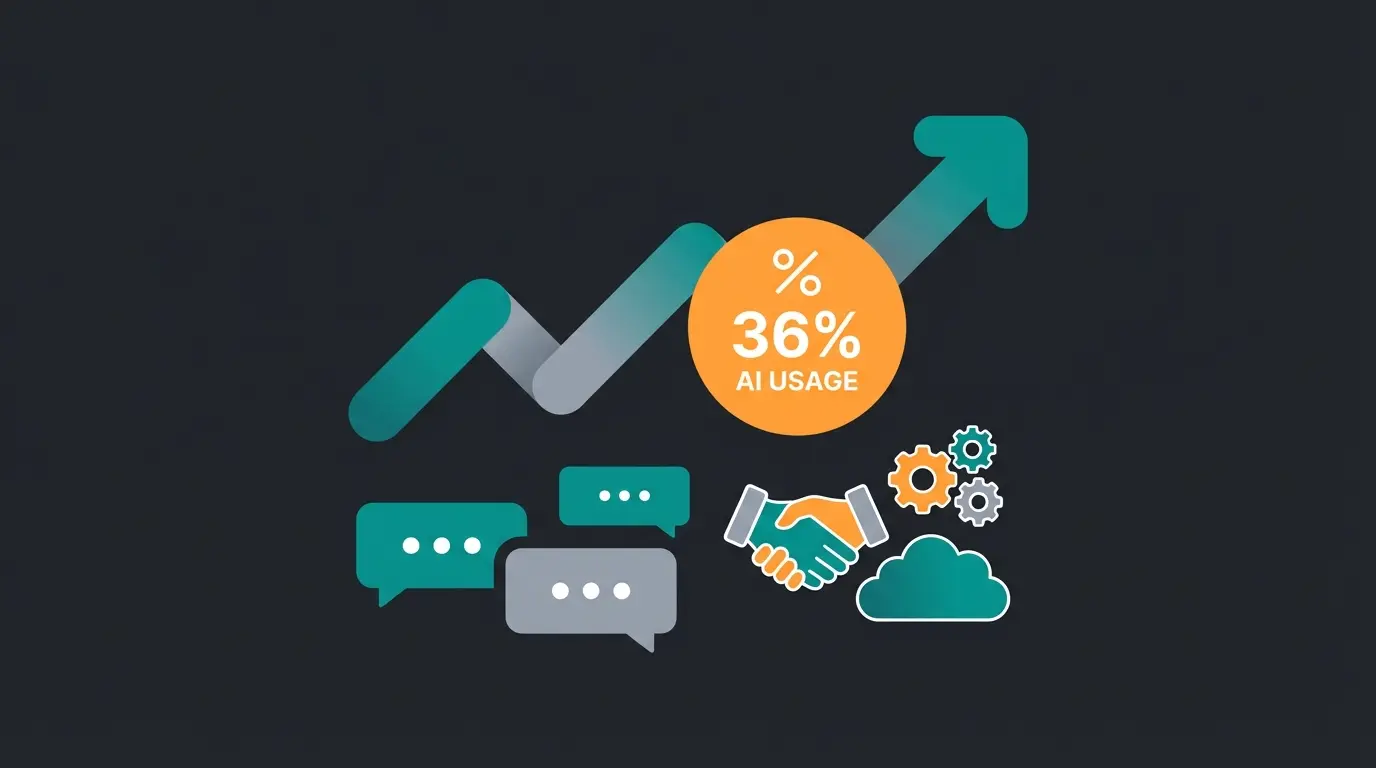
Interestingly, acceptance of chatbots is higher than many assume. A 2024 study by the digital association Bitkom shows that AI has arrived in the mainstream economy. 36% of companies already use AI, and another 47% are planning or discussing its implementation.
Even the tone of interaction has changed: according to research from Deutschlands Marktforscher, 99% of users address their AI assistants informally, while only 1% use formal language. This shows that the chatbot is increasingly perceived as a "colleague" or "partner," no longer just as software.
How Do Chatbots Work? Technology Simply Explained
When we want chatbot explained in simple terms, we need to distinguish between three technological evolution stages. For companies, choosing the right technology is crucial in determining whether the bot is perceived as an annoying barrier or a helpful consultant. The chatbot types comparison provides deeper insights into each approach.
1. Rule-Based Chatbots (The "Click Bots")
This is the simplest form. Think of it as a decision tree.
- How it works: The bot follows a predefined path (If user clicks A, show answer B).
- Advantage: Inexpensive, error-free for simple processes (e.g., "Reset password").
- Disadvantage: As soon as the user deviates from the script ("I have a different problem"), the bot fails. It has no intelligence, only logic.
2. AI Chatbots (NLP & Machine Learning)
These bots "understand" language. Thanks to Natural Language Processing (NLP), they recognize the intent behind a sentence, even if it contains typos or is colloquially phrased.
- How it works: The bot analyzes the sentence "I want to buy shoes" and recognizes the intent purchase intention and the entity shoes.
- Advantage: More flexible and natural interaction.
- Disadvantage: Must be trained and reaches its limits with complex, ambiguous queries.
3. Generative AI & Agentic AI (The New Standard)
This is where the current revolution is happening, powered by Large Language Models (LLMs) like GPT-4. As Chatbot AI transforms the industry, understanding these advanced capabilities becomes essential.
Generative AI: The bot doesn't rely on pre-made response modules but formulates answers in real-time. It can summarize product descriptions, draw comparisons, and respond empathetically.
Agentic AI: This is the most important trend for 2025 according to Gartner. While generative AI "only" creates content, Agentic AI can act.
According to AgilePoint research, by 2028, 15% of daily work decisions will be made autonomously by Agentic AI. The difference between KI-Mitarbeiter AI Agents and traditional chatbots is becoming increasingly significant.
Chatbot Use Cases: More Than Just Customer Service
Most articles about "What is a chatbot" list "24/7 availability in support" as the main benefit. That's correct, but it falls short. The biggest content gap in the current discussion is the shift from Service to Sales. Understanding how AI chatbots transform customer interactions reveals the full potential.
The Classic: Customer Support (Reactive)
This is about efficiency and cost reduction:
- Ticket deflection
- Status inquiries ("Where is my package?")
- FAQ answering
- Goal: Free up human agents for complex tasks
The New Standard: Product Consultation & E-Commerce
This is where the untapped potential lies. We're talking about Conversational Commerce. The chatbot becomes a Digital Product Consultant, and the impact of conversational commerce and AI on retail is transforming the industry.
Guided Selling: In an online shop with 10,000 items, customers are often overwhelmed. Filters (size, color, price) are technical, but not emotional. A consultation bot asks: "What do you need the running shoes for? Marathon or relaxed jogging in the forest?"
Global retail revenue via chatbots expected by 2028 according to Juniper Research
Increase from $12B in 2023 to $72B by 2028
Software applications expected to contain Agentic AI by 2028 per Gartner
Customers willing to pay more for personalized experiences
Revenue Projection: Juniper Research forecasts that global retail revenue through chatbots will grow from $12 billion (2023) to $72 billion by 2028. That's growth of 470%.
Example Breitling: The luxury watch manufacturer uses automated Instagram DMs not just for support, but to query preferences and guide users to the perfect watch – a classic "sales funnel" in chat format, as documented by Warmly.ai.
FAQ Bot vs. Product Consultant: The Key Difference
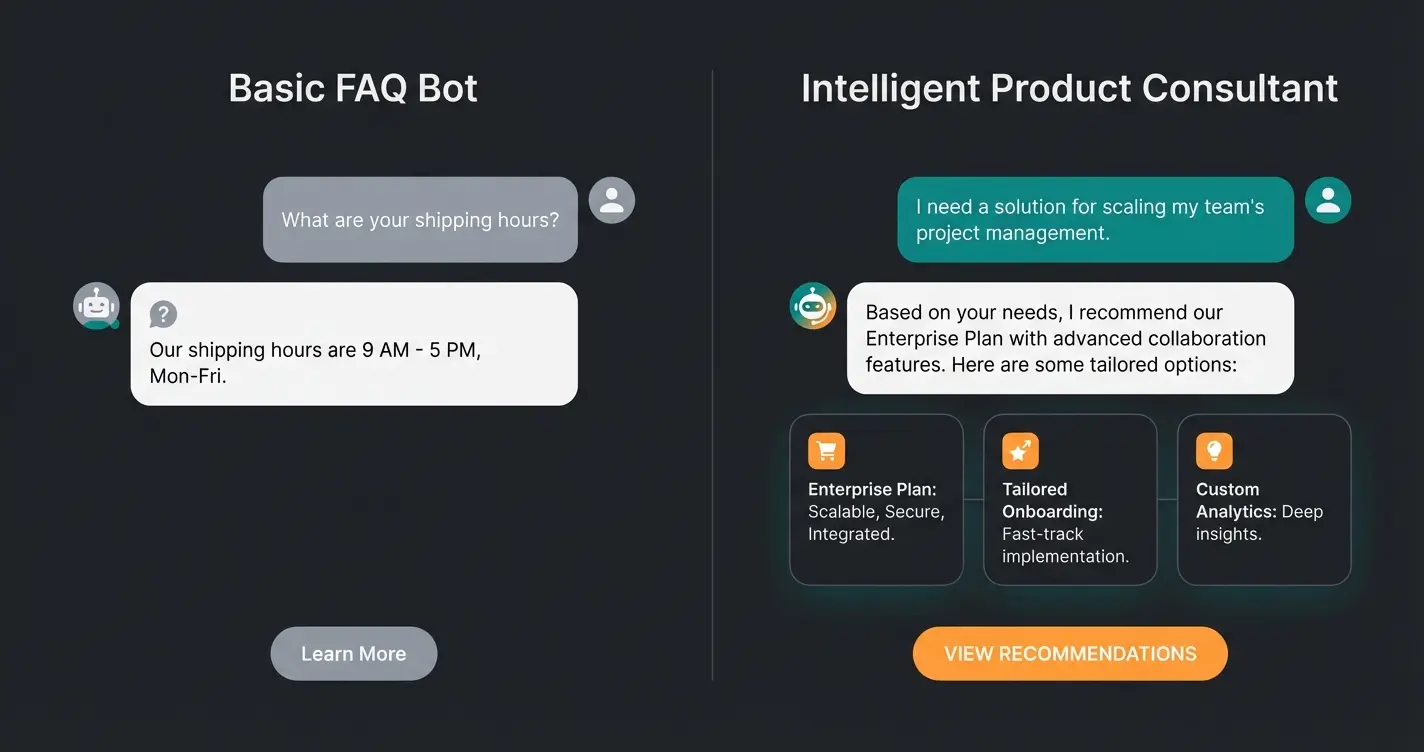
Many companies implement a chatbot with the wrong objective. They want to "reduce tickets." But if you want to generate revenue, you need to design the bot differently. The growing field of AI Product Consultation is reshaping how businesses approach this challenge.
Here's the direct comparison between a classic service bot and a modern sales bot (product consultant):
| Feature | Classic Service Bot (FAQ) | Digital Product Consultant (Sales AI) |
|---|---|---|
| Primary Goal | Cost reduction (Cost Center) | Revenue generation (Profit Center) |
| Trigger | Reactive (User has a problem) | Proactive (User seeks a solution/product) |
| Metric | Ticket Deflection Rate, Processing Time | Conversion Rate, Cart Value, Leads |
| Dialog Style | "How can I help?" (Waits for input) | "Are you looking for a gift or something for yourself?" (Leads the conversation) |
| Psychology | Factual, problem-solving | Empathetic, needs-oriented, persuasive |
| Technology | Often rule-based or simple NLP | Generative AI / Agentic AI (Context understanding) |
Stop using chatbots just for support. Discover how AI-powered product consultation can increase conversions and deliver personalized shopping experiences at scale.
Start Your Free TrialBenefits of AI Chatbots in Product Consultation
Why should companies invest in a "Digital Product Consultant" instead of just relying on filter functions in the shop? The potential of AI e-commerce transforms is substantial, and understanding KI E-Commerce implementations reveals the competitive advantage.
1. Hyper-Personalization Instead of Mass Processing
E-commerce websites are often static. Every visitor sees the same homepage. An AI chatbot, however, can respond to individual context within milliseconds.
Scenario: A user is looking at three different laptops. The bot recognizes the pattern and asks: "Are you torn between performance and battery life? For video editing, I'd recommend Model A; for university work, Model B is sufficient."
Data: According to Accio research, 80% of customers are willing to pay more for better, personalized experiences.
2. Conversion Uplift Through Guided Selling
The "paradox of choice" is one of the most common reasons for abandoned purchases. When customers have too many options, they often buy nothing at all.
- The chatbot reduces complexity. It doesn't just filter technically; it curates.
- Companies like Offset Solar were able to generate over $1.2 million in revenue through messenger bots by qualifying leads before a human took over, as reported by Warmly.ai.
Implementing AI-powered guided selling strategies can dramatically improve conversion rates and customer satisfaction.
3. Scalability of Expert Knowledge
You can't clone a top salesperson. But you can clone an AI bot.
- A company can feed the knowledge of its best product managers into the AI training.
- This expert knowledge is then available to 1,000 customers simultaneously – at 3 AM just as at Monday morning.
Gartner Trend: By 2027, 50% of companies that had planned to reduce staff will abandon those plans because they realize that AI and humans must work in tandem. The AI handles the volume; humans handle the complex cases, according to Gartner research.
4. Zero-Party Data Collection
In a world without third-party cookies (data privacy regulations), data that customers voluntarily provide is worth its weight in gold.
- In chat, customers reveal details: "I have dry skin," "I'm looking for a gift for my wife," "My budget is $50."
- This data (zero-party data) is more precise than any tracking tool and enables extremely targeted retargeting.
Practical Examples: What Great Consultation Looks Like
Theory is good, practice is better. What does an ideal interaction with a "Consultation Bot" look like? Exploring successful AI Chatbot for E-Commerce implementations provides valuable insights.
Scenario: The Online Wine Merchant
The Bad Bot (Rule-Based):
- Bot: "Hello! How can I help?"
- Customer: "I'm looking for a wine for dinner."
- Bot: "Here's a link to our 'Red Wine' category."
- Result: Customer is left alone with 500 products. Abandonment.
The Good Bot (Generative AI / Guided Selling):
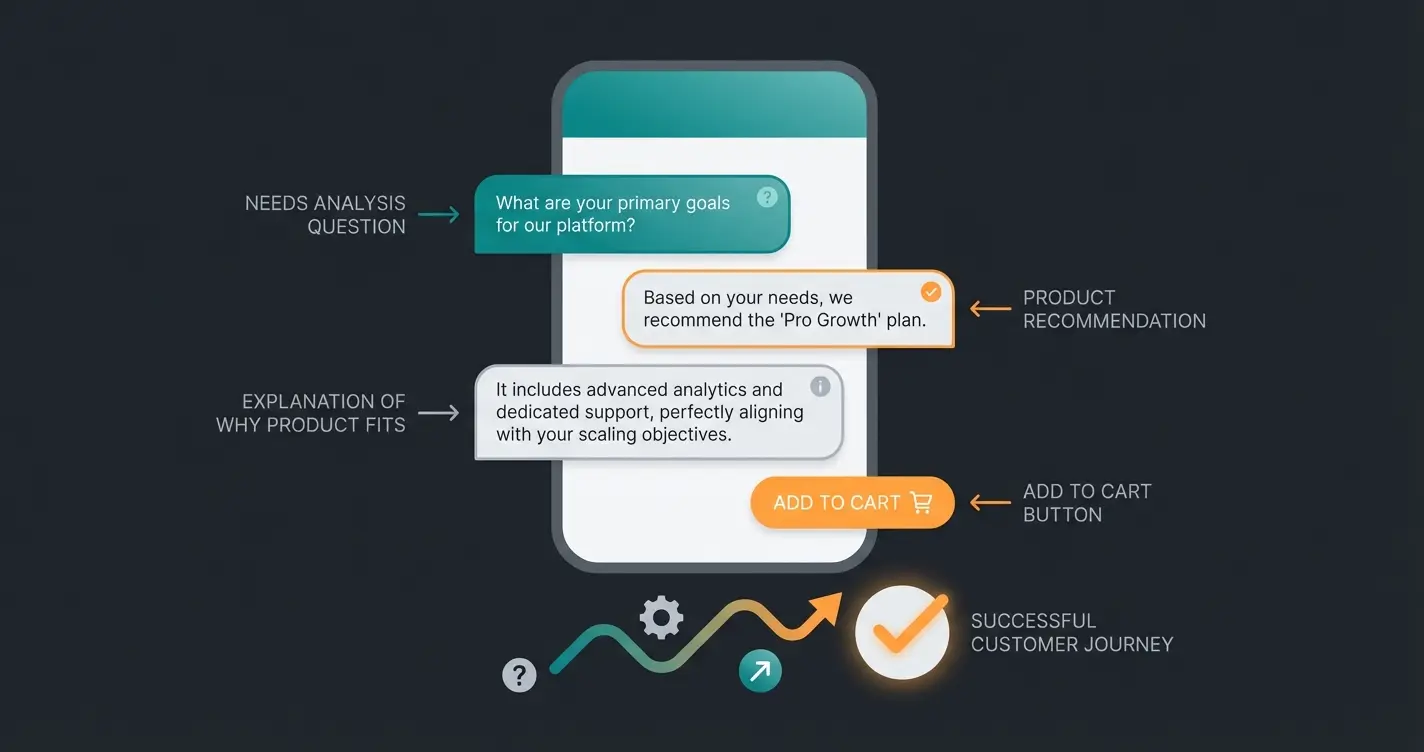
- Bot: "Hello! Are you planning a special dinner? What's on the menu?"
- Customer: "We're having beef steak and potatoes."
- Bot: "Sounds delicious! A full-bodied red wine pairs excellently with red meat. Do you prefer fruity or dry and oaky?"
- Customer: "Rather dry, but not too expensive."
- Bot: "Got it. I have two favorites for you: The Cabernet Sauvignon 2019 ($12) is very popular and robust. If you want something special, the Rioja Reserva ($18) is perfectly aged. Shall I add the Rioja to your cart?"
- Result: Consultation, recommendation, conversion.
Real-World Success Stories
H&M: Uses a chatbot on Kik and other platforms that functions as a "Style Guide." It asks about preferences and assembles outfits instead of just showing individual items, as detailed by Denser.ai.
David's Bridal: The bot "Zoey" functions as a bridal consultant. It doesn't just process appointments but sold dresses worth $30,000 fully automatically in the first weeks, according to LivePerson.
The Future: Agentic AI and the Agent-less Illusion
Where is the journey headed? Should companies now lay off all employees and replace them with bots?
The Trend Toward Agentic AI
As already mentioned, Agentic AI is the next big leap. Gartner defines this as AI systems that can autonomously pursue goals.
For e-commerce, this means: The bot doesn't just consult; it acts. It could independently reorder from the supplier when a product is out of stock, or proactively offer the customer an alternative before they even ask.
The Danger of Unofficial Tools
A fascinating trend that Gartner has identified: By 2027, 40% of all customer inquiries will no longer arrive at the company itself but will be resolved by "unofficial" third-party tools (e.g., the customer asks ChatGPT: "How do I reset my XYZ router?" instead of calling the hotline), according to Contact Centre Summit research.
Conclusion: From Cost Saver to Growth Engine
The question "What is a chatbot?" must be answered anew.
It's no longer the small window in the bottom right that annoys. It's the central interface for customer communication of the future.
Companies that view chatbots only as a cost-saving measure in support miss the biggest opportunity: The scaling of excellent consultation. The Digital Product Consultant never sleeps, never has a bad mood, and knows every detail of 10,000 products.
Recommended Actions
- Analyze your current bot conversations: Are they reactive or proactive?
- Identify products that require explanation: These are perfect candidates for guided selling.
- Start a pilot project with a "Guided Selling" approach: Have the bot ask questions instead of just waiting for keywords.
The technology is here. Customers are ready (and already address AI informally). Now it's up to companies to open the dialogue.
Frequently Asked Questions About Chatbots
A chatbot usually operates text-based (e.g., in a web browser or WhatsApp), while voice assistants (voicebots) like Siri or Alexa respond to spoken language. However, the underlying technology (NLP) is often similar. Both are designed to understand natural language and provide helpful responses, but the interaction modality differs significantly.
Not completely. Studies show that a hybrid solution works best. The chatbot handles routine tasks and initial consultation (approximately 80% of inquiries), while complex or emotional cases are transferred to humans ("Human Handover"). Gartner predicts that by 2027, 50% of companies that planned staff reductions will abandon those plans, recognizing that AI and humans must work together.
Costs vary greatly. Simple builder systems start at a few dollars per month. Custom enterprise solutions with integration to inventory management systems and generative AI training can cost five to six figures, but also offer a significantly higher ROI through revenue growth. The key is to consider not just the cost but the potential return on investment through increased conversions and reduced support overhead.
Yes, when implemented correctly. Modern providers in the US and EU strictly adhere to data protection compliance like GDPR and CCPA. It's important that no personal data is sent to servers without consent, especially when using LLMs from providers outside your jurisdiction without proper data processing agreements.
For support bots, traditional metrics include ticket deflection rate and processing time. However, for sales-focused product consultation bots, you should prioritize conversion rate, average cart value, lead qualification rate, and customer satisfaction scores. The shift from cost-center to profit-center thinking requires different KPIs.
Join leading e-commerce brands using AI-powered conversational commerce to boost sales and deliver exceptional customer experiences 24/7.
Get Started Free