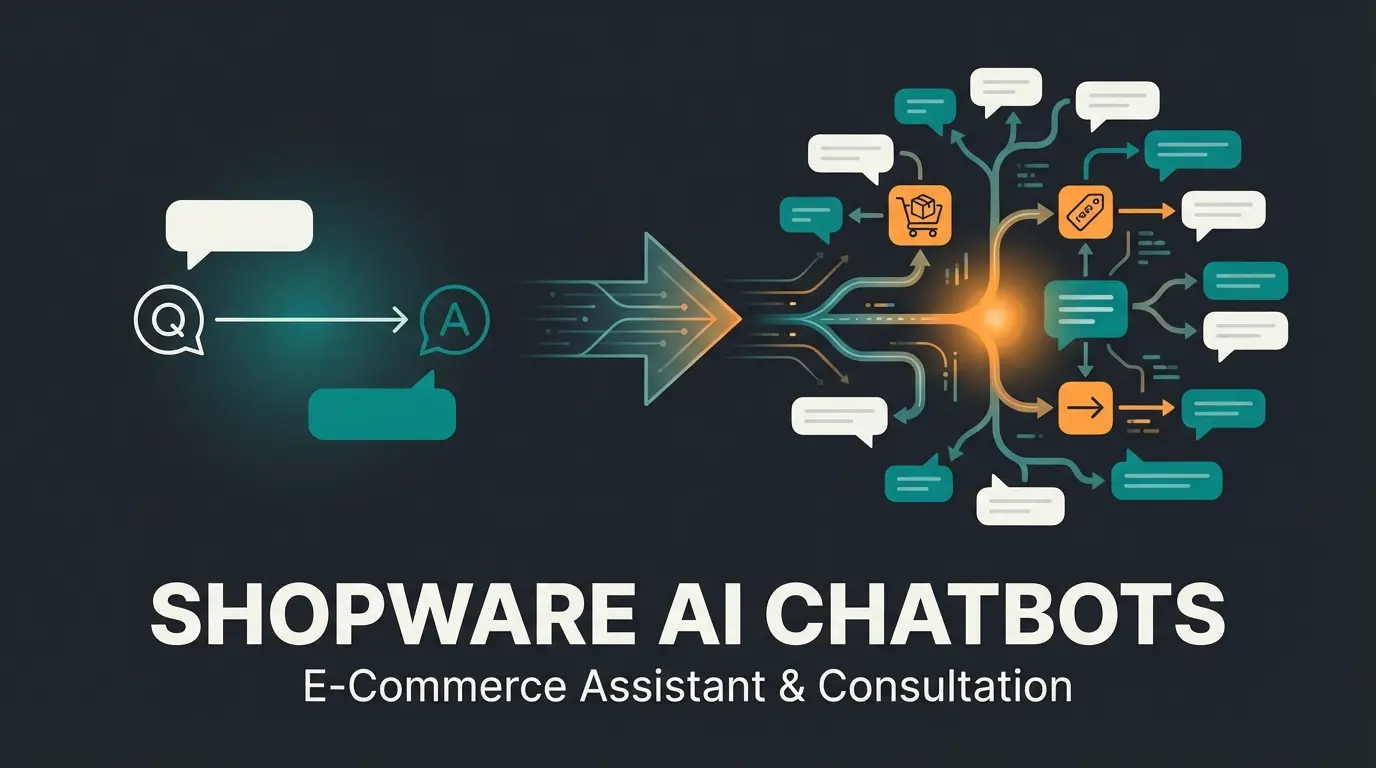
What Is an AI Chatbot and Why It Revolutionizes E-Commerce
We're writing the year 2026. The days when a chat window on a website was merely a glorified contact form, or a simple bot that only spit out a link to the terms and conditions when it detected the keyword "return," are over. When we talk about an AI chatbot today, we're no longer discussing annoying pop-ups but rather the most powerful sales tool available to e-commerce since the invention of the shopping cart.
The market has radically transformed. While companies in the early 2020s primarily deployed chatbots for cost reduction in customer service (ticket deflection), market leaders now recognize the true potential: revenue generation. A modern AI chatbot is no longer a digital gatekeeper but a highly qualified sales advisor available 24/7, never having a bad day, and knowing the entire product range by heart.
In this comprehensive guide, you'll learn why the technology is ripe for the mass market right now, how to differentiate yourself from the competition, and why an intelligent chatbot is the answer to declining conversion rates and rising customer acquisition costs. The shift from reactive support to active product advice represents one of the most significant opportunities in digital commerce today.
Definition: AI Chatbot vs. Traditional Chatbot
To understand the potential, we first need to demystify the technology. Many companies still use outdated systems and wonder about poor user acceptance. Understanding the chatbot AI difference is crucial for making informed decisions about your digital strategy.
The Traditional, Rule-Based Chatbot (The "Click Robot")
Think of a classic chatbot like a very simple decision tree. It operates on the "if-then" principle. The bot scans the user's text for predefined keywords (e.g., "invoice," "delivery"). The limitation becomes apparent quickly: if a customer types "Where is my package?" the bot understands it. But if the customer types "I'm eagerly awaiting my goods," the bot often fails because the keyword is missing. It's rigid, inflexible, and frequently leads to frustration.
The AI Chatbot (The "Understander")
An artificial intelligence chatbot is based on Large Language Models (LLMs) and Natural Language Processing (NLP). It analyzes not just keywords but the intent and context behind a message. It can conduct flowing conversations, ask follow-up questions, and remember previous statements in the chat history. The advantage is clear: it understands nuances, slang, and complex sentence structures. It appears human and empathetic.
| Feature | Traditional Chatbot | AI / Generative Chatbot |
|---|---|---|
| Technology | Scripts & Decision Trees | NLP & Machine Learning (LLMs) |
| Flexibility | Low (Rigid) | High (Dynamic) |
| Learning Capability | None (Must be manually programmed) | Learns from interactions & data |
| Application Area | Simple FAQs, status queries | Consultation, sales, complex support |
| User Experience | Often frustrating ("I didn't understand you") | Natural & Helpful |
The 3 Evolution Stages of Chatbots
The development of chat technology can be divided into three clear phases. Most German online shops are still stuck in stages 1 or 2. This is your opportunity to gain market share by leaping to stage 3. Understanding the history of chatbots helps contextualize where the technology is heading.
Stage 1: The FAQ Bot (The Information Desk)
This was the entry point for many companies. The bot is essentially a searchable FAQ page in chat format. It saves the support team time on trivial inquiries ("What are your opening hours?", "How much is shipping?"), but it doesn't actively contribute to business success. According to moin.ai, many businesses still operate at this basic level.
Stage 2: The Support Bot (The Problem Solver)
Here, tools like Zendesk or Userlike integrate deeply into business operations. The bot can create tickets, retrieve order status from the ERP system, and generate return labels. The goal is efficiency improvement and cost reduction in the service center. That's important, but it's purely a cost consideration (Cost Center). Our comprehensive chatbot types comparison explores these distinctions in greater detail.
Stage 3: The Product Advisor (The Revenue Driver)
This is the era of the intelligent chatbot in 2026. This bot doesn't wait for problems—it solves purchase blockers. Consider this scenario: a customer lands on a category page for "running shoes." There are 200 models. They're overwhelmed. The AI chatbot proactively engages: "Hey! Are you looking for shoes for asphalt or more for forest trails?" Through targeted follow-up questions (Guided Selling), the bot filters the assortment and presents the 3 matching models. It acts like a top salesperson in brick-and-mortar retail.
Keyword-triggered responses, static information delivery, no learning capability
Ticket creation, order tracking, return processing, efficiency-focused
Proactive engagement, needs analysis, personalized recommendations, revenue-focused
Top AI Chatbot Solutions Compared
The market is flooded with tools. For decision-makers, it's important to categorize solutions not just by price but by purpose. AI sales agents are becoming increasingly sophisticated, making the right choice more critical than ever.
1. The Generative Giants (Generalists)
Examples include ChatGPT (OpenAI), Claude (Anthropic), and Gemini (Google). Their strength lies in unmatched language quality and world knowledge. However, without massive customization, they "hallucinate" facts about your products. They're not "out-of-the-box" GDPR-compliant for customer data use in Germany and don't know your current inventory levels.
2. The Support Suites (Service Focus)
Examples include Zendesk, Intercom, Userlike, and Moin.ai. Their strength is perfect integration into ticket systems. They have a strong market position in Germany (especially Userlike and Moin.ai) with a focus on data protection, as noted by moin.ai. Their weakness is that their historical focus lies on service and support. Sales psychology and proactive product consultation are often secondary or must be painstakingly configured.
3. Specialized Sales Assistants (Your Niche)
Here, solutions specifically developed for Guided Selling position themselves. Their focus is on conversion rate optimization, basket size increase, and reducing return rates through better pre-purchase consultation. They use RAG (more on that shortly) to translate product data sheets into sales arguments. Success stories like the "Fashion Assistant" from Breuninger demonstrate how this category is changing the market, as reported by iteratec.com.
| Capability | Classic Bot | General AI (ChatGPT) | Specialized Sales AI |
|---|---|---|---|
| Understanding Context | None | Excellent | Excellent + Product Focus |
| Product Knowledge | Manual Entry | Generic/Hallucination Risk | RAG-Powered Accuracy |
| Data Privacy (GDPR) | Variable | Requires Configuration | Compliance by Design |
| Setup Time | Weeks | Hours | Days to Weeks |
| Primary Goal | FAQ Deflection | General Assistance | Sales & Conversion |
Benefits of an Intelligent Chatbot in Sales
Why should you invest budget in a chatbot AI specialized in sales? The data for 2025/2026 is clear. Digital product consultants are proving their worth across industries.
1. Conversion Rate Increase
Studies show that customers who interact with a chatbot have up to 67% higher probability of completing a purchase, according to research from amraandelma.com and atidiv.com. When a customer is uncertain, they abandon without consultation. With consultation, they buy. An AI bot can provide this consultation scalably for thousands of visitors simultaneously.
2. 24/7 Expert Consultation (Scalability)
Your best human salesperson needs sleep. Your AI doesn't. Especially in e-commerce, many purchases happen in the evenings or on weekends. An intelligent chatbot captures these leads when no human is available. According to botpress.com, 62% of consumers now prefer to speak immediately with a bot rather than wait for a human agent. Implementing 24/7 product consultation has become a competitive necessity.
3. Return Rate Reduction
This is an often-overlooked benefit. Returns often result from wrong expectations or wrong purchases (e.g., wrong size, incompatible accessories). A sales bot clarifies before the purchase: "Does this spare part fit my model X?" Through precise answers, the probability of wrong purchases drops drastically.
4. Revenue Increase Through Cross-Selling
A human salesperson might forget to offer the matching socks with the shoes. An AI never forgets. Through intelligent analysis of the shopping cart, the bot can recommend accessories at the right moment ("Would you like to add the matching care product for these leather shoes?").
Customers interacting with AI chatbots show significantly higher conversion rates
Consumers choose immediate bot assistance over waiting for human agents
AI chatbots capture leads during evenings and weekends when staff is unavailable
German customers often ignore standard product recommendations, creating opportunity for personalized AI guidance
See how an intelligent AI chatbot can become your most effective sales tool. Get personalized product consultation that converts browsers into buyers.
Start Your Free TrialTechnology Deep-Dive: RAG and Why Your Bot Must Know Your Inventory
Many companies shy away from AI because they fear "hallucinations"—meaning the bot invents products or names wrong prices. The solution to this problem is called RAG (Retrieval Augmented Generation). Understanding this technology is essential for successful AI Chatbot Integration.
What Is RAG?
Think of RAG like a librarian assisting the AI language model (the genius). Here's how it works: The user asks: "Do you have a red winter jacket in size M?" Without RAG, the AI guesses or says something general about jackets. With RAG, the system first searches in your own database (product feed, inventory) for the exact information. The answer: The AI formulates the found information friendly: "Yes, we have the 'NorthPole' model in red and size M still 3x in stock. Would you like me to show it to you?"
For e-commerce, RAG is indispensable, as highlighted by leadmetrics.ai and webkul.com. It guarantees that the AI chatbot only uses facts you provide (product descriptions, availability, shipping info) while still formulating charmingly and humanly. Conversational AI product consultants leverage RAG to deliver accurate, contextual responses every time.
What German Businesses Must Consider (GDPR & EU AI Act)
The use of AI in Germany is subject to stricter rules than in the USA. This isn't an obstacle but a quality feature when done right.
1. The EU AI Act (Important for 2026)
Since August 2024, the EU AI Act has been in force, and as of August 2026, the transparency obligations for chatbots (Article 50) take full effect, as detailed by digitalzentrum-berlin.de and ecovis.com.
- Labeling Requirement: Users must know they're speaking with a machine. A notice like "I am the digital assistant of [Company]" is mandatory.
- Transparency: AI-generated content must be recognizable as such.
- Risk: Violations can be expensive. Therefore, rely on providers that offer "Compliance by Design."
The official europa.eu documentation provides comprehensive details on these requirements.
2. Server Location and Data Protection
For German B2B and B2C customers, data security is essential. Use solutions that guarantee hosting in the EU (ideally Germany). Ensure that training data isn't used to train the public models of US giants (Data Privacy Shield). Providers like Userlike or superchat.com strongly advertise "Made in Germany"—a trust factor you should leverage for your sales bot as well.
Practical Example: How AI Conducts a Sales Conversation
To illustrate the difference between a "dumb" bot and an intelligent chatbot, let's look at a scenario in wine retail. This example showcases what AI Product Consultation looks like in practice.
Scenario A: The Rule-Based Bot (Outdated)
Customer: "I'm looking for a wine for a gift." Bot: "Please select a category: 1. Red Wine, 2. White Wine, 3. Rosé." Customer: "I'm not sure exactly, he likes bold wines." Bot: "I didn't understand you. Please select a category: 1. Red Wine..." Result: Customer leaves the shop annoyed.
Scenario B: The AI Sales Advisor (State of the Art)
Customer: "I'm looking for a wine for a gift." AI Bot: "That's a lovely idea! 🍷 Do you happen to know what the recipient likes to eat or whether they prefer dry or fruity wines?" Customer: "He grills a lot of meat and likes it bold." AI Bot: "Ah, a bold red pairs perfectly with grilled meat. I'd recommend a Primitivo from Manduria or a Spanish Rioja. Both have lots of body and go great with BBQ. Would you like me to show you our top-rated options in the price range up to €20?" Result: Customer feels advised, clicks on the products, and buys.
This example shows: The AI chatbot doesn't sell through filters but through needs. It imitates the conversation with a sommelier. This approach, demonstrated by success stories from companies highlighted on touchpoint.agency, represents the future of e-commerce consultation. A proactive Digital Product Consultant can transform your customer experience completely.
The Future of AI Chatbots in E-Commerce
AI Chatbots for E-Commerce are rapidly evolving beyond their current capabilities. The integration of multimodal AI, voice interfaces, and augmented reality product visualization will create even more immersive shopping experiences. Companies that invest now in building their AI consultation infrastructure will have a significant competitive advantage.
The technology continues to advance rapidly. Current developments point toward AI assistants that can understand and respond to images ("What shoes would match this dress?"), process voice commands seamlessly, and even provide AR-powered virtual try-on experiences guided by conversational AI. Understanding and working with evolving AI Chatbots positions your business for long-term success.
Conclusion: The Future Belongs to Automated Consultation
E-commerce stands at a turning point. In a market characterized by saturated channels and rising ad costs, the conversion rate becomes the most important currency. An AI chatbot acting as an intelligent product advisor is one of the most effective levers to maximize this currency.
Companies like Snocks and Breuninger are already showing that the courage to innovate is rewarded. The technology (RAG, LLMs) is ready, and the legal frameworks (EU AI Act) are clearly defined.
Action Recommendations for 2026
- Analyze Your Gap: Do you only have an FAQ bot or already an advisor?
- Test Guided Selling: Start with a product category that requires intensive consultation.
- Focus on Compliance: Choose partners who take GDPR and EU AI Act seriously.
The question is no longer whether you'll use AI in sales, but how quickly you'll start before your competitors do.
FAQ: Common Questions About AI Chatbots
Costs vary significantly. While simple support suites start at a few hundred euros per month, specialized sales bots with RAG integration and custom setup often range in the four-figure monthly range. However, the ROI (Return on Investment) through increased sales often amortizes these costs within a few months.
No, and that shouldn't be the goal. It should relieve your staff (from standard questions) and complement them (through 24/7 availability). Complex escalations or emotional complaints should still be seamlessly handed over to humans ("Human Handover").
Thanks to modern RAG technology, bots no longer need to be trained for months. They can often go live within 2-4 weeks by simply connecting to your product feed and help pages.
While ChatGPT is a general-purpose AI assistant, specialized AI chatbots are configured specifically for your business. They use RAG to access your product data, are GDPR-compliant, and are designed for specific use cases like sales consultation rather than general conversation.
It depends on the provider. Look for solutions with EU server locations, proper data processing agreements, and transparent AI disclosure. Providers advertising 'Made in Germany' or 'EU Hosting' typically offer stronger compliance guarantees.
Discover how an intelligent AI chatbot can revolutionize your customer consultation. Join leading e-commerce brands using AI to boost conversions and reduce returns.
Get Started Today