Introduction: The Two Faces of AI in E-Commerce
The year 2025 marks a turning point for Shopware merchants. With the release of Shopware 6.7 and the introduction of "Agentic Commerce," artificial intelligence (AI) has definitively arrived at the core of the system, as reported by Shopware. The promises sound enticing: product descriptions at the push of a button, automated translations, and images that tag themselves.
Yet while the e-commerce world celebrates that shop administration is becoming easier, a critical question often remains unanswered: Does this AI actually help your customer with shopping?
The current search landscape for "Shopware AI" paints a clear picture: the focus lies almost exclusively on backend efficiency. Merchants save time. That's important, no question. But in a market where the global cart abandonment rate still exceeds 70% according to Envive AI, efficiency alone isn't enough. A perfectly managed shop that leaves customers alone with 5,000 items is still just a digital self-service warehouse.
This article illuminates what the native Shopware AI (Shopware KI) actually delivers (and why you should use it), but more importantly reveals what it lacks: the ability to act like a real salesperson. We'll show you how to bridge the gap between admin automation and active product advice, and why this represents your greatest competitive advantage for 2025.
Part 1: The Status Quo – What Shopware's AI Copilot Does
To understand Shopware AI, we must first examine the native tools that Shopware provides starting with version 6.7. Shopware has made a massive push with the introduction of the AI Copilot and the vision of "Agentic Commerce." These features are deeply integrated into the Shopware Admin and aim to eliminate manual processes. These features are primarily available starting with the Shopware Rise and Evolve plans, as detailed by Atwix.
Here's the current state of technology that every Shopware merchant needs to know:
1. Content Creation and Optimization
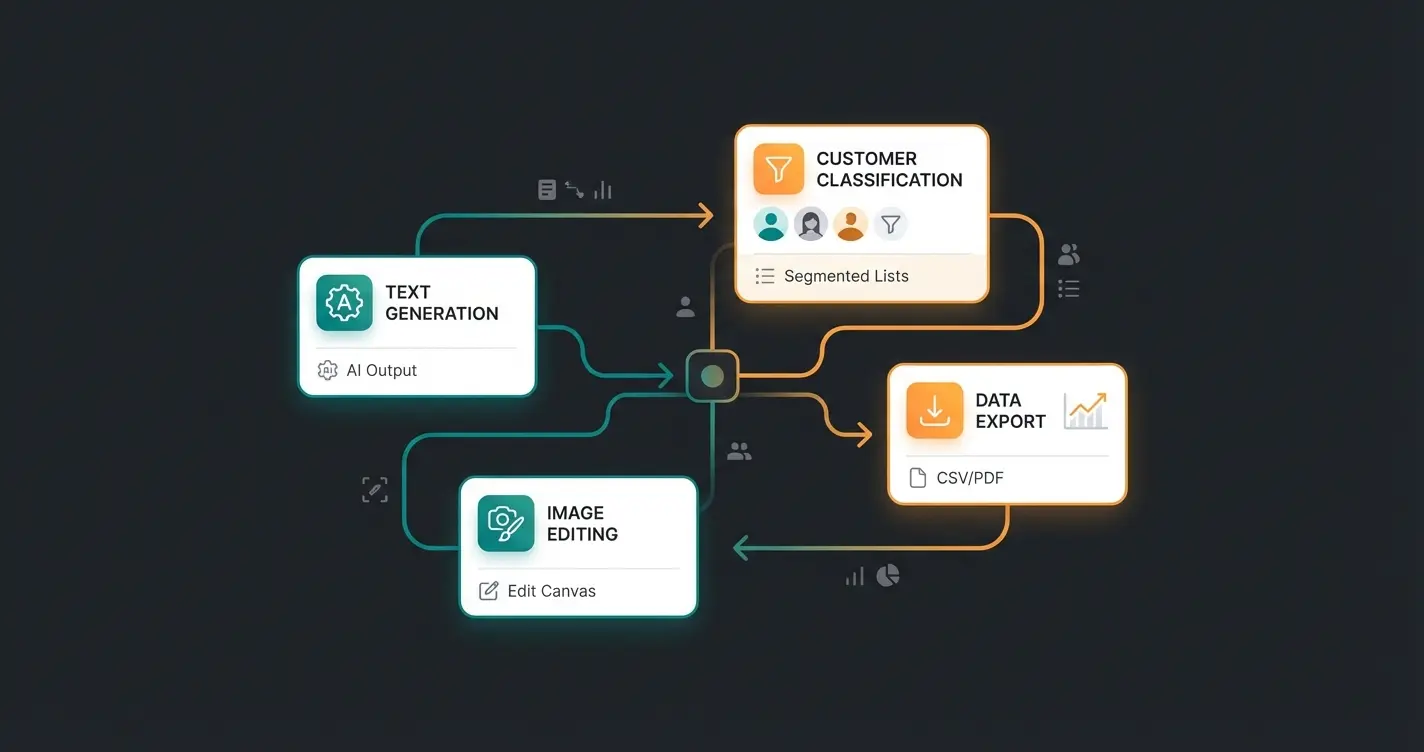
The most frequently used feature is text generation. The Copilot uses generative AI to create product descriptions, category texts, or content for shopping experiences.
- Function: You input keywords, the AI writes the text.
- Value: Massive time savings when onboarding new product ranges.
- Feature Highlight: The AI checks texts for spelling and can translate them directly into multiple languages, often making external translation agencies unnecessary.
2. Visual AI: The Image Keyword Assistant & Editor
Images are conversion drivers, but their management is tedious. According to Exwe, Shopware's visual AI capabilities have become essential for modern e-commerce operations.
- Image Keyword Assistant: The AI analyzes uploaded images and automatically assigns relevant alt tags and keywords. This is a direct lever for better SEO and improved internal search.
- AI Image Editor (New in 2025): Merchants can remove backgrounds from products, generate backgrounds, or place products in new scenes (e.g., "shoe on a forest clearing") without using external tools like Photoshop.
3. Data and Customer Management
This is where the strength of process automation becomes evident. As highlighted by ITDelight, these features significantly reduce manual workload.
- AI Export Assistant: Instead of writing complex SQL queries, merchants can generate CSV exports in natural language (e.g., "Export all orders from yesterday over €100").
- Customer Classification: The AI analyzes order history and assigns labels (e.g., "bargain hunter," "VIP customer") that can be used for marketing campaigns in the Rule Builder, as documented by Codixio.
- Review Summary: For products with hundreds of reviews, the AI summarizes the feedback ("Customers praise the quality but criticize the fit"), helping buyers decide faster.
4. Personalization in Checkout
An often underestimated feature is the Custom Checkout Message. Based on the shopping cart, the AI generates a personal message after purchase. According to Brainstreamtechnolabs, this feature significantly enhances customer experience.
- Example: "Enjoy your new running shoes! Here's a care tip..."
- This strengthens customer loyalty at a moment of highest attention.
Part 2: The Content Gap – Why Backend Automation Falls Short
When we look at current search results and agency guides, one thing stands out: everyone talks about how to get products online faster. Nobody talks about how to sell them better.
The "Silent Shop" Problem
Imagine walking into a physical specialty store. The shelves are perfectly organized, the price tags are correct (thanks to AI Copilot), and the decoration is beautiful (thanks to AI Image Editor). But: there's no salesperson.
If you don't know exactly what you need, you're lost. This is exactly the state of most online shops today.
- Search bars require the customer to know the shop's vocabulary.
- Filters often overwhelm with technical attributes (e.g., "frame height in mm" for bicycles).
- Product descriptions are static – they don't answer individual follow-up questions.
The Missed Revenue Opportunity in Numbers
The data for 2024/2025 is clear. While backend AI saves costs, the revenue lever lies in frontend interaction. Research from Amraandelma and Citrusbug confirms these findings.
Customers interacting with AI sales consultation show 12.3% vs 3.1% conversion rates
Customers complete purchases faster when supported by AI, reducing decision paralysis
Returning customers spend more with personalized recommendations and consultation
Global rate that backend optimization alone cannot solve
Studies show that customers who interact with AI-powered product consultation achieve a conversion rate of 12.3%, compared to 3.1% for customers without interaction. That's a fourfold increase. Additionally, customers complete their purchases 47% faster when supported by AI, as decision paralysis is reduced according to HelloRep AI.
The strategic gap: The native Shopware AI Copilot optimizes the catalog. What's missing is optimization of the conversation.
Part 3: The Solution – From Admin AI to Digital Sales Consultant
To grow organically in 2025 and differentiate from marketplaces like Amazon, Shopware merchants must take the step from "administrative AI" to "consultation AI" (Guided Selling). This is where AI Product Consultation becomes essential.
What is AI Guided Selling?
Unlike generative text AI in the backend, which writes one text for everyone, a Sales AI conducts an individual dialogue with one customer. It's not a classic support chatbot (that asks "Where's my package?"), but a product consultation advisor that functions as one of your digital sales consultants.
Scenario: The Difference in User Journey
Here we see the direct comparison between a standard Shopware setup and a shop with integrated Sales AI.
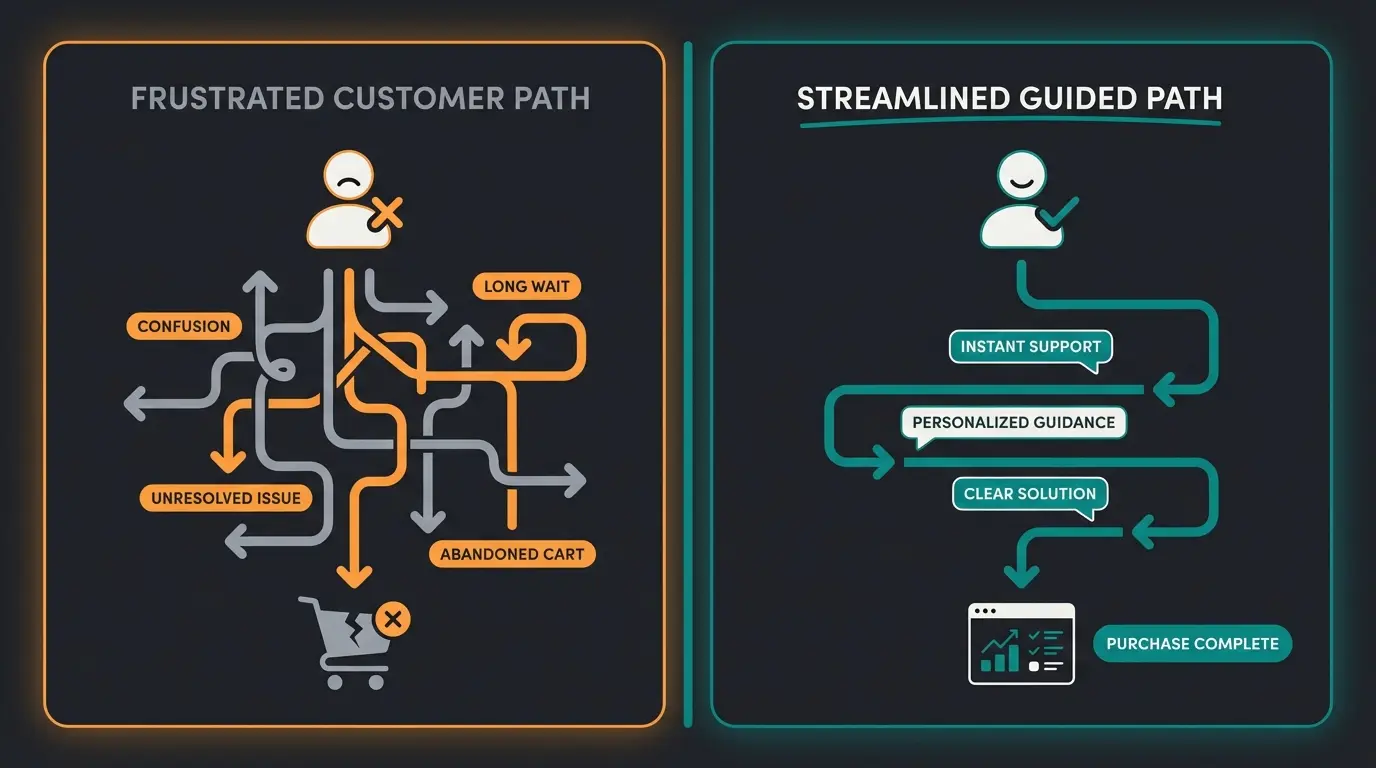
Scenario A: Standard Shopware (Self-Service)
- Customer searches: "Mountain bike for beginners".
- Result: List with 40 bicycles, sorted by price.
- Customer problem: "Which one fits my body height? Do I need full suspension or hardtail?"
- Action: Customer opens 5 tabs, reads technical data, gets confused.
- Result: Abandonment or purchase of the cheapest model (high return probability).
Scenario B: Shopware with AI Sales Assistant (Guided Selling)
- Customer enters shop: A chat window or avatar greets them: "Looking for something specific or should I help you find the perfect bike?"
- Dialogue: Customer: "I'm looking for a mountain bike, but I'm a beginner." AI: "Great! Where will you mainly ride? More on forest paths or steep terrain?" Customer: "Mostly forest paths, nothing too wild." AI: "Got it. And how tall are you? That's important for frame size."
- Recommendation: The AI filters the Shopware catalog in the background and presents three specific models with reasoning: "Based on your forest paths, I recommend Model X. It's low-maintenance (hardtail) and fits your height perfectly."
- Result: Purchase decision with confidence, higher margin, lower return rate.
Technical Implementation in Shopware
This type of AI is (still) not a native component of the Shopware Core. It's usually implemented through specialized apps or integrations that access product data via API. Implementing AI-powered product advice requires understanding the technology distinction.
- LLMs (Large Language Models): Understand the customer's unstructured input ("I want something red for a wedding").
- Vector Databases: Connect these wishes with structured data from Shopware (Color: Red, Category: Pumps, Availability: >0).
Stop losing customers to decision paralysis. Our AI-powered product consultation increases conversions by 4x while reducing returns.
Start Free TrialPart 4: Strategic Comparison – Native Shopware AI vs. Sales AI
To plan investments for 2025, this direct comparison helps. It clarifies that it's not an "either-or" but a "both-and" situation. Understanding AI-driven product consultation requires seeing both sides.
| Feature | Native Shopware AI (Copilot) | AI Sales Assistant (Guided Selling) |
|---|---|---|
| Primary Goal | Efficiency & Time Savings | Revenue & Conversion Rate |
| User | Merchant / Admin / Content Team | End Customer / Shopper |
| Location | Shopware Administration | Storefront (Frontend) |
| Technology Focus | Generative AI (Text, Image Editing) | Conversational AI (Dialogue, Consultation) |
| KPI Impact | Reduced Operating Costs (OpEx) | Increased Revenue & Cart Value |
| Example | "Write an SEO description for this shoe." | "Which shoe matches my blue dress?" |
| Availability | Native from Shopware 6.7 (Rise/Evolve) | Third-party Integrations / Custom Dev |
The Agentic Commerce Alliance – A Look Into the Future
Shopware itself has recognized that the journey doesn't end here. With the founding of the Agentic Commerce Alliance in July 2025, as reported by PR Newswire and Digital Commerce 360, Shopware positions itself against monopolization by Big Tech (Amazon, Google).
The goal: A standard where AI agents from different systems communicate with each other. In the future, a customer's "shopping bot" could negotiate directly with your shop's "sales bot." This represents a significant step forward for AI consulting in e-commerce.
Shopware AI Copilot handles content generation, image tagging, data exports, and customer classification to save merchant time
APIs and vector databases connect backend product data with frontend conversational capabilities
AI Sales Assistants engage customers in dialogue, understand needs, and guide them to the right product
Maximum efficiency meets maximum revenue – the winning formula for 2025
Part 5: Implementation Tips for a Holistic AI Strategy
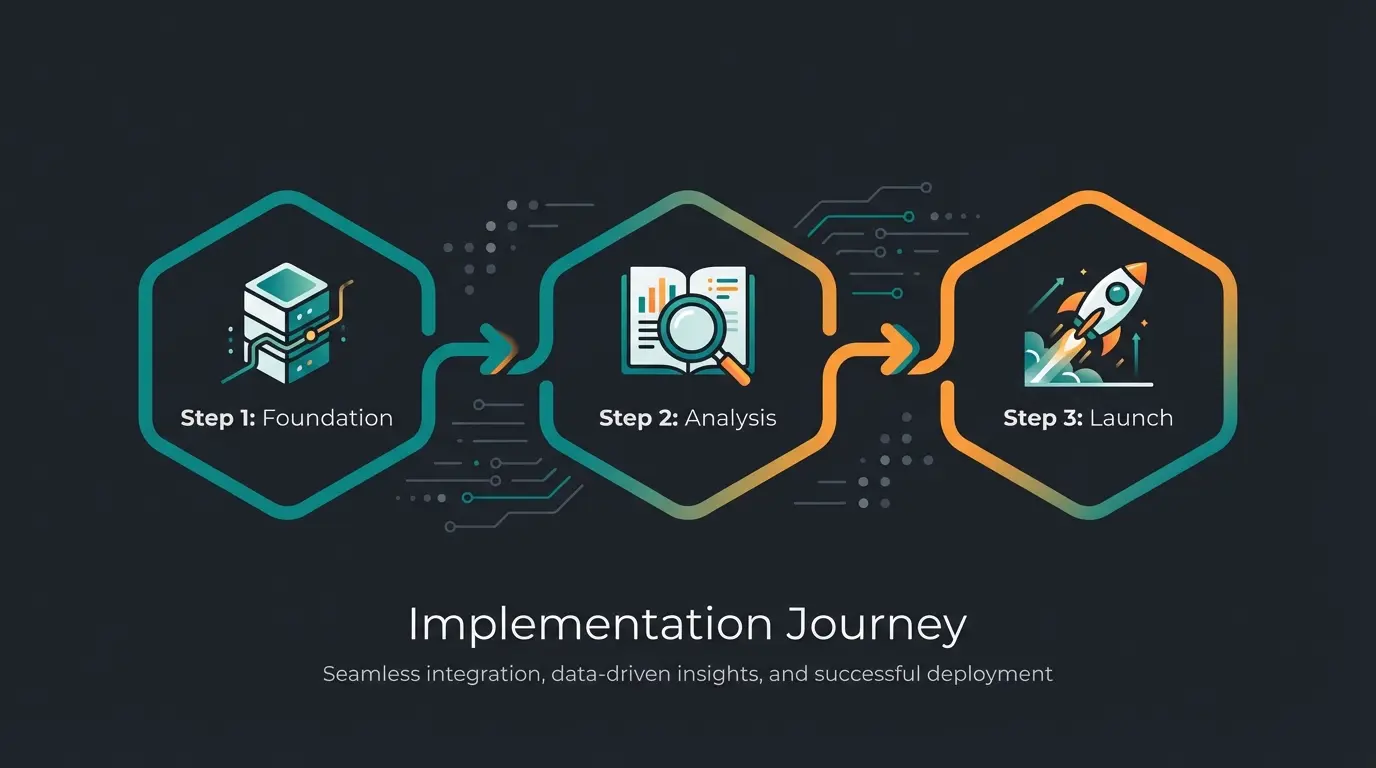
How do you bridge the gap between admin efficiency and customer consultation? Here's a 3-step plan for Shopware merchants looking to implement revenue-generating product consultants.
Step 1: Lay the Foundation (Shopware 6.7 Update)
Ensure you've updated to Shopware 6.7+. Use the native features to perfect your data quality.
- Action Item: Use the Image Keyword Assistant to tag all images. A Sales AI in the frontend can only recommend products that are cleanly tagged in the backend.
- Action Item: Use the Review Summary to find out what customers love about your products. These "arguments" are gold for sales conversations.
Step 2: Identify Consultation-Intensive Product Ranges
Not every product needs AI consultation. Customers buy socks without help. But with complex products, that's where the money lies. This is where AI product consultation makes the difference.
- Analysis: Check your analytics. Where is the bounce rate high? Where do many support inquiries come in?
- Examples: Electronics, sports equipment, cosmetics (skin type consultation), furniture.
Step 3: Pilot a Frontend AI
Don't start with the entire shop. Choose one category for a "Digital Consultant" using AI product consultation.
- Integration: Look for solutions in the Shopware Store or from agency partners offering "Conversational Commerce" or "Guided Selling."
- Measurement: Compare the conversion rate of customers who use the consultant with those who only use search. The benchmark is +300%.
Before & After: The Customer Journey Transformation
To visualize the impact of implementing AI-powered product consultation, consider these two contrasting scenarios:
Standard Shopware Experience
- Customer searches "red shoes"
- Receives list of 500 shoes sorted by popularity
- Applies filter for color, still sees 200+ options
- Opens multiple product pages, compares specifications
- Gets overwhelmed by choice paralysis
- Abandons cart or leaves shop entirely
With AI Sales Consultation
- Customer asks "I need red shoes for a wedding"
- AI responds: "What style are you going for? Elegant heels or comfortable flats?"
- Customer: "Elegant but not too high"
- AI: "Perfect. What's your dress color? I'll make sure they complement it."
- AI presents 3 curated options with explanations
- Customer purchases with confidence, low return probability
Conclusion: Automate Your Sales, Not Just Your Work
The introduction of Shopware 6.7 and its native AI features is a big step for the platform. It frees merchants from the burden of repetitive tasks. But efficiency doesn't sell products – emotions and consultation do.
The "Blue Ocean" for Shopware merchants in 2025 doesn't lie in generating product descriptions even faster. It lies in breaking the silence in the online shop.
While your competition is still busy optimizing their admin processes, you can gain a real competitive advantage through customer-oriented AI (Sales AI). You transform your shop from a passive catalog into an active consultant that understands, guides, and convinces customers.
Frequently Asked Questions About Shopware AI
Many AI Copilot features are included in commercial plans (Shopware Rise, Evolve, Beyond). In the Community Edition, they are often limited or require separate subscriptions/plugins.
The native AI features were massively rolled out and expanded with Shopware 6.7 (released mid-2025). An update to this version is highly recommended for accessing the full AI Copilot capabilities.
No, and it shouldn't. The AI Copilot relieves them of routine tasks (e.g., translations), and a Sales AI in the frontend handles standard purchase consultations. This gives your team time for complex cases and genuine relationship building.
An initiative founded by Shopware in July 2025 to create open standards for AI in e-commerce and prevent dependence on large tech monopolies. It enables AI agents from different systems to communicate with each other.
Compare conversion rates between customers who interact with the AI consultant versus those who only use standard search and filters. Track cart value differences, return rates, and time-to-purchase. The benchmark shows a 4x conversion improvement with AI assistance.
Join leading Shopware merchants using AI sales assistants to increase conversions by 4x. Start your free trial and see the difference guided selling makes.
Get Started Free
Lasse is CEO and co-founder of Qualimero. After completing his MBA at WHU and scaling a company to seven-figure revenue, he founded Qualimero to build AI-powered digital employees for e-commerce. His focus: helping businesses measurably improve customer interaction through intelligent automation.