Introduction: The Problem of Silent Shelves
Imagine walking into a physical store. The shelves are full, the selection is enormous. You're looking for running shoes but don't know which model is suitable for your knee problems. You look around. No salesperson is in sight. Nobody asks: "Can I help you?" After five minutes, you leave the store frustrated and without making a purchase.
This exact scenario plays out millions of times daily in e-commerce. We've built beautiful Shopify stores with optimized checkouts and high-resolution images. But we've forgotten the most important element of retail: The consultation.
When you search for "Shopify product consultation," you often find agencies that want to help you set up your store. That's important, but it's not what this article is about. Here, we're discussing the automation of purchase advice for your customers. It's about transferring the experience of a top salesperson into the digital world—scalable, available around the clock, and data-driven. This is where AI product consultation becomes essential for modern e-commerce success.
In this article, we analyze why traditional filters and static quiz apps (the "if-then" logic) are reaching their limits and why AI-powered product consultation (Guided Selling 2.0) is the biggest lever for conversion rate optimization and return reduction in 2025.
The Paradox of Choice: Why Customers Don't Buy
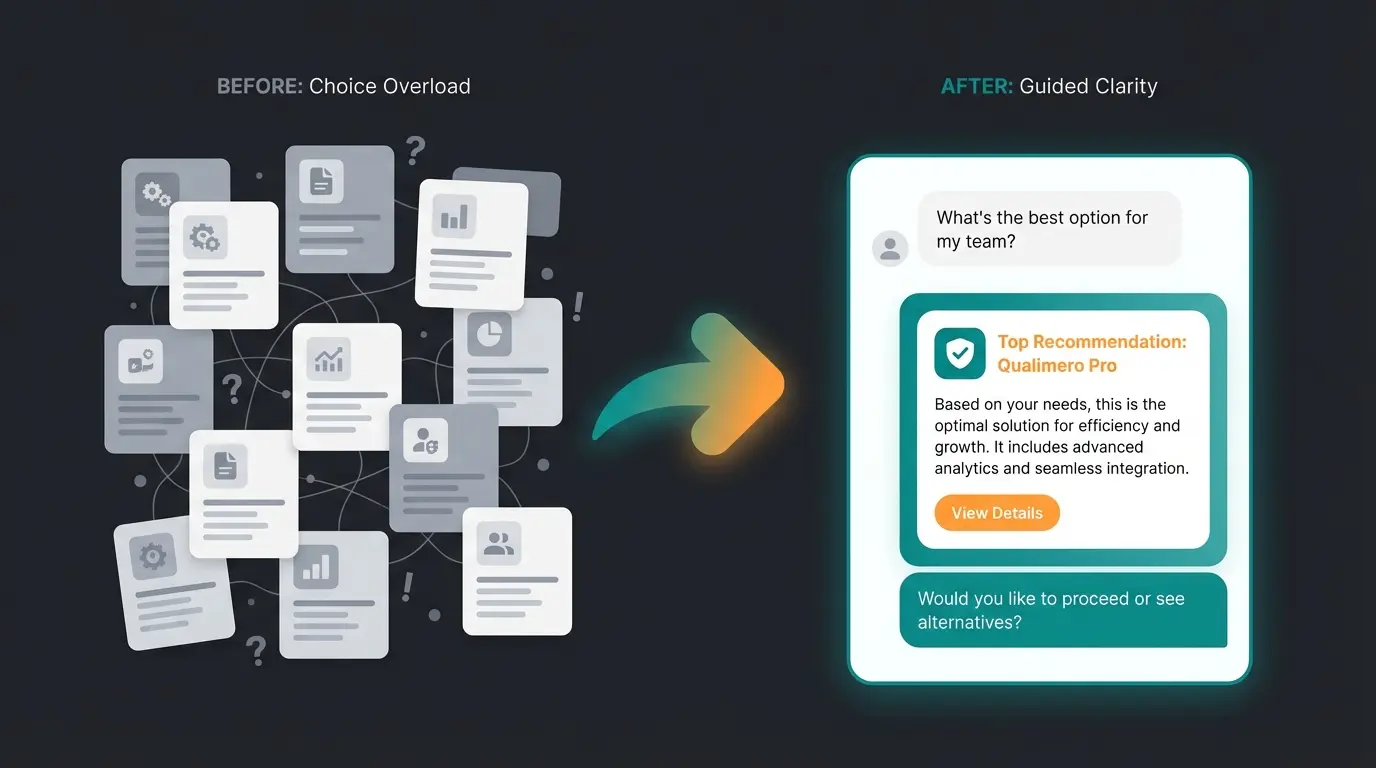
Before we talk about technology, we need to understand the psychology of not buying. E-commerce suffers from a phenomenon that psychologists call "Choice Overload" or the paradox of choice.
The Psychology of Decision Paralysis
Studies consistently show that too much choice doesn't lead to more sales—it leads to fewer. The famous jam experiment from Winsome Marketing demonstrated that 30% of customers bought jam when only 6 varieties were offered. When 24 varieties were presented, the purchase rate dropped to just 3%.
Research suggests that customers confronted with more than 12 decision points show slower reaction times and higher cart abandonment rates. According to a survey of 5,500 consumers cited by Agility PR, 4 out of 5 shoppers feel "decision fatigue" from the sheer volume of search results and ineffective filters.
Due to overwhelming choice and lack of guidance
Meaning 98-99 visitors leave without buying
Leading to slower decisions and cart abandonment
From ineffective filters and too many results
The "Silent" Visitor Problem
In your Shopify store, this manifests as a high bounce rate on category pages (Collection Pages). The customer sees 50 products, feels overwhelmed, and leaves. According to Red Stag Fulfillment and TrueProfit, the average conversion rate for Shopify stores lies between 1.4% and 1.8%. This means nearly 99 out of 100 visitors leave without buying—many not because they didn't want the product, but because they couldn't decide.
This is exactly where digital product advice comes in. It breaks down complexity and guides the customer by the hand through their purchase journey.
The Evolution of Advice: From Filters to AI
The way we guide customers to products online has evolved dramatically. We're currently in the transition from Phase 2 to Phase 3, and understanding this evolution is crucial for staying competitive.
Level 1: The Filter (The Customer Does the Work)
This is the standard in almost every Shopify theme. The customer must already know what they need (e.g., "Size M," "Color Blue," "Material Cotton"). The problem? It assumes expertise. A customer looking for "running shoes for knee problems" doesn't know whether to filter for "Cushioning: High" or "Drop: 8mm." Filters sort—they don't advise.
Level 2: The Static Quiz (Shopify 1.0)
This is the current market standard, dominated by apps like RevenueHunt, Quizify, or Octane AI according to RevenueHunt and Quizify. A "Product Recommendation Quiz" asks questions and uses rigid "if-then" logic (Logic Jumps) to display products.
Example: Question: "Do you have dry skin?" → Answer: "Yes" → Logic: Show products with tag 'Dry Skin'.
The "Maintenance Trap": These apps are excellent for simple product ranges. But they have a massive weakness: Manual mapping. When you add 50 new products to your store, you must manually edit the quiz and integrate the new products into the logic trees, as discussed on Reddit. The experience often feels more like an interrogation than a conversation. There's no room for follow-up questions ("Why is this cream better?").
Level 3: AI Product Consultation (Shopify 2.0)
This is where the market is heading with Large Language Models (LLMs) and AI agents. An AI analyzes your product data (descriptions, metafields) in real-time and conducts a dialogue in natural language. According to Qualimero and Rep AI, this represents the next generation of AI-driven consultation.
The crucial difference: No manual linking of questions to products is required. The AI "understands" that a shoe with the attribute "strong cushioning" is good for "knee problems" without you having to explicitly program this rule. When you add new products, the AI automatically reads them and can immediately recommend them, as explained by Shopify Engineering.
Customer must know exact specifications. No guidance provided. High expertise required.
Rigid if-then logic. Manual product mapping. High maintenance burden.
Natural conversation. Automatic product understanding. Self-updating recommendations.
Why "Consultation" Sells More Than "Recommendation"
There's a subtle but crucial difference between a product recommendation and a product consultation. Understanding this distinction is key to maximizing your conversion potential with digital product consultants.
The "Why" Is the Key to Selling
A classic quiz spits out a results page at the end: "Here are your products." A genuine Shopify product consultation through AI delivers the reasoning:
This explanation builds trust. According to McKinsey studies, 71% of consumers expect personalized interactions and 76% are frustrated when these are absent. As reported by Business Chief, personalization here doesn't just mean knowing the customer's name—it means understanding their needs and responding to them. This is exactly what AI consulting in e-commerce delivers.
Objection Handling: The Conversion Multiplier
A static quiz cannot handle objections. If the price is too high for the customer, they abandon the process. An AI advisor can react dynamically:
Customer: "That's too expensive for me."
AI: "I understand. If you can do without the waterproof membrane, the 'BasicRunner' model would be an excellent alternative for €40 less, still offering very good cushioning."
This is the moment when a visitor becomes a buyer. It's the power of 24/7 product consultation that never gets tired, never gets frustrated, and always has an alternative ready.
Stop losing customers to choice overload. Our AI product consultation engages visitors in natural conversations and guides them to the perfect purchase.
Start Your Free TrialTechnical Integration: How AI Reads Your Shopify Store
Many merchants shy away from AI because they fear complex integrations. The good news: Modern Shopify consultation tools use Shopify's native infrastructure. You don't need to be a programmer, but you do need to maintain your data properly. This is where understanding KI E-Commerce fundamentals becomes essential.
The Power of Metafields
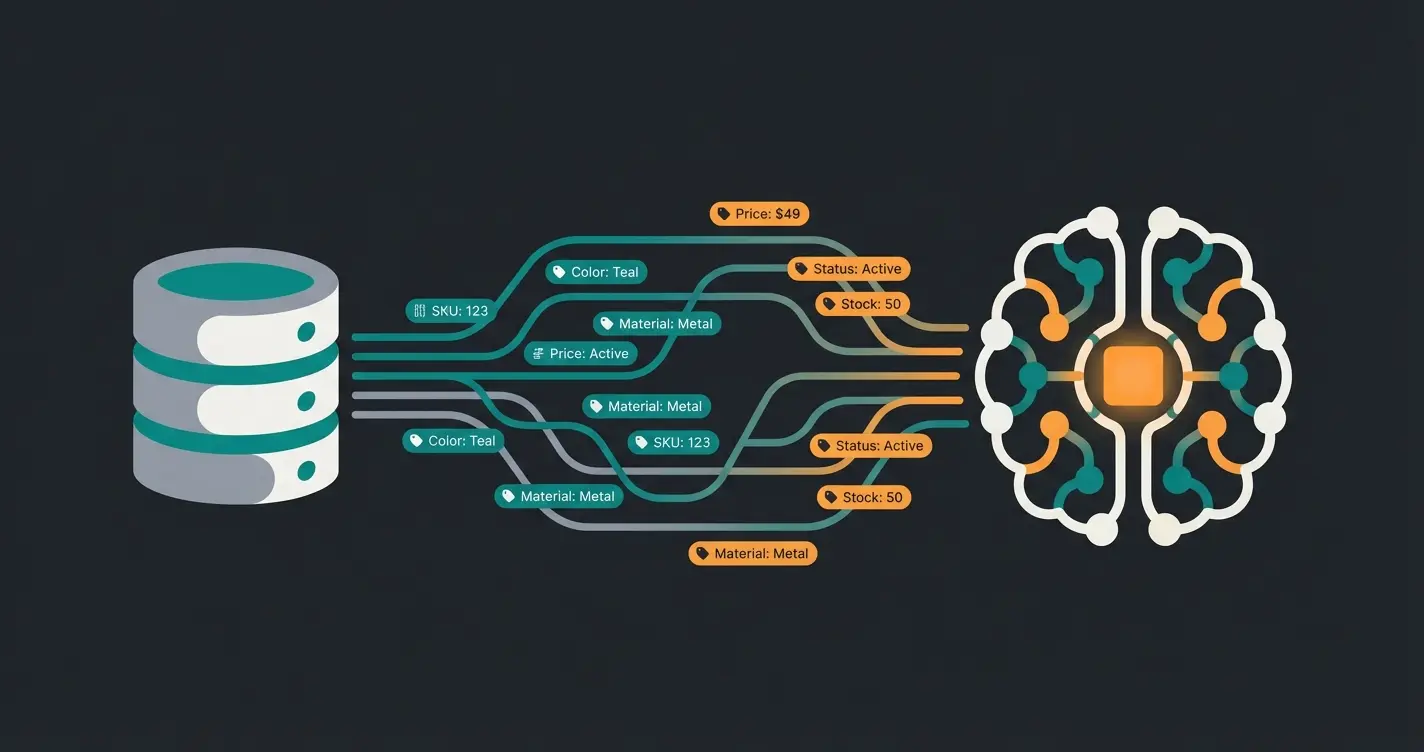
For functional AI consultation, Shopify Metafields are essential. AI cannot "see" how soft a fabric is unless it's documented in the data. According to Shopify and Shopify Dev, Shopify has invested massively in data structuring (Standard Metafield Definitions) in recent years.
How to Structure Your Data for AI
- Standardized Categories: Use Shopify Taxonomy. When you categorize a product as `Apparel & Accessories > Clothing > Shirts`, Shopify automatically unlocks relevant metafields like `size`, `material`, `neckline`, and `color` according to StoreSEO.
- Descriptive Attributes: Use metafields for specific consultation attributes. For cosmetics: Skin type (Oily, Dry), Application time (Night, Day), Active ingredient (Retinol, Hyaluronic Acid). For sports: Surface (Asphalt, Trail), Level (Beginner, Pro).
- Unstructured Data (Descriptions): Modern LLMs can also read flowing text in product descriptions as noted by Shopify. Ensure your descriptions aren't just promotional but contain facts ("Suitable for...", "Helps with...").
No More Manual Logic
The biggest advantage of the AI solution over quiz apps is eliminating "mapping tables." Previously with quizzes, you had to define: If Answer A, then show Product ID 1234. Today with AI, the system uses "Vector Search" or "Semantic Search" as explained by Ice Cube Digital. It matches the meaning of the customer query ("I have back pain") with your product attributes ("ergonomically shaped," "supportive") without you ever explicitly drawing this connection.
This is the foundation that makes AI product consultants so powerful—they understand context and meaning, not just keywords.
ROI & Business Case: Numbers That Convince
Why should you invest in product consultation for your online shop? The answer lies in three key metrics: Conversion Rate, AOV, and Return Rate. Understanding these numbers shows why AI Selling is revolutionizing e-commerce.
1. Conversion Rate Increase
As mentioned, the Shopify average sits at approximately 1.4% - 1.8%. According to Aiden, merchants using Guided Selling often report conversion rates that are 3x to 4x higher among customers who use the consultation tool compared to those who only browse. When you eliminate uncertainty, people buy.
2. Reducing Return Rates
This is often the overlooked "hidden champion" of product consultation. According to Shopify and Return Prime, the average return rate in e-commerce was approximately 16.9% in 2024, with even higher projections for 2025. In the fashion sector, it often reaches 30-50%.
The causes include "Bracketing" (ordering multiple sizes for selection) and incorrect product expectations. The solution? Precise Shopify purchase advice ensures the product truly fits—not just size-wise, but for the intended use case. Someone who buys the right running shoe doesn't return it because it pinches. A reduction in returns of just 5% often has a greater impact on profit than a 10% increase in revenue.
3. Increasing Average Order Value (AOV)
AI advisors are masters of cross-selling. Consider this scenario: A customer buys a premium coffee machine. The AI consultation responds: "An excellent choice. To keep the machine limescale-free for a long time, 90% of our customers recommend adding this special descaler. Should I add it for you?"
Personalized recommendations can increase revenue by 10-15% according to research. This is precisely what AI-powered product consultation enables at scale.
For customers using consultation vs. browsing only
That proper consultation can significantly reduce
From personalized cross-sell recommendations
Often exceeds 10% revenue increase in profit terms
Comparison: Quiz App vs. AI Sales Agent
To make your decision easier, here's a direct comparison of the two technologies. This comparison shows why AI-powered consultation outperforms traditional approaches.
| Feature | Classic Quiz App | AI Product Consultation |
|---|---|---|
| Technology | Static decision trees (If/Then) | Large Language Models (LLM) & Vector Search |
| Setup | Complex: Questions must be manually linked to products | Fast: AI scans product catalog automatically |
| Maintenance | High: New products must be manually added to quiz | Minimal: Automatic synchronization with Shopify |
| User Experience | Monologue (Question-Answer-Click) | Dialogue (Chat, follow-up questions, natural language) |
| Flexibility | Rigid: Can only map predictable paths | High: Can respond to unexpected questions |
| Objection Handling | Not possible | Possible ("Why so expensive?", "Is this available in red?") |
| Cost | Lower entry, more expensive at scale | Higher entry, more efficient for large catalogs |
Practical Tips for Implementation
If you're ready to implement Shopify product consultation in your store, follow these steps to ensure success with your AI-powered product consultation strategy.
Step 1: Data Hygiene Before AI
Before installing any tool, clean up your data foundation. Use apps or Shopify's bulk editing to fill in missing attributes. According to XGen Tech, pay attention to consistent naming in tags and metafields—don't use "Size" once and "size" another time.
Step 2: Start Small
You don't need to automate the entire store immediately. Begin with your most complex category (e.g., "Skincare" or "Mattresses"). Test a "hybrid approach": A short quiz for pre-qualification (3 questions) that then transitions into an AI chat.
Step 3: Prominent Placement
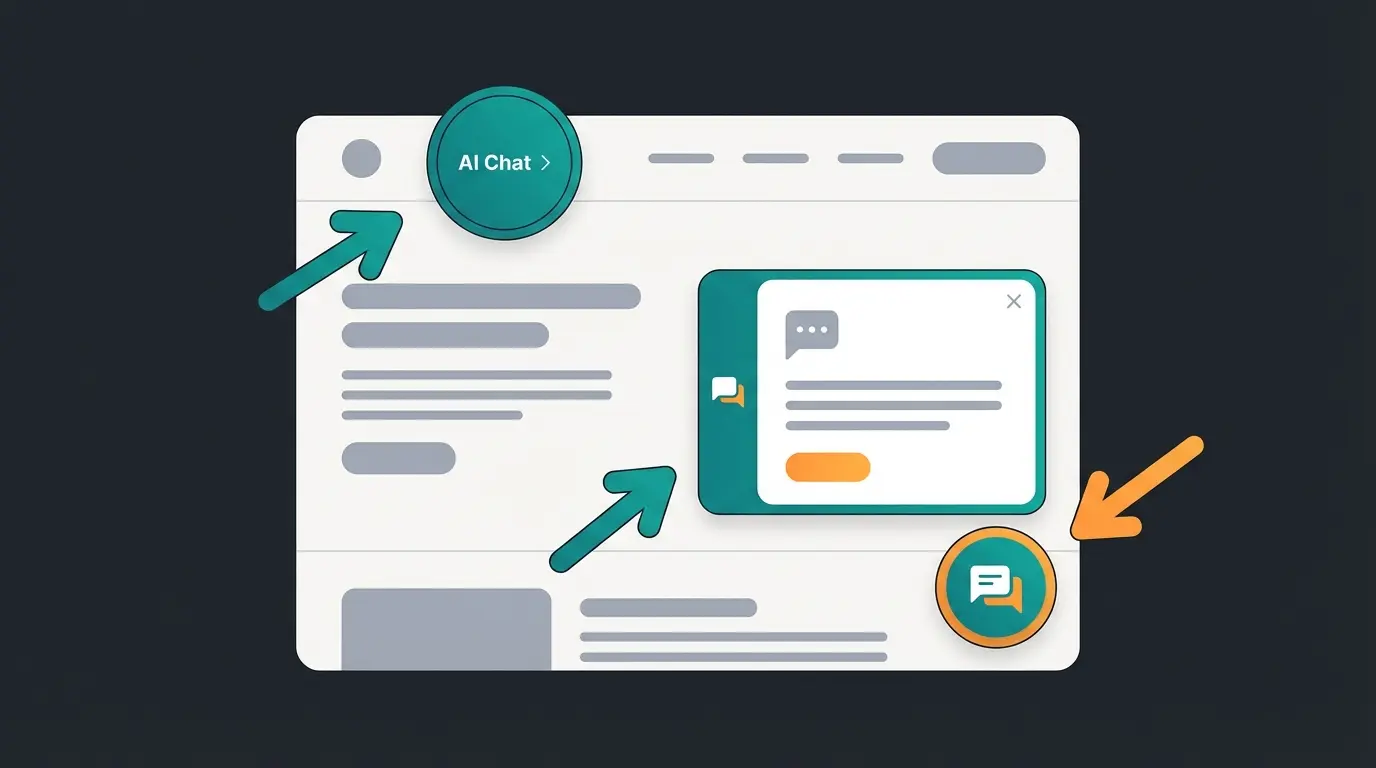
Don't hide the advisor on a subpage. Integrate a "Product Finder" button directly in the header or as a floating element (Floating Widget). Use contextual pop-ups: "Still looking for the right gift? Get advice."
The Sales Funnel of Advice: Visualizing the Journey
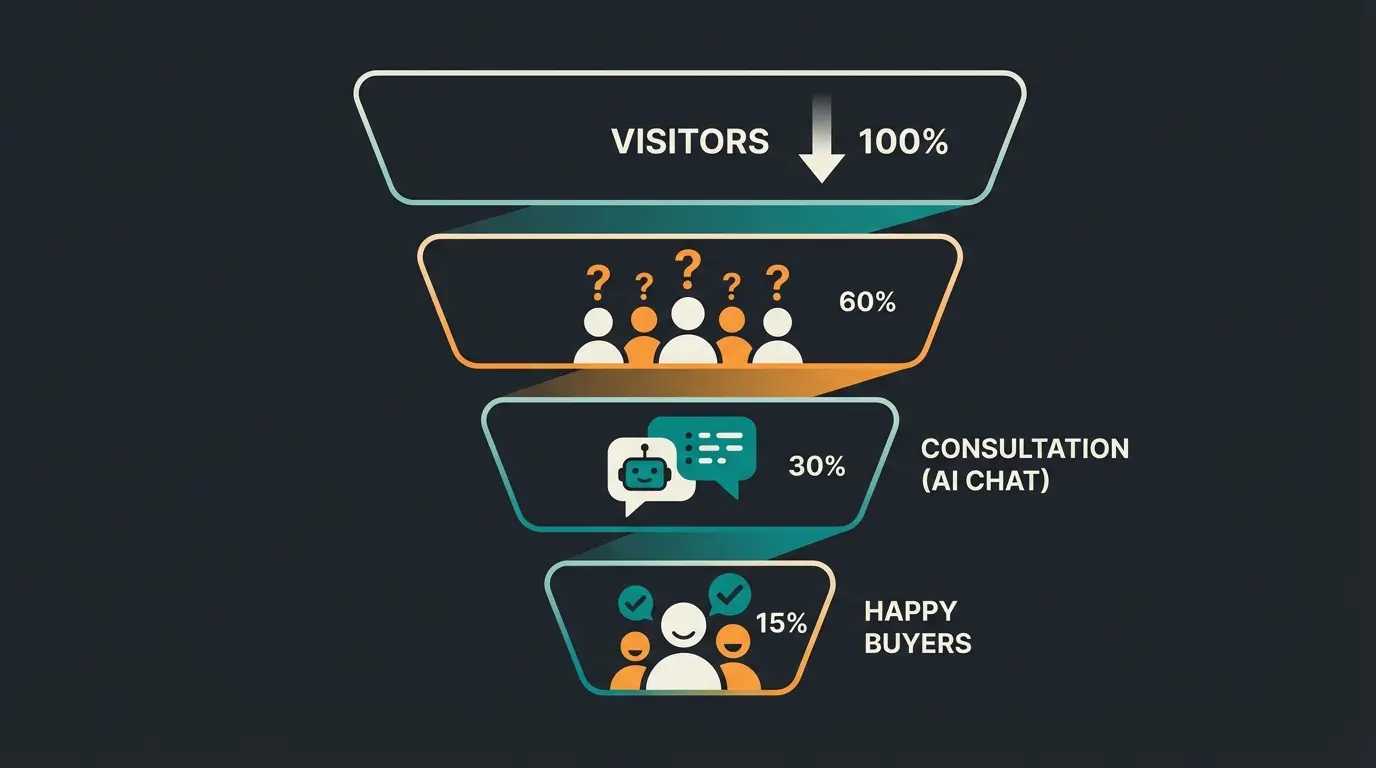
Understanding how product consultation fits into your customer journey is essential. The consultation funnel shows exactly where AI intervention captures otherwise lost customers and guides them toward confident purchases.
Consider the flow: All Visitors enter your store, many become Confused Visitors when faced with too many options. Those who receive consultation become Consulted Visitors who understand their options. Finally, these informed shoppers become Confident Buyers who complete their purchase and rarely return products.
Without intervention at the "confusion" stage, you lose the vast majority of potential customers. This is exactly where product consultation e-commerce solutions create the most value—by intercepting confused visitors before they bounce.
Conclusion: Build an Assistant, Not Just a Shop
E-commerce is transforming from a place of transaction to a place of interaction. Customers are tired of endless searching. They want solutions, and they want them fast.
The search for "Shopify product consultation" shouldn't lead you to an agency explaining how to install a theme. It should lead you to the realization that your shop itself can be the best advisor.
The technology is here. AI tools are no longer futuristic—they're a competitive advantage available today. While your competition is still formulating static quiz questions, your store can already conduct real sales conversations—transforming visitors into happy repeat customers.
Are you ready for Shopify 2.0? Review your metafields today and experience the difference between a quiz and genuine consultation.
FAQ: Common Questions About Shopify Product Consultation
Shopify consulting usually refers to B2B services from agencies that help merchants build their stores. Product consultation (or Guided Selling) is a feature within the store that helps end customers find the right product through automated guidance and recommendations.
For classic quizzes, apps like RevenueHunt, Quizify, or Octane AI are market leaders. For AI-powered consultation (Conversational Commerce), solutions like Manifest AI, Rep AI, or Gojiberry are establishing themselves as the new standard.
By providing detailed advice before purchase (e.g., on fit or exact use case), the likelihood of wrong purchases decreases significantly. Precise consultation replaces "ordering to try out" and ensures customers receive products that truly match their needs.
No. Modern Shopify apps are "no-code" solutions. However, you must ensure that your product data (Metafields, Tags, Descriptions) is properly maintained so the AI can access accurate information.
Most merchants see measurable improvements within 2-4 weeks of implementation. The key metrics to track are conversion rate among consultation users, average order value changes, and return rate reduction. Starting with one complex product category allows you to measure impact before scaling.
Join forward-thinking Shopify merchants who are already using AI consultation to increase conversions, boost AOV, and reduce returns. See the difference real sales conversations make.
Get Started Free
Lasse is CEO and co-founder of Qualimero. After completing his MBA at WHU and scaling a company to seven-figure revenue, he founded Qualimero to build AI-powered digital employees for e-commerce. His focus: helping businesses measurably improve customer interaction through intelligent automation.