Introduction: The Paradox of Choice in E-Commerce
Have you ever wondered why customers leave your shop even though you carry exactly the product they're looking for? The answer often lies not in a lack of offerings, but in abundance. In an era where the average online store carries thousands of items, selection has become a burden.
Welcome to the age of the Shopware product finder. In this comprehensive guide, you'll discover why traditional search has become outdated, how Guided Selling can double your conversion rate, and why 2025 is the year when Artificial Intelligence (AI) is replacing static questionnaires.
Imagine standing in a supermarket in front of a shelf with 24 different jam varieties. And the next day in front of a shelf with only 6 varieties. Where are you more likely to buy?
The famous "Jam Study" by psychologists Sheena Iyengar and Mark Lepper delivered a stunning result: While the large shelf attracted more glances, ten times more people purchased from the small shelf (30% purchase rate vs. 3% purchase rate), according to CMSWire and Scandiweb.
This phenomenon is called the "Paradox of Choice". Applied to your Shopware store, this means: the more options you offer, the more likely the customer will buy nothing at all. Studies show that 64% of lost conversions can be attributed to users being overwhelmed by selection and not intensifying their search, as research from Cognitive Clicks demonstrates.
What is a Shopware Product Finder?
A Shopware product finder (often called a product advisor or guided selling tool) is a software solution integrated into your Shopware 6 store. Unlike a classic search bar or technical filter that queries attributes like "size" or "color," the product finder functions as a digital sales consultant. It asks the customer needs-oriented questions (e.g., "What do you want to use the laptop for?") and translates these answers into technical product recommendations.
This approach aligns perfectly with modern AI product finder strategies that focus on understanding customer intent rather than just filtering attributes. The goal is to replicate the helpful in-store experience where a knowledgeable salesperson guides you to exactly what you need.
The Business Case: Why You Need a Product Finder
Implementing a product finder isn't a gimmick—it's a hard economic necessity. Here are the three most important levers for your revenue:
1. Increasing Conversion Rate (CR)
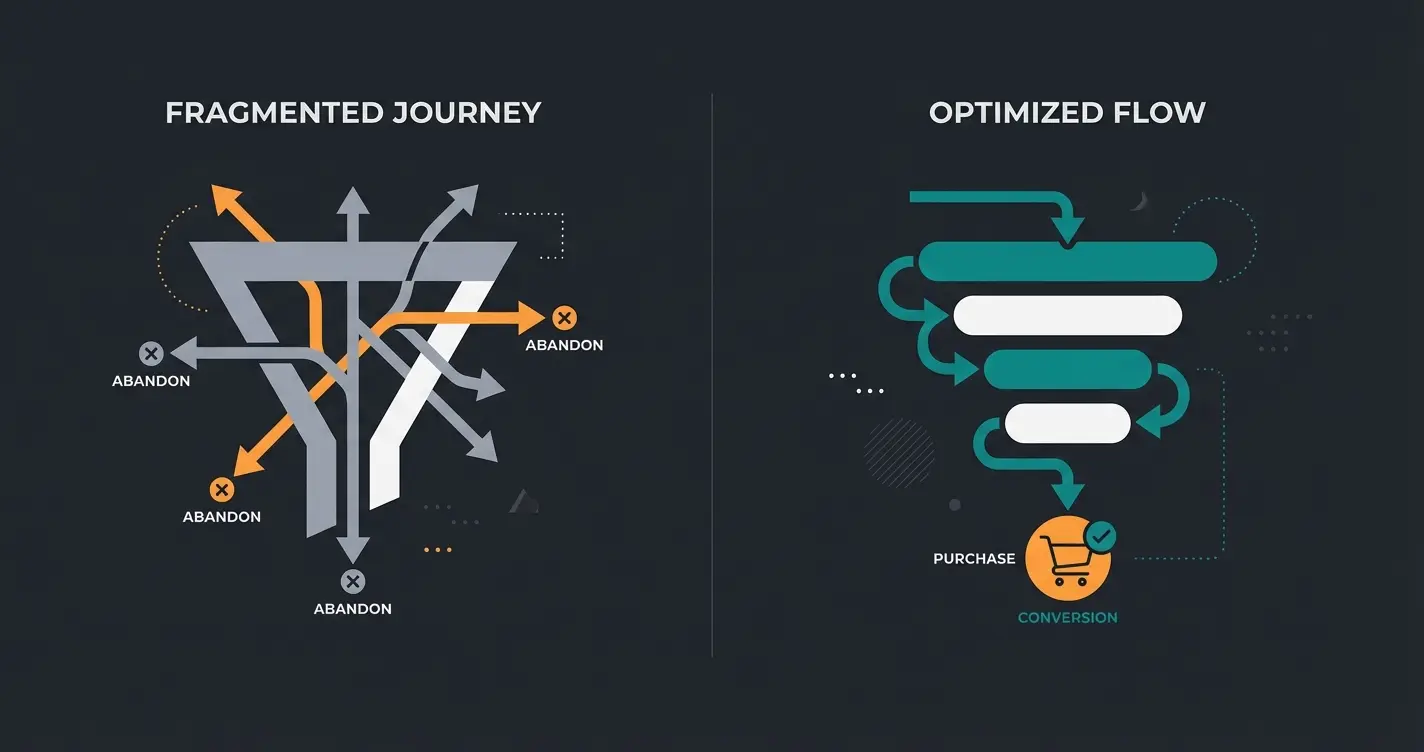
Customers who don't know what they need don't buy. A product finder takes the uncertain visitor by the hand. Data shows that reducing complexity—for example, by narrowing down 24 to 6 relevant options—massively increases purchase probability, as Invesp research confirms. Through Guided Selling in Shopware, you transform browsers into buyers by breaking through "Decision Paralysis."
Understanding the principles of AI guided selling is essential for any modern e-commerce operation looking to maximize conversions. The key difference between traditional filtering and guided selling lies in the approach: filters exclude while consultation includes and recommends.
2. Reducing Return Rates
Returns are the number one profit killer in e-commerce. In Germany, approximately every tenth online purchase is returned, according to Bitkom research. In the fashion industry, the rate often exceeds 50%, as noted by Neocom.ai and Uptain.
The main reasons for returns are often banal:
- 54% of customers return goods because they don't like them or they don't fit
- 37% intentionally order multiple variants for selection
An intelligent Shopware product finder works preventively here. When a customer is precisely advised before purchase (e.g., through size consultation or compatibility checks for technical devices), the probability of a mis-purchase drops drastically. Those who buy the right product don't return it. This is where AI product consultation becomes invaluable.
Due to customers overwhelmed by selection
With curated options vs. unlimited choice
Because products don't fit expectations
Customers ordering variants just to try
3. Relieving Support Burden
Especially in B2B or with products requiring explanation (e.g., e-bikes, machine parts, nutritional supplements), support spends a lot of time with the same recurring questions: "Does part A fit machine B?"
An automated product advisor intercepts these questions before they're asked. It acts as a 24/7 salesperson who never gets tired and always has technical knowledge ready. Implementing AI Customer Service automation can dramatically reduce support tickets while improving customer satisfaction. This approach to AI consulting in e-commerce represents a fundamental shift in how online stores operate.
The Evolution of Product Search in Shopware
To understand why many shops are still leaving potential on the table today, it's worth looking at the development stages of search technology. Where does your shop currently stand?
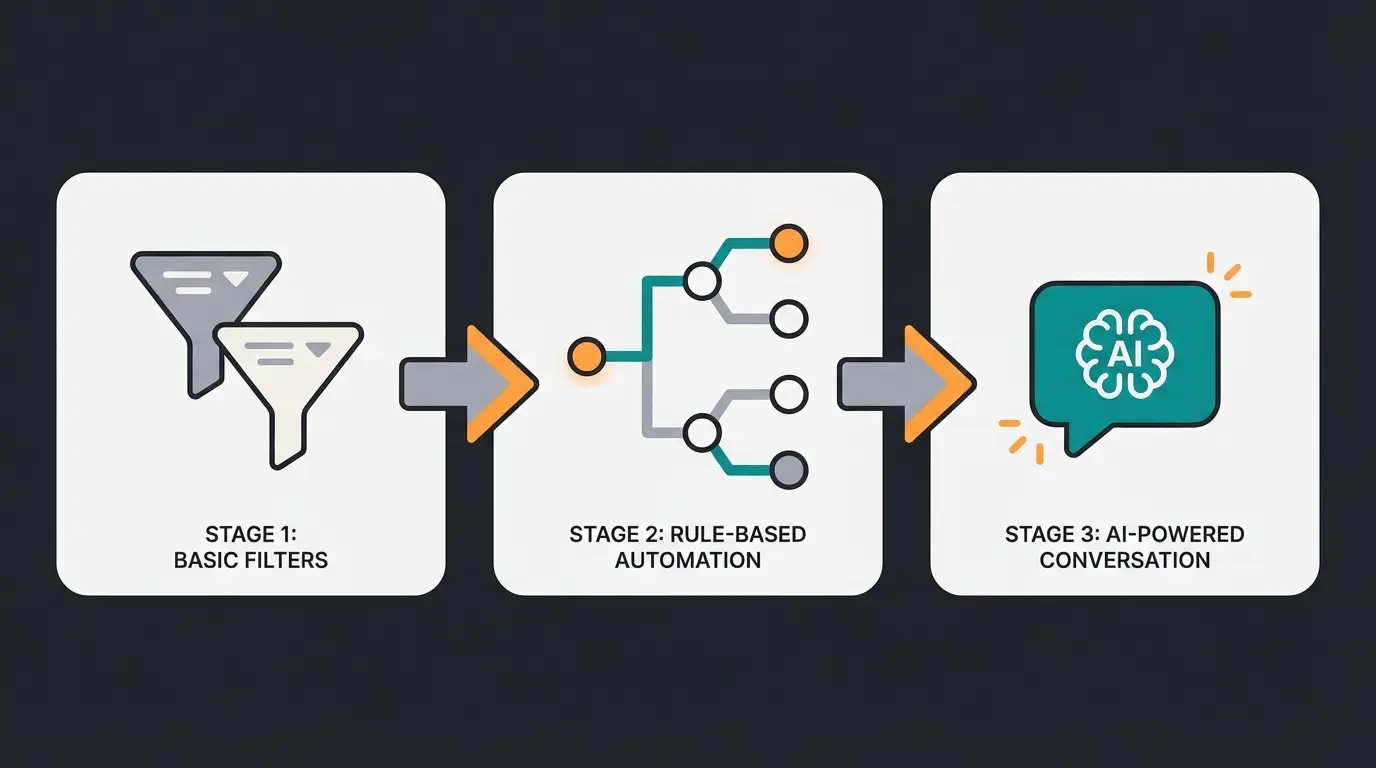
Phase 1: The Classic Filter (Faceted Search)
This is the standard in Shopware 6. In the sidebar, customers find filters for price, manufacturer, color, and material.
- Advantage: Fast and familiar
- Disadvantage: Requires expert knowledge. A customer looking for a "laptop for video editing" often doesn't know they need to filter for "32 GB RAM" and a "dedicated graphics card," as Excentos points out
- Status: Necessary but not sufficient for consultation
Phase 2: The Static Quiz Advisor (Generation 1.0)
This is where most current Shopware product finder plugins come into play. These are hard-coded decision trees.
Example: Question 1: Male or Female? -> Question 2: Sporty or Elegant? -> Result.
- Advantage: Better than pure filters since it's needs-oriented
- Disadvantage: Extremely maintenance-intensive. When new products arrive, you often have to manually adjust the logic. Additionally, these systems are rigid: if an answer doesn't fit the scheme, the customer ends up in a dead end ("No results found"), as MyTotalRetail highlights
Phase 3: AI-Powered Product Consultation (The Future)
This is the "Blue Ocean" where you can differentiate yourself from the competition. Modern solutions use Artificial Intelligence (AI) and Large Language Models (LLMs) to simulate real conversations.
- Functionality: The AI understands context ("I'm looking for a gift for my wife who likes hiking") and dynamically matches this with your product data
- Advantage: No manual maintenance of question trees, dynamic results, human-like interaction
This evolution toward intelligent Shopware AI product consultation represents a paradigm shift in how e-commerce platforms serve their customers. The integration of AI consultants is transforming the entire industry.
Traditional faceted search requiring customer expertise—good for experts who know specs
Pre-programmed decision trees with fixed paths—better UX but high maintenance
Dynamic, conversational AI that understands context and adapts—the future of guided selling
Deep Dive: Static Plugins vs. AI Consultant
Many shop operators face the choice: buy an inexpensive plugin from the Shopware Store or invest in an intelligent SaaS solution? Here's the detailed comparison to help you decide.
Comparison: Classic Plugins vs. AI Product Consultation
| Feature | Classic Shopware Plugin (Static) | AI Product Consultant (Modern) |
|---|---|---|
| Technology | If-This-Then-That logic (decision tree) | Machine Learning / NLP (Natural Language Processing) |
| Setup | Manual creation of questions & linking with attributes | Automatic reading of product feed (Feed Ingestion) |
| Maintenance Effort | High: Rules often need adjustment for new products | Low: AI automatically learns from new product data |
| User Experience | Feels like a form / quiz | Feels like a chat / real sales conversation |
| Flexibility | Rigid. Customer must click predetermined answers | Dynamic. Customer can enter free text or remain vague |
| Zero Results | Frustrating ("No results") | Constructive ("I don't have exactly that, but here's an alternative because...") |
| Scalability | Difficult with >1,000 products | Unlimited scalability |
The Maintenance Dilemma
The biggest hidden cost factor with static plugins is time. If you have an assortment of 5,000 items and the season changes, with static finders you often have to intervene manually to ensure that the new winter jackets are also displayed for the question "What keeps warm?" An AI solution simply reads the product description "keeps warm down to -20 degrees" and connects this automatically.
This is precisely why modern AI product consultation solutions are gaining traction—they eliminate the constant maintenance burden while delivering better results.
Consultation vs. Filtering
The crucial difference lies in psychology:
- Filtering is exclusive (Reduce 1,000 products to 5)
- Guided Selling is leading (Understand the problem and offer the 1 solution)
An AI consultant doesn't just query attributes; it also explains the "why." "I recommend this running shoe because you indicated that you often run on asphalt and need good cushioning." This builds trust. The approach mirrors what AI product consultation tools are designed to achieve.
Stop losing customers to choice overload. Our AI-powered product finder integrates seamlessly with Shopware and requires zero maintenance of decision trees.
Start Free TrialWhich Product Finder Fits Your Shop?
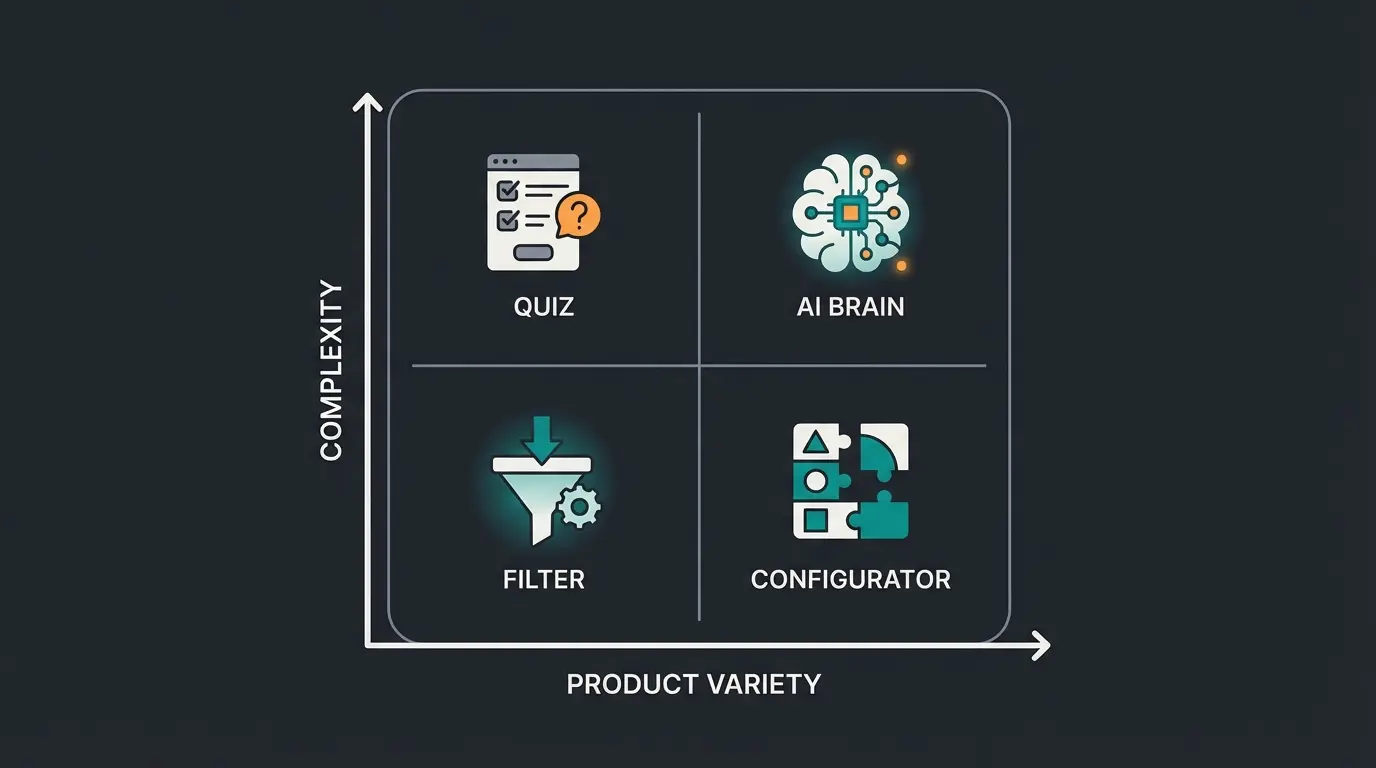
Not every shop needs a high-end AI. Use this decision guide:
Scenario A: The "Socks Shop" (Low Complexity)
Do you sell products that everyone understands (e.g., socks, simple office supplies, standard decor)?
- Recommendation: Use Shopware 6 standard filters or a simple product finder plugin for < €100
- Reason: Nobody needs AI consultation to buy white socks. Here, price and availability count
Scenario B: The "Fashion Store" (Medium Complexity)
Do you sell clothing, furniture, or lifestyle products?
- Recommendation: A visual Guided Selling approach
- Reason: Here it's about style and fit. An image-based quiz ("Which living style do you like?") helps enormously. Plugins like "Interactive Productfinder" in the Shopware Store can serve well here
Scenario C: The "Expert Shop" & B2B (High Complexity)
Do you sell electronics, sports equipment, auto parts, nutritional supplements, or industrial machinery?
- Recommendation: AI-powered product consultation
- Reason: Your customers are laypeople, your products are complex. The risk of mis-purchases and returns is high. A static tree quickly becomes too complex here (combinatorial explosion). Only AI can meaningfully clarify the nuances between "gaming PC for beginners" and "workstation for 3D rendering" in dialogue
For B2B scenarios especially, leveraging Shopware 6 chatbots with AI capabilities can transform your pre-sales process entirely.
Implementation in Shopware 6: Best Practices
Integrating a product finder into Shopware 6 is easier than ever today thanks to its modern architecture ("API-first").
1. Using Shopping Experiences
Shopware 6 offers a powerful CMS with Shopping Experiences, as detailed in Shopware documentation and their feature overview.
- Placement: Don't just build the product finder on a subpage. Integrate it as a teaser on the homepage ("Not sure what you need? Start the advisor") or as a pop-up on category pages
- Technology: Most modern tools can be integrated via JavaScript snippet or directly as a block in Shopping Experiences
2. Data Quality is King
Whether plugin or AI: your finder is only as good as your data.
- Maintain attributes: Ensure that properties in Shopware are cleanly maintained
- Descriptions: For AI tools, detailed product descriptions are gold, as the AI derives consultation logic from them
3. Digital Sales Rooms (For B2B)
If you're active in B2B, take a look at the Shopware feature Digital Sales Rooms, as described by IT Delight and Shopware. Here, sales representatives can create interactive presentations and guide customers live through the shop. An automated product finder is the perfect complement for times when no representative is available (self-service).
4. The Decision Funnel (Visualization)
Think of the user journey as a funnel:
- Vague Idea: Customer arrives on the site ("I need something new to wear")
- Interaction: Product finder asks 3-5 questions (style, occasion, budget)
- Suggestion: System shows 3 top matches with reasoning
- Completion: Customer adds product to cart
Understanding KI E-Commerce best practices ensures you implement these features effectively for maximum impact.
Conclusion: The Future is Consultative
E-commerce is changing. In a world of abundance, the shop with the largest assortment doesn't win—the shop that best guides customers through that assortment does.
A Shopware product finder is no longer a "nice-to-have" today but a crucial competitive advantage. While static filter plugins are sufficient for simple assortments, the future—especially for complex products—belongs to AI-powered consultation. It reduces returns, relieves your support, and gives customers the feeling of being understood.
Action Items for Shop Operators
- Analyze your return rate and support inquiries. Where are customers uncertain?
- Test whether your current filters resolve this uncertainty
- Start small: Implement a product finder for your most complex category and measure the uplift in conversion rate
The path from the search bar to the digital sales conversation is the path to more revenue in 2025.

Frequently Asked Questions (FAQ)
Simple plugins in the Shopware Store start at around €50-100 one-time or small monthly fees, as listed in the Shopware marketplace. Professional AI SaaS solutions are often in the monthly three-digit range but typically pay for themselves through reduced returns within a few weeks.
Yes, absolutely. In fact, Guided Selling is often better on smartphones than classic filters. Filter menus are fiddly on small screens; a chat or quiz interface is natively optimized for mobile ("Tinder for products").
For most Shopware plugins and external SaaS solutions, no programming knowledge is needed. Integration usually happens through Shopping Experiences or simple plugin configurations in the backend.
A generic support chatbot answers FAQs and handles complaints. An AI product consultant specifically focuses on understanding customer needs and matching them to products—it's a specialized sales tool, not general support. The AI consultant asks consultative questions like "What do you want to achieve?" rather than just "How can I help?"
Static plugin solutions can be configured in a few hours to days. AI-powered solutions typically require 1-2 weeks for initial setup including product feed integration, but then require minimal ongoing maintenance compared to static solutions.
Join leading Shopware stores using AI-powered product consultation to boost conversions by up to 30% while reducing returns. No complex decision trees to maintain—just connect your product feed and let AI do the work.
Get Started Free
Lasse is CEO and co-founder of Qualimero. After completing his MBA at WHU and scaling a company to seven-figure revenue, he founded Qualimero to build AI-powered digital employees for e-commerce. His focus: helping businesses measurably improve customer interaction through intelligent automation.