
Why the price tag only tells half the story
Shopware license costs are only 15 to 25 percent of what you will actually spend running a shop. The rest, hosting, development, plugins, maintenance, and personnel, makes up the bulk of the real bill. Knowing the full picture before you commit is the only way to plan a budget that holds.
Germany's e-commerce sector generated €84.7 billion in revenue in 2025 (EHI/HDE). That figure represents a market where margins are tight and infrastructure decisions compound over years. Choosing a platform is a multi-year capital commitment, not a monthly subscription you walk away from.
The confusion around Shopware costs usually comes from comparing license tiers in isolation. A merchant who moves from Community to Rise sees a €600/month line item appear. But they often overlook the agency retainer, the plugin subscriptions, and the server scaling costs that were already accumulating. Total cost of ownership (TCO) is the only metric that tells the full story.
TCO covers every recurring and one-time expenditure tied to operating a shop: platform licensing, initial development, ongoing hosting, third-party integrations, staff time, and external agency hours. For a mid-sized Shopware merchant, that number typically falls between €80,000 and €200,000 over three years.
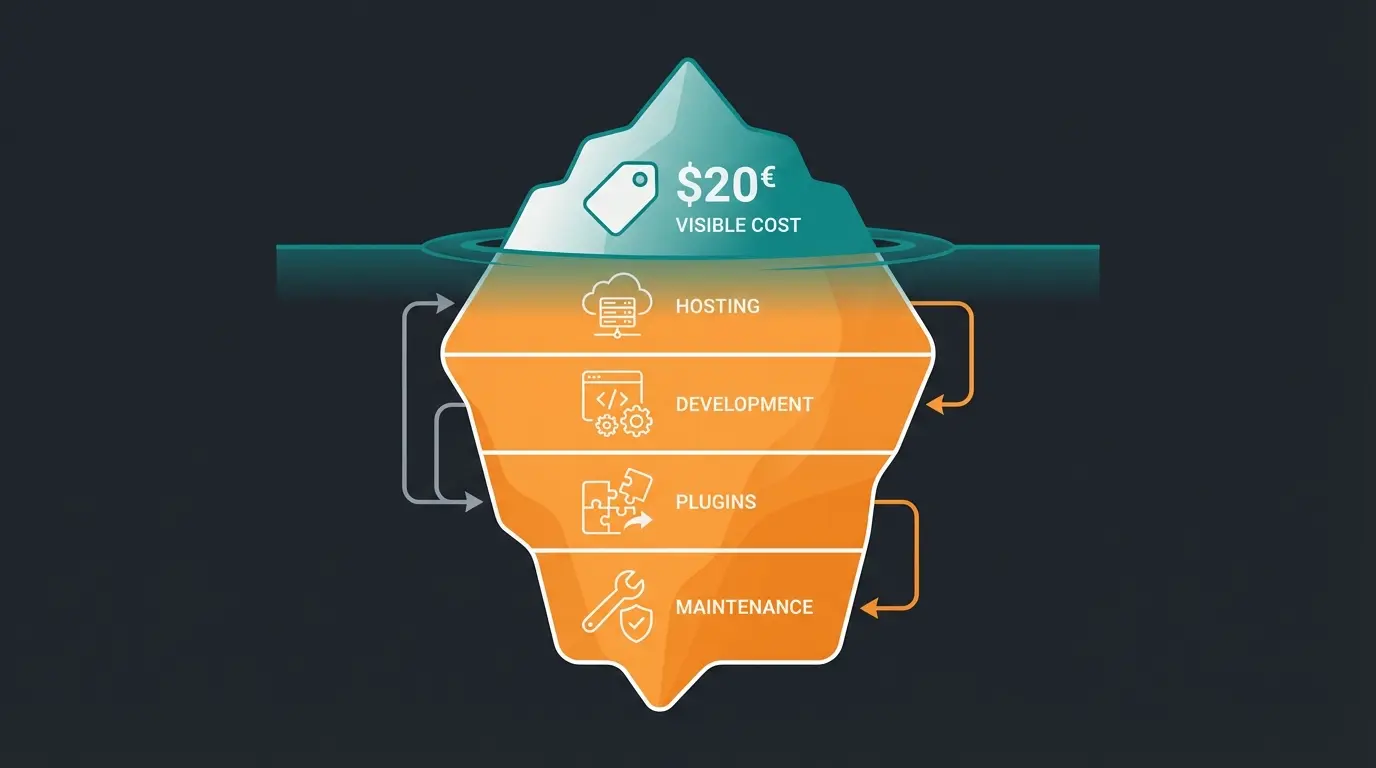
Official Shopware 6 license costs (monthly)
Shopware offers four tiers as of Q2 2026: Community Edition at no license fee, Rise at €600/month, Evolve at €2,400/month, and Beyond at approximately €6,500/month. Each tier unlocks progressively more native features, but the jump in price is not linear with the jump in capability. For most growing shops, the real question is whether Rise covers the gap or whether Evolve's B2B suite justifies its cost.
Community Edition is open-source and free to download. It covers the core storefront, order management, a basic CMS (Shopping Experiences), and standard checkout flows. You own the installation. You bear the infrastructure costs. You manage every update. Nothing in the license prevents you from running a seven-figure shop on Community. Many do.
What Community does not include: the B2B Suite (customer portals, quote management), AI Copilot, Publisher workflow tools, and dedicated Shopware support beyond the community forum. For shops that need any of these, the options are custom development or a tier upgrade. Custom development costs for B2B portal functionality alone typically run €8,000 to €20,000, which reframes the €600/month Rise fee as a potentially cheaper alternative.
Tobias Schaefer, a freelance Shopware developer with over ten years of platform experience, puts it plainly: "For most shops I build, Community Edition is the right starting point. The missing features are real but rarely needed until a business has outgrown its first setup." (tobias-schaefer.com) That observation holds up across most small-to-mid projects.
Rise adds flow automation, AI Copilot, digital sales rooms, and priority support queues. For merchants who need rule-based promotions at scale or subscription models, the €600/month cost displaces significant custom development. See the full breakdown in our Shopware Rise overview.
Evolve at €2,400/month targets mid-market merchants who need native B2B features: quote management, customer-specific pricing, advanced permissions, and multi-currency catalogs. Without Evolve, those features require either expensive custom development or a patchwork of third-party plugins. The license fee competes directly with that development cost.
Beyond is Shopware's enterprise tier. Pricing is negotiated, but the ~€6,500/month figure is consistent with publicly available data and agency briefings as of 2026. It includes dedicated account management, SLA guarantees, and features not available in lower tiers. See our Shopware Enterprise guide for detailed comparisons.
| Edition | Monthly fee | Target profile | Key additions |
|---|---|---|---|
| Community | €0 | Startups, lean teams, developers | Core storefront, CMS, basic checkout |
| Rise | €600 | Growing D2C merchants | Flow builder, AI Copilot, digital sales room |
| Evolve | €2,400 | Mid-market, B2B hybrid | B2B suite, quote management, advanced pricing |
| Beyond | ~€6,500 | Enterprise, high-GMV | Dedicated SLA, custom integrations, 24/7 support |
For a detailed tier comparison, the Shopware pricing plans guide covers the decision logic in full. The official Shopware pricing page lists current features per tier.
The Fair Usage Policy: what happens when you succeed?
Shopware's Fair Usage Policy caps gross merchandise volume (GMV) at five times the annual license fee per tier. For a Rise merchant paying €7,200/year, that cap sits at €36,000 in annual GMV before an upgrade becomes required. Merchants approaching that ceiling face either a tier upgrade or a negotiated arrangement, and the cost jump from Rise to Evolve (€600 to €2,400/month) is significant.
The policy prevents a single high-volume merchant from extracting disproportionate infrastructure and support value at a low tier price. That rationale is legitimate. But for merchants scaling aggressively, it creates a planning problem: revenue growth triggers licensing cost growth, often at an inconvenient moment.
Since March 2025, Shopware's Fair Usage Policy also requires all Community Edition users to report their GMV. Stores exceeding €1 million in annual GMV must upgrade to a paid plan. This is a meaningful change for high-volume Community merchants who previously operated without any licensing cost. The Shopware license models article covers how the policy interacts with different business models and scaling scenarios.
One-time costs: what does setup cost?
Setup costs for a new Shopware shop range from €5,000 for a lean MVP to over €200,000 for a fully custom enterprise build. The spread is wide because the definition of "done" varies enormously. An MVP with a standard theme and basic payment integration is a fundamentally different project than a headless PWA with custom B2B logic and ERP integration.
Agency hourly rates in Germany for certified Shopware partners run €100 to €180/hour as of 2026. That range reflects both the agency tier (Silver vs. Platinum partner) and the project complexity. Freelancers typically bill €70 to €110/hour, which looks cheaper but often means less structured project management and higher revision risk on complex builds.
A realistic MVP, covering theme customization, catalog import up to 5,000 SKUs, payment gateway integration, basic SEO setup, and launch testing, requires roughly 80 to 150 agency hours. At €130/hour mid-range, that translates to €10,400 to €19,500 in development alone.
| Project type | Typical budget | Timeline | What's included |
|---|---|---|---|
| Lean MVP | €5,000 - €15,000 | 4-8 weeks | Standard theme, basic catalog, payment integration |
| Mid-market shop | €15,000 - €50,000 | 8-16 weeks | Custom theme, ERP lite, product configurator |
| Full B2B platform | €50,000 - €120,000 | 16-32 weeks | B2B suite, custom pricing, deep ERP/PIM integration |
| Enterprise build | €120,000 - €200,000+ | 6-12 months | Headless architecture, microservices, multi-store |
Data migration is consistently underestimated. Moving product data, customer records, order history, and SEO URL structures from a legacy platform adds 20 to 40 hours to most projects. For shops with large catalogs (50,000+ SKUs), that climbs to 80 to 150 hours. A common mistake: skipping SEO redirect mapping during migration. Every URL that changes without a 301 redirect loses accumulated search equity. For a shop with 2,000 indexed pages, remapping URLs properly takes 10 to 20 hours but prevents the traffic loss that undermines the business case for migrating in the first place.
Third-party integrations multiply setup costs fast. A standard ERP connector (SAP, Microsoft Dynamics, or JTL) adds €3,000 to €12,000 depending on whether a pre-built plugin covers the use case or custom middleware is required. Tobias Schaefer notes in his Shopware pricing breakdown that "ERP integrations are almost always more complex than the first estimate" (tobias-schaefer.com). Budget €5,000 to €15,000 per integration.
The Shopware agency costs article covers how to evaluate agency proposals, what line items to challenge, and what a fair project specification looks like.
Ongoing operating costs: the hidden drivers
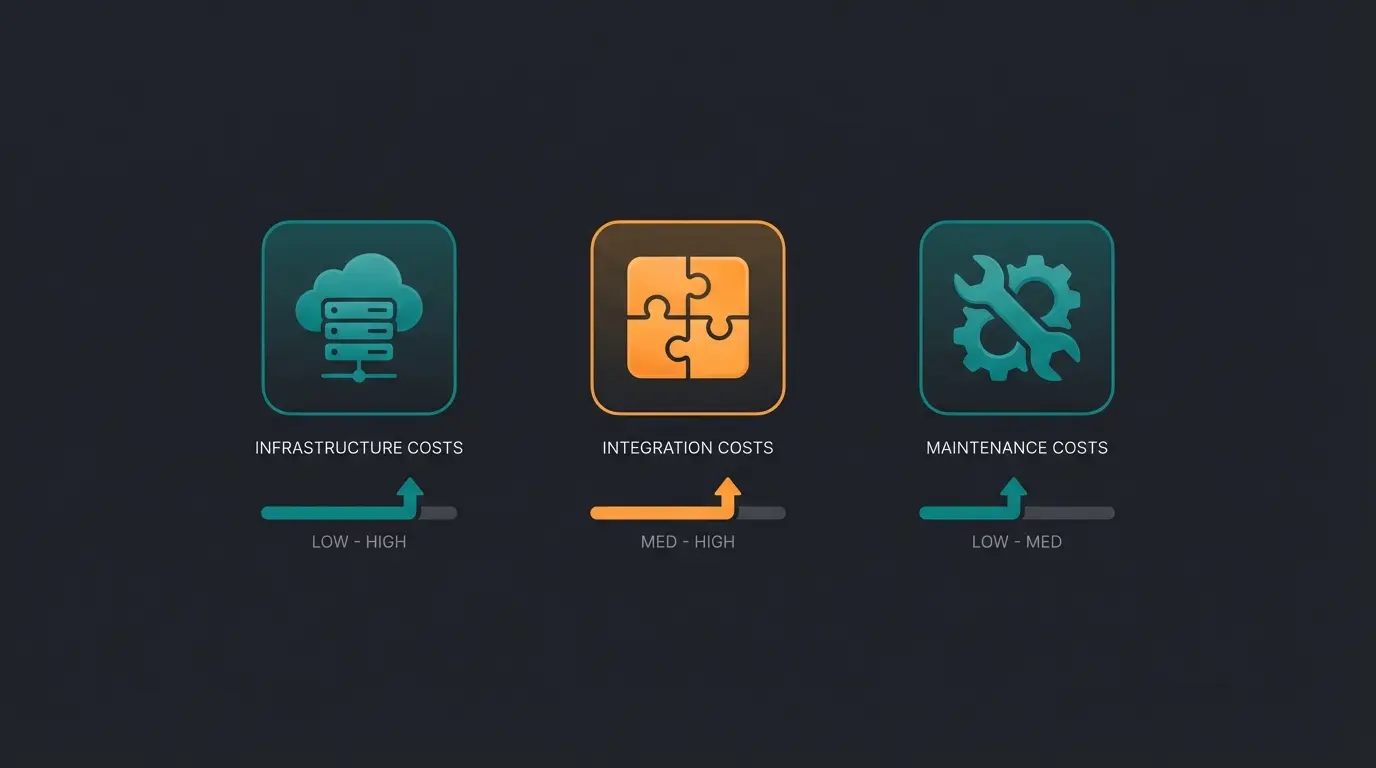
After launch, the recurring cost structure has three main components: hosting, plugins, and maintenance. Together they typically run €660 to €5,300/month for a mid-sized shop. These costs are predictable but frequently underbudgeted because merchants focus on the one-time setup number rather than the monthly burn rate.
Hosting
Hosting costs split along a self-managed versus managed spectrum. Self-hosted infrastructure on a VPS or dedicated server runs €30 to €500/month depending on traffic and redundancy requirements. That price looks attractive until you factor in the internal time cost of server administration, security patching, and uptime monitoring.
Managed Shopware hosting from providers like maxcluster, Mittwald, or timmehosting runs €60 to €400/month. maxcluster became an official Shopware Recommended Hosting Partner in November 2025. The upper end covers high-availability setups with staging environments, automatic backups, CDN integration, and guaranteed uptime SLAs.
Plugin costs
Plugin costs are the most variable line item and the budget category everyone underestimates. The Shopware Store lists thousands of extensions spanning three pricing models: free (limited functionality), SaaS subscriptions (€10-500/month), and one-time purchases (€300-2,000). A mid-sized shop running standard operations typically needs an SEO plugin, review management, a payment gateway extension beyond native options, and at minimum one analytics or feed tool.
The distinction between SaaS plugin pricing and one-time purchase matters more than it appears. SaaS plugins (€10-500/month) include ongoing updates, hosting of external services like API connections, and support. One-time purchases (€300-2,000) are cheaper upfront but shift the update burden to you. When Shopware releases a major version, one-time-purchase plugins may require a paid upgrade or stop working entirely. We have tested both models extensively and recommend SaaS for anything touching checkout, payment, or customer data. The ongoing cost is worth the guaranteed compatibility.
Maintenance retainers
Shopware releases major updates regularly, and each update requires regression testing, plugin compatibility checks, and deployment verification. An agency retainer of €500 to €2,000/month covers this systematically. Merchants who skip the retainer and handle updates ad hoc often face concentrated costs: a major version upgrade deferred for two years becomes a €15,000 project instead of a predictable monthly expense.
| Cost category | Low end | High end | Notes |
|---|---|---|---|
| Managed hosting | €60 | €400 | HA setup with CDN and backups at high end |
| Shopware license | €0 | €2,400 | Community to Evolve; Beyond negotiated separately |
| Plugin subscriptions | €100 | €500 | SEO, reviews, payment, loyalty, feeds |
| Maintenance retainer | €500 | €2,000 | Agency hours for updates, patches, minor fixes |
| Total monthly | €660 | €5,300 | Excluding license for Community shops |
Payment processing fees belong in the TCO calculation. Stripe charges 1.4% plus €0.25 per transaction for European cards. On €1,000,000/year GMV, that is €14,000 to €29,000 in processing fees, more than some annual license costs. Payment provider selection is a cost lever worth optimizing.
Security costs are often invisible until they are not. SSL certificates (free via Let's Encrypt or €50-150/year for extended validation), DDoS protection, PCI compliance for payment handling, and GDPR-compliant data processing agreements all carry either direct costs or agency hours. A security incident on an unpatched Shopware installation costs significantly more than a year of preventive maintenance. The math is clear.
Mobile commerce now accounts for 63.12% of B2C orders in Germany via smartphone (Statista, 2025). That means hosting performance on mobile, particularly page load time under LTE conditions, directly affects revenue. Under-investing in CDN and caching infrastructure is a false economy when more than half your orders come from mobile devices.
Personnel costs and AI-powered cost optimization
Personnel costs are the largest and least discussed component of Shopware TCO. Customer service, catalog management, order processing, and returns handling consume staff hours at a rate that scales with order volume. For shops doing 500 or more orders per day, service staffing alone can cost €5,000 to €15,000/month. This is where AI-driven automation creates the most measurable financial impact.
Gartner data (2025) puts the median cost of a self-service customer interaction at $1.84 per contact, compared to $13.50 for an agent-assisted contact. The ratio is roughly 7:1. A shop handling 3,000 customer contacts per month, with 60% routable to self-service, saves approximately €17,000/month by shifting that volume. That is arithmetic, not a projection.
The Rasendoktor case study quantifies what this looks like in a real Shopware deployment. Rasendoktor, an online specialist for professional lawn care products, deployed an AI employee for product consultation and customer service. The results: 16x ROI, 100% automation rate on routine inquiries, and 40% reduction in support costs. Those numbers were achieved on a mid-sized German e-commerce operation, not an enterprise-scale deployment.
Rasendoktor, lawn care e-commerce
Neudorff, garden supplies
Neudorff vs. human agent cost
The mute shop problem is worth naming directly. Most Shopware shops operate like stores with no sales floor staff. Products are displayed, prices are listed, but nobody answers when a customer hesitates at the product page. The conversion cost of silence is real: Baymard Institute (2025) data shows the global cart abandonment rate at 70.19%. Their research also finds that checkout usability improvements alone can recover 35.26% of that lost revenue.
An AI employee that answers product questions mid-checkout, covering specifications, compatibility, and return policy, removes a documented abandonment trigger in real time. This is not theoretical: Gartenfreunde, a German online retailer for garden products, achieved a 7x higher conversion rate and 45% click-through rate on product recommendations after deploying AI-assisted product consultation. The cost per converted customer dropped while basket value increased.
For Shopware merchants evaluating where automation fits in the cost structure, AI product consultation covers the implementation patterns and how integration with Shopware's native APIs works in production environments.
The implication for TCO planning is direct: personnel cost reduction through AI deployment is not a soft benefit. It is a hard-number line item. A merchant who reduces support costs by €2,000/month through automation has effectively offset their Rise license fee more than three times over. That reframing changes the ROI calculation for the entire platform investment.
I will be direct about something we see in our own data. The merchants who deploy AI for customer service and product consultation do not just reduce costs. They generate incremental revenue from conversations that previously ended without a purchase. Rasendoktor's 16x ROI includes both the cost savings and the revenue uplift from AI-guided product recommendations. Treating AI automation purely as a cost center misses half the financial impact.
TCO calculation: 3-year example with ROI
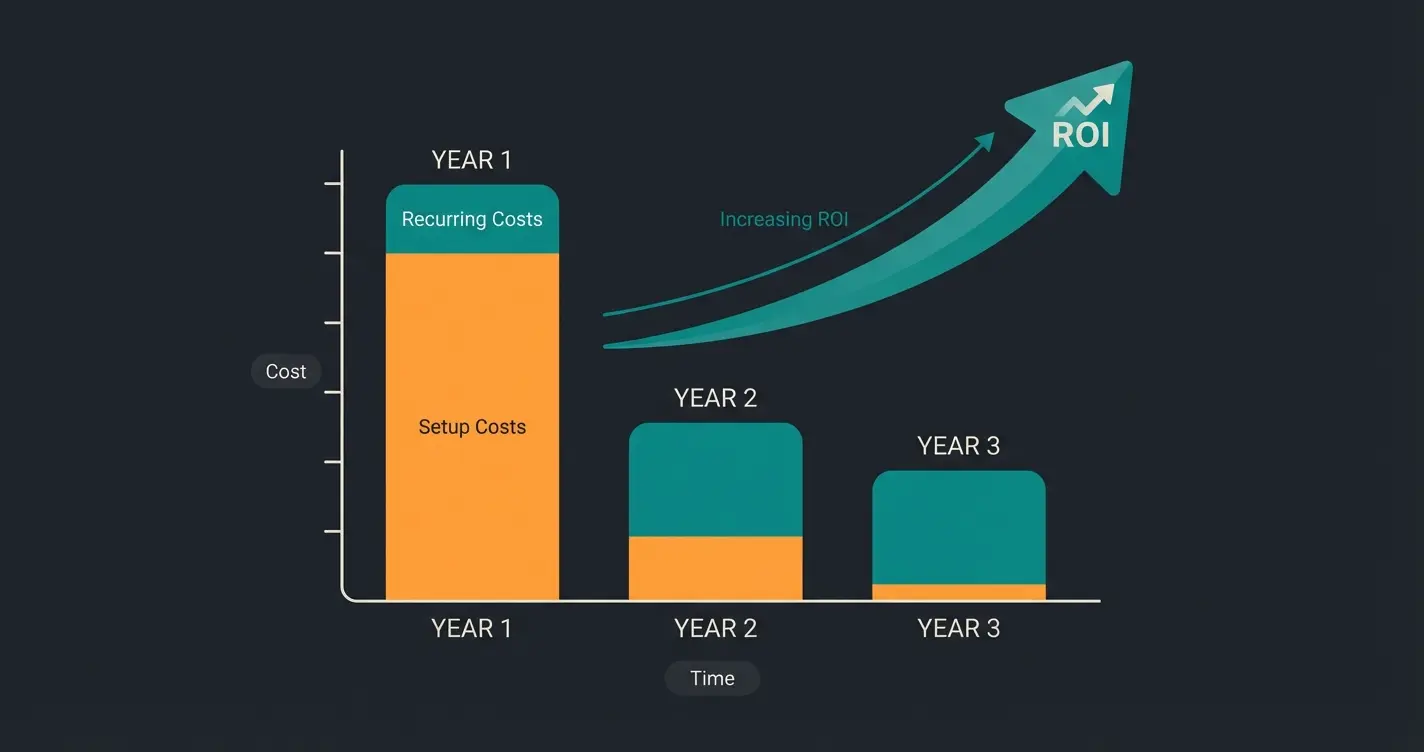
A three-year TCO calculation for a mid-market Shopware shop reveals the true cost of platform ownership and the leverage points where smart spending pays back. The example below uses a shop doing €800,000/year in GMV, running Rise, with managed hosting and a standard plugin stack. Representative profile, not an outlier.
Year one is the most expensive. Setup costs are front-loaded, the team is learning the platform, and the shop is not yet optimized for conversion. Years two and three see the per-revenue-unit cost drop as the infrastructure stabilizes and incremental improvements build on a solid base.
| Cost category | Year 1 | Year 2 | Year 3 | 3-year total |
|---|---|---|---|---|
| Shopware Rise license | €7,200 | €7,200 | €7,200 | €21,600 |
| Setup / initial development | €35,000 | €0 | €0 | €35,000 |
| Managed hosting | €2,400 | €2,400 | €3,000 | €7,800 |
| Plugin subscriptions | €3,600 | €3,600 | €4,200 | €11,400 |
| Agency maintenance retainer | €12,000 | €12,000 | €14,400 | €38,400 |
| Payment processing (1.6% avg) | €12,800 | €12,800 | €13,500 | €39,100 |
| Personnel (customer service) | €36,000 | €36,000 | €36,000 | €108,000 |
| Contingency (10%) | €10,900 | €7,400 | €7,800 | €26,100 |
| Total | €119,900 | €81,400 | €86,100 | €287,400 |
The personnel line at €36,000/year assumes one part-time customer service employee focused on the shop. Conservative. For shops with 200+ orders per day, the staffing cost is substantially higher. The personnel line is also where AI automation creates the most leverage: reducing it by 40% saves €14,400/year, which pays back an AI deployment in under six months.
A Forrester Total Economic Impact study found that merchants achieve "211% ROI with a payback period of eight months" after migrating to modern e-commerce platforms. While that figure specifically references a BigCommerce TEI study, the underlying methodology, measuring incremental revenue gain, cost reduction, and operational efficiency against total investment, applies directly to any Shopware migration or upgrade decision.
License costs in this example total €21,600 over three years: 7.5% of the €287,400 total. That ratio confirms the 15-25% figure cited earlier. At the high end of setup spend, the license share compresses further. The takeaway: optimizing the license tier is a relatively small lever compared to optimizing agency costs, plugin stack, and personnel efficiency.
For merchants migrating from a legacy platform rather than launching fresh, add a migration cost line of €8,000 to €25,000 depending on catalog size, custom logic, and SEO redirect mapping complexity. The Forrester TEI methodology shows an average payback period of eight months for merchants who invest properly in migration. Under-investing in the migration itself, particularly in URL redirect mapping and data integrity testing, typically extends the payback period by adding technical debt from day one.
The contingency line at 10% is not optional padding. Scope creep on development projects, emergency security patches, platform-breaking plugin conflicts, and server scaling events are statistically likely over a three-year horizon. In our projects, we have seen that merchants who do not budget for contingency end up pulling from operating capital to cover platform emergencies. That is avoidable.
Cost-saving tips: how to reduce Shopware costs
Reducing Shopware costs without compromising capability requires targeting the right line items. License fees are rarely the right target. The highest-leverage cost reductions come from smarter plugin selection, deferred customization, AI-driven personnel optimization, and structured agency relationships.
Start on Community and upgrade with evidence. Community Edition covers a substantial share of shop requirements. Upgrading to Rise or Evolve is justified when a specific missing feature creates quantifiable revenue impact or development cost that exceeds the license delta. Upgrading out of anticipation adds cost without adding value.
Audit your plugin stack annually. Plugin sprawl is common. A shop live for two years often has six to eight plugins covering partially overlapping functionality. One audit that eliminates two redundant subscriptions saves €100 to €300/month. No functional loss.
Use retainer contracts, not hourly billing, for predictable maintenance. Agencies charge a premium for unscheduled hourly work. A structured monthly retainer reduces the effective hourly rate by 15 to 25% and ensures availability when you actually need it.
Automate high-volume, low-complexity customer interactions. Routine inquiries covering order status, return policy, and product specifications are the highest-volume and lowest-complexity service contacts. Automating them with an AI employee reduces service cost per contact to below $2, compared to $13+ for human-assisted contacts (Gartner, 2025). Our clients report ROI multiples between 6x and 18x on this specific optimization.
Scope the MVP tightly and iterate. The most expensive development projects are ones with undefined scope. A tightly scoped MVP with a roadmap for phases two and three costs 30 to 50% less than a single large project with evolving requirements. Every change mid-project is billed at the agency's full hourly rate. Changes after launch, on a stable codebase, cost less.
Choose hosting that scales incrementally. Over-provisioning hosting for peak load that arrives four weeks per year is expensive. Managed hosting with auto-scaling handles traffic spikes without requiring permanent over-provisioning. The cost difference: €150 to €300/month.
- Run on Community Edition until a specific feature gap justifies upgrading
- Audit plugin stack every 12 months for redundancies
- Lock in agency retainer pricing instead of ad-hoc hourly billing
- Deploy AI for routine customer service contacts (cost per contact drops from $13.50 to $1.84)
- Use auto-scaling hosting instead of fixed over-provisioned servers
- Scope MVP tightly, defer non-critical features to post-launch phases
- Negotiate payment processing rates at scale (saves €5,000-15,000/year on €1M GMV)
Conclusion: investment instead of cost block
Shopware costs are substantial but predictable when planned correctly. A mid-market shop should expect to spend €80,000 to €150,000 over three years in total platform costs. The merchants who treat that figure as an investment, optimizing each line item against its revenue contribution, consistently outperform those who focus narrowly on minimizing the license fee.
The license tier decision matters, but it is not the primary lever. Hosting, plugins, agency relationships, and personnel costs are collectively four to six times the license cost. Those are the optimization targets.
Stand Q2 2026, the merchants generating the strongest ROI from Shopware are not those who spent the least. They are those who deployed capital efficiently: lean setup, appropriate tier, structured maintenance, and AI-driven cost optimization in customer service and sales. The Rasendoktor 16x ROI and Neudorff 99% cost-per-chat reduction are not anomalies. They are the outcome of applying financial discipline to operational costs with the same rigor used for platform selection.
License fees range from €0 (Community Edition) to approximately €6,500/month (Beyond). Rise costs €600/month and Evolve €2,400/month. The license is only 15-25% of total operating costs. Hosting, plugins, and maintenance add €660 to €5,300/month depending on shop size and configuration.
The Fair Usage Policy caps GMV at five times the annual license fee per tier. A Rise merchant paying €7,200/year has a GMV cap of €36,000 before an upgrade is required. Since March 2025, Community Edition users exceeding €1 million annual GMV must also upgrade to a paid plan.
Certified Shopware partner agencies in Germany charge €100 to €180/hour as of 2026. For a full mid-market shop build, expect 200 to 400 agency hours, putting the development cost in the €20,000 to €70,000 range. The Shopware agency costs guide covers how to evaluate and compare proposals.
The software license is free. You can download, install, and run a commercial shop without paying Shopware for the software itself. Your costs are hosting (€30-500/month), development, and plugins. Enterprise features from Rise and Evolve must be built as custom development if you need them on Community.
For a mid-market shop doing €800,000/year GMV on Rise, the 3-year TCO totals approximately €287,400 including setup, licensing, hosting, plugins, maintenance, payment processing, and customer service. License costs represent 7.5% of that total. Merchants who deploy AI automation can reduce the 3-year total by €30,000 to €50,000.
The data is specific. Gartner puts self-service cost at $1.84/contact versus $13.50 for agent-assisted. Rasendoktor achieved 16x ROI and 40% support cost reduction with an AI employee. Neudorff reported 99% cost savings per chat. For shops handling hundreds of daily contacts, AI automation is the highest-leverage cost reduction available.
More traffic is only half the equation. An AI employee handles product consultation, order inquiries, and customer service 24/7, at a fraction of staffing costs. Merchants report 40% support cost reductions and up to 16x ROI. Find out what that looks like for your Shopware shop.
Book a free consultation
Kevin is CTO and co-founder of Qualimero. As an AI architect with over 15 years of experience as CTO and CPO in the tech industry, he designs the AI systems that automate tens of thousands of customer interactions daily for Qualimero's clients — reliably, securely, and at scale.