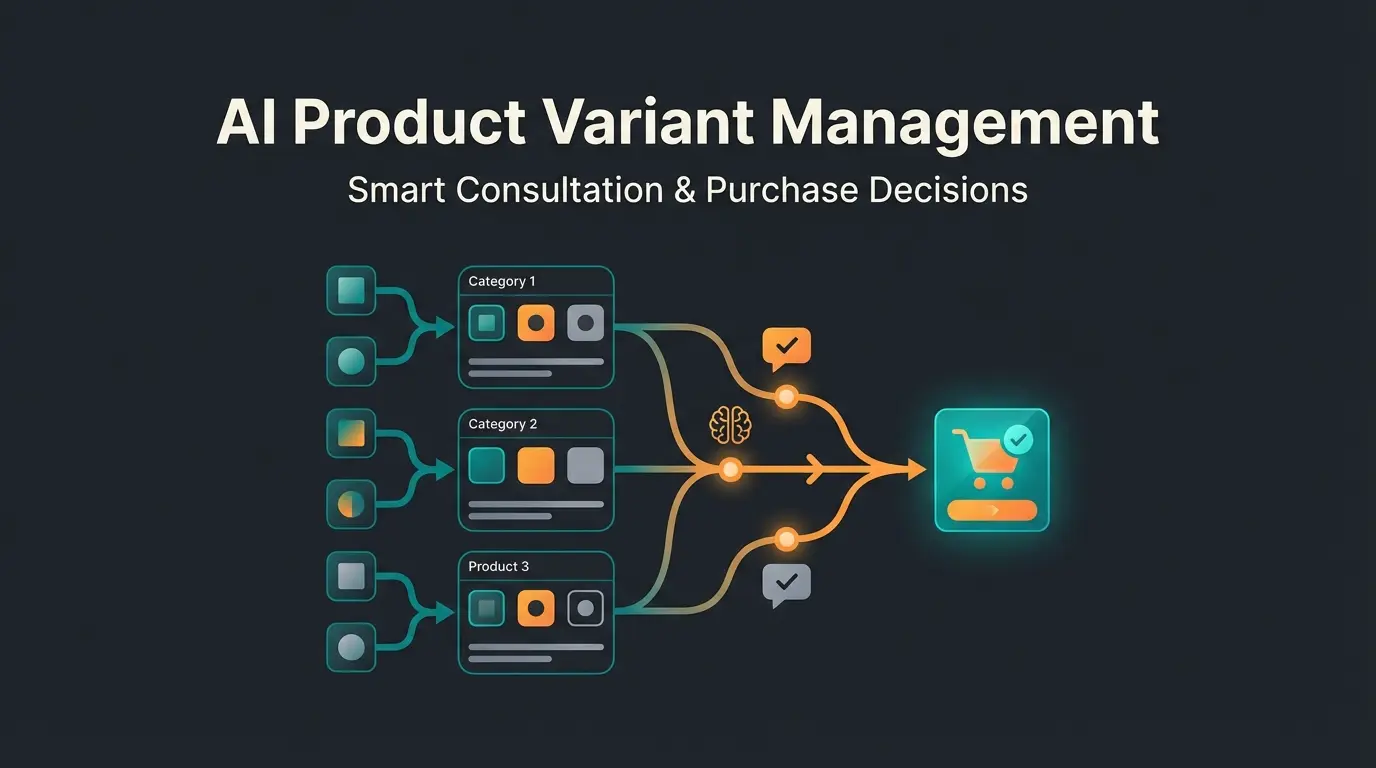
The Misunderstanding Behind 'Shopware Consulting'
Have you searched for 'Shopware consulting' because you need an agency for a technical update or store relaunch? That's understandable—especially given the end-of-life of Shopware 5. But while you invest thousands of euros in technical infrastructure, 90% of merchants overlook the most important lever for increased revenue: digital consultation *within* the store.
In this comprehensive guide, you'll discover why the classic definition of 'Shopware consulting' is no longer sufficient and how you can bridge the gap between technical perfection and genuine customer dialogue using AI-powered sales consultation. When you work with a Shopware full service agency, you're addressing only half of the equation.
When you search for Shopware consulting on Google today, you'll find almost exclusively service offerings from agencies. The search results are dominated by offers for migrations, template development, and performance optimization. This makes logical sense, as the market is in upheaval: since the end-of-life of Shopware 5 in July 2024, many merchants are under pressure to migrate their systems to Shopware 6 to avoid security vulnerabilities, as noted by Shopware and Datrycs.
But here lies a critical misunderstanding. Most merchants define 'consulting' as a service that they themselves use to build the store. They pay experts (hourly rates between €100 and €160 are common in Germany, according to Qualimero's agency cost analysis) to build a technically perfect platform.
In an era when the cart abandonment rate in Germany exceeds 72%, as reported by Retail News and Uptain, it's no longer enough to simply 'display' products. This article expands the concept of Shopware consulting. We're not just talking about how you receive advice (through agencies), but how your store advises your customers (through AI). This is the 'Blue Ocean' in e-commerce 2025: The automation of sales consultation.
The Two Types of Shopware Consulting
To succeed in the competitive landscape of 2025, merchants must understand that there are two completely different types of consulting, both of which are essential. Understanding this distinction is crucial for any AI consulting guide strategy.
Type 1: Strategic-Technical Consulting (The Traditional Path)
This is what you currently find in the top 10 search results. It's the foundation of your e-commerce business. Here you work with certified Shopware agencies that understand how AI can optimize your technical infrastructure.
- Focus: Infrastructure, code quality, interfaces (ERP/PIM)
- Migration: The switch from Shopware 5 (or Magento/Shopify) to Shopware 6. This is often a complex project with costs ranging from €15,000 to over €75,000, depending on the degree of customization, according to Vierpunkt Commerce and Operun
- Performance: Optimization of loading times (Core Web Vitals), as slow stores lose customers
- Processes: Automation of order processing in the backend
- The Provider: An agency or freelancer
- The Problem: This consulting usually ends at 'Go-Live'. The agency ensures that the store works, but not necessarily that the customer feels understood
Type 2: Digital Product Consultation (The New Path)
This is where disruption happens. Instead of hiring human consultants for sales (which is unscalable in e-commerce), innovative merchants are using Guided Selling and AI agents. This approach to AI-powered product consultation represents the future of customer engagement.
- Focus: User Experience (UX), sales psychology, conversion rate
- Needs Analysis: Asking the customer: 'What are you planning to do?' instead of 'Which category are you looking for?'
- Curation: Recommending 3 suitable products from 5,000 items
- Objection Handling: Immediately clarifying questions about returns or fit in dialogue
- The Provider: An AI solution (SaaS), integrated into Shopware 6
- The Advantage: This consultation is available 24/7, scales infinitely, and costs a fraction of human service employees
Most merchants invest entirely in agency-led technical consulting
Digital product consultation is typically overlooked entirely
The result of leaving customers without guidance in your store
The Empty Store Syndrome: Why Traditional Filters Fail
Imagine you enter a specialty running shoe store. The store is immaculately clean, perfectly lit (thanks to your agency), but there's no salesperson in sight. Instead, a clipboard hangs on each shelf with a list: 'Please check: Cushioning (Hard/Soft), Drop (mm), Pronation (Yes/No).'
Would you buy? Probably not. You'd feel overwhelmed and leave. This is exactly what happens in online stores. We call it the 'Empty Store Syndrome', as documented in Qualimero's research. Customers suffer from the 'Paradox of Choice.' Too many options don't lead to more sales, but to cart abandonment.
Why Static Filters Fall Short
Shopware 6 offers excellent filter functions (faceted search) out of the box. However, these require expert knowledge from the customer. A customer isn't searching for a 'laptop with 16GB RAM and i7 processor.' A customer is searching for a 'laptop that's fast enough for video editing and not too heavy for university.' Static filters cannot answer the second query. AI consultation can. This is where AI-powered sales consultants make all the difference.
| Feature | Classic Shopware Search/Filter | AI Sales Consultant (Next-Gen Consulting) |
|---|---|---|
| Input | Keywords ('running shoe red') or checkboxes | Natural language ('I'm starting to jog and have knee pain') |
| Understanding | Only matches text components (full-text search) | Understands context, intent, and problems |
| Result | List of 50 products (customer must choose) | Recommendation of 1-3 top products with reasoning |
| Data Basis | Static attributes (size, color) | Unstructured data (reviews, descriptions, usage data) |
| Goal | Finding (if you know what you're looking for) | Advising & Convincing (Guided Selling) |
| Conversion | Average 2-3% | Potential to double through relevance |
According to Acowebs and Digital Web Solutions, average e-commerce conversion rates hover around 2-3%. AI-powered consultation has the potential to significantly improve these numbers through personalized, contextual recommendations.
How the AI Solution Works in Shopware 6
Perhaps you've heard of Shopware AI Copilot and are wondering: 'Isn't that already built into Shopware?' The answer is: Yes and no. Understanding this distinction is essential for making informed decisions about AI product consultation in your store.
Backend Efficiency vs. Frontend Sales
Shopware has done fantastic work with the AI Copilot (available from version 6.5.1.0 in commercial plans), as documented by Rhiem Intermedia and Shopware's official documentation. However, these features primarily focus on merchant efficiency in the backend:
- Creation of product descriptions
- Summarization of reviews
- Classification of customers for marketing tags
- Export assistants
What the AI Copilot is (still) missing is the active sales role in the frontend, as noted by Talk Commerce. It helps you manage the store, but it doesn't conduct a sales conversation with the customer.
Integrating an AI Sales Consultant
This is where specialized solutions come into play that connect to Shopware via API. Thanks to the API-first approach of Shopware 6, integration is seamlessly possible, as confirmed by Qualimero's technical documentation and Shopware's developer resources. Proper AI-readiness hosting is essential for optimal performance.
1. Data Connection (The Foundation)
The AI consultant isn't manually fed. It pulls data through the Shopware Store API:
- Product data (title, description, prices)
- Properties (such as size, material)
- Availability (live stock)
- Customer reviews (social proof)
2. The 'Brain' (Domain Expertise)
Unlike a basic chatbot that only answers FAQs ('Where's my package?'), the sales bot is trained on your product range. It becomes a Domain Expert. For example: In a wine store, the AI knows which red wine pairs with beef, based on the acidity and tannin values in the Shopware attributes. This is the power of AI sales assistants.
3. The Output (Guided Selling)
The AI guides the customer through a dialogue. It asks follow-up questions when the customer's input is too vague and presents products directly in the chat window or on a dynamic landing page (Shopping Experience). This approach to AI product consultation transforms how customers discover products.
Consulting meant agencies building templates. Marketing was limited to newsletters. Human-intensive, slow processes.
ERP integration emerged. Consulting expanded to FAQ pages and static filters. Partial automation began.
Automated sales consultation. AI conducts dialogues and curates products in real-time. Full-scale personalization.
Case Study: From Search Bar to Sales Conversation
Let's walk through a concrete scenario to illustrate the difference. This example demonstrates how AI consultation transforms the customer journey.
Scenario: A customer visits an outdoor online store. They're looking for a jacket for autumn.
The Old Way (Without Consultation)
- Customer clicks on the 'Jackets' category
- They see 450 items
- They use the 'Men's' filter → 200 items
- They use the 'Waterproof' filter → 80 items
- They scroll through 5 pages of product images. They're unsure: 'Is this jacket too warm for 15 degrees?'
- They abandon the site to search for reviews on Google. Cart abandonment.
The New Way (With AI Shopware Consulting)
The customer opens the store. A subtle chat window or 'Product Advisor' button greets them.
Result: The customer was understood, advised, and guided to purchase – without leaving the store. This is the power of AI product consultation in action.
Stop losing customers to indecision. Let AI guide every visitor to their perfect product with personalized, intelligent consultation.
Start Your Free AI Consultation TrialImplementation & ROI: Agency Hours vs. Scalable AI
When you think about 'Shopware consulting,' you're surely thinking about costs. Let's compare the investment in an agency with the investment in an AI solution. Understanding how AI integration cuts costs is crucial for making the right decision.
Agency Cost Structure (Technical)
For technical adjustments and maintenance, you pay on average in the DACH region (Germany, Austria, Switzerland) in 2025:
- Hourly rate: €100 – €160
- Maintenance contracts: €150 – €800 monthly for updates and security
- Project costs: A relaunch quickly costs €25,000 to €70,000
These costs are necessary ('Cost of Doing Business'), but they don't scale directly with revenue.
AI Consultant Cost Structure (Sales)
An AI solution is usually a SaaS model (Software as a Service).
- Setup: Often plug-and-play via the Shopware App Store. Setup in days, not months.
- Costs: Monthly fee (often three figures) + possibly performance-based commission.
- Scalability: The AI can advise 1 customer or 10,000 customers simultaneously. The costs remain almost the same.
The ROI (Return on Investment)
Why is the investment in digital consultation worthwhile?
- Conversion Rate Uplift: Products with reviews and consultation convert significantly better. Studies show that products with reviews convert up to 68% better, according to Envive AI. Active consultation has a similar effect.
- Reduction of Returns: When the customer is asked before purchase what they need the product for, the probability of a wrong purchase decreases.
- 24/7 Availability: Most cart abandonments happen in the evenings and at night, as documented by Uptain and Digital Magazin. No human consultant is online at 11 PM – but your AI is.
Products with consultation and reviews significantly outperform
AI captures sales when human advisors aren't available
AI scales infinitely without additional cost
Comparison: Support Chatbot vs. AI Product Consultant
Many merchants confuse general support chatbots with AI sales consultants. The differences are fundamental and impact your bottom line directly.
| Aspect | Traditional Support Chatbot | AI Product Consultant |
|---|---|---|
| Primary Focus | FAQ answering, ticket reduction | Sales conversion, product matching |
| Data Source | Pre-written scripts and knowledge base | Live product data, reviews, customer behavior |
| Goal | Reduce support load | Increase revenue per visitor |
| Conversation Style | Reactive, problem-solving | Proactive, consultative selling |
| Learning | Static, manually updated | Continuously learns from interactions |
| ROI Measurement | Tickets deflected | Revenue attributed, conversion lift |
Trust Signals and Technical Requirements
To compete with traditional agency landing pages in search results, your AI solution must demonstrate technical credibility. Key trust signals include:
- 'Made for Shopware' certification or equivalent partner status
- Plugin compatibility with Shopware 6.x versions
- API documentation showing clean integration patterns
- Security compliance (GDPR, data processing agreements)
- Performance metrics (response times, uptime guarantees)
The implementation process should be transparent: Setup → Configuration → Training → Go-Live. Most AI consultation solutions can be deployed in days rather than the weeks or months required for custom agency development.
Frequently Asked Questions
Shopware consulting traditionally meant hiring agencies for technical setup, migration, and maintenance. In 2025, it has expanded to include two distinct types: Type 1 (Technical consulting by agencies for infrastructure) and Type 2 (Digital product consultation by AI for customer-facing sales). The modern definition recognizes that both technical excellence AND customer guidance are essential for e-commerce success.
In the DACH region, Shopware agency hourly rates typically range from €100 to €160. Maintenance contracts cost between €150 and €800 monthly. Full relaunch projects range from €25,000 to €75,000 depending on complexity and customization requirements. These are necessary investments for technical infrastructure but don't directly scale with revenue.
AI doesn't replace human consultants—it complements them. You need human expertise (agencies) for technical setup, migration, and custom development. AI excels at customer-facing sales consultation, handling thousands of simultaneous conversations 24/7 at a fraction of the cost of human sales teams. The optimal strategy uses both: humans for building the store, AI for selling in the store.
AI consultation solutions integrate via Shopware 6's API-first architecture. They pull product data, properties, availability, and reviews through the Store API. The AI is trained on your specific product catalog, becoming a domain expert. It presents recommendations directly in chat interfaces or dynamic Shopping Experience pages, all without modifying core Shopware functionality.
Key ROI drivers include: conversion rate improvements (products with active consultation convert significantly better, similar to the 68% lift seen with reviews), reduced returns (customers make better-informed purchases), and 24/7 availability (capturing sales during off-hours when most cart abandonments occur). The scalability means costs remain relatively flat whether you're serving 100 or 10,000 customers simultaneously.
Conclusion: Optimize the Consultation, Not Just the Code
The search for 'Shopware consulting' often leads you to technical experts. That's good and important, because a stable, fast Shopware 6 store is the foundation of your success. Agencies do indispensable work in migration and maintenance. According to Deutscher Presseindex, the pressure to migrate to Shopware 6 continues to grow as legacy systems become security risks.
But in 2025, technology alone is no longer enough. The market is saturated, customers are demanding, and attention spans are short.
Don't waste the traffic you're buying expensively through Google and Meta on a silent product list. Transform your Shopware store into an active sales room that personally greets and advises every visitor. Additional conversion optimization statistics from Uptain confirm that personalized customer experiences significantly impact purchase decisions.
Start Your Transformation Today
Don't wait until your competition closes the consultation gap. The merchants who combine technical excellence with AI-powered sales consultation will dominate the market in 2025 and beyond. Your customers deserve more than filters and search bars—they deserve guidance, understanding, and personalized recommendations that lead them to exactly what they need.
Join forward-thinking merchants who've discovered the power of AI-powered product consultation. Transform browsers into buyers with intelligent, personalized guidance.
Start Free Trial Now