Introduction: The End of Silent Expansion
If you run a Shopware store, you've probably heard the mantra a hundred times: "Be where your customers are." That's the fundamental promise of Shopware multi channel. So merchants install plugins, connect their feeds to Amazon, eBay, Kaufland, and Otto, and wait for the revenue to roll in.
But in 2025, mere presence is no longer enough.
The e-commerce landscape has changed dramatically. While technical hurdles have almost disappeared thanks to solutions like Shopware Multichannel Connect or middleware like Channable, a new and dangerous gap is emerging: the service gap.
Imagine opening five new stores on the best shopping streets (Amazon, Otto, Zalando), but not hiring any staff. The shelves are full, the prices are right, but when a customer asks: "Will these hiking boots fit wide feet?" – there's silence. That's the reality of many multi channel strategies today. We synchronize data, but we don't synchronize the dialogue.
The Shopware AI features available today are impressive for backend operations, but customer-facing consultation remains the critical missing piece. In this article, we'll analyze why the classic approach to feed optimization is reaching its limits and how you can use an AI-powered strategy to not just list your Shopware products, but actively sell them on every channel.

Part 1: The Current State of Multi Channel Tech
To understand where the journey is heading, we need to briefly examine where we stand. Shopware 6 is designed from the ground up as an "API-first" platform, making it one of the most powerful tools for multi channel commerce.
Technical Architecture: Shopware 6 Sales Channels
Unlike older systems, Shopware 6 treats every sales channel as equal. Whether it's your own online store, an Instagram feed, or a marketplace – technically, they're all "Sales Channels" according to Bay20 and Shopware documentation.
- Headless capability: Shopware can deliver data to any frontend system
- Individual configuration: Each channel can have its own currencies, languages, shipping methods, and even prices
- Central management: Inventory is managed centrally to prevent overselling
Current Market Leaders in Feed Management
Most merchants use middleware solutions for marketplace connections. The top search results and market leaders in this space focus on the logistics of data:
- Shopware Multichannel Connect (via ChannelEngine): The official solution for connecting to over 1,300 marketplaces directly from Shopware as documented by Shopware Store.
- Channable & Pickware: Excellent tools for feed optimization and rule engines (e.g., "If stock < 5, increase price on Amazon") as shown by Channable and Pickware integrations.
The Problem: The Logistics Trap
These tools are brilliant at ensuring data is correct. They answer questions like: Is the price current? Is the image uploaded? Is the inventory synchronized?
But they ignore the most important variable in commerce: the uncertain customer.
Current analyses from Quivo show that marketplaces like Otto and Amazon deliver enormous traffic volumes, but conversion rates often suffer because product detail pages (PDPs) are static. A customer on Otto.de can't simply call your customer service. They're alone with their questions. If they don't find the answer in the bullet points, they click to a competitor or buy the cheaper product from Temu.
Part 2: Marketplace Reality in 2025
Before we get to the solution, we need to know the battlefield. The European and American e-commerce markets have unique characteristics. A Shopware multi channel strategy must reflect these realities and adapt accordingly.
The Big Players and Their Evolution
According to current data from trade associations like GetByrd and Retail News, marketplaces continue to grow faster than pure online stores. Over 50% of e-commerce revenue runs through marketplaces.
| Marketplace | Relevance for Shopware Merchants | Trend 2024/2025 |
|---|---|---|
| Amazon | The dominant player. Essential for reach, but brutal price competition and little brand identity. | Focus on Prime & fast logistics. |
| Otto (EU) | The quality champion. Strong growth (GMV > €7 billion) with stricter merchant filtering than Amazon. Quality and consultation matter more than the cheapest price. | Strong curation, growing user base (12.2 million active customers). |
| Kaufland/eBay | The challenger. High growth, broad assortment. | Aggressive expansion, attracting many merchants. |
| Temu/Shein | The disrupters. Flooding the market with cheap goods. Western merchants cannot compete on price here. | Forcing established merchants to compete on service & quality. |
Why Quality Products Need Consultation
The modern e-commerce consumer is demanding. Studies show that buyers expect detailed product information and are skeptical of "black box" algorithms. According to research from E-Commerce Trust Mark Austria, 92% of consumers want clear labeling when AI is being used.
- Security need: Customers demand transparency about AI usage in their shopping experience
- Data privacy: GDPR is not a bureaucratic hurdle but a quality feature. US-centric tools often ignore this
- Trust through expertise: Where AI e-commerce transforms the shopping experience, transparency builds customer confidence
Here lies your opportunity: While Asian platforms compete on price and Amazon competes on logistics, you as a Shopware merchant can score points through expert knowledge – but only if that knowledge is available across all channels.
E-commerce revenue now flowing through marketplaces rather than direct stores
Consumers who want clear labeling when interacting with AI systems
Typical wait time for customer service responses on marketplace questions
Otto's growing gross merchandise value driven by curated merchant selection
Part 3: Multi Channel 2.0 – Exporting Knowledge
Here we leave the beaten paths of standard SEO articles. Most agencies now advise you: "Optimize your titles and images." That's correct, but it's 2015 thinking.
Multi channel 2.0 means: We don't just export product attributes (size, color, weight), we export consultation competence.
The AI Product Consultant Concept
Imagine you could clone your best salesperson and place them next to each of your products on Amazon, Otto, and in your web store. This salesperson never sleeps, responds instantly, and knows every detail from your PIM (Product Information Management).
This is exactly what modern AI technology enables when deeply integrated with Shopware. The AI Product Consultation approach transforms how merchants interact with customers across channels.
Difference from Shopware AI Copilot
Shopware itself has done fantastic work with the "AI Copilot." Features like AI-generated product descriptions, image keywords, or review summaries are extremely helpful for merchants in the backend according to Agiqon Shopware analysis and the official Shopware AI documentation.
- Shopware AI Copilot: Helps merchants work more efficiently (backend focus)
- AI Consultant (Your approach): Helps the customer make a purchase decision (frontend focus)
This distinction is crucial. While Conversational Commerce continues to evolve, the real competitive advantage comes from deploying AI where it matters most: at the customer decision point.
How Does This Work Technically?
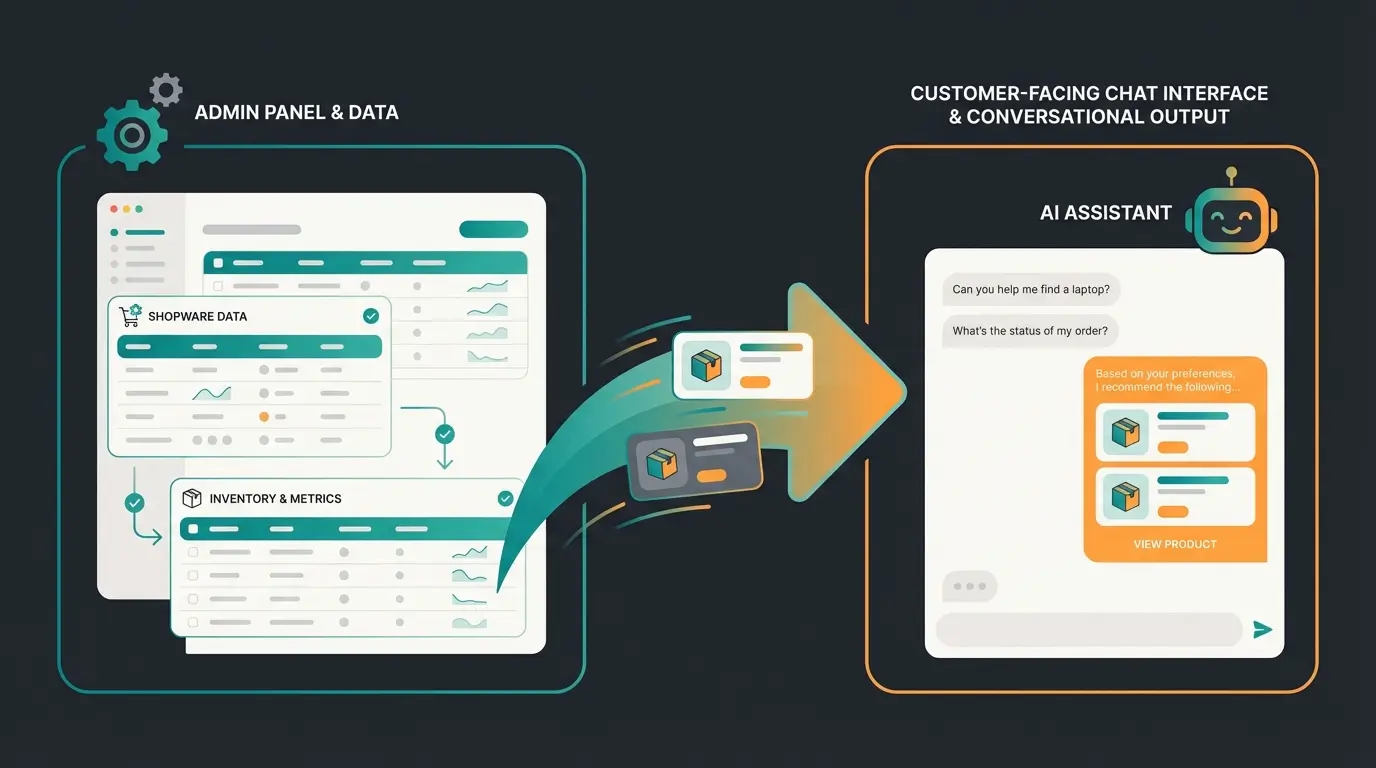
The architecture for such a solution leverages the openness of Shopware 6:
Shopware 6 serves as the leading system. Here lie the structured data (Properties, Custom Fields) and unstructured data (descriptions).
An AI solution (e.g., based on LLMs, but GDPR-compliant hosted) docks via API to Shopware. It reads not just the title but understands context.
Attribute 'Water column: 20,000mm' is translated by AI into 'Suitable for extreme continuous rain and alpine tours.'
In-shop: as interactive chat widget on the PDP. On marketplaces: AI generates dynamic Q&A sections or optimized consultation texts.
The key insight is that AI transforms static rules into dynamic, context-aware responses that adapt to each customer's specific questions and concerns.
Part 4: Case Study – The Hiking Boot Scenario
Let's walk through this abstract-sounding concept with a concrete example that demonstrates the real-world impact of AI-powered product consultation.
The merchant: "AlpinSports24" (fictional), uses Shopware 6.
The product: A technical hiking boot from a premium brand.
The channel: Otto marketplace.
Scenario A: The Classic Approach
AlpinSports24 uses a standard plugin for their multi channel strategy:
- Data push: Title, 3 images, price, and the manufacturer's standard description are pushed to Otto.
- Customer arrives: A prospect with wide feet (hallux valgus) sees the boot. The description only says "Material: Nubuck leather."
- Customer uncertainty: The customer is unsure. They send an email to the merchant through the Otto portal.
- Delayed response: AlpinSports24 responds after 24 hours (standard SLA).
- Lost sale: The customer has long since bought a shoe on Amazon where the reviews said "Fits great for wide feet." Revenue lost.
Scenario B: The AI-Consultation Approach
AlpinSports24 uses an AI solution built on top of Shopware, implementing what AI Customer Service best practices recommend:
- Analysis: The AI analyzes the Shopware data (last width: Wide) and historical customer questions. It recognizes: "Fit is the main purchase barrier for this product."
- Content enrichment: Before data goes to Otto, the AI enriches the description: "Particularly suitable for wide feet and hallux valgus thanks to extra-wide last."
- Interactive consultation: In the Shopware store, customers can ask the widget: "I have hallux, will this hurt?" – The AI responds immediately: "No, this model is specially padded and seamless in the forefoot area."
- Conversion success: On Otto, the customer buys immediately because of the better description. In the store, they buy because of confirmation through the chat. Conversion increased.
This scenario demonstrates how AI eliminates waiting times and transforms the customer experience from frustrating to frictionless.
Stop losing sales to unanswered questions. Our AI Product Consultant integrates seamlessly with Shopware to provide instant, expert guidance across every channel.
Start Your Free TrialPart 5: Strategic Implementation & GDPR
A topic that US competitors often hide in footnotes is business-critical in Europe and increasingly worldwide: data protection.
When you integrate AI into your Shopware multi channel strategy, you're operating in a sensitive area that requires careful consideration.
GDPR Compliance Requirements
- Server location: Use AI models hosted in Europe or with appropriate data processing agreements
- Training data: Ensure your customer data is not used to train public models (like standard ChatGPT)
- Transparency: As studies show, consumers want to know if they're talking to an AI. Label AI responses clearly (e.g., "AI Assistant"). This builds trust rather than suspicion.
The implementation of multilingual AI chatbots must consider these compliance requirements from day one, not as an afterthought.
Integration into the Shopware Ecosystem
The technical hurdle is lower than expected. Since Shopware 6 is based on Symfony and Vue.js with excellent API documentation, external "intelligence layers" can be seamlessly connected.
What's important is that the AI has access to the Custom Fields in Shopware. Often the true USPs (Unique Selling Propositions) are hidden in these technical fields that are often lost in standard feeds.
Modern AI-powered sales consultants can leverage this deep product data to provide consultation that rivals – or exceeds – human expertise.

Part 6: Your Success Implementation Checklist
The market for Shopware multi channel solutions is dividing in 2025 into two camps: the "distributors" who only push data, and the "consultants" who win customers.
To belong to the second group, you should follow these steps for implementing AI product consultation effectively:
1. The Technical Foundation (Must-Have)
- Shopware 6 Update: Use a current version (at least 6.5+) to benefit from the latest API features and the AI Copilot in the backend
- Choose middleware: Rely on proven tools like Shopware Multichannel Connect or Channable for pure logistics (inventory/price) as documented by Shopware's official platform
- PIM maintenance: Your data quality in Shopware is the fuel. Fill attributes and properties meticulously
2. The Channel Strategy (Strategic Fit)
- Marketplace selection: Don't be "everywhere," but where your margins work
- Premium marketplaces (Otto): For fashion, furniture, high-quality technology
- Volume marketplaces (Amazon): For volume (but beware of dependency)
- Emerging marketplaces: For FMCG, household, price-sensitive categories
3. The Service Layer (The Game Changer)
- Content audit: Check if your product descriptions on marketplaces answer questions or just list data
- AI integration: Evaluate solutions that can translate your Shopware data into natural language
- Feedback loop: Use customer questions from chat to permanently improve your Shopware product descriptions. If 10 people ask about "sole hardness," that info belongs in the first line of the description
Building an AI-powered digital sales infrastructure isn't just about technology – it's about fundamentally rethinking how you serve customers across every touchpoint.
Classic vs AI-Enhanced Multi Channel Comparison
Understanding the practical differences between traditional and AI-enhanced approaches helps clarify the value proposition:
| Feature | Classic Approach (Feed Tool Only) | AI-Enhanced Approach (Your Advantage) |
|---|---|---|
| Inventory Sync | ✅ Yes (Real-time) | ✅ Yes (Real-time) |
| Price Sync | ✅ Yes | ✅ Yes |
| Product Texts | ⚠️ Static (Copy from shop) | 🚀 Dynamic & Channel-optimized |
| Customer Questions | ❌ Manual / Slow (24h+) | ✅ Instant / Automated |
| Return Rate | 📉 High (due to wrong purchases) | 📈 Low (thanks to better consultation) |
| Guided Selling | ❌ Not available | ✅ AI recommends based on needs |
| 24/7 Consultation | ❌ Limited to business hours | ✅ Always available |
| Setup Effort | Medium | Medium (thanks to Shopware API) |
Frequently Asked Questions About Multi Channel
Shopware Multi Channel refers to selling products across multiple sales platforms (marketplaces, social media, own shop) from a central Shopware 6 system. Technically, Shopware 6 treats each channel as an equal 'Sales Channel' with individual configurations for currencies, languages, and prices. The API-first architecture enables seamless data synchronization through middleware tools like Shopware Multichannel Connect or Channable.
While data sync ensures correct prices, images, and inventory levels, it ignores the customer's decision-making process. Customers on marketplaces often have questions that static product descriptions cannot answer. Without consultation capability, merchants lose sales to competitors whose descriptions better address customer concerns – or who simply respond faster to inquiries.
AI Product Consultation transforms static product data into interactive, personalized guidance. The AI understands product attributes in context (translating technical specs into benefits), answers customer questions instantly, and enriches marketplace listings with consultation-style content that proactively addresses common concerns. This reduces purchase barriers and accelerates decision-making.
It can be when implemented correctly. Key requirements include hosting AI models in Europe or with appropriate data processing agreements, ensuring customer data isn't used to train public models, and clearly labeling AI interactions. Transparency about AI usage actually builds trust – studies show 92% of consumers want clear labeling when AI is involved.
Focus on marketplaces where your margins work rather than trying to be everywhere. Premium marketplaces like Otto reward quality and consultation with higher margins. Volume marketplaces like Amazon deliver reach but require careful margin management. Evaluate each channel based on your product category, brand positioning, and operational capacity for customer service.
Conclusion: From Distribution to Consultation
Shopware offers the perfect launchpad with its technology. But you have to build the rocket yourself. Say goodbye to the idea that multi channel is just "IT work." It's sales work.
The merchants who win in 2025 and beyond understand that the battle isn't fought on feeds and product data alone. It's won in the micro-moments when customers have questions – and in whether those questions get answered instantly or become reasons to click away.
With the right AI strategy, you have the best sales representative in the world – on every channel, around the clock. The technology exists. The integration paths are clear. The only question is: will you continue distributing data, or start having conversations?
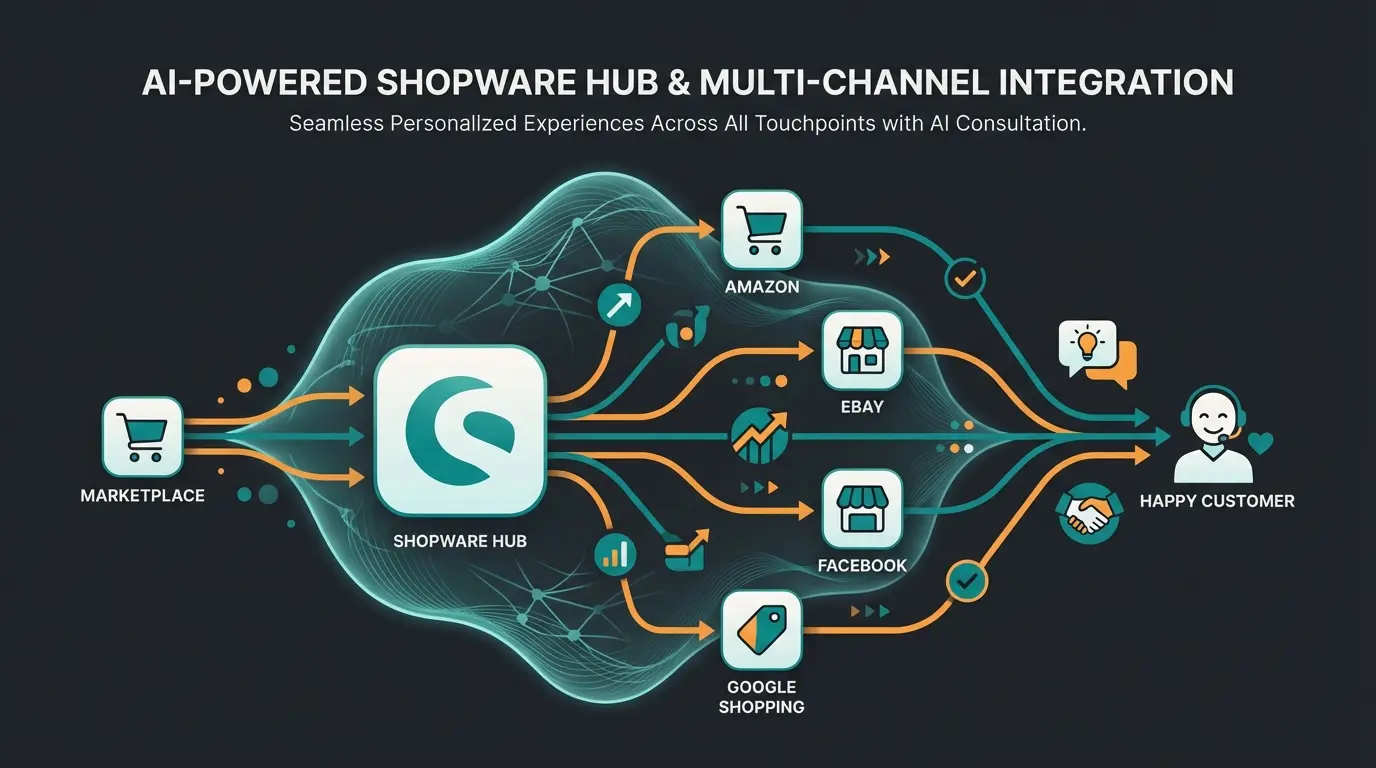
Join forward-thinking Shopware merchants who are winning customers through AI-powered consultation. Get instant, expert product guidance across every sales channel.
Start Your AI Consultation Journey