
The Two Faces of Shopware Marketplaces
E-commerce in 2025 is more complex than ever. For Shopware merchants, the question is no longer whether they should be present on marketplaces, but how they can do so profitably. The search term 'Shopware marketplaces' reveals a common misunderstanding, as it describes two completely different business models that we will clearly separate in this article:
- Multichannel Commerce: You use your Shopware system as a central hub to sell products on external platforms like Amazon, eBay, Otto, or Kaufland. This is the path for 95% of all merchants looking to generate reach. According to Blankspace, marketplace presence is essential for modern e-commerce success.
- Multivendor Marketplace: You transform your own Shopware store into a platform where other merchants can offer their products (similar to what Zalando or Amazon do). This is a highly complex model that requires specialized plugins like those from Webkul.
The reality for most merchants is sobering: Technical connection to Amazon has become easy thanks to modern plugins. But selling profitably is hard. On marketplaces, there's brutal price competition, minimal customer loyalty, and high return rates. This is where AI e-commerce strategies become crucial for differentiation.
This article is not an ordinary technical guide. We not only analyze the best tools for connection (and clarify why you should no longer use 'Shopware Markets'), but also show you a strategy for using Artificial Intelligence (AI) to escape price wars. We demonstrate how you can use marketplaces for volume while turning your Shopware store into a margin machine through AI-powered consultation.
Total German e-commerce market size
Sales generated through marketplaces
Monthly visitors to Amazon Germany
Monthly visitors to eBay Germany
Multichannel Strategies: Selling on Amazon & Kaufland
Germany is a marketplace country. With e-commerce revenue of over 85 billion euros, of which 54% is generated through marketplaces, there's no way around Amazon (approximately 400 million monthly visits) and eBay (approximately 150 million visits). But how do your products efficiently get from Shopware 6 to these platforms? Understanding this is fundamental, and our Shopware SEO guide provides additional context for optimizing your presence.
The Elephant in the Room: The End of Shopware Markets
For a long time, 'Shopware Markets' was promoted as the native solution. Here's a crucial update for your 2025 planning: Shopware Markets in its old form (based on Brickfox technology) is history.
Shopware has undertaken a strategic realignment and introduced Shopware Multichannel Connect. This new solution is based on ChannelEngine technology, as confirmed by ChannelEngine's partnership announcement. This is important because many older blog articles still make outdated recommendations. Anyone setting up a future-proof enterprise solution today will end up with the combination of Shopware and ChannelEngine.
The Big 3 Marketplace Connectors Compared
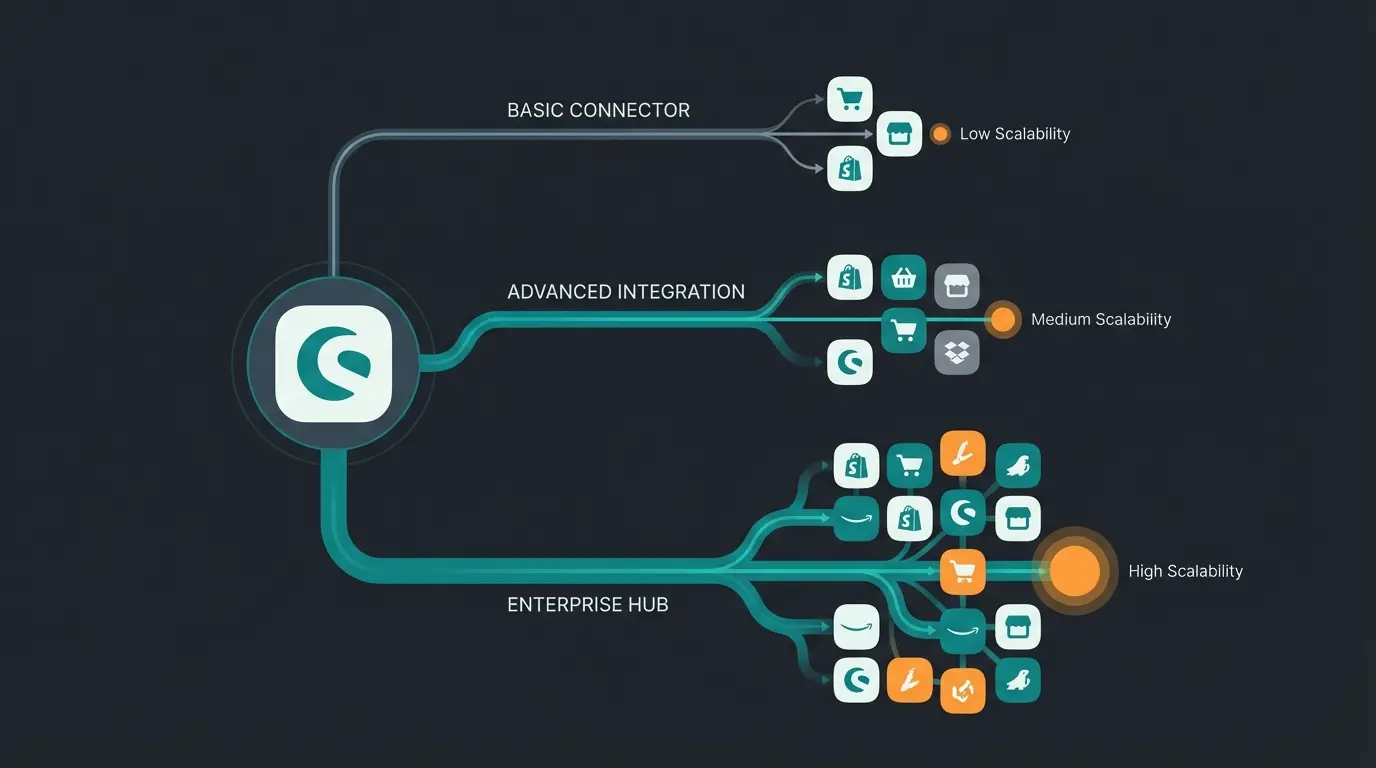
For Shopware merchants, there are three dominant ways to synchronize products in 2025. Choosing the right tool determines your fixed costs and flexibility. This comparison addresses a major gap in existing content - no other resource provides a clear, unbiased comparison of costs, features, and suitability for different business sizes.
A. Magnalister: The Champion for SMBs
Magnalister is deeply rooted in the Shopware community and is the first choice for many small to medium-sized merchants. It's a plugin that integrates directly into the Shopware backend – there's no external middleware you need to log into separately. According to Hubyte's analysis, this direct integration approach significantly reduces complexity for growing businesses.
- Functionality: Direct upload from Shopware, price and inventory synchronization, order import
- Advantage: Very cost-effective (starting from €49/month according to GetApp), simple setup, Shopware 'look & feel' is preserved
- Disadvantage: For extremely high data volumes (millions of SKUs) or very complex logistics rules, middleware can be more performant
B. Shopware Multichannel Connect via ChannelEngine
This is the new official recommendation from Shopware for ambitious merchants. ChannelEngine is a powerful middleware that sits between your shop and the marketplaces. As Shopware's official documentation explains, this solution offers enterprise-grade capabilities.
- Functionality: Shopware sends data to ChannelEngine -> ChannelEngine optimizes and distributes to 950+ marketplaces
- Advantage: Enormous scalability, connection to exotic international marketplaces, repricing tools included
- Disadvantage: Higher complexity and cost structure than a pure plugin. It's a standalone SaaS product
C. Brickfox: Middleware for Complex Data
Brickfox positions itself as a 'Unified Commerce Hub.' It's more than just a connector; it often brings PIM functionalities (Product Information Management) with it.
- Functionality: Control of marketplaces, but also supplier connections
- Advantage: Strong when you need to mix products from different sources (ERP + supplier feeds) before marketplace export
- Disadvantage: Often overkill for merchants who 'only' want to list their Shopware products on Amazon
Decision Guide: Which Tool Fits Your Business?
| Feature | Magnalister | Multichannel Connect (ChannelEngine) | Brickfox |
|---|---|---|---|
| Type | Direct Plugin (in Shopware Core) | Middleware (SaaS) | Middleware / PIM |
| Target Group | SMB to Upper Midmarket | Midmarket to Enterprise | Enterprise / Complex Logistics |
| Costs | From €49/month + low transaction fees | Individual / Enterprise Pricing (often revenue-based) | Project-based / Enterprise Pricing |
| Setup | Easy (Self-Service possible) | Medium (Onboarding often required) | Complex (Integration project) |
| Marketplaces | Focus on Top Channels (Amazon, eBay, Otto, Kaufland, Etsy) | 950+ worldwide (incl. Niches & Global) | Focus DACH + Important International |
| Special Feature | Price rules directly in plugin, attribute matching | Repricing tools, currency management | Supplier management integrated |
Multivendor Strategies: Building Your Own Marketplace
Before we get to the AI strategy, a brief look at the second search intent: Multivendor. Perhaps you don't want to sell on Amazon, but become the next Amazon for your niche (e.g., a marketplace only for vegan cosmetics or classic car parts). This approach requires understanding the AI capabilities comparison between different platforms.
Shopware 6 is not a multivendor system by default. It's designed for one seller (you). To transform it into a marketplace, you need specialized extensions.
The Solution: Webkul Multi-Seller Marketplace
The market leader for this functionality in the Shopware ecosystem is Webkul. The plugin massively extends Shopware:
- Seller Profiles: Third parties can register and create their own profiles
- Commission Structure: You as the operator determine what percentage you retain per sale (e.g., 15%)
- Product Approval: You moderate products before they go live
The Hidden Challenge: The Service Gap
Back to multichannel selling (you sell on Amazon). You've chosen a tool (e.g., Magnalister) and your products are online. Now begins the real problem that hardly any technical guide discusses. This is where AI customer service solutions become essential.
The Problem: On marketplaces, your products become 'commodities' (interchangeable goods).
- Loss of Consultation: In brick-and-mortar retail, a salesperson asks: 'What do you need the bicycle for?' On Amazon, the customer only sees a technical table.
- High Returns: Because consultation is missing, the customer orders the wrong part. Returns eat up your margin.
- Price War: When the product looks identical, the cheapest price wins.
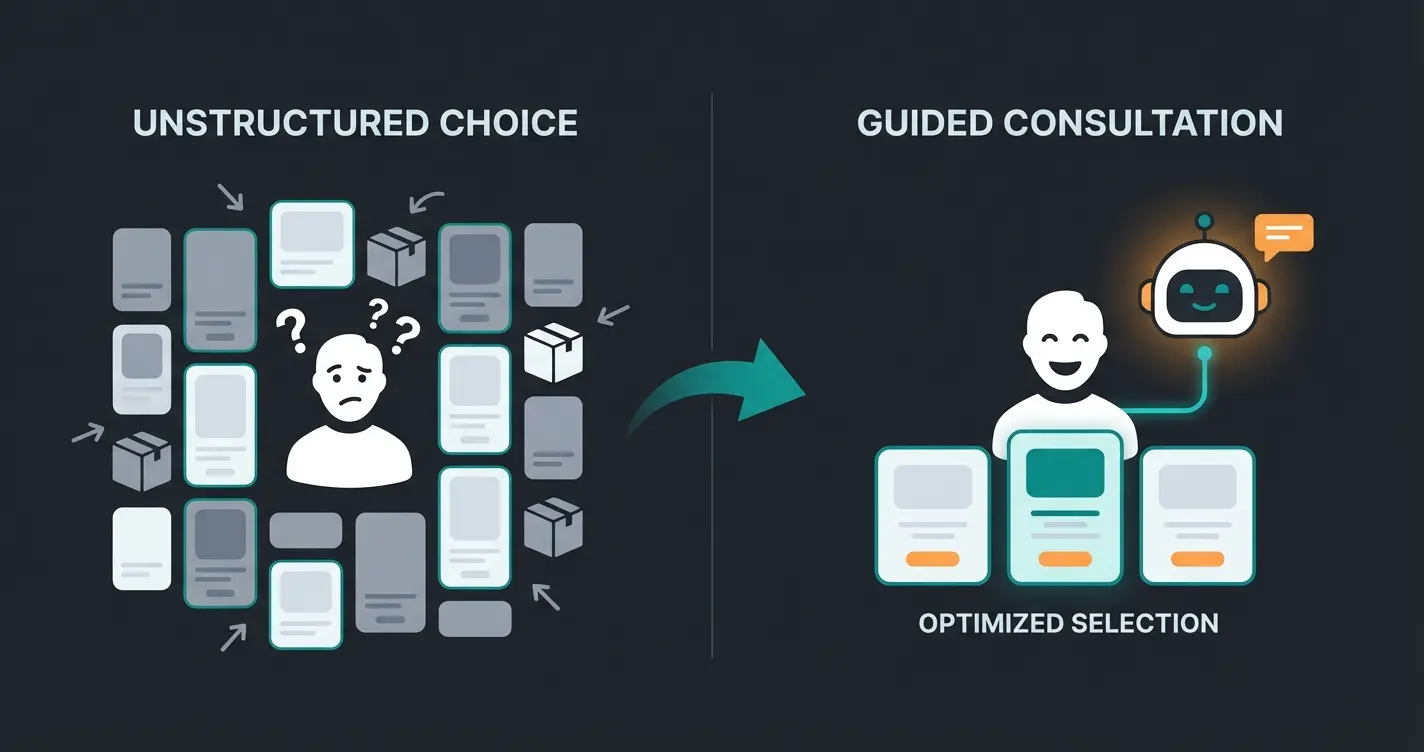
Most 'connectors' don't solve this problem. They only push 'dumb' data (SKU, price, title) from A to B. This creates a service gap. The customer is overwhelmed by the selection and often doesn't buy at all, or buys the wrong thing. Understanding how AI Chatbots transform customer interactions is key to bridging this gap.
Transform marketplace visitors into loyal customers with AI-powered product recommendations that reduce returns and increase margins.
Start Free TrialDifferentiation: How AI Changes the Game
To be successful in 2025, you need to split your strategy into two parts. This represents a major opportunity that no competitor is currently addressing in the Shopware marketplace space:
- On Marketplaces: Use AI for data optimization (ranking & conversion)
- In Your Own Shopware Store: Use AI for product consultation (customer loyalty & margin)
Strategy A: AI for Marketplace Listings
Marketplaces like Amazon work algorithmically. Whoever has the best data wins. Manual maintenance is too slow. According to E-Commerce Germany News, AI-enhanced product data significantly improves marketplace performance.
- AI-Powered Attributes: Use tools like the Shopware AI Copilot or external ChatGPT integrations to analyze your product descriptions and add missing attributes. Example: Your Shopware product has the text 'Lightweight summer jacket.' The AI generates attributes for marketplace export like 'Material: Linen', 'Season: Spring/Summer', 'Fit: Regular Fit.' These attributes are crucial for filter searches on Zalando or Otto.
- Review Summaries: Use AI to create summaries from your shop reviews ('Customers particularly praise the durability, but note that it runs small'). This honest information in marketplace content reduces returns.
Strategy B: The Own Shop Advantage - AI as Sales Consultant
This is your biggest lever. Why should a customer buy from your Shopware store instead of Amazon? Because they get consultation there. This is exactly what AI-powered consultation enables.
Amazon is a search engine ('I know what I want'). Your store must be a consultant ('I have a problem, help me'). Implementing Shopware AI chatbots creates this differentiation effectively.
1. Guided Selling & AI Product Advisors
Instead of letting the customer click through 500 categories, use plugins like the 'AI Product Advisor' or 'Guided Selling' extensions for Shopware 6, as documented in Shopware's extension marketplace.
The Scenario: A customer is looking for running shoes.
- Amazon: Shows 10,000 results, sorted by bestseller.
- Your Store (with AI): A chatbot or interactive advisor asks: 1. 'Where do you run? (Forest/Street)' 2. 'How often per week?' 3. 'Do you have knee problems?'
- Result: The AI recommends exactly three models with justification: 'Model X suits you because it offers the best cushioning for asphalt.'
Generate brand awareness through marketplace presence and reach millions of potential customers
Product quality and reviews create interest in your brand identity
Attracted by promise of better service, consultation, and expertise
Guided selling creates high-margin sale with reduced return risk
2. The Economic Effect
This type of consultation used to be expensive (personnel). With plugins like the 'Custom GPT Sales and Support Assistant' as found on Shopware Store or 'Microsoft AI Copilot Studio' integrations, this 24/7 consultation costs only a fraction. For comprehensive support automation, explore how to automate Shopware support effectively.
- Conversion Rate: Increases massively because decision uncertainty ('Does this fit?') is removed
- Returns: Decrease because the product matches the requirements
- Margin: Since you provide added value, you're less comparable and don't have to participate in every price war
The key insight is that AI consultation closes the gap between customer questions and product expertise, creating value that marketplaces simply cannot replicate.

Implementation Guide: 4 Steps to AI-Optimized Business
Here's your roadmap for implementation in Shopware 6. Following this structured approach ensures you maximize both marketplace reach and AI-driven differentiation:
Step 1: The Foundation (Clean Core)
- Ensure you're running Shopware 6.5 or higher to be able to use AI Copilot features, as detailed in Shopware's YouTube tutorials.
- Clean up your master data. AI can enhance data, but 'garbage in, garbage out' still applies.
Step 2: The Connection (Connect)
- For SMBs: Install the Magnalister plugin. Start with Amazon and eBay. Use the 30-day trial period to set up attribute matching. Resources from Magnalister provide detailed setup guides.
- For Enterprise: Contact Shopware for Multichannel Connect (ChannelEngine). Plan for an integration phase of 4-8 weeks.
Step 3: Data Optimization (Optimize)
Use the Shopware AI Copilot (Export Assistant) to create special feeds for marketplaces. Let the AI rewrite product descriptions so they don't count as 'duplicate content' (one text for the shop, one variation for Amazon). According to Agiqon Shopware experts, this approach significantly improves both SEO and marketplace performance.
Step 4: The Differentiation (Consult)
- Install an AI product advisor in your shop (e.g., from Golle IT as listed on their website or Biloba IT)
- Train the bot with your product data (PDF manuals, FAQs)
- Promote in your packages (sold via Amazon) your own store with the argument: 'Unsure next time? Use our digital product advisor in the shop for the perfect selection.' This converts marketplace customers to regular customers.
For comprehensive product recommendation strategies, our guide on AI powered product consultation covers advanced implementation techniques.
Upgrade to Shopware 6.5+, clean master data, prepare for AI integration
Install Magnalister (SMB) or ChannelEngine (Enterprise), start with Amazon/eBay
Use AI Copilot for unique marketplace descriptions, enhance attributes automatically
Install AI product advisor, train with your data, convert marketplace customers to loyal shop customers
FAQ: Common Questions About Shopware Marketplaces
With Magnalister, prices start at €49 per month plus a small revenue share depending on the tariff. With Shopware Multichannel Connect (ChannelEngine), prices are significantly higher and often based on GMV (Gross Merchandise Volume), but offer enterprise support and access to 950+ marketplaces globally.
No, Shopware Markets (based on Brickfox) is no longer actively promoted as the primary solution and has been replaced by the partnership with ChannelEngine. Existing users should plan a medium-term migration to Shopware Multichannel Connect for continued support and updates.
Yes, there are numerous plugins like the 'AI Content Generator' or 'ChatGPT Assistant' that run via your own OpenAI API key. These can generate texts, answer customer inquiries, and optimize SEO data. According to Shopware's extension marketplace, several certified options are available.
Only if you occupy a very strong niche. Technical costs with plugins like Webkul (approximately €299 one-time) are low, but marketing costs to attract buyers and sellers are enormous. The chicken-and-egg problem makes this viable only with existing significant traffic.
Absolutely. AI serves two critical functions: First, optimizing product data feeds for better marketplace rankings through automated attribute enhancement and unique descriptions. Second, and more importantly, AI consultation in your own store creates a competitive advantage that pure marketplace presence cannot match.
Conclusion: Connecting is Silver, Consulting is Gold
The era when you simply 'pushed' products from Shopware to Amazon is over. The tools for this (Magnalister, ChannelEngine) are mature and necessary, but they're no longer a guarantee of profit.
The winner in 2025 uses multichannel connection for reach and AI integration for profitability. By using marketplaces as a customer acquisition channel and building your own Shopware store into a competence center through AI consultation, you escape the comparability trap.
Start today: Review your current marketplace interface and test one of the AI consultation plugins in the Shopware Store. The difference between 'storing' and 'selling' lies in the intelligence of your consultation. Exploring AI product consultation is your next strategic step.
Stop competing on price alone. Implement AI-powered product consultation that brings high-margin sales back to your store and converts marketplace browsers into loyal customers.
Get Started Now