
Why Your Shopware Store Needs More Than Just Images
Imagine walking into a specialty outdoor equipment store. You're looking for a tent. But there's no salesperson in sight. Instead, small signs are stuck to the shelves: "Customers who viewed this tent also bought these stakes." Does that really help you when you don't know if the tent is even suitable for your planned winter tour?
This is exactly how millions of customers feel every day in online stores across the globe.
In the world of e-commerce, we've long relied on static Shopware product recommendations. We configure cross-selling sliders, define "accessory" groups, and hope the "customers also bought" algorithm handles the rest. But in 2025, that's no longer enough. The market is saturated, and customers have become more demanding.
The thesis of this article is clear: Those who still rely exclusively on static cross-selling widgets are leaving massive revenue on the table. The future belongs to AI-powered product consultation (Guided Selling), which transforms the static online store into an interactive advisory space. Companies mastering AI-powered product consultation are already seeing dramatic improvements in their conversion metrics.
In this comprehensive guide, you'll learn:
- How to maximize the standard Shopware 6 features for product recommendations
- Why 86% of your customers probably ignore your current recommendations (Banner Blindness)
- How to simulate real consultation conversations using Artificial Intelligence (AI) and significantly increase your conversion rate
The Basics: Setting Up Standard Shopware 6 Cross-Selling
Before we dive into the future of AI consultation, we need to understand the foundation. Shopware 6 offers solid out-of-the-box tools to implement Shopware product recommendations. If you're not using these yet, this is your first step.
Shopware primarily distinguishes between two methods for suggesting products on the detail page (PDP) or in the shopping cart: manual assignment and Dynamic Product Groups.
Manual Assignment (The Classic for Accessories)
Manual assignment is the most precise but also the most maintenance-intensive method. It's excellent for technical accessories that must be 100% compatible (e.g., the specific battery for a camera).
How to set it up:
- Navigate in the Shopware Admin to Catalogs > Products
- Open the desired product and select the Cross Selling tab
- Click on "Add new Cross Selling"
- Give the section a title (e.g., "Matching Accessories")
- Under "Type," select the option Manual Assignment
- Now manually search for the products to be displayed and add them
According to Firebear Studio, this method gives you complete control over which products appear together, ensuring no mismatched items confuse your customers.
Advantage: You have full control. No inappropriate products are displayed.
Disadvantage: With a product range of 10,000 items, manual maintenance is economically barely feasible.
Dynamic Product Groups (Automation Through Rules)
To reduce maintenance effort, Shopware 6 offers powerful Dynamic Product Groups. Here you define rules by which Shopware automatically loads products into a stream. As documented by Shopware, this feature enables sophisticated automation of your recommendation strategy.
Setup steps:
- Go to Catalogs > Dynamic Product Groups
- Create a new group, e.g., "High-priced Hiking Boots"
- Define conditions in the Rule Builder: Example: Category is "Hiking Boots" AND Price is greater than €150 AND Stock is greater than 0
- Return to the product (Cross Selling tab)
- Select Dynamic Product Group as the type and link the group you just created
The intelligent product consultation capabilities of Shopware's Rule Builder provide the foundation for more sophisticated recommendation strategies.
The strategic benefit: This method allows you to create "New Arrivals" sliders or "Bestseller" lists that update themselves. As soon as a new product meets the criteria (e.g., "New = Yes"), it automatically appears in the recommendations.
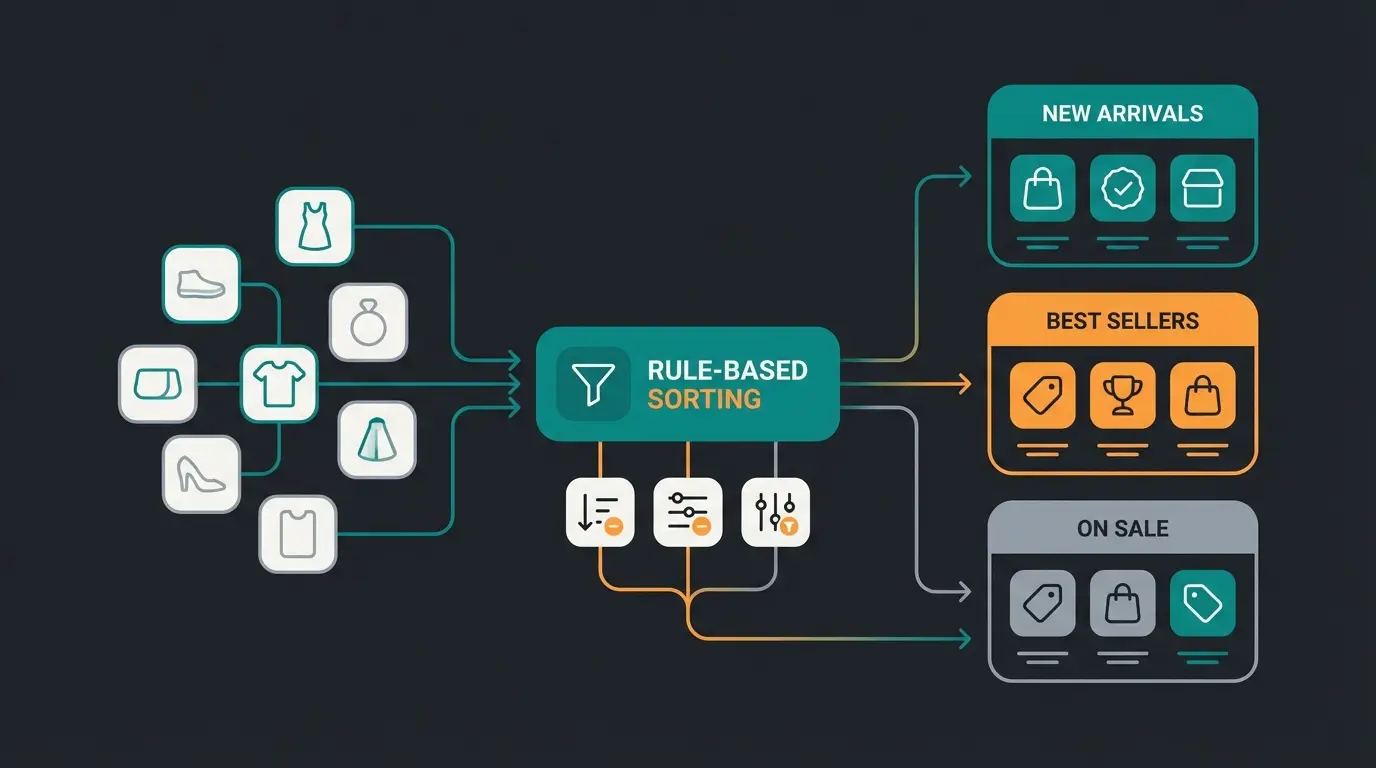
The Limits of the Standard Approach
Although these tools are functional, they have a fundamental problem: They are product-centric, not customer-centric.
- They show what you want to sell (or what others bought)
- They don't know what the current visitor needs right now
- They're based on rigid rules ("Show products from Category X"), not on user context
This creates a gap between the technical feature "Cross-Selling" and the real customer need for orientation. Understanding how AI sales assistants bridge this gap is crucial for modern e-commerce success.
The Problem: Why Classic Recommendations Often Fail
If Shopware product recommendations are technically so easy to set up, why do so few customers click on them? The answer lies in user psychology and information overload.
The Phenomenon of Banner Blindness
Studies paint a stark picture for traditional display advertising and static recommendation widgets. The phenomenon of Banner Blindness states that users have learned to ignore everything that looks like advertising or is located in typical edge areas (right column, footer).
Percentage of consumers who have developed immunity to standard recommendation widgets
Typical click-through rate for poorly placed cross-sell elements
Users who don't even perceive standard product sliders
Research from Infolinks confirms that 86% of consumers suffer from banner blindness. The human brain filters out "visual noise" to focus on the main content. A standard "Customers also bought" slider is often perceived as such noise. According to Growth Src, click-through rates on such standard elements often lie in the per-mille range (approximately 0.06% to 0.35% for display ads, similarly low for poorly placed cross-sells).
If your Shopware product recommendations consist only of a half-hearted slider at the bottom of the page, you're investing in a feature that 8 out of 10 customers don't even notice.
The Missing "Why" (Context Gap)
Another problem is the missing context. An algorithm based on "Collaborative Filtering" (customers who bought X also bought Y) works purely statistically.
The algorithm doesn't know the "why" of the purchase. It sees only correlations, not causations. Without knowing why a customer is viewing a product (purpose of use, experience level, budget), recommendations remain a game of chance. This is where digital product consultants make a transformative difference.
Choice Overload (The Paradox of Choice)
Paradoxically, too much choice can prevent purchase. When you show a customer 20 "similar items" below the product, you often trigger Choice Paralysis. According to research highlighted by Netsuite, the customer becomes uncertain ("Maybe the other product is better after all?") and abandons the purchase to research further.
Zoovu research confirms that Guided Selling tools can drastically shorten the time to purchase decision and reduce returns because customers buy products that truly fit their needs.
The Solution: AI-Powered Product Consultation
Here comes the paradigm shift. Instead of simply showing the customer more products, we need to help them find the right product. We're moving from Product Recommendations to Product Consultation.
What is AI Product Consultation?
AI Product Consultation (often also called Guided Selling or Conversational Commerce) uses Artificial Intelligence to simulate the dialogue of a salesperson in a store. Instead of static filters ("Color: Red", "Size: XL"), the AI guides the customer through a needs-oriented process. As Highspot explains, this approach fundamentally changes how customers discover products.
Technologically, this is often based on Large Language Models (LLMs) or specialized decision trees that are integrated into Shopware via plugins. The AI Product Consultation approach represents a complete evolution in how online stores engage with customers. According to Battery Included AI, these systems understand product data semantically rather than just through keyword matching.
Comparison: Static Cross-Selling vs. AI Consultation
To clarify the difference, a direct comparison is worthwhile:
| Feature | Standard Shopware Cross-Selling | AI Product Consultation (Guided Selling) |
|---|---|---|
| Data Basis | Sales statistics ("Others bought...") | Explicit customer needs ("I need...") |
| Interaction | Passive (Customer must look) | Active (System asks/advises) |
| Format | Static image slider | Chat, quiz, or interactive advisor |
| Goal | Click maximization | Problem solution & trust building |
| Personalization | Low (Group-based) | High (Individual & Real-time) |
| Data Quality | Implicit (Click behavior) | Zero-Party Data (Customer says what they want) |
How AI Works in Shopware
Modern AI plugins for Shopware 6 work differently than old recommendation engines. As documented by Shopware, the integration capabilities for AI solutions have expanded significantly.
- Data Understanding: The AI "reads" your product data (descriptions, properties, data sheets). It understands not just the keyword "Waterproof" but the semantic context ("Good for rainy weather")
- Needs Analysis: Through a chat window or guided dialogue, the AI asks the customer about their requirements (e.g., "Are you looking for ski boots for beginners or professionals?")
- Matching: The AI matches the requirements with product properties and provides a reasoned recommendation ("I recommend this boot because it has a wider fit, which is ideal for your foot type")
According to EXWE, this approach effectively combats banner blindness because it requires interaction and provides real added value. The AI-driven consultation methodology transforms passive browsing into active engagement.

Stop guessing what your customers want. Our AI Product Consultation asks them directly and delivers personalized recommendations that convert.
Start Your Free TrialStrategies for Better Recommendations: Right Place, Right Time
Even the best AI is useless if placed incorrectly. A successful strategy for Shopware product recommendations must meet customers along their journey.
1. The Product Detail Page (PDP): The Advisor
Here the customer is already interested but often uncertain.
Standard Error: A slider with "Similar Items" that leads the customer away from the current product.
AI Strategy: A "Digital Advisor" button or chatbot directly next to the "Add to Cart" button.
- Use Case: The customer is looking at a laptop. The AI asks: "Would you like to know if this laptop is powerful enough for video editing?"
- Added Value: Elimination of purchase doubts (Conversion booster)
Implementing AI-powered Guided Selling on your product pages can dramatically reduce bounce rates while increasing add-to-cart rates.
2. The Shopping Cart: The Impulse Seller
The customer has decided. Now is the moment for classic cross-selling, but done intelligently.
Standard Error: Displaying expensive alternatives (Upselling) that make the customer think twice.
AI Strategy: "The Last-Minute Reminder". Analysis of the cart for missing accessories.
- Use Case: A flashlight is in the cart. The AI checks: "Do you have batteries? This model requires 3x AAA, which are not included."
- Added Value: Increase in average order value (AOV) and avoidance of post-purchase frustration
According to Rhiem Intermedia, this strategic approach significantly outperforms random cross-sell suggestions. Implementing AI-driven consultation in your cart can capture additional revenue that would otherwise be lost.
3. The Category Page: The Filter Replacement
Category pages with 500 items are overwhelming.
Standard Error: Endless scrolling and complex technical filter bars.
AI Strategy: A "Product Finder" quiz above the product list.
- Use Case: "Find the perfect running shoe in 3 steps."
- Added Value: Quick orientation and reduction of bounce rate
An AI product finder on category pages transforms overwhelming product catalogs into guided shopping experiences.
AI Product Finder quiz helps customers narrow down from hundreds of options to relevant matches
Digital Advisor eliminates purchase doubts with contextual product knowledge and comparisons
Last-Minute Reminder analyzes cart contents and suggests essential missing accessories
Service follow-up recommendations based on purchase for future engagement
Data & Facts: Why the Switch Pays Off
The switch from static recommendations to intelligent consultation isn't just a UX topic—it's a hard business case. Current market data for 2024/2025 proves the potential:
Additional revenue generated by companies mastering personalization vs. competitors
Maximum conversion increase from relevant personalized product recommendations
Consumers who expect personalized interactions from online stores
Customers frustrated when personalization is absent from their shopping experience
According to Envive AI and Salesso, companies that master personalization generate 40% more revenue from these activities than their competitors.
Research from Wiser Notify and Ecomposer shows that personalized product recommendations can increase conversion rates by up to 288% when they're relevant.
Data from OWD reveals that 71% of consumers expect personalized interactions. Even more importantly, as Adam Connell reports, 76% are frustrated when these are absent.
According to Getqonfi, the use of Guided Selling tools can drastically shorten the time to purchase decision and reduce returns because customers buy products that truly fit their needs.
The AI consultation approach represents one of the highest-ROI investments an e-commerce business can make today. For a deeper understanding of how this applies to your sector, explore our guide on KI E-Commerce strategies.
Case Study: The Tent Dilemma Solved
Let's revisit the example from the beginning to translate theory into practice.
Scenario: A customer is searching in your Shopware shop for a tent for a camping trip to Norway.
The Old Way (Standard Shopware Cross-Selling)
- The customer clicks on a standard igloo tent
- Below the product, they see a slider "Similar Items": 5 more tents, wildly mixed (a beach tent, a family tent, an expedition tent)
- They see a slider "Accessories": Stakes, waterproofing spray
- Result: The customer is confused. Is the igloo tent waterproof enough for Norway? Are the other tents better? They leave the shop to google reviews. Purchase abandoned.
The New Way (AI Product Consultation)
- The customer clicks on the igloo tent
- A subtle chat window or "Advisor" widget opens: "Are you planning a trip to a rainy region or more for summer vacation?"
- Customer clicks: "Norway, lots of rain."
- The AI analyzes the data: The current tent has only 2,000mm water column
- AI Recommendation: "For Norway, I recommend our 'Nordic Pro' model. The current tent is great for festivals, but you'll get wet in continuous rain in Scandinavia. The 'Nordic Pro' has 5,000mm water column and reinforced seams."
- Additional AI tip: "Since the ground in Norway is often rocky, I've also found the matching rock ground stakes for you."
- Result: The customer feels understood and competently advised. They buy the more expensive tent (Upselling) and the stakes (Cross-Selling). Sale completed + higher AOV.
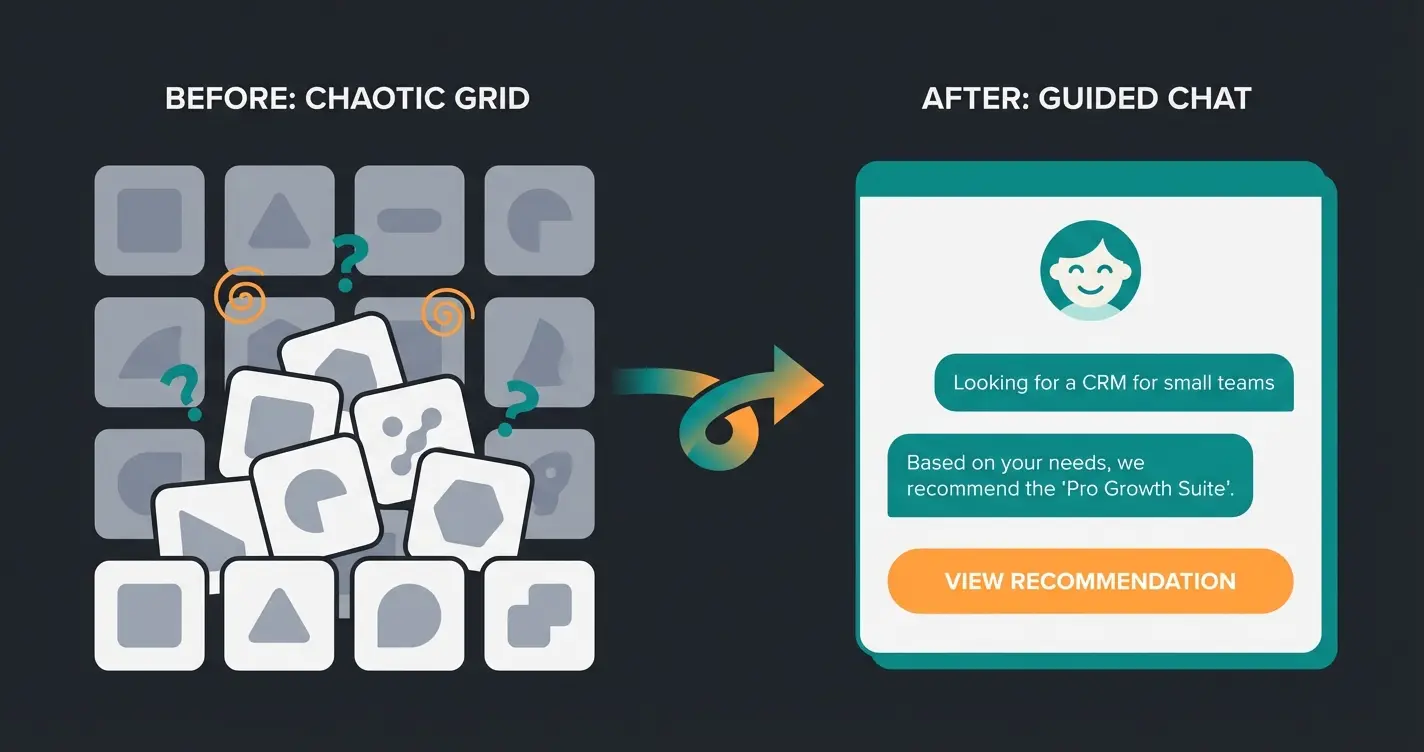
This transformation exemplifies what AI-powered sales consultants can achieve—moving from confusion to clarity, and from abandonment to conversion.
Bridging the Gap: From Browsing to Buying
The fundamental challenge in e-commerce is what we call the "Consultation Gap." Understanding this gap is crucial for implementing effective Shopware product recommendations.
The Old Way: A user sees 50 products → Gets confused → Leaves without purchasing.
The New Way: A user has a question → AI answers with context → User buys the specific product that fits their needs.
This shift from passive product display to active consultation represents the core evolution that AI Produktberatung brings to modern e-commerce. The key differentiator isn't showing what to buy, but explaining why it fits the customer's specific situation.
Conclusion: The Future is Conversational
The era of static Shopware product recommendations is coming to an end. Not because cross-selling is dead, but because the way how we sell is evolving.
Customers no longer want to see algorithmic lists based on the behavior of strangers. They want solutions for their specific problems.
Your To-Do List for 2025:
- Audit: Check your current cross-selling sliders. Are customers clicking on them? (Use heatmaps)
- Basic Hygiene: Use Dynamic Product Groups in Shopware 6 to at least eliminate manual maintenance efforts
- Upgrade: Test AI-powered consultation tools (Guided Selling). Start with consultation-intensive categories (e.g., sports equipment, electronics, cosmetics)
The step from "Customers also bought" to "How can I help you?" is the decisive competitive advantage in an overcrowded e-commerce market. Use the technological possibilities of Shopware and AI to turn visitors into loyal customers.
FAQ: Common Questions About Shopware Product Recommendations
In Shopware 6, you activate cross-selling in the admin area under Catalogs > Products. In the "Cross Selling" tab, you can add new recommendations and choose between manual assignment and Dynamic Product Groups. Manual assignment gives you precise control for specific accessory relationships, while Dynamic Product Groups automate recommendations based on rules you define.
Cross-selling offers complementary products (e.g., socks with shoes), while upselling tries to sell the customer a higher-value or more expensive version of the current product (e.g., premium leather care instead of standard spray). Both strategies increase average order value, but cross-selling adds breadth while upselling adds depth to the purchase.
Yes, AI can massively improve recommendations by not only using statistical purchase data but analyzing the context and needs of customers in real-time (Guided Selling). This often leads to higher conversion rates and fewer returns because customers buy products that truly fit their needs rather than making decisions based on what strangers purchased.
Banner blindness occurs because users have learned to ignore elements that look like advertising or appear in typical promotional areas. Studies show 86% of consumers suffer from this phenomenon. Standard "Customers also bought" sliders are often perceived as visual noise, resulting in click-through rates as low as 0.06%. Interactive AI consultation breaks through this by requiring engagement and providing genuine value.
Traditional engines use collaborative filtering (what others bought) and work purely statistically. AI consultation understands product data semantically, asks customers about their specific needs through interactive dialogue, and provides reasoned recommendations explaining why a product fits. This shifts from showing what to buy to advising why it's the right choice.
Stop leaving revenue on the table with static cross-selling. Discover how AI-powered product consultation can increase your conversion rates and average order values.
Get Started Free
Lasse is CEO and co-founder of Qualimero. After completing his MBA at WHU and scaling a company to seven-figure revenue, he founded Qualimero to build AI-powered digital employees for e-commerce. His focus: helping businesses measurably improve customer interaction through intelligent automation.
