Why Your Understanding of Personalization Costs You Revenue
When you search for Shopware personalization as a shop owner or e-commerce manager, you probably have a very specific image in mind. You think of engraved pens, t-shirts with custom photo prints, or cereal mixes that customers can assemble themselves. That's the classic approach. That's what Google shows you in the first ten search results: technical guides for the 'Custom Products' extension.
But let's be honest: that's just the tip of the iceberg.
While you focus on giving customers tools to modify a product, you might be overlooking a much bigger problem: the customer often can't find the right product in the first place. According to Firebear Studio, many e-commerce businesses struggle with this exact challenge.
In an era when attention spans are shrinking and choices are exploding, offering configurable products alone is no longer enough. True personalization in 2025 doesn't mean the customer has to design the product—it means the shop understands the customer.
This article isn't another technical manual for backend settings. It's a strategic guide showing you how to bridge the gap between technical configuration and genuine, human-like consultation. We'll show you why filters and search bars have become outdated and how AI-powered consultation (Guided Selling) can massively boost your conversion rates. If you're looking to implement AI product consultation in your Shopware store, this comprehensive guide will show you exactly how to do it.
Part 1: The Status Quo – Standard Shopware Personalization
To understand where we're heading, we need to briefly examine where we stand. Shopware 6 is a powerful system that comes with solid tools out of the box. These are essential for technical processing but don't solve the psychological sales problem.
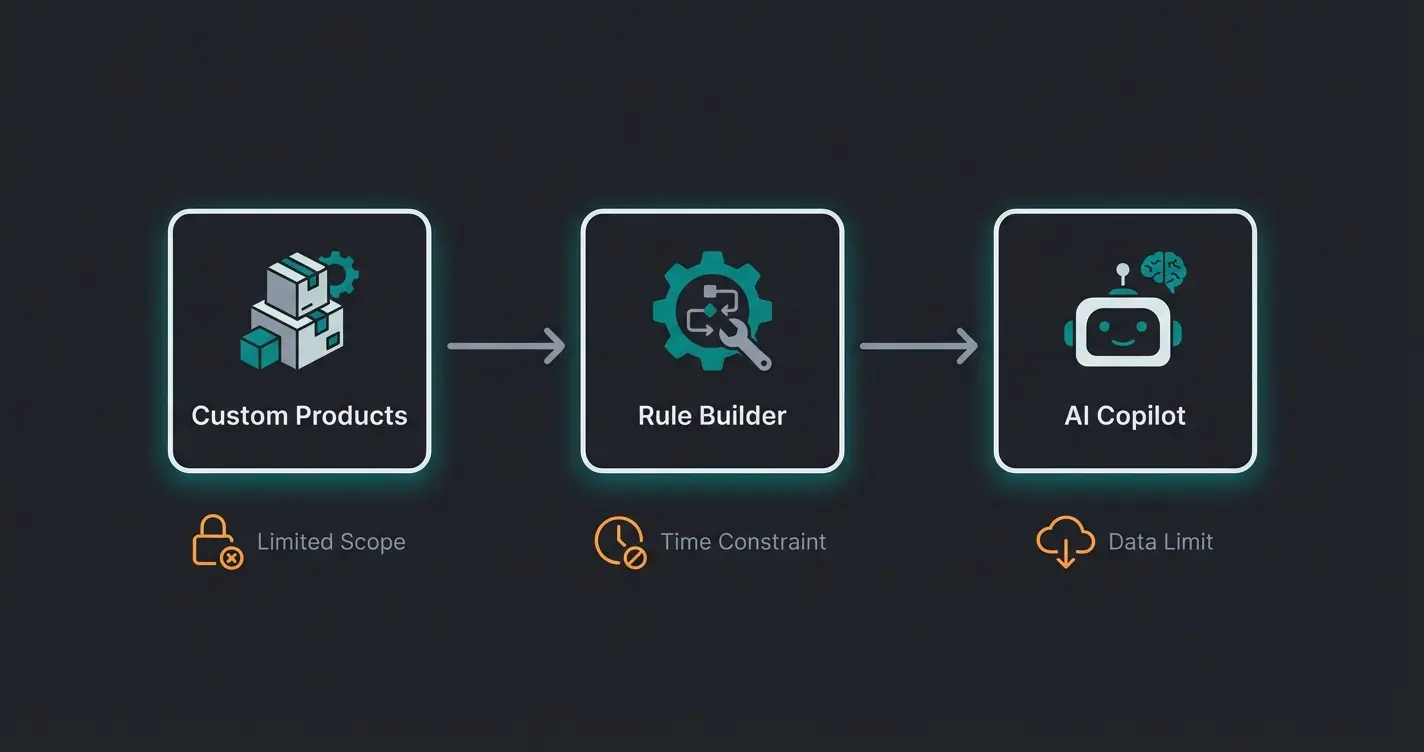
The Custom Products Extension
When you browse official Shopware documentation or plugin stores, this is the standard. The Shopware 6 Custom Products extension is excellent for:
- Visual customizations: Upload images for printing
- Text inputs: Name engravings or greeting messages
- Optional add-ons: Checkboxes for gift wrapping or warranty extensions
The catch: This form of personalization assumes the customer already knows they want to buy this specific product. It doesn't help them decide which product is right for them. It's a tool for production, not for sales.
The Rule Builder: Behind-the-Scenes Personalization
Another powerful tool in the Shopware arsenal is the Rule Builder. As noted by Kenner-Soft, it enables data-driven personalization:
- Pricing: VIP customers see different prices than new customers
- Shipping: Certain countries or cart values trigger free shipping
- Promotions: 'Customers who haven't purchased in the last 30 days receive 10% off'
The limitation: The Rule Builder reacts to past behavior or static data (location, customer group). It cannot hold a dialogue. It cannot know that a customer is searching for a bicycle for their daughter today, even though they've only bought professional racing bike parts before.
Shopware AI Copilot: The Merchant's Assistant
Shopware has significantly upgraded with the AI Copilot, as detailed by Communicode. Features like AI-generated product descriptions, image keyword assistants, or personalized checkout messages are fantastic efficiency boosters for you as a merchant.
But here too: most of these features optimize your work processes in the backend. The direct, consultative interaction with uncertain customers in the frontend is often still left to classic filters. Understanding Shopware AI capabilities helps you leverage these tools effectively while recognizing their limitations for customer-facing consultation.
Part 2: Why Filters and Configurators Fail
Imagine walking into a specialized running shoe store. The salesperson doesn't greet you. Instead, they hand you a clipboard with a list of 50 technical attributes: 'Heel-to-toe drop in mm?', 'Pronation support yes/no?', 'Cushioning level 1-10?'
If you're not an expert, you turn around and leave. This is exactly what happens daily in thousands of online shops. We call it 'filtering,' but for the customer, it's overwhelming.
The Paradox of Choice (Choice Overload)
Science has confirmed this phenomenon for decades. In the famous 'Jam Study' by psychologists Sheena Iyengar and Mark Lepper, customers in a supermarket were presented with either a selection of 24 jams or just 6 jams. According to Rokt's analysis of this study, the results were shocking and remain relevant for every Shopware personalization plugin developer:
- Large selection (24 varieties): Attracted more attention, but only 3% bought
- Small selection (6 varieties): Fewer browsers, but 30% bought
This means: Too much choice without guidance paralyzes the buying decision (Analysis Paralysis). When you give a customer 500 products and 20 filter options, the probability of purchase drops drastically.
24 options with no guidance
6 curated options
When choice is simplified
The Gap in the Customer Journey
This is where standard tools fail:
- Custom Products: Allows configuration, but no consultation
- Filters: Require expertise (the customer must know what 'Gore-Tex' is to filter for it)
- Recommendation Engines: ('Other customers also bought') are based on statistics, not current needs
What's missing is the digital sales conversation. This is precisely where AI consulting in e-commerce becomes essential for modern online stores.
Part 3: AI-Powered Product Consultation (Guided Selling)
Here begins the new era of Shopware personalization. We need to redefine the term. Personalization is no longer about editing a product—it's about finding the perfect solution through dialogue.
What is Conversational Personalization?
Instead of leaving the customer alone with filters, an AI takes on the role of an experienced salesperson. This is often referred to as 'Guided Selling' or 'Conversational Commerce.' The concept of AI Guided Selling is transforming how online stores interact with their customers.
The process changes radically:
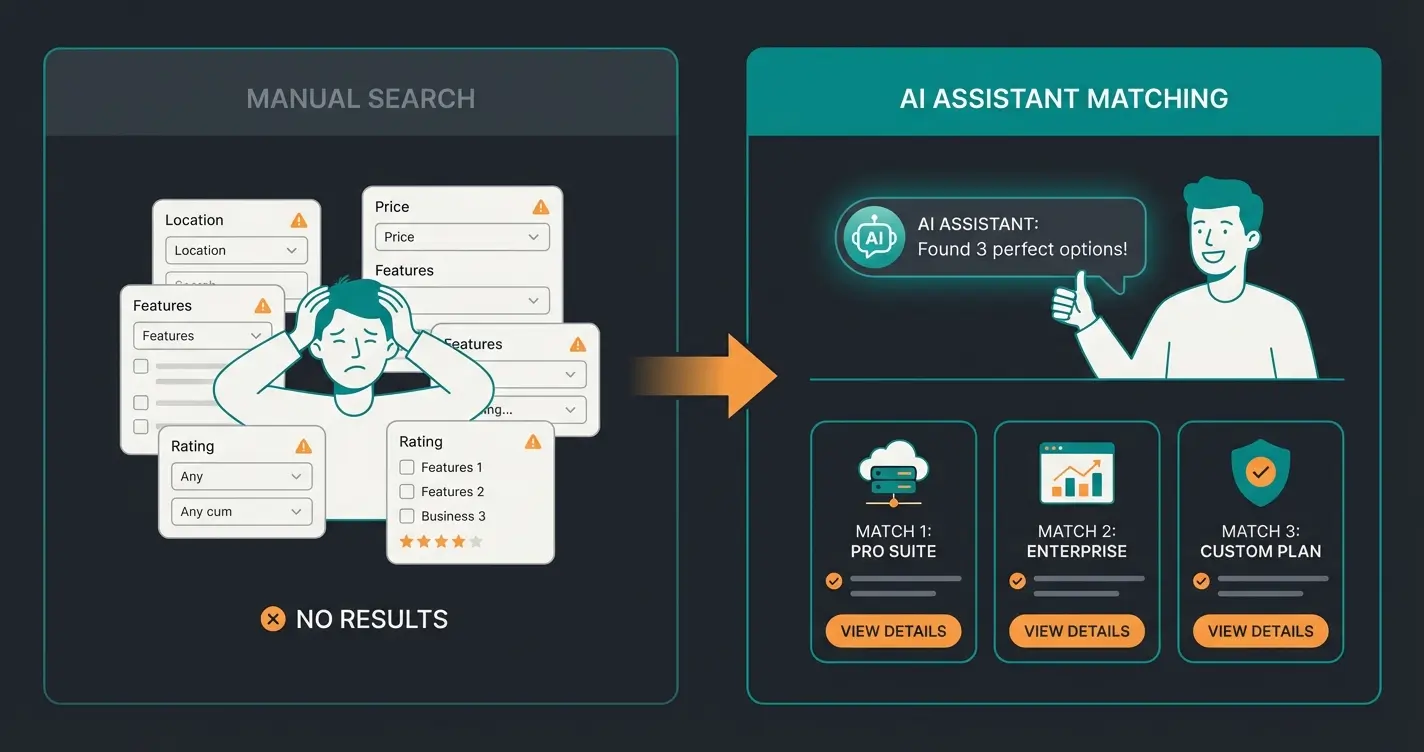
- Old (Filter): Customer selects 'Category: Mountain Bike' -> 'Travel: 140mm' -> 'Frame: Carbon'. (Result: 0 hits or confusion)
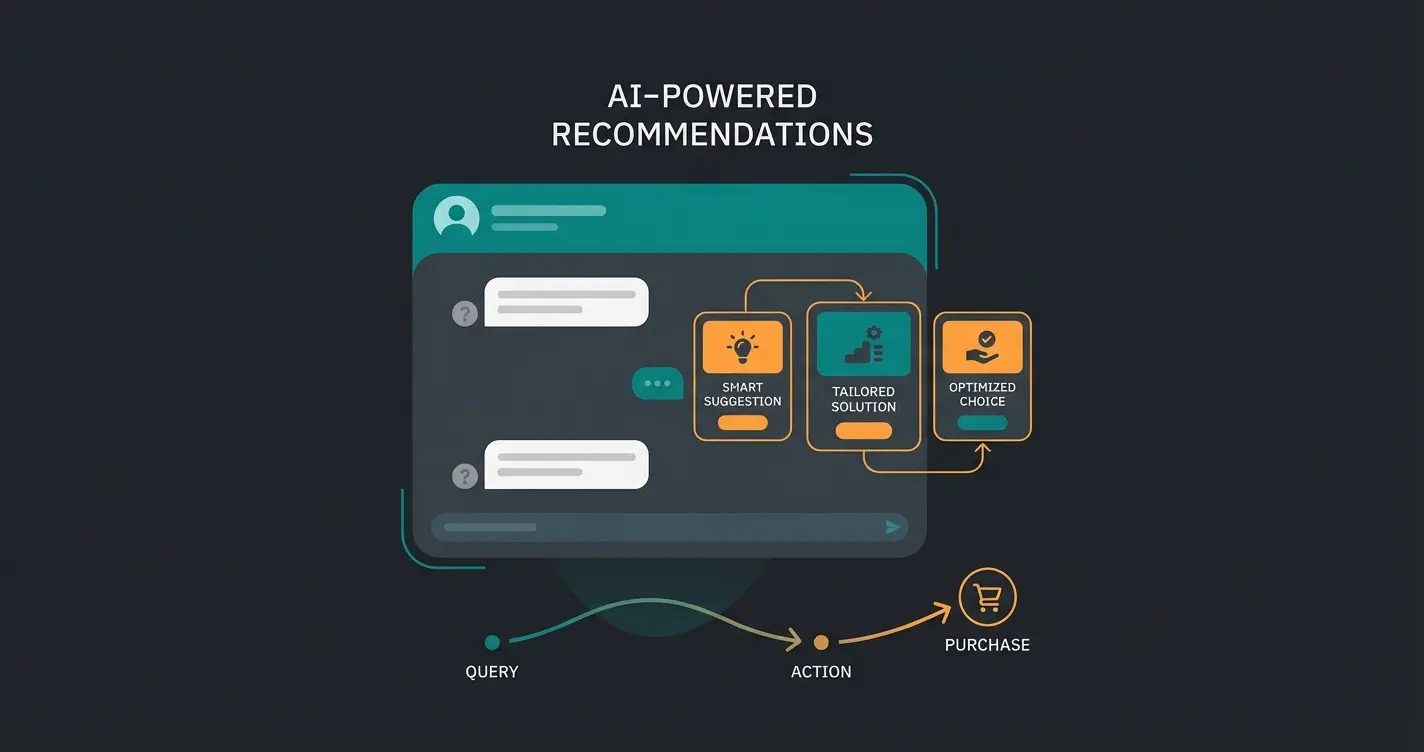
- New (AI Consultation): The AI asks 'Where do you mainly want to ride?' Customer responds 'Mostly forest trails, but also the Alps in summer.' AI follows up 'I understand. For the Alps you need reserves. How important is weight compared to stability?' Customer says 'I want to climb fast.' AI recommends 'Then I recommend this all-mountain bike with a carbon frame. It's light enough for climbing but offers enough safety for descents.'
Why AI Makes the Difference
Earlier 'advisor tools' were often just disguised filters (static decision trees). Modern AI solutions understand context. According to Sprinklr's research, this contextual understanding is what separates effective AI from simple rule-based systems:
- Needs-oriented: The AI translates 'I have back pain' into technical filters ('ergonomic mattress, soft firmness')
- Real-time reaction: When the customer says 'That's too expensive,' the AI suggests alternatives or explains the added value instead of just showing 'No results'
- Scalability: An AI consultant can advise 10,000 customers simultaneously—24/7, without waiting time
This is where Shopware 6 chatbots come into play, offering intelligent conversation capabilities that traditional tools simply cannot match.
Hard Facts: The Impact on Conversion Rates
The data is clear. Companies that use Guided Selling and AI Chatbots see significant improvements. According to analysis from Cases Media and Envive AI:
- Revenue increase: Chatbots and Guided Selling can boost conversion rates by 20% to 70%, especially for complex products
- Customer satisfaction: Over 70% of customers prefer quick answers through chatbots over waiting for emails or hotlines, as reported by Firework
- Reduced returns: Those who receive better advice buy the right product. This massively reduces return rates—a decisive factor in e-commerce, according to Radial
With AI-powered Guided Selling
For instant AI responses over waiting
Simultaneous consultations without limits
Part 4: Standard Configuration vs. AI Consultation Comparison
To illustrate the strategic significance for your Shopware shop, we've contrasted the approaches. This helps you decide which type of personalization you need for which product groups.
| Feature | Shopware Custom Products | Standard Filters & Search | AI Product Consultation |
|---|---|---|---|
| Primary Goal | Product individualization (unique items) | Product narrowing (selection) | Solution finding & consultation |
| Interaction | Static (customer fills in fields) | Mechanical (click on checkboxes) | Dynamic & Dialogic (Q&A) |
| Customer Prerequisite | Must already know the product | Must understand technical details | Only needs to know their problem/need |
| Suitable For | Gifts, t-shirts, business cards | Simple goods (socks, cables) | Complex products (bikes, cosmetics, electronics) |
| Conversion Impact | High with purchase intent, low with uncertainty | Medium (risk of 'Choice Paralysis') | Very High (builds trust & reduces abandonment) |
| Setup Effort | Medium (create templates) | Low (standard data) | Low to Medium (AI learns from product data) |
The 3 Levels of Shopware Personalization
Understanding where your shop stands on the personalization maturity model is crucial for planning your next steps. Here's how personalization capability evolves:
Customer selects color/size. Tools: Shopware Custom Products. Status: Basic requirement.
Shop suggests 'You might like...' Tools: Cross-selling plugins, Rule Builder. Status: E-commerce standard.
AI asks 'What's your goal?' and advises. Tools: AI Guided Selling, Conversational AI. Status: The 2025 competitive advantage.
The approach of E-Commerce Personalization is evolving rapidly, and shops that embrace Level 3 consultation are seeing dramatic improvements in customer satisfaction and conversion rates.
Stop losing customers to choice paralysis. Our AI Employee guides every visitor to their perfect product—24/7, like your best salesperson.
Start Your Free TrialPart 5: The User Journey – Before vs. After
How does this change feel for your customer? Let's walk through a typical customer journey in a Shopware shop for skincare products.
Scenario A: The Classic Shopware Shop (Before)
- Entry: Lisa (35) is looking for a new face cream for dry skin but doesn't want chemicals
- Search: She types 'cream dry' in the search bar. Result: 145 products
- Filter: She opens the filter panel. Ingredients: (list with 50 chemical terms—Lisa is overwhelmed). Skin type: She selects 'Dry'. Still 80 products. Brand: She doesn't know them
- Abandonment: Lisa clicks on three products, reads long descriptions, is unsure whether 'hyaluronic acid' or 'retinol' is better. She leaves the shop to Google. Conversion lost.
Scenario B: The Shop with AI Personalization (After)
- Entry: Lisa lands on the homepage. A subtle widget asks: 'May I help you find the perfect skincare for your skin?'
- Dialogue: The AI asks 'How does your skin feel right now?' Lisa clicks or types: 'Often tight, especially after showering.' AI responds 'I understand. Do you prefer certain ingredients or natural cosmetics?' Lisa: 'Yes, please only natural ingredients, no parabens.' AI: 'Got it. Are you looking for something for day, night, or both?' Lisa: 'A day cream with sun protection would be great.'
- Result: The AI presents exactly 3 products: 'Here's your perfect match: The Hydro-Nature Day Cream. It's 100% natural, has SPF 20, and uses aloe vera to combat the tightness.'
- Purchase: Lisa feels understood and advised. She adds the product to her cart. Conversion won.
This transformation is precisely what makes AI in customer service so powerful—it creates personalized experiences at scale.
Part 6: Practical Implementation in Shopware 6
You're convinced, but how do you get this into your shop? The good news: Shopware 6 is perfectly suited for such integrations thanks to its 'API-first' architecture. This is where Shopware automation capabilities really shine.
1. Integration via Apps and Plugins
The Shopware Store already offers initial approaches to Guided Selling. Search for terms like 'Product Guide,' 'Advisor,' or 'Quiz.'
- Advantage: Quick installation, often 'no-code' solutions
- Disadvantage: Many standard plugins are static 'if-then' trees and not true AI. Make sure the plugin actually uses NLP (Natural Language Processing) or just runs through rigid paths
2. Using External AI Services (Headless)
For a true AI experience, many agencies connect external AI engines (like OpenAI or specialized e-commerce AIs) via the Shopware API, similar to approaches described by Atwix.
- The workflow: The AI reads your product feed (title, description, properties) from Shopware. A chat widget is embedded in the frontend
- The advantage: The AI learns automatically. When you create a new product in Shopware, the advisor knows about it immediately
For businesses seeking a comprehensive solution, exploring AI Product Consultation providers can help identify the right partner for your needs.
3. Data Maintenance is King
Whether 'Custom Products' or AI advisor: your system is only as good as your data. As highlighted by Medium's analysis of e-commerce AI implementation:
- Maintain properties: An AI can only recommend what it knows. If your mountain bike is missing the 'intended use' attribute, the AI can't match it
- Use Shopware AI Copilot: Use the internal Shopware tools to optimize your product descriptions and properties before unleashing a customer AI on them. Let the Copilot extract properties from texts to strengthen your data foundation
The success of KI E-Commerce implementations depends heavily on the quality and completeness of your product data.
Real-World Success: AI Employees in Action
The theoretical benefits of AI consultation become tangible when you see real implementations. Companies across various industries have deployed AI-powered consultation with remarkable results.
Consider how garden supply retailers have transformed their customer experience. The case study of AI Employee demonstrates how an AI assistant can handle complex product inquiries about plants, tools, and seasonal supplies—questions that would traditionally require extensive staff training.
Similarly, the implementation of AI Employee Flora showcases how botanical and lifestyle retailers can leverage AI to provide expert-level advice on product selection, care instructions, and complementary purchases—all without human intervention.
These real-world examples prove that AI consultation isn't just theoretical—it's delivering measurable results for Shopware merchants today.
Conclusion: Help Your Customers Choose, Not Just Configure
The term Shopware personalization stands at a turning point.
Yes, use the Custom Products extension if you sell customizable t-shirts. That's craft. But if you sell complex products where customers need advice, then stop relying solely on filters and search bars.
The statistics don't lie: customers are overwhelmed by choice. They long for guidance. AI-powered consultation offers exactly that: it scales the experience of a top salesperson to every single visitor on your website.
The future of e-commerce doesn't belong to those with the most products, but to those who guide customers to the right product fastest.
Frequently Asked Questions About Shopware Personalization
Yes, basic personalization with Custom Products and the Rule Builder is possible through Shopware's backend interface without coding. For advanced AI-powered consultation, many solutions offer no-code integrations via the Shopware plugin store or headless API connections that agencies can set up for you.
Shopware 6 offers significantly more flexibility thanks to its API-first architecture. While Shopware 5 relied on traditional plugins, Shopware 6 enables seamless integration of external AI services, modern headless frontends, and real-time personalization through its enhanced Rule Builder and Flow Builder.
Costs vary significantly based on complexity and provider. Simple quiz-style guided selling plugins start around €50-200/month. Full AI consultation solutions typically range from €200-1000/month depending on traffic volume and features. The ROI usually justifies the investment through increased conversion rates and reduced returns.
Yes, modern AI consultation tools are designed to work with your existing product catalog. They typically import product titles, descriptions, properties, and categories via Shopware's API. The more complete your product data (especially custom properties and attributes), the better the AI can provide accurate recommendations.
Basic implementations can be live within 1-2 weeks, including plugin installation and initial training on your product data. More complex, custom-built solutions with deep integrations typically take 4-8 weeks. Many AI platforms offer self-learning capabilities that improve recommendations automatically over time.
Join leading e-commerce brands using AI consultation to boost conversions by up to 70%. Get started with your own AI Employee today.
Start Free Trial Now
Lasse is CEO and co-founder of Qualimero. After completing his MBA at WHU and scaling a company to seven-figure revenue, he founded Qualimero to build AI-powered digital employees for e-commerce. His focus: helping businesses measurably improve customer interaction through intelligent automation.