
The German E-Commerce Market: A Double-Edged Sword
Germany is Europe's economic powerhouse and represents enormous potential for online retailers. According to projections from the German Retail Association (HDE) and analysis by marktundmittelstand.de, e-commerce revenue for 2025 is expected to reach approximately €92.4 billion. However, anyone looking to successfully run Shopify in Germany quickly encounters a harsh reality: the German market is one of the strictest and most demanding in the world.
Most merchants setting up Shopify for Germany spend weeks fighting through the jungle of GDPR, imprint requirements, and packaging laws. They breathe a sigh of relief once the shop is "legally compliant" and wait for sales. But often those sales don't materialize, or return rates explode. If you're considering different platforms, our Shopware vs Shopify comparison can help you make an informed decision.
Why? Because most guides stop at the wrong point. They teach you how to avoid legal warnings—but not how to sell to skeptical German customers.
In this comprehensive guide for 2025, we'll not only cover the mandatory legal compliance program (including the new accessibility laws effective June 2025) but also dive into the "freestyle" portion: How you can overcome the "German Angst" about wrong purchases using Guided Selling and AI-powered consultation, transforming your shop from a static catalog page into an interactive sales space.
German e-commerce market size for 2025
Market share of PayPal in German online payments
Cart abandonments occurring on mobile devices
Germans preferring to pay after receiving goods
Part I: The Must-Do Program – Legal Compliance & Localization
Before we discuss growth, we need to lay the foundation. A Shopify store in German must meet specific legal and cultural requirements. Both Google and your customers expect these fundamentals to be in place. For a complete walkthrough, check our Shopify Store Germany setup guide.
Legal Compliance: More Than Just an Imprint
The "German Angst" doesn't just affect customers—it also affects merchants with the fear of legal warnings (Abmahnung). Shopify is fundamentally a Canadian system, but it can be excellently adapted to German law in 2025.
The "Big 4" of Legal Texts
You absolutely need the following pages, which must be accessible from every subpage (usually in the footer):
- Impressum (Legal Notice): Provider identification with a valid address for legal service.
- Datenschutzerklärung (Privacy Policy - GDPR): Detailed disclosure about cookies, tracking, and data processing.
- Allgemeine Geschäftsbedingungen (Terms & Conditions): The rulebook for your shop.
- Widerrufsbelehrung (Cancellation Policy): Including a sample withdrawal form.
The "Button Solution" (Critical for Checkout)
A classic stumbling block for Shopify Germany is the buy button. According to § 312j BGB (German Civil Code), the final button in checkout must clearly signal that money will be charged. Labels like "Order" or "Continue" are liable to legal warnings and result in no valid contract being formed, as confirmed by cr-online.de and e-recht24.de.
- Permitted: "Order with payment obligation" (Zahlungspflichtig bestellen), "Buy," "Buy now"
- Not permitted: "Register," "Order," "Continue"
- Implementation in Shopify: This can be adjusted in the theme's language settings (Checkout & System)
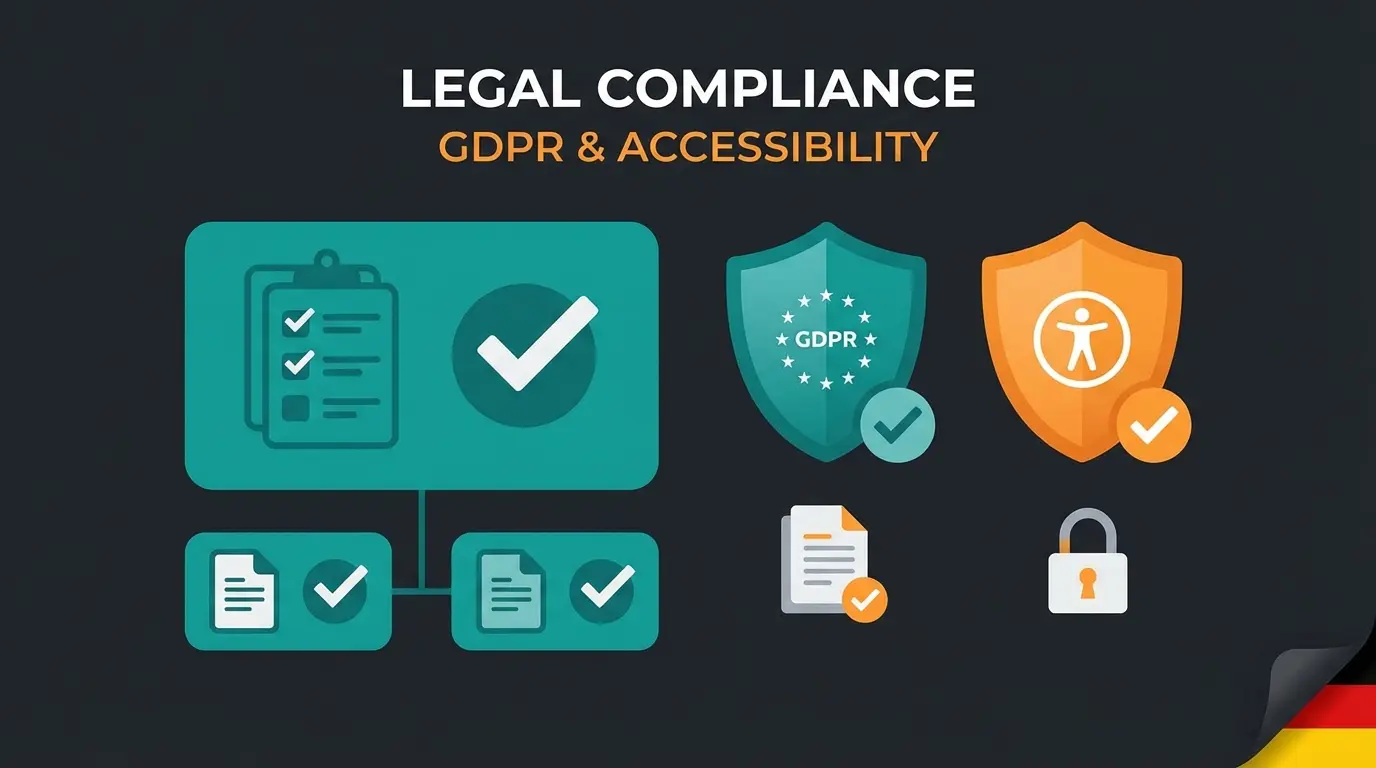
New from June 2025: The Accessibility Strengthening Act (BFSG)
A topic many merchants don't yet have on their radar: Starting June 28, 2025, B2C online shops must be accessible, as detailed by shopify.com and shop-fabrik.net. This applies to shops that must comply with the European Accessibility Act (EAA) and WCAG 2.1 guidelines (Level AA). Understanding the EU AI Act is also crucial for businesses implementing AI solutions.
- Who does it affect? Almost all merchants (exceptions apply only to micro-enterprises with fewer than 10 employees AND under €2 million revenue, though caution is still advised according to tante-e.com and eshop-guide.de)
- What needs to be done? Pay attention to contrasts, scalable fonts, alt-texts for images, and keyboard navigability. Many modern Shopify themes (like Dawn) are already well-prepared, but individual customizations must be checked.
Payment Methods: How Germans Want to Pay
The localization of Shopify for DACH (Germany, Austria, Switzerland) stands or falls with the checkout. Credit cards are not the gold standard here.
According to the EHI study "Online-Payment 2024/2025" and data from haendlerbund.de, ehi.org, and retail-news.de, the distribution of preferred payment methods in Germany looks like this:
| Payment Method | Market Share (Revenue) | Relevance for Your Shop |
|---|---|---|
| PayPal | approx. 28.5% | Essential. The standard for trust and speed. |
| Invoice Payment | approx. 25.8% | Critical. Germans love "goods first, then money." |
| Direct Debit | approx. 17.3% | Important, often covered via PayPal/Amazon Pay. |
| Credit Card | approx. 12.3% | Standard, but not dominant. |
| Installment Payment (BNPL) | approx. 4.3% | Strongly growing, increases cart value. |
Action recommendation: Activate Shopify Payments. This covers credit cards, Klarna (invoice payment & instant transfer), and Apple/Google Pay. PayPal usually needs to be integrated separately as an express checkout. Without invoice payment (via Klarna or PayPal Plus), you'll experience significant cart abandonment in Germany.
Shipping & Logistics: The Expectation Standard
"German Angst" also applies to shipping. Customers expect speed (1-3 days) and reliability. Check our guide on Shopify returns management for best practices on handling the return-heavy German market.
- DHL is King: Integration with DHL (e.g., via apps like Sendcloud or easyDHL) is a trust signal. Packstation delivery is a must for many customers.
- Returns: Germany is the "world champion of returns," as noted by sendcloud.com and ecommercegermany.com. A clear, customer-friendly return policy (often expected to be free) is a conversion driver, even if it costs margin.
Part II: The "Freestyle" – Why German Customers Abandon Carts
You've made your shop legally compliant, integrated PayPal, and set up DHL. Your traffic is there, but the conversion rate is hovering at 1.5%? Welcome to the club.
The problem isn't your Shopify Germany setup. The problem is the psychology of the German buyer.
The "German Angst" Phenomenon in Shopping
German consumers are extremely risk-averse and detail-oriented in international comparison. While an American often buys impulsively ("Looks cool, I'll try it"), the German customer asks:
- "Does this really fit my specific problem?"
- "What if I have to return it?"
- "Are there hidden disadvantages?"
This consumer behavior creates unique challenges that standard e-commerce approaches fail to address. For insights on how other platforms handle similar challenges, see our Shopware customer service guide.
The "Static Shop" Problem
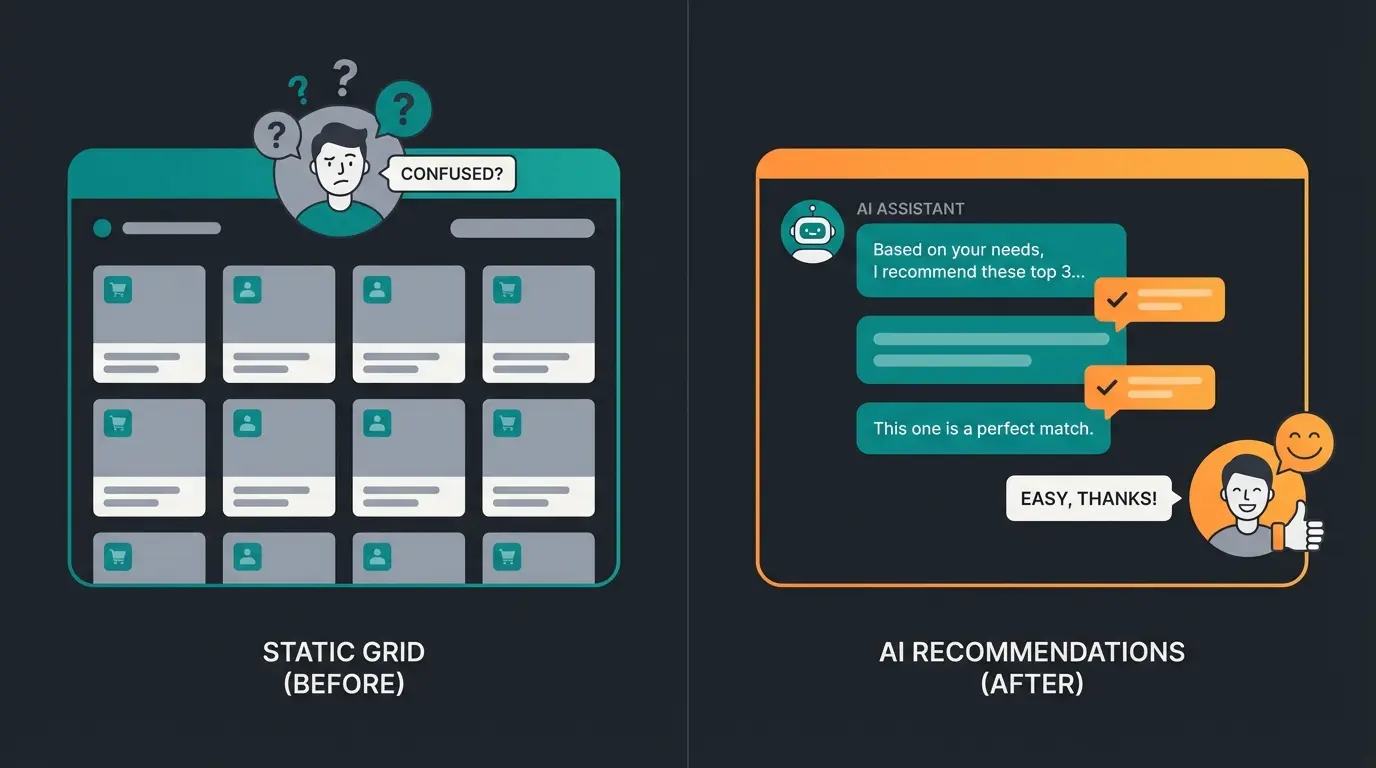
Standard Shopify themes are like self-service stores. They look good, offer filters (size, color, price), but provide no consultation.
Imagine going into a specialized running shoe store:
- Scenario A (Standard Shopify Shop): You stand in front of a shelf with 50 shoes. You can sort by "red" and "size 42." But you don't know which shoe is good for your knee problems. Result: You leave (cart abandonment).
- Scenario B (Consultative Shop): A salesperson approaches you: "Do you run more on asphalt or in the forest? Do you have joint pain?" They recommend one perfect shoe. Result: Purchase + Trust.
The gap in German e-commerce isn't technical in nature—it's a service gap.
Impressum, GDPR, AGB, Cookie Consent - Without this, you can't even play
PayPal, Invoice, Klarna - Trust through familiar payment methods
Fast delivery, free returns, DHL integration - Reducing purchase risk
AI-guided selling, personalized recommendations - The competitive advantage that converts
Part III: The New Standard – AI-Driven Product Consultation
To win in Germany in 2025, you need to digitize the specialized salesperson. This is where Guided Selling and Artificial Intelligence come into play. It's no longer just about showing products, but about guiding customers to the right product. Learn more about implementing AI Guided Selling in your store.
What is Guided Selling?
Guided Selling replicates the consultation conversation in the online shop. Instead of leaving customers alone with filters, the shop asks questions and recommends suitable products based on the answers, as explained by shopify.com. Implementing an AI Product Finder can dramatically improve this experience.
Why AI Makes the Difference (Beyond Chatbots)
Many merchants think of "AI" as ChatGPT writing product texts, or as dumb chatbots that rattle off FAQs ("Where's my package?"). The trend for 2025, however, is the AI Shopping Assistant, as highlighted by gaasly.com and maxcluster.de. For a deeper dive into chatbot technology, explore our AI Chatbot E-Commerce guide.
Standard Search vs. AI Consultant Comparison
| Feature | Standard Shopify Search/Filter | AI-Powered Sales Assistant |
|---|---|---|
| Interaction | Passive (customer must know what they're looking for) | Active (system asks about needs) |
| Logic | Keyword-based ("running shoe red") | Context-based ("shoe for marathon, knee-friendly") |
| Result | List with 50 products | 2-3 curated recommendations with reasoning |
| Psychology | Creates "Choice Overload" | Creates certainty ("This fits me") |
| Conversion | Average (~1-2%) | High (often >4-5% through relevance) |
Practical Example: The "Consultation Factor"
Imagine a skincare shop (Shopify Germany cosmetics niche):
- Without AI: The customer filters for "cream" and "dry skin." They see 20 products. Uncertainty remains: "Is this also for sensitive skin? Does it work with my serum?"
- With AI Consultant: A widget asks: "How does your skin feel after washing?", "What is your main goal (anti-aging, blemishes)?" The AI analyzes the answers and says: "Based on your sensitive skin, we recommend Product X because it's fragrance-free, combined with Serum Y."
This closes the gap between the need for security (German Angst) and the online offering. It drastically reduces the return rate because the products fit. For expert guidance on implementing such solutions, consider our AI consulting for ecommerce services.
Stop losing German customers to uncertainty. Our AI-powered guided selling solution bridges the trust gap and increases conversions by up to 300%.
Start Your Free TrialPart IV: Best Practices for Shopify Germany 2025
Beyond the AI revolution, there are proven hygiene factors you need to optimize for the Shopify DACH market.
Trust Signals: Certificates and Reviews
In Germany, the saying goes: "Trust is good, control is better."
- Trust Seals: The Trusted Shops seal is extremely well-known in Germany and demonstrably increases conversion. The TÜV or EHI seals also work wonders.
- Reviews: Use apps like Judge.me or Loox, but pay attention to GDPR compliance (no unsolicited review emails!). Import reviews if you're migrating. Germans read reviews very carefully.
For strategies on improving customer interactions, see our guide on Shopify customer service.
Language & Tone: "Du" or "Sie"?
Localization for Shopify in German also concerns the form of address:
- Trend: In e-commerce (fashion, lifestyle, D2C), the informal "Du" is becoming standard.
- Caution: In the B2B sector or with conservative products (insurance, expensive furniture, medical aids), the formal "Sie" can still build trust.
- Important: Be consistent! Nothing looks more unprofessional than a mix of "Dein Warenkorb" (Your cart - informal) and "Geben Sie Ihre Adresse ein" (Enter your address - formal) in checkout.
Performance & Mobile First
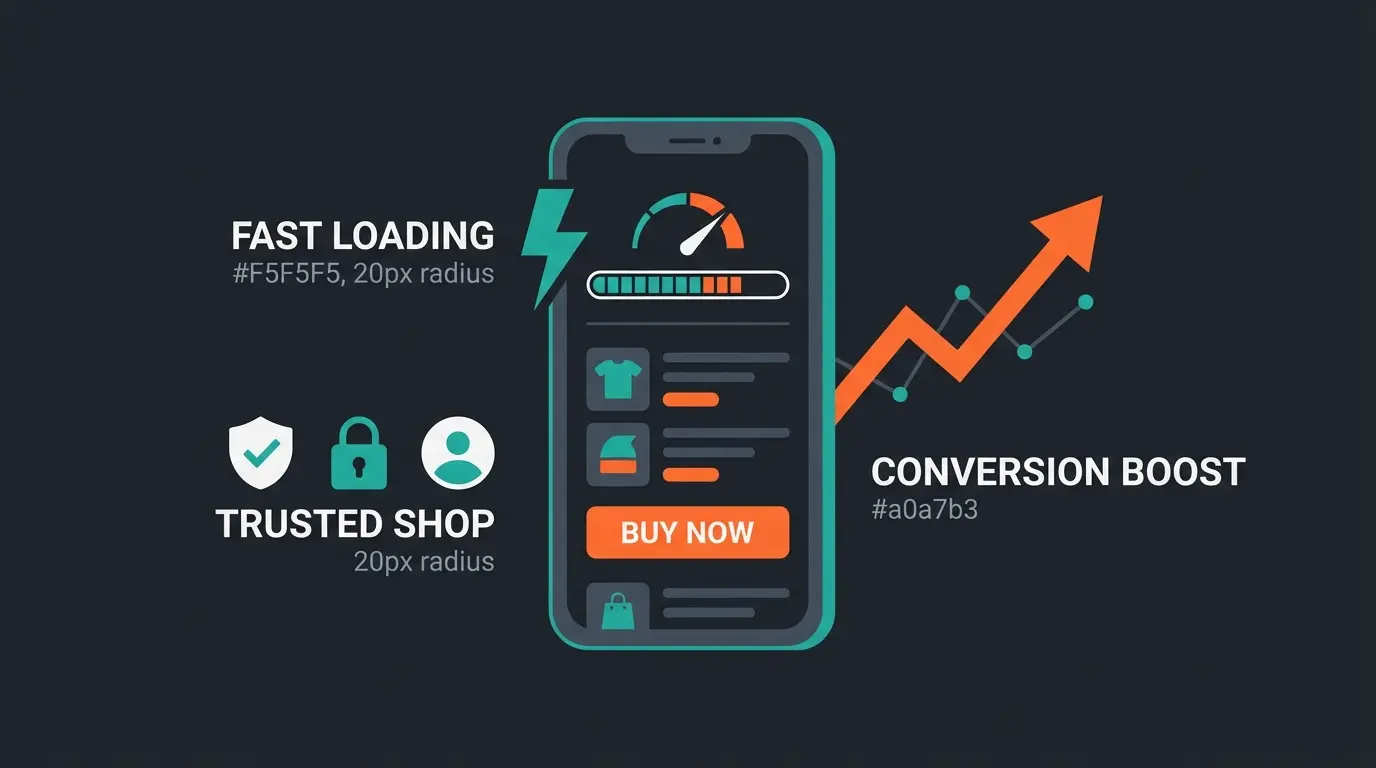
According to current trends and research from digital-magazin.de, over 74% of cart abandonments occur on mobile devices. German customers are impatient.
- Optimize images (WebP format)
- Use a lean theme (Shopify 2.0 themes like Dawn or Prestige)
- Avoid too many pop-ups that block the screen on mobile (Google penalizes this)
For a comprehensive optimization strategy, our Shopify SEO Guide covers everything from technical setup to content strategy.
Part V: Checklist – Is Your Shop "Germany Ready"?
Use this list to check your status quo. This comprehensive checklist covers both legal requirements and conversion optimization elements.
Phase 1: Legal & Basics (The Foundation)
- ☐ Impressum complete and linked?
- ☐ Privacy Policy current (including cookie tool like Consentmo or Usercentrics)?
- ☐ Terms & Conditions & Withdrawal legally compliant?
- ☐ Button Solution: Does checkout say "Order with payment obligation" or "Buy"?
- ☐ Prices: Base prices (per 100g/1kg) visible for applicable products?
- ☐ Taxes: 19% VAT correctly set (consider OSS procedure for EU sales)?
Phase 2: Trust & Payment (The Security)
- ☐ Payment Methods: PayPal, credit card, Klarna (invoice) active?
- ☐ Shipping: DHL/Hermes integrated and delivery times ("1-3 business days") specifically stated?
- ☐ Trust Badges: Trusted Shops or SSL seal visible?
Phase 3: Conversion & Growth (The Competitive Advantage)
- ☐ Language: Is the shop completely in German (including error messages in checkout)?
- ☐ Accessibility: Is the shop ready for BFSG 2025 (contrasts, alt-tags)?
- ☐ Consultation: Is there a Guided Selling element (quiz, product finder, or AI assistant)?
- ☐ Returns Management: Is there a simple returns portal for customers?
If you're comparing platforms for your German market entry, our Shopify vs WooCommerce comparison can help you make the right choice.
Conclusion: Compliance is the Start, Consultation is the Goal
The market for Shopify in Germany will continue to grow in 2025, but will also become more competitive. The days when it was enough to simply put products online are over.
The merchants who will be successful in 2025 are those who master two things:
- They respect the legal and cultural standards (legal compliance, PayPal, invoice payment) to even participate in the game.
- They counter German skepticism with excellent digital consultation.
By using AI and Guided Selling to take your customers by the hand, you build exactly what is the hardest currency in German e-commerce: Trust.

Yes, Shopify is completely legal in Germany. However, you must adapt your store to comply with German legal requirements including a proper Impressum (legal notice), GDPR-compliant privacy policy, AGB (terms and conditions), and the legally required button labeling for checkout. Using specialized apps like Händlerbund or IT-Recht Kanzlei can help automate compliance.
For German customers, PayPal is essential (28.5% market share), followed by invoice payment via Klarna (25.8%). Direct debit and credit cards are also important but less dominant. Without offering invoice payment (Rechnungskauf), where customers pay after receiving goods, you'll experience significant cart abandonment from German shoppers who prefer this risk-free option.
The Barrierefreiheitsstärkungsgesetz (BFSG) takes effect June 28, 2025, requiring B2C online shops to be accessible according to WCAG 2.1 Level AA standards. This includes proper color contrasts, scalable fonts, alt-texts for images, and keyboard navigation. Most merchants are affected unless they qualify as micro-enterprises with under 10 employees AND under €2 million revenue.
German customers abandon carts due to 'German Angst' – uncertainty about whether a product truly fits their needs. Beyond offering familiar payment methods and clear return policies, implement AI-powered guided selling that asks questions and provides personalized recommendations. This consultative approach addresses the security need and can increase conversion rates from 1-2% to over 4-5%.
It depends on your industry. E-commerce, fashion, lifestyle, and D2C brands increasingly use the informal 'Du.' However, B2B sectors or conservative products (insurance, expensive furniture, medical products) often benefit from the formal 'Sie.' Most importantly, be consistent throughout your entire store – mixing formal and informal address appears unprofessional.
Don't just survive in Germany – thrive. Our AI consultation platform helps you build the trust German shoppers demand while boosting conversions and reducing returns.
Start Building Trust Today
Lasse is CEO and co-founder of Qualimero. After completing his MBA at WHU and scaling a company to seven-figure revenue, he founded Qualimero to build AI-powered digital employees for e-commerce. His focus: helping businesses measurably improve customer interaction through intelligent automation.
