Shopify Checkout Optimization 2026: From Frictionless to Sales-Driven
Learn how to optimize your Shopify checkout for 2026. Reduce cart abandonment with AI consultation, German payment methods & proven conversion tactics.

Why 71% of Your Customers Abandon at Checkout
Imagine running a physical retail store. 100 people walk in, browse around, and 70 of them place products in their shopping carts. They walk up to the register, place their items on the counter—and then, just before paying, they turn around wordlessly and leave. Without the merchandise.
Sounds absurd? In e-commerce, this is daily reality.
If you're searching for ways to optimize your Shopify checkout, you've probably already read the standard tips: 'Make your page faster,' 'Remove unnecessary fields,' 'Offer free shipping.' These are important fundamentals—the table stakes to even be in the game. But in 2026, simply removing technical hurdles isn't enough anymore.
The market has changed. The technology has changed. And most importantly: your customers' expectations have changed.
In this comprehensive guide, I'll show you not only how to master the technical basics (and why you need to forget about `checkout.liquid` immediately), but we'll dive into Checkout Optimization 2.0: How to use artificial intelligence and psychological triggers to eliminate your customers' uncertainty and transform your checkout from a mere cash register into a top-performing salesperson.
The Harsh Reality: Quantifying the Cart Abandonment Problem
Before we optimize, we need to quantify the problem. Current data for the German market paints a clear picture:
- Cart Abandonment Rate: According to absatzwirtschaft.de and digital-magazin.de, the average abandonment rate in Germany sits at approximately 71.4%.
- Mobile First, Mobile Worst: On smartphones, the situation is even more dramatic. Here, up to 74-80% of users abandon the purchase process, as noted by wpbeginner.com.
- Financial Impact: German online shops lose billions in revenue annually due to cart abandonment.
Desktop and mobile combined in German e-commerce
Significantly higher on smartphones and tablets
Users who abandon due to forced registration
Why Customers Really Abandon Their Carts
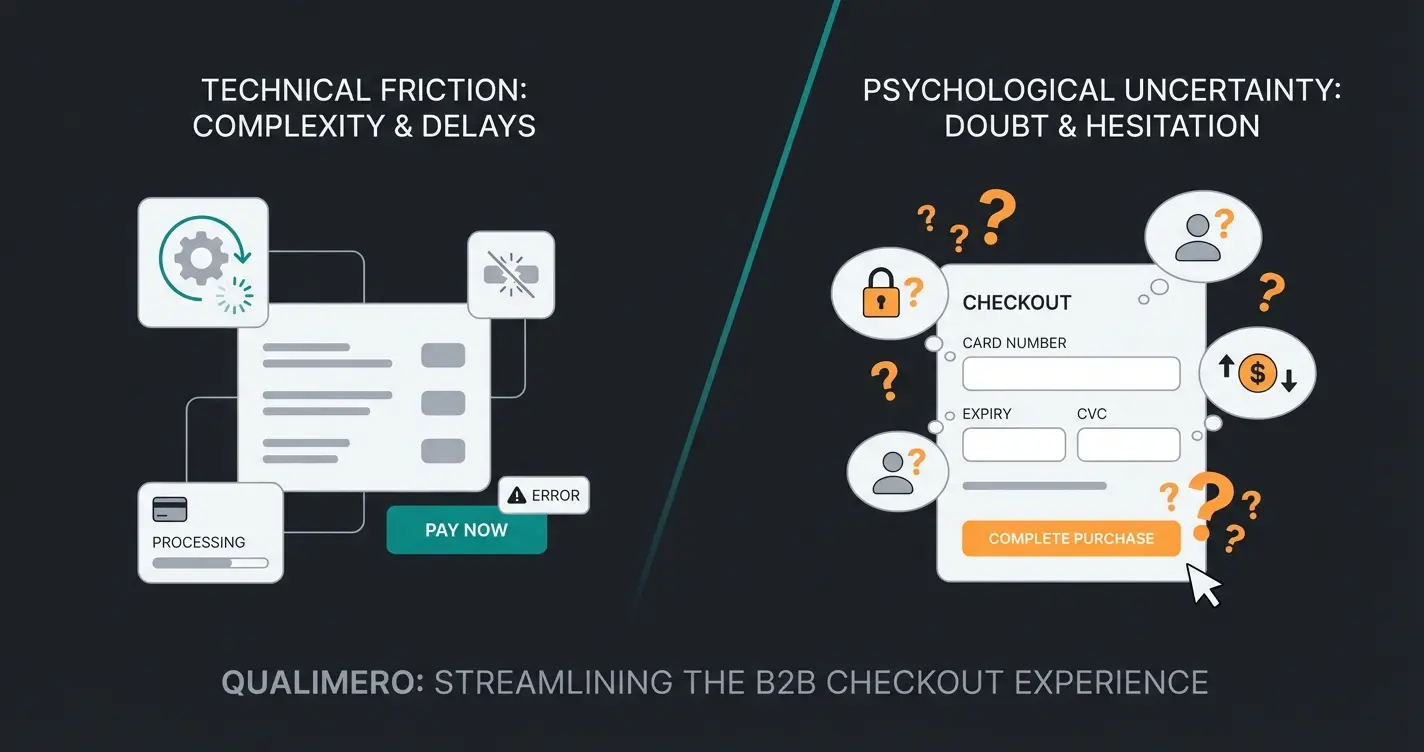
Most agencies will tell you: 'The checkout was too complicated.' But that's only half the truth. We need to distinguish between two types of obstacles:
- Technical Friction: The page loads slowly, the customer must create an account, or they can't find their preferred payment method. This is 'dumb' revenue loss—entirely preventable.
- Psychological Uncertainty: The customer could buy but hesitates. 'Will this actually fit?', 'Will it arrive in time?', 'What if I need to return it?'. This is where most optimization efforts fall short.
Most Shopify checkout optimization hacks focus exclusively on point 1. Today, we're going to solve both. Understanding the difference between friction and uncertainty is crucial—similar to how AI for cart abandonment prevention approaches the problem from multiple angles.
Technical Foundation: The Must-Haves for 2026
Before we discuss AI and psychology, we need to ensure your technical house isn't built on sand. Google and your customers expect these standards as baseline requirements.
The Shopify One-Page Checkout
For a long time, the multi-step checkout (3 pages: Info > Shipping > Payment) was the standard. That era is over. Shopify introduced the One-Page Checkout, and the data speaks clearly.
- Performance: The One-Page Checkout loads faster and reduces clicks significantly.
- Conversion Boost: Merchants report conversion rate increases of 7.5% to 20% after switching, according to charle.co.uk and digismoothie.com.
- Fewer Abandonments: The consolidated view reduces abandonment rates by up to 35%.
Guest Checkout Activation
In Germany, data minimization is a virtue. The requirement to register ('Create Customer Account') is one of the main reasons for purchase abandonment (approximately 23% of users abandon for this reason alone).
- The Solution: Enable the option 'Customers can check out as guests' in your Shopify settings under Checkout.
- The Compromise: Offer account creation after the purchase on the 'Thank You' page. At that point, you already have the money, and the customer feels no pressure.
Mobile Optimization and Auto-Fill Features
Since nearly 80% of traffic is mobile, your checkout must be 'thumb-friendly.'
- Google Autocomplete: Enable address auto-completion in your Shopify settings. This saves typing effort and drastically reduces address errors.
- Keyboard Layouts: Ensure that when entering phone numbers or postal codes, the numeric keypad automatically appears on smartphones (Shopify handles this correctly by default, but verified themes are essential).
These technical foundations mirror what you'd implement when optimizing Shopware checkout—the principles remain consistent across platforms, even if implementation differs.
Payment Methods: Addressing German Consumer Preferences
You can have the most beautiful shop in the world—if German customers can't find their preferred payment method, they're gone. The German market is unique in international comparison. Credit cards are not the measure of all things here.
Most Popular Payment Methods in Germany (2024/2025)
Based on current EHI studies and market data from stripe.com, ehi.org, and retail-news.de, the following distribution emerges:
| Payment Method | Market Share / Relevance | Why You Need It |
|---|---|---|
| PayPal | ~27.7-29% | The undisputed king of wallets. Offers buyer protection and one-click solutions. |
| Invoice (Pay Later) | ~26.7% | Extremely important for Germany. German customers want to see the goods first, then pay. Without invoice payment, you lose conservative buyer segments. |
| Direct Debit | ~16.7% | Still very popular, often processed via PayPal Plus or Klarna. |
| Credit Card | ~11.4% | Standard, but less dominant in Germany than in the USA or UK. |
| Buy Now Pay Later | ~3.9% (rising) | Important for high-value carts (electronics, furniture, high-ticket items). |
Strategic Payment Recommendations for Your Checkout
- PayPal Express: Integrate the PayPal Express button directly at the top of checkout or even in the shopping cart itself.
- Klarna / [Shopify Payments](/blog/shopify-payments): Use Shopify Payments to seamlessly integrate Klarna (Shopify invoicing & instant transfer). This covers the need for 'goods first, then money' without you bearing the default risk. You can learn more about similar integrations in our Shopware Klarna integration guide.
- Local Heroes: Selling to Austria (EPS) or the Netherlands (iDEAL)? Enable these methods through Shopify Markets for regional optimization.
For a deeper dive into available options, see our guide on Shopify payment methods, adapting to each platform's specific requirements.
Legal Compliance: The Button Solution Pitfall
Many Shopify merchants adopt US themes and only half-heartedly translate them. This can become expensive in Germany. Warning associations are just waiting for checkout errors.
The Button Solution (§ 312j BGB German Civil Code)
In Germany, the final click that seals the contract must be clearly labeled. A button with the text 'Continue,' 'Order,' or 'Sign Up' is not permissible and results in no valid contract being formed (and you'll receive a legal warning), as confirmed by e-recht24.de, it-recht-kanzlei.de, and otto-schmidt.de.
Permitted button labels include:
- 'Order with payment obligation' (Zahlungspflichtig bestellen)
- 'Buy' (Kaufen)
- 'Buy Now' (Jetzt kaufen)
Terms & Conditions and Cancellation Policy
These must not only be linked but ideally confirmed directly in the checkout or at least placed very prominently ('Click-to-Accept' is often safer in Germany, even though legal interpretation sometimes allows 'visibility is sufficient'—play it safe).
Checkout Extensibility: The Technical Update You Can't Ignore
If you're using Shopify Plus or have made deep customizations, you might still have heard about the `checkout.liquid` file.
Warning: This file is dead.
Shopify is completely transitioning to Checkout Extensibility.
- Deadline 1: Since August 2024, `checkout.liquid` no longer works for information, shipping, and payment pages, as noted by rootsyntax.com and yourstorewizards.com.
- Deadline 2: By August 28, 2025, the 'Thank You' and 'Order Status' pages must also be converted, according to stape.io and shopify.com.
Why This Change Benefits You
The old method was insecure and made updates difficult. The new Checkout Extensibility is 'Upgrade-Safe.' You use apps and UI extensions to customize the checkout. This means:
- Faster loading times across all checkout pages
- Full compatibility with Shop Pay (which massively boosts conversion)
- Easier integration of upsells and trust badges without code manipulation
Understanding these technical distinctions is important when comparing platforms—our Shopware vs Shopify comparison explores how each handles customization differently.
Checkout Optimization 2.0: From Order Processor to Sales Advisor
Up to this point, we've discussed things that every good shop should have. Now we come to your competitive advantage—the differentiation that separates good from great.
Most optimizations aim to remove friction (Make it fast). But the real magic happens when you add confidence (Make it safe).
Ideal state: Fast checkout, confident customers. High conversion rates.
Technical problems killing sales. Competitors focus here with speed optimization.
The hidden revenue killer. Fast checkout but customers still hesitate. YOUR opportunity.
Critical failure state. Both technical and psychological barriers blocking sales.
The Problem: The Uncertainty Gap
Why does a customer who has already entered their address abandon? Often it's a last, nagging question:
- 'Will the package really arrive by Saturday?'
- 'Does size M fit if I usually wear L?'
- 'Is this compatible with my 2020 model?'
A static FAQ link leads the customer away from checkout. That's deadly for conversion. The customer might find their answer, but the friction of navigation often means they never return to complete the purchase.
The Solution: AI as Your Digital Sales Consultant
Instead of a dumb chatbot that only says 'Hello,' innovative shops are now integrating AI agents directly into the checkout process, as highlighted by shopify.com and eesel.ai.
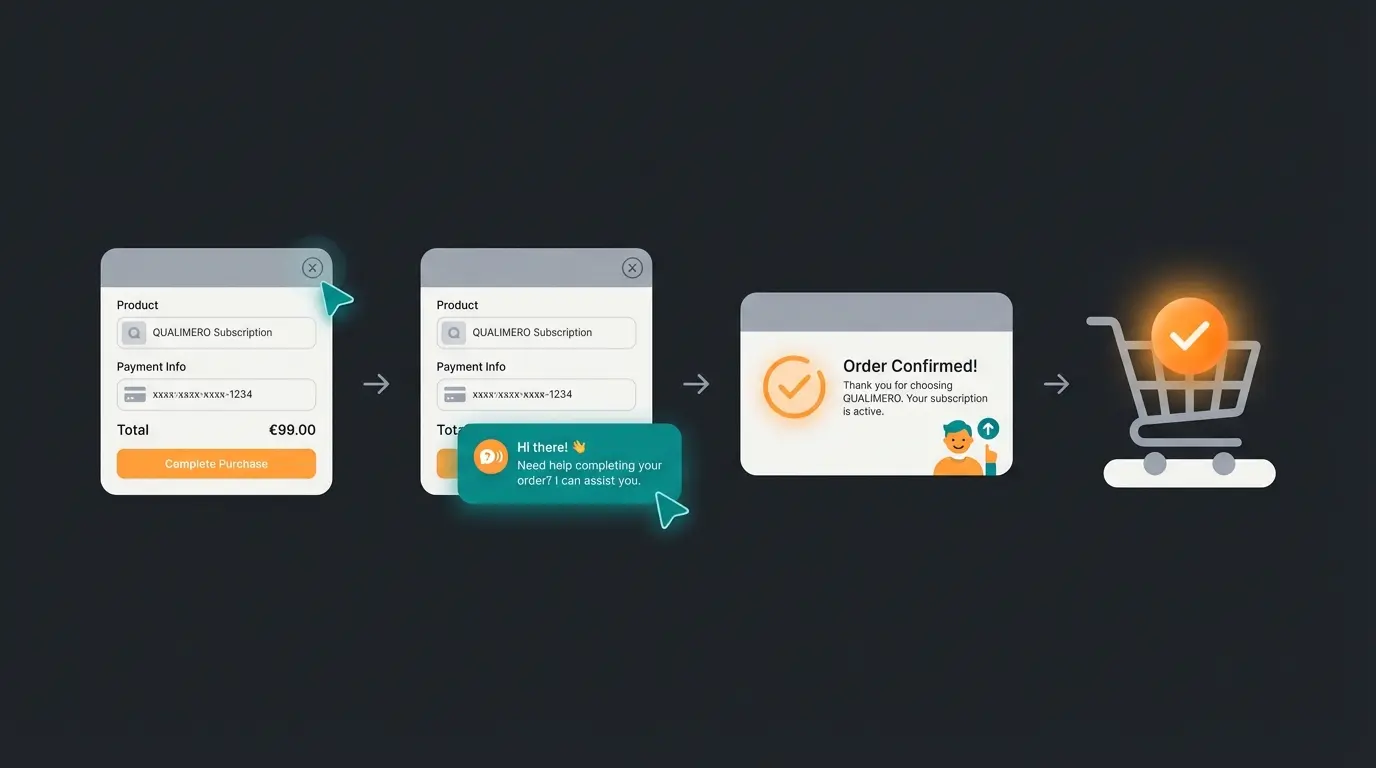
Imagine the following scenario:
- The customer lingers unusually long on the payment page (mouse movement analysis detects hesitation).
- Instead of letting them leave, a chat window opens discretely (not intrusively!).
- AI: 'Hello! I see you're looking at the [Product Name]. Are you unsure about delivery time or sizing?'
- Customer: 'I need it by Friday.'
- AI: 'Since you're in Munich and we ship today, delivery is 98% guaranteed by Thursday. Should I prioritize express shipping for you?'
Why AI Checkout Consultation Works
- Active Intervention: You don't wait until the customer leaves (abandoned cart email), but save the sale before it's lost.
- Context Knowledge: The AI knows the shopping cart contents and delivery conditions, providing relevant answers instantly.
- Trust Building: It feels like a salesperson in the store who nods and says: 'Good choice, that'll fit.'
This approach to AI product consultation transforms passive checkout pages into active sales environments. The technology behind these AI-powered product recommendations has matured significantly, enabling real-time, context-aware assistance.
Implementation Tools for AI Checkout Consultation
There are now Shopify apps that enable exactly this 'Active Consultation' without requiring programming. Search the App Store for solutions that use 'Checkout UI Extensions' and integrate GPT-4 or similar models to match product data live. The integration of AI customer service capabilities directly into the checkout flow represents the next frontier of e-commerce optimization.
This concept of conversational commerce is transforming how online shops interact with customers at the most critical moment—the point of purchase. By deploying intelligent AI employees in your checkout, you're essentially giving every customer access to a knowledgeable sales consultant.
Stop losing sales to customer uncertainty. Our AI product consultants integrate directly into your checkout flow, answering questions and resolving doubts before customers abandon.
Start Your Free TrialUX Hacks and Design Refinements for Higher Conversions
To conclude, here's a list of quickly implementable UX improvements that are often overlooked but deliver significant impact:
1. Shipping Cost Transparency (Pre-Checkout)
Nothing kills conversion faster than unexpected shipping costs in the last step (the main reason for 55% of abandonments).
2. Trust Badges in the Right Location
Don't just slap logos in the footer. Place security seals (Trusted Shops, SSL, Norton) and payment logos directly under the 'Buy' button or in the credit card input area. That's where the pain of spending money arises—that's where the trust 'band-aid' is needed most.
3. Remove the 'Company' and 'Address Line 2' Fields
If you sell B2C, hide the 'Company' field by default or make it 'Hidden unless clicked.' Every field removed increases conversion measurably.
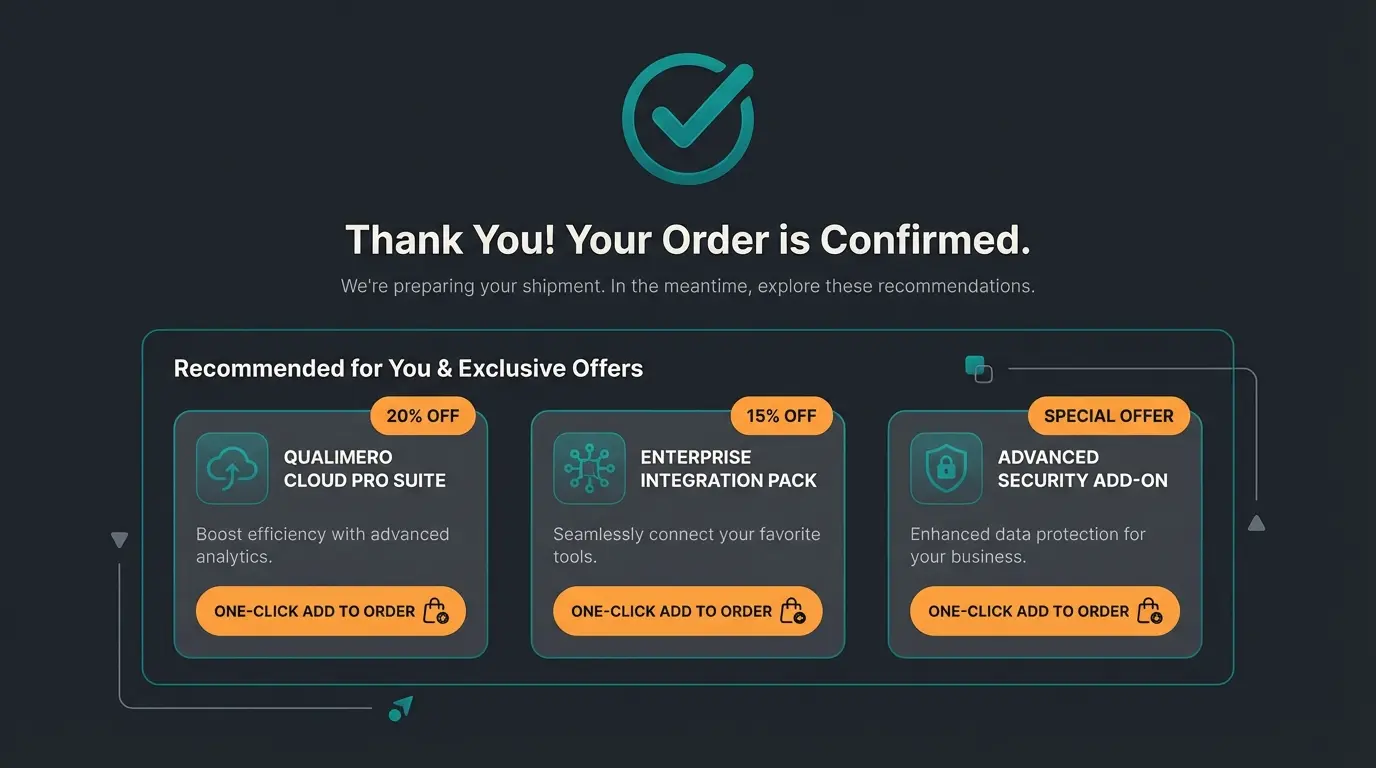
4. Cross-Selling in Checkout (Post-Purchase)
Don't try to distract the customer during payment. But after they've clicked 'Buy' (on the Thank You page), willingness for an additional purchase is at its highest.
Use apps for Post-Purchase Upsells. 'Add the matching batteries—15% discount, only now.' One click is enough since payment data is already stored. This approach integrates well with Shopware email marketing strategies for follow-up engagement.
The Complete Optimization Roadmap for 2026
Shopify checkout optimization isn't a one-time project but an ongoing process. The days when it was enough to install a standard theme are over. Similar to Shopware conversion optimization, success requires a systematic approach.
Activate One-Page Checkout, enable guest checkout, minimize loading times. These are table stakes.
PayPal, invoice payment (Klarna), and legally compliant buttons are non-negotiable for Germany.
Transparent costs and trust elements at critical touchpoints throughout the checkout flow.
Use AI not just for text, but as an active sales consultant in checkout to close the psychological uncertainty gap.
Your competition optimizes for speed. When you optimize for trust and consultation, you win the race for the customer. The integration of AI-powered consultation in e-commerce represents the next evolution in checkout optimization.
Frequently Asked Questions About Shopify Checkout Optimization
For German markets, the most critical optimization is ensuring you offer the right payment methods—particularly PayPal (27-29% market share) and invoice payment via Klarna (26.7% market share). Additionally, legal compliance with the 'Button Solution' requiring specific button text like 'Zahlungspflichtig bestellen' (Order with payment obligation) is mandatory to avoid legal warnings.
According to merchant reports and industry studies, switching from the traditional 3-step checkout to Shopify's One-Page Checkout typically delivers conversion rate improvements of 7.5% to 20%. The consolidated view also reduces overall abandonment rates by up to 35% by minimizing clicks and loading times.
Address entry abandonment is primarily caused by psychological uncertainty rather than technical friction. Customers often have last-minute questions: 'Will this arrive in time?', 'Is this the right size?', 'Is it compatible with my model?'. These doubts, when unanswered, trigger abandonment. AI-powered consultation directly in checkout can address these questions before the customer leaves.
Checkout Extensibility is Shopify's new framework replacing the deprecated checkout.liquid file. Since August 2024, the old method no longer works for core checkout pages, and by August 2025, all checkout pages must use the new system. It offers faster loading, full Shop Pay compatibility, and easier integration of upsells and trust elements without coding.
Traditional chatbots are reactive FAQ tools that wait for customers to ask questions. AI consultation is proactive—it detects hesitation through behavioral signals (like extended time on payment pages) and intervenes with contextual help. It knows the shopping cart contents, delivery conditions, and product details, providing personalized assistance that feels like a knowledgeable sales associate.
Ready to Transform Your Checkout Experience?
The checkout is where revenue is won or lost. While your competitors focus solely on removing friction, you have the opportunity to build confidence and close the uncertainty gap that causes 71% of German shoppers to abandon their carts.
Check your payment method settings today and explore the new AI apps in the Shopify Store. Your revenue will thank you.
Join the merchants who have transformed their checkout from a transaction page into a conversion machine with AI-powered consultation that answers customer questions in real-time.
Get Started Free Today
Lasse is CEO and co-founder of Qualimero. After completing his MBA at WHU and scaling a company to seven-figure revenue, he founded Qualimero to build AI-powered digital employees for e-commerce. His focus: helping businesses measurably improve customer interaction through intelligent automation.